Showing posts with label Statistics. Show all posts

06 June 2026

Yesterday Was The Monthly Jobless Report

The numbers are quite good, 172K new jobs in the non-farm payroll and was unemployment unchanged at 4.3%.

What is notable is where the job growth occurred, largely leisure and hospitality and local and state government employment. 

The former is driven by the World Cup being in the United States, though it increasingly looks like this will be a bit of a bust, because foreigners do not want to be subject to the tender mercies of Customs and Border Patrol or ICE.

I'm not sure were the local government pickup is coming from, though a part of it could be from former federal civil servants finding new jobs. 

These numbers make a rate hike by the Federal Reserve almost certain.

I think that the analysis from the CEPR is a good summary:

  • Jobs are growing far faster than the breakeven rate
  • Wages are not keeping pace with inflation
  • Workers are still reluctant to leave jobs
  • Job-killing AI is not visible in the data 
  • Self-employment is lagging  

The last one is not at all surprising.  When the social safety net is reduced, striking out on one's own as an entrepreneur becomes far more risky.

Of course, all of the above is predicated on accepting that the numbers are real, so YMMV. 

04 June 2026

It's Thursday ¯\_(ツ)_/¯


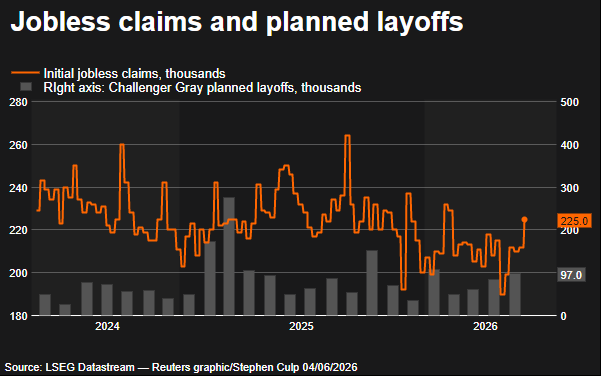
Claims and planned layoffs
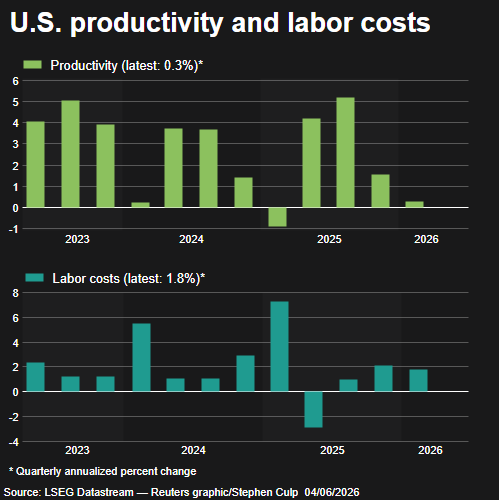

Labor costs and productivity



The state of the economy is ………
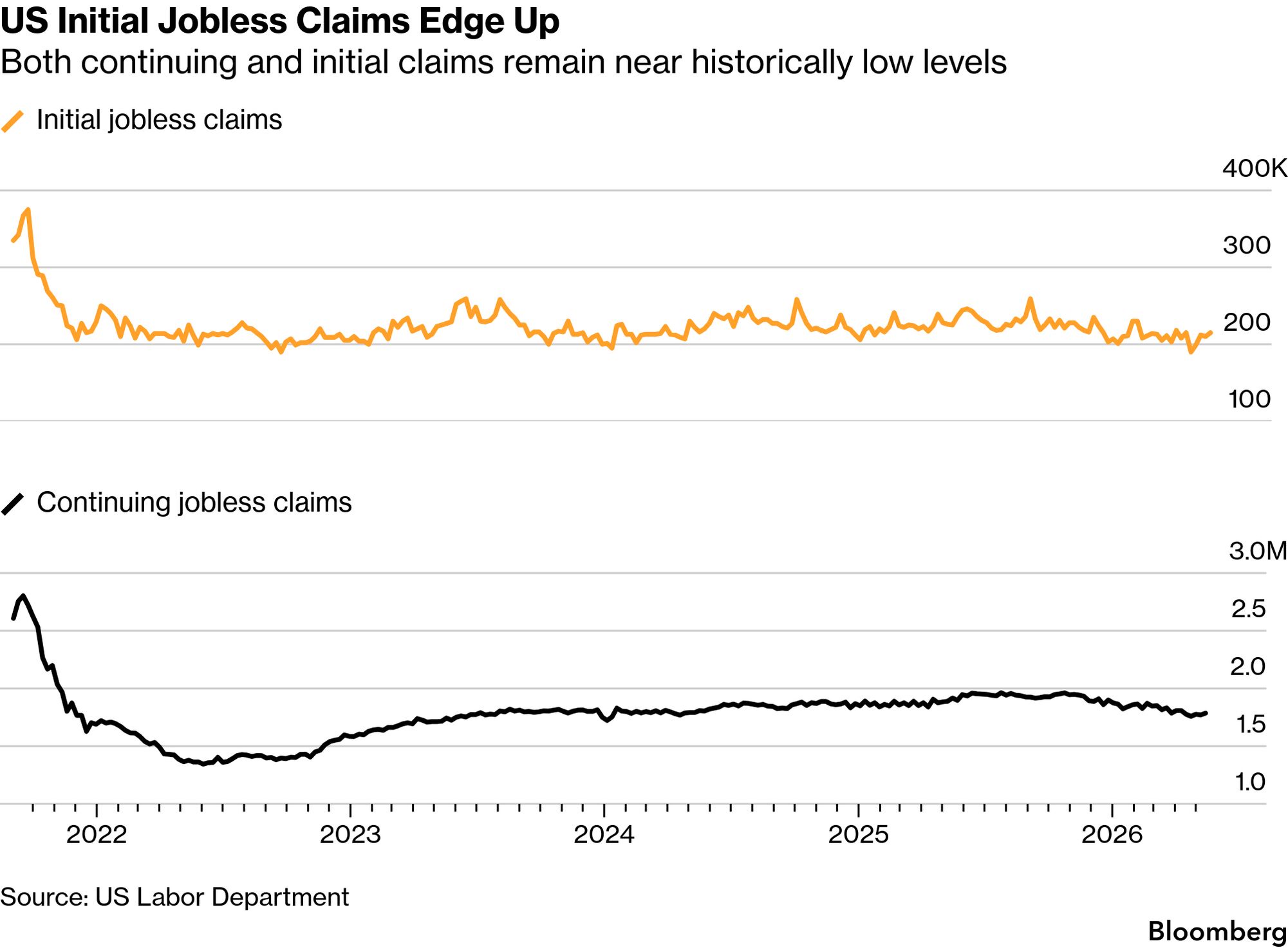
So, he have a spike in initial unemployment claims, though continuing claims, which are actually from a week earlier, fell.

Planned layoffs remain low, though they are up a bit, and productivity rose slightly, but wages did not keep up with inflation.

Meanwhile, I get serious 2008 vibes from the fall in factory construction jobs as well as the increasing exodus of realtors from the profession.

The number of Americans filing claims for unemployment benefits increased more than expected last week, touching their highest level in four months, but the underlying trend remained consistent with a stable labor market.

Economists shrugged off the rise in weekly jobless claims reported by the Labor Department on Thursday as volatility related to ​last Monday's Memorial Day holiday. Claims tend to rise around public holidays. They said there were no signs yet the Middle East conflict was having a noticeable impact on the labor market, ‌though uncertainty was growing.

………

Initial claims for state unemployment benefits rose 13,000 to a seasonally adjusted 225,000 for the week ended May 30, the ​highest level since the first week of February. Economists polled by Reuters had forecast 213,000 claims for the latest week. The four-week moving average of claims, which irons out week-to-week volatility, increased only 6,500 to 214,750.

………

Layoffs remain low by historical standards, despite high-profile job cuts by technology firms related to the adoption of artificial intelligence. U.S.-based employers announced 97,006 ​job cuts in May, about 39% of them in the technology sector, a separate report from global outplacement firm Challenger, Gray and Christmas showed on Thursday. That was up 16% from April.

………

Still, planned job cuts rose only 3% compared to the same period last year. Though employers have not responded with mass layoffs to rising shortages and inflation stemming from the U.S.-Israeli war with Iran, now in its fourth month, economists said that could change, the longer the conflict drags on.
The Labor Department's Job Openings and Labor Turnover Survey, or JOLTS report, on Tuesday showed hiring decreased and layoffs fell in April, suggesting the increase in payrolls that month was due to lower layoffs. A stable labor market allows the Federal Reserve to focus on inflation. Financial markets expect the U.S. central bank to keep its benchmark overnight interest rate in the 3.50%-3.75% range into 2027.

U.S. stocks opened lower. The dollar slipped against a basket of currencies. U.S. Treasury yields fell.
A third report from the ​Labor Department's Bureau of Labor Statistics showed worker productivity growth ​slowed faster than initially thought in the first ⁠quarter, but the underlying trend remained strong and a boost is expected from businesses adopting artificial intelligence for many roles.
Nonfarm productivity, which measures hourly output per worker, increased at a downwardly revised 0.3% annualized rate last quarter. That was the slowest since the first quarter of 2025. Productivity was previously estimated to have risen at a 0.8% pace last quarter. Economists ​had expected productivity growth would be revised down to a 0.5% pace.

As to factory construction:

Yesterday, the Commerce Department released data on construction in April. It showed that factory construction is continuing to fall. In nominal terms, it dropped another 1.2 percent in April from its March level. Adjusting for inflation, the decline would be roughly 1.3 percent.

Factory construction has been on a downward path since the third quarter of 2024. It is now down by close to 27 percent from its recent peak.

 As to realtors:

The slowest housing market in decades is stretching into its fourth year, and even real-estate agents who made it this far are reaching a breaking point. Most of them are independent contractors and get paid when a deal closes. With fewer sales to go around and homes taking longer to sell, more agents are ditching the industry or finding second jobs.

……… 

The downturn is also hitting mortgage-loan officers and the many other industries reliant on home sales, from appraisers and photographers to appliance manufacturers.

………  

The National Association of Realtors had 1.4 million members as of April, down from a peak of 1.6 million in October 2022. 

 This seems to me to be a Wile E. Coyote moment economy.

28 May 2026

It's Thursday ¯\_(ツ)_/¯


Unemployment

Inmflation>
So, both initial and continuing unemployment claims rose last week, though only by a bit.

More significantly, inflation continues to spike, and consumer spending and GDP for the last quarter was adjusted down which means that Trump's new pet Fed Chairman is likely not going to convince the rest of the FOMC to cut rates.

US inflation increased at its fastest pace in three years in April, driven by higher energy prices amid the war with Iran, and cementing economists’ views that the Federal Reserve could hold interest rates unchanged well into next year.

Surging price pressures are eroding household income and could restrain consumer spending and economic growth this quarter. Income at the disposal of households after adjusting for inflation dropped for a third straight month in April, other data showed on Thursday. Given the soaring cost of living, Americans are growing frustrated with Donald Trump’s handling of the economy. A Reuters/Ipsos survey last week showed the president’s approval rating fell to nearly its lowest level since he returned to the White House, hit by a drop in support among Republicans. Trump won the 2024 presidential election in large part because of his promise to lower inflation.

The government on Thursday also revised down the growth pace in consumer spending in the first quarter to 1.4% from the previously reported 1.6% annualized rate. Overall gross domestic product (GDP) growth was slashed to a 1.6% rate from the 2.0% pace estimated last month.

So it's beginning to look like Stagflation, and elections are 5¼ months away.

12 May 2026

Don't Expect the New Fed Chair to Cut Rates

Not with US inflation rising to 3.8% last year and more inflation in the pipeline from energy disruptions as a result of the US-Iran war.

We are in for a bumpy ride. 

US inflation jumped to 3.8% in April as the war in the Middle East continued to drive energy prices and everyday costs for Americans.

Prices rose 3.8% over the last year, according to the data from the Bureau of Labor Statistics, the highest jump since 2023.

This is the second official measure of the consumer price index, which measures the price of a basket of goods and services, since the start of the war with Iran. In March, prices rose 3.3%, up from 2.4% in February.

And consumer sentiment is falling as well.  Go figure.

08 May 2026

It's Thursday ¯\_(ツ)_/¯ (On Friday)

So, initial unemployment claims are up slightly but remain low, and continuing claims fell

Applications for US unemployment benefits rebounded slightly after falling in the previous week to near the lowest levels in decades, signaling layoffs remain muted despite recent job-cut announcements.

Initial claims rose by 10,000 to 200,000 in the week ended May 2, according to Labor Department data released Thursday. The median forecast in a Bloomberg survey of economists called for 205,000 applications.

Continuing claims, a proxy for the number of people receiving benefits, fell to 1.77 million in the previous week, a new two-year low.

Also, the monthly jobs numbers came out. And notwithstanding claims that it is exceptional, the number is actually rather anemic, with about 115,000 jobs added to the work force.

The U.S. job market blew past expectations again in April, buoyed by gains across industries including retail, transportation and warehousing, and healthcare. The results were a sign that the labor market remained resilient so far in the face of the Iran war.

The numbers

The American economy added 115,000 jobs in April, the Labor Department said Friday, far exceeding expectations.

That was down from a net gain of 185,000 in March. But it was much better than the 55,000 jobs that analysts polled by The Wall Street Journal had expected to see for April.

The unemployment rate stayed unchanged at 4.3%, as economists had expected.

Not a bloody clue as to that the f%$# is going on here. 

What I do know is that we are about 2-4 weeks into when ships stopped at the Strait of Hormuz should have arrived at their destinations and that oil reserves fell off of a cliff in April  

Global oil reserves plunged at a record pace in April, as the conflict in the Middle East strains supplies and raises the risk of a further sharp jump in prices ahead of the summer travel season.

Stockpiles of crude fell by nearly 200mn barrels, or 6.6mn barrels a day, estimated S&P Global Energy, even as higher prices triggered a collapse in demand of about 5mn b/d, the sharpest ever fall outside of the Covid-19 pandemic.

That fall in economic demand is driven by a fall in economic activity.

Things are going to get a lot worse. 


30 April 2026

It's Thursday ¯\_(ツ)_/¯


I is confuzzled
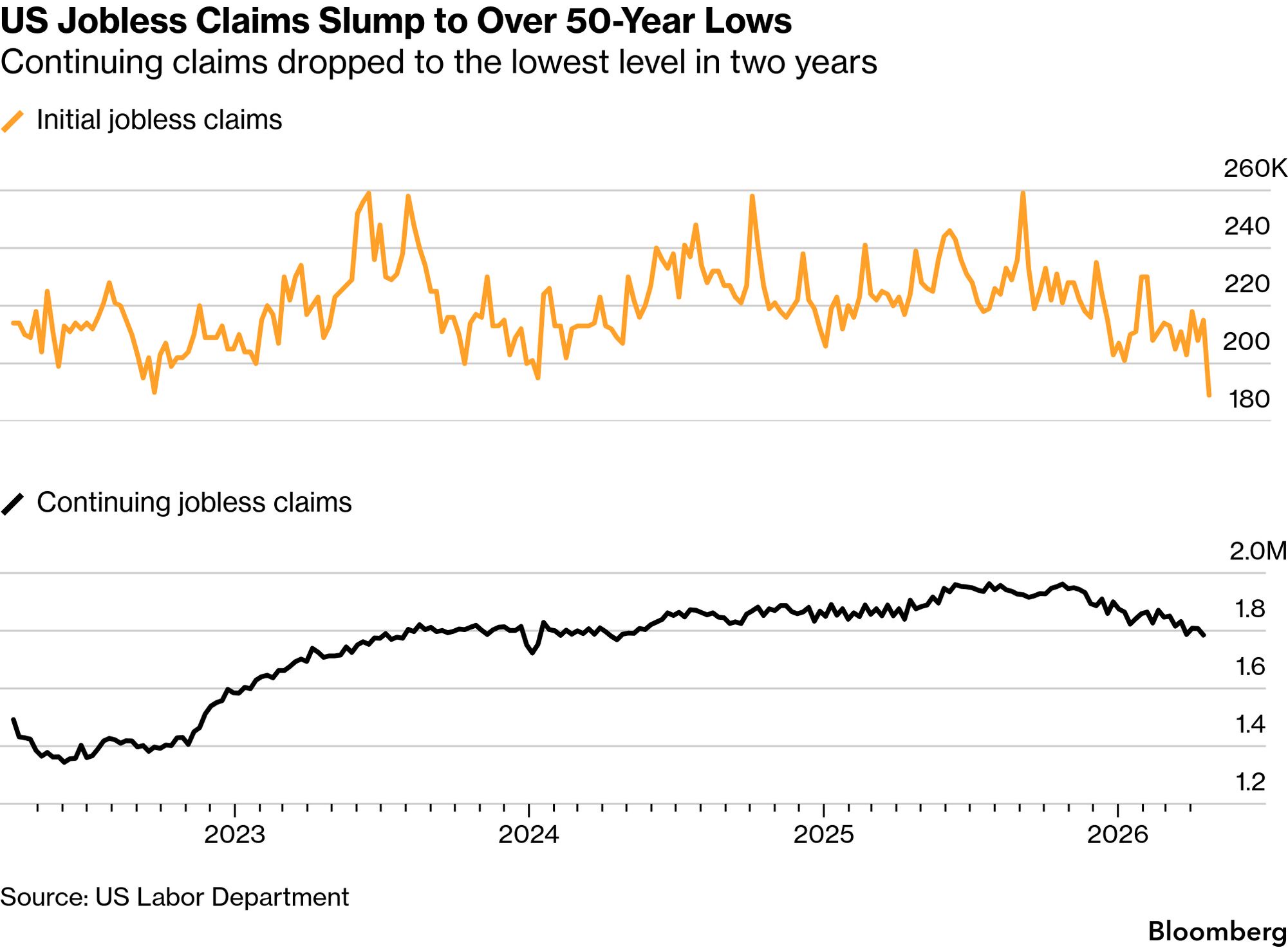
We have a busy Thursday, first with initial unemployment claims falling to a 57 year low and continuing claims fell to a 2 year low.

This makes no sense at all to me, though being recently unemployed may effect my perception of all of this: (Or maybe the Trump administration is just falsifying the data

Given the announcements of large layoffs, this makes no sense to me.
Applications for US unemployment benefits plunged to the lowest level in decades, a sign that job-cut announcements have not yet meaningfully translated into layoffs.

Initial claims fell by 26,000 to 189,000 in the week ended April 25. according to Labor Department data released Thursday. The median forecast in a Bloomberg survey of economists called for 212,000 applications.

Continuing claims, a proxy for the number of people receiving benefits, dropped to 1.79 million in the previous week, the lowest in two years.
Meanwhile, it appears that we have good GDP numbers, but that makes sense when you consider that this statistic includes all of the money being set on fire by the AI bubble.

US economic growth accelerated at the start of the year, bolstered by a massive AI-driven upswing in business investment.

Inflation-adjusted gross domestic product increased an annualized 2% in the first quarter after the longest-ever federal government shutdown limited growth in the closing months of 2025, according to an initial estimate issued Thursday by the Bureau of Economic Analysis.

Consumer spending, which comprises about two-thirds of economic activity, increased at a better-than-expected 1.6% rate, driven by demand for services including healthcare and financial services. Business outlays on equipment and structures advanced 10.4%, the fastest pace in almost three years and supported by rapid investment in artificial intelligence.
Finally, inflation seems to be heating up in a big way.
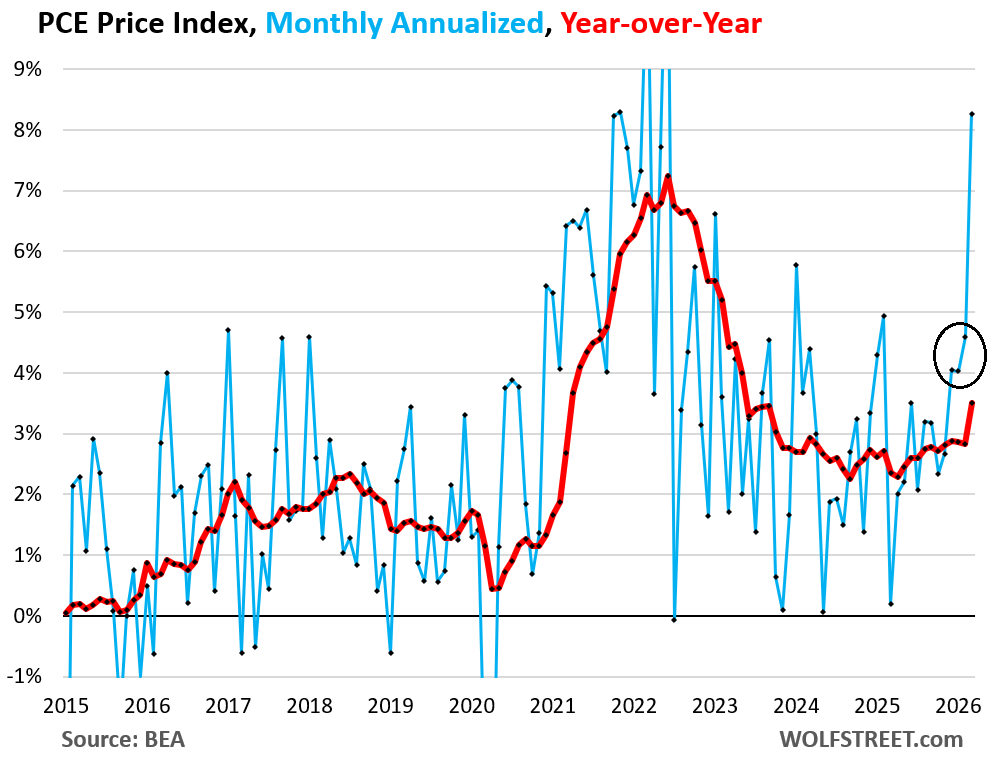
The PCE price index, which the Fed favors for its inflation yardstick, spiked by 0.66% in March from February (+8.3% annualized), the worst spike since mid-2022 at the peak of the inflation surge.

Inflation has been accelerating since mid-2025. In each of the three months of December, January, and February – so before the war and before the energy price spike – the PCE price index had already surged by 4% to 4.6% annualized (black circle in the chart). The March spike is on top of that acceleration (blue line). And it was energy, but not just energy.

Year-over-year, the PCE price index jumped by 3.5%, the worst since May 2023 (red line). The Fed’s target for the year-over-year measure is 2.0%, and PCE inflation has been moving away from it relentlessly for the past 10 months, and the energy price spike came on top of it.

Whatever is going on, it ain't good.

23 April 2026

It's Thursday ¯\_(ツ)_/¯

And not that much happened.  (I'm gonna be a part of next week's claims data)

Initial claims rose by 6,000 to 214,000 and continuing claims rise by 12,000 to 1.821 million.

The consensus is that the Federal Reserve will hold rates steady. 

Hell if I know what is going on. 

16 April 2026

It's Thursday ¯\_(ツ)_/¯

So, initial claims are down, continuing claims are up, and I am about 24 hours away from becoming an unemployment statistic.

F%$# this.  I need some quality time with my cats. 

09 April 2026

It's Thursday ¯\_(ツ)_/¯

So this week, initial claims rose more than expected, and continuing claims fell more than expected.

I have no f%$#ing clue what this all means, but inflation appears to spiking as well, which strongly implies that we won't see any more rate cuts from the Fed. 

New applications for U.S. unemployment benefits increased moderately last week, showing no signs of labor market deterioration and potentially giving the Federal Reserve room to keep interest rates unchanged as it monitors the economic fallout from the U.S.-Israeli war with Iran.

Monthly inflation rose by the most in 12 ​months in February and economic growth almost braked in the fourth quarter, other data showed on Thursday. Economists expect that price pressures increased further in March as the war drove up the cost of energy and other products.

………

Initial claims for state unemployment benefits rose 16,000 to a seasonally adjusted 219,000 for the week ended April 4, the Labor Department said. Economists polled by Reuters had forecast 210,000 claims ​for the latest week. Low layoffs are anchoring the labor market. A surge in global oil prices has sent the national average gasoline retail price soaring above $4 per gallon for the first time in ⁠more than three years and wiped $3.2 trillion from the stock market in March. 

Economists are bracing for a jump in inflation in March, with the Consumer Price Index expected to increase about 1.0% on a monthly basis, translating to a year-on-year rise of about 3.3%. The government ​will release the CPI report for March on Friday. Inflation already was elevated before the war, largely because of Trump's broad import duties.

A separate report from the Commerce Department's Bureau of Economic Analysis showed the Personal Consumption Expenditures Price Index increased 0.4% in February, the largest increase since February 2025, after gaining 0.3% in the prior month. The increase, which was in line with economists' expectations, reflected strong rises in the prices of recreational goods and vehicles as well as clothing and footwear.

………

Excluding the volatile ​food and energy components, the PCE Price Index increased 0.4% in February for a second straight month. In the 12 months through February, so-called core PCE inflation advanced 3.0% following a 3.1% increase in January. The slowdown in year-on-year core PCE inflation reflected last year's high ​readings dropping out of the calculation.
The U.S. central bank tracks the PCE price measures for its 2% inflation target.

Economists say monthly PCE inflation needs to increase 0.2% for a sustained period to bring inflation back to target. The release on Wednesday of the minutes of the Fed's March 17-18 policy ‌meeting showed a ⁠growing group of policymakers felt last month that rate hikes might be needed to counter inflation.

The central bank left its benchmark overnight interest rate in the 3.50%-3.75% range. The odds of a rate cut this year have greatly diminished.

I am not sure what is going on, but it ain't good.

29 March 2026

Cooking the Books

It now appears that we have evidence that the Trump administration is manipulating economic data for their own political gain.

Gee, who could have seen that coming?

An obscure methodological change lowered a key measure of inflation in January, prompting questions about how government statistical agencies produce and report economic data.

Deep inside its monthly inflation report on Friday, the Bureau of Economic Analysis said that the cost of legal services rose 1.8 percent in January. That was an unusually large increase, but not nearly as big as the double-digit gain that some forecasters were expecting.

The reason for the divergence: The agency, which is part of the Commerce Department, had changed the source of its data on legal prices, relying on wholesale prices from the Bureau of Labor Statistics rather than the consumer price data it usually uses.

A technical tweak to such a small category — legal services account for less than 1 percent of overall consumer spending — would ordinarily draw little notice.

But in this case, the adjustment was enough to shave roughly a tenth of a percentage point off the monthly change in the core Personal Consumption Expenditures price index. That is a meaningful difference to investors, who track even tiny moves in the index for hints of when and how the Federal Reserve will next adjust interest rates. The central bank officially targets the P.C.E. index, not the better-known Consumer Price Index, when making policy decisions.

The bureau provided no public disclosure of the change. Economists learned about it only when they reached out to the agency to understand why their forecasts had been so far off.

As I have said repeatedly, the economic data from the Trump administration should not have the presumption of regularity. (See hereherehere, and here)

12 March 2026

It's Thursday ¯\_(ツ)_/¯


Blah, blah, blah!
Unemployment


Housing starts and building permit applications


Gas Prices
Short version, both initial and continuing claims are down, but new housing starts are cratering.

Considering last weeks abysmal jobs reports, and a general lack in both the honesty and the competence of  the BLS and other agencies under Trump, I'm not sure of the reliability of these number.

I'm pessimistic.

The number of Americans filing new applications for unemployment benefits fell last week, suggesting labor market conditions remained stable even after the economy shed jobs in February, but the U.S.-Israeli war against Iran poses a downside risk.

For now, the low level of layoffs evident in the report from the Labor Department on Thursday should give the Federal Reserve ​room to keep interest rates unchanged for some time as the conflict in the Middle East drives up oil prices and threatens to fan domestic inflation, economists said. The war has raised gasoline prices by at least ‌20% since it started.

………

Initial claims for state unemployment benefits slipped 1,000 to a seasonally adjusted 213,000 for the week ended March 7. Economists polled by Reuters had forecast 215,000 claims for the latest week. Claims have been tucked in a 199,000-232,000 range this year amid low layoffs. The government reported last week that nonfarm ​payrolls decreased by 92,000 jobs in February, the sixth decline since January 2025 and the second largest.

………

The number of people receiving unemployment benefits after an initial week of aid, a proxy for hiring, dropped 21,000 to a seasonally adjusted 1.850 million during the week ended February 28, the claims report showed. The so-called continuing claims could be declining as some people exhaust their eligibility, limited to 26 weeks in most states.

Continuing claims also do not include recent college graduates, who are experiencing long spells ​of unemployment, because they have limited or no work history, disqualifying them from claiming jobless benefits. The unemployment rate increased to 4.4% in February from 4.3% in January.

………

Other news on the economy was mixed, with the housing market still mired in weakness and ​the trade deficit contracting in January. Single-family housing starts, which account for the bulk of homebuilding, dropped 2.8% to a seasonally adjusted annual rate of 935,000 units, the Commerce Department's Census Bureau said in a separate report.

The report was delayed by last year's shutdown of the federal government. The drop in homebuilding ‌likely reflected inclement ⁠weather as single-family housing starts tumbled 33.3% in the Northeast and fell 4.6% in the South, among the areas slammed by heavy snow and frigid temperatures in January.

Single-family starts dropped 6.5% year-on-year.

The hell if I know what is happening here. 

06 March 2026

It's Friday ¯\_(ツ)_/¯

It's pretty brutal, with non-farm payrolls falling by 92,000 and unemployment rising to 4.4%.

Hiring fizzled in February, a sign of unexpected weakness in the labor market that sent warning signs flashing through the broader economy.

Employers slashed 92,000 jobs last month, the Labor Department reported on Friday, with losses cutting across nearly all major sectors. The unemployment rate ticked up to 4.4 percent.

The report dimmed the picture of the labor market, injecting a surprising note of caution into an economy already reeling from chaos in energy markets brought on by the war in Iran and fresh unknowns over trade policy. And it all but foreclosed the prospect of a swift resurgence in job growth after an anemic year of hiring that was weighed down by economic uncertainty.

………

Revisions to previous months bolstered the case that the job cuts in February were consistent with a broader decline rather than a blip. In December, employers shed 17,000 jobs, down from an earlier estimate of a gain of 48,000, and hiring figures for January were also revised downward slightly, to 126,000. Taken together, job growth for the last three months effectively slowed to zero.

 In related news the stock market is now officially down for the year

A roller-coaster week in the stock market left the S&P 500 in negative territory for the year, after data on Friday showing weakness in the job market added to investors’ consternation stemming from the Iran war.

The S&P 500 fell 1.3 percent on Friday, taking the index’s losses for the week to 2 percent, its worst week of the year so far. The index fell into negative territory for the year on Thursday and now sits 1.5 percent lower than it was at the end of 2025.

Stocks were choppy all week as investors gauged the inflationary impact of the war with Iran, with oil prices rising sharply as crucial energy exports from the Persian Gulf have ground to a halt. Brent crude, the international oil benchmark, settled on Friday at over $92 a barrel, up almost 30 percent over the past week. That’s the biggest weekly rise in the oil price since April 2020, when markets globally were roiled by the coronavirus pandemic. In turn, what customers are paying at the pump has risen sharply as well.

The war ain't helping, but I called recession a few months ago, and I am sticking by that.

05 March 2026

It's Thursday ¯\_(ツ)_/¯


Initial Claims


Imports/Exports.Inflation


Wages and Productivity 
Initial claims are flat, and continuing claims rose slightly.

New hiring? Not so much.

The number of Americans filing new applications for unemployment benefits was unchanged last week and layoffs dropped sharply in February, consistent with stable labor market conditions.

While other data from the Labor Department on Thursday showed worker productivity slowed in the fourth quarter, the trend remained strong, helping to curb growth in labor costs ​in 2025. Labor market stability and rising inflation risks from the U.S.-Israeli war with Iran reinforced economists' views that the Federal Reserve was in no rush to resume cutting interest rates.

………

Initial claims for state unemployment benefits were flat at a seasonally adjusted 213,000 for the week ended February 28. Economists polled by Reuters had forecast 215,000 claims for the latest week. The unchanged reading was despite unadjusted filings in New York shooting up 17,434 as the state reeled from a massive winter storm.

………

The import duties have since been struck down by the U.S. Supreme Court. Trump responded to the ruling by imposing a 10% global tariff and later announced it would rise ⁠to 15%.

………

Hiring plans soared 140% from January, but they were down 63% compared to last February. Tepid hiring means some people who lose their jobs are experiencing long bouts of unemployment.

The number of people receiving unemployment benefits after an initial week of aid, a proxy for hiring, increased 46,000 to a seasonally adjusted 1.868 million during the week ended February 21, the claims report showed. The data does not include unemployed recent college graduates, whose lack of or limited work history disqualifies them from claiming ​jobless benefits.

We'll have the unemployment rate tomorrow. 

03 March 2026

Headline of the Day

Judge: IRS broke law ‘approximately 42,695 times’ in giving DHS data

The Washington Post

That is both a very large and a very precise number. 

20 February 2026

Even Using the Trump Administration's Figures

The U.S. economy was pretty week in the 4th quarter of 2025, even as Trump's Treasury Secretary, and poster child for smug assholes, Scott Bessant was suggesting robust growth

The number is even worse when you realize that a huge portion of economic activity are AI fraudsters setting money on fire. 

The U.S. economy slowed sharply at the end of 2025 to cap a volatile year in which consumer spending and an A.I. investment boom helped keep growth on track despite tariffs, uncertainty and the longest government shutdown in history.

Gross domestic product, adjusted for inflation, grew at a 1.4 percent annual rate in the final three months of the year, the Commerce Department said on Friday. That was down from a 4.4 percent rate in the third quarter, partly because of the prolonged shutdown.

It was a fittingly messy end to a year in which the economy proved more resilient than many forecasters feared, but fell far short of the revival that President Trump promised on the campaign trail.

Inflation, which Mr. Trump promised to end “on day one,” picked up in 2025. The trade deficit in goods, which Mr. Trump promised to shrink, hit a record high. The manufacturing sector, which Mr. Trump promised to restore, shed jobs.

Not good. 

19 February 2026

It's Thursday ¯\_(ツ)_/¯

And we have the latest unemployment numbers.

Initial claims fell sharply, but continuing claims continue to rise.

I find the latter number more significant than the latter.

Applications for US unemployment benefits fell by the most since November, adding to evidence of stabilization in the labor market.

Initial claims decreased by 23,000 to 206,000 in the week ended Feb. 14, according to Labor Department data released Thursday. That was lower than all but one estimate in a Bloomberg survey.

In the past year, new applications have fallen below the 210,000 mark only a handful of times. That level of weekly filings is a sign that layoffs widely remain low. The data also suggest that people who were temporarily unable to work due to a severe winter storm that spanned the country in late January have returned to their jobs.

However, continuing claims, a proxy for the number of people receiving benefits, rose to 1.87 million in the previous week, the highest since early January. 

………

Separate data out Thursday showed the US trade deficit widened in December, capping a year marked by erratic tariff policy. 

 I think that we are already in a recession, and that it will get much worse, but what the hell do I know.

05 February 2026

It's Thursday ¯\_(ツ)_/¯

We have a few bits of news, first unemployment numbers where, initial claims jumped by 22,000 to 231,000, and continuing claims rose from 1.82 million to 1.84 million, which is obviously bad news.

Applications for US unemployment benefits rose by more than forecast last week, when severe winter weather gripped much of the country.

Initial claims increased by 22,000 to 231,000 in the final week of January, according to Labor Department data released Thursday. Claims exceeded all estimates in a Bloomberg survey of economists.

Continuing claims, a proxy for the number of people receiving benefits, increased to 1.84 million in the previous week.

Business disruptions tied to severe winter weather may have prompted more Americans to seek unemployment assistance. Initial claims figures have generally showed that companies are largely reluctant to reduce headcount amid solid economic growth.

………

Those reductions contributed to more than a doubling in the number of US announced job cuts in January from a year earlier, according to Challenger, Gray & Christmas Inc. Hiring intentions also softened, the outplacement firm’s data showed earlier on Thursday.

Also we have the largest number of job cuts in a January since 2009, at the the height of the great recession. 

US companies announced the largest number of job cuts for any January since the depths of the Great Recession in 2009, according to data from outplacement firm Challenger, Gray & Christmas Inc.

Companies last month announced 108,435 job cuts, a 118% increase from a year earlier. The report on Thursday also showed hiring intentions slid 13% from a year earlier to 5,306 — marking the weakest total for any January in the firm’s records back to 2009.

“Generally, we see a high number of job cuts in the first quarter, but this is a high total for January,” said Andy Challenger, the company’s chief revenue officer. “It means most of these plans were set at the end of 2025, signaling employers are less-than-optimistic about the outlook for 2026.”

Finally, US job openings hit a 5 year low in December.

US job openings dropped to the lowest level in more than five years in December and data for the prior month was revised lower amid a softening in labor market conditions at the end of 2025.

Job openings, a measure of labor demand, decreased by 386,000 to 6.542m by the last day of December, the lowest level since September 2020, the labor department’s Bureau of Labor Statistics said in its Job Openings and Labor Turnover Survey, or Jolts report, on Thursday.

Data for November was revised down to show 6.928m job openings instead of the previously reported 7.146m. Economists polled by Reuters had forecast 7.20m unfilled jobs. Hiring increased by 172,000 positions to a still-low 5.293m in December.

If I hadn't called recession a few months back, I'd be calling it now. 

25 January 2026

Lies the Media Tells Us

Notwithstanding the media reports, the 2025 murder rate fell significantly.

The headlines of 2025 painted a portrait of America in chaos, driven by the financial logic of America’s media ecosystem. It’s number one product isn’t news, but fear.

“NYC youth crime doubled since controversial state Raise the Age Law kicked in,” exclaims one hysterical New York Post headline from September. “Business owners express frustration over crime surge in Federal Hill,” reads a banner from FOX45 News, a local outlet in Baltimore. “Office shooter’s rampage shows terrifying rise of motive-free violence, experts warn,” goes a Fox News heading from August.

The scary headlines were all underscored by inflammatory rhetoric from the Trump administration, which continued to insist that America’s cities are crime-ridden hell holes well into the new year.

Selective media coverage of crime certainly isn’t a new phenomenon, though it’s worth revisiting — especially because new data suggests 2025 was actually one of the least violent years for the US in over a century.

According to fresh Council on Criminal Justice crime statistics, Axios reports, murder rates fell 21 percent last year across the 35 largest cities in the US. It’s the single largest one-year-drop ever, the publication reports, and possibly the lowest homicide rates we’ve seen as a nation since the year 1900 — when the last generation of frontier outlaws were still robbing train cars.

Homicide wasn’t the only crime that fell in 2025. Out of 13 crimes tracked by the Council on Criminal Justice, 11 of them were lower last year than in 2024. Aggravated assaults, for example, fell by 9 percent across the 35 cities, while gun assaults and robberies dropped off by 22 and 23 percent, respectively. (The only category that increased was drug crimes, up 7 percent — and which are nonviolent.)

This a toxic combination of the, "If it bleeds, it leads," ethos of local news and the oligopolistic nature of news, particularly broadcast news/

They are selling a lie. 

24 December 2025

It's Thursday ¯\_(ツ)_/¯ on Wednesday

Because of the holiday, they issued the initial unemployment claims a day early. 

So, initial claims fell and continuing claims rose.

As you can see from the graph, continuing claims have continued to rise, indicating the general weakness of hiring.

Applications for US unemployment benefits fell last week, highlighting the seasonal swings in the data at this time of year.

Initial claims decreased by 10,000 to 214,000 in the week ended Dec. 20, according to Labor Department data released Wednesday. The median forecast in a Bloomberg survey of economists called for 224,000 applications.

Continuing claims, a proxy for the number of people receiving benefits, rose to 1.92 million in the previous week, rebounding from a significant decline at the end of last month. 

………

Overall, Wednesday’s figures are consistent with a labor market seeing relatively low layoffs, a trend that has remained intact throughout the year despite heightened economic uncertainty. While multiple large employers, including PepsiCo Inc. and HP Inc., have announced job cuts recently, those plans have yet to translate into a notable pickup in actual layoffs.

That's probably note the headline economic news though (Yes, I'm burying the lede) is that GDP in the 3rd quarter rose more than expected, along with growing consumer spending and declining consumer confidence, (Yeah, I have no bloody clue what is going on here)

Today’s GDP report, delayed by the government shutdown, was the “initial” report for the third quarter. Data collection for it occurred before the government shutdown. It replaces the “advance estimate,” which got canceled due to the shutdown at the time, and the “second estimate” (originally scheduled for November 26). So this release is essentially the “second estimate” and includes the revisions that would have been part of the second estimate.

And WHOOSH went the economy in Q3. Gross Domestic Product, the broadest measure of the economy, grew by an annual rate of 4.3% in Q3, adjusted for inflation, after the 3.8% growth in Q2, and the -0.7% decline in Q1, according to the Bureau of Economic Analysis today.

By comparison, in the years between the Great Recession and the pandemic (so excluding recessions), average quarter-to-quarter GDP growth was 2.5% annual rate. The average 20-year quarter-to-quarter GDP growth, including recessions, was 2.2% annual rate.

The decline in Q1 had been driven by an explosion of imports due to tariff frontrunning. Imports deduct from GDP; exports add to GDP. But that frontrunning of tariffs in Q1 and other trade shifts due to tariffs caused a dramatic improvement of the trade deficit in Q2 and Q3, from the horrible levels of Q1, contributing substantially to the high growth rates in both quarters.

Consumers also pitched in and spent hand over fist, despite their allegedly very sour mood as depicted by these silly consumer sentiment surveys. Consumer spending, adjusted for inflation jumped by 3.5%, the highest since the red-hot quarters last year.

As to the specific numbers on consumers, consumer confidence fell by 3.1 points to 89.1, but consumer spending rose sharply, though a lot of that appears to be medical spending, which might indicate a surge in medical inflation.

As to my take on what is going on?  No clue. 

18 December 2025

It's Thursday ¯\_(ツ)_/¯


I'm calling bullshit on this one
And the initial claims fell back to about where it was 2 weeks ago, though continuing claims continue what appears to be their inexorable rise

If more interest is the fact that mainstream economists are increasingly calling bullshit on the inflation numbers coming from the Trump administration.

Gee, ya think? 

The titles of analyses of today’s inflation numbers from the Trump administration included “Lost in Translation” from TD Securities, “Delayed and Patchy” per William Blair and “Swiss Cheese CPI report” from EY-Parthenon.Indeed, inflation in several categories that had long been stubborn seemed to nearly evaporate, according to the government. Chief among those were shelter costs, which make up about a third of the consumer price index, but other categories like airfares and apparel notably declined.

Several forecasters pointed to the absence of October data—which resulted in pages of blank spaces in the widely watched report—as effectively the same as assuming no price growth for the month. That culminated in sizable downward pressure on the November inflation figures, they said. Some noted the shortened collection period could have also skewed the data.

In the aftermath of the Trump administration’s decision to cite a government shutdown as reason not to issue data, the president’s comments that any affordability crisis is a “hoax,” and simmering concern over his August firing of the head of the Bureau of Labor Statistics, long-awaited data from the agency was released Thursday. It stated that US inflation, which has been rising for much of the past year, cooled to a four-year low last month.

The so-called core CPI, which excludes food and energy, increased 2.6% in November from a year ago—the slowest pace since 2021, the BLS said. That also happens to be below every estimate in a Bloomberg survey of economists. Some economists seem to agree on something else: the numbers are off.

Occam's razor suggests that Trump and his Evil Minions™ are simply lying and falsifying data.

Given their track record of mendacity, a flipped coin is more likely to tell the truth than they are.