I think I know what it’s like to be a mother now. For approximately six weeks, I’ve been mother hen to our four little suburban backyard chickens. I now understand why mothers worry. All the time. Like it’s their job. Because, well, it is… You’re responsible for this little creature, and the world is a scary place, and it’s your job to protect them. And just like I predict any ventures into actual motherhood would go, I basically threw my kids under the bus. Metaphorically speaking, of course.
I’ve started and stopped this post about backyard chickens several times. I have so much I could say about them, I don’t know where to begin. But the bigger challenge is what exactly to share. The nitty gritty details of backyard chicken ownership? The bigger philosophical & ethical questions surrounding the concept of “owning” a creature? The hopes and dreams that get stirred up every time I acknowledge that the chickens, like Mark and I, desperately crave more land?

From all the questions friends have asked, it does seem that some of you would like to know more about the details of keeping chickens. Perhaps you are, as I once was, pining for the day when you could have your own backyard flock to care for. Maybe you would keep chickens if you could, but your town ordinances or life circumstances don’t allow for it. Or maybe you have no real interest in keeping any sort of livestock but you’re curious about our experiences because, well, there’s something exciting and mysterious about it. Indeed, I agree that keeping chickens is a fun and exciting adventure, and I especially think those pinkish-white orbs of healthy proteins and fats that the hens produce daily are full of mystery and magic!

As for the mundane details of keeping chickens, I’ll leave that to the countless websites already devoted to the subject. Instead, I’m better equipped to tell the story of our experiences for the past six weeks, through photos and words.

Compost Machines. In her coop she becomes a recycler without peer, making better compost of her manure and bedding than a $100,000 mechanical compost-turner can do… ~Gene Logsdon in The Contrary Farmer’s Invitation to Gardening
For us, the decision to have chickens at our house was an easy one, especially for my compost-loving boyfriend. Chickens literally take ‘waste’ such as food scraps, weed seeds, and bugs, and turn it into two very valuable products in a very short amount of time: eggs and manure. Chicken manure is great for a garden, and, when you add hay or straw to their bedding, the hens will naturally turn the mixture into a very healthy compost in no time.

Local Food. The factory farm has succeeded by divorcing people from their food, eliminating farmers, and ruling agriculture by corporate fiat. ~ Jonathan Safran Foer in Eating Animals
In addition to the boost we knew the manure would give to our garden, we were also motivated by the desire to stop buying eggs from elsewhere. Typically we bought from farmstands or other backyard chicken owners, but occasionally resorted to large Vermont egg producers. Not knowing where our food comes from has been a harder and harder pill to swallow, and one that we’d like to avoid altogether by responsibly raising and growing as much of our own food as possible. After all, even local factory farms are still factory farms.

This is what qualifies as a "free range" chicken. See, they've not in cages! Oh, and their beaks are cut to prevent them from killing one another in such a stressful environment. Photo from FlexYourFood.com
Free Entertainment. The hen’s chief form of entertainment is singing, and while she’s no Streisand, her music is more soothing than rock and roll, and is so redolent with contentment as to supply the human listener with more consolation than a hundred-dollar-an-hour psychiatrist. ~Gene Logsdon in The Contrary Farmer’s Invitation to Gardening
Sometimes, early morning, I can sit with my laptop outside, before the bright sun makes the screen glare unbearable. When I started writing this post weeks ago I was sitting next to the temporary extended chicken coop we made – allowing the hens into a garden bed where snow peas had just been removed.
Oh, it’s sad to say goodbye to any garden crop. Especially the snow peas. But oh, how the chickens loved their new play area, and how I loved sitting there watching them. So much so that we even moved a porch chair to the garden for better viewing. The way the chickens cluck at each other, dance around as they scratch for insects or stray remnants of snow peas, roll around in dirt baths – it’s all amusing, and even borderline hypnotizing to watch them!

Bertha saying hi to the camera. She's more attentive to us humans than the others, always looking us in the eye.
Our Schedule. They are much easier to care for than a dog, and don’t bark all night. ~Gene Logsdon in The Contrary Farmer’s Invitation to Gardening
The chickens are fun to watch – and listen to – any time of day, but they do require a bit more care than Logsdon led me to believe in his quote above. Get a load of our daily routine:
- We, along with (we assume) any neighbor within 2 blocks who has their windows open, wake up to their morning squawking noises around 6-6:30
- One of us (usually me) goes downstairs to greet them, offer water and food, and let them into their outdoor pen
- Check for eggs they may have laid in their nesting box since last night
- Go back to sleep for an hour or so. (Yes, we lead luxurious lives!)
- Wake up again to their noises, sounding something like bak-AK bak-AK, as they lay eggs
- Give up on trying to sleep more. Get up and start the day.
- Check to see that the water dish has been overturned; refill
- Pick some weeds from the garden and watch the chickens run to see what goodies were thrown into the pen
- Stand there and watch them for a while
- Check for any eggs
- Make breakfast with eggs and garden greens
- Throw food scraps/compost to them. They love being the beneficiaries of burnt rice (my fault, it’s true), unfinished oatmeal breakfast, and stale cereal (that one is all Mark).
- Refill water
- Unscrew part of the coop to clean it or check for stray eggs that they may have laid on the wrong side
- Do more garden weeding, aka hunting for chicken treats. They especially enjoy clover and any leaves from brassica plants.
- At dusk, the chickens put themselves to bed by hopping into the coop and roosting
- Humans start nighttime procedure:
- Close up the hatch
- Refill the water for morning
- Move night fence into position
- Lock it into place
- Position tree stump blockade in front of it
- Double-check that all fences are tight
- Pray no malicious critters get in overnight

The chickens eating something that I burned on the stove
The Gateway Drug. Chickens are the gateway urban-farm animal. If smoking marijuana led to snorting cocaine, then chickens eventually led to raising meat birds. ~Novella Carpenter in Farm City: The Education of an Urban Farmer.
They say chickens are the gateway drug – if you will – to more adventurous homesteading endeavors. Other livestock, perhaps, or larger farmstead operations. In the case of Novella Carpenter, chickens were the “gateway farm animal” to honeybees, turkeys, goats and even pigs. We’ve been approaching this chicken adventure as one step on our journey to a real homestead one day, with a larger flock of chickens, some goats, horses, honeybees. Maybe even a cow or two. One day.
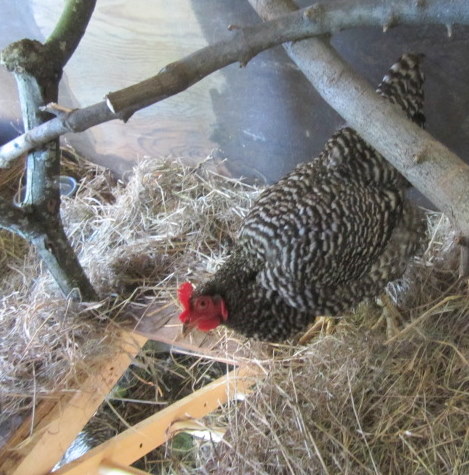
Chickenness = Happiness. Chickens need to fully express their chickenness ~Melissa Meece, paraphrasing Joel Salatin.
Virginia farmer Joel Salatin has been an inspiration to us since we – and the world – first started hearing the name Polyface Farms through books like Michael Pollan’s Omnivore’s Dilemma and films like Food, Inc. I think we’re well on our way to being Lunatic Farmers ourselves (as Salatin refers to himself), especially as we continue to learn and question what it means to have a homestead with livestock. Joel is often quoted talking about the “pigness” of a pig or the “chickenness” of a chicken, as in, his farm strives to allow animals to express themselves fully. Throughout our evolving routine in caring for our chickens, we were always questioning whether they were allowed to express their chickenness. In many ways, they were. But in some important ways they were not.
For us, our chickens continued to convince us every day that we need more land. They want to roam free during the day, have enough space to scratch and dig in new soil every day, finding weeds and bugs to snack on without us having to bring it to them in a pen.
 Taking a dust bath
The Grass is Greener on the other side. Literally.
Our garden simply isn’t big enough for us to be able to let the chickens range freely wherever their little hearts desire. Plus, our yard is not fenced in, and there are no real boundaries for the hens to learn where our land starts and ends. It has pained us to keep them fenced-in. And they haven’t liked it too much either. There have been several escapes or attempted escapes, with no other goal than to get to the other side of the fence where the grass is growing. In their case, the grass is literally greener on the other side of the fence. I’ve moved and re-structured the fences half a dozen times to give them bigger areas to roam, with mixed results. Regardless, our efforts to give them the space to be happy in our urban farmette continues to necessitate a choice between their needs and ours.

The Incident. One night a few weeks ago we had an experience to which every chicken owner we’ve met can relate: we lost a chicken – in our case, to a skunk. It was a horrendous, traumatic experience for all involved, except perhaps the skunk, who wasn’t the slightest bit alarmed about my shovel in his face once we came into the scene, too late to save the hen.
After all was said and done, and Shenandoah was buried next to Calvin in our growing pet cemetery, I found myself reflecting on the many lessons I could choose to take from the experience. I also beat myself up about being an irresponsible chicken mama, unfit to ever take on the responsibility for another life. I strengthened the fence and hatch and nighttime lockdown procedures to protect the other three. In fact, I obsessed over this. I researched skunk repellents and urban chicken predators. I talked to my therapist about life and death, morality and responsibility. I had nightmares every night, and awoke at the slightest noise. Mark and I shared our goals with owning chickens in the first place, and urban homesteading as a concept.

I created a border of cayenne pepper around the coop, which was supposed to deter critters from getting too close. At least until the next rain.
What we decided to do was not an easy decision, but it was one we had already been considering, given that we had travel plans coming up and no ‘chicken babysitter’ plan. We gave up our hens. Shenandoah’s death made it abundantly clear that we did not feel right about having chickens here anymore. I still think chickens play a vital role in the homestead ecosystem, and when it comes time for us to live out that dream on more land, I’m sure a new flock, with an even more secure coop, will be one of our first projects. But for now, we passed along our three lovely ladies to a friend and fellow chicken owner – with a bigger yard and better coop. From what we hear, they are adjusting nicely to the transition. And we still have visitation rights!
As for me, I’m sleeping better these days. I guess we’ll be eating less omelets and more oatmeal from now on. Only now, if I burn the oatmeal, I won’t be able to feed it to my little babies!


 Renovations & Relationships