Wordless Wednesdays

They say no news is good news. I’ve always found this phrase confusing because there are at least two ways to interpret it, but given that I’m a glass half full kind of gal, I mean it in the following way: You haven’t heard much from me recently but that’s okay because things are good. I’ve been happily on vacation, attending events, watching myself on tv, and contemplating big life changes. More to come on that last topic, but for now I thought of something fun to share after seeing this blog highlighted on WordPress’ Freshly Pressed site yesterday.

Mark and I enjoy taking photos as much as (or more than?) the next person so why not take time each week to share some just for your entertainment? And why not make it on Wednesdays, that mid-week hump day when everyone could use a break from a busy week? This week’s photos come from recent adventures at farms, farmstands, and in our own backyard garden.


Farmers’ Market Update

It’s a little late in the season to be giving you an update on our involvement in the local farmers’ market. There are only four markets left, and we won’t even be there for two of them! But, in the spirit of using this blog as a journal of our experiences, here’s a late summer update.

Our First Day.

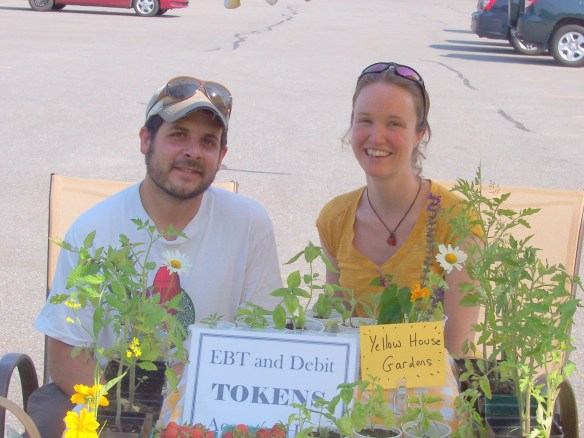
Some of what we had for sale that day: Tomato plants, herbs, strawberries (oh how I miss you!), garlic scapes, flowers, and bags of salad greens.

The first market went well, mostly because we sold plants that weren’t available elsewhere at the market, and because we had some good friends stop by and buy us out of a lot of things!

That day we learned that we needed a different setup – at the very least, we needed a bigger umbrella that could shield the produce from the heat of the sun. Oh, and a bigger table was on the wish list too.

But at the time we were just using what we had. In fact, up until about two weeks before the first market we didn’t have anything for our stand: no table, tablecloth, or umbrella/tent.  Now, I’m not one for praying, but I do occasionally ask for a sign that I’m putting my energy in the right place. And so, with a little asking, and openness to receiving, we found ourselves in possession of a card table, an umbrella, a wooden shelving unit, and a perfectly-sized yellow tablecloth about a week before the first market. All for free. And a friend offered to create a logo for Yellow House Gardens.

Oh, and we acquired those red plastic Coca-Cola crates for free, too, from a local deli. Super useful for carrying plants and produce to market! (Also, versatile enough to turn two of them into chicken nesting boxes, when we had chickens.)

Our Growing Stand.

At our second market we upgraded to a new tent instead of the tiny umbrella (thanks anyway, Rocko!), and used the new wooden shelving to showcase plants for sale.

But the tent dwarfed our little table – especially once we stopped using the wooden stand at future markets.  What we needed was more presence! Something to make market goers stop and take notice of our stand.

Future incarnations of our display included a bigger table loaned from the market managers, and more recently a 6′ table borrowed from an acquaintance. We’ve also been on the other side of the market, facing the parking lot instead of having our backs to it. It’s a little like musical chairs with the vendors each week as there’s no set “spot” for us. We just show up and fit in wherever we can on the long grassy patch next to the Burlington Elks Lodge.

Here’s our stand a few weeks ago in August. For sale at this market: potatoes, cherry tomatoes, beets, carrots, eggs, cucumber/tomato salad, kale, chard, bok choi, salad greens, and flowers.

Jenny-the-Truck gets packed to capacity for some markets, especially when Mark insists on bringing the nice deck chairs with us. We typically don’t block the truck window with the table like that. But then again, it is only a mile to the market.

Signage.

As you can see in the photos above, a white paper with some words on it hangs off the front of our table. It says “Yellow House Gardens: A Microacreage in Burlington, VT”. My friend Shawn designed a logo for Yellow House Gardens, which we have happily put into use on some of our other signs. (You can learn more about Shawn’s mission-driven project Wahter Man and contact him here.)

But the truth is, we haven’t been great about signage that displays our name clearly. Most of our signs and pricing are hand-written (and both of us have poor handwriting!).

This sign has been with us from the beginning. Maybe we thought it would foster a dialogue about backyard gardening, inspire others to be food producers, or just create a sense of community with the market shoppers – most of whom are neighbors. But mostly people don’t notice it.

Sometimes I think signs are over-rated. We love telling our story in person to market customers: “We’re not ‘real farmers’, just people with a backyard garden about a mile from the market,” we say. We have a backyard garden, too, but I don’t have enough sun to grow tomatoes, they say. Or, Oh, you’re the house with the flowers in the front yard! I’m your neighbor two block away. 


As the market season winds down, we reflect on what it means to have been food producers, selling our own food to friends and neighbors. Not everyone gets the opportunity to have this experience. We were lucky enough to have a small local market that had space for more vendors, and friendly market managers who welcomed us with open arms despite our total lack of consistency and clarity about what we were selling!

Of course, not everyone wants to have this experience. We were excited about the opportunity for many reasons, mostly so that we could learn what it’s like to sell our stuff to others in a low-pressure & fun environment. Over the course of the season we went through a lot: from the master suite renovation to a stint at keeping chickens, from spring flooding to flooding from Irene (which destroyed our community garden plots). But through it all we came to the conclusion that we want to keep being food producers. In fact, we want it so bad that we’re actively seeking land to do so on a bigger scale.

You can expect some more thoughts on this in the coming weeks, but for now here are some of the practical things I learned from our first experience in this business together. Things that I hope to remember as we continue on our food producer journey in the future.

A better display means more sales, or at least, more people stopping by to take a look. Of course, I had already learned this nugget of wisdom when I took a workshop on marketing for farmers’ market stands last winter, but I guess everything is better learned through firsthand experience.

Confidence (in your product/price/quality) is professional. We did our best at growing food that we’d want to eat and selling it to our neighbors at a fair price. But given the newness of this venture, and the tricky attachment that can come when you put a price tag on something that was made with love, we may not have always seemed confident in our products. For one thing, I let customers barter with me on price. Sometimes I even encouraged it. How much is this kale? Eh, take whatever you want for $3. Haggling might be a good way to operate a yard sale, but it doesn’t work as well for a business.

Diversity is nice, but so is consistency. We are proud of the fact that we have a very diverse table of offerings each week. We bring fresh produce from our gardens, typically harvested that morning, and we experimented with lots of prepared foods, too. Our vendor friends enjoyed trading their goodies for our prepared foods at the end of the day. But they weren’t a big hit with paying customers, and we’re not sure why. One thought is that our table might be a little too diverse. People respond well to consistency in products and prices, and we’ve been anything but consistent. Do you have chard? Yes, we grow chard at our house but didn’t bring any this week. Oh, well I’ll buy some from you next week. We won’t be at the market next week. And so on.

A smile goes a long way. 

The little things

I always love it when little things make a huge impact.

Like a flower blossom. In the garden this evening, Mark was thrilled to find that his precious tomato plants have been enjoying all the recent  heat and humidity. Tomatoes are growing on the vine and more are on the way. “I love these little yellow blossoms. It’s like the stars coming out at night,” he said. Garden-inspired prose abounds these days.

Just living is not enough,’ said the butterfly.  ‘One must have sunshine, freedom,  and a little flower.’ ~Hans Christian Andersen

Like a rainstorm. The spring floods have come and gone and now we’re in the heat of summer, where a rainstorm every few days is welcomed with open arms. A rainshower means, at the very least, that we don’t have to water the garden for the next 12-24 hours. At best, it means plants have the water they need to stay cool, keep growing, or bear fruit, and our rain barrel is full for tomorrow’s watering chores. Everyone is happy.

Many a man curses the rain that falls upon his head, and knows not that it brings abundance to drive away the hunger.  ~Saint Basil

Like security. Two packages of metal hook-and-eye latches cost about $5, yet their value is priceless. Quickly installed on the chicken coop one night after dark, the latches save time opening and closing gates to the pen, and opening the egg hatch to gather the magical pink orbs, of which we get three to four a day.  Prior to latches, we were opening the egg hatch with our cordless drill.  (Yes, we’re silly.) The latches also skilled in the art of peace-of-mind. I have been having regular nightmares about the chickens escaping or dying an ungodly death at night because our fencing is questionably adequate to keep out suburban critters (think: raccoons, skunks, squirrels -who typically won’t harm chickens but may try to eat chicken feed- and neighborhood dogs). In fact, one night I went out to check that the hens had enough water for the morning and I found a very confused skunk inside the pen! Heart racing, I slowly and carefully joined him in the pen to move the fences so he could get out. I did not get sprayed, no eggs were stolen, the hens were safely upstairs in the coop, but I was resolute on fixing our fencing. Cross your fingers I’m not jinxing the situation by mentioning it, but I think the chickens are now more secure thanks to a few inches of metal!

The average man [chicken] does not want to be free. [S]he simply wants to be safe. ~H.L. Mencken

Like kisses. Enough said.

Twas not my lips you kissed, But my soul ~Judy Garland


Making time

I have a lot to say, but no time to say it.  If I could, I’d tell you about our latest house and garden projects, the seasons changing, a new housemate moving in. About planning and patience, about busy days and tired nights.

Time is moving faster than ever, it seems, especially with me holding down the fort solo. My partner in crime is learning his own lessons about biting off more than he can chew, the nitty gritty of bathroom renovations, and that big lesson we keep re-learning over and over again: that everything takes longer (and costs more) than you think it will. Everything. It’s called the planning fallacy and my guess is that some people are more susceptible to it than others.

Here’s a quick photo recap of some of the things going on here – from harvesting some of the abundant dandelions dotting our greenspaces (healthy greens for sauteing, flowers for wine, and roots for dandelion coffee), to planting flowers in the front garden, to installing the new kitchen shelving unit… I guess it’s understandable that I’ve been too busy to write!

I promised a photo of our stone pathway – here’s the path from the driveway to the front porch. We’re still working on acquiring enough stones for the entire front walkway.

We love our stone path

We dug up tons of perennial flowers from our friends’ house in Winooski last weekend (thanks, Lisa and Zach!) and planted them in our front garden. I set up some drip lines to help keep them watered for the times when Vermont isn’t flooded.

In the kitchen, we used to have a monstrous wooden thing. It was sort of an open cabinet/room divider/countertop, but it didn’t really perform any of those functions all that well.

"Before" 1

"Before" 2

So we fired the old cabinet and hired something in its place. Our new open shelving unit is made from beautiful Vermont maple.  It’s open and airy. It at least triples our usable storage space. A perfect blend of functional and beautiful. I think he’ll do the job just fine.

"After" 1

"After" 2

The final photo for tonight shows the (almost) final stages of painting what-was-once-Ross’-room-soon-be-our-new-housemate’s-room. I promise the color will look more consistent when it’s dry.

Freshly painted

Believe it or not, painting the trim white took much longer than the walls. One more of those lessons that I’d write about, if only I could find the time.

Lessons from this weekend: Rocks, a Washboard, and a Pergola

I learned a lot this weekend. Here’s a few nuggets of wisdom  conveyed to me by the universe over the past 48 hours or so.

Lessons #1 and #2

  1. Despite our best efforts, our gardens will not win any awards for the neatest, most organized, or earliest crops. We see the vegetable seedlings for sale at stores around town, and at this weekend’s farmers’ market, all of which look huge compared to our seedling babies. We watch our backyard neighbor tending his garden plants every day – in a much more orderly, organized and detail oriented way than we could ever do. His plants are lush and radiant. I tell myself that ours will catch up…
  2. I learned that I could have a new career harvesting rocks out of our backyard.
  3. Mark and I were not the only ones who couldn’t remember that yesterday was a holiday.
  4. Daylilies are incredibly resilient and seem to like horse manure almost as much as we do.
  5. We’ve got great friends. This weekend wouldn’t have been what it was without friends who: loan us their tools indefinitely, give up an entire weekend for a carpentry project at our house, meet us at ReBuild in the rain to design a homemade grill and find cheap parts for it, brew tasty beer, play awesome music, teach us their gardening tricks, respond to emails immediately with advice and an offer to lend a hand, and encourage us to keep on doing what we’re doing.

    Lesson #6

  6. I like the washboard. Musically, anyhow. Unfortunately, it seems to put Mark to sleep as it’s not quite complex enough. Out at a show Saturday night, I was ecstatically tapping my feet to the rhythms of a spoon run across a washboard while Mark was finding a new fascination with the electronic synthesizer. Once again I’m reminding that we could star in a sitcom called The Luddite and the Technophile. Our chemistry despite our differences continues to baffle and amaze me.  (As for how I like the primary functionality of a washboard, ask me again in a few years when we’re living off the grid, forgoing the modern conveniences of washing machines and other appliances.)

    Lesson #7

  7. Even the best managed compost bins can go sour if they don’t have enough aeration. We finally managed to turn our now-defrosted compost pile to let it dry out.
  8. A bench on the front porch is always inviting, even when you live on a very busy street.
  9. The final, and best, lesson as of late: it takes about two weekends to build a pergola.

Lesson #9 - Part 1

Lesson #9 - Part 2

Breaking ground

My garden journal has a big exclamation point under today’s date: We finally broke ground at the Intervale community garden plots today! A beautiful sunny day in the sixties, we couldn’t help but get ourselves out there for some digging and planting.

Here’s what our plots looked like before we did anything today. Obviously you can’t tell where ours start and end from this photo; it’s more for my own reference I suppose. The bed centered in the photo that is lined with wood and has yellow straw on top is our garlic bed that overwintered.

This is only my second year growing garlic, and I can tell you, the newness of this exciting endeavor hasn’t yet worn off. We planted garlic heads in the fall, covered them with soil and a thick blanket of mulch, and let them sit – all winter long – for nearly six months. It is a worrysome experience: Will they survive? Did I plant them too early? Too late? Did I use enough mulch to protect them from the winter elements? Did I use too much and risk smothering their tender shoots as they reach for the light come spring? These questions fill my mind all winter long, intensified by the fact that we don’t very live close to our community garden to be able to check on them regularly.

And then one spring day my questions are answered. The small green shoots reach out of the straw, stretching as they wake up from winter dormancy. They are alive and beautiful.

As if that weren’t enough, the garden offered other garlic gifts today as well. Garlic that had accidentally not been harvested last summer was growing in other parts of the garden, so we dug them up and planted the tiny heads of garlic today, which can likely be harvested as small garlic bulbs in the fall.

While at the garden for hours today we also turned lots of soil to get ready to plant our root crops. We’ve decided to use the Intervale plots (two adjacent garden plots) for potatoes, beets, carrots, onions and garlic. Oh, and we’ll give winter squash another shot, though we didn’t have much success last year. All of these are crops that don’t require much maintenance or regular harvesting, thus, we don’t mind growing them three miles from our house.

At our home gardens we’ll plant Mark’s beloved tomatoes and peppers, snow peas (already in the ground), and lots of salad greens, spinach, kale, chard and other yummy greens. If I had any energy left today I’d be out there right now planting more spinach seeds…

Believe it or not there’s actually still snow on the ground in places, but with this new green growth today it seems that spring has finally arrived.

First Day of Spring?

Last year Burlington had a heat wave in March which allowed us to get started in our community garden plots way earlier than our neighbors. Here’s what one of our plots looked like.

It's a manure party

We had already turned the soil, staked out beds, added horse manure and planted some seeds. All by the middle of March.

By comparison, here’s what today looked like in Burlington.

Photo from SherryDigitalPhotos on Flikr

It snowed most of the day. Nothing really accumulated, but it put a damper on Mark’s efforts to rake out the snow so the ground could absorb it.

Happy Spring.


Welcome to mud season

Mud season

Mark stood on the porch and surveyed the backyard with a frown. This time last week we were digging in the dirt, planting seeds at my mom’s new garden. Here in Burlington there’s snow still on the ground; the weather is teasing us into thinking it’s spring one day, and winter the next. There’s no way for the soil to soak up all the moisture for at least another week or so, making digging and planting impossible. Welcome to mud season.

We’d prefer to be able to get started in the gardens by now. Clocks spring ahead, St. Patty’s Day, Spring Solstice, all symbolize new growth, green, the changing of the seasons. Before we know it we’ll be up to our ears in work: amending the soil, sowing seeds, transplanting, weeding, etc.  But for now it’s the daily struggle of not being able to get outside and get started that is driving us crazy.

Oh sure, there are plenty of things we could do indoors – starting seeds, organizing gardening supplies, and of course, all the home remodeling projects that we were going to do this winter that aren’t yet completed.

But we’d rather have our hands in the soil.

Mark beating up the snow with a rake

After waking up to snow on the ground yesterday, it warmed up slightly and we did get a little bit done outside. Mark thought it would be productive to tell the snow just what he thought of it, by beating it up with a rake. I took to organizing my storage unit car in the driveway.

I’m sure all the anticipating will be worth it. I’m sure when we’re busy with project after project this summer, going at a ridiculous pace like we are known to do, we’ll look back longingly and wish it were March again.  For the moment, though, it’s just hard to believe the growing season will ever come.

A few of my favorite new things

There’s a lot of new things going on here.

  • As I write this I am sitting in my new office, looking at a new view in the backyard.
  • Next to me light is streaming in from our new window in the bathroom.
  • Our front yard has a new sign explaining what the heck the hay and leaves are all about, and it also receives sunlight in new places.
  • I have nine jars of preserved food newly put away (apple butter, pickles and pasta sauce).
  • For the past few days our house has hosted a new guest – it’s first non-couchsurfer guest.
  • Mark’s new chainsaw has provided us with a lot of firewood.
  • We have a newly-created pantry shelf in the stairwell between the kitchen and basement thanks to Mark’s handiwork.
  • We also have a new idea about flooring on the second floor: cork.

Some photos to help you visualize some of these changes are below.

The “before” on our bathroom.  The tape on the walls was us trying to draw out how big a window we wanted.  The walls are an ugly yellow and the poor quality of light and ventilation added to the yuck factor.

The photo below is the “After,” or more accurately, “During” the renovation stage, which we’re still in.

We initially picked up a used window at ReBuild, after being convinced by an efficiency expert friend that the difference in efficiency between a new and old window are negligible.  In other words: It would be better to save $ and resources by buying a used window than a brand new one, despite the tiny gain in efficiency we might get from a new one.  (Windows in general are super inefficient – we’ve done ourselves a disservice in the energy department by putting a window in where there used to be an insulated wall. But the gains in happiness and aesthetics are well worth it for us.)  I was thrilled with the decision to get a used window until our contractor saw it and explained that it was actually a window from a commercial building and wouldn’t install properly in our house.  After another trip to ReBuild to return the window and check out other ones, we gave up and went to everybody’s favorite big box store: Lowe’s.  There we were able to find a clearance window of the perfect size for only twice the price.  Lesson learned: sometimes buying used wastes time and effort.  Silver lining: on our second trip to ReBuild we found a beautiful bathroom medicine cabinet for only $20 that would have cost well over $100 new.  Score!

We have beautiful views out the window – it’s amazing how such a small change makes a huge difference in the bathroom.  Now if we could only get the wall put back together!

I now have a desk set up in the room behind our bedroom (next to the bathroom).  We’re still not sure if we’ll ever knock down that wall and expand the ‘master suite’ – for now we continue to live in an unpacked space that feels temporary at best. The views out the window are into the backyard. Now that the tree is gone, it’s a great window for watching the sunrise.  To you perceptive blog readers: yes, that is a disposable coffee cup.  No, I’m not drinking coffee these days, nor are we generally purchasing one-time-use products.  The cup belongs to our otherwise eco-friendly contractor.

Mark got a new chainsaw (thanks to Mark’s parents!) and has had ample opportunity to use it this past week.  Our backyard view used to be taken up entirely by this box elder tree.  The pros of this tree was the privacy it afforded while seasonally full of leaves, and the squirrel corridor from one tree to another across our backyard.  The cons were many.  Box elders are typically considered “junk” trees – they don’t offer much value to humans or other creatures as far as food, habitat or aesthetics, they drop thousands of seeds that sprout up everywhere and have persistent suckers that will keep coming back even after the tree has been cut down.  This tree was ~50 feet tall and rotted through the middle.  After cutting it down it stank like an unclean bathroom and bled red sap.  Stranger things have happened.  Goodbye old tree.

Mark had some help from friends (thanks Noah and Chris!) with cutting down this tree as well as a big limb off a silver maple in the front yard.

This is what the front yard looked like after the huge branch came down, nearly taking our porch with it.

This is now what our backyard view now looks like.  You can see Mark in the distance talking to our neighbor (arms akimbo – that’s him!) in our neighbor’s huge garden that abuts ours.  The garden will be thrilled that we’re letting tons more light in without the tree.  Next project: make wood chips from the smaller branches and chop up the big pieces for firewood.

I painted this sign and put it in the front yard as a way of explaining to our neighbors that the mess on our front yard is intentional.  We’ve gotten a lot of curious looks from passersby, but no inquiries as of yet.  The “350” sign is in honor of last Sunday, 10/10/10, “a day to celebrate climate solutions,” brought to us by the nonprofit global organization 350.org.  In 188 countries worldwide, people performed community workdays on 10/10/10 to implement solutions to the climate crisis.  We performed our own mini-workparty at our house by continuing the garden planning and expansion, and participated in some of the events in Burlington in the afternoon.

The final pic for today is of the 350.org workparty celebration in Battery Park.  We all gathered around the Solar Bus and posed to add our spirited photo to the multitude of event photos being broadcast around the world.


Conversation With God About Lawns

On the topic of the front lawn conversion, I found this funny post on a blog about permaculture.

Imagine the conversation The Creator might have had with St. Francis on the subject of lawns:

God: Hey St. Francis, you know all about gardens and nature. What in the world is going on down there in the Midwest? What happened to the dandelions, violets, thistle and stuff I started eons ago? I had a perfect “no maintenance” garden plan. Those plants grow in any type of soil, withstand drought and multiply with abandon. The nectar from the long lasting blossoms attracts butterflies, honey bees and flocks of songbirds. I expected to see a vast garden of colors by now. But all I see are these green rectangles.

St. Francis: It’s the tribes that settled there, Lord. The Suburbanites. They started calling your flowers “weeds” and went to great lengths to kill them and replace them with grass.

God: Grass? But it’s so boring. It’s not colorful. It doesn’t attract butterflies, birds and bees, only grubs and sod worms. It’s temperamental with temperatures. Do these Suburbanites really want all that grass growing there?

St. Francis: Apparently so, Lord. They go to great pains to grow it and keep it green. The begin each spring by fertilizing grass and poisoning any other plant that crops up in the lawn.

God: The spring rains and warm weather probably make grass grow really fast. That must make the Suburbanites happy.

St. Francis: Apparently not, Lord. As soon as it grows a little, they cut it… sometimes twice a week.

God: They cut it? Do they then bail it like hay?

St. Francis: Not exactly, Lord. Most of them rake it up and put it in bags.

God: They bag it? Why? Is it a cash crop? Do they sell it?

St. Francis: No Sir. Just the opposite. They pay to throw it away.

God: Now let me get this straight. They fertilize grass so when it does grow, they cut it off and pay to throw it away?

St. Francis: Yes, Sir.

God: These Suburbanites must be relieved in the summer when we cut back on the rain and turn up the heat. That surely slows the growth and saves them a lot of work.

St. Francis: You are not going to believe this Lord. When the grass stops growing so fast, they drag out hoses and pay more money to water it so they can continue to mow it and pay to get rid of it.

God: What nonsense. At least they kept some of the trees. That was a sheer stroke of genius, if I do say so myself. The trees grow leaves in the spring to provide beauty and shade in the summer. In the autumn they fall to the ground and form a natural blanket to keep moisture in the soil and protect the trees and bushes. Plus, as they rot, the leaves form compost to enhance the soil. It’s a natural circle of life.

St. Francis: You better sit down, Lord. The Suburbanites have drawn a new circle. As soon as the leaves fall, they rake them into great piles and pay to have them hauled away.

God: No. What do they do to protect the shrub and tree roots in the winter and to keep the soil moist and loose?

St. Francis: After throwing away the leaves, they go out and buy something which they call mulch. The haul it home and spread it around in place of the leaves.

God: And where do they get this mulch?

St. Francis: They cut down trees and grind them up to make the mulch.