Showing posts with label NYC. Show all posts

Wednesday, April 01, 2015

Druggie Vampire Women of B&W City: A GIRL WALKS HOME ALONE AT NIGHT, THE ADDICTION, NADJA


Like so many broken down NYC artists and writers before me, I've submissively followed my vampire anima--my creative muse-- like a doting Renfield, scooping up any fly turns of phrase or spider ideas she cares to drop behind her, protected from direct harm (her rabid fangs of madness) only by some half-remembered Hegel quote kept around my ravaged neck. Lonely in the throng of my fellow lonesome vampire secretaries--all of us aging and dying as we're drug from one Annexia to the next while our vampire muses stay young and lush and flush in their coffin pages and occasionally celluloid--I simultaneously crave and fear the isolation she needs to emerge from her hairy coffin. 

The East Village where I used to live now can only be afforded by the rich or older-than-me bastards with rent controlled apartments. But back in the 80s-90s you could live in downtown NYC for only $500 a month, and there was a sudden outbreak of female druggie downtown vampire artists onscreen, serving well as metaphors for the city itself, and AIDs, drug addiction, and art's constant struggle for fresh blood. Anonymous thirsty youth prowling a city that never sleeps just waiting for a bite = ideal vamp habitat. Now we live in squalor in Park Slope and make double what we used to but can't afford to go to a bar and buy $15 drinks, so everyone's in bed by midnight; we can barely afford a gallon of Coke Zero, 2 packs of cigarettes, fifth of bourbon, and gram of weed a day habit. No vamp can find us now - and our anima slumbers out of reach, deep in the Demeter's rat-infested hold.

But there's always the 90s to revisit, and now, thanks to a genius female Iranian director, there's an indication some element of the 90s black-and-white druggy urban vampire dream lives on, in a sub-section--west side-- where it's always balmy, where it's forever the past, and LPs and cassette mix tapes are still the hard currency of connection. Iran's Bad City (aka Bakersfield, CA) a town located between the grime of Bleeker Street and the clankety-clank of Eraserhead. 


THE ADDICTION
1995- Dir Abel Ferrara 
****

"Dependency is a marvelous thing," whispers Lili Taylor to her NYU thesis advisor as they shoot up together. "It does more for the soul than any formulation of doctorate material." Of course she's going to give him more than just dissertations and heroin, she's going to give him eternal hunger in exchange for his opiated blood --basking in the satisfaction of two cravings being satisfied in one suck. She rules her space, this guy may be a teacher but he's at her feet. Yet before long she's trapped in the loft of a pompous male vampire who drinks her blood and leaves her to contort the day away in agonizing anemic double-withdrawal, giving her the gift of a copy of Burroughs/ Naked Lunch to help her learn to control her junky cravings. Ferrara leans in on Taylor's prolonged, agonized day --maybe the most extended, harrowing depiction of drug withdrawal I've ever seen, or felt (though mine were from alcohol-- probably only about 1/10 as agonizing but very similar movements and breathing). She finally makes it into the service elevator and down to the street, as we all do, to get her fix, the city barely noticing how messed up she is, which is both its best and worst habit.

Naturally someone helps, giving more than the Red Cross would ever ask and she's fine again. 

The Addiction, in other words, in a 90s black-and-white horror movie that's about a lot more than just stakes and exsanguination, it's got interesting things to say--both out loud and in the coolest voiceover narration in all of cinema, a veritable doctoral thesis on evil-cum-advocacy for drug addiction, whispered by Lili Taylor, so glassy-eyed perfect for the part it's like you're overhearing while nosing around some downtown NYC bookstore. 

This is no bullshit vamp psychobabble or empty LA posturing, It's real NYC, real philosophy in action, courtesy a script by Ferrara's long-time "more Catholic-junkie synergy than a dozen Jim Carrols" screenwriter Nicholas St. John. And Taylor brings just the right mix of whispery conviction to the words--a sublime mix between the idealistic and jaded, the philosophy-mad young Ritalin prescription-owning liberal arts NYU sophomore, made instantly seasoned cool by a few semesters of literary salons under Washington Square's ever-popping space needle. Cognizant of language's inadequacy even when stretched to the limit, yet unable to stop talking, she's the ideal doctoral candidate, i.e. she's annotated. She's able to back up being full of herself with memorized quotes. Following her thesis to its "the horror, the horror" nadir/pinnacle, she embraces madness, and physical decomposition (i.e. the rotting teeth so common to heroin addicts) as par for the course when transcending the dichotomy of life and death, pleasure and pain, being and nothing. 

It all starts when--just a normal grad student heading home-- she's accosted on the street by sexy vampire Annabelle Sciorra, who leads her into an alley (back when NYC had those) and says "tell me to go away" (the equivalent of "you don't want any part of this, kid" or "just say no") before throwing her against the wall and giving her the reverse fix that sets it off. Scared but turned on, Taylor just can't say no to Sciorra's hot, exotic promise. Who could? We've all seen her in Jungle Fever. Therefore, it's all the victim's fault, but is that rationalization on the vamp's part--a way rapists take advantage of fear-paralysis-- or one of those lore things, like they have to be invited in or can't cross your threshold?

Taylor's subsequent journey from shame to rapture includes an expanding wealth of widened perception--brain opening up to encompass all the horrors our conscious minds usually suppresses. As her brain opens, her body decomposes. Like Jeff Goldblum's Brundle in Cronenberg's Fly, she notes her corporeal changes a dispassionate theorist's eye, succinctly elaborating on the strange joy involved with divesting oneself from ones' own fate. They let their known parameters of self be outmoded. If the pursuit of knowledge means they morph into some unknown creature, what else is life for? Only emotion makes it all bad or tragic.

Well I remember, around the same mid-90s period, scaring girlfriends and co-workers with my own drugged-out wild-eyed rants about how I could see through time, and how space was an illusion. I saw their concern and silence as if from a distance. Taylor's fellow doctoral candidate and study buddy Edie Falco, for example, is similarly horrified by how far off the deep-end diving board her once-sober and similarly timid friend has fallen/risen. Taylor, in terse retort sneers: "Your obtuseness is disheartening as a doctoral candidate." Hot damn! She said obtuseness! From then on, it's clear just who's gonna ace their thesis dissertation, who's just going to 'pass'. Falco hurries along the dotted lines of the known, buried in books, made sexless as a side effect of proximity to the fumes from old library glue. But Taylor's huffing the solvents of the opiated beyond--seen beyond the veil--waltzed past all the old dead men still wrestling with phony differentiations between past and present, free will and destiny--and she still has the finely-etched hyper-perspicacity to succinctly elaborate--well within the parameters of dead philosopher quotations--these new paradigms to the thesis committee. The addiction has organized her life, broadened her perspective, cinched her doctorate, and made her as full of moral decay and intellectual flourish as New York City itself.

With its Weegee-style black and white photography, The Addiction manages on a flop house budget what Coppola's Dracula couldn't with all its smoke and mirrors, which is to harken all the way back to the vampire film's mythopoetic Murnau roots. Nosferatu's dissertation on the hydra polyp finds parallel with Taylor's My Lai massacre microfiche montage. The invasion of disease-carrying rats in Mina's hometown finds parallel in The Holocaust exhibit, visited by Falco and Taylor at a local museum--mass Europen death happening in the moment-- the 3-D space of 2D photos from the camps like an intrusion of the past, of death divorced from history and time, made current through the seeing of it.

No one actually dies in this vamp universe, there's no time and they were never living anyway, for one doesn't live below 14th Street. They just drag themselves around Artists and academics alone are smart enough to know that, unless they say yes to dangerous experiences (unprotected anonymous sex, heroin, vampire biting) they'll have nothing interesting to say in their art or thesis and they'll wind up just another flyover college part-time faculty hack. Receiving the disease was their decision, like a "welcome to the disease which there is no cure for" bathroom mirror urban myth. For some that's a death sentence, for others, it's a diploma. 

Throughout the film, Taylor is so sublimely low-key, sexy and very convincing in the lead she seems to become almost legitimately supernatural. She owns the role, the film, the city--she conquers with nothing but her low height and a purring whisper that seems born to say Nicolas St. John's clear-eyed lines. Abel must have lost his shit when he saw how good she was, how great this film was gonna be. Too bad more people can't get behind it, perhaps from their own lack of experience with STDs, drugs, philosophy. history, pretentious salons, or New York and its flea-bitten artsy undertow, its stolen shot seediness, which Abel captures better than anyone else. 

Also, it's hard to find. Not even legal in the US anymore, no region one to be found. Though I'd love to see it delivered in deep Criterion blacks, the fact that my copy is a semi-legal all-region non-anamorphic version (from Romania!) makes perfect meta commentary sense, as the film itself seems semi-legal, capturing a pre-ordinance-choked mid-90s Greenwich Village NYC, a Bleeker Street that's still wild and woolly; every storefront a decaying mass of failed punk band stickers, air pumping with ghetto blaster hip hop blaring from broken speakers. (PS 6/22- it's since come out on Blu-ray! Yay!)

Look, it's not perfect. Some of the dialogue about persecuting war crimes and living according to one's own blah blah is pretty naive (on the other hand, they are in college). Russell Simmons was a producer, which might explain the music not always being perfect (i.e. the tacky, soulful Temptations title theme song). Often the guerilla-style stolen street shots can get pretty shaky/woozy, and the whispering is sometimes hard to hear. But how often does a film about NYC college life really have such an authentic grasp on both grad school babble and heroin culture, so much that it swims in decadent drugginess and high-falutin' concepts rather than merely dipping a toe in and then skittering away, giggling or screaming? Even Roger Avary's heroin users comes off looking anemic by comparison. The Addiciton is in fact the only film of its kind, the only one to blend philosophical theory with folklore/vampirism, AIDs, addictive drugs and draws such a clear line between the four their differences vanish and they align like three identical transparency overlays. Kids need to learn --it's no longer enough to make out with your thesis advisor to be 'radical'. Shoot up for the first time, and drink his blood! Do the reading and then you can pass judgment on it (likening the smell of the NYU library with the rot of a charnel house) on your way out. 


You could fold images of Taylor in her shades (below) right in with Warhol's
black and white Edie Sedgwick,Velvet Underground, and 'moving portraits'
 factory footage and not miss a mink-lined "beat." That's good, as
 their music that's this film's only real precedent (just the Hold Steady is their only real antecedent).

Re-watching Addiction lately for purposes of this post, I started writing down relevant quotes and found myself wanting to write down the whole script, each line like manna to any starving/thirsty liberal arts graduate alcoholic or autodidact drug addict wandering the wilderness: "Existence is the search for relief from our habit, and our habit is the only relief we can find." --I lived by those words while drinking myself into oblivion all through the mid-to-late 90s. Watching Taylor convulse on the street in withdrawal reminded me of when I was so far gone it would take hours for me to get myself together enough to get downstairs to the liquor store--which was, literally, right next door. With a twenty dollar bill taped to my shaking hand, I'd try to be too fast to stumble, trying to get my bourbon and make it back up to safety of my apartment without falling, vomiting or convulsing on the street and winding up at Bellevue in the care of old Bim. It being important too that I go and come back soon- before the real shakes and DTs start.

"... little turkeys in straw hats."
So yeah, this is right up there with The Lost Weekend for the authentic NYC 90s addict-alcoholic experience, all the better for being, as is traditional for Ferrara, void of preachy sober resolutions. Instead, it's a call to luxuriate inside your sickness. "Self realization is annihilation of self." Its a way to excuse, rationalize, and forgive the self-destructive tendencies clotting human history's arteries with war crimes so vile they crash time's mainframe, and to forgive, forgive, and rationalize our own self-poisoning.

Oh yeah, Skooly D, a longtime Ferrara collaborator, appears and scores. Christopher Walken shows up for a few killer moments as already mentioned; Onyx, Cypress Hill beatboxes the soundtrack with druggy raps pitch-shifted through blunt smoke: "I want to get high / so high" while Ferrara's camera prowls the graffiti-caked turf, and if you were a big partier in NYC in the 90s, then damn, this be like a muhfuggin' scrapbook.

Today, well, junkies, your city is gone (from downtown anyway; the Safdie Brothers can still find the pulse in the back alleys of the outer boroughs). Luckily, the buzzy flashback of that first ecstasy and cocaine highball stroll at dawn after an all-night sesh lingers---just ask the drug-dealer alien in Dark Angel [1990] AKA I Come in Peace == that's the best shit there is.


NADJA 
1994 - Dir Michael Almereyda 
***1/2

Like Taylor in The Addiction, Nadja (Elina Löwensohn) talks incessantly, albeit far less philosophically, with much less contentment with eternity. "I want to simplify my life," she blathers at a downtown bar to some future victim, "even on a superficial level."  The dude buys her another drink, as if hearing nothing she's saying, and she's barely saying anything, except that compared to NYC, all Europe is a rural village, and that the city actually gets more alive and exciting after midnight (no shit). Born "in the shadow of the Carpathian mountains," she's East Village Eurotrash from old Transylvanian money, currently grieving her father, Dracula (Bela Lugosi, seen via ingeniously overlapped and incorporated images from [the public domain] White Zombie), even though she hated him because he made her "eat butter." Van Helsing (Peter Fonda) has finally staked him, only after finding him strung out on drugs (like the real Bela), "old, confused, surrounded by zombies," notes Helsing, "he was like Elvis in the end."  Van Helsing's nephew (Marin Donovan)--the most fey boxer ever--is married to Nadja's new love interest (Galaxy Craze). They meet when Galaxy asks her for a cigarette at a nameless coffee house and we fall in love too, right off, with Craze's strung out 'love child of Molly Ringwald and Ally Sheedy' look. We can tell she would make a great vampire --her speech already half-forgotten, vaguely slurred but very open, like she's talking to a therapist while trying to hide that she's bleeped on Oxycodone courtesy the chick from Liquid Sky. David Lynch is the morgue attendant in charge of Drac/Bela's body. He helped produce the film --he's playing Mel Brooks to Michael Almereyda's version of himself forThe Elephant Man. Lots of video art with Pixelvision cameras making snow look Atari; Nadja walks down the street at night, digging the flakes, smoking and gliding, and then Portishead starts, "How can it feel / this moment?"  That's when Craze, looking super androgyne sexy in her lumberjack coat, asks for a light; the water starts to whistle in the kettle. She tells her his brother wants to destroy her."Does he live in Carpathia," Craze asks, concerned. Nadja looks at her coldly, "no - Brooklyn." The sound in these dialogue scenes is crisp, you wish like hell barroom chat could be this writerly with concrete details and deep analytical acuity. "The pain of life is the pain of fleeting joy." with the only music that which you put on the jukebox yourself, trippy 90s Lynch style post-noir trip-sludge, over which you might slide the words of your forceful Euro-style assertions of fleeting joy monologue like slotted spoons. 

Crazy keeps a tarantula as a pet, "he scares most people." The dialogue is pretty great; Nadja is impressed when Craze runs to grab the tarantula so she doesn't crush it in her freaking out over a Dracula puppet going off on their Christmas tree. You realize you would hang out with these people intensely for days after you met them, unable to tear yourself away, if you banged into them. As you wonder if the whole cast is matching Craze's zonked disaffect out of a kind of filial love (ala the men with Mina Harker in the novel of Dracula, or Helen "Mina Harker" Chandler in The Last Flight.)

Galaxy Craze
Nadja's writer-director Michael Almeyreda displays a clear love of the good things in life/death: cigarettes, Universal horror (particularly Dracula's Daughter), Jean Cocteau, and the lesbian vampire movies of the 70s, and cool, wry black and white art films like Lynch's, Madin's, and Kern's. He wondrously fuses the downtown grit of NYC with the Universal pre-code Expressionism of Karl Freund within a narrative structured like a loose remake of the 1935 Universal horror classic, Dracula's Daughter, (the 'first' lesbian vampire movie) crossed with the more overtly sapphic Vampire Lovers and Daughters of Darkness. The occasional lapses into pixelated imagery, culled from a then-the-rage Fisher Price Pixelvision movie camera, create a feeling of dreamy disconnect, reflecting perhaps the Nadja eye view (especially when she disappears into parallel dimensions, becoming in a sense one of the unseen audience) and making the rest of the film's grainy video-ish look seem like high grade nitrate by comparison. It's under the Pixelvision we're treated to one of the hottest lesbian bite scenes ever. It's subtle, beautiful, strange, and it outclasses Jean Rollin at his own game in one button (though Rollin would never throw away the hottest parts for such low pixel rates, and maybe that's the problem.) Even if heterosexuality triumphs in the end, it's hard to hate Martin Donovan for--like even Jared Harris here, all young and ravishing, as Nadja's doom-slinging twin brother--he's truly man-crushable, and he does have a pretty good reason, by then we're so far beyond either the hypocritical prudishness that undoes most vampiric/sapphic trysts. (See also: Almereyda's classy and underrated The Eternal.) And stick around to the end credits music cuz it's Spacehogg! Remember them? How a movie made in Manhattan in 1994 could know in advance how to make itself a perfect time and coolness-level capsule baffled the imagination of everyone but those of us who know the answer: Almereyda.... Almereyda. 

A GIRL WALKS HOME ALONE AT NIGHT
2014 Dir Anna Lily Amirpour
****

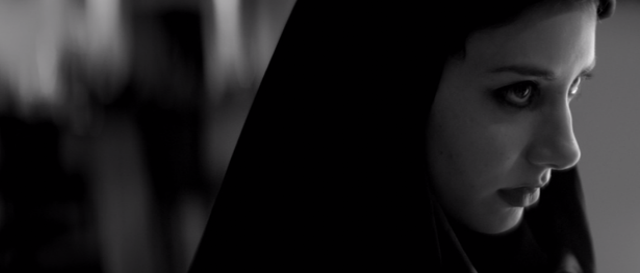
At last! An Iranian vampire love story, told in resonant black and white and set in the 80s (at least music-wise) in the fictional but familiar "Bad City," (actually Bakerfield, CA), run-down and littered with ever-pumping skeletal oil derricks (pumping up "blood" as Daniel Plainview would say). There's nowhere to run but out in the depressed Bad City, the only people on the street are hustlers and drug-dealers; the only thing worth having is a car; the days are marked by a junkie father's itchy paranoia. First-time director/skateboard star Amirpour makes a big entrance with this film--positing herself somewhere between Sofia Coppola and Abel Ferrara--as does star Sheila Vand, as strange and cool a specter of feminist vengeance for oppressed Middle-Eastern women as you could ask for. Wrapped in her black hijab like Dracula's cape (or Nadja's hood), she preys mainly on male predators, usually waiting until they've shot up heroin or done some lines of coke before making her move--all the better to get high off the blood (though this is never spelled out, it will be clear to any one of a drug-using nature). Her hunting pattern is to silently stalking her and mirror her (male) quarry, gauging whether to kill them based on their response. The wrong responses get killed, some just get passed by, the glass slipper right response comes from the young, insecure but semi-cool Arash (Arash Marandi), a go-getter forced to give up his prize car to dad's evil drug dealer, a giant, buff, coked-up, abusive tattooed pimp with a habit of sticking fingers in girls' mouths (big mistake). Even though Arash's blood is rich in MDMA (after a costume rave where he dresses as Dracula), our heroine holds off indulging, instead bringing him up to her room and engaging with him in an extended slow-motion shared moment below a madly whirling disco ball, with White Lies' "Death"-- playing on her record player. A perfect song to bring them together, as it builds slowly to an emotional grandeur all the more special for seeming to be coming so guilelessly true to their shared moment ("I love the quiet of the nighttime / the sun is drowned in deathly seas") Amirpour lets the moment completely land and for that moment the film becomes the Let the Right One In-verse of Sixteen Candles,


A lot of movies use pop songs, but how many 'get' the heady deep tissue impression pop music makes on the young, how the right songs come pouring from radios like poems conjured from their own unconscious, there to linger and associate this moment, this now, which has completely stopped, or at least slowed way down, with this song?  Dazed and Confused, Perks of Being a Wallflower, Rushmore, The Big Chill, Lost in Translation i.e. not very many. Most just try to force new songs from sister corporation labels down the synergy pipe--they don't get it. Kids dazzled by surging hormones are way better at feeling then analyzing or conveying their desires, so music fills the gap like a translator-cum-DJ wedding planner, and each song that does this hangs in the person's history like a combination scrapbook photo and emotional high replay. A Girl Walks Home Alone might be the first where pages of unspoken dialogue beams out between two quiet characters who barely move as the music plays.


Slight as it is, Amirpour's film sits nicely inside the druggie black and white vampire girl genre, it's the Tom Waits graveyard at the edge of the 'down and out' black and white 16mm post-neorealist movement between Jarmusch's early work and the early 00s Argentine new wave (as in Bolivia and Suddenly). I would have dug it if the film slowly turned to color during the ecstasy scene, then slowly back down to black and white for the come-down. I'm always hoping more films will try that kind of thing. So few do, besides Coffin Joe's Awakening of the Beast (1969) and Wizard of Oz. God damn it.


Either way, the film does nail exactly what ecstasy is like, capturing the rush of blood in the ear and the way a teasing hottie will surround you with auric tentacles of come-hither, leading you on, only to brush you off the instant you bust a move, sending you reeling with the double kick of heady intoxication and sudden, short-shock shame. And in its own way, Amirpour's White Lies moment does all that one better, the slow motion really reflects the temerity of the moment, and so it does later as well, while we wait for Anash's hand to come out of a glove compartment--wondering if a gun will come out-- and the slow drone music drives us onwards into the oil-black future, tapping our typewriter train ride way to Annexia, Zentropa, and on and on, loyal as Oskar, doomed as Håkan before him, ready for our William Tell routine, one goddamned Seward asylum fly at a time... but no drug so sweet as to turn the city again to color...

Saturday, August 16, 2014

Micro-Manager Munchausen: THE STRAIN, SHARKNADO 2, and a little bit THE LEGO MOVIE


Heroes used to dread their appointed hour. They'd dart around town begging help from civilians instead of saddling the heroic measure. They'd turn away from the call, citing 'reasons' like poor marksmanship or their Quaker faith, or Ingrid Bergman sticking them for the cost of a train ticket back in Paris, or all the droids or cows needing repair back on Uncle Ned's farm. But now, in today's crowded sci fi/horror climate, well, just try and stop him from rescuing you, no matter how safe you are, or how much you'd prefer to wait for a qualified professional. Cops, parents, ex-wives, children, all regard our new brand of hero as a Munchausen Chicken Little, especially since he's nearly always a deadbeat dad with a history of micro-management heroism that's already cost him his wife, house and perhaps even joint-custody because, even if he just passes a crying kid or distraught mom on the street on the way to divorce court (proximal morality), he has to force his help upon them instead. These new crazy 'heroes' run around like William Shatner with gremlins on the plane, grabbing lapels of bewildered pedestrians, blocking ambulances, yelling "Don't you get it?!" at overstretched EMTs. They've only ever been the villain in two movies: STRAW DOGS and THE LEGO MOVIE. And in one most people presume he's the hero since he's played by Dustin Hoffman, and in the other he eventually lightens up. But in two major TV events this summer--THE STRAIN (the new FX show from the mind of acclaimed sci fi horror maestro Guillermo del Toro) and SHARKNADO 2: THE SECOND ONE (the Syfy original sequel that's far inferior compared to the original [see here])--these micro-managing ex-husbands are just obnoxious. Even as the world ends or CGI sharks fly through the air, they run around with humorless unshaven urgency, saving everyone in sight, whether they like it or not.

THE STRAIN begins with the story of NYC health officer Dr. Ephraim Goodweather (the usually bald Corey Stoll) refusing to listen to his superiors when a plague-infested plane lands at JFK. Most passengers are dead. Four survivors are anxious to get home and start spreading the 'news' and he wants to contain them in a makeshift hazmat lab. Meanwhile a savvy old Jewish pawnbroker tries to advise him on what's going on, but Goodweather has the man arrested for having a sword in an airport terminal. Almost immediately, our urge to see the world wiped out just to spite this twit is insurmountable.


It doesn't help that the bad guys (led by Thomas Eichorst, left) are far cooler: they honor their deals, pay in cash, do their research, invest heavily in make-up and black market organs; their urge to see the world end is indicative less of greed and more of simply of being turned on by chaos. Hell, I say let these long-tongued vamp zombies have a crack at planet custodianship --they couldn't possibly leave it worse off than they found it.

Goodweather disagrees, or rather hasn't thought that far ahead, being obligated by his little taste of power as a CDC agent to grab those passing lapels. He's so self-righteous and negligent that he even ignores the edicts of his superiors and winds up under arrest, yet still invites himself to tromp all over the rights of others as he attempts to be on time just once to his hearing over joint custody for his 'yawn' little son. There's a word for this type of guy, Munchausen by-proxy, or rather, as I call them, 'dad of great adventure'. They can't admit their insecurity and ambivalence about their roles as second class citizen in the modern family unit, and so refuse to either leave the family unit or stay with their wife; they can neither stand to be with or to abandon their kid, and are more determined with each passing missed court date to convince mom and child that he wants to be with them more than anything but you know, um.... he has to force himself on a world that doesn't want saving, or at least it doesn't want to be saved by him, and who can blame it? So wait right here, judge, somewhere a child is crying.

Naked white/grey monsters are always played by limber, sinuous dancers. 
Anyway, we know from the start that Goodweather's showing good sense in trying to quarantine these survivors but at the same time, we would hate to be unable to get home after a lengthy cross-Atlantic flight, forced to wait in a sterilized plastic cube for weeks while he tinkers with our blood samples and stammers excuses to the court stenographer. Plus, why would we root for Goodweather to stop the spread of a plague when that's going to be the whole show? I love a lot of del Toro's art design and I admire his willingness to kill children, but I've always winced when he goes too far with his saintly Catholic family mi madre es mi vida bullshit and the whole business with the giant worm tongue leaping out of the monster's faces is too familiar, thanks to his already using it in MIMIC and BLADE II that even Paul W.S. Anderson it used it in RESIDENT EVIL. We've seen it, bra.


Meanwhile there's this idiot woman whose husband is infected and he's barking at her to run away while she can; their dog's blood is dripping from his mouth and she just stands there like a moron, frozen in 'terror', well within striking range of his forked tongue. He's telling her to run, and we're screaming at the screen for her to run, and she just stands there, until we wonder how she ever lived past the second episode. But the next scene she's burying the dog and after the neighbor complains because he still hears growling she pushes him into the shed to feed her now-chained husband so we're back into thinking she's awesome. It's that kind of show, and typical of del Toro, for every corny Mexican soap moment there's two kickass touches, or vice versa.


Last year, The Asylum (the offshoot of Concord which was the 80s version of New World which was the 70s version of AIP) gave us the surprise meme hit SHARKNADO (see: Wronger than the Storm). Now we got the the sequel, bound for much tweeting, and therefore of great interest to fading actors in need of being seen by the young 'constant-texter' generation. Aye, matey, to trod bravely before the green screen curtain and be eaten in style, knowing for sure your every flubbed line will earn a hundred winky tweets...

But there's the rub, for in intentionally courting camp, what crap may come?

Chickens Little of the Sea

We start off right in the thick of it as Fin (Ian Zering) and his re-united family (ex-wife Tara Reid and his son and daughter) get stalked by sharks on a plane. Fin, ever the hero, gets the plane down safely, but no one bothered to tell him that NYC is blessed with a stalwart network of first responders, and anyone who mentions needing to build a bomb to a deli owner in Times Square should be turned into Homeland Security, not helped in his mission. Unlike most sensible people, Fin doesn't find shelter, or take an Ambien and go to sleep 'til it's all over; he runs around trying to find the other members of his traveling party and components for his homemade bomb, which he plans to throw into the wind to save us all. Dude, this ain't California, you can't just drive anywhere throwing bombs around. And what's more, traffic is at a standstill anyway, add a flood and a tornado and....

As Dennis Weaver put it in Touch of Evil: it's a mess. It's a stinkin' mess.

I know our cops have problems with quick response in certain neighborhoods but not, my friends, in midtown, so their lack of presence as Fin amoks around Broadway is suspicious. No one is attacked unless seen first by Fin as he races past, clocking them for B-list celeb status (included in his posse, slightly used versions of: Vivica Fox, Kelly Osbourne, Judd Hirsch, Judah Friedlander, Biz Markie, Downtown Julie Brown, Billy Rae Cyrus, Rachel True, Andy Dick, Mark McGrath) at which time they're either devoured by a passing shark or rescued by his quick thinking and thus obligated to join the panicky parade running down his errant brood as they run around trying to find him. Matt Lauer, Kelly Ripa, and Al Roker look on from the TV screen, rolling with the sharknado concept as a fact barely worth an eyebrow raise (just avoid making seal-like movements).

Fin's hero complex was perfect for LA in the original because it made sense.  He had to protect the valuable clientele of his beachfront bar, and it's at a beachfront bar just like it, we can imagine, that the notion of a sharknado first developed. Who amongst us hasn't drunk deep from a sandy beer after a long day body surfing and imagined how badass it would be if sharks came through the window and started chasing people around the pool table, or swam in the air, or that the rec room floor was water so you had to jump from couch to couch? All these things and more, SHARKNADO had.

That Fin was an ex-lifeguard gave him an excuse for his chronic rescuing out west. His idiot desire to rescue his family before they're in danger was offset with a Hawksian sense of real time and tidal surge momentum. We followed the incoming flood from Fin's bar on the beachfront to the boardwalk, the parking lot, downtown, and inland and up into the Hills. A tangible rainy vibe was to be found in their impromptu getaway car; the windshield wipers and radio traffic delays meshed perfectly with the conversation on where to go from there, creating a vibe familiar to anyone who's ever left a drunken party with a new maskeshift tribe piling into the car to head off to a second location.  We had John Heard as the comic relief, bashing sharks with his barstool; barmaid Nova (Cassandra Scerbo - above left), the stealth warrior, brandishing a shark scar (with its own Quint backstory) and a shotgun; wingman Jason Simmons helped with the heavy lifting; Finn doing the driving and moral high ground posturing. Together they raced with the inward tide as it filled the streets and stalled highway traffic with sharks and flotsam, leading to exit ramp winch rescues, and various members of his party being eaten, such as his daughter's douche bag boyfriend as the shark water filled his ex-wife's living room but left the driveways merely damp as if from a distant rain machine.

And as Fin's UV-damaged ex-wife, Tara Reid was perfectly cast. Embittered, hungover but still with some vague torch for old Fin, she veered the Hawksian dynamic towards a weird comedy of remarriage, with Nova as the Marilyn Monroe and Reid as the Ginger Rogers (in Hawks' MONKEY BUSINESS).


In short, SHARKNADO had a lot of things going for it the sequel lacks. As a Corman-affiliated film it conjured up the good old days of movies like ATTACK OF THE CRAB MONSTERS; it turned its budgetary limits into an asset, which SHARKNADO 2's NYC location simply will not permit. Gone is Nova, the badass barmaid with the sexy scar, so there's no interesting sexual dynamic (that Fin's too noble to sleep with her provided the previous film's emotional core in ways lacking with his old flame here), and there's no bar, no tide rushing in-- the way the tidal surge in the original. The first film had a flood first, then the tornado, so it made more sense -- there was a build-up --from the ocean sharks to the beach sharks to the flooded rain gutter sharks and so on. Here sharks start hitting up in the cruising altitude of a 747 and just get less credible from there. New York is too real a place, too concrete, there's no time for grandstanding or defying gravity (vs. fantasy unreal LA); when Fin drops into the city to find his family, he's indignant at having to wait in traffic --surely there's something Jud Hirsch as his cabbie can do! This is important! He has to run to Queens to rescue his family from the baseball game.

If you're a NYC resident, his grandstanding is painful. Without the setting of surreal LA enhancing the CGI phoniness, this sequel is less like a surprise so-bad-it's-great entry amid a deluge of crappy CGI monster/bad weather hybrids and more a 'too aware everyone is tweeting about me to not make duckfaces' shitshow --as prefab and empty as a string of commercials for Shark Week during a Jay and Silent Bob film edited for content and watched on TNT by a mid-life crisis-having unemployed divorcee pothead after coming home, buzzed and alone, from lunch at the Wal-Mart parking lot Hooters... again. 

Oh well, we still have the original, and the great untold shark story present in Tara Reid's weary face. As the wife who steps back into the eye of the Munchausen storm, booting the far more interesting Nova out of the sequel, she leaves not a single extraneous breath of sexy air. While Fin runs around building bombs and leaving suspicious packages on subway platforms, it's Reid who provides the real scary story here. You can read it in her skin, an epidermal horror story, in slow mummifying motion, about how a hundred young and glowing B-list actors went into the sun twenty years ago and came out looking like bad taxidermy. Botox and collagen took the rest.

Anyway, they delivered the bomb.

Wednesday, July 02, 2014

Dawn of the Dinkins: RANDOM ACTS OF VIOLENCE (2013), BLANK CITY (2010)


I came late to the party in Manhattan, but in 1992, moving in gradually via couch osmosis, it was still, at least, a party. The white boy funk thing was big -- Spin Doctors, Blues Traveller --my band, the Mud, 2 Skinny Js.... we danced like maniacs at Wetlands, New Music Cafe, Tramp's, Nightingale's-- most now long closed or sold, rebranded. But back then there was no 'cabaret law' (it's still illegal to dance in NYC). Back then you could drink on the street (if you wrapped it in a brown paper bag - known as the "bag law") And you could smoke. It's all gone...  but at least in the early 90s the party was still raging. Disney hadn't commandeered the porn marquess of Times Square. You could still see hookers--gay and straight--loafing out on the dirty boulevard. 

You maybe read my 2011 piece, Manhattan Sinking Like a Rock, wherein I admonished the average New Yorker for letting all our lovely sleaze disappear. I predicted (or rather hoped for) a time when the city might be sleazy and crime-ridden once more, to allow cheap rents and flourishing arts.

Man, was I wrong. NYC will never slide again or rage again, There's too much $$ invested in its real estate for the 1% to let the rents drop. No one is taking the accursed city down into the artistic abyss anymore, not without a grant, (you know, to cover the insurance).

Godard homage indicated by pose and striped shirt

Brit filmmaker Ashley Cahill feels as I do about NYC. He too remembers the brown bags and dancing wherever the fuck days of old- and he's done something about it. And that something is serial murder. Looking like some weird cross between Seth Meyers and Beck, Cahill puts himself in the center a fauxcumentary where he kills random citizenry in order to set the fuse on what he hopes will be a rent-lowering, Summer of Sam-style fear-upping art-blooming crime wave. 

God (or rather godlessness) bless his tousled little head. He's doing this for you, for me, for US, for posterity.

The film's had more than a few titles before settling on RANDOM ACTS. It was CHARM, for example, which is moronically vague, but on Netflix Streaming, with one of those ubiquitous torture porn-looking covers, it has finally landed before me as RANDOM ACTS OF VIOLENCE. I don't know how it made it past my usual ignoring of such things (for I dread torture porn as it leaves me dispirited for years, even decades). But I am glad I did. 

If you share my mistrust of all the nanny state health that NYC is touting these days, this is your movie!

Celebrity friends should always be displayed proudly.
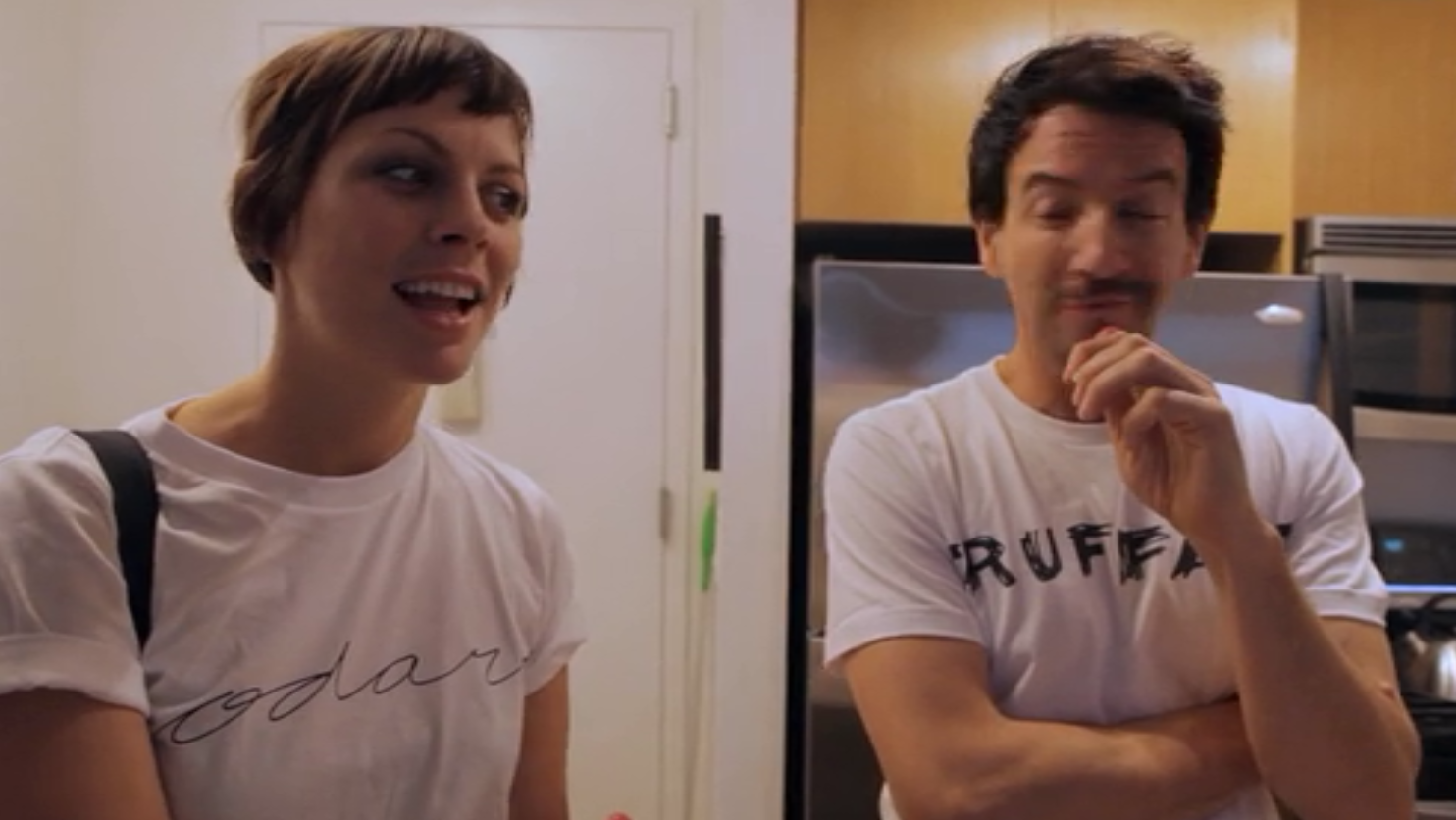
Godard and Truffaut T-shirts
scenebomber

It's one of those first-person meta-documentary violence deconstructions ala MAN BITES DOG, with Cahill as a slightly more homicidal version of, presumably, himself, since both he and his character are Godard-hip and so able to use the low budget and stolen shot approach as contextual meta-commentary beyond just the subject (the film is dedicated to Sam Fuller!). And though he never says so outright, he clearly shares my dislike of the second-guessing anxiety that sabotages so many homicidal comedies, i.e. the need to have Winona Ryder feel remorseful and turn on Slater in HEATHERS, or to only put her disappointing dates into comas they can one day recover from (in SEX AND DEATH 101 -see "Why Can't We All Just Morally Compromise?), or to have Dexter only kill other serial killers, or Edward the TWILIGHT vampire be a 'vegetarian.'

In other words, so many films or shows that want to be naughty are afraid to get all Alex and his Droogs-level challenging to our limits of audience identification. They want to be Scorsese but are afraid of telling Tommy DeVito to get his shine box. Not our boy Ashley. Once he does his first random stabbing in RANDOM, man, you know this Tommy be shine box splintered. Cahill is no kibbitzer!


After a lengthy opening monologue, Malcolm stops addressing the camera on the greatness of pre-Giuliani NYC (when it beat out Detroit as "the murder capital of the world"), and we're off the known grid of the normal disaffected poseur: Someone answers an anonymous door he's been knocking on, and we're expecting some kind of standard pre-arranged greeting scene (wherein a camera is already inside waiting for him as per so many reality shows). Instead, he grabs the unlucky inhabitant, throws her onto her couch and stabs her repeatedly and rapidly, without any drama or Bernard Hermann scissor music to let us prep for the discomfort and shock. He's suddenly moved faster than the cameraman and become a real threat. We're just not expecting it and its genuinely shocking - way beyond the usual tacky violence of Hollywood. Even though we know it's not 'real' per se, it's hard not to shiver, almost painfully. So many fauxquementaries have tried to get to this same spot, only to pull back like little pussies. Cahill dives in, and ignores our ashen complexions.


Your reaction will probably be centered around your own neighborhood: if you live in the suburbs, even our contemporary Disney-sanitized NYC might seem scary just for being unknown, but to me the suburbs are far scarier. When I'm visiting friends there, I'm awake all night, freaking out over the quietude and feeling of vulnerability. There's usually at least three doors and dozens of ground floor single pane windows that even a child could break into, so how can I fall asleep? Don't they have bars on windows and deadbolts? And it's so dead quiet after, say, midnight. Not a creature is stirring. Like Roderick Usher one better, I can hear the mice in the neighbor's walls. In NYC we have deadbolts on thick metal doors, and only one possible entry window (the one above the fire escape) and neighbors on every side who can hear any cry for help. But if your buzzer goes off or there's a knock on the door while you're watching RANDOM ACTS OF VIOLENCE, I imagine it could be quite scary. And when Malcolm garrotes a guy for texting in what looks like the Anthology Film Archives' downstairs screening room it's fun to imagine seeing the film there and realizing you forgot your turn your phone off, afraid to even move to find it in your bag lest this guy be sitting behind you.

So even if --or because--it's a bit unnerving, one must applaud the filmmaker's full commitment to the tenets of starting a crime wave. And if he eventually turns on his own crew, and finally even his own French girlfriend, well that's to be expected. What's not expected is the deader-than-deadpan approach that never trivializes the violence Malcolm commits while never judging it either, so we end up in a very unique zone that's the opposite of HEATHERS' hypocritical inference that we're all so impressionable we need a pretty girl's buzzkill morals to remind us killing our high school enemies isn't "cool."

That's Jamie Frey (of the Brooklyn What?) at left-a buddy of mine who showed up in a random
RANDOM tracking shot, a
comforting indication that the raw edge of NYC ain't totally dead

But even if our sense of identification is pushed to HENRY,  CLOCKWORK or RICHARD III extremes, we trust Cahill because he is so openly homicidal he shatters our conception of safety, of distance from the screen, in ways we rarely see; he evinces a thorough knowledge of the movies. The phrasing he incorporates into his speech conveys among other things a deep absorption of GODFATHER 2 ("You gonna help me with these things I gotta do, or what?"), TAXI DRIVER, GOODFELLAS, and BREATHLESS. And I applaud how much this approach ties into true film fans' collective rejection of banal reality and his Don Quixote-esque quest to exhume the twitchy corpse of New York's grimy past. Like all great quests it's doomed to backfire, but then again NYC hasn't ever been the same, not ever. Even one day to the next, it's never the same. It's like a mutating geographical variation of THE THING. Any chance to shape its mutant growth to our liking has long since gone before we even got there. Yer we already did shape it, sometime or other, and never for the better or the worse.. Always, always both.

Vince Gallo!

BLANK CITY (2010) is a real documentary about the time and place Cahill longs to return to, specifically NYC's underground 70s film scene. It's full of exquisite glimpses into the early 8mm and 16mm clips of the artsy downtown druggie enclaves centered around CBGB's, Max's Kansas City, Tompkins Square Park (when it was a homeless encampment) and the Alphabet City shooting galleries. The age of Youtube, Final Cut, and digital video put an end to the uniqueness of the scene. But I too remember how we used to project 8mm and 16mm films on white walls or sheets for gathered friends and/or family members. Each showing was a one-time event, special in the way no amount of today's Skyy Vodka sponsorship, rooftop screening fests, and swag can equal. And the kids then had more drugs--they could afford them living in $10 a month loft apartments with ten other people. So with ample footage from the original films (by people like Amos Poe and Richard Kern) and talking heads like Lydia Lunch, Steve Buscemi, Thurston Moore, John Waters, Deborah Harry, and various members of various punk bands, it's better than being there, I'm sure - at least smell-wise, and--I'm fairly sure--way better than having to see the entirety of each film.

With its good sense of humor about the poverty-enforced ingenuity of these early filmmakers, it's possible to long to return to BLANK CITY's innocence and imagine how great it would be to see the whole films, even while knowing in reality they would be excruciating for more than a few minutes, and the lack of air conditioning or clean underwear would eventually wear us down. In that sense, BLANK CITY is better than being there, while making you long to return anyway. I especially loved the snippets of ROME 78 - a re-enactment of the fall of an empire as filmed on the sly around the City's more Roman-esque landmarks, so while a kid in a toga dies in the Central Park fountain, 70s tourists walk by; a coliseum scene occurs in front of the Bronx Zoo lion cage, etc. It's the kind of gutsy shot stealing that makes New York City great!

ROME 78 - John Lurie (bottom)

And it's in that sense that the documentary's poverty-is-the-mother-of-invention reverie is so invaluable, and the scene's inclusiveness so impressive. The proletarian mix of thick New York accents, kids kicked out of their working class Bronx neighborhoods for being gay or fleeing their midwestern nowheresville hometowns like MIDNIGHT COWBOY makes for a cohesive unit of subculture that was too out there to become mainstream, but did anyway. There's also a coordinated effort merged the downtown punks with the uptown African-American WILD STYLE graffiti artists, dancers and street poets. All of it goes to prove that if you're literate, young, bisexual, and hot you can never be considered homeless in a neighborhood/time where everyone takes care of everyone else and the class system is part of what's being rebelled against... until of course the money starts rolling in...


And it's that money and the eighties that leads to skyrocketing rents, which means big real estate investments, which means the end of the squats and slums of the Village, which means the need to protect those investments, which means Republican mayors. So gradually, especially with the incursion of Giuliani in 1994, the herald of zero tolerance public smoking, the abolition of the 'brown bag' drink, and the Cabaret Law that Kevin Bacon fought successfully in FOOTLOOSE in the 80s but we lost in the 'real life' of the New York streets in the 90s, the crackdowns on the drugs at Limelight, the rise of swing dancing, the rise of video, DVD, FCP, AIDS, the WWW, and 9/11 and my own near death over and over from alcoholism... we lost it all. I blame Giuliani for all of it. We could use a man like Ed Koch or Dinkins again.

Lydia Lunch

Shooting your own shit is so easy now it's hard to warrant a film festival at all, hard to motivate people to go find some shady address from a hand-drawn flyer and sit on the concrete floor for three hours when the movie you're showing them is a mere click away on the home screen. Back then if you had a projector and a camera you could make a movie on Monday and get it back from Kodak by the weekend and screen it promptly for a 100 rowdy urchins. And since everyone knew everyone else and half the people were squatters and no one had TVs to compete with, and half the people were in the movie anyway. So huge crowds packed into lofts and garages and wherever and legends were born, and today these squalid art films are shown in university classes. But that will soon change as more and more class moves to the web and more and more public screenings are too unreliable. In other words, there's no word of mouth anymore because word of mouth itself has proliferated to infinity, and posting invites to Facebook is so easy that there are now so many options none of them end up being anything worth doing. If you went outside, well, you couldn't smoke there anyway, might not know anyone, just pay $14 for a mixed drink. Man, I remember when shit was still immediate, urgent, vital, cheap...

You know, like with Friendster. 

Basquiat (I left the red loading circle in, for art's sake)
POST SCRIPT

There's this other documentary on Netflix, WE CAUSE SCENES: THE RISE OF IMPROV EVERYWHERE (2013), about a group of NYC hipsters who do big flash mob-ish pranks and I'm a little jealous of their huge turnouts, which would seem to contradict all I've said here. But on the other hand, I've never been good at highly organized 'spontaneity.' It's fine for some people but the New Yorker embodied by Cahill in RANDOM ACTS or the filmmakers in BLANK CITY might point out as I do that it's just conformity in a new package.

Safe for mainstream consumption

I can respect the original gaggle of dudes involved in the 'sudden improv' concept, but the idea that whole masses of people want to join up and be led into safe, happy flash mob antics makes me realize that cigarettes are essential to true revolution (and I say this as part of Shelley Jackson's SKIN project) It lacks the 'everyone's in charge' freedom of similar movements (as in the Merry Pranksters or the Cockettes or Diggers) that relied on chaos for true freedom of the sort impossible without very strong psychedelics and tobacco. The idea that sober people eagerly participate in chances to get told what to do in order to 'break away' from lockstep drone reality makes no sense. This is how ideas like the Diggers morphed into cults like the Mansons, and how the Rolling Stone mossed, and how Times Square became 'family-friendly.'


Thank god there's one artist who will never break that seal. His name? Abel Ferrara. At least he understood how NYC --and therefore the world--would end in 4:44: LAST DAYS ON EARTH, not with a bang but with NY1's Pat Kiernan delivering a quietly dignified sign off.

All else is just Sony... selling itself copies of its older self... through the TV mirror.

Thursday, October 04, 2012

A Stoner Shall Rise: SHROOMS, THE LOVED ONES, CABIN IN THE WOODS


Oh my are the demons ever colorful this season. Clad all in pink and wrapped up in bizarre incestuous serial torturer pair bonds in ways shows like DEADLY WOMEN on Investigative Discovery dream about. It makes me understand the frailty of demons and the necessity of pot for modern survival and to blazes with anyone who'd tell you different. To blazes with those not blazin'...

SHROOMS (2007) had been staring me down from my Netflix Streaming cue for years now, since before you or your grandchildren were even born, in a way, so finally I went for it one soggy afternoon, sprinkled atop a peanut butter and cracker to mask the taste. But, aside from a talking cow and some nice Irish gloom, the trip was a bummer, more muddled than that stale yellow film feeling I used to get trying to snap into action through taking--as these kids did--shrooms on a rainy camping trip when I was so full of whiskey I could barely talk, and yet painfully sober, stuck with people I did or didn't like as companions that never understood what I was trying tray abthing haren't sewa theem? Whoa, I thought I'm guess hard tripping was!


You know how it is, those soggy six AM Sundays after the bars are closed and only stupid college kids and burnouts take shrooms to get over the hump, 'cuz it worked... once. And whoa, that stupid college burnout, baby, is maybe you. And the goddess of the fungus takes one peek down your flooded basement soul, senses your weakness and decides rather than heal your wounds, to lay into you like a bitchy girlfriend-mom hybrid... for eight miserable hours. And even after her cruel relentless mockery mellows out and your closed-eye hallucinations fade back to normal blurry bands of gray, even then you can't sleep because by then its three in the afternoon and the third eye visuals, sink-holes and leprous faces keep picking at the scabs of your soul.

But hey, there's a film called SHROOMS, and no, here the shrooms don't really cause evil in and of themselves, in fact they're kind of a red herring. But they're there. They're not going away. The trouble is, maybe these campers should have been smoking pot instead, and passing around some whiskey and just calling it a day. Shrooms can be hit or miss, pummeling you or protecting you, depending on the spore's magic mood, and of course set and setting are so important. A sunny day with your favorite people at, taken a few hours after a light lunch, at, like, three PM, with good music and incense and some minor butterflies over the excitement? That's ideal. But pot never fails us... just as it never quite succeeds. That's just part of its deal. Pot's hangover is included in the high, there's no misery deferred and returned with interest at a more convenient time. It's pay as you go. Shrooms though, are paid off in installments for weeks, or else you end up drinking and taking more to taper off, and that never works.

The signifiers and signs of horror meanwhile (masks, knives, corridors, POV steadicams, phone calls, Martin Balsam in PSYCHO-style unmaskings) are now so beyond cliche they don't even need to be tied to anything substantial; having a stoned hipster gesture towards them with his thumb is enough. The hipster's thumb is the new black and CABIN IN THE WOODS (2012) has taken this idea farther than anyone yet this year. Metatexually refracting the cliche of attractive high school seniors heading off to the woods for R&R, T&A, death and Lovecraftian abstraction, cometh the humble stoner--the inevitable fifth or seventh wheel in gangs of young people heading off into the wilderness since that obnoxious brother in the wheelchair in TEXAS CHAINSAW MASSACRE (1977).

In this sea of cliche, this stoner shall rise. As the smoke rises, man, so the stoner...


And instead of a fifth wheel, lo! The unicyclist.

Yes, in exploring this character, horror has recognized its target audience and isolated a common thread that runs counter to general programming: the insider realization that pot protects you from evil. All along we were right to be paranoid, man, things are all... weirder and more perverse and vile than we imagined in our trippiest delusions. And Mary Jane's loyal sheepdog sanity never abandoned us and won't now.

And as so often happens, this concept is literally true as recent studies show. 
 What is even more troubling is that the United States Government actually did a secret follow up-study on the Virginia findings, in the mid '90's. When it only served to confirm the results of the 1974 research, and showed that THC (one of the main active ingredient in cannabis – and the one the government loves to hate), when administered to mice, protected them against malignancy, true to form, our government attempted to bury the results. Fortunately, a draft copy of the study was leaked to the journal, AIDS Treatment News, and the media covered the story. An excellent article by Paul Armentano, Deputy Director of NORML, covers this part of our shameful history. (more)
I can't really reveal what happens in THE CABIN IN THE WOODS since 'holy shit! no way! Really? O man!' reactions are so essential, but I will quote Gregory Cwik's article on it in the current issue of Acidemic's Journal of Film and Media: 
"... after Halloween was labeled a morality play, its character's seemingly punished for acting immorally, smoking became a death sentence for horror characters. Instead, Whedon's pothead uses his bong as a weapon against the enemy. Maybe its a sign of changes to come." 
Maybe it is, if we kill enough old people first, by which I mean those who think it should be illegal (because they have never tried it). Maybe their personal embargo serves us not them. Unable to keep food down after chemo, they nonetheless refuse to smoke the pot that might help with that since it's 'the devil's weed' when all along it was their only truly safe and effective remedy. They die sooner and so can't vote anymore, and progress moves forth. Part of growing up should be the realization you can't believe a word Uncle Sam tells you, and that doctors sometimes are barred from recommended holistic and herbal remedies, as the AMA won't acknowledge their effectiveness (having never tested them, because tests are too expensive and herbs can't be patented so there's no return on investment which is a bit like saying water isn't good for quenching your thirst because we can't patent it... yet). Fail to realize this and Darwinian nature shall take its course.

Ignorance of a law doesn't make you immune, only weed does that. Is there any better reason why the law is so scared of it?
In the recent Aussie tor-por prom-com THE LOVED ONES (2009) pot brings a hot Goth girl Mia (Jessica McNamee) and a nervous hipster together for prom. I shan't discuss the 'main attraction' of the film, a protracted torture sequence, but suffice it to say that torturer Lola (Robin McLeavy) is a stunning psychotic presence, bringing so much whacked-out gusto she single-handedly elevates the whole production to near-cult status. If HEAVENLY CREATURES' Kate Winslet and Melanie Lynskey were Horace and Rebecca Fem in THE OLD DARK HOUSE (1932), McLeavy would be the locked upstairs brother, Saul. Maybe you don't get that reference, but if you don't you should see both films fast, before it's too late.

Lola's unwilling prom date-torture boy is the beautiful boy Xavier Samuel, whose best bud is the smart aleck stoner Jamie (Richard Wilson), a hipster nerd with fearful, darting eyes who snags Mia for the prom. She proceeds to smoke all his pot, embarrass him in front of distrustful teachers. and look askance upon his chosen corsage... but she also "puts out," even if it's kind of a train wreck version. For better or worse, hotness and reefer heal all wounds. Having dated a girl who not only looked a lot like Mia but was just as bi-polar and brilliant and sexy and crazy and burning every bridge I ever built just to watch the fire (then crying that it was so sad, then laughing, etc... but who cares because she was so damned hot yeah you tell yourself that but gradually your own emotions start to buckle under the strain of her DSM-IV), I can vouch for the realism of McNamee's fearless portrayal. For all the damage our time together wrought upon the life I had built, it ranks as the most romantic, swooning, delirious year of my life, even if it lasted only a few weeks, tops.

It was all good, the love far past the point of bearability, but then her polar cap shifted. And torture commenced.

Now that I'm older, crippled by the psycho bitch stalker of time, hobbling around with the TV blasted and a sense of irrelevance hanging on me like a wet afghan woven by elderly skeletal hands, the boiling water lobotomy wiping out everything but the archaic recesses of my frozen Swedish heritage. And my hands! My elderly carpels and metacarpals twisting like the yellow lines of a woebegone stretch of Mad Max Aussie highway, I finally relate to Mia's level of discontent and the tragic self-cutting of the Kristen Stewart-Hillary Swank lesbian lovechild, Xavier, and of my own past DSM-IV-quoting love in ways as prosaic as a summer's day. It all coincides perfectly with that Saturday night fall depression when all those days wasted kicking it with the TV for endless Blu-ray moviethons instead of going to the beach come back to haunt you.

The eyes, Manolo. They never lie.
That's because psilocybin can awaken spiritual visions but also conjure nightmares that can creep into this plane thanks to your expanded ability to see them, like strangers across the room who take your noticing them as an invitation to manifest further, like the strange  guy in the corner who you made the mistake of making eye contact with and now he stalks you all through the party, working up the nerve to come say hi, his shyness slowly creeping you the fuck out. Can anyone else at the party even see him?

These thoughts can be horrifying to the shroomer. The stoner, on the other hand, can't hold onto them long enough.

The film SHROOMS crashes and rises from the moldy Irish mud and shows how some days the psilocybe spirits are less kind than in others. And heavy Catholic guilt makes murder of 'sluts' an easy sacrificial treat on some elder god level. But this film isn't satisfied with just squirming down that dark poison trail, there has to be big twists which SPOILER ALERT.... ah, you guessed it already.

Top: Shrooms / Bottom: Cabin in the Woods
The best of these stoner horrors addressed in this post is obviously CABIN IN THE WOODS (2012), a pothead Truman Show, with a Lovecraftian chaser, but instead of comedy it's only a terrifying farce, featuring a WAXWORKS edge-of-sanity assortment of Escher-esque monsters and the feeling of constantly being watched (and waxed) by unseen cameras, which is what paranoia on pot is all about--both fun and unnerving, colorful and creepy...relaxing and nerve-wracking... and, uh... colorful? Did I say that one? Yo, did I mention it cures cancer? I shall now gargle whiskey while my little friend sings "Swanee River," I thank you.

It was in the summer of 1997, when I was still drinking, and so very social, and constantly amidst a sexy posse and one particularly colorful LSD trip in Sheep's Meadow (Central Park, NYC) back when you could still smoke outdoors and enterprising homeless guys regularly patrolled between the blankets selling waters ($1) and cold Heinekens bottles ($2) from rolling coolers. As we consumed the Heinekens and the acid made the trees glow like a beautiful Shakespearean jigsaw classical painting I'd dimly remembered seeing at the Met, which was right behind us... Because this was Central Park, where everyone from George Washington to Treat Williams in HAIR had hung out, getting toasted. Then, in a flash the thing came to me: Every homeless guy selling beer looked like Harry Belafonte. Within minutes I could see the way these were clones using Sheep's meadow as a testing ground, selling Heinekens laced with chemicals and monitoring the results with secret cameras placed on the heads of dragonflies, and the Meadow itself, with its glowing blue and green Kentucky grass, was an experimental grid, the blazing reflection of the grass blades in the sun hiding the cracks of the secret trap doors where the Belafontes, as we called them, retreated when their coolers were empty. They went down long stairs to get more beer, and check in with their overlords, and monitor us and our reactions.

How else did they get the beer so cold and sell it so cheap, and why else would they all look so Belafonte-ish if they weren't ghostly clones of Belafonte who probably has some great beer-broker DNA? See? You can't answer.

Just as in SHROOMS, the world kicks in around you when your senses are enhanced. The landscape seems designed to heighten whatever your brain tells your eyes and ears to see. And the bastards down there finally decided to make it plain to the rest of the world, via the film THE CABIN IN THE WOODS. This film is my proof about the Belafonte system.

End of meaningless anecdote.

"Belafonte!"
In THE CABIN IN THE WOODS, there's a found diary written by a tragic one-armed mutant hillbilly cannibal girl, who at the time of writing had been watching her family slowly disappear into the dad's HOSTEL-like 'black room' and it's this grisly idea that provides the film's only real unpleasantness. In my metatexutal undercurrent journal I marked this family down as relatives of the crazy Lola from LOVED ONES and the unstable murderer in SHROOMs, but the torturer in LOVED takes the cake and her victim could surely use some pot. Hell, even I was deeply nauseous after watching it, and while the tropes of male-on-female psycho torture porn cinema are so grisly and unpleasant my feminist liberal arts programing won't allow me to even read the synopses, I generally love crazy SPIDER BABY / AUDITION type girls torturing guys- as nature intended. But giving victims lobotomies via drilling a hole through the third eye and then pouring in boiling water, that's horrible to imagine, horrible to think anyone could even think like that, anyone presumably sane and just writing a screenplay. Then again, my childhood friend Alan used to think like that. Yeesh, I forgot about that.

Killing is one thing, but burning away a human's pineal gland, their third eye? Who could be so cruel? Who could deny a person the ability to dream and see the world beyond 3-D space? I mean, aside from our own government and its absurd anti-drug hysteria, of course, for their fear of anything consciousness-raising is the great tragedy of our modern age. Lumping psychedelics in with neighborhood scourges like heroin and crack? Dumb, man. Because we take those drugs and KNOW they're scuzzy - but a scumbag gives us LSD and our minds expand, we follow them into the meat-grinder, not your dumb naysaying church, because if you're that wrong about one drug, maybe you're wrong about crack, too. This is what Graham Hancock calls The War on Consciousness, a war so insidious he was scheduled to speak about it at TEDtalks, but they waffled and pulled him last minute (1). This shit's real. Science is scared of its own shadow. This is your brain on drugs, smelling hmmmm-mmm good in their frying pan home. This is your brain slowly dying in jail for trying to save your grandmother's life by spiking her brownies. Better she be vomiting a slow agonizing post-chemo death than getting the munchies and spending too much time on the couch, right, "America"?

Final Score:
SHROOMS - **
THE LOVED ONES - ***
CABIN IN THE WOODS - ***1/2

PS -11/13 The marijuana laws are slowly being reformed! Was it this blog post that brought people around?  (no). 
NOTES:
(1) this happened after the original date of this post, but I'm doing some rewrites as is my wont here in 4/13)
Related Posts Plugin for WordPress, Blogger...