Poetry for Breakfast

Anything that can be thoroughly said in prose might as well be said in prose. The everyday intellect remains satisfied with abstraction and explanation in prose; the poetic mentality wants more. In narrative poems, the poetry adds the secret (unsayable) room of feeling and tone to the sayable story. Philosophy in its more logical incarnations strives to eliminate powers of association because they are subjective and uncontrollable. Poetry, on the other hand, wants to address the whole matter of the human — including fact and logic, but also the body with its senses, and above all the harsh and soft complexities of emotion. Our senses, excited by sound and picture, assimilate records of feeling that are also passages to feeling. Poems tell stories; poems recount ideas; but poems embody feeling. Because emotion is il-logical—in logic opposites cannot both be true; in the life of feeling, we love and hate together—the poem exists to say the unsayable.

Donald Hall

Breakfast Served Any Time All Day: Essays on Poetry New and Selected at Shortcovers

I Got Lost

Beach Walk

I found a baby shark on the beach.
Seagulls had eaten his eyes. His throat was bleeding.
Lying on shell and sand, he looked smaller than he was.
The ocean had scraped his insides clean.
When I poked his stomach, darkness rose up in him,
like black water. Later, I saw a boy,
aroused and elated, beckoning from a dune.
Like me, he was alone. Something tumbled between us–
not quite emotion. I could see the pink
interior flesh of his eyes. “I got lost. Where am I?”
he asked, like a debt owed to death.
I was pressing my face to its spear-hafts.
We fall, we fell, we are falling. Nothing mitigates it.
The dark embryo bares its teeth and we move on.

Henri Cole

Henri Cole’s Blackbird and Wolf won this year’s Lenore Marshall Poetry Prize recognizing the most outstanding book of poetry published in the United States in the previous year.

Henri Cole at poets.org

Henri Cole at poemhunter

Blue Covenant

Maude Barlow, interviewed at The Tyee by Rob Annandale:

If you are ever going to share water from a water-wealthy area of one part of the world to another or even within an area — and you might find one day that Alberta’s going to need help, for instance — it has to be done by the people deciding through their government on a not-for-profit basis. So it’s a really important argument for public control of water, this notion of “should you share from place to place.” Because if it were allowed to be corporately controlled the way energy is controlled, water from Canada would go to Las Vegas. It would go to the golf courses and the automobile and computer industries in the U.S. It would not go to the kids in Latin America and Africa who are dying right now from lack of water. So it would have to be decided on a humanitarian basis and it would have to be decided on a not-for-profit basis.

That’s number one. Number two, we all collectively have to be sure that we can ecologically afford to move massive amounts of water. I believe that mostly, nature put water where it belongs and when we start to play around with this, we are playing God to some very serious extent.   [more]

Barlow’s latest book is Blue Covenant: The Global Water Crisis and the Coming Global Battle for the Right to Water

Blind Photography

From a book review by Andy Ilachinsky at Tao of Photography:

Anybody with a decent camera can take a picture of a crack in the sidewalk – and have the image met with blank stares and mutterings of “Yeah, it’s a crack in the sidewalk., so what?” It takes a blind photographer to so effortlessly use a physical symbol – i.e., a photograph of some “thing” – to represent the deeper, inner experience of how “difficult it is to walk to class” on a campus built by people who can see. By not being able to see things, the blind photographer naturally focuses on using the things that the camera is able to capture to show what else things are. And that is what the very best photography has always been about.

[…]

The blind obviously have much to teach us sighted photographers how to really see. They teach us to pay attention to all of the little “invisible cracks” in the world, and to not rely exclusively on our eyes in doing so. There is no better place to begin the first lesson on this journey of illumination – which takes the form of a gentle admonition to just “close your eyes” – than to savor the examples in this magnificent book, Seeing Beyond Sight. Highly recommended.

If the book is as good as the post, it’s really something.  Read the whole thing here

Here’s Seeing Beyond Sight at amazon.ca

Obamaland?

From a review of Rick Perlstein’s Nixonland by Alexander Cockburn:

… considerations of political economy are alien to Perlstein. The political mission of Nixonland is pretty clearly to set the stage for a candidate of liberal consensus and healing, who has since happily materialized in Barack Obama. It goes without saying that if the Illinois senator were actually to propose altering the distribution of income and wealth in America, the heavy artillery would come out against such ‘divisive’ rabble-rousing. Yet consensus—the wrong kind, naturally—has come through the fires of divisiveness. In late September, after an avalanche of phone calls to Congress had denounced Treasury Secretary Paulson’s planned $700 billion bailout at a rate of 99 to 1, the Republicans in the House of Representatives, along with 95 mutinous Democrats, rejected the plan—controverting the injunctions of both the Republican and the Democratic candidates. Both McCain and Obama—the latter heavily freighted with Wall Street advisers and campaign contributions—supported the bankers’ coup, consummated in Congress on October 4. Invoking bipartisanship, Obama declared that he would have to delay envisaged social spending programmes, and emphatically nixed suggestions that he use the moment of maximum negotiating leverage before the Senate vote to insist on regulatory reform, or relief for beleaguered homeowners rather than banks.

Progressives, perennially on the alert for the arrival of Stormtroopers on Main Street, have seized on Governor Sarah Palin as Nixonland’s new suzerain, distracting themselves from the unpleasant reality that it was the Democrats and their ticket that pushed through the bail-out. The us Treasury will now superintend a wave of foreclosures and evictions, amid the landscapes that nourished the young Nixon. Fertile opportunity lies ahead for right-wing populism. Perhaps the Boudicca of the Backwoods will be reborn in years to come as America’s echo of Poujade.

Read the whole article here

via 3 quarks daily

Altruism & Evolution

From Peter Dizikes at The Boston Globe:

In his new book “The Superorganism,” out today, [E.O.] Wilson and his co-author, Bert Holldobler, argue that natural selection operates on the group, not just the gene. The lavishly-illustrated volume examines the complex systems that help insect societies survive, from an intricate array of communication signals to the elaborate architecture of nests. But Wilson – though not Holldobler – goes further, saying altruism occurs not because animals share family ties, but because certain altruistic acts have become useful for the overall survival of insect groups.

“The close kinship of the members of these groups is a consequence, not a cause, of their evolution,” says the ever-genial Wilson in an interview at his home in Lexington. He believes altruistic (or eusocial) societies developed in ecological conditions where food was plentiful enough to allow insects to practice “progressive provisioning,” in which a mother leaves its offspring with food, as some wasps or bees do. This creates a need for others in the insect society to stand guard over the young.

Given these conditions, Wilson postulates, an insect group experiencing a single beneficial genetic mutation – such as the ability to distinguish nest mates from outsiders, a trait many insects possess – might adopt altruism as a useful social behavior.

Read the whole article here

Two American Women Poets

Morocco

In the mountains, at dusk,
Berber children carry water
pails with their teeth,
to strengthen them, the guide says.

Later I duck into a phone booth,
but you don’t want to talk,
claiming there is no time
to repeat yourself.

I’m 27 and deep into the wind-whipped Sahara.
You will leave me in three weeks
for a hearing woman, a German like yourself,
who doesn’t say “what? what?”

I want to say, listen
to the angry sounds of the July desert,
listen to the sounds

I imagine: camels grunting,
sand beating against tourist Jeeps,
babies whimpering in Arabic.

I whisper, manchmal, wenn es leise ist
sag mir du horest.*

*Sometime when it’s quiet,/tell me what you hear.

Katie Wagner

Interview with Katie Wagner

From a review by Kathryn Wagner, of “The Incognito Body” by Cynthia Hogue:

In her latest book, Hogue embeds quotations from Buddhist leaders; the poets Robert Duncan, Marianne Moore, Wallace Stevens and Denise Levertov; celebrated Harvard English professor Elaine Scarry; and numerous others to create a patchwork effect of language and imagery, an effect that makes the reader consider Scarry’s argument that pain doesn’t “simply resist language but actively destroys it.” However, as these poems demonstrate, Hogue writes her way into, around and over her pain, always with her face turned toward the sunlight of life. This is not to suggest that the writing of these poems was cathartic for Hogue, but merely that the poet appears to defeat Scarry’s thesis.

The central title series, “The Incognito Body,” is drawn from a journal that Hogue kept during the first year of her illness; she wanted to record an experience she was not sure would ever change, and spent two years fine-tuning the poem’s shape. In the first section of her title poem, Hogue quotes lines from The Duchess of Malfi (Malfi’s lines are in italics):

With slow, slug-
moves (gray-
pouched skin), I
more contemptible: since ours is to preserve
earthewormes: didst though ever see a Larke in a
cage? such is the soule in the body…
limp to this shore,
stand in white
light on white sand,
step into sea
so salty that
I float free
of gravity.

But this book is not only about Hogue’s experience with pain; it also explores how pain can facilitate (and hinder) the creative process. She writes, “Pain bleeds through imagination, unimaginative: / it just is. One wishes to do something, go somewhere, / but everywhere the sensation remains, / the body in pain. Its eyes look / on fuchsia and lilac overtaking / the black fence, it still bleeds, / and I am knowing this.” Poetry isn’t only defined by words but also by the white space or line breaks on the page; here, the white space seems to want to portray pain as a character that is at times muted, other times rampant.

In another section of the center poem, subtitled “The Exhibit of Pain,” Hogue dissects the cycles a person with a chronic illness experiences, presenting these cycles as cold facts, so to speak, in the form of framed excerpts of medical language taken from an Icelandic doctoral student’s unpublished article. (In 1979-1980, Hogue enjoyed a Fulbright-Hayes Fellowship to Iceland.) The exhibit’s Blue Gallery notes that “chronic patients exaggerate personal / disability and unfortunate event, / triggering unnecessary sympathetic / arousal, feelings of anxiety, and tonic changes in muscles.” The Red Gallery suggests that “confusing desire for a pleasure with a need / for pleasure is a self-defeating position: / that one must give in to short-term / pleasure.”

The whole review is here

Tide in the Sonoran Desert

Exodus/Éxodo by Charles Bowden with Julián Cordona, photographer

Charles Bowden on the cross-border exodus of Mexicans into America:

We park in the darkness a few hundred yards from the line. There is no moon and the hot blackness seems to stalk us with menace. We are poised in the largest corridor at that moment for illegal immigration in North America, the Altar Valley sweeping up from Sonora to the west flank of Tucson sixty miles away. It is an empty stretch of the Sonoran Desert, an upland of grass and mesquite, which as it flows north gives way to saguaro, creosote, and burning desert ground.

In the darkness, we drink beer. It is around midnight with nothing out and about but people fleeing into the United States and agents paid to stop them.

The tape machine comes on and then, the first question: “Where are we right now?”

And I say, “We’re probably within two to three hundred yards of the fence. It’s invisible. It’s like when you look overhead. There aren’t any Mexican stars or American stars. It’s like a great biological unity with a meat cleaver of law cutting it in half. We’re in an odd circumstance. We’re in a national wildlife refuge, a sanctuary, and there’s a thousand Mexicans out here scared to death and trying to make it into the United States, and there’s a couple thousand pounds of drugs moving around us, and there’s men with AKs guarding the drugs, and there’s dozens, perhaps hundreds, of Border Patrol personnel with the hairs on the back of their necks standing up. If you look to the north-northeast you can see the glow of the lights of Tucson, and they’re gonna have to move constantly for three days to get there.

“They follow the person in front of them. And they fall a lot. And they’re afraid. They’re afraid of the desert at night anyway. It’s a different desert when you’re being hunted. They’ve spent their lives as human beings. They cross the wire and they become deer surrounded by lions. The only thing you can really hear out here are insects and fear. Hundreds of square miles just crackling with fear. These people are risking their lives tonight to cross this desert and when they get to their Chicago or their Los Angeles or their North Carolina they will send more money back to Mexico next year than Mexico will make from almost any other legal source. You take a man, you put him three hundred yards south of here, and he can’t find a job, he can barely feed himself. You move him across this desert, you get him to an American city, and Mexico no longer has to feed him. He becomes a money pump, like a private ATM that sustains their society. Oddly enough, moving human flesh in a few years is gonna be more lucrative than moving cocaine. Mexico has finally found a product that makes it money: expelling its own citizens into a foreign country.”

I stand in the darkness, in that pitch of night, and I realize I am tired and I love the taste of the cold beer on my tongue.

Then I’m asked, “Well, what’s the solution to this problem?”

And I ask, “What’s the problem?”

Read the rest here

Bowering on Curnoe

George Bowering on The Moustache: Memories of Greg Curnoe:

The model for this book is The Orchard, Flint, MI: Bamberger Books, 1988 by Harry Mathews. In his foreword to that short book Mathews wrote: ‘In the early seventies I had told Georges Perec about Joe Brainard’s I Remember series, in which the American writer, already distinguished as an artist, had demonstrated a new and altogether seductive approach to autobiography. My account proved somewhat inexact: my inaccuracy can be forgiven in that it led Perec to begin his own Je me souviens (published in 1978), a less intimate but no less enthralling work than Brainard’s.’ Mathews went on to say that shortly after his friend Perec’s early death he adopted the ‘I remember’ mode to write about him, not as homage but as a way of getting words down in front of him to help him face the dismay caused by Perec’s departure. The day after Greg’s funeral, sitting in Frank Davey’s house in London, Ont., before I knew what I was doing, I wrote the first entry in this ‘I Remember’ book. I needed the words there and here. It was a hard book to write, but writing this kind of book is in another sense quite easy. More than anything else, I wanted to keep it simple. I wanted to keep away from the twelve?cylinder language that made Greg shake his head. I took as my other model Greg’s very important work Drawer Full of Stuff.GEORGE BOWERING
¯
I remember the night before Greg Curnoe’s funeral. We were over at his house, and Angela was sitting on the couch with Sheila for about six hours. Late in the evening I noticed that they were wearing similar sweaters. High necks, thick glossy material, cable knitting in connected diamond shapes on the front. Angela’s was grey, and of course Sheila’s was orange. I said to these two blonde women, look, you’re wearing just about identical sweaters. Sheila said that just attests to Angela’s good taste in clothing. Angela said but George bought this for me last Christmas. Sheila’s daughter said Greg bought that sweater for Sheila last Christmas. We all rolled our eyes for the hundredth time.

¯
I remember the time Greg Curnoe brought a care package to his son Galen. Galen was going to Emily Carr art school in Vancouver, the first time he had ever lived away from home. Greg had a great big cardboard carton or maybe two. The carton contained a drum and drumsticks, many packages of Oreo cookies, and numerous other items his parents had figured Galen would need. We carried the box or boxes to Granville Street, where my car was parked. We loaded the stuff and climbed in. A thin Vancouver rain had been happening all day and into the evening, but I had the sunroof open. I started the engine and then just sat there at the curb, feeling the light rain come in. After a while Greg said George, I’m getting wet. I scolded him and gave him a lecture about the pride we west coast people have in our sunroofs. We kept our silence for a while, and then Greg said now I think that’s completely wrong. I closed the sunroof and started the drive to the east end of the city. In the general direction of London, Ont.

¯
I remember going to Lake Erie with Greg and Sheila. It was a hot day in late August. Sheila took Owen’s diaper off and let him run naked on the beach till a crabby Ontario woman complained from her cottage. Angela dashed into the water and came back out when she spied half a rotted grayling. Greg wore his beach outfit, a pair of long pants, shoes and socks, and a work shirt buttoned at the neck. At the front of the A. Millard George Funeral Home, on a paint?spattered easel, was the last self?portrait Greg did. He is shirtless. Below his neck he is pale, as if he had been wearing his top button done up all through the summer of 1992.

¯
I remember coming to Toronto to tape a debate about baseball on Daniel Richler’s television show. I flopped in the big USAmerican chain hotel downtown and turned on the television set. There was Greg at a table with several other people on Richler’s show. It was about the language used in art criticism. Greg said he wanted to hear something from the critics but he could not stand their post?French?discourse jargon. The editor of a magazine defended her magazine’s language in some talk that was impenetrable. As the programme went on Greg lapsed into baffled silence. I have always respected Greg’s favourite word about the art?making process: ‘interesting’.

¯
I remember Greg’s pencil, the one he used when he wrote on his paintings. He usually wore it behind his ear, and sometimes it protruded from his thick hair. When I was a kid you often saw carpenters with pencils behind their ears, but these days hardly anyone does that. I would like to, but I wear glasses. Most people I know wear glasses. The other person I remember wearing a pencil behind his ear, and sometimes sticking out from his hair, was bpNichol. Greg Curnoe and bpNichol both loved comic strips when they were kids and later, when they were adult artists and writers. They both started to be artists and writers by drawing comic strips. They both drew comics till the day they died, and they were both really funny.

¯
I remember Greg Curnoe’s knuckles. Whenever you posited something he felt he ought to argue with, or at least express hesitation about, he would rub his knuckles back and forth fast in his hair at the side of his head. Sometimes right above the pencil stuck behind his ear.

¯
I remember when Greg started making the lettered landscapes, really big ones. He got the large rubber stamps handmade by a guy who charged him five dollars each for the letters and the other things, question marks and so on. The guy made a left parenthesis and a right parenthesis. Greg paid five dollars for the ( and another five dollars for
the ) . Really stupid, Greg said. When they were in the box he couldnt tell which was which.

¯
I remember one night in 1967, in Greg and Sheila Curnoe’s apartment, where everything was painted in bright colours. At about two o’clock in the morning, Greg said oh, Angela, dont be so sensiteeve. Greg always said that was the USAmerican pronunciation.

¯
I remember one time that Greg and I drove over to Paris, Ont. I was fascinated by Paris, Ont. It was halfway to Hamilton, where David McFadden lived. I had introduced Greg to McFadden. Why not? Several other artists and writers were expressing interest in Paris, Ont. at the time. It had a neat railroad trestle, something like Lethbridge’s, but smaller. Eventually the poet Nelson Ball moved to Paris, Ont. I said whimsically that I would like to live there. It is a pretty little Ontario town. Greg wanted me to move there so we could have the Paris-London Correspondence.

¯
I remember installing Greg Curnoe’s notorious mural at Dorval Airport. Greg Curnoe and Bob Fones and I walked through the airport with photo I.D.s on our chests. It was Canada’s centennial year, and they were decorating Canadian airports with Canadian art. Guido Molinari in Vancouver, Brian Fisher in Montreal. They didnt put London artists in the London airport or Vancouver artists in the Vancouver airport. Expo ’67 was on in Montreal, and we were putting up the mural in the tunnel for U.S. arrivals. While we worked, many USAmerican tourists made funny faces. The mural was all about aviation, and there was even a working propeller. There was a painting of a zeppelin with Owen Curnoe in the gondola. There was also a painting of a man who looked something like President Johnson getting his hand chopped off by a propeller. We had to use a drill to make holes in very hard Italian marble. Greg kept sending us to the hardware store for more drill bits. It was annoying work but a great painting. They made us put a screen over the propeller. Then some USAmericans complained, and the Department of Transport took the mural down. I think Greg was pissed off and pleased.

¯
I remember the first time I ever saw Greg Curnoe executing a watercolour. I just wrote ‘execute’ partly because I know how he would laugh and scoff and rub his nose at the word. He had just come back from Victoria, and he had a sketch-pad and a little case of watercolours with him. He showed us a watercolour painting of the old sink in his room at the Empress Hotel. It was wonderful and brightly coloured. Then he sat at the kitchen table and did a watercolour of our garage. Terrific. He liked the word ‘terrific’. I went with him down to his Vancouver dealer’s. We sat in the back room, and then a man arrived. He was a collector. He said I want that one and that one and maybe that one. Greg said hold on, I have to have something to show them back home. I don’t know, but I think that man may have got the sink and our garage.
¯
I remember Greg Curnoe the Canadian nationalist with a great sense of irony. That’s not irony, George, he would say, that’s just the way I see things. During the 1967 centennial celebrations, Greg entered and won the Great Centennial Cake Contest. He told me he figured no one else entered. Greg’s cake was enormous, and it had orange and blue icing. The flavour was back bacon and maple sugar. For the official presentation with politicians in Ottawa, Greg went and had a suit made. It was yellow with black buttons. He wore pointed-toe black boots. This is what the blue writing on the orange cake said: Canada, I think I love you, but I want to know for sure. Both Greg Curnoe and bpNichol quoted The Troggs.
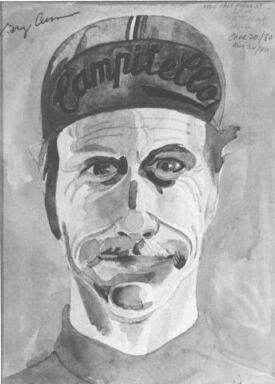


Remembering Curnoe

Before his tragic death in 1992, Greg Curnoe had submitted to Brick Books a manuscript based on extraordinarily detailed research into the history of 38 Weston, his address in London, Ontario. The result is a journal/collage that traces the occupancy of that one small plot of land hundreds of years back into aboriginal times when land in this country was not plotted according to the laws of geometry. Deeds/Abstracts is an intensely concentrated and particular cross-section of Canadian history, layer upon layer upon layer. Brick Books is proud to offer this exemplary work-in-progress (a 500-year diary can never be complete) assembled by a much-loved and keenly-lamented Canadian artist of the first importance. Greg Curnoe was born in London in 1936. He was a founder of the Nihilist Spasm Band, the Forest City Gallery, and Region magazine.

Front and back covers are after paintings by Greg Curnoe. The text includes 12 colour plates of photographs and Curnoe paintings.