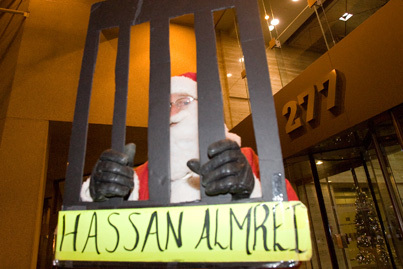
Forgotten at Christmas … And the Rest of the Time Too

Human Rights Protest

From mississauga.com:

Mississauga’s Hassan Almrei will spend an eighth consecutive Christmas behind bars without ever being formally charged with a crime or standing trial.

Hundreds of his supporters, including jolly old St. Nick himself, reminded the federal government of that tonight when they staged a protest outside the Canadian Security Intelligence Service in Toronto.
The suspected Cooksville terrorist has been denied bail three times since his arrest at his Agnes St. apartment back in October 2001. He has been in custody since then.

Almrei is one of five Muslim foreigners held under a national security certificate that allows the Canadian government to detain them indefinitely as a threat to public safety based on secret evidence.
But, while the four other men have been released on strict conditions, Almrei remains in jail. He has even staged several hunger strikes to bring public and media attention to his case.

“Security certificates represent two-tier justice, the lowest-standard available because of the fact that those affected are refugees and permanent resident,” said Matthew Behrens of the Campaign to Stop Secret Trials in Canada organization. “We’re here tonight to remind the Canadian public, government officials, and federal court judges that secret trials and deportations to torture cannot be subject to amendments and tinkering. They must be abolished.”

Almrei is now being held at the Kingston Immigration Holding Centre.

The federal government is continuing its efforts to deport the five Muslim men. All five are scheduled to go before Federal court judges soon.

“Even though the Supreme Court of Canada declared unconstitutional the process under which he has been detained, it is a telling indication of the Canadian government’s blind obedience to the fear-mongering lies of CSIS and the RCMP that he remains behind bars,” Behrens said earlier. “All he has ever asked is for the government to charge him if there is a case to be made, or release him so he can get on with what remains of his life.”

The Syrian-born Almrei’s bid to be released received a huge boost last year when the Supreme Court of Canada struck down the law that has allowed federal authorities to keep him behind bars.

The country’s high court ruled the old security certificate system, used by the federal government to detain people without charging them on the basis that they’re an alleged threat to national security, violates the charter of rights.

Almrei was being detained under that process for more than five years.

As a result of the Supreme Court’s decision, the federal government earlier this year filed an updated national security certificate against Almrei, renewing its intention to deport him from Canada over allegations he is connected to terrorists.

Under the new law, a special legal advocate can now check on the state by challenging the government’s claims that evidence must be kept secret. They also can challenge the relevance and weight of the facts.

CSIS alleges Almrei is linked to terrorist kingpin Osama bin Laden and his al Qaeda network.

Almrei said he has never had anything to do with bin Laden, and denied any links to terrorism.
In interviews with The News, Almrei has consistently expressed fear that he will be tortured if he’s sent back to his native Syria, a country with a horrid human rights record, according to Amnesty International.

Almrei admitted to training in a military camp in Afghanistan in 1991-92, but not to become a terrorist. He told the court he wanted to help Afghani refugees who were devastated by the Russian invasion.

CSIS & Omar Khadr

Canada’s Security Intelligence Service will be investigated with respect to its role in the Omar Khadr case:

The role of Canada’s spy service in the case of Guantanamo detainee Omar Khadr will come under scrutiny, according to a surprise announcement made by the Security Intelligence Review Committee Wednesday.

The Ottawa watchdog agency said it would conduct an in-depth investigation into the actions of the Canadian Security Intelligence Service and prepare a report for early next year.

The committee (SIRC) is mandated to review the spy service at the request of the government or can independently choose to investigate a case. The statement issued Wednesday said the investigation was at the initiative of the SIRC.

“Parliament and the people of Canada must have confidence that the Service is carrying out its duties and functions appropriately, effectively and in accordance with the law,” SIRC chair Gary Filmon said in the statement. “This review will help to illuminate these issues in respect to Mr. Khadr.”

Read the rest here

The Security Intelligence Review Committee is an independent body charged with the task of overseeing CSIS:

The Security Intelligence Review Committee (SIRC) is an independent agency of the government of Canada empowered to oversee and review the operations of Canada’s security service, the Canadian Security Intelligence Service and investigate complaints against CSIS. SIRC was established in 1984 as a result of the reorganization of Canadian intelligence that also saw the creation of CSIS. This reorganization was recommended by the McDonald Commission investigating the former security service of the Royal Canadian Mounted Police which was found to have engaged in illegal activities.

SIRC’s role is to review the activities of CSIS to ensure that the extraordinary powers granted the security service are “used legally and appropriately, in order to protect Canadians’ rights and freedoms.”

[…]

SIRC is made up of five members appointed by the federal government. The committee meets monthly with its day-to-day operations being handled by an executive director.

The current members of SIRC are:

Due to the sensitive material SIRC members are required to handle, members of the committee are sworn into the Queen’s Privy Council of Canada, if they are not already members, in order to put them under the provisions of the Security of Information Act.

What’s Up With Emerson

Now that US Ambassador David Wilkins has so kindly given Canada the permission of the US to repatriate our citizen, wtf’s up with David Emerson?  We know wtf’s up with Wilkins:

Neither the United Nations nor the United States is blocking the return home of Abousfian Abdelrazik, a Canadian citizen, so Foreign Minister David Emerson should stop stalling and repatriate him, Dawn Black, the NDP’s defence critic said Monday.

“He’s marooned, he’s never charged with any crime and now his own government fails to assist him,” Ms. Black said in an interview. “I think that’s wrong.”

Senior government officials – in documents marked “secret” and “Canadian eyes only” – warned the Harper government against allowing Mr. Abdelrazik to come home to Canada because doing so might upset the Bush administration.

But U.S. ambassador to Canada David Wilkins suggested this weekend that repatriating Mr. Abdelrazik, who has been granted temporary safe haven and is living inside the Canadian embassy in Khartoum, wouldn’t upset Washington.

“The Americans have been clear that they see no problem with his return,” Ms. Black said. In light of the government’s very “tarnished record of how they dealt with Maher Arar” – who was also labelled as an Islamic extremist by Canadian security agents – “one questions what Minister Emerson and the Conservatives are doing on this file,” Ms. Black said.

Anne Howland, a spokeswoman for the minister, said Mr. Emerson could not comment about the case because Mr. Abdelrazik is suing the government to force his repatriation.

His predecessor, Maxime Bernier, told Parliament that it was the UN Security Council travel ban that precluded Mr. Abdelrazik’s return. But the so-called UN 1267 blacklist of al-Qaeda suspects specifically allows for a travel-ban exemption for citizens to return home.

There are numerous documented cases of people on the UN 1267 list returning home. For instance, Abdelghani Mzoudi, a Moroccan once accused of involvement in the Sept 11, 2001, attacks, was acquitted by a German court. Although he remains on the 1267 list, he flew to Morocco on a commercial airline in 2005.

Similarly, there are instances of Canadians on the U.S. no-fly list – notably Mr. Arar – who are now able to fly domestically and internationally after the intervention of Canadian government officials.

The Harper government apparently no longer considered Mr. Abdelrazik a security risk. Not only did Mr. Bernier grant him “temporary safe haven” in the embassy, but last December it advocated to the UN Security Council 1267 committee that he be delisted. In February, senior Foreign Affairs officials suggested a travel ban exemption could be requested to permit Mr. Abdelrazik to return home.

“This would require ministerial decision,” the memo, dated Feb. 28, says. It is marked “secret.” No ministerial decision has apparently been made.

But the assessment by Foreign Affairs that Mr. Abdelrazik should be delisted isn’t shared by some intelligence operatives.

Two senior government officials – Isabelle Desmartis, director of intelligence for Transport Canada and Debra Normoyle, director-general for security and emergency preparedness at Transport Canada, labelled Mr. Abdelrazik an “Islamic extremist” in documents marked “secret” and dated April 30, 2008. That’s the same label Canadian intelligence agents applied to Mr. Arar before his arrest in New York and torture in Syria.

In the Abdelrazik file, the documents warned that “senior government of Canada officials should be mindful of the potential reaction of our U.S. counterparts to Abdelrazik’s return to Canada as he is on the U.S. no-fly list.”

Mr. Abdelrazik, a Montreal resident who was granted refugee status in Canada in 1990 and became a citizen in 1995, was imprisoned in Sudan while visiting his ailing mother in 2003. Mr. Abdelrazik was jailed in Sudan’s notorious Kober prison, where he says he was beaten and tortured.

Previously obtained documents, marked “CSIS” – a reference to Canada’s Security and Intelligence Service – say he was imprisoned “at our request,” meaning at Canada’s request. He was released in July, 2005, after the second of two prison stints. Both Air Canada and Lufthansa refused to honour his ticket home to Montreal. By then he was on Washington’s no-fly list. He wasn’t added to the UN list until a year later.

Maybe Wilkins is full of shite.  Maybe Emerson.  Maybe both.  Canadian citizenship is being emptied of meaning.

Khadr & McCain

Time and again in the discussion of the use of torture by the US on its detainees, the focus is on extreme physical torture and that the effects of psychological torture are minimised or erased altogether [oh not that there seems to be overwhelming outrage about the physical torture either!].  In a society that is apparently characterized by the belief of a majority of its people in an unseen god, I am sometimes bemused by our inability to accept the reality and seriousness of psychic suffering.

I’m struck by the way that the minimisation and outright erasure often echoes sexist themes.  For instance, when video was released recently showing the interrogation of Canadian Omar Khadr by CSIS officials at Guantanamo Bay, I heard many people talk about the “whining, crying baby” they saw in Khadr, rather than the young man broken by fear, isolation, sleep deprivation, despair and various other forms of humiliation and threats.

Journalist Judi McLeod noted that:

Nothing on the video shows Khadr having been tortured or mistreated.

This despite the fact that it is known that Khadr was subjected to what is euphemistically referred to as the “frequent flyer programe” which involves moving a detainee from one cell to another every three hours, in Khadr’s case, every day for nearly two months so that he cannot get a long, uninterrupted period of sleep.  This is only the torture that we know about for sure.  Khadr has alleged other abuses, such as being threatened with rape and being used as a human mop to clean the floor of his own urine.  His allegations are very similar to those made by other Guantanamo detainees, despite the fact that they’ve had no contact with each other.

We cannot see these kinds of abuses on the tape so they have been dismissed by many.  The results of the abuse in terms of Khadr’s psychological state are easily dismissed by some, such as Sgt Lance Morris:

“Whoever has sympathy for a young snivelling, whining, crying Omar is misplaced sympathy because this is not a man who deserves any sympathy,” he told CBCNews.ca.

“I use all my sympathy for Chris Speer’s widow and two children. I have none left for Omar Khadr.”

Morris has repeatedly stated he believes Khadr is responsible for throwing the grenade that killed Speer.

I have only sympathy for Speer’s family.  But we do not know that Omar Khadr killed Speer and we don’t know what forces affected or perhaps even coerced him, as a child, to do so if he did.  The irony is that some have said US forces should have killed Khadr on the spot, as the Geneva Conventions perhaps allow during a time of war (though I would dispute that); but the US has also argued that the Conventions don’t apply to people who are not formally members of a military force at war but rather, “enemy combatants” and seemingly covered by no law the the US administration has yet been able to unearth.

At the moment though, my interest is in the dialogue used to dismiss Khadr’s suffereing, the whining, snivelling crying baby stuff.  Whereas some of us saw Khadr’s behaviour as proof positive that he has been abused, others saw it as further evidence of the evil and cowardice that they believe Khadr represents.

Even fifteen-year old boys, then, are held to the standard of machismo expected of a US soldier under torture.  At the same time, John McCain, who admits that he “cracked” under torture, attempted suicide and signed “confessions” is valorized and many people acknowledge that cracking under torture is “normal”.  In the case of McCain, however, it is the physical torture that is highlighted:

“Every two hours,” according to a 2007 profile in the Arizona Republic, “one guard would hold McCain while two others beat him. They kept it up for four days…His right leg, injured when he was shot down, was horribly swollen. A guard yanked him to his feet and threw him down. His left arm smashed against a bucket and broke again.”

[…]

“He was placed in a cell and told he would not receive any medical treatment until he gave military information. McCain refused and was beaten unconscious. On the fourth day, two guards entered McCain’s cell. One pulled back the blanket to reveal McCain’s injured knee. ‘It was about the size, shape and color of a football,’ McCain recalled. Fearful of blood poisoning that would lead to death, McCain told his captors he would talk if they took him to a hospital.”

Yet McCain is fairly consistently cast in the role of war hero while Omar Khadr is a snivelling baby.  This makes me wonder to what extent we have been affected by the seeming inability of the US to come up with a definition of torture other than one that results in harm just short of death.  A 2002 US Deparment of Justice memo noted that torture is comprised of:

only those “extreme acts” that cause pain similar in intensity to that caused by death or organ failure.

Leave aside, just for now, the impossibility of measuring the amount of torture that would cause death or organ failure.  Oh wait.  Let’s not.  It’s impossible to measure the amount of torture that could lead to death or organ failure at least in part because people are different and because torturers are unlikely to take individual differences into account when meting out punishment.  Does the victim have high blood pressure?  is s/he suffering from an undetected heart condition?  diabetes?  iron poor blood?

Of course, if you believe, as I do, that the definition is already impossibly barbaric, these questions mean nothing to you.  However, they do serve to highlight the notion that one’s person’s discomfort may be another’s torture and also that psychological vulnerabilities are not likely to be the subject of concern for the torturers when applying such “enhanced interrogation” techniques as persistent, long-term sleep deprivation.  It is well-known that teenagers require more sleep than adults.  Some experts have even suggested that teenagers would benefit from a later start to their school day due to their increased biological need for sleep!  The American Psychological Association has stated that early high school start times are “tantamount to abuse“.

Besides leading to poor concentration, inability to learn due to poor cognition, memory and understanding, sleep deprivation also leads to psychopathologies such as depression, ADD/ADHD and behavioural problems.  These emotional or psychological “pathologies” hurt.  They hurt emotionally and they hurt physically.

I assume, as well, that this method wouldn’t be used if the torturers didn’t believe that it would inflict harm on the person being subjected to it.  That being the case, the fact that some people accuse Omar Khadr of being a cry-baby for reacting to it belies logic.  The technique is expected to harm anyone to whom it is applied and there is no surprise in the fact that it may have inflicted more harm on Omar Khadr than on an adult.

This leads me to ask, what is it that some people needed to see on the Khadr tapes to be convinced that he had been harmed?  Beatings?  Electrodes being applied?  Fingernails being pulled out?

The Center for Victims of Torture defines “torture” like this:

Torture is the deliberate and systematic dismantling of a person’s identity and humanity. Torture’s purpose is to destroy a sense of community, eliminate leaders and create a climate of fear.

It also notes that psychological torture is increasingly relied upon because it leaves no physical evidence:

Beatings and psychological torture are the most common forms seen at the Center for Victims of Torture (CVT).  CVT clinicians have seen more sophisticated forms of torture over the years, especially psychological torture, that do not leave physical scars. This makes it more difficult for survivors to seek redress or make asylum claims.

CVT notes that

  • In CVT’s experience, psychological torture can be more damaging and cause more severe and long-lasting damage even than the pain of physical torture.
  • A recent study found that degrading treatment and psychological manipulation cause as much emotional suffering and long-term mental health harm as physical torture. (Torture vs Other Cruel, Inhuman, and Degrading Treatment. Basoglu et al. Archives of General Psychiatry, Volume 64, March 2007)

The use of waterboarding inflicts primarily psychological damage rather than ongoing physical damage:

  • Survivors say mock executions left them feeling they were already dead
  • Survivors relive these near-death experiences in their nightmares or flashbacks.
  • CVT clients have told us that they pleaded with their torturers to kill them, preferring real death over the constant threat and intolerable pain it caused

If we believe only what has been confirmed in the US about Khadr’s treatment at Guantanamo Bay, we must accept the truth of the fact that he has been tortured.  Sleep deprivation

  • Causes a host of negative psychological effects, the most prominent is cognitive impairment.
  • Sleep-deprived individuals take longer to respond to stimuli and sleep loss causes attention deficits, decreases short-term memory, speech impairments, perseveration and inflexible thinking.  These symptoms may appear after one night of total sleep deprivation, after only a few nights of sleep restriction (5 hours of sleep per night).
  • Sleep restrictions can result in hypertension and other cardiovascular disease.

Further, Physicians for Human Rights [download pdf]completed a study on the US use of psychological torture in 2005, concluding, among other things:

The use of psychological torture followed directly from decisions by the civilian leadership as well as high ranking military officers, including those in the Executive branch, and their support of decisions to “take the gloves off” in interrogations and “break” prisoners by employing techniques of psychological torture including sensory deprivation, isolation, sleep deprivation, forced nudity, the use of military working dogs to instill fear, cultural and sexual humiliation, mock executions, and the threat of violence or death toward detainees or their loved ones. These kinds of techniques have extremely devastating consequences for individuals subjected to them and can be just as harmful and are often more long-lasting than physical torture.

There is no convenient split between mind and body.  There is really no way to torture someone either physically and not psychologically or vice versa.  And there is no way to predict which forms of maltreatment will lead even to meeting that terribly high bar of death or organ failure.

John McCain tried to commit suicide in order to escape ongoing beatings and isolation and also signed a confession and gave information, though he says it was either misleading or trivial inforamtion.  John McCain has been sanctified as an American hero.  Young Omar Khadr has been tortured at Guantanamo Bay and abandoned by his country in isolation, in a jail cell.  Yet he is a snivelling coward.  I venture to say that McCain might also have wept had he been visited by US personnel, mocked and told he was going to be left behind to be tortured further by the North Vietnamese because his country didn’t give a damn what happened to him.

Pathetic Excuse for a Sovereign Nation

If the US was trustworthy, perhaps this would be justified.  We know the US is not trustworthy.  From the Globe and Mail:

Senior Canadian intelligence officials warned against allowing Abousfian Abdelrazik, a Canadian citizen, to return home from Sudan because it could upset the Bush administration, classified documents reveal.

“Senior government of Canada officials should be mindful of the potential reaction of our U.S. counterparts to Abdelrazik’s return to Canada as he is on the U.S. no-fly list,” intelligence officials say in documents in the possession of The Globe and Mail.

“Continued co-operation between Canada and the U.S. in the matters of security is essential. We will need to continue to work closely on issues related to the Security of North America, including the case of Mr. Abdelrazik,” the document says.

Although heavily redacted, the documents illuminate a government keen to placate the Bush administration, irrespective of the guilt or innocence of Mr. Abdelrazik, who has lived in the lobby of the Canadian embassy in Khartoum for nearly three months.

[…]

The Abdelrazik documents – prepared by senior intelligence and security officials in Transport Canada, the unit that creates and maintains Canada’s own version of the terrorist “no-fly” list – make clear that it was the U.S. list that kept Mr. Abdelrazik from returning to Canada when he was released from prison three years ago.

That appears to contradict the explanation by former foreign minister Maxime Bernier who told the House of Commons that “Mr. Abdelrazik is currently not able to return to Canada on his own because he is on the United Nations’ list of suspected terrorists.”

Mr. Abdelrazik is on the UN’s so-called 1267 list – named for the resolution co-sponsored by Canada that created it – but the travel ban allows specific exemptions, including travel for medical reasons, to make the pilgrimage to Mecca and to return to the country of citizenship.

Mr. Abdelrazik was jailed in Sudan’s notorious Kober prison, where he says he was beaten and tortured. Previously obtained documents, marked “CSIS” – a reference to the Canadian Security Intelligence Service – say he was imprisoned “at our request” meaning at Canada’s request.

CSIS agents interrogated Mr. Abdelrazik with the co-operation of Sudan’s security services in December, 2003, while he was in Kober prison. Mr. Abdelrazik says he told Canadian diplomats he was being tortured in Kober, but they didn’t care.

The classified Transport Canada documents show the Bush administration labelled Mr. Abdelrazik a terrorist threat on July 20, 2007, the same day he was released by the Sudanese government, which said it could no longer imprison a man they deemed to be innocent.

He was also put on the Bush administration’s Transportation Security Administration’s “no-fly” blacklist at the same time.

Two days later, Lufthansa and Air Canada refused to allow Mr. Abdelrazik to fly home to Montreal from Khartoum via Frankfurt. That was before Canada had its own no-fly list and more than a year before the Bush administration succeeded in adding Mr. Abdelrazik’s name to the UN list of alleged al-Qaeda operatives.

Most international airlines are unwilling to risk sanctions by the Bush administration and refuse to carry anyone on the U.S. blacklist even if they are flying a route that doesn’t involve a U.S. stop or airspace.

Meanwhile, the Canadian government made it clear to Air Canada that even without its own list, it didn’t want the airline to allow Mr. Abdelrazik on its flights.

“If you should revisit your position on transporting Mr. Abdelrazik, the government of Canada would expect you to discuss arrangements for such travel with us,” the airline is warned in another government document, also marked secret.

The two senior officials whose names are attached to the secret document naming Mr. Abdelrazik as an “Islamic Extremist” – Isabelle Desmartis, director of security policy for Transport Canada, and Debra Normoyle, director-general of security and emergency preparedness at Transport Canada – did not return calls for comment.

“The words are defamatory,” Mr. Hameed said, referring to the “Islamic Extremist” label.

The description echoes that used by the RCMP to describe Maher Arar, who received an apology and was paid more than $10-million in compensation by Ottawa for its complicity in identifying him to U.S. counterterrorist agents, who then sent him to Syria where he was tortured.

In the final report of the Arar commission of inquiry, Mr. Justice Dennis O’Connor concluded “the RCMP had no basis for this description, which had the potential to create serious consequences for Mr. Arar in light of American attitudes.”

Mr. Abdelrazik denies any link with Islamic extremists groups or al-Qaeda.

He says he simply wants to return to his family in Montreal.

Foreign Affairs officials say in correspondence with Mr. Hameed that the Canadian government supports removing Mr. Abdelrazik from the UN blacklist of alleged al-Qaeda suspects, but the government declines to confirm that publicly.

Meanwhile, the government continues to refuse to issue Mr. Abdelrazik a new Canadian passport. His previous one expired while he was imprisoned and his Sudanese jailers returned it to the Canadian embassy.

Canadian diplomats say they would issue him emergency travel documents, but only if he had an airline ticket.

That is impossible as long as he remains on the U.S. no-fly list.

*****

‘Canadian eyes only’

Although he’s committed no crimes and there’s no known evidence linking him to dangerous activities or individuals, Canada refuses to allow Abousfian Abdelrazik to return from effective exile in Sudan to his home in Montreal. This document, dated April 30, 2008 and prepared by two Transport Canada security officials, shows the Canadian government was concerned about how the United States would react if Mr. Abdelrazik were allowed back into Canada.

*****

Transport Canada and other senior Government of Canada officials should be mindful of the potential reaction of our U.S. counterparts to Abdelrazik’s return to Canada as he is on the U.S. No-Fly List and the Department of Treasury’s Specially Designated Nationals and blocked Persons.

“Canadians” Betray Canadian Values

I will soon have to grab some vacation time, before my disgust, horror and abject sadness become overwhelming.

It appears that “our true north strong and free” is neither as strong nor as free as I had believed.  Public opinion about the situation of Omar Khadr seems to be polarized:

For every statement of support, however, there were damning words of condemnation aimed at both Khadr and his family.

The late family patriarch, Ahmed Said Khadr, was an associate of Osama bin Laden; the family spent time living in at least one of his compounds. His mother, who now lives in Toronto with Omar Khadr’s siblings, has publicly assailed Canada’s moral values.

“This kid is a terrorist, plain and simple, and he comes from a terrorist ‘al Qaeda’ family,” read one posting.

Another wrote: “He’s a Canadian of convenience… every single (member of the Khadr family) are not real Canadians.”

At the National Post, a reader’s letter:

Omar Khadr made his bed; let him lie in it. He betrayed Canada, and would do so again if given the opportunity by our legal system. He should be stripped of his citizenship. To consider him an object of pity cheapens the sacrifices made for Canada by so many others.

Doug Stallard, New Glasgow, N. S.

Morally bankrupt bigoted asshats.  The fact that Omar Khadr’s “family patriarch” is a member of Osama Bin Laden’s family is of little import.  Members of the Bin Laden family have been good friends with the George Bush, H. W. AND W., families for twenty years:

George Bush Sr. was in a business meeting at the Ritz Carlton Hotel in Washington on the morning of September 11th with one of Osama Bin Laden’s brothers.

Exclamation mark.

Mere association with the Bin Laden family does not a criminal make.  (Okay, okay, maybe the Bush example isn’t the greatest, since Junior became a war criminal, but you get the idea).  It does seem to be established that Omar Khadr’s association with the Bin Laden’s was less than business-like.  It is alleged that he accompanied his father to both Pakistan and Afghanistan for “terrorist” training and that, allegedly, he was apprehended in Afghanistan by American troops after he allegedly threw a grenade at an American soldier and killed him.  There is little doubt that US troops nearly killed him in response.

Omar Khadr was fifteen years old at the time he was apprehended.  Any military training took place before that time.  Omar Khadr was a “child soldier”, like Ishmael Beah, a former child soldier from Sierra Leone who has been welcomed in Canada with open arms.  Is that because the people he was trained to kill were Africans and not white Americans?

Khadr’s mother assails the moral values of Canada and Canadians?  So do I.  As far as I know, that is no crime and certainly not a crime that can be attributed to the child.

“He’s a Canadian of convenience”?  Not a “real” Canadian?  Well, there it is, the bigotry in all its gross ugliness.  Who are the “real Canadians” then?  The white anglos whose maternal and paternal great grandparents sailed from Southampton?  What about francophones?  First Nations people?  African, Caribbean, Polish, Ukrainian, Russian, Serbian, Croatian, Pakistani, Chinese, Japanese, Korean, Phillipino, Latin American, Indian – you get the idea – Canadians?  How long do you have to be here before it “counts”? 

Khadr made his bed?  He’s a terrorist?  I thought that we lived in a country under the rule of law.  I didn’t know that it was acceptable to so many Canadians that one of our child citizens has been held for six years without trial.  I didn’t know that we felt it acceptable to hold an accused person guilty and thus accountable for crimes that had not as yet been proven.

I didn’t want to know that any of us, in Canada, believed that citizenship was something that could be stripped from us as a matter of convenience.

I am shocked that our government’s betrayal of this child can be twisted to appear as if it’s the child’s betrayal of us.  What truly cheapens sacrifices made for Canadian freedom is our rejection of principles of democracy when it comes to Omar Khadr.

As it turns out, Khadr’s “amoral” family is more principled than many other Canadians:

At the Khadr family’s home, his sister Zaynab described the vitriol as misplaced.

“People have been blinded with rage, but I think they’re putting it in the wrong place,” she said.

“I’m not saying my brother is guilty and I’m not saying he’s innocent. I’m saying that what’s happening is not right – to an enemy or a friend.”

How absolutely sane and reasonable of Ms Khadr.  How … “Canadian” of her.

Some have said that the interrogation of young Mr. Khadr by members of CSIS was pretty serene, pretty tepid, not particularly shocking and so … Canadian.  Who could object?

It is not so much the behaviour of the CSIS interrogators that bothers me.  It is the condition of young Mr. Khadr.  His tangible fear of his American captors.  His reference to “torture”.  His perfectly understandable despair.  What bothers me is how he got that way.  That his fellow citizens didn’t give a flying FUCK what had already happened to him or what might happen to him.

No there weren’t any scenes of young Mr. Khadr being tortured on the tapes.  Did anyone seriously expect THAT?  We have other evidence that Mr. Khadr was mistreated besides these tapes.  We know that he was a “frequent flyer” (I just love how we use these harmless euphemisms to refer to psychological abuse); moved from cell to cell every three hours for months so that his sleep was constantly interrupted.  He has made other allegations of abuse:

Omar Khadr alleges serious mistreatment by his U.S. captors — including that he was threatened with rape and was used as a mop to clean up urine on his cell floor — in his first public comments since he was detained on an Afghanistan battlefield in 2002.

The Toronto-born accused terrorist, who was 15 when the U.S. government claims he lobbed a hand grenade that fatally injured a U.S. special forces soldier, also says he told a Canadian delegation in 2003 that the Americans “would torture” him — so he told them “whatever they wanted” to hear.

The first-person allegations are contained in eight typed pages of an affidavit Mr. Khadr, now 21, swore for submission to a war-crimes commission the United States established to try terror suspects following the Sept. 11, 2001, attacks.

In preparation for public release, U.S. censors have blacked out certain portions, citing concern terrorists could discover — and presumably prepare to resist — specific interrogation techniques.

In one untouched passage, Mr. Khadr recalls how, at age 16, he was used as a mop after he had been cuffed in various contorted positions for at least an hour, and urinated on himself and the floor.

“Military police poured pine oil on the floor and on me,” Mr. Khadr says. “And then, with me lying on my stomach with my hands and feet cuffed together behind me, the military police dragged me back and forth through the mixture of urine and pine oil on the floor.”

There is plenty of evidence that the US has engaged in the torture of its detainees at Guantanamo Bay.  Where is Doug Stallard from New Glasgow, Nova Scotia’s outrage about the betrayal of democratic principles and values by his Canadian government?

We need a serious awakening.  Those of us who have been quite miserably awake for too long now must raise our voices to our reprobate Prime Minister, our asshat MPs, and anyone else whose attention we can rouse to stop the torture, to stop the illegal detainments and to bring Omar Khadr home!  We are the only fucking Western country that has not done so!  We are George Bush’s ASS WIPES!

I hope that, as in the case of Henry Morgentaler’s Order of Canada, the voices of the spinning spineless Canadians are just the ones that are being heard more loudly at the moment rather than truly representative voices or I’m gonna have to move to freezing Iceland.

UPDATE I:  Comments from Stephen Harper, Khadr’s Canadian lawyer, Dennis Edney and his US lawyer, Lieutenant-Commander William Kuebler:

Edney asked why Harper would criticize China’s human rights record but ignore the situation in Guantanamo.  

“It boggles my mind that this prime minister is prepared to criticize China over human rights and is prepared to lambaste Mexico for the way its criminal justice system is applied to a Canadian,” he said.  

“But when you have a young Canadian who is in Guantanamo Bay whom Canadian courts have said has been abused and tortured, our government remains silent.”  

Kuebler said the U.S. would probably have complied with a request from Harper to have Khadr transferred into Canadian custody — but the request hasn’t been made. 

As a result, Kuebler said, any harsh treatment endured by Khadr is Canada’s responsibility.  

“The Canadian government has continued to hide behind assurances for the U.S. government that Omar Khadr is being treated humanely when it knew that . . . those assurances were false,” he said.

UPDATE II:  I’m moving this link up from the comments, video of FOX newscast with Lt.C. Ralph Peters saying “we should have killed that punk on a battlefield where it was legal to do so”.  Riveting.  Disgusting.

http://muslimsagainstsharia.blogspot.com/2008/07/ltc-ralph-peters-on-omar-khadr-gitmo.html

Thanks to Muslims Against Sharia

Canadian Charter Rights

This week, videotapes of the interrogation of Canadian citizen and child soldier Omar Khadr will be released to the public, thanks to Canadian courts:

Lately, clandestine activities provided for in 1984’s CSIS Act have been running into a competing and concurrent law. The Charter of Rights and Freedoms bestows some of the world’s highest civil-liberties protections to Canadian citizens, meaning that just as CSIS is getting more ambitious about chasing alleged terrorists at home and abroad, it is finding it is getting a lot harder to keep national security secrets.

“This has got to be the decade that the spies came in from the cold,” Jim Judd, CSIS’s director said in a speech in April. “Whether voluntarily, or kicking and screaming.”

He spoke of a world where the “judicialization” of intelligence practices and aggressive reporting threatens the very idea of state secrecy.

For the moment, the rule of law is relatively healthy in this country. 

Illness of the Body Politic

Lloyd Axworthy says the Canadian body politic has been infected by an American virus:

There is a disturbing virus settling into Ottawa. Let’s call it the Spreading Northern Security Plague, a variation of a virulent strain of illegal counterterrorism practices imported from the Bush White House. Its symptoms were first detected in the Maher Arar case, where a Canadian was sent off to be tortured in a Syrian jail. Only years later was an inquiry established, presided over by a courageous judge who blew the whistle on such nefarious practices by our security forces.

But by then, the disease had become embedded in the body politic of successive governments with all the signs of a well-established syndrome in which security trumps human rights, international covenants can be disregarded, commissions of inquiry can be secretive and dismissive of rule and procedure, and vital information on crucial issues such as the transfer of Afghan detainees is deliberately withheld.

And now, we learn of Abousfian Abdelrazik, a Sudanese Canadian who was imprisoned in Khartoum, allegedly at the request of CSIS, and who has been stranded in the country for nearly five years. That the Canadian government, knowing full well the egregious human-rights record of the Sudanese regime, would leave one of its citizens marooned in the Sudan, is inexplicable.

The outbreak of this malady eating away at our valued respect for rules of law is also demonstrated by the cases of Abdullah Almalki, Ahmad El Maati and Muayyed Nureddin, three Canadians held in a Syrian jail who say they were tortured during interrogations.

From information already on the public record, it appears likely their disappearance and detention were prompted by Canadian influence, and that the information used in interrogations came from Canada.

It seems the spirit of Alberto Gonzales, the former Bush attorney- general who defended similar proceedings in U.S. courts, is alive and well in Ottawa.

Well, I’m not sure that Stevie Wevie needed Dubya to come up with the concept of secrecy but, no doubt, George and the gang have given him some good ideas.  And we’d be wise to find a vaccination for this bug sometime soon.  Maybe in time to save the life and sanity of our child soldier, currently languishing at Guantanamo.

Read the rest of Axworthy’s incisive artice   here