Save with Used - Good
-
To see product details, add this item to your cart.
Ships from: GREENWORLD BOOKS Sold by: GREENWORLD BOOKS
Save with Used - Very Good
-
To see product details, add this item to your cart.
Ships from: HPB-Diamond Sold by: HPB-Diamond
Download the free Kindle app and start reading Kindle books instantly on your smartphone, tablet, or computer - no Kindle device required.
Read instantly on your browser with Kindle for Web.
Using your mobile phone camera - scan the code below and download the Kindle app.
Follow the author
OK
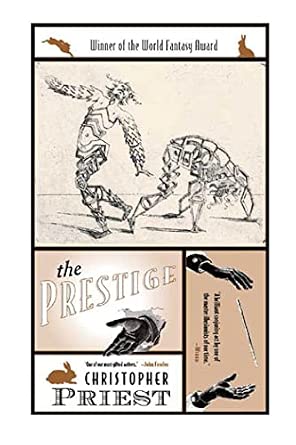
The Prestige
Purchase options and add-ons
Winner of the World Fantasy Award
Christopher Priest's The Prestige is the inspiration for the movie directed by Christopher Nolan, starring Hugh Jackman and Christian Bale
In 1878, two young stage magicians clash in the dark during the course of a fraudulent séance. From this moment on, their lives become webs of deceit and revelation as they vie to outwit and expose one another.
Their rivalry will take them to the peaks of their careers, but with terrible consequences. In the course of pursuing each other's ruin, they will deploy all the deception their magicians' craft can command--the highest misdirection and the darkest science.
Blood will be spilled, but it will not be enough. In the end, their legacy will pass on for generations...to descendants who must, for their sanity's sake, untangle the puzzle left to them.
- Print length368 pages
- LanguageEnglish
- Publication dateSeptember 15, 1997
- Dimensions5.5 x 0.92 x 8.25 inches
- ISBN-100312858868
- ISBN-13978-0312858865
Book recommendations, author interviews, editors' picks, and more. Read it now.
Customers who viewed this item also viewed

Inverted World (New York Review Books Classics)PaperbackFREE Shipping on orders over $35 shipped by AmazonGet it as soon as Thursday, Jun 11
The Prestige - ScreenplayJonathan NolanPaperbackFREE Shipping on orders over $35 shipped by AmazonGet it as soon as Thursday, Jun 11
The Affirmation (Valancourt 20th Century Classics)PaperbackFREE Shipping on orders over $35 shipped by AmazonGet it as soon as Thursday, Jun 11
The GlamourPaperbackFREE Shipping on orders over $35 shipped by AmazonGet it as soon as Thursday, Jun 11
The Gormenghast Novels (Titus Groan / Gormenghast / Titus Alone)PaperbackFREE Shipping on orders over $35 shipped by AmazonGet it as soon as Thursday, Jun 11
Customers also bought or read
- Ice: The hypnotic dystopian cult classic (Pushkin Press Classics)
Paperback$11.04$11.04FREE delivery Jun 11 - 15 - Ursula K. Le Guin: Five Novels (LOA #379): The Lathe of Heaven / The Eye of the Heron / The Beginning Place / Searoad / Lavinia (Library of America, 379)
Hardcover$25.68$25.68Delivery Thu, Jun 11 - Star Maker (S.F. MASTERWORKS) by Stapledon, Olaf New Edition (1999)
Paperback$20.16$20.16$3.99 delivery Jun 10 - Jul 17
Editorial Reviews
Review
“A brilliant conjuring act by one of the master illusionists of our time.” ―Wired on The Prestige
“One of our most gifted writers.” ―John Fowles on The Prestige
“Extraordinary--like a dazzling magic act!” ―Entertainment Weekly on The Prestige
“A dizzying show of a novel....Imagine Possession rewritten by Barbara Vine, or Robertson Davies at his most smoothly diabolical. A brilliantly constructed entertainment!” ―The Washington Post on The Prestige
“As ingenious as it is suspenseful.” ―Newsday on The Prestige
“Nothing quite prepares you for the sinister complexity and imaginative flair of The Prestige . . . Magnificently eerie.” ―Anthony Quinn, The Sunday Times
“Beautifully written . . . Two magicians vie with each other to create the perfect illusion: vanishing from one part of the stage and reappearing instantaneously in another. It's a story of utter fakery and scientific audacity. The pioneer of electrical power, Nikola Tesla, appears in a supporting role; to say more would reveal too much. Priest masters the merging of SF and mainstream, and The Prestige is his finest novel to date.” ―New Scientist on The Prestige
“A taut, twisting, prize-winning story of two magicians and their fierce fin-de-siècle rivalry that taints successive generations of their respective families...An unexpectedly compelling fusion of weird science and legerdemain.” ―Kirkus on The Prestige
“Remarkably akin to the style of the late Robertson Davies...Priest has brought it off with great imagination and skill.” ―Publishers Weekly on The Prestige
“Hypnotic...The Prestige provides the satisfaction of an ambitious and well-told entertainment.” ―San Francisco Chronicle
“The Prestige is in every way a marvelously scary entertainment with one of the creepiest final revelations in recednt years. Don't miss the magic show!” ―Gahan Wilson, Realms of Fantasy
“Just as a magic act should be: filled with haunting marvels.” ―Time Out London on The Prestige
About the Author
Excerpt. © Reprinted by permission. All rights reserved.
The Prestige
By Priest, ChristopherTor Books
Copyright ©1997 Priest, ChristopherAll right reserved.
ISBN: 9780312858865
I
It began on a train, heading north through England, although I was soon to discover that the story had really begun more than a hundred years earlier.
I had no sense of any of this at the time: I was on company time, following up a report of an incident at a religious sect. On my lap lay the bulky envelope I had received from my father that morning, still unopened, because when Dad phoned to tell me about it my mind had been elsewhere. A bedroom door slamming, my girlfriend in the middle of walking out on me. ‘Yes, Dad,’ I had said, as Zelda stormed past with a boxful of my compact discs. ‘drop it in the mail, and I’ll have a look.’
After I had read the morning’s edition of the Chronicle, and bought a sandwich and a cup of instant coffee from the refreshment trolley, I opened Dad’s envelope. A large-format paperback book slipped out, with a note loose inside and a used envelope folded in half.
The note said, ‘Dear Andy, Here is the book I told you about. I think it was sent by the same woman who rang me. She asked me if I knew where you were. I’m enclosing the envelope the book arrived in. The postmark is a bit blurred, but maybe you can make it out. Your mother would love to know when you are coming to stay with us again. How about next weekend? With love, Dad.’
At last I remembered some of my father’s phonecall. He told me the book had arrived, and that the woman who had sent it appeared to be some kind of distant relative, because she had been talking about my family. I should have paid more attention to him.
Here, though, was the book. It was called Secret Methods of Magic, and the author was one Alfred Borden. To all appearances it was one of those instructional books of card tricks, sleight of hand, illusions involving silk scarves, and so on. The only aspect of it that interested me at first glance was that although it was a recently published paperback, the text itself appeared to be a facsimile of a much older edition: the typography, the illustrations, the chapter headings and the laboured writing style all suggested this.
I couldn’t see why I should be interested in such a book. Only the author’s name was familiar: Borden was the surname I had been born with, although when I was adopted as a small child my name was changed to that of my adoptive parents. My name now, my full and legal name, is Andrew Westley, and although I have always known that I was adopted I grew up thinking of Duncan and Jillian Westley as Dad and Mum, loved them as parents, and behaved as their son. All this is still true. I feel nothing for my natural parents. I’m not curious about them or why they put me up for adoption, and have no wish ever to trace them now that I am an adult. All that is in my distant past, and they have always felt irrelevant to me.
There is, though, one matter concerning my background that borders on the obsessive.
I am certain or to be accurate almost certain, that I was born one of a pair of identical twins, and that my brother and I were separated at the time of adoption. I have no idea why this was done, nor where my brother might be, but I have always assumed that he was adopted at the same time as me. I only started to suspect his existence when I was entering my teens. By chance I came across a passage in a book, an adventure story, that described the way in which many pairs of twins are linked by an inexplicable, apparently psychic contact. Even when separated by hundreds of miles or living in different countries, such twins will share feelings of pain, surprise, happiness, depression, one twin sending to the other, and vice versa. Reading this was one of those moments in life when suddenly a lot of things become clear.
All my life, as long as I can remember, I have had the feeling that someone else is sharing my life. As a child, with nothing to go on apart from the actual experience, I thought little of it and assumed everyone else had the same feelings. As I grew older, and I realized none of my friends was going through the same thing, it became a mystery. Reading the book therefore came as a great relief as it seemed to explain everything. I had a twin somewhere.
The feeling of rapport is in some ways vague, a sense of being cared for, even watched over, but in others it is much more specific. The general feeling is of a constant background, while more direct ‘messages’ come only occasionally. These are acute and precise, even though the actual communication is invariably non-'verbal.
Once or twice when I have been drunk, for example, I have felt my brother’s consternation growing in me, a fear that I might come to some harm. On one of these occasions, when I was leaving a party late at night and was about to drive myself home, the flash of concern that reached me was so powerful I felt myself sobering up! I tried describing this at the time to the friends I was with, but they joked it away. Even so I drove home inexplicably sober that night.
In turn, I have sometimes sensed my brother in pain, or frightened, or threatened in some way, and have been able to ‘send’ feelings of calm, or sympathy, or reassurance towards him. It is a psychic mechanism I can use without understanding it. No one to my knowledge has ever satisfactorily explained it, even though it is common and well documented.
There is in my case, however, an extra mystery.
Not only have I never been able to trace my brother, as far as records are concerned I never had a brother of any kind, let alone a twin. I do have intermittent memories of my life before adoption, although I was only three when that happened, and I can’t remember my brother at all. Dad and Mum knew nothing about it; they have told me that when they adopted me there was no suggestion of my having a brother.
As an adoptee you have certain legal rights. The most important of these is protection from your natural parents: they cannot contact you by any legal means. Another right is that when you reach adulthood you are able to ask about some of the circumstances surrounding your adoption. You can find out the names of your natural parents, for instance, and the address of the court of law where the adoption was made, and therefore where relevant records can be examined.
I followed all this up soon after my eighteenth birthday, anxious to find out what I could about my brother. The adoption agency referred me to Ealing County Court where the papers were kept, and here I discovered that I had been put up for adoption by my father, whose name was Clive Alexander Borden. My mother’s name was Diana Ruth Borden (née Ellington), but she had died soon after I was born. I assumed that the adoption happened because of her death, but in fact I was not adopted for more than two years after she died, during which period my father brought me up by himself. My own original name was Nicholas Julius Borden. There was nothing about any other child, adopted or otherwise.
I later checked birth records at St Catherine’s House in London, but these confirmed I was the Bordens’ only child.
Even so, my psychic contacts with my twin remained through all this, and have continued ever since.
* * *
The book had been published in the USA by Dover Publications, and was a handsome, well-made paperback. The cover painting depicted a dinner-jacketed stage magician pointing his hands expressively towards a wooden cabinet, from which a young lady was emerging. She was wearing a dazzling smile and a costume which for the period was probably considered saucy.
Under the author’s name was printed: ‘Edited and annotated by Lord Colderdale.’
At the bottom of the cover, in bold white lettering, was the blurb: ‘The Famous Oath-Protected Book of Secrets’.
A longer and much more descriptive blurb on the back cover went into greater detail:
* * *
Originally published as a strictly limited edition in 1905 in London, this book was sold only to professional magicians who were prepared to swear an oath of secrecy about its contents. First edition copies are now exceedingly rare, and virtually impossible for general readers to obtain.
Made publicly available for the first time, this new edition is completely unabridged and contains all the original illustrations, as well as the notes and supplementary text provided by Britain’s Earl of Colderdale, a noted contemporary amateur of magic.
The author is Alfred Borden, inventor of the legendary illusion The New Transported Man. Borden, whose stage name was Le Professeur de la Magie, was in the first decade of this century the leading stage illusionist. Encouraged in his early years by John Henry Anderson, and as a protégé of Nevil Maskelyne’s, Borden was a contemporary of Houdini, David Devant, Chung Ling Soo and Buatier de Kolta. He was based in London, England, but frequently toured the United States and Europe.
While not strictly speaking an instruction manual, this book with its broad understanding of magical methods will give both laymen and professionals startling insights into the mind of one of the greatest magicians who ever lived.
* * *
It was amusing to discover that one of my ancestors had been a magician, but I had no special interest in the subject. I happen to find some kinds of conjuring tedious; card tricks, especially, but many others too. The illusions you sometimes see on television are impressive, but I have never felt curious about how the effects are in fact achieved. I remember someone once saying that the trouble with magic was that the more a magician protects his secrets, the more banal they turn out to be.
Alfred Borden’s book contained a long section on card tricks, and another described tricks with cigarettes and coins. Explanatory drawings and instructions accompanied each one. At the back of the book was a chapter about stage illusions, with many illustrations of cabinets with hidden compartments, boxes with false bottoms, tables with lifting devices concealed behind curtains, and other apparatus. I glanced through some of these pages.
The first half of the book was not illustrated, but consisted of a long account of the author’s life and outlook on magic. It began with the following words:
* * *
’I write in the year 1901.
’My name, my real name, is Alfred Borden. The story of my life is the story of the secrets by which I have lived my life. They are described in this narrative for the first and last time; this is the only extant copy.
‘I was born in 1856 on the eighth day of the month of May, in the coastal town of Hastings. I was a healthy, vigorous child. My father was a tradesman of that borough, a master wheelwright and cooper. Our house—’
* * *
I briefly imagined the writer of this book settling down to begin his memoir. For no exact reason I visualized him as a tall, dark-haired man, stern-faced and bearded, slightly hunched, wearing narrow reading glasses, working in a pool of light thrown by a solitary lamp placed next to his elbow. I imagined the rest of the household in a deferential silence, leaving the master in peace while he wrote. The reality was no doubt different, but stereotypes of our forebears are difficult to throw off.
I wondered what relation Alfred Borden would be to me. If the line of descent was direct, in other words if he wasn’t a cousin or an uncle, then he would be my great- or great-great-grandfather. If he was born in 1856, he would have been in his middle forties when he wrote the book; it seemed likely he was therefore not my father’s father, but of an earlier generation.
The Introduction was written in much the same style as the main text, with several long explanations about how the book came into being. The book appeared to be based on Borden’s private notebook, not intended for publication. Colderdale had considerably expanded and clarified the narrative, and added the descriptions of most of the tricks. There was no extra biographical information about Borden, but presumably I would find some if I read the whole book.
I couldn’t see how the book was going to tell me anything about my brother. He remained my only interest in my natural family.
At this point my mobile phone began beeping. I answered it quickly, knowing how other train passengers can be irritated by these things. It was Sonja, the secretary of my editor, Len Wickham. I suspected at once that Len had got her to call me, to make sure I was on the train.
‘Andy, there’s been a change of plan about the car,’ she said. ‘Eric Lambert had to take it in for a repair to the brakes, so it’s in a garage.’
She gave me the address. It was the availability of this car in Sheffield, a high-inileage Ford renowned for frequent breakdowns, that prevented me from driving up in my own car. Len wouldn’t authorize the expenses if a company car was on hand.
‘did Uncle say anything else?’ I said.
‘such as?’
‘this story’s still on?’
‘Yes.’
‘Has anything else come in from the agencies?’
‘We’ve had a faxed confirmation from the State Penitentiary in California. Franklin is still a prisoner.’
‘All right.’
We hung up. While I was still holding the phone I punched in my parents’ number, and spoke to my father. I told him I was on my way to Sheffield, would be driving from there into the Peak District and if it was OK with them (of course it would be) I could come and stay the night. My father sounded pleased. He and Jillian still lived in Wilmslow, Cheshire, and now I was working in London my trips to see them were infrequent.
I told him I had received the book.
‘Have you any idea why it was sent to you?’ he said.
‘Not the faintest.’
‘Are you going to read it?’
‘It’s not my sort of thing. I’ll look through it one day.’
‘I noticed it was written by someone called Borden.’
‘Yes. Did she say anything about that?’
‘No. I don’t think so.’
After we had hung up I put the book in my case and stared through the train window at the passing countryside. The sky was grey, and rain was streaking the glass. I had to concentrate on the incident I was being sent to investigate. I worked for the Chronicle, specifically as a general features writer, a label which was grander than the reality. The true state of affairs was that Dad was himself a newspaperman, and had formerly worked for the Manchester Evening Post, a sister paper to the Chronicle. It was a matter of pride to him that I had obtained the job, even though I have always suspected him of pulling strings for me. I am not a fluent journalist, and have not done well in the training programme I have been following. One of my serious long-term worries is that one day I am going to have to explain to my father why I have quit what he considers to be a prestigious job on the greatest British newspaper.
In the meantime, I struggle unwillingly on. Covering the incident I was travelling to was partly the consequence of another story I had filed several months earlier, about a group of UFO enthusiasts. Since then Len Wickham, my supervising editor, had assigned me to any story that involved witches’ covens, levitation, spontaneous combustion, crop circles, and other fringe subjects. In most cases, I had already discovered, once you went into these things properly there was generally not much to say about them, and remarkably few of the stories I filed were ever printed. Even so, Wickham continued to send me off to cover them.
There was an extra twist this time. With some relish, Wickham informed me that someone from the sect had phoned to ask if the Chronicle was planning to cover the story, and if so had asked for me in person. They had seen some of my earlier articles, thought I showed the right degree of honest scepticism, and could therefore be relied on for a forthright article. In spite of this, or perhaps because of it, it seemed likely to prove yet another dud.
A Californian religious sect called the Rapturous Church of Christ Jesus had established a community in a large country house in a Derbyshire village. One of the women members had died of natural causes a few days earlier. Her GP was present, as was her daughter. As she lay paralysed, on the point of death, a man had entered the room. He stood beside the bed and made soothing gestures with his hands. The woman died soon after, and the man immediately left the room without speaking to the other two. He was not seen afterwards. He had been recognized by the woman’s daughter, and by two members of the sect who had come into the room while he was there, as the man who had founded the sect. This was Father Patrick Franklin, and the sect had grown up around him because of his claimed ability to bilocate.
The incident was newsworthy for two reasons. It was the first of Franklin’s bilocations to have been witnessed by non-members of the sect, one of whom happened to be a professional woman with a local reputation. And the other reason was that Franklin’s whereabouts on the day in question could be firmly established: he was known to be an inmate of the California State Penitentiary, and as Sonja had just confirmed to me on the phone he was still there.
Copyright © 1995 by Christopher Priest
Continues...
Excerpted from The Prestige by Priest, Christopher Copyright ©1997 by Priest, Christopher. Excerpted by permission.
All rights reserved. No part of this excerpt may be reproduced or reprinted without permission in writing from the publisher.
Excerpts are provided by Dial-A-Book Inc. solely for the personal use of visitors to this web site.
Product details
- Publisher : Tor Books
- Publication date : September 15, 1997
- Edition : First Edition
- Language : English
- Print length : 368 pages
- ISBN-10 : 0312858868
- ISBN-13 : 978-0312858865
- Item Weight : 1.05 pounds
- Dimensions : 5.5 x 0.92 x 8.25 inches
- Best Sellers Rank: #772,242 in Books (See Top 100 in Books)
- #562 in Historical Fantasy (Books)
- #6,452 in Contemporary Literature & Fiction
- #11,888 in Science Fiction (Books)
- Customer Reviews:
About the author

Discover more of the author’s books, see similar authors, read book recommendations and more.
Customer reviews
Customer Reviews, including Product Star Ratings help customers to learn more about the product and decide whether it is the right product for them.
To calculate the overall star rating and percentage breakdown by star, we don’t use a simple average. Instead, our system considers things like how recent a review is and if the reviewer bought the item on Amazon. It also analyzed reviews to verify trustworthiness.
Learn more how customers reviews work on AmazonCustomers say
Generated from the text of customer reviewsSelect to learn more
Top reviews from the United States
- 5 out of 5 stars
Best read ever!
Reviewed in the United States on November 30, 2017The Prestige - Christopher Priest’s highly inventive, masterfully crafted tale written in the grand tradition of Victorian novels of mystery and suspense, specifically Wilkie Collins’ The Woman in White (use of multiple narrators) and Moonstone (epistolary novel). The language is so well tuned and exact, so vividly clear, many the time turning the pages I felt as if I was launched miraculously back into the streets, flats and performance halls of turn-of-the-century London. So compelling and thrilling, my response to the British author repeats esteemed critic Garry Indiana's words regarding the literary output of Georges Simenon, “I know how he does it, but I have no idea how he can do it.” Christopher Priest - what a marvelous weaver of fictional magic. And speaking of magic, please read on.
True, the novel begins and ends at a country estate in modern-day England where journalist Andrew Westley and Lady Kate Angier, both young and single, take turns narrating as they sit together and move about in Kate’s family mansion, however this is but the frame – the bulk of the narrative consists of the respective diaries of two of their long dead ancestors, Alfred Borden and Rupert Angier, illustrious stage magicians who had been engaged in a bitter, vindictive rivalry protracted over many years, beginning in the late nineteenth century. The plot is simply too good and contains too many surprises for me to divulge any tantalizing secrets, thus I will shift my observations to a number of the novel’s underlying themes and philosophical enigmas.
Illusion: Counterpoint to nimble skill and dexterity performing sleight of hand and misdirection, concealment and manipulation on stage, Alfred Borden and Rupert Angier are also master illusionists as each pens his diary. Claiming the two magicians are less than reliable narrators is understatement as we are never entirely certain where the illusions start and where they stop, where reality begins and where it ends. Now you read it; not you don’t. And in case you might not catch the shift since it is so easy to miss, there is one short chapter of the novel where Christopher Priest deftly slides into telling the tale in objective third person – a crafty authorial variation on now you read it; now you don’t.
Revenge: Ah, retaliation, vengeance, payback, reprisal - the juice of mountains of fiction and generous helpings of history. But, as both Alfred Borden and Rupert Angier discover the hard way, the aftermath of vengeful words and actions are never nearly as clear-cut and confined as we might conceive. In many cases, the person extracting revenge is completely oblivious to the full range of consequences, sometimes affecting men, women and children over a number of generations.
Secrecy: An enormous part of a stage magician’s art is secrecy - how the trick is performed. Alfred Borden and Rupert Angier extend their secrecy to nearly all aspects of their personal and professional lives. Of course, the more secrets one has, more the possibility of being discovered. But while a secret remains a secret, the magician maintains a power, an advantage over his audience if stage magic; over his family and associates if his secret pertains to his personal life. The ultimate disgrace for a stage magician – having the secret of his trick revealed publicly during a performance. Of course, this is exactly the practice of both Alfred Borden and Rupert Angier.
Twins: Just think of the power a magician would possess if he had an identical twin he kept secret. All the jaw dropping feats of stage magic he could perform – I’m over here on this side of the stage, presto, in an instant, I’m over there on that side of the stage. Such secrecy and magic might qualify as the ultimate illusion. One could stake a career on such an astounding trick. However, two people going through life pretending they are one and the same person will undoubtedly alter a sense of one’s individual identity, one of the prime hallmarks of what it means to be human. Or, will it? Can a master of illusion pull it off successfully? Many the author captivated by the idea and possibilities of twins, my personal favorite: Shakespeare’s The Comedy of Errors featuring not one but two sets of twins.
Identity of the Self: Robert Nozick has a thought experiment where, after an accident, half of one person’s brain (along with memory) is transferred to a second person’s body. Both Tim, the giver, and Tom, the receiver, live after the operation and both Tim and Tom claim to be Tim. Are they both right? The next day Tim dies and Tom is now the only person claiming to be Tim. Does Tom (now Tim) assume the old Tim’s rights and obligations, including the right to live with Tim’s wife and kids? The ancient world knew such a dilemma of identity with the ship of Theseus: the planks and other parts of the ship are all replaced over time. After the last old plank is removed and replaced, is it the same ship or a different ship? What if less than half of the ship is replaced? What if more than half is replaced? The variations are endless. The Prestige hurls a few crazy twists into the mix.
Electricity – The end of the nineteenth century, the heyday as stage performers for the novel’s two magicians, was also the heyday for inventors such as Thomas Edison and Nikola Tesla. In 1879 electric lights were first used for public street lighting. The possibilities and power of electricity captured the public’s imagination. And if a performer could include the sizzling, popping currents of this newly found power into their act– what a show!
Jolt of the Weird: Although a Victorian thriller in the tradition of Wilkie Collins, please keep in mind Christopher Priest has been strongly influenced by H. G. Wells. Similar to his science fiction novel Inverted World where events move along at a measured pace until the jolt of the weird, The Prestige has its own weird jolt which leads to a series of even weirder jolts. One of the most fascinating and astonishing last parts of any novel you will ever read. If you are stirred to consider The Prestige, I’m accomplished my own bit of magic as a reviewer.
23 people found this helpfulSending feedback...Sending feedback...HelpfulThank you for your feedback.Sorry, we failed to record your vote. Please try againThanks, we'll investigate in the next few days.Sorry, We failed to report this review. Please try again - 4 out of 5 stars
I like it but I don't. Now beam me up.
Reviewed in the United States on May 12, 2007I'd like to give this book 4.5 stars, since it's a great read (I stayed up to the earlier hours to finish it), and is very cleverly plotted with great surprises and twists.
My main problem with the book is probably my fault. I believed it to be a 'historical' novel, something like "Carter Beats the Devil" by Glen David Gold. I didn't know it had won the 1996 World Fantasy Award. This meant I became rather upset when the book took a sharp turn into the fantastical during the Tesla part of the story. I was thinking TV, not the pseudo-science that actually appears. It seems to me something of a cheat for a book that's about stage magicians, not real Magicians.
It was also a shame that the mechanisms behind the two great magic tricks were revealed. This goes against the magician's code, and spoils their mystery. That's why I can't imagine reading the book again, since most of its charm is in that mystery.
To be fair, there is some ambiguity about how one of the magicians does his great trick. Unfortunately, this is jettisoned in the movie.
The last part of the book seems rushed and unconvincing. Of course, it allows for a great ending.
I was pleased that one of the character is called Andrew, and is from Wilmslow. Me too; a nice bit of duality there.
3 people found this helpfulSending feedback...Sending feedback...HelpfulThank you for your feedback.Sorry, we failed to record your vote. Please try againThanks, we'll investigate in the next few days.Sorry, We failed to report this review. Please try again - 5 out of 5 stars
Spooky & Nuts! Fantastic.
Reviewed in the United States on April 1, 2026The twists and turns at the end of this book are nuts and Anne Rice spooky. Would have liked to have seen it in the movie, but it was already a long film. Enjoyed immensely.
Sending feedback...Sending feedback...HelpfulThank you for your feedback.Sorry, we failed to record your vote. Please try againThanks, we'll investigate in the next few days.Sorry, We failed to report this review. Please try again - 5 out of 5 stars
Wonderful book
Reviewed in the United States on March 22, 2026Very entertaining
Sending feedback...Sending feedback...HelpfulThank you for your feedback.Sorry, we failed to record your vote. Please try againThanks, we'll investigate in the next few days.Sorry, We failed to report this review. Please try again - 3 out of 5 stars
If you're expecting a novelization of the movie...
Reviewed in the United States on April 4, 2023***Spoilers***
I know, the novel came before the movie, but I've enjoyed watching "The Prestige" for so many years, that I finally committed to reading the book, expecting it to be similar to the film.
It ain't. Yes, the book is about two competing magicians, but the movie only retains the time period of the main story, and some of the character names. They are vastly different tales, otherwise.
In my opinion, this novel is actually more of a horror story than the twisty, engaging fantasy the movie is. The further along I got in the book, the more I kept thinking "Edgar Allen Poe". And the ending of the book pretty much solidified that Poesque vibe.
That said, I just couldn't get into it. Nothing engrossing about the art of magic. Didn't root for either Borden or Angier. And the whole encounter with Tesla was clunky.
So, if you're hoping for a book that reads like the movie, don't bother. If you want a macabre story that's reminiscent of Poe, you may like this.
8 people found this helpfulSending feedback...Sending feedback...HelpfulThank you for your feedback.Sorry, we failed to record your vote. Please try againThanks, we'll investigate in the next few days.Sorry, We failed to report this review. Please try again - 4 out of 5 stars
The book is always better than the movie!
Reviewed in the United States on May 3, 2026As a fan of the movie The Prestige, I went in with high hopes and this book did not let me down. If you enjoyed the film, this is definitely worth reading. The book is more complex and quietly unsettling rather than a direct retelling. It’s a rewarding read that sticks with you.
Sending feedback...Sending feedback...HelpfulThank you for your feedback.Sorry, we failed to record your vote. Please try againThanks, we'll investigate in the next few days.Sorry, We failed to report this review. Please try again - 5 out of 5 stars
I'm happy
Reviewed in the United States on April 16, 2026Great shape for a used 20 year old book
Sending feedback...Sending feedback...HelpfulThank you for your feedback.Sorry, we failed to record your vote. Please try againThanks, we'll investigate in the next few days.Sorry, We failed to report this review. Please try again - 5 out of 5 stars
Not the same as the movie. Brilliant!
Reviewed in the United States on April 19, 2011I saw the movie first. I am of the opinion that the movie was brilliant, exciting, and of a very high quality.
Usually, it is the case that a story either makes a good book or a good movie. It is very rare that both are worth your time. I had loved the movie. I knew the story. I knew the surprises... For some years now I saw no reason to investigate the book.
However, I have had a recent interest in reading about magic and I decided to give the book a chance. What we have here is that rare instance when the book and the movie are both excellent - and different enough that having seen the movie will in no way spoil the surprises of the book. It's not the same story.
It's not a perfect book. Another reviewer commented that the two magicians are not given equal time. This is true. Also, while the ending was creepy and original, it did seem to end abruptly. I have chosen to overlook some of these weaknesses and go ahead with a five star review because I don't think a five star review means a flawless work. What it ought to mean is a work with enough positive traits that it overwhelms those flaws to the point where they are eclipsed. There is a surplus of brilliance in this book and it should not be missed on account of the movie.
16 people found this helpfulSending feedback...Sending feedback...HelpfulThank you for your feedback.Sorry, we failed to record your vote. Please try againThanks, we'll investigate in the next few days.Sorry, We failed to report this review. Please try again
Top reviews from other countries
Arakasi5 out of 5 starsUne captivante plongée dans le monde de la prestidigitation
Reviewed in France on July 24, 2013En illusionnisme, « le Prestige » est le point d’orgue d’un tour de magie, le moment où le prestidigitateur fait jaillir l’impossible du possible, suscitant ainsi stupeur et enchantement. Tout ceci n’est évidemment qu’illusion et si le spectateur s’y laisse prendre volontiers, les autres magiciens n’ont qu’une hâte : découvrir la clef de l’énigme. Car le Prestige n’est pas seulement source d’émerveillement, il l’est également de fortune, de gloire et de réussite. Un état de fait qui n’a jamais été aussi vrai que dans l’Angleterre victorienne où les théâtres à la mode se disputent les numéros de magie et où tous les praticiens de ce noble art se livrent à une lutte acharnée pour attirer l’admiration exclusive du public – une lutte qui peut aller fort loin car pour acquérir un nouveau tour ou le subtiliser à un confrère, des illusionnistes sont prêts à commettre bien des vilénies, allant jusqu’à l’espionnage, au vol et pire encore.
Nous sommes à la fin du XXe siècle à Londres où un conflit de ce type va naître entre deux jeunes magiciens, tous deux aussi talentueux et orgueilleux l’un que l’autre, Alfred Borden et Rupert Angier. Un accident tragique et personnel va débuter leur querelle, querelle qui ne va pas tarder à dangereusement dégénérer, la haine entre les deux illusionnistes atteignant des sommets sans commune mesure avec l’élément déclencheur du duel. Surtout que l’enjeu du conflit n’est pas mince : rien de moins que le tour le plus demandé et le plus mystérieux de toute l’Angleterre, celui de « L’homme transporté » où l’illusionniste se transfert instantanément d’un coin à l’autre d’un théâtre. Des petites échauffourées, on passe progressivement à des actes de malveillance de plus en plus graves, menaces, vandalismes, chantages… Aucun acte, aucune extrémité ne semble à même de rebuter les deux hommes dans leur course forcenée à la gloire. Où s’arrêtera l’escalade ?
Avec « Le Prestige », Christopher Priest nous offre une captivante plongée dans le monde de la prestidigitation avec ses secrets, ses traditions et ses multiples codes. Doté d’une ambiance très réussie, le roman est mené comme un tour d’illusionniste ; tout n’y est que faux-semblants, fausses pistes, semi-mensonges, au point qu’il y devient parfois difficile de distinguer la vérité de l’élucubration et l’illusion du fantastique… Le récit se démarque par une construction particulièrement ingénieuse : on y découvre d’abord les mémoires d’Alfred Borden, avant d’enchaîner sur le journal intime de Rupert Angier (ses deux récits étant entrecoupés de passages fort intrigants se situant au début du XXIe siècle et mettant en scène leurs descendants respectifs). Les récits des deux magiciens se complètent, se contredisent, s’éclairent et s’obscurcissent l’un l’autre, créant ainsi une suspense grandissante qui trouve sa conclusion dans un final de haute volée. Quand l’histoire prend fin et que le Prestige nous est enfin révélé, bien des zones d’ombre persistent… Mais où serait le plaisir d’un tour de magie, si tout nous était dévoilé ?
Sending feedback...Thanks, we'll investigate in the next few days.Sorry, We failed to report this review. Please try again
Casey John Nedry4 out of 5 starsFinely crafted bit of work
Reviewed in Japan on January 6, 2020The writing is excellent. The split structure works well as a narrative choice. Parts 1-3 as well as 5 whizzed by but part 4 was a bit of a slog. Angier’s is written as a verbose narrator I suppose. Picked this up because I enjoyed the movie and wanted to see how they compared. I found both a delight too read.
Sending feedback...Thanks, we'll investigate in the next few days.Sorry, We failed to report this review. Please try again
Robert Fratila5 out of 5 starsGreat Book!
Reviewed in Canada on April 2, 2014So far, this book is a great read. Can't put it down, except to write this review. Would recommend to anyone!
Sending feedback...Thanks, we'll investigate in the next few days.Sorry, We failed to report this review. Please try again
A. Whitehead5 out of 5 starsBrilliant, complex, gripping, haunting.
Reviewed in the United Kingdom on July 15, 2006The Prestige is the ninth novel by the British SF author Christopher Priest. It was first published in 1995 and won the World Fantasy Award for that year. It is Priest's best-known novel and apparently his most successful. It is currently being made into a film by Christopher Nolan (Batman Begins, Memento) starring Hugh Jackman and Scarlett Johansson, due for release in late 2006/early 2007.
The Prestige is the story of two feuding magicians from the late 19th Century, the aristocratic Rupert Angier and his working-class nemesis, Alfred Borden, and how that feud affects later generations of their families, personified in the mid-1990s by Borden's descendent Andrew Westley and Kate Angier. A strange mystery has haunted Andrew's life and his search for the answer leads him to Kate and the story of the feud.
From there the novel takes us back some 130 years and relates, in two separate sections, the life stories of Alfred Borden and Rupert Angier. Borden's story is told as a somewhat (deliberately) confused narrative, supposedly a commentary on a book on stage magic, but Borden's need to tell his story takes over and he goes into detail about his life and the feud with Angier. We learn that Borden develops an incredible magic trick which no-one can fathom, a trick which is then improved upon by Angier, to Borden's fury. The narrative then switches to Angier's more formal diary. Angier's story forms the bulk of the novel and takes us through his youth and his slow beginnings at the art of magic until his fateful meeting with Borden and the consequences of that meeting.
Priest tells his story by shifting between four first-person narratives (Andrew and Kate in the present, Rupert and Alfred in the past), altering his prose style between the two periods with apparent ease and painting these four central characters and the other characters described in their tales with depth and layers. As well as giving an insight into the world of stage magic he brings turn-of-the-century Britain to life with its slow, reluctant letting go of the old century and its embrace of the new, symbolised by the power of electricity. Electricity itself is nearly a character in the novel, the awe which Angier holds it in described with a nearly fetish-like quality and brought to life through the historical figure of Nikolai Tesla, who plays a minor but key role in the narrative.
The Prestige is a puzzle built upon twists, turns and conflicting mysteries. It's like an M Night Shymalan film but one where the twist you were confidently expecting is suddenly yanked out of sight and something unforseen being dropped in its place. Some may question whether if this is really an SF novel, so subtle are the ideas being explored here, but by the end of the book more overt SF elements have emerged and it is a tribute to Priest's writing that he keeps things firmly grounded in reality. The ending, when it comes, may strike some as abrupt, but on another level it is the perfect, ambiguous ending to a nearly perfectly-tuned mystery. The Prestige is one of the most finely-written, 'different' SF novels I've ever read, and firmly recommended to all.
Sending feedback...Thanks, we'll investigate in the next few days.Sorry, We failed to report this review. Please try again
Ambica5 out of 5 starsEnjoyable Read
Reviewed in India on September 9, 2016Just brilliant! But let me warn you, the movie is better than the book! But the book is still good, An absolute riveting read. We just dive head on to the world of magic of a forgotten era. If you enjoy a complex narrative then you'll enjoy this. There is the business of magic, well etched lead characters, Telsa, love, betrayal and much much more.
Sending feedback...Thanks, we'll investigate in the next few days.Sorry, We failed to report this review. Please try again