Precious Bodily Fluids
-

Aguirre, the Wrath of God (Werner Herzog, 1972)
From its first shot, here is a film that invites its own phenomenology, another potential description or requirement of the art film. We slowly zoom into a line of men descending a South American mountain. The aspect ratio must be 4:3, because the screen is working with an unusual vertical movement, human vertical movement. It’s…
-

Happy Together (Wong Kar-Wai, 1997)
An “art film” in the sense that every shot provides a new occasion for experimentation but with a stronger sense of connection between story and plot. Other WKW films, particularly 2046 a few years later, render the break between story and plot more stark. Here, we have lots of black-and-white, then back to color, with…
-

The Bling Ring (Sofia Coppola, 2013)
The Bling Ring (dir. Sofia Coppola, 2013) – Quick, flashy, blingy, the counterpoint to Somewhere (in terms of editing). Sofia is still very interested in celebrity culture and young women/girls. They’re all somewhat about this: The Virgin Suicides, Lost in Translation, Marie Antoinette, and these last two. But let’s be careful of making this too autobiographical. Although this is the…
-
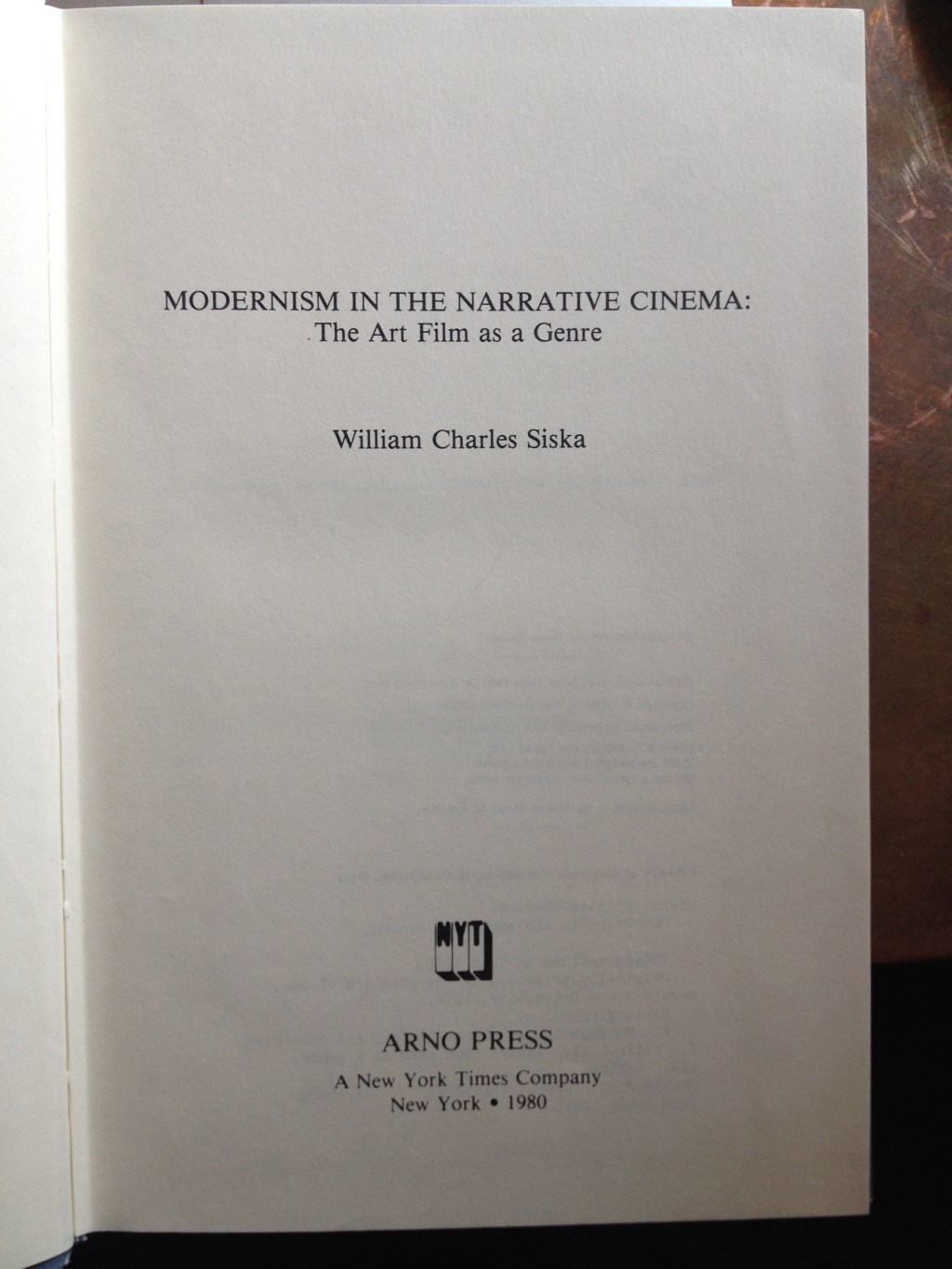
Modernism in the Narrative Cinema, William Charles Siska
It’s worth noting at the outset that, although published in 1980, this is a doctoral dissertation from 1976. As such, it is dated and functions chiefly (at this point) as a critical artifact that helps trace the discourse of art-cinema criticism. Siska begins by more-or-less establishing “genre” as something determined by its audience (1) but…
-

On the History of Film Style, David Bordwell
Another work from Borwell within his broader project of doing aesthetic/formal film history that doesn’t discount the industrial or economic aspects but nevertheless insists that aesthetics on its own demands its own account. As is becoming more customary for Bordwell’s work, it starts off on the defensive. In chapter 1, Bordwell responds to accusations that…
-

The Classical Hollywood Cinema, David Bordwell et al.
For my purposes, I only cursorily read the bulk of this and focused on chapter 30, “Since 1960: the persistence of a mode of film practice.” Bordwell/Thompson/Staiger’s method is scientific and highly valuable, which this book goes to show. It’s even laid out like a Bible, with dual columns on each page that cross-reference the…
-

To the Distant Observer, Noël Burch
To The Distant Observer: Form and meaning in the Japanese cinema, Noël Burch Burch aims to do something akin to Bordwell/Thompson/Staiger in The Classical Hollywood Cinema, namely, a formally driven approach to constructing a system of standard narrative film within the bounds of a particularly nation during it’s so-called “golden age.” Burch notes…
-

The Magician (Ingmar Bergman, 1958)
The original Swedish title is The Face, and that’s more fitting. Diegetic conversations are all about faces, particularly the face of the the magician. Faces convey truth and deception, they bear false beards and eyes that frighten so as to distract from their mendacity. These characters, as usual for Bergman, can’t get away from metaphysics, but…
-

Red Desert (Michelangelo Antonioni, 1964)
Have been reading through Mark Betz’s Beyond the Subtitle: Remapping European Art Cinema, which includes a chapter entitled, “Wandering Women: Decolonization, Modernity, Recolonization.” Although the chapter only mentions Antonioni’s Red Desert, its main argument applies as much to this film as to any. Monica Vitti functions, according to Betz, as the archetypal European woman of cinema…
-

The Virgin Suicides (Sofia Coppola, 1999)
The film achieves something unusual and delightfully nuanced: a kind of secondary identification that subverts the typical male POV by rendering it merely a proxy of women (or in this case, girl) characters. The story is told in retrospect by a few grown men reminiscing about some enigmatic girls from their shared youth. Despite the fact…
-
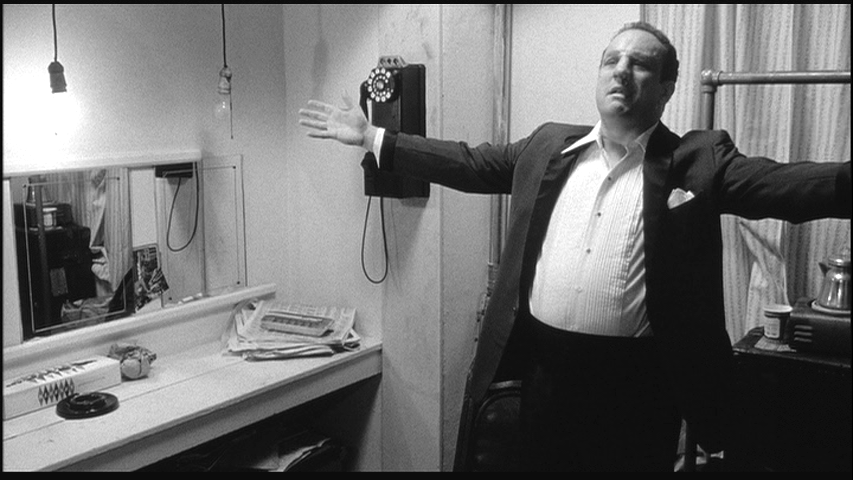
Raging Bull (Martin Scorsese, 1980)
The opening credits sequence is all slow-mo, glorying in a static frame long shot of LaMotta warming up in the ring alone, distanced but surrounded by spectators. Occasional flashes of diegetic photography punctuate the image. The bold, overt shot (uninterrupted save for the flashes?), set to orchestral music, sets the film apart from sports…
-

Delicatessen (Marc Caro + Jean-Pierre Jeunet, 1991)
An aesthetic of stylized trash set in a dystopic, post-apocalyptic France overwhelmed with a warm red-orange-green color scheme. Terry Gilliam meets Time Burton, and then some. It’s a live-action cartoon, warped, overly filtered, highly stylized. Sounds function as the abnormal but regular heartbeat of a social space. The synchronized rhythms move toward a climax and…
Got any book recommendations?
 Precious Bodily Fluids