Archive Page 2

Skiphosoura – ‘solving’ the transition to pterodactyloids

Life reconstruction of Skiphosoura bavarica. Art by Gabriel Ugueto.

I’m delighted that today I have a new paper out with a really exciting new pterosaur, that I think adds an awful lot to our understanding of pterosaur evolution, as well as the animal itself being rather interesting. It’s often fairly easy to say that a new find ‘fills a gap in the fossil record’ but some gaps are much bigger than others, or a situation is rather complex that can be clearly resolved with the right fine (or at least, provide an interesting new hypothesis). To follow through this new find and its implications, we need to start with a short bit of pterosaur history and evolution.

For the first couple of centuries of pterosaur research we could split them into two groups: the rhamphorhynchoids and pterodactyloids and the two simply didn’t connect. The earlier rhamphorhyncoids (now properly called ‘non-pterodactyloid pterosaurs’) had proportionally small heads and necks, a separate naris and antorbital fenestra, a short wing metacarpal, wing fingers where phalanx 1 was quite short and 4 quite long, a long fifth toe and, most obviously, a long tail that was usually bound together with long zygapophyses. The pterodactyloids were then the opposite, long heads and necks, a single merged nasoantorbital fenestra (NAOF), a long wing metacarpal, a long 1st and short 4th wing phalanx, a reduced 5th toe and a short and unbound tail.

This all changed with Darwinopterus and the discovery of a pterosaur with a big head and neck, an NAOF but otherwise a very much non-pterodactyloid body plan. This gave us a new grade, the monofenestratans, and when a bunch more species and specimens were found or recognised, they formed a nice cluster that were all close to one another but clearly different from their forerunners and the later pterodactyloids. It certainly answers some questions – the head and neck evolved first and then the rest of the body changed, but it’s not really showing a clear transition or pattern of all of these various characters that are being altered. All of the characters past the neck might have changed second, but in which order did they alter, and which ones came first in the head? For that, we’d really need some more intermediates, one that plugs the gap from the non-pterodactyloids to the first monofenestratans, and then again from these to the pterodactyloids? To try and simplify the problem, we have A, C and E, but can we get B and D? Well, guess what?

So in the new paper out today, I and my colleaguesdescribe and name a new monofenestratan, Skiphosoura. There’s a *lot* I could say here, but there’s a lot in the paper and a massive supplementary info section, so I’ll try and keep this short and sweet and concentrate on the big stuff.

First off, it’s huge, the biggest known from anything like a complete specimen and one of the largest things in the Solnhofen (important aside, it’s from the Solnhofen), alongside the biggest Rhamphorhynhcus and Petrodactyle coming in close to 2 m in wingspan. Although disarticulated, it’s nearly complete with almost every bone present and they are in somewhat 3D, so we get access to tons of data we’ve not had before in the monofenestratans. It has a bony head crest, it’s got big teeth, it’s pretty robust and it’s got long legs. Looking at the specimen that first time I saw it, it was clear it had some odd features and it certainly looked more derived than Darwinopterus and the others, but was it really? When we ran a phylogenetic analysis is where things really got interesting.

Skiphosoura really does come out as ‘D’ in the analogy above, it’s got a bunch of features that we associate with the early monofenestratans, but it’s also got some very pterodactyloid like features that show a transition from one state to the other and plug this gap very effectively. Even more intriguingly, Dearc, the recently described Scottish giant is pulled up from being a derived rhamphorhynchine close to Rhamphorhynchus, and to being ‘B’, the link from these to the monofenestratans. Lining these up we then get a really clear transition for pretty much all of the characters I listed up top.

The head in Dearc is notably long and its neck is longer than earlier forms, plus the naris is huge so these are all more derived that we see in the traditional ‘rhamphorhynchoids’ but are not yet at the  monofenestratan condition (and as an aside, have a more derived prepubis too, so it’s not quite all head and neck first). In Skiphosoura, we have the big head and long neck and confluent NAOF of the monofenestratans, but we also now have a longer wing metacarpal than before, the wing finger proportions are nearly all the same, so 1 is longer and 4 shorter than the earlier forms but not at the pterodactyloid ratios, the fifth toe is greatly reduced, but still has two bones and not the one of the pterodactyloids and most notably the tail is short, but still bound by zygapophyses. So, we’ve got a bunch of features that more derived than in Darwinopterus and kin, but not quite at the pterodactyloid condition.

The evolution of pterodactyloid pterosaurs. Line drawings by Skye McDavid.

This is really, really cool. This is giving us a real insight into the pattern and timing of changes across the whole skeleton and what that means for how and when all these different and important shifts happened. Remember that the pterodactyloids get much bigger than the earlier forms, and have a fundamental change in their wing shape (the massive reduction in the uropatagium that comes with a short tail and reduced 5th toe) and a fundamental difference to how they walk, so these are not just anatomical traits changing, they represent a fundamental shift in their biology and with massive implications for how pterosaurs changed over time and the opening up of new niches and the creation of a new body plan. Skiphosoura and Dearc really plug those gaps and help show the transition and this should be a major source of research going forwards looking at those changes to the body plan and the implications to flight and terrestrial locomotion to explain how the pterodactyloids became the animals that they were and that dominated the Cretaceous. Hopefully this is a first, but major, step in that progression.

There are obviously various other things in this paper too, that are at least worth mentioning here briefly. While this is not the first monofenestratan from the Solnhofen, these are currently very rare and so this is quite an addition. The 3D nature of the skeleton adds a ton of new information on these intermediates and is basically the only one that is preserved like this right now, so it’s really important in that regard. We have a new phylogeny in play, that it addition to the resolution in the middle of the tree, adds some novel relationships down the bottom (or firms up some previously very uncertain areas), and on a personal level, it’s nice to see Petrodactyle included and it pop out basically where I thought it would, and with some more characters supporting it’s identification as a valid taxon. I should mention at this point, that there’s a ton of new characters in this tree (which is really comprehensive) and, if we’re right about the relationships, there is a serious bit of taxonomic revision needed on the various Darwinopterus-like taxa with animals previously considered different species of a single genus being spread around the tree. Finally, we have some commentary on ecology and behaivour of these animals, so there is a lot crammed in and stuff that is relevant to pterosaur evolution, taxonomy, relationships, anatomy, flight, ecology and more. It is, therefore, I think fair to shout about it quite a bit!

Obviously to round off, I want to thank my collaborators and coauthors, Adam Fitch, Stefan Selzer, and René Lauer and Bruce Lauer (and the Lauer Foundation). It’s taken a ton of work to get to this point and I’m delighted we made it. Now go read the rest of the paper because there’s a lot to unpack here and this isn’t doing much more than scratching the surface. You can access it here:

Hone, D.W.E., Fitch, A., Selzer, S., Lauer, R., & Lauer, B. 2024. A new and large darwinopteran reveals the evolutionary transition to the pterodactyloid pterosaurs. Current Biology.

While I’m posting links, it seems like a good opportunity to mention that like so many others, I have made the leap to Bluesky, and I do also have a (not that much used) LinkedIn account too. So if you want to follow me there, please do. For now my Twitter is still running, but I think it’s only a matter of time till that fades, but my Facebook page is still doing fine. There will be a new episode of Terrible Lizards next week that will be all about this paper, so more info coming there soon too.
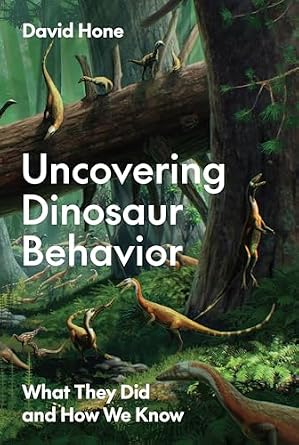
Uncovering Dinosaur Behaviour

By now I imagine that almost everyone reading this is aware that I have a new book out, but if you somehow did not, then here’s a chance to catch up and learn a bit more about it (and hopefully I can entice you to buy a copy). The title, as is rather given away above, is Uncovering Dinosaur Behaviour and it’s out with Princeton University Press today, though copies have been circulating for a while at a few events and I know it’s been sold at the Smithsonian too.

The subject matter is pretty obvious from the title, but if you have read my other books then the style is a little different. This isn’t a classic popular science work, but somewhere between that and a formal text book (what is sometimes called the grey literature). So the tone of writing is rather more formal, the level is a bit higher (you might well need to look up some words and even concepts if you are not a biology student), and it’s fully referenced throughout (though, ugh, with numbered references – not my choice!). So don’t grab it and think it’ll be a breezy read, it’s there to really be read and through about in way that I don’t think my others have been, and I was aiming for this to be accessible, but also getting much deeper into the subject and with ideas and summaries that will be actively useful for students of science and practicing researchers. I really hope it’ll be a go-to source on this subject for a lot of academics in the next few years. Steve Brusatte read an early version of it and said it read like a series of review papers and that’s what I was aiming for and captures the level of detail I was going for, so that was nice.

On that note, I do need to thank Andy Farke, Cary Woodruff and Dave Shuker who were all kind enough to read the whole book for me and give me their feedback as my own personal referees, in addition to the two formal ones appointed by Princeton (of which Steve was one). They all gave me their time and help and made for a much stronger, and hopefully more accurate, work. While I’m thanking people, special thanks needs to go to Gabriel Ugueto who is the illustrator. In addition to doing the amazing cover and all of the full colour inserts, he did a couple of dozen line drawings for the text as well. So the book is really well illustrated, with far more pictures than my previous books and there’s a load of photos in there as well, so it really is a beautiful book.

It starts off with quite a long set of introductory chapters to get into the basics of dinosaurs (for non-dinosaur experts), behaviour (for non-ethologists) and then fundamentals of palaeontology and what data is and isn’t available (for non-palaeontologists). After that, it’s a deep dive with, as noted above, a series of review-like chapters with each tackling a major area of dinosaur behaviour: feeding, signalling, combat, reproduction etc. In each I try to lay out the state of the art of our current understanding of the subject, go into where the problems and gaps lie with it, and then finish with some suggestions for future studies and where I think we can go with it. So it’s not just a ‘here’s what we know’ set-up of the traditional text book or review, but also getting into the problems and solutions and trying to be positive about steering the discussion into some more productive areas of research for dinosaur behaviour.

Obviously this is all very dinosaur-centric as you may expect, but I do think I highlight a bunch of issues that are more general concerns with how we reconstruct a lot of palaeo behaviour. I can’t really speak for things like mammoths and trilobites, but certainly some of the things I flag up absolutely appear in papers on fossil crocs, pterosaurs and other Mesozoic animals that I’ve come across and so this book will hopefully have a broader appeal and interest than those just trying to look at allosaurs or alamosaurs.

If you want to know more, I rather inevitably covered this at length in the new episode of my Terrible Lizards podcast, so you can check that out if you want some more info and I got into a lot more detail than I do here. There’s also a link to a healthy discount code which at the time of writing I think is still good to use. I’ve already had one glowing review from Marc Vincent of Love in the Time of Chasmosaurus so check that out if you need more.

The book is available in all kinds of places online and in shops, but here’s the link the Princeton’s webpage as the official source.

Hone, D.W.E. 2024. Uncovering Dinosaur Behaviour. Princeton University Press.

Spinosaur feeding

It’s been too long since I got involved in spinosaur research, but I have recently re-entering the fray with a new paper. It was out last week, but I’m in the field and only just got the time and internet access to be able to put this post out.

A couple of years back I was mulling over some issues of the tooth row of spinosaurs and especially the pattern of there being very large teeth at the front of the jaw and in the middle but small in between and at the back. This presumably had some functional significance since this pattern is present in crocodiles, but greatly exaggerated in spinosaurines, but doesn’t show up in a lot of specialist fish eaters like dolphins or gharials. I was chatting to Eric Snively about this, and he suggested that we ask Domenic D’Amore who has done a lot on croc jaws. He was intrigued and suggested we rope in Evan Johnson-Ransome who is in Chicago and is working on spinosaur jaws for his PhD. And so a project was born, to look at the teeth (well alveoli, we have a lot of holes in jaws and not many teeth), and the patterns in the jaws of crocs and spinosaurs and see what we could see.

Dom already had a great dataset on crocs and in a previous paper had categorised their feeding habits based on head and tooth shapes, so we had a great baseline for comparisons. What we’ve found here adding in essentially every spinosaur cranium and jaw that we could, is that spinosaurines and baryonychines do have the same basic pattern going on described above. They have big teeth at the front of the snout, then some really small ones, then bigger ones again and then they reduce in size progressively to the rear. But while the teeth are all generally quite close in size to one another in the baryonychines, this pattern is massively exaggerated in the spinosaurines with much greater differences between the biggest and smallest teeth.

This is already quite well known, but I don’t think we, or anyone else, has realised just how different they are in this regard and the graphs in the work really show this. This pattern really puts the baryonychines closer to more fish-specialist predators with long jaws and thin, similarly-sized teeth, and spinosaurines closer to the big modern crocs, that eat plenty of fish, but also happily go for larger prey and including relatively large tetrapods. Spinosaurines don’t just have absolutely larger teeth (they are generally much bigger animals than baryonychines) but they are proportionally larger too. We also think this explains the undulating jaws of spinopsaurs with the largest teeth having larger roots and so necessitating a deeper jaw to accommodate them. All of this points to a pretty fundamental split in their feeding ecology with spinosaurines pretty clearly built to have a more powerful bite or bigger and / or tougher prey than baryonychines, again both proportionally and absolutely.

As a side note, even big fish-specialist crocs like gharials and Tomistoma are reported to predate on large vertebrates, so given the size of the baryonychines, this really doesn’t rule out them taking things like small dinosaurs or crocs as prey, but does suggest that fish (and other generally smaller aquatic prey) would be a more important part of their diet than in their bigger cousins. We need to be really clear here with sizes – spinosaurines were generally rather bigger than baryonychines so when we say that the former took larger prey than the latter, we mean proportionally. If we had one of each group that were the same size, the baryonychine would generally be taking smaller food than the spinosaurine. So that difference would be still more exaggerated given that spinosaurines are also bigger (at adult).

Another area we comment on is the rosette, the little subcircular expansion at the tip of the jaw and what this means. This turns up in crocs and other fish eaters too, but none of us had actually come across a functional explanation for this and so we are able to propose one here. Moving though water quickly is of course tough, and so reducing drag is really important and having thin jaws will really help here. But, you also want to snag what you are aiming at, and it’s going to be trying to escape, then a wider jaw will help. So we think the rosette is a compromise, allowing the jaw to be generally narrow but wider at the point most likely to contact prey and so give it a better chance of grabbing something without overly slowing it down.

Once you have grabbed the food, what then? Spinosaurs are odd for theropods in that they don’t have curved teeth and they have reduced or no serrations, and the alignment of the upper and lower jaws are good for holding but not much else. In short, they are not well suited to cutting off chunks of flesh or taking apart something large in the way that other theropods could with their slicing dentition. That points to a couple of possibilities then, either spinosaurs generally took fairly small stuff that they then swallowed whole or with the minimum of processing, or they had another mechanism to break up what they grabbed. They can hardly do a croc-like death roll, and their proportions are odd enough that a foot-pin and pull with the teeth that other theropods could do might not work here either. A bit of a leftfield suggestion we have is that the arms might have played a roll, some terrapins will use their claws to shred fish in the water and then grab the bits, and while they are built very differently, spinosaurs are nothing if not well equipped in the strong-arms-and-big-claws department, so it’s something they might well have been able to do.

So, there should be some useful data and ideas in there. As I said before, it’s no secret that spinosaurines and baryonychines are built a bit differently, especially in the tooth department, but we have gone well beyond that basic fact and built up some decent ideas about the kinds of things they might be trying to catch, and then how they would process them. Small steps perhaps, but certainly chipping away at the issues of their ecology and giving us some ideas to work on.

Finally, I do of course need to thank my colleagues for all their work on this paper, it’s been a really enjoyable process putting this together. You can read the full paper here:

D’Amore, D.C., Johnson‐Ransom, E., Snively, E. and Hone, D.W., Prey size and ecological separation in spinosaurid theropods based on heterodonty and rostrum shape. The Anatomical Record.

Mea Culpa – Luchibang the Chimera

It has been a long time since I wrote such an important post, but this is a big subject and science is about self-correction and it would be wrong not to note when I made the error (and though hopefully also in this case, have worked to fix it). At least some readers will remember the cool istiodactylid pterosaur I named a couple of years ago – Luchibang a decent sized, but young animal, that was really well preserved.

Even during review, and after publication, a couple of colleagues said they thought it was a chimera – two specimens stuck together to make a more complete one. Such a practice is not uncommon with Chinese fossils (and plenty of others) and indeed one of my coauthors Xu Xing was instrumental in revealing the famous ‘archaeoraptor’ as a chimera. Many of these forgeries or composites are hilariously easy to spot and are not well done, indeed one of the original referees on the first paper who was happy with the specimen, the much-missed Lu Junchang, once took me on a tour of local dodgy specimens in Beijing fossil shops.

Given that we knew the specimen had come from a fossil dealer and the prevalence of such specimens, we did take the suggestion most seriously. The suggestion was that the head had been added to the body and so for our phylogenetic analysis we ran the head and body separately and together to see if they clustered together or apart on the tree and they came largely together. I re-prepared parts of the specimen myself and even had this process witnessed by a fellow and independent palaeontologist who verified we could find no joins or glues in the suspect areas. The specimen, with these issues, was presented at a pterosaur conference to talk though the possible fakery with an expert audience and go over the specimen as a whole, the characters in the head and body, the phylogeny and the preparation work.

In short, I think we did just about everything we could have realistically done to ensure that the specimen was genuine. (Note, it was way, way too big to do anything like CT or X-ray it and those cost a ton of money, and the specimen was very fragile so transporting it was a bad idea, and something like UV photography we had experimented with on Chinese material and found known fakes that looked genuine and known genuine specimens that could look like fakes, so it’s not that reliable on these rocks). Indeed, one paper that has cited the original Luchibang paper did so discussing how to spot forgeries from China and used our work as a reference for what they did to check that their own specimen was genuine.

But, as I’ve already given away, I was wrong. I was fooled. Someone did indeed combine two different specimens and did such a superlative job that I and others missed it, even when specifically looking for it. In fact even those who had raised suspicions of it, had identified breaks in the specimen as joins that are different to those we have now found (i.e., it wasn’t assembled in the way they thought it was and hadn’t identified the correct joins because they were well hidden).

This revelation came about because the slab was actually damaged in a flood in a museum that was housing the specimen and this clearly destroyed some glues or something that held them together and the top layers of rock that had been used to disguise the joins. A Chinese PhD student working on pterosaurs, Shunxing Jiang, got in touch with me about this and so we set out to correct the record, and so we have a new paper out (along with Xu Xing and Adam Fitch from the original paper, and with Yizhi Xu too) trying to fix the record.

The head of the specimen is still that of an istiodactylid and we have actually retained this as a holotype and name-bearing specimen. The recent Ozeki et al. (2023) paper had coded this as a head only in their analysis because of their concern about the postcranium and this was still borne out as a unique taxon, and our original diagnosis was actually based primarily around features of the head so we do still think there is a new taxon here. As such this remains a valid Chinese istiodactylid.

We have however, naturally, revised and changed other major interpretations. We don’t know the ontogenetic stage of the animal and its unusual proportions are clearly incorrect (or at least, unknown) and so our ecological interpretations are also off the table. To do as thorough as job as possible in correcting things, we have listed every paper that has cited the original Luchibang paper and went through to see if their results or interpretations might have been affected. Happily most are not at all, and others it is a very simple correction, but we hope this will have mitigated the effects of our mistake as far as possible and of course this new paper stands as a formal correction of the issue.

I am sure there will be some wailing and gnashing of teeth, but this really should not produce any kind of crisis in palaeontology. There are fakes out there and they do occasionally get into the literature. It’s been a problem in the past and will be one in the future too, but it’s not like museums are full of fakes and all the amazing Chinese specimens are chimeras etc. But it is a humbling, even humiliating, lesson that even as someone who has written about these issues on this very blog and took time and effort to check, could still be caught out. I did my best and came up short.

But I can take some consolation in that we have acted swiftly to correct the record and put out this paper and this post to try and clear up the mess and inform colleagues of the issues and how we think the chimera was assembled. I don’t think there should be any panic about existing collections, but it does mean we need to learn more about how these forgeries are perpetuated and be on our guard against them. That I and other colleagues were fooled (even if others were still suspicious) shows the quality of the work and that even being careful is not always enough.

The full paper is online and open access and also published in the same journal so hopefully linking up the original erroneous paper and this correction a little more effectively and to help point people to the correction.

Hone, David W. E., Jiang, Shunxing, Fitch, Adam J., Xu, Yizhi, and Xu, Xing. 2024. A reassessment on Luchibang xingzhe: A still valid istiodactylid pterosaur within a chimera. Palaeontologia Electronica, 27(2):a41.

On the trail of giant Tyrannosaurus rex

So today a paper breaks that has managed to cause controversy and misunderstanding for the last couple of years without having even been published. But today it is formally out and I’m sure that all the same issues (and more besides) will arise, so I’ll (at least attempt) to set the record straight here right now and cut off at least some of the (misguided or even malicious) representation that I’ve seen already. And that has come about really because my colleague Jordan Mallon and I suggest that T. rex could get to some 15 m in length and 15 tons in mass! Much, much bigger than any contemporary estimates, so what gives?

I should note already that to at least some readers, this isn’t news. We had an abstract on this project at a couple of conferences and journalists got hold of that, and while we did answer a couple of questions that came our way, we didn’t give any interviews or promote the work and so it’s rather inevitable that it got misreported and then that got misinterpreted. The most obvious problems were claims that:

a) our work only applied to T. rex (it doesn’t, it’s just the model)

b) we were upscaling the estimates for known animals (we weren’t, these are our projections of how big they could get) and

c) we did this to make sure T. rex stayed at the biggest theropod because we are T. rex stans ( I have *literally seen this* and it’s obvious stupid).

So what do we say and what do we mean? The best start point to get to that is to look at how we started on this. From the start of my career, I’ve been working on sizes of dinosaurs and the issues of estimating their size and what that means for their biology. Dinosaurs really were very odd in terms of how big they got and that opens up lots of interesting questions about how they got that big, how they grew, and how they functioned ecologically at large sizes. That interests the public too, and as a result there has inevitably been something of a parade of both ‘the largest X of all time’ for various dinosaur species and clades as well as ‘which was biggest?’ arguments over both species and specimens. And these are not inherently boring, but a) there’s a lot of them and b) a lot of it is kinda meaningless when scaling up fragments of specimens to try and work out which might have been 1% longer or heavier. But in particular this is meaningless when we look at specimens.

There are no good specimens of Spinosaurus. There are a handful of poor ones for Giganotosaurus. So we don’t know what we have for these animals in terms of normality – both are huge, but have we by chance found one of the largest members of these species (think a 2 m tall human) but we’ve randomly only ever found small individuals of something that never normally gets a mention in these debates like Acrocanthosaurus or Zhuchengtyrannus for that matter? Maybe they regularly got to 18 m long but as we’ve only even seen a couple of ‘small’ ones, we assume that’s their normal size. This is the kind of thing we were thinking about – do we really have a good idea of just how big the big species of relatively well-known species like Tyrannosaurus rex could be based on what we have? Are Scotty and Sue already giants, or are they more modestly sized and animals could get way, way bigger? After all, you wouldn’t pick 1000 random humans and think you likely got close to the largest human ever, so why do we think that might be the case for Tyrannosaurus, let alone Spinosaurus? This is after all, really common in biology. Look up the record sizes for individuals almost any species and they are massively bigger than the average or even typically ‘large’ animals and there’s no reason to think that even large dinosaurs wouldn’t fit this pattern.

So to look at this we (OK, Jordan) took a big dataset of alligators as a model for tyrannosaur growth, applied some filters and options to this (sexual dimorphism, biases in the fossil record), and applied it to the datasets we have of Tyrannosaurus that factor in things like the hypothesised growth rates and their distribution of sizes and try and model where the upper end of tyrannosaur sizes might be.

We find that Scotty and Sue are probably in the top 1% of body sizes (c. 8 t and 12 m long), so they genuinely are very big animals and it’ll probably be a long time before we find a decent skeleton that is bigger. So they are probably safe for now as your top picks for big theropods. But much as we expected, they are not even close to being as large as our model predicts. Our upper bound for this is some 15 m long and 15 t (note you don’t have to be much longer to be a lot heavier since you are increasing in three dimensions).

To be 100000% clear – we do not have any remains of any theropods this size. This is an estimate, based on a bunch of other estimates, extrapolations and uncertainties and we are in no way shape or form claiming this is *the* magic number of how big they got. But, based on the available data, we think it’s a pretty good ballpark figure and would be a good starting point when assessing say, the biomechanics or physiology of a giant tyrannosaur. We think it’s a pretty robust starting point for further discussions.

Obviously this issue does apply to huge numbers of dinosaurs and other fossil animals too. Things like various fossil mammals were we do have datasets of dozens and dozens of animals that likely represent a real population and might have a more constrained growth are going to be less affected (say mammoths), but any discussions about things like the largest sauropods, crocodilians, pterosaurs, temnospondyls etc. really should bounce into these same problems. If you have even a dozen specimens, but especially if you have only one or two, are they in the middle of the distribution of sizes, or at the bottom, or at the top? If they are already at the top, most others would be much smaller and vice versa, and that’s going to be a far bigger problem for working out ‘which species was bigger?’ than the fact that a different scaling approach to an incomplete tail might make your favoured animal 20 cm longer and now the biggest.

There is something of an irony here of course about us writing a paper that treads a fine line between “15 tons T. rex how awesome” and “2 “we need to stop arguing about how big dinosaurs were” but we have hopefully stayed on the right side. After all, big size is inherently interesting ecologically and biomechanically and this is worth talking about – working out what populations were like and how they were structured is important, and things like size are massively important for functional biology and looking at things like prey sizes in predators or feeding heights in herbivores (and then competition) are fundamentally linked to size. But it hopefully also then does highlight the futility of the constant ‘which was biggest?’ arguments and claims when we really don’t have any idea what the distribution of sizes are like on top of the traditional problems of scaling individuals from fragments.

We’re not stupid enough to think we will even begin to curb this endlessly running argument, but hopefully it will give pause for thought and we can at least try and steer the discussion towards things like what this means for these animals. Spinosaurus and Giaganotosaurus were massive carnivores, whichever way you look at it, and they lived at different times, in different places, with different faunas and environments to Tyrannosaurus and so each would be unique. That one of these might once in two million years have produced an animal marginally longer or heavier than the other two really doesn’t tell us anything about any of them and their size is what is interesting.

Anyway, there’s lots more to unpack so go ahead and click through the link to the paper. It is fully OA and should be accessible at the link below. I need to sign off by saying thanks to Jordan Mallon for all his hard work on this, he is very much the senior author of two here, and to Mark Witton who kindly provided some early art form his upcoming book which we were allowed to use in the paper and in the PR materials we have put out. And a final reminder, T. rex is cool, but we really didn’t do this work to make it the biggest and bestest dinosaur eva, after all, it already was.

Mallon, J.C .& Hone, D.W.E. 2024. Estimation of maximum body size in fossil species: a case study using Tyrannosaurus rex. Ecology and Evolution. DOI: https://doi.org/10.1002/ece3.11658

Intraspecific variation in Rhamphorhynchus

Over the years I’ve muttered about intraspecific variation on here a fair bit. In general, it’s a problem for vertebrate palaeontology as our sample sizes are really low, so working out if having two more teeth is normal variation or likely a feature of taxonomic and ecological significance, or if this much larger individual is just part of a spectrum or a male is very hard to do. It leaves a lot of gaps and uncertainty in our interpretations and there’s not much we can do about it. However, what is odd is that there are cases where we very much can act on this and haven’t (cough, Coelophysis, cough) but today in a paper led by Mike Habib, we’ve tackled that issue for Rhamphorhynchus at least.

There are simply loads and loads of these out there, getting on for a couple of hundred in public collections and many of them are complete, or at least complete enough, that you can measure most of the major elements and see what the variation is like. We went into this expect this to actually be quite low as flight is supposed to be pretty constraining on how animals move and so their exact proportions and shapes might be more limited than terrestrial animals and those that swim. Also, it’s an opportunity to look at the idea that tail vanes were sexually selected display features, since if that was the major reason for the tail to be long, we’d expect this to either show more variation, or to be bigger in bigger specimens.

We do indeed find high levels of constraint (i.e., low levels of variation) in the head, neck, torso, forelimbs and hindlimbs, but also somewhat unexpectedly, in the tail too. That does very much point to them being very consistent at all sizes and that’s really useful to know for a few reasons.

First of all it’s very useful for various taxonomic and systematic characters, since for pterosaurs we often use differences in things like the ratios of the wing phalanges or the humerus vs femur to see how similar or how different they were. So this consistency within a species is good evidence that deviations from this represent genuine differences (or that things that are very similar are probably related). This really then should prove to be pretty foundational for future studies (and means that the old ones reliant on this assumption are pretty safe).

Second, it does well support the idea that all of Rhamphorhyncus muensteri are one species and that the revision by Chris Bennett that lumped several supposedly different taxa into this one was appropriate and that these do all belong together. Chris’ paper was already very solid but this is an independently line of evidence to support his revision, and again, so many papers are based on this species that having this firmed up (and future lumping or splitting of other species looking at their consistency) is really nice.

Although as noted above, the tail was low in variation, this did increase in larger individuals. Anyone who has kept up with the sexual selection literature and some of the stuff I’ve done on this with dinosaurs and pterosaurs will know that this is largely the pattern you would expect here. If the tail was important in providing at least some control in flight, that would explain the low variation, but when the animals get bigger and become sexually mature and signaling could / would dominate then we’d expect increasing variation as tails get larger and a longer tail might be an important signal. Early pterosaurs had tail vanes at the end of the tail, which absolutely could function to help control flight, but they are also quite varied in shape (despite the limited number known) and that they change in late in ontogeny which are both pretty major indicators of a signaling function.

This is a pretty short and simple paper, building on a major dataset that I’ve been building for years on top of Wellnhofer’s original big set of Rhamphorhynchus measurements. These kinds of dataset are invaluable for studies like this that can help frame our understandings of basic information about a species (just think how many arguments on things like species identification, ontogeny, anagenesis and the like could be resolved for tyrannosaurs if we had a dataset of 150 animals of one species) and we do need to do more like this for the datasets we do have or could get (I’d love to get full skeletal measurements of all the good Protoceratops out there). So while it’s not the biggest and most in depth publication, it really does provide some useful support for major ideas and hopefully sets up a lot more for the future.

The paper is in PeerJ so it’s fully OA and available here:

Habib, M.B., & Hone, D.W.E. 2024. Intraspecific variation in the pterosaur Rhamphorhynchus muensteri – implications for flight and socio-sexual signaling. PeerJ: 17524.

Theropods bit sauropods too!

Courtesy of Davide Bonadonna (www.davidebonadonna.it)

For anyone with the misfortune to be a long time reader of these pages, you’ll know I’ve done a fair bit of work on bite traces on various bones. These are very often those bites inflicted by tyrannosaurs, in part because those were often accessible to me, but mostly because being the only large theropods around at the time, it meant it was relatively easy to assign bites to tyrannosaurs. Coupled with their apparent propensity to bite into or through bones compared to other theropods, this also made for fairly abundant specimens to work on.

But what about other faunas, the Late Cretaceous of Asia and North America are weird with their numbers of bone biting tyrannosaurs, but what about sauropod dominated faunas and where the theropods are smaller in general and less able to bite into bone? Having worked on one really intriguingly bitten Diplodocus from the Morrison a while back, this was an issue that had been on my mind with only a handful of bitten sauropod bones described, despite the fact that there were surely plenty more out there.

And so to my new paper. I’d wanted to do some kind of survey of sauropod bites for ages and started on one based on reports in the literature but they were few and far between. Speaking to Emanuel Tschopp and Matt Wedel garnered a few more and specimens that they’d seen in person but it was still rather lacking details, till Emanuel mentioned he had a student, Roberto Lei working on something similar. The two of them then took up the project and did a major survey of the AMNH collections with it’s many, many Morrison sauropod bits (and so dragged Mark Norell into the project too). When we got into analysing the data, we realised that we needed more knowledge of the jaws and teeth of the Morrison theropods that Mark or I could provide and so Christophe Hendrickx was roped in as well to work on that side of things and so here we are.

The paper itself is sizable and there’s loads to go through in terms of background and methodology but as it’s in PeerJ and fully open access I won’t go into all the details here, but it’s well worth checking out and all the supplementary data that is there (including some nice 3D scans of bitten bones). What follows really is more or less a few bullet points of some of the key findings or discussion areas from the paper, but there should be something of interest here for those interested in taphonomy, theropods, sauropods, ecology and more.

Ok so first off there’s a good number of sauropod bites out there – we had more than 80 bitten bones, and now we’ve found them, despite the work on our catalogue, plenty would benefit from detailed descriptions and some taphonomic and anatomical context. But while these are not quite as common as tyrannosaur bites, they are more common than previously realised.

This does come with the huge caveat that there’s clearly huge variation in the Morrison as seen from the very high bite rates in the Mygatt Moore quarry and their almost entire absence in the Carnegie quarry, so it is highly variable and might be hard to find an average value given that.

At least some of the bites we can confidently refer to as scavenging ones given their location (e.g., on the faces of centra) which would be hard to reach except on a long dead carcass when literally tons of meat would have been available before that came to be an accessible part to bite, and no bites we found showed traces of healing or were in a position to have likely been delivered as part of a predation attempt. While hard to prove, it’s likely that most if not all of these bites were either scavenging traces or at least very late stage carcass consumption.

As to who bit them, well we do run into the old problem of there being a bunch of similarly sized theropods with similar teeth and apparently biting capacity that makes it hard to identify which might be responsible for any given bite. We do discuss bite shape patterns and tooth spacing more than has been done before, but ultimately sheer size means we could refer a few to the largest theropods around and exclude a few smaller ones.

Notably, the Morrison theropods show quite a high level of tooth wear, which somewhat clashes with the lack of adaptations to biting into bone (compared to tyrannosaurs) and the lower overall rates of bite traces. So what is wearing their teeth if they are not biting bones? The answer lies in that they are not biting the bones we have as fossils, which are almost exclusively adult animals. Big sauropod bones are hard to bite into and harder still to destroy and eliminate from the fossil record. We know the juveniles are out there as they show up in mass mortality sites, and sauropods likely laid dozens or hundreds of eggs a year, so animals under a ton in mass should abound. They were what were wearing down theropod teeth, being preferentially hunted and consumed with smaller and less ossified bones being rather easier to destroy and not built like the large adult ones that would be picked around.

In short, despite a rather different composition of herbivores and carnivores, some overall similar patterns with theropods as predators and scavengers and taking predominantly juvenile prey seems to have been similar for tyrannosaur and non-tyrannosaur centric faunas. Sauropods were much bigger than the average ceratopsian or hadrosaur but the ecological patterns are similar when it comes to carnivore behaviour.

My thanks as ever to my coauthors and colleagues on the paper and I hope this proved an interesting set of issues. The upcoming episode of Terrible Lizards will have more on this too and Matt has a post of his own over at SV-POW so keep your eyes peeled for more updates

Lei, R., Tschopp, E., Hendrickx, C., Wedel, M., Norell, M.A., & Hone, D.W.E. 2023. Bite and tooth marks on sauropod dinosaurs from the Morrison Formation. PeerJ 11:e16327.

A new and large ctenochasmatid pterosaur from the Solnhofen region

Ok, so new pterosaurs come out all the time and yes, the Solnhofen region of Southern Germany is home to many, many pterosaurs in general and many ctenochasmatids specifically. This probably isn’t really a surprise since they keep turning up and given the quality of the preservation and the amount of time and space that has yet to be explored in the quarries, there’s almost certainly more out there. But, it’s still nice to see another new one, and in this case it’s both near complete and really well preserved and it’s also the largest yet known pterosaur beds from this region.

So, please welcome Petrodactyle wellnhoferi. Fully laid out in wingspan it’s just over 2 m so comparable (but a bit larger than) the largest known Rhamphorhynchus and larger than any of the other pterodactyloids in the Solnhofen beds. It’s also probably a subadult animal based on the lack of fusion in the skull (which has broken up a bit) and bits of the pelvis, although the rest of the skeleton is well fused. So it does look like it would probably have some more growing to do before it died so an adult animal would probably have been even larger. By pterosaur standards of course a 2 m or so wingspan is positively modest, but aside from Dearc and some other unnamed giant bits out there, it’s one the largest pterosaurs prior to the Cretaceous and the largest pterodactyloid too. There’s really not much to say about the size beyond this, but it does suggest that there are still larger things out there to find. I’d also note that there’s a bunch of isolated large wings and other bits in the Solnhofen that are clearly from large ctenochasmatids but Petrodactyle is bigger than any of them and doesn’t appear to be the same thing based on the available measurements of the wings etc.

That statement goes to the obvious question as to this being a new taxon, and well, yes. It’s very obviously distinct from the smaller taxa that have long and low skulls with lots (often lots and lots) more teeth. It’s also not got the long neck of something like Ardeadactylus, and has different teeth and a massively different crest to Cycnorhamphus, and indeed different head to possible ctenochasmatids like Germanodactylus. Overall it’s likely something close to Cycnorhamphus given the size, the tooth arrangement and the expanded frontoparietal crest tat the back of the skull which should have given it a strong bite. That said, the thing it’s arguably most similar to is Normannognathus from the Upper Jurassic of France. Annoyingly however, this is known only from the anterior tip of a snout and jaw making it rather hard to compare but it’s generally similar in size and shape and with a mammoth crest on the nose. However, close inspection shows quite a few differences in the details of the size, shape and position of the teeth and the nasoantobital fenestra and suggests that the two are distinct (though clearly similar) and enough that it’s worthy of a name.

On that note, the name here harks back to the very first formal publication of a pterosaur where famously the ‘Pterodactyle’ was mistakenly spelled or typeset wrong as ‘Petrodactyle’ on the cover. Our name here is intended to honour that work and the progress made in pterosaur research since. (And yes, before anyone asks we did read the ICZN rules carefully and consult with several people on this and we are sure the name is fine, we’re not messing with priority with a known incorrect name, that was never a formal genus anyway, that was put forwards 200 years ago). The species name, rather obviously honours Peter Wellnhofer for his extraordinary work on the Solnhofen pterosaurs (and let’s not forget plenty of other pterosaurs too and Archaeopteryx) and he’s long overdue having a Solnhofen pterosaur named in his honour.

The taphonomy of the specimen is rather unusual and worthy of comment. Most pterosaurs from the area are either brilliant preserved and articulated, or have fallen to bits and so either missing obvious things like wings and legs, or are only preserved wings and legs. Here, the animal has fallen to bits completely, almost every bone that could come apart has, including lots of bits like the first three metacarpals that almost never separate, but it’s also still pretty much all there and with the pieces next to each other (the wing finger bones are close to the hand and upper arm which is close to the scapulocoracoid, the cranium is next to the mandible etc.). This implies that the animal sank intact (or the bits would have dropped off and been lost if it decayed in the floating phase), but that it underwent decay in situ on the bottom and presumably took a good while to be buried or the decay would not have been extensive, and it must have been a low energy system or small bits like the teeth and ribs and toe bones would have drifted off. That’s all unusual for the Solnhofen in general, but it turns up as a pattern in other vertebrate fossils (including some pterosaurs) from the Mörnsheim Formation where this thing is from.

This Formation is on top of the beds in the area and is one that’s not well studied and the local quarry that produced this pterosaur has also been responsible for a bunch of other new taxa recently and suggests that there’s a whole raft of new finds out there still to come which is exciting. Yes, there continue to be new pterosaurs from Germany, but if there’s a whole new fauna from beds that have been little explored and would add a nice temporal aspect to being able so study their evolution that’s really nice.

Of course I’d like to finish by mentioning my collaborators, and in particular René and Bruce Lauer. I imagine few readers are aware of them, but they have created the Lauer Foundation for palaeontology and education and made their collection available for research. I’m sure some readers will already be moving to type that this makes the new specimen part of a private collection and therefore shouldn’t be published on, let alone, named but this isn’t the case. The Foundation has been set up with research in mind and material from it has already been described and named in a number of venues (just not the pterosaurs before now) and they have partnered with several institutes including the Natural History Museum. In short, these specimens are very much in the public realm. I do though want to thank them for allowing me to work on the material and supporting this work (and others which are still to come) as well as the contributions to the paper (René is responsible for the all the photographs including the UV work, and Bruce the stuff on the collection history and geology). I look forwards to doing more in the future with them. 

The paper is fully open access and available online here:

Hone, D.W.E., Lauer, R., Lauer, B., and Spindler, F. 2023. Petrodactyle wellnhoferi (gen. et sp. nov.): A new and large ctenochasmatid pterosaur from the Late Jurassic of Germany. Palaeontologica Electronica.

Everything you didn’t think to ask about the pterosaur sternum (and were afraid to ask)

Pterosaurs flew! No big shock there, but obviously flight places major constraints and selective pressures on the skeleton and we see that with the incredibly conservative nature of the pterosaur skeleton as a whole. So one would think that the associate flight apparatus in particular would be especially conservative and say more constrained than the feet or the neck, but it turns out an absolutely critical part of pterosaur anatomy is both basically all but unstudied and wildly variable, yes, it’s the sternum.

To try and correct that, I’ve just published a huge paper cataloguing and describing basically every sternum for every pterosaur out there. I’ve deliberately not covered every known one for a couple of very well-represented taxa like Rhamphorhynchus (where there’s a dozen or so known) but every taxon with a sternum (more than 60 it turns out!), however incomplete, is included and there are technical drawings of all of the well preserved ones. In this regard I need to give a massive, massive, massive shout-out to Skye McDavid who did all the technical illustrations for this paper and is a major reason why it looks so nice and I think helps communicate the anatomy of these bones. See her work and commission her to draw for you here.  Also a quick thank you to Rene and Bruce Lauer of the Lauer Foundation for providing access to, and photos of, a couple of really useful specimens that filled in a gap for me.

There’s been only a handful of descriptions of pterosaur sterna ever described properly. Hunting though the literature I repeatedly came across one line notes about it, even when one was well-preserved and featured in a photograph and only a couple of papers have looked at them in detail (and then not said much to be honest). Phylogenetic analyses of pterosaurs regularly included no sternum traits or only one or two, less than many simple traits like the unguals or pteroid. This is not a well-studied piece of the skeleton, despite it anchoring all the major flight muscles of (checks notes) a clade of flying animals! And ones that also were quadrupedal, so the sternum (and how it fits to the coracoids) and the associated musculature is also critical for terrestrial locomotion as well. This is the sort of thing that pterosaur works should probably not be overlooking!

What astounded me though, as hinted above, is just how incredibly variable they are between and *within* species. For an animal normally so limited in variation this is a key feature which is tremendously varied in overall shape and appearance and with loads of different details in the size, shape, arrangement and thickness of all kinds of bits to it that will affect where and how the coracoids fit, the muscles attach and the shape of the chest as a whole.

However, a major part of this seems to come down to the fact that the sternum is generally really poorly ossified and in fact I suggest it is often primarily cartilaginous in most animals (certainly juveniles) and only becomes bone, and thin bone at that, in near adult animals. That would explain a lot of the variation seen and the often complete absence of the sternum as a whole (or at least the sternal plate) in even some extremely well-preserved pterosaurs that aren’t missing any other features at all. That answers some questions (why the variation) but opens up others. Given how well ossified the flight apparatus is for even embryonic pterosaurs, how the hell have they ended up with a sternal plate of cartilage even in near mature large animals? The forces for flight muscles should be massive and the sort of thing to trigger early ossification not leave it till the last minute. And why is it so varied even in the adults where it’s well-preserved, id there a lot more going on in their muscles and so flight and ability on the ground that we have overlooked? And can we get some useful information out of this on their ecology and evolution, despite the poor preservation? These are questions I’ve left unanswered, but I am looking into them and I’d encourage others to do so as well.

I did, briefly, look at the ontogeny of the sternum and based on a nice (and so far not properly described) sternum seen under UV light it looks like the development is quite close to that hypothesised by Rupert Wild back in the 1970s based on a young Eudimoprhodon specimen. This would nicely align pterosaurs with other derived archosaurs and fits the general idea that they are indeed close to the Dinosauromorpha, but again there much more to do here.

The paper clocks in at 20 000 words and 21 figures (two thirds of which are multi-panel figures) so the MS is already very long and complex and I simply didn’t have the space or energy to get into phylogeny, origins, musculature, mechanics or pterosaur evolution in general even if I’d wanted to. Pointing out some very leading issues and hopefully priming things for future research and discussion is the best I could do after the mammoth description section but I would like to think it leaves the pterosaur sternum in a much better place than we found it and ready to spark renewed interest and research into this critical feature.

This is, to be sure, a pretty niche paper since the discussion in that context is a bit flimsy and I don’t think anyone is going to sit and read through all the descriptions for fun. But any new sternum coming up or any phylogeny or look at flight can now I think use this as a very comprehensive starting point to check what information is out there. Such ‘basic’ papers of anatomical description and illustration are so important (I use Wellnhofer’s 1970s classics and Bennett’s Pteranodon monograph almost every time I write a pterosaur paper) and so I hope this paper will add something useful in that regard. For now though, I’m mostly glad it’s off of my ‘to do’ list.

The paper is fully open access and available online here: Hone, D.W.E. 2023. The anatomy and diversity of the pterosaur sternum. Palaeontologica Electronica, 26.1.A12.

Why I don’t like using modern animal patterns in palaeoart

I remember from some years ago a pub chat with John Conway about what makes ‘good’ palaeoart. We came to the conclusion that it was down to three main things, 1) is it good artistically – is there a nice composition, correct use of perspective, shading and general technique, 2) is it accurate in the sense that the anatomy, environment etc. is right (no Velociraptors vs Diplodocus) and 3) personal taste. In other words, people can produce technically brilliant and scientifically accurate material and you don’t have to like it if it’s not to your taste (though hopefully people would still appreciate it). The others of course remain somewhat subjective too depending on what the artist is actually going for (if you want it to be surrealist or a tribute to 19th Century art then accuracy may not be what you are aiming for – just like John’s own recent History of Painting book.).

This last point about ‘what you like’ is most relevant here because I want to talk about a common theme in palaeoart that I really don’t like and while I’ll try to rationalise and explain it, I do want to be clear that it is a personal preference and so doing this doesn’t really make you wrong and I don’t want to give that impression. So what is this thing I’m now going to moan about for several hundred words? It’s using really clear and obvious patterns and colours from modern animals and applying them to dinosaurs. (And yes, other things too but usually dinosaurs).

I don’t mean really common patterns or general ones like countershading, marine animals being blue or forest ones being dappled or stripes that go through the eyes or anything like that, I mean doing an oviraptorid with the colours of a parrot, or a sauropod with a giraffe pattern or a lammergier pattern on a dromaeosaur or puffin-beaks on pterosaurs or plenty of others. This approach has been around for a long, long time but it appears to be ever more common and increasingly present in high-profile art and projects. I have thought about this a fair bit and what I don’t like boils down to a few key points.

First off, it seems really unoriginal. If you are making palaeoart that is supposed to be as rigorous and scientifically accurate as possible then there’s a lot of creativity potentially taken out of what you can do, but there’s plenty of options and freedom in colours and patterns (while still being realistic) with the unknown. Taking that away that option from yourself and your audience seems a real waste and one I can’t understand. OK, I can’t draw for toffee, but isn’t making up the colours and designs of the animals one of the most fun and creative bits? Just copying another species seems such an incredible waste of an opportunity.

Next up, it’s very distracting. I’m sure there are all manner of weird and unusual animals out there with odd patterns that can be copied without it being obvious (though I still think it’s better avoided) but it certainly pulls me out of looking at the art in front of me and simply going ‘but that just looks like a weird golden pheasant / king vulture / gemsbok’ rather than considering the art itself. It actively does a disservice to the work by distracting you from it.

Perhaps more importantly, I think duplicating well-known colours and patterns is something that, accidentally or deliberately, conveys things about animal depicted because of our understanding and associations with those patterns. If you put a peacock’s colours on a maniraptoran theropod you are imbuing it with cultural or behavioural traits about how they display and their mating system, their habitats and so on that we generally don’t know at all (or are most unlikely to be similar). It’s making inferences that shouldn’t be there and that’s not a good way to communicate about long lost animals and surely that’s a major aim of most palaeoart? I think it often shows a lack of understanding about signals too – after all, something like an agamid might have a bight head and neck to best show off it’s colours, but transferring that to a ceratopsian doesn’t make a lot of sense when the back of the frill and the neck would not be the most obvious place for bright signal colours to appear when the front of the frill has evolved to be the main signal. It’s ignoring or misunderstanding how the signals likely work in both the living model and the extinct animals and again that’s not conveying good information.

There are for sure common patterns like the general white and grey of seabirds, or eye stripes and bright breasts in birds, or occasional striping on antelope that can be easily transferred to dinosaurs and pterosaurs and the like *because* they are either generic, or ecologically driven, or are non-descript (you can’t point to a bird with an eye stripe as being unique it’s so common in a way that you can a puffin bill or a macaw’s pattern) and so again, this isn’t any kind of ‘never’ instruction to copy living taxa. But I think it’s far, far more often a problem than it is a good thing and I can’t be the only one who thinks this, can I?

Actually I know I’m not, since I’ve had this conversation with a few colleagues (palaeoartists and academics and those who span the two) and I know I’m not alone, though I also don’t know how far this feeling runs. Again, I’m not saying this can’t or shouldn’t be done and there’s always a time and place to break the ‘rules’ for various reasons, but what appears to be an often default opinion of just taking one set of colours and patterns and transferring them to another is way too common. It is, to me, not only dull and unoriginal but actively misleading in a way and imbues ancient animals with symbolism and traits that they shouldn’t have while taking the audience out of the moment. So please do it less and think about why you do it when you do.

Display features in the fossil record

It’s been more than a while coming but here’s an actual normal blogpost for the blog that’s not just PR for one of my own papers or projects (don’t worry, more of that coming sooner or later). This one has been prompted by some repeated comments I’ve seen in recent months about the hypothesis of various features being used for display by academics discussing dinosaurs in particular, but other extinct animals too.

The argument basically runs ‘you say it’s for display only because you don’t know what it is’ and usually followed with ‘like when archaeologists say it’s for ceremonial purposes when they don’t know what it’s for’. I can’t speak for my fellow professionals studying human culture, but I can very much speak for the assessment of display features having written perhaps more on this than anyone else when it comes to dinosaurs and pterosaurs at least.

First off, yeah, some researchers are very much guilty of this. One recent paper did argue something was for ‘display’ and that was the last word on the subject. That is, there was no actual evidence or discussion of the implications and how it might function or have evolved or what it was a good signal etc. and that’s clearly suboptimal at best. And it’s hardly new, it’s a classic old argument for lots of things on dinosaurs that’s been about for a century at this point and so people arguing for display without data isn’t some recent phenomenon. However, for plenty of cases we either do have decent scientific evidence or it’s fairly trivial to make a reasonable argument and that comes from our understanding of sexual selection in particular and signaling structures in general. So here’s a breakdown of the kind of lines of evidence and reasoning that can support display as a function.

1. It has no clear mechanical function. Not every bit of anatomy is functional in presenting a positive advantage to an animal, and some can be optimised for multiple things, or are used only very occasionally, or, yes, can be cryptic and we don’t know what they are for. But in general, selection is very good at getting rid of things that are costly and not useful (see how quickly flightless birds reduce their wings for example) and things argued to be for display are often large and heavy and are unlikely to survive many round of selection.

2. Diversity of form between species. There’s a reason the claws, fingers, ulna, humeri, spine and even ribs of moles, golden moles, marsupial moles, pangolins, aardvarks, armadillos and anteaters look very similar and that’s convergent evolution based on strong selection for a clear mechanical function. Animals, especially closely related ones, doing the same things in the same ways will almost inevitably end up with very similar anatomy. There’s a reason the wings of birds all look similar (flight), but the variety seen in their tails or head wattles etc. (display) are so varied. There’s probably only one or two optimum mechanical shapes and repeatedly deviating from that, especially in close relatives is a display hallmark. There’s also a general suggestion (though I think untested) that these tend to evolve rapidly as well compared to more classic functional traits.

3. Diversity of form within species. Moose all look alike but their antlers can be very different to one another and there’s usually far more variability of display features between individuals than other anatomical features, and that’s before the possibility of things like dimorphism (though an absence of dimorphism is not an argument against a signalling function for various reasons).

4. Rapid growth late in ontogeny. Sexually selected and display structures grow when the animal is at, or close to, sexual maturity and are very small or non-existent before then. So if there’s any indications of the growth rate from having multiple animals at different ages or sizes this can really help.

5. Structures are costly. A related point to 1, but the idea of ‘honest’ signals means that these features should be expensive to grow or maintain and have some kind of disadvantage for bearing them. And that also means they tend to be big and obvious (though with various trade-offs often at play limiting size – things can’t grow forever).

6. Analogy. While few features are clearly analogous to those seen in living clades (though of course some like fossil deer have lots of living and well-studied relatives) it is possible to draw analogies for some. The elongate tail streamers of microraptorines and various Cretaceous birds are obviously similar to those of numerous extant birds which have been shown to be signaling structures, so it’s reasonable to infer that similarly shaped ones in related animals with similar ecologies and behaviours and doing similar things.

Not everything fits these moulds perfectly. Features can be multi-functional like elephant tusks where they are under sexual selection but also are used to fight off predators, strip bark from trees and other things and probably are under selection to optimise multiple activities. And of course functions can change over evolutionary history with, for example, horns potentially shifting from an initial display feature to an anti-predator function or combining the two. Thus what the original function of a feature may have been and what selection pressures drove it to its current condition are not necessarily the same thing (though I suspect often are).

Take something like pterosaur head crests which have repeatedly been suggested to have some kind of steering function. We’d expect there to be only one or two optimised versions of this given the complexities of flight and the extreme similarity of pterosaur wings to each other, but instead we see enormous varieties of crests, they vary between and within species and both grow in size and change shape during ontogeny and are apparently small or absent in young juveniles. Despite the suggestion that this has a mechanical advantage, it’s not clear how it would work and one might expect if head crests were so useful they would have appeared in birds and bats too at some point, and it’s not like pterosaurs are short of flight control surfaces. Plus of course, for such light and flying animals, these would have been heavy features and therefore presumably costly.

So it’s fairly easy to make a case for these as display features even if we can’t do a detailed analysis of their flight mechanics or look at the detailed ontogeny and variation of many (any?) species to the degree we would like. In short, yes, palaeontologists need to be much better at explaining how and why they are arguing for display as a feature and simply saying ‘it’s big and odd’ while kinda hinting at a couple of these points, really isn’t good enough. But on the other hand, a lot of the things argued to be display features (ankylosaur armour, ceratopsian frills, hadrosaur crests, tyrannosaur hornlets, spinosaur sails etc.) fit most or all of these categories and even if in-depth analyses aren’t possible, it’s certainly a reasonable starting hypothesis that they are there for display.

So the often knee-jerk response of ‘ugh, you just say it’s display without evidence’ belies a real lack of understanding of the ways we can make reasonable inferences about these features and the simple fact that big and weird structures almost by default will match these lines of evidence (when say a big tooth or long leg or extra toe will not) should not argue against these as a starting point for discussion. Display features are rampant in large tetrapods at least and it should be no surprise that highly vision-oriented animals like dinosaurs and pterosaurs would have gone down various display routes. Yes, we need better arguments and testing, but I’m more than confident that many of these features will ultimately be shown to have had display as a major part of their functionality.

Anurognathid pterosaurs ate insects at night

Yes, it’s very early in the year but before 2023 had even hit, this paper managed to squeeze out actually appearing online on New Year’s Eve when I, and indeed most of the world, were not keeping tabs on journals so it rather passed everyone by and I’m now rushing to catch up! The good news is that it’s more anurognathid pterosaurs (arguably the best pterosaurs and certainly the cutest). These odd little animals have had a lot of attention in recent years with a bunch of new finds (some of which include new taxa like Cascocauda) and are just generally an increasingly well-studied clade given how many seem to preserve soft tissues which is rather nice.

For as long as I think anyone remembers, the anurognathids have been considered to be aerial insectivores, flying around at night and trying to catch insects on the wing. I don’t think there are any papers that have seriously challenged this hypothesis, and it’s been the default for decades given that their basic body plan and head shape means they have a massive gape, huge eyes, small teeth and wings well suited to this kind of flight. But it’s also an idea that hasn’t really been tested in any real way, relying on some basic (but perfectly reasonably) comparisons to things like whip-poor-wills and other similar birds.

So the central point of this paper was to try and do some more formal comparisons and see just how the anurognathids fare in comparison. I must confess I didn’t contribute massively to this paper, the lead author Alex Clark, who is based in Cincinnati, contacted me last year with the idea for the paper and really needed help with the pterosaur bit. He’s wrapping up his Masters on bird ecology and thought that it would be a good idea to do some formal comparisons on head shape in various insect-catching birds and those that operate in low light to the anurognathids to see how they overlapped. We also put in some comparisons to some insectivorous bats in terms of their canine shape and the similarly shaped teeth in the pterosaurs.

The details are of course in the paper but the really short version is this. Anurognathid heads shapes in terms of their gape is really similar to that of other birds that catch insects on the wing (like swallows and nightjars) and not like that of other pterosaurs. Their eyes are huge and again are like those of nocturnal, or low-light operating birds (in fact they are generally proportionally even larger). In short, this really strongly supports the conventional interpretations of anurognathid ecology. The tooth comparisons to bats were rather less helpful and the data is very scattered, and it’s at least not contradictory to the general idea.

No, on the one hand, no real surprises here. Our fundamental ideas were solid and the previous comparisons were reasonable, meaningful and turned out to be well-supported. Still, it’s really nice that this does back things up and that our basic inferences about anurognathids were correct and it means that those almost infinite drawings of the spiraling around after insects in the dark are not out of date. On that note, the paper does include some lovely new art of that very action with a new piece by Rudolf Himawan shown here.

I’d like to add a final quick thanks to Chris Bennett for generously letting us reuse some of his drawings to make our own figures clearer and to Manabu Sakamoto who gave us some useful pointers on some of the analyses. Mostly though, I need to thank Alex for inviting me to work with him on this project in the first place and seeing this paper through to the end.

Clark, A.D., and Hone, D.W.E. 2023. Evolutionary pressures of aerial insectivory reflected in anurognathid pterosaurs. Journal of Anatomy.


@Dave_Hone on Twitter

Recent Comments

SkyeMcDavid's avatarSkyeMcDavid on Introducing Laueropterus
Silvan Spiess's avatarSilvan Spiess on Reforming reviews
James Timmons's avatarJames Timmons on Reforming reviews
Jason R. Abdale's avatarJason R. Abdale on Reforming reviews

Archives

Enter your email address to follow this blog and receive notifications of new posts by email.

Join 606 other subscribers

Design a site like this with WordPress.com
Get started