
The thing about tutorials
January 17, 2018
Just musing here for a bit. I’ve been immersing myself in some oil painting tutorials, wondering if I want to switch back to oils again after 2 years of acrylic work (and several years of working in oils before that). In the last post I shared some of my recent work on a garden theme. I was feeling that I needed to develop a more painterly approach to complement my tendency to perfectionist draughtsmanship.

Charcoal value study of garden scene
Most of the tutorials out there I find too slick. There are tips offered, but often they are only tricks on, ‘how to paint trees, fruit, dogs, kittens, mountain views water’ and so forth. I avoid those.
I settled on Colley Whisson’s work because of the ease with which he handles the paint and complex subject matter. But as I got deeper into trying some of his approaches out in my own work, I found that I was moving away from my own truth and toward someone else’s way of working. This might be necessary up to a point when trying to learn new skills, but I notice now that I’m trying to paint like Colley, not like me.
I never wanted to make realistic landscapes or scenes. And actually, I think the woollen-felt pieces I did in response to Piet Oudolf’s gardens are closer to my soul than the paintings I’ve done of the same subject. The more I’ve followed the tutorials, the closer my work has been getting to conventional landscapes. The challenge for me is in the technique, but the intention of the painting is getting lost, since it is pulling me in a direction that I don’t want to move in.
Take a painter I’m moved by- Jeroen Krabbé. His joyful, decorative approach is totally unique to him (while many of the online oil painters are interchangeable to my eye). I’ve studied his work and seen his originals for the last 10 years and they always bring me somewhere new- in how I see, and in the possibilities of paint. The medium here is not so relevant, he works in oils, but his paintings would work equally well in acrylics. He’s a colour person like me.

Jeroen Krabbé, from his site
Oils are messy, they are stinking up my studio where I also spend a lot of time doing yoga, reading etc., and the clean up, despite not using terps or other traditional paint thinners, takes longer. I think I’ll finish up the one that is on the easel and put the oils back in storage for now and get back to the natural progressive process my work was moving in before I took this side trip. It was a fun trip, though.
Art & garden
August 19, 2017

museum and café buildings with entrance to garden top middle
Gardens and art, art gardens. I’m reading a book about the wild garden of the imagination (it’s in Dutch, not easy reading in any language, author is Kris Pint).
And in the book I’m writing about alternative paths for the arts, gardens and greening projects keep cropping up. Everything for me, after an active career in the arts and graphic design, seems to lead back to the garden.
Yesterday my sister in law and I visited one of my favourite museums, Museum de Buitenplaats in Eelde. Roughly translated the name refers to ‘the outside’. The museum and gardens were designed as a whole, and when I first saw the building and gardens about 10 years ago, I was already enchanted. Now, the formal gardens have matured, the garden artist’s vision has been realised, though as with all living things, it is still in constant development.

garden entryway
We went to see a show of the English portrait artist, Michael Reynolds. The paintings inspired me in their application of paint, and colour. Then we visited the gift shop (yummy), and afterwards, finally, the gardens. We ended with a cuppa in the café and a luscious piece of cheesecake. Nourishing on all levels. But the gardens lifted my heart most of all. The formal structure, balanced by playful details and strategically placed sculptures, gives a sense of order and peace. In August most of it is carried by form- in a symphony of greens. Flowers are present for sure, but the riot of flower beds contrasting with the high walls of green hedges is probably at its best in June and July.

glass and metal sculpturee
I think what I love most is to be amazed- either by art, or by turning a corner in a garden like this and discovering a little water feature or sculpture. The sculpture in the middle of the pond is by Lotte Blocker, I was deeply touched by her exhibition in Zwolle several years ago. How wonderful that her work has been placed here as well. It is perfect.

pond with sculpture
Not shown is a new orchard just planted, with old apple races that used to grow here on this estate 300 years ago. The museum itself is part of a complex of beautiful buildings that are also full of art and sometimes open to the public for guided tours. Though the main museum building is ultramodern, a lot of attention is paid to the history linked with the location. It is a sense-around experience that makes me wish every museum had its own garden!

espaliered pear trees
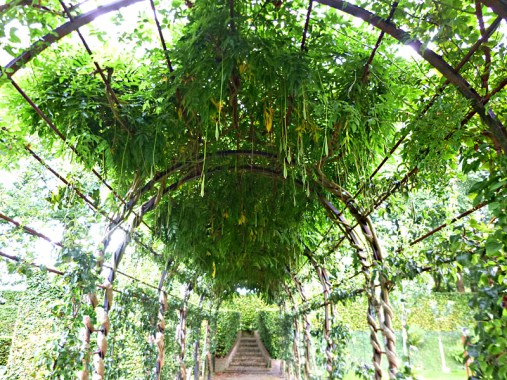
wisteria pods
Black & white
July 29, 2017

There is a book of Juane Xue’s work called , ‘Color is my wealth’. I share this sentiment, as color is the driving factor in most of my paintings.
But lately I’d been craving the feel of charcoal in my hand, the smooth way it goes onto the paper, the play between dark, rich passages, and lighter ones lifted out with a kneaded eraser. When I was 10 years old, I started out learning to draw with charcoal in my art lessons with Abe Weiner. It remains a medium I’m familiar and comfortable with. The fact that color doesn’t figure in charcoal drawings lets me focus on form and texture. Very relaxing actually. In painting you have to juggle form, value, intensity, all the while keeping an eye on color balance as well.
Our neighbor who keeps his horses in the field behind our house is very ill. Over the past 20 years, we have had so much pleasure from Bernardo, a large Groninger work horse and jumper. I rode him once, and D let me help train him, and taught me to fit him up with all the carriage equipment and harnesses. Whenever D was away, I attended to Bernardo’s sore hoof, and made sure that he had enough food and water. Now his owner is in the hospital, the horse will probably be sold.
I made these drawings for him to remind him of the good things in life, while he lies in pain in a bed far from his home and horses. The second sketch is of Junarla, and her new foal, Juno, quite a character already as you can see below. D bought Juno in a more optimistic time, to have a new horse to train because Bernard is already around 20 years old. I sent the drawings off last week, hopefully they are giving our friend some solace. I guess Juno, now 2 1/2, will be sold as well.

Juno and Junarla, ‘Come on mommy and play’ charcoal on paper 18 x 24″
Canals and edible gardens
January 14, 2017


These two images were a departure of sorts for me, they are based on some photos I took in high summer last year. I don’t get inspired much by the idea of painting landscapes, it feels too limiting. But these two small format pieces on panel were done with a large brush to keep from getting caught up in details, and I like their freshness.
Every day I walk through these wide open Dutch skies and fields. There is a lot of water where we live, giving movement and direction to the flat, spread out landscape. I am constantly moved by the land here, how the light hits trees and fields, the changing colours throughout the day. It would be a natural painting subject if it weren’t milked ad infinitum by good and bad local painters. I have rarely found an ‘in’ to painting my surroundings because I like to use lots of colours and I need room for fantasy as well as reality.
Here is another realistic one from the same series:


This piece, done more recently, is more in line with what comes naturally to me. I love how the landscape elements creep into the still lifes, or is it the other way around? It is also large, 50 x 50 cm.
This one below was more successful to my eye, I knew more about where I wanted to go with it.

Pears and bottles acrylic on canvas board
I love the small boat in the upper left corner, floating on a sewn sea with little red stitches. These pieces definitely have their own rhythm and structure if I step aside and follow where they want to go.
The latest in the series:

Honey garden acrylic on canvas board
There were lots of surprises here, it is quite large, 50 x 70 cm. The little boat has returned to a more prominent place. The beet is kind of archetypal and the spirals please me.(There are elements reminiscent of some of Bob Knox’s work. A fellow artist from Findhorn who taught me by example, just how fun art could be. If you google him you’ll probably come up with a lot of his beautiful New Yorker covers.)
Leading on from here, ‘Garden’ is my new theme, I think. I’m totally inspired by our community edible garden and the work of Fritz Haeg.
Joyful discovery painting mystery tour
June 5, 2016
To the loyal handful of followers, thanks you make it worthwhile. And to new passers by. thanks for dropping in. It feels good to be sharing my joyful discovery painting mystery tour with you.
Continuing with the ‘Spirit of Trees’ series, I took on an unfamiliar subject this time- landscape/architectural. This painting is a lesson in overworking, and why it is so compelling, even though 9 times out of 1o it goes wrong. Below is a version I found ok but too fussy (with the detailed roof tiles). I wanted a yellow tree per se. And I wanted to keep it painterly and fresh. But I kept trying to get the whole thing looser, and eventually, I feel I lost the sunniness of this version. See painting under this one.

Grandfather tree sunny 50 x50 cm acrylic
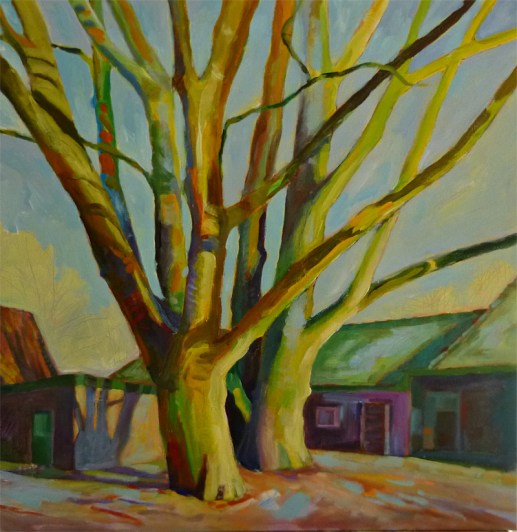
Grandfather tree meets the walking dead
In my search to use my own colours rather than the given ones (see that the warm terracotta from the rooves is replaced by greens), I feel I lost something of the warmth of the first version. It kind of looks eerie, like the light before a bad storm moves in.
Between this phase of the painting and the previous one, I had also painted the sky soft yellow, you can see the remnants of that behind the buildings. That move killed it, so I reinstated the blue. You know what?, it began not to be fun any more, yet I’d started it with a wonderful sense of excitement. I’ve learned ( I hope!!!) to stop when the joy goes underground and painting becomes about trying to ‘correct’ something, or ‘get it right’. The fatal flaw in this painting was that I started with a concept (yellow tree) and didn’t listen enough to the subject or the painting.
A few days later, I got inspired by a photo I’d made of two onions on my work table. I took an old painting and drew right ontop of it, then started in painting rapidly, leaving some patches of background exposed. I loved it so much after the initial blocking in, that I didn’t dare to work on it any more.

Onions1 acrylic
So I put it aside and started a new one ontop of yet another old painting. I listened better this time and kept the freshness. It is mostly done, see below.
Here is what I learned, the lessons are particular to my own trajectory toward an intuitively sensed goal of where my truest work lies. So maybe they will be applicable to you, maybe not, but here they are:
- let parts of the painting remain unfinished if that’s what looks right
- cherish the roughness, don’t try to paint ‘beautifully’
- don’t try to have everything make sense
- follow the painting, not my original ideas about it when I started
- don’t describe, dance.
- the goal isn’t to get the subject right, but to get the painting to feel good, true
By the way, I feel that this tutorial taught me more in a few minutes than several advanced painting workshops I’ve taken. And buying a brush similar to the one this woman used was also a revelation! Materials help or hinder so much.
Here is the second onion painting, almost done. It makes me very happy.

Onions2 acrylic
What we need more of
November 24, 2015

Art holds time, oil pastel collage, S Zoutewelle-Morris
It has been ages, nearly 3 months since I posted. Hi again, to the handful of faithful followers who make this worth doing.
Crazy months dealing with health issues. There is an operation coming soon, and hopefully after that things will settle down into a more normal routine again.
My art is in a turbulent period of its own. I think I included some of the newer experiments this last summer,where I was letting go of form and trying to paint more intuitively. I’ve been more comfortable with watercolour sticks (a kind of crayon that is water soluble) and collage lately, than oil paints. I want to do quick, spontaneous studies rather than labour over one painting.
Rende and I have an upcoming exhibition in a high quality interior store here in the north of Holland. He’ll be showing woodwork and photography, and I’ll hang 18 pieces, oil pastels and oil paintings. I’ll link to the site when they’ve got our info there.
I know I’ve posted the art above before here, and probably the quote as well, but it is worth repeating:
What we need more of is slow art; art that holds time as a vase holds water: art that grows out of modes of perception and making whose skill and doggedness make you think and feel; art that isn’t merely sensational, that doesn’t get its message across in ten seconds, that isn’t falsely iconic, that hooks onto something deep-running in our natures.
In a word, art that is the very opposite of mass media. – Robert Hughes
Two prints for sale
June 8, 2015
Some time ago I had some prints made of a few of my oil pastels. They’re mostly sold out, but I have 2 left I’d like to make available for purchase.

SOLD Tuscan landscape is 36 x 30 cm (14″x 12″) (image area not including wide border).
(later) I just ran across one more of this one.

SOLD OUT Living Tree is 26,5 x 30 cm(10,5″ x 12″) (image area, there is a very thin white border).
Both images are printed on beautiful quality heavy watercolor paper. Acid free.
They are 60 Euros ($67 each)
or 100 Euros for both ($112). Includes shipping anywhere. They will be packed in a cardboard tube.
Payment by Paypal or bank transfer. Contact me through the comments if you are interested.
Barry Lopez: Tell a story that helps
May 5, 2015

Barry Lopez (source of photo)
Barry Lopez is one of the writers who has ‘accompanied’ me on most of my adult journey as an artist. (See my post Barry Lopez, A literature of hope ). He is a nature writer, but that short description doesn’t do him justice. He is also a poet who feels the pain of the Earth deeply. And, he is an artist who understands and exemplifies what art is for, especially in these times.
I love these artists and role models,who have sustained their passion and honed their craft over the years. They are gradually turning into our present day Elders. Hearing Gary Snyder or Barry Lopez speak unfailingly reunites me with the best in myself.
This morning I looked at an almost completed draft of my book so far and couldn’t relate to it. I’d momentarily lost my sense of True North, and wondered how I would finish it with this late-stage failing of nerve. Unable to write, I decided to do some research for a later chapter on ‘art and wounded places’, and watched several of Lopez’s talks. And one of them showed the way out of of my impasse. It gave me a new lens for looking at my work and lifted me out of the familiar contradictions I usually get caught in when stuck.
He spoke about story telling. He’d had a conversation with a traditional man,( I sense he meant someone indigenous), and asked if this man’s people made a distinction between fiction and non-fiction like we do in Western society. The man answered, ‘For us, the difference isn’t between fiction and non-fiction, but between an authentic and inauthentic story.
Lopez asked him the difference and he said, ‘An authentic story is about us.’
‘Yes?’, Lopez asked.
‘And an inauthentic story is about you’, replied the man.
Lopez had a crucial insight as a result of this conversation. He realised that the story you tell as a story teller is not worth our listening to if it is just about you. He said,’We don’t need to know about you, we need to know about us’. I think what he is saying here, is that a writer needs to delve down beyond the purely personal until he strikes something universal in human experience which will illuminate all our lives. Also, adding my own note here, if an artist is working with rage or pain, she has a responsibility to transform it before it hits the page. We all know how bad life can be, we have the mass media to tell us all about that.
It is the artist alchemist’s task to harness that personal negativity and transcend it, and to use it as raw material to craft images of hope.
Lopez says that an authentic story needs to do two things; first of all it has to help. And secondly it has to be about ‘us’.
I want everything I write to end with this note:’Here is what I saw, what do you think?’. Instead of saying, ‘Here is what I saw and this is what you should believe’. -B.Lopez
The writers, artists and musicians I’ve respected most and who have inspired me in my life so far, are growing older along with me. Like Barry Lopez, time and experience distil their youthful passion to a focused potency. I feel enormous wisdom radiating from these people. But even more than the understanding they have gained through living and practising their calling, they embody compassion.
Lopez said,’
I want more than anything to see people do well. I want to see people thrive. And the system I see in place all over the world is killing people. I feel that as a physical pain, as grief every day when I get up in the morning. What drives me is – if you’re going to tell a story, tell a story that helps. If you’re going to collaborate with directors, filmmakers, artists et , make common cause with people whose desire is to help.
Not to direct the show or tell somebody else what to think, but to behave in a helpful manner for the benefit of everybody.
(See the 3 minute clip of this talk here )

Bottles and still life, oil on canvas board
I’ve been concentrating on developing my oil painting for nearly 5 years now. Having a long career as a fine artist, graphic designer and calligrapher up until then, I already had a good foundation of drawing and composition. So I didn’t have to start from scratch, luckily. It has been mostly about learning the medium, and I’ve shared that process here fairly regularly. This is my first painting after a several months interlude of copying the work of some other artists. I learned a lot from that process, mostly about paint application and relaxing a little.
Basically I’m satisfied with this painting, it is another step along the way. What I am sure of, though, is that this isn’t my destination- ie perfecting realistic representation. I’ll talk more about that in a minute. Meanwhile, this has a nice story behind it.
Awhile back, I took a photo of a bowl of nectarines at my mother in law’s home and did a few paintings from it.

It eventually landed downstairs near where Rende’s computer is. We moved my bottle collection out of our show window and they ended up in front of this still life. (You may recognise some of my first paintings of this collection from several years ago.)


So the bottles against the still life caught Rende’s magic eye, and he made several photos, they were so rich and juicy and deep, they nudged me out of my uninspired period- I had to paint them.
Painting something that is already beautiful is a major challenge! The question is, what can you add? The painting all the way at the top is a response to the richness of Rende’s photo, but it is also about mastering technique to capture what moved me. I liked the sharp clarity of the glass against the fuzzy background; a special challenge was muting the fruit still life behind the glass to make it look out of focus as it was in the photo.
But technique is never the end goal, it is simply a tool. My journey in paint is away from rendering to suggesting. But I don’t know how to do that, so I have to keep doing one piece at a time and let the work teach me. I don’t know if anyone can see the steps made since the first glass paintings, but I am moving closer to painting the way I feel.
Also important to me, not quite achieved in this last painting is letting go of form to the extent that the canvas surface becomes interesting in itself. The rhythm of the brush strokes, the layers of paint, the texture of thick and thinly applied colours all are more interesting to me than depicting a real object perfectly.
I want to paint that way NOW. But take it from me, this process of discovering your own vocabulary of marks can’t be rushed or forced. In ‘Art and Fear’, by Bayles and Orland, (super book by the way), I remember something about how important it is to develop pleasurable working habits, and that these somehow also help you to find your work. I think even the set up of your palette could influence how you use colour, for example. One person might place the cadmium yellow closer and another might place it at a far end, so it is less easy to reach- so you just end up using the colour closest to you.
I watched a video of David Hockney painting one of his landscapes from his show ‘a Bigger Picture’. All his years of daily work just flowed out of his brush like a guided dream. He did one complete painting a day, and it looks so easy! But watching him taught me about working from back to front (sky first, then branches) in a landscape. It completely changed my thinking, so this is the set up for the next painting, same subject slightly different crop. I’ve sketched in the masses in the background and foreground, and am aiming to suggest more and work even more loosely.

Set up for second painting
Take one ‘Chocolate Rain’, and call me in the morning.
February 6, 2015

In 2011, my book ‘Chocolate Rain’ was published by Hawker Publications, UK. It has been received well and has steadily found its way into the hands of more and more relatives, carers and professionals who work with people with dementia.
Last month I received wonderful news, my book had sold out of the first printing and is being reprinted because it had been chosen along with 24 others as part of Reading Well’s Book Prescription list for Dementia! I went to the official launch while I was in London, met a few friends there, John Killick and Richard Hawkins to name two, and was inspired to learn more about this initiative.
Reading well is a health initiative of the Reading Agency, a non profit that encourages people to read more. Their Books on Subscription project is brilliant in its simplicity. They team up with libraries, health professionals, and health organisations to make self-help books on common health problems widely available through libraries.
At the launch I was most impressed by the transdisciplinary collaboration that makes this project possible. Reading Well’s Book prescription list for Dementia is actively promoted by the Society of Chief Librarians, partly sponsored by the Arts Council England, and works closely with health organisations like the Alzheimer Association. The combined efforts of all of these bodies make general health information, in this case information about dementia, low threshold and easily available to everyone through their local public library. Particularly cool, I find, is that doctors and other professionals (therapists, social workers, etc) can prescribe these books to their patients so that they can become more empowered by becoming informed about their-, or a relative’s condition.
Last year the books were available in 95% of all the libraries in the UK.
In its first year, the scheme reached 275,000 people with accredited self-help reading, helping people to understand and manage common mental health conditions such as anxiety and depression. Library issues of titles on the core book list have increased by 113% and around 7,000 health professionals are using the scheme on a regular basis to recommend books.
What it means for me and the other 24 authors, is that our books will get a huge boost in getting out to where they are needed. Last year’s book saw large sales increases as well, which is only good news to anyone who relies in part on royalties for their income.
My book is an activity/support for carers book, additionally there are books on Living well with dementia, including, ‘Dementia Positive’ by John Killick, Luath Press. In the category, Support for relatives and carers, Graham Stoke’s much lauded,’And still the music plays’, published by Hawker. And in Personal stories, ‘The little girl in the radiator: mum, Alzheimer’s and me’ by Martin Slevin, (Monday books).
‘Chocolate Rain’ is available at the many Dementia and Care congresses organised by Hawker publications in the UK. And on line from Book depository, Amazon uk, etc., and directly from Hawker publications.
 Art Calling