

Fifty years after its first publication, The Lord of the Rings found a new and even larger audience in a new medium, the three films directed by Peter Jackson and released in successive years 2001–2003. These are some of the most successful films ever made. The three between them had taken some £1,279 million at the box office, a figure certainly multiplied by VOD and DVD sales, especially of the extended versions which will give a final total running time of close on twelve hours. It is impossible to estimate how many viewers this will represent, since one DVD can be seen by many people, and conversely the box office takings are inflated by repeat viewers, but it is safe to say that hundreds of millions of people have seen or will see the films. There will almost certainly be more viewers than readers (though of course they are often the same people). In light of this it may seem bizarre that while Peter Jackson was making the films, the moguls of Hollywood, alarmed at the ever-increasing scale and cost of the production, sent to New Zealand a ‘script doctor’, whose job it was to get the films back on track. The ‘script doctor’ immediately saw the faults in the Tolkien plot. Having heroes riding (or in this case walking) to the rescue of a threatened people was of course perfectly familiar and acceptable, as in The Magnificent Seven: but there was no need to have two threatened peoples, Rohan and Gondor. One of them could be cut out, which meant that the battle of Helm’s Deep could be amalgamated with the battle of the Pelennor Fields. A love-interest for Aragorn was also clearly vital, but once again there was no need for two of them: either Arwen or Éowyn should go, preferably Arwen, and Aragorn should then marry Éowyn instead of politely dissuading her. One could then make a further saving by eliminating the figure of Faramir. Meanwhile, though there was some doubt about the wisdom of having such small and unheroic figures as hobbits as heroes, they might be retained as a gimmick: but four of them were one too many. And it was absolutely vital that one of the hobbits should die. With changes like these, The Lord of the Rings could be converted into a perfectly acceptable, run-of-the-mill movie script–at the expense, of course, of cultural contrast, originality, emotional depth, and a few other inessentials. The script doctor’s advice was ignored, and Jackson’s films perhaps convinced even the moguls in the end that there was something they did not know about popular appeal. Nevertheless, the changes proposed do say something about the individual and even eccentric nature of Tolkien’s work. So often it does not do what one might expect. But the success of the films does raise a more important issue. For many people, The Lord of the Rings now means the film version, not the books. In what ways are the two versions different, and would Tolkien himself have approved of the difference?
The Art of Alan Lee
15 Dec

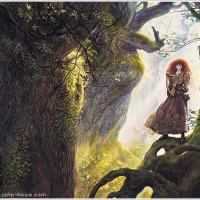
I appreciate fantasy artwork both for its aesthetic merits and for its importance to selling fantasy novels. They say you should never judge a book by its cover but I will freely admit that there has been more than one occasion on which I have been drawn to read or buy a book because of a spellbinding illustration on the cover that has made me just itch to find out more. Some illustrators have become as synonymous with certain writers’ work as the words themselves – it is difficult to imagine Alice in Wonderland without John Tenniel’s iconic sketches, Dickens and Phiz go together like salt and vinegar, and even today most editions of C S Lewis’s Narnia novels are adorned with the illustrations of Pauline Baynes. Perhaps the most perfect example as far as fantasy novels go of an author and illustrator being artistic soul-mates is that of Alan Lee and J R R Tolkien.
Top Posts & Pages




The Inn at the Edge of the World

Click image to read my short story 'The Inn at the Edge of the World' in Bardic Tales and Sage Advice, Vol. 8.
The Witch of Wicken Fen

Click image to read my short story 'The Witch of Wicken Fen' in Aphelion, the Webzine of sci-fi and fantasy.
Tolkien
-

Another Road to Middle Earth
Fifty years after its first publication, The Lord of the Rings found a new and even larger audience in a new medium, the three films directed by Peter Jackson and released in successive years 2001–2003. These are some of the most successful films ever made. The three between them had taken some £1,279 million at the […]
-

After the King: Tolkien’s heirs
It is something of a relief, having looked last month at his critics, to turn this time to Tolkien’s many admirers. It would not be true to say that there was no such thing as epic fantasy before Tolkien: there was a tradition of English and Irish writers before him, such as E R Eddison and […]
-

Tolkien: The Monsters and the Critics
“This is not a work that many adults will read right through more than once.” With these words the anonymous reviewer for the Times Literary Supplement (25 November 1955) summed up his judgment of J R R Tolkien’s The Lord of the Rings. It must have seemed a pretty safe prophecy at the time, for of […]
-

The Wolf in the Attic
1920s Oxford: home to C S Lewis, J R R Tolkien and, in Paul Kearney’s novel The Wolf in the Attic, Anna Francis, a young Greek girl looking to escape the grim reality of her new life. The night they cross paths, none suspect the fantastic world at work all around them. Anna lives in a […]
-

Of Wood Woses and Wild Men
In The Lord of the Rings a strange and primitive folk named the Woses came to aid the men of Gondor in breaking the siege of Minas Tirith. These wild woodland people lived in the ancient forest of Druadan, below the White Mountains. In form they were weather-worn, short-legged, thick-armed and stumpy-bodied and they knew wood-craft […]
 Fabulous Realms