
Frescoes in Sistine Chapel by Michelangelo. (Wikimedia Commons)
Threat and Competition, Authoritarianism and Dominance
Stress, specifically severe and chronic, doesn’t only cause, worsen, or increase trauma, physical sickliness, mental illness, addiction, alcoholism, antisociality, dysfunction, impulsivity, aggression, and violence; doesn’t simply or inevitably damage people, waste human potential, and cripple a society. It’s not only a factor of harm, as the human species evolved to deal with stress, sometimes to thrive in it. Human nature always seeks to make the best out of a bad situation, even when it comes at great cost. The human reaction to stress always attempts, however imperfectly and inadequately in many cases, to rise to the occasion. This might be why collective action is often most impressively successful in response to the hardest of times, such as the New Deal following the Great Depression. Difficulties can force people to think more deeply and innovatively. It shakes up the stultifying status quo and lets fresh air into the public mind and imagination.
Right-wing mentality, behavior, and social order is an evolved adaptive response of survival toward threats and competition: mortality salience, terror management theory, etc. Real or perceived threats, risk, danger, violence, and death induces right-wing authoritarianism (RWA), as linked to low measures of liberal-minded ‘openness to experience’. Whereas competition, conflict, high inequality, dominance hierarchy, and power disparity induces social dominance orientation (SDO), which is positively correlated to dark triad (Machiavellianism, narcissism, & psychopathy; + sadism) and negatively correlated to ‘honesty-humility’ (HEXACO). RWAs are the stereotypical authoritarian followers and SDOs the stereotypical authoritarian leaders, with Double Highs (RWA+SDO) concentrated on the far right (Bob Altemeyer). Threats and competition tend to coincide, which is why RWAs and SDOs tend to operate in concert as part of shared authoritarian movements, groups, and power structures.
The point is that its adaptive, however distasteful and demoralizing this is to liberals and leftists. Though one doesn’t want to get stuck in such a worldview, our species might not have survived without this capacity. Think of parasite-stress theory and the behavioral immune system. Infectious diseases and parasites that are spread by human contact (nonzoonotic) increase conservatism, authoritarianism, xenophobia, and punitiveness — oppressively closing down society and closing ranks to exclude outsiders. Every society that turned totalitarian earlier last century had high rates of such disease. Yet it can motivate and inspire a population toward greatness. Look how the USSR transformed a feudal society into a modern industrialized global superpower almost over night, if it can’t be denied that it was done brutally. The Soviets didn’t just generally overhaul their society but, specifically, improved public health. The infectious disease rate dropped vastly. This is the likely cause for why the late Soviet period saw a liberalization of culture, an emerging openness as the strictures loosened. Ironically, authoritarian policies, by having improved health conditions, likely contributed to authoritarianism having lost its binding power over the public mind.

Germans stand on top of the Wall in front of the Brandenburg Gate, before this section was torn down in the hours before the West German leader walked through the Gate to greet his East German counterpart. (Wikimedia Commons)
Regal vs Kungic, Greatness vs Goodness, Work vs Labor
Extreme stress tends to bring out extremes in human nature, both good and ill. The negative extremes stand out because of how destructive and sad they can be. So much unnecessary struggle and suffering is the cost of a stressed-out society, especially seen in high inequality (Keith Payne, Richard Wilkinson, Kate Pickett, etc). Yet at the same time, stress puts the psyche into overdrive to confront, tackle, and resolve problems. Consider how humans come together during catastrophes (Rebecca Solnit, A Paradise Built In Hell). This can even be true for long-term stress. For the lucky few who survive the harm and aren’t ground down by it, for those who escape the worst of oppression and persecution, the challenges of a dangerous and deranged society can occasionally induce greater levels and expression of cognitive functioning. This is part of the survival response. The brain goes into high gear because it has to in order to match demands, but running at the maximum all the time has massive costs and consequences to health and well-being. Individuals, segments of the population, or entire generations are sacrificed for group survival.
This might be similar to the underlying dynamic for the old observation about creative genius coinciding with ‘madness’: emotional instability, psychiatric disorders, alcoholism, drug addiction, etc. The data does show that neurodivergence corresponds with mental illness, as well as physical illness — those with autism and/or ADHD are more likely to have mood disorders, addictive behavior, psychosis, dementia, metabolic syndrome, etc. It also fits an observation made by Agner Fog in his scholarly tome, Warlike and Peaceful Societies. What he calls a regal society is a combination of RWA and SDO; maybe think of it as dominance authoritarianism, beyond run-of-the-mill group conformity alone. Kungic societies, on the other hand, are a combination of liberalism and egalitarianism. But the distinction between the two stands out in cultural output. Many of the greatest artists in history were products of regality. In regal societies, literature, music, art, and architecture tends to be perfectionist, complex, meticulous, ornate, embellished, luxurious, and pompous; often large, conspicuous, obtrusive, glorifying, monumental, and permanent; as well as rule-bound, precise, controlled, formulaic, stylized, and repetitive. Regality is like porn. We all know it when we see it. But as few of us Americans have ventured far out of regality, the kungic is less familiar to us.

Baiga Tribe in India is known for their art of tattooing or ‘Godna’. (Wikimedia Commons)
While the regal aspires to greatness, the kungic is often satisfied with mere goodness or else mere personal value. Regality is meant to impress and overwhelm or even intimidate, to make one feel small and insignificant in comparison, such as an Egyptian pyramid or medieval cathedral that towers over the individual and reaches up to the sky. The difference is particularly seen at the other extreme endpoint of kungic societies. That tends toward the personal and idiosyncratic, often impermanent or even transitory with no aspiration of it lasting for millennia, much less imposed upon eternity. Consider a traditional Zen garden where the patterns in the sand are meant to represent the shifting nature of reality, a monument only to emptiness and the intangible. Or more commonly, there is the widespread indigenous practice of tattoos, meant to only last as long as the body they adorn. To go further into the kungic might push us entirely into different territory. The example I always return to is that of the Piraha. Among known cultures, they appear to be one of the least stressed, traumatized, and mentally ill; as well as the least authoritarian, hierarchical, and punitive. Maybe that relates to why they also lack any native tradition of storytelling, art, and decoration. They don’t memorialize or cling to anything, don’t attempt to maintain collective memory — almost more Buddhist than Buddhists.
The world we know is the end product of centuries and millennia of regality. The remnants of all things kungic are so scant in the modern West, particularly in the modern US, to be almost incomprehensible. We generally assume that regality is the purpose of society, the height of civilization. We’ve been indoctrinated to revere greatness. Involving this insight, Fog argues that, “The regal periods in human history have not only produced war, tyranny, imperialism, slavery, cruelty, and mayhem, but also formed the preconditions for the highly developed society that we live in today. Most of the basic principles of law that are necessary for a civilized society to function today were developed in regal periods. Classical music, as well as many of the magnificent pieces of art and architecture that we are impressed by today, was created under the regal regimes of the past. We admire old fairy tales without realizing that they were written to glorify sovereign kings and emperors and to make unambiguous distinctions between friend and foe, between good and evil. And we enjoy the fruits of past scientific, technological, and political progress without thinking of the incredible hardship that made it possible.” An example of that is how the Cold War provoked a race between the USSR and the US to ever greater technological achievement and prowess, which included a concerted effort to mass educate the public in the STEM fields.
When I first read Fog’s book, that larger point of civilizational greatness stood out the most to me. While I was reading the section on art, I happened to be sitting in the domed atrium of the West Baden Springs Hotel. It’s about as regal as you can get. Located in southern Indiana, it’s an old resort area that once attracted a lot of money. It was a favorite location to visit by well known figures from politics, Hollywood, and organized crime. It was designed as an expression of privilege and power, of excessive wealth, extravagant inequality, and conspicuous consumption. The design, murals, statues, etc imitated the traditional style of European architecture that once would’ve been a symbol of aristocracy and nobility. But with its vaunting dome, it simultaneously was a modern architectural feat to inspire awe by it’s sheer magnitude.

West Baden Springs Hotel Atrium, built 1901. (Wikimedia Commons)
It’s not only that hunter-gatherers have never built such things nor would be able to. More importantly, they’d have no motivation to do so and likely couldn’t even imagine attempting it. One intriguing detail came up in a book I was reading lately. Generally, indigenous foragers are content to do as little labor as possible for survival. They’re usually societies of not only low stress but also low need. In particular when still living on traditional hunting lands, they don’t lack food and other resources to meet all their daily requirements. To maintain this healthy state, they use birth control to limit their populations to the carrying capacity of the environment they’re in. They’re incentivized to live in balance with the ecosystem and its constraints, not to endlessly strive for ever greater achievements, not to push the furthest extreme of consumption and destruction (i.e., Wetiko). This lifestyle allows them to labor far less than either farmers or industrialized moderns (Marshall Sahlins, The Original Affluent Society). Most of their labor is casual and social, particularly emphasizing the latter. It’s often more about a community solidifying its ties through shared activity, such as group songs and chants.
This reminds me of an old conservative fear, as typically trotted out as a critique of the welfare state. Though I’ve dismissed it in the past, I now recognize there may be a kernel of truth to it. The right-wing has often fallen into moral panic over human laziness, the belief that people wouldn’t work unless forced to and extrinsically rewarded with money, prestige, authority, privilege, etc. And of course, unless there is punishment for those who refuse to work or refuse to do the work that’s available — go down into that dark mine where you’ll get black lung or else your family will be homeless and starve. A major purpose for privatizing and destroying the commons was to deny people access to natural resources and so deny them the ability to take care of their own needs naturally, as humans have done for time immemorial. It’s part of creating and enforcing artificial scarcity. The capitalist class rightly understands that no one would freely choose to work in a factory, a data center, a warehouse, a big box store, etc. It’s not the kind or degree of labor we humans evolved for.
That’s why capitalism requires coercion, and also why it’s long been understood a free society isn’t possible with high inequality. Related to that, without threats of desperation, without enslavement or wage slavery, few humans would willingly participate in building palaces for royalty, skyscrapers for plutocrats, battleships for empires, or whatever else. And without an unfree working class to do their bidding and take care of the needs of the privileged, there couldn’t be sustained a class of architects, masons, artisans, and other related professionals to dedicate their lives to such massive projects. Specifically, a caste- or class-based society creates a privileged elite that has the free time, resources, opportunities, and support to sit around thinking about ‘great’ things. Without the suffering masses, there wouldn’t be professional politicians, generals, CEOs, tycoons, bankers, judges, lawyers, celebrities, etc. It would even be hard to maintain an intelligentsia of journalists, authors, philosophers, scientists, public intellectuals, artists, etc.

SpaceX CRS-14 Falcon 9 rocket lifts off. (Wikimedia Commons)
Vanity and Narcissism or Progress and Public Good
This is partly what is meant about Make America Great Again. It’s a desire for a great empire that’s capable of taking great actions, of forcing their greatness on the world — all guided by great (cis-hetero, white) men, of course. As an example, public wealth and resources are used to build Elon Musk’s rockets and satellites, as a demonstration of Western power, capacity, and supremacy. It’s largely irrelevant why we’re spending so much money to feed the narcissism of the already wealthy. There is no evidence that such activities are a net benefit to humanity and the planet. Every time a rocket is launched, more of the atmosphere is literally burned up. The motivation of the aspiring technofeudalists seems to be simply the fantasy of building space resorts and havens for themselves to escape to, as the world is literally decimated. In some ways, these elites apparently define their own greatness according to how much destruction they can cause, as part of an accelerationist vision of supposed creative destruction. But they mainly focus on the destruction part with the assumption that the creativity, presumably useful and beneficial, will follow later.
The point is that something like a rocket ship proves the greatness of not only the elite but of all society that the elite get credit for. It’s not a matter of a good reason for doing it, just that it can be done. It’s a vanity project. All of regality is about collective vanity, the reason group narcissists like MAGA evangelicals are drawn to follow individual narcissists like Donald Trump. The laboring classes are supposed to be satisfied knowing they’re part of the greatness. Similar to the wages of whiteness for racists, these are the wages of imperialism offered to imperial subjects. It’s supposed to be a psychological and social compensation for their miserable lives, as if all their sacrifices go to a greater cause. Unlike the oppressed and brutalized that are the targeted victims in the permanent underclass and in foreign countries, at least the favored imperial subjects in the heart of the empire get to participate in a shared identity of greatness. They get to watch the martial parades and hear about the great wars and victories of the imperial military. Or they get to watch a rocket launch into space to prove and demonstrate they’re defeating the commies.
Yet there is also a genuine sense of human progress. Not all of this aspirational greatness is narrow-minded self-praise. American imperialism, during the Cold War, had an air of leading the world into a bright future. Many Americans and even non-Americans were persuaded and inspired by that vision of greatness, in many ways utopian. It wasn’t merely about getting the first human to the moon but what it meant to have developed science and technology to such a degree that it was possible at all. If that could be accomplished, then maybe there were no limits to what humanity could do. It’s similar to why Romans could feel proud of what their own empire accomplished with highly advanced structures (Coliseum), infrastructure (roads, aqueducts, etc), and trade networks (pony express-style system, largest fleet of boats, etc). The Romans really had achieved feats of the likes never before seen. To a degree, there was a validity to that pride, if it comes before the fall.

Roman Colosseum. (Wikimedia Commons)
Even amidst authoritarian evil, people can feel uplifted in striving toward improvement, betterment, and progress. The Nazis exhibited this. They did more than just persecute and kill millions of people. Until self-destructing in a blaze of their military greatness, the Nazi government had resurrected the economy (e.g., erased national debt), improved conditions for the working class (e.g., German Joy), rebuilt infrastructure (e.g., Autobahn), and so much else. It’s why so many older Germans persisted in feeling nostalgic about the Nazis, long after World War II ended. The Nazis also had been the leading researchers in the world in numerous fields, from organic farming to cancer treatment. It’s true their organic farms were operated with slave labor, but at least Nazi soldiers got to eat high quality organic food. On a more interesting note, the Nazi leadership protected Otto Warburg, a cancer researcher who was Jewish and openly gay (Sam Apple, Ravenous). One official explained that they did so not only for the good of Germany but for the good of the world. By the way, Warburg’s theory increasingly looks like it might be correct (Metabolic Theory of Cancer: Past and Present).
It’s not unlike how the United States only became the new world leader of scientific research when it too became an empire, in enforcing Pax Americana. No other social system other than goliaths, as Luke Kemp calls them in Goliath’s Curse, can rally such vast resources and direct them toward targeted ends. Or at least, I can’t think of a counterexample, other than some smaller-scale regal societies like the Renaissance city-states. Part of it is that, when regality rules, many brilliant and talented individuals are drawn to the center of Goliaths. That’s why, during the height of Hellenic culture in the Alexandrian Empire, so many of the greatest ‘Greek’ philosophers, physicians, and teachers weren’t even ethnically Greek. And it’s precisely in concentrating so much human potential in one place that forms the creative hubs that potentially ratchets up dynamic innovation (Richard Florida, The Rise of the Creative Class). But the losers in this equation experience brain drain (Richard Florida, The Flight of the Creative Class). Once again, it’s not exactly clear it’s a net gain for humanity overall.
This is where the liberal and egalitarian have a strong counter-argument. What is all this greatness for? What purpose does it serve and to what end or whose benefit? In response to MAGA authoritarian rule, it’s not only a critique of what kind of greatness this is and whether or not it’s really great at all. More important, why prize greatness of any sort over all else? Why not, instead, seek to Make America Good Again? My point would be simply to note that, for whatever reason, so often the public good is a response to dark times. If not for the 1929 stock market crash and Great Depression, there wouldn’t have been the public demand to have elected Franklin Delano Roosevelt nor the political will to have enacted his New Deal, along with Lyndon B. Johnson’s Great Society following it, nor Richard Nixon’s shockingly radical progressivism. The post-war liberal consensus was a product of mass failure and strife that demanded a collective effort of both greatness and goodness. The US became the shining city on the hill. But the point is that it was the goodness that justified the greatness.
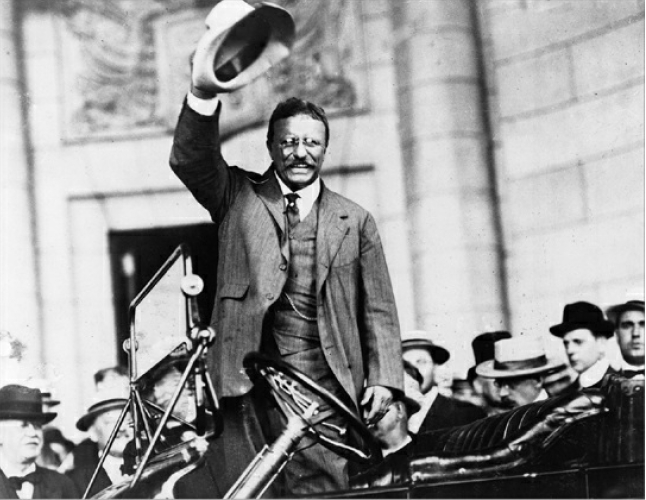
Theodore Roosevelt visits Washington, D.C., 1914-05-26. (Wikimedia Commons)
Only a generation earlier, the same pattern had occurred. The first Roosevelt presidency, that of Teddy, was in response to the Gilded Age and the conflict it spawned during the Populist Era. That’s what jumpstarted Progressivism in the first place. Though very much a product of regal authoritarianism and plutocracy, TR as a right-wing Progressive carried forward some sense of noblesse oblige, the ideal of moral greatness that was demanded of the leadership, at a time of crisis when many worried the elite no longer were able to rule well (The Crisis of Identity). But he also understood that the public good transcended identitarianism, including racial supremacy (Brian Kilmeade, Teddy and Booker T.), and partisanship (Confession of Faith; Socialism, II — Where We Can Work with Socialists; & Theodore Roosevelt, an Autobiography; see Capitalists Learning From Socialists). He was willing to be a great leader and to accept sacrifices. Like LBJ understood later about desegregation (“I think we just delivered the South to the Republican Party for a long time to come.”), TR realized that forcing political and economic reforms would come at a cost, specifically that trust-busting would lose him re-election. But that didn’t stop him. Rather than promoting his own personal greatness, he sublimated his identity into the greatness of the American nation as an aspiring empire.
It wasn’t only imperialism, though. Having had a sickly childhood, TR personally identified with the public health crisis that had been crippling society, not to mention having caused so much harm and death. [Tellingly, his nephew FDR also dealt with major health issues. This might be what allowed these figures to act as counter-elites.] In that period, many Americans believed America could and should do better. It was akin to how the catastrophe of the American Civil War helped promote an emerging national identity that coincided with national projects: railroads, national museums, land grant colleges, etc. Heading into the 20th century, a new period of large-scale projects came on the scene, partly inspired by nation-wide protest movements and strikes. There was no singular identity of being American prior to the US having become an imperial goliath, and it was a new national citizenry that could imagine national greatness. But it also inspired major projects at all levels of government, such as the Milwaukee municipal socialists being the first to build a sewage system for the entire city population, not limited to the wealthy areas. All that we take for granted now was once a radical proposal.

Emil Seidel, first socialist mayor in US, running mate of Eugene V. Debs. (Wikimedia Commons)
Great Problems Require and Inspire Great Solutions
Only great civilizations can achieve such greatness. But then again, only great civilizations need to do so at all. That’s because they’ve often created the problems they needed to solve or overcome. If not for mass urbanization exacerbated by mass industrialization, there wouldn’t have been mass malnourishment and disease epidemics. Obviously, hunter-gatherers don’t need to develop and construct a complex sewage system. It’s a non-issue. But also, under normal conditions while maintaining traditional diets and lifestyles, most indigenous people maintain high levels of health and so aren’t immunocompromised. They don’t require grand solutions to problems that they simply prevent from ever occurring. Most of the worst harms indigenous people experience come from outsiders: settler colonialism, conflict, war, genocide, encroachment, poaching, resource exploitation, and introduction of infectious diseases. Indigenous Americans, for example, had no STDs until Europeans came along. And malaria, likely as one of the many deadly diseases that originated in farming communities, only later spread to wild mosquito populations.
To shift gears, let’s descend from the stratosphere of greatness. The same basic principle applies at all levels and, potentially, in all societies. During times of extreme duress and challenge, there sometimes can be an impulse to pursue entirely new courses of action, often what initiates the move toward regality and the formation of goliaths. It reminds me of something Daniel Everett said. Trained as a linguist, he came to study the Pirahas as a missionary, with the hope of translating the Bible into their language. While being trained at a Bible college, a professor told him that a people can only be saved after they’re made to feel lost. The problem with the Pirahas is that they don’t feel lost, they don’t have any major problems that need to be solved. They are comfortable and content. But if you introduced some diseases, eliminated their natural resources, and deforested their territory, you certainly could make them severely and despairingly lost and hence suddenly in need of salvation from the civilizing process (Norbert Elias). That’s why colonial projects have almost always involved destroying indigenous cultures, lifestyles, and food systems; while forcing onto them the dominator’s religion and diet (see note about Charles Darwin at the end of Ancient Dietary Ideology Persists).

Pirahas of Brazil. (Wikimedia Commons)
As the reader might sense, the author is somewhat of two minds. We modern Westerners live in the accrued gains and consequences of centuries-long imperial and national greatness, as part of ruling global superpowers, their alliances, and trade networks. So much that the liberal-minded love about creative hubs and big cities is all the cultural greatness — beautiful buildings, museums, art galleries, libraries, universities, theatres, concert halls, ornamental gardens, public parks, etc — that accretes to and concentrates in such places. But we typically don’t think about what was lost in gaining that greatness, what horrors preceded and impelled its being built. That can be seen in the treasure trove of nearly every major Western museum that is filled with the stolen loot from past pillaging. In one sense, regal goliaths can be centers of creativity and innovation, but more often than not they simply pilfer the creativity and innovation of other societies, such as with the brain drain phenomenon. The brilliance and talent that was supported, promoted, and honed in another country simply gets siphoned off. Many great empires end up becoming dependent on a constant influx of human capital and culture of trust from elsewhere, as they eat their own seed corn. As Agner Fog notes, regality requires constant expansion and exploitation or else it collapses in on itself. Goliaths are never sustainable long-term.
It’s not that there is never an early period of genuine greatness when collective ambition dynamically transforms a society and propels it into becoming a goliath. But that eventually results in a lazy ruling elite that, in being used to feeding at the public trough, takes their wealth and power as a privilege that doesn’t need to be earned or justified. Contrast the Roman Republic to the Roman Empire. The Roosevelt administrations represented the equivalent as an American Republic, whereas Donald Trump’s MAGA is clearly in the stage of imperial decline. That was evoked so blatantly in the words of Jeffrey Epstein, a native-born product of the American Empire. In a 2009 email to psychologist Roger Schank, “This is the way the jew make money.. and made a fortune in the past ten years„ selling short the shippping futures„ let the goyim deal in the real world” (one might think the elite would know how to write and spell). And talking to Bill Gates two years later in 2011, Epstein asked “how do we get rid of poor people as a whole?” Once they’ve used up the peasants and drained them dry, once they’ve stolen all the public wealth and resources, once they’ve parasitized and enshittified (Corey Robin) the entire economy, what do they do with all the useless eaters that get in the way and will cause problems. This is the likely reason Epstein was obsessed with organizing and funding AI projects.

Donald Trump supporters storming the U.S. Capitol Building on January 6, 2021. (Wikimedia Commons)
That’s the strongest critique toward the idealization of and nostalgia about greatness. In the end, if a regal goliath lasts long enough, it will eventually collapse under the weight of its own greatness turned decadent, corrupt, and malignant. On a rare occasion, a goliath can persist for many centuries. But typically, they’re already facing the signs of their own mortality in a century or two; according to the data analysis Kemp discusses. So, in the case of the United States, we are already past our prime. American imperial aspirations began with the post-revolution Indian Wars (one of my ancestors, as a soldier, was already helping to militarily genocide the natives in Kentucky as early as 1790), the Federalist’s Constitution (Federalist’s “Vigorous Executive” and Project 2025’s Imperial Presidency), and President Thomas Jefferson’s Louisiana Purchase (stolen land of imperial territory transferred to the young nation-state).
We on the broad left have good reason to wonder if something else is possible. But it’s not necessarily an all-out attack on the concept of greatness as inspirational and aspirational excellence, collective or personal. In the argument being made here, there really is something about a certain level of stress that, under certain circumstances, can induce an increased development and expansive (or at least divergent) manifestation of human potential. That’s seen as well in the most small-scale of societies. Indigenous people are often initiated into the shamanic path after sickness, a near death experience, or some kind of trauma. One factor or another intervened to shift their psychological development in an atypical direction to bring forth otherwise buried abilities and aptitudes. When one capacity is harmed or lost, other capacities can be developed to a greater degree as compensatory mechanism (e.g., a blind person who can echolocate objects and/or feel the gravity of the moon).
One might note, by the way, the Piraha don’t even have shamans — that might indicate how healthy, low stress they are. It reminds me of something I read about shamanism. Belief in spirits, demons, etc usually coincides with higher disease rate. On a related note, the nutritionist Mary Ruddick, in following in the footsteps of Weston A. Price, has visited healthy traditional populations around the world. Like Price, her focus is on diet and nutrition. And like Price, she hasn’t only observed overall better physical health and immunity but also better mental health and prosocial behavior. She made one additional observation. While traveling somewhere in rural Africa, likely during one of her visits with the Hadza, she talked to teachers in rural schools. One thing she inquired about was autism, specifically how common it was in their students. The teachers told her they had never observed it. These were professionally-trained teachers who knew about autism, but just had never personally seen it in that area of rural Africa.

The pivotal paraphernalia of a shaman is the headgear called wasang in the Limbu language. It manifests the notion of soul flight. The picture was taken in Mangshila during a ritual. (Wikimedia Commons)
Genetic Potential and Neurodiversity
We are overflowing with immense potential, but all of that evolved as contingent responses to diverse environmental conditions that have shaped the physiology, neurocognition, psychology, and behavior of homo sapiens. It requires some causal or contributive factor to epigenetically tap a specific potential. Otherwise, it continues to lie fallow and unseen, as if it doesn’t exist. That fits in with my argument about neurodivergence. As a potential, of course there is all kinds of diverse cognitive capacity in every human, the possible ways our minds could operate. But there is a reason why modern forms of neurodivergence correlate, both positively and bidirectionally, with higher rates of toxic stress (chronic and/or severe), adverse childhood experiences (ACEs), trauma, chemical toxic exposures, unhealthy diet, gut issues, microbiome imbalances, metabolic syndrome, autoimmune disorders, cancer, dementia, mitochondrial dysfunction, brain inflammation, psychosis, mood disorders, etc (Chris Palmer, Brain Energy; Nadine Burke Harris, The Deepest Well; Lawson R, Wulsin, Toxic Stress; & Aimie Apigian, The Biology of Trauma). We should be unsurprised that every major type and category of physical disease, neurocognitive condition, and psychiatric disorder, along with numerous health issues, are all simultaneously increasing.
My own original theory is that, when times are most uncertain, human biology will increase the varieties of genetic expression in the population; and maybe increase mutations as well (e.g., autistics have more de novo mutations). Normally suppressed and invisible traits will appear and proliferate. It’s a defense mechanism, especially at the collective level. Most of those traits won’t be beneficial and will simply cause the individual problems, neither being helpful to anyone around them. But even if only a small percentage offer some immense and unique advantage in the face of a threat or rival, it could mean the difference of a population surviving the crisis or not. During the worst of times, out-of-the-box thinking and behavior could suddenly become supreme or, at least, given some tolerance, leeway, and priority. This might, to a degree, explain why technological progress skyrockets during wartime. It’s not only that the neurodiverse might become more common but also such people can become highly prized because they can, when the right individual is paired with the right problem, get amazingly effective, successful, and unexpected results. One imagines the scientific teams developing the atomic bomb were packed full of neurodivergents with highly specialized minds.

The “Baker” Explosion, part of Operation Crossroads, a US Army nuclear test at Bikini Atoll, Micronesia, on July 25, 1946. (Wikimedia Commons)
This is one of those personal lines of inquiry, as I’m a neurodivergent of some sort; possibly on the autism spectrum but almost certainly ADHD, if undiagnosed beyond learning disability, borderline thought disorder, and major depressive disorder. My thinking, in any case, is highly atypical. And as is often the case, many of my family and friends are neurodiverse in their own unique ways — we freaks tend to flock together. One of my neurodiverse friends also has struggled with many difficulties and challenges from childhood onward, in many ways far worse than I have. But in both of our cases, it was having been overwhelmed by problems at points in our lives that drove us to develop extreme levels of neurodivergent abilities. The thing is that, as a radical left-winger, I don’t have any desire to turn my neurodivergence into an inherent identity that is politicized as genetically-determined. That’s not my style, nor does it fit the evidence.
It was precisely having such severe problems that forced my friend and I to develop skills of problem-solving, although in entirely different ways. While strongly ADHD, she has some more common features of autism such as underdeveloped cognitive empathy, which is to say she has a hard time with accurately reading people’s state of mind and behavioral motivations. She makes up for that with highly developed pattern recognition and situational awareness where she models people more from an external approach. Instead of building models of individuals in and of themselves, she builds models of the worlds in which humans inhabit. These world models are visually real to her, in that she can see them in her minds eye where she can investigate and interact with them, can shift and alter them. It’s like Doctor Manhattan’s skill of mechanistically pulling apart matter and putting it together again, sometimes in new form.

The main cast of the 2009 film adaptation of Watchmen. (Wikimedia Commons)
My own neurodivergence went in an entirely other direction. Whereas my friend tended toward anxiety-driven manic phases, I’ve spent most of my life as a monopolar depressive combined with and exacerbated by introversion. I see the whole world as if from inside it, even to the point of imaginatively crawling into people’s heads and looking out through their eyes. It’s not that this was a talent I was born with, since I was actually rather obtuse when younger. I didn’t grasp people at all and the social world was beyond me. But I overcompensated to the degree I now have far more cognitive empathy than anyone I’ve personally known. Combined with social science study, this comes from decades of depressive rumination, to the point of obsessive-compulsion. I can expend amazing amounts of time and effort contemplating what someone else would consider a minor incident or interaction. My mind never stops. I worry over little details a thousand times until I know every facet of it, captured the essence of it, and internalized it within my cognitive repertoire and mapping.
This is what trained me to be a great researcher. I’m intensively and thoroughly focused, in ADHD style, when I’m on the trail of some topic or issue that my curiosity catches scent of. But like my friend, I’m additionally a master of pattern recognition. I’ve gathered a million facts, ideas, observations, insights, speculations, theories, etc. Then I’ve worked them over until I’ve linked them into a immense web of thought, usually with various overlapping hypotheses I’m working on to explain it all. It’s not uncommon for me, while thinking about a book I’m in the middle of, to dredge up a thought I had decades earlier in my life. I never drop anything, constantly gathering it all together and reinforcing the links. Talk to me about almost anything and I’ll instantly throw out numerous related pieces of info, references, and such. An article like this one here is a product of this never-ending process.
The point is what my friend and I are capable of is the product of specific environmental conditions that compelled us in our respective directions. And it came at an extreme cost for each of us, both mentally and physically. During my lowest periods, I barely survived my depression, as I had near daily suicidal ideation for years, including serious suicidal attempts. I came to obsessive overthinking because I was desperately trying to find my way out of a dark place. One of the intriguing aspects of depression is that it perfectly matches sickness behavior. I’ve come to realize that depression isn’t anything by itself but simply the mind and body’s way of trying to contain and solve a problem. But in my case, it took me decades to even begin to grasp some of the exact underlying factors that were involved (e.g., malnourishment from deficiencies (animal fats, fat-soluble vitamins) & excesses (carbs, seed oils)). In the process of escaping the clutches of depression, I developed an impressive toolkit of cognitive abilities, none of which I’d now possess if my life had been as pleasant and comfortable as the Piraha. Is that a price worth paying for greatness of a sorts? I don’t know, but I have my doubts.

The round barn at Hancock Shaker Village. (Wikimedia Commons)
Conclusion: Eustress and Alternatives
Let’s return to the collective level. I recently watched the biopic musical, The Testament of Ann Lee, about the early leader of the Shakers. As my great grandfather was an orphan raised in a Shaker community, I’ve long been fascinated by them and other kinds of communes, religious (Pietists, Hutterites, etc) and secular (Owenites, East Wind Community, etc). Mainly from the period preceding the American Revolution to the period following the American Civil War, the Shakers were a religious group that grew and flourished during times of strife, conflict, and uncertainty. But in the 19th century, though renown for their strictness, they became famous as the leading inventors and innovators of agricultural methods, seed cultivation, farming technology, and architectural design. They also had one of the largest creative production of music of any religion in history. One might also note they often took in society’s outcasts, and so it’s likely they ended up with a disproportionate number of neurodivergents.
Living in harsh times again, maybe we on the broad left can take some lessons from all of this. It’s sometimes when the world seems at its most dire that there can also be the strongest hope for something different to emerge. As proven by scholarship (history, archaeology, anthropology, ethnography, etc), humans are one of the most adaptable species on the planet and so, if not always thriving, we do have a knack for surviving in amazing ways. In a moment like this as the old order feels like it’s collapsing all around us, it’s the scenario of risk being opportunity. For inspiration, check out Rojava or Democratic Autonomous Administration of North and East Syria (DAANES) in autonomous northeastern Syria. It’s the application of social ecology (Murray Bookchin) as part of democratic confederalism that joins together multicultural communities. There is also Zomia, the region of Southeast Asia that has resisted rule by states and empires for millennia.
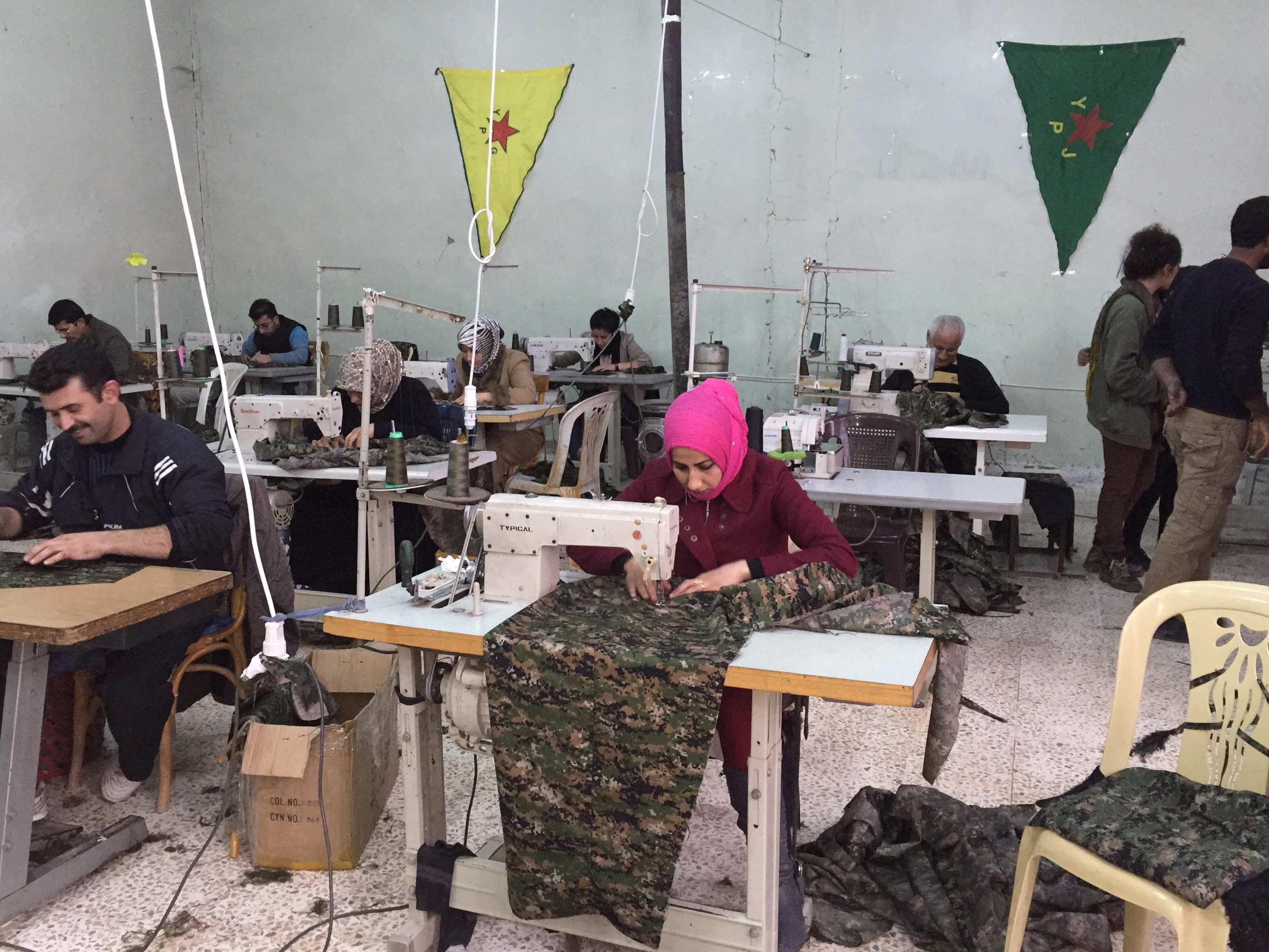
The autonomous administration is supporting efforts for workers to form cooperatives, such as this sewing cooperative in Derik. (Wikimedia Commons)
It’s good to be reminded that, while regality is treated as the norm and goliaths act like they rule the whole world, there remains numerous independently self-governed people. Rather than mere remnants of the past, those living counter-examples might point us to a different future. Then I’d put that into the context of the rest. We neurodivergents who have often felt out of place and unappreciated in the world as it has been might find that our thinking styles — if perceived as crazy, dysfunctional, and antisocial — might, in fact, have much to contribute. For those of us who have already paid the price, it would be nice to make better use of our hard-earned skills. But at the same time, it would be even nicer to move toward a less deranged society that didn’t push people into a victimized survival mode of neurocognitive extremes. If maybe it’s my crazy liberal-minded ‘openness’, I’d like to imagine we could find a balance point of eustress and so find a way to release more of our potential without so many casualties. While surely not fitting right-wing forced work of elite rule, I suspect more people would be willing to collectively labor toward a worthy society, if ever given the opportunity.
 Marmalade