Showing posts with label bitcoin. Show all posts

Tuesday, August 25, 2026

Not A Bug But A Feature

Source
Datafinnovation are out with more impressive research described in a blog post entitled Losing The Blacklisting Race and a paper entitled Enforcement Speeds In DeFi: Limits to a Race Against Time by Ben Charoenwong et al.

The blog post is more accessible, so that's what I will quote from. But for the details you need to read the paper. The blog post's TL;DR is:
First, we explore the empirical reality of OFAC’s blacklisting efforts. The results there are stark: nearly all addresses are completely empty by the time OFAC manages to blacklist them. This result is robust across time, attacker and type of attack. Second, we construct a simple model to explain why this outcome is inevitable with competent attackers. Evasion strategies which work in our model match those we find employed in the wild.
Below the fold, I start from Datafinnovation's work and explore its context.

Tuesday, May 26, 2026

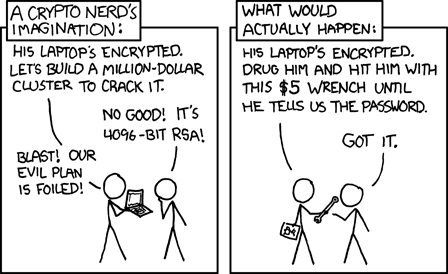
Wrench Attacks

XKCD #538
A year ago I wrote The Risks Of HODL-ing sparked by Mitch Moxley's They Stole a Quarter-Billion in Crypto and Got Caught Within a Month. Moxley recounts the kidnapping of Veer Chetal's parents to persuade him to hand over his share of the loot:
the Lamborghini was suddenly rammed from behind by a white Honda Civic. At the same time, a white Ram ProMaster work van cut in front, trapping the Chetals. According to a criminal complaint filed after the incident, a group of six men dressed in black and wearing masks emerged from their vehicles and forced the Chetals from their car, dragging them toward the van’s open side door.
Below the fold I look at Bloomberg updates from last week on why the crypto-bros are having to spend vast sums on defending against the threat of HODL-ing.

Tuesday, April 28, 2026

Dormant Digital Assets

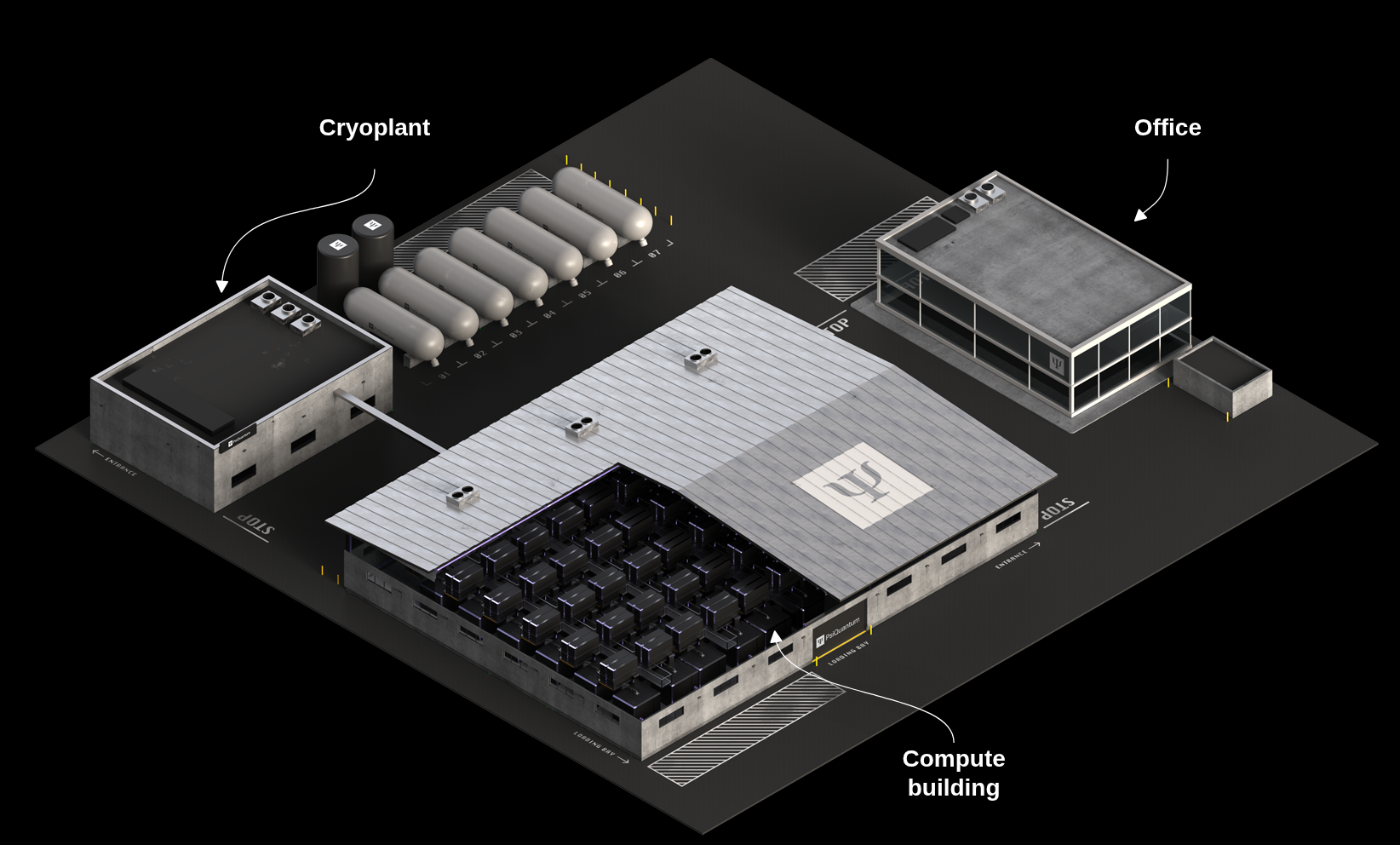
PsiQuantum's computer
Four and a half years ago I wrote The $65B Prize about the potential reward for developing a "sufficiently powerful quantum computer" capable of cracking Bitcoin's encryption. It was based on work by Aggarwal et al, who were then projecting it would happen between 2029 and 2044. The $65B was the notional value of the wallet containing the million Bitcoin Satoshi Nakamoto mined originally.i But I noted that:
Chainalysis estimates that about 20% of all Bitcoins have been "lost", or in other words are sitting in wallets whose keys are inaccessible. That is around another 3.6 million stranded Bitcoin or at the current "price" about $234B.
So the potential prize was almost $300B.

Nearly a year ago I followed up with The $740B Prize. There are two reasons why the prize was then bigger but is now smaller than that:
  • Bitcoin's "price" had then increased from about $65K to around $107K, but it is now around $76K.
  • Because the "market cap" of Michael Saylor's Strategy was 1.6 times the "market cap" of its stash of Bitcoin, it was possible to use Saylor's algorithm to amplify the prize. But the factor has decreased from 1.6 to 0.81, so the algorithm no longer works.
But the threat to Bitcoin, and other cryptocurrencies, is far worse than I described in either of these two posts. The date is closer and the range of threats much broader. Follow me below the fold for the details.

Thursday, March 19, 2026

Metastablecoin Fragmentation (updated)

A fundamental problem for decentralized systems like permissionless blockchains is that their security depends upon the cost of an attack being greater than the potential reward from it. Various techniques are used to impose these costs, generally either Proof-of-Work (PoW) or Proof-of-Stake (PoS). These costs have implications for the economics (or tokenomics) of such systems, for example that their security is linear in cost, whereas centralized systems can use techniques such as encryption to achieve security exponential in cost.

Shin Figure 3
Now, via Toby Nangle's Stablecoin = Fracturedcoin we find Tokenomics and blockchain fragmentation by Hyun Song Shin, whose basic point is that these costs must be borne by the users of the system. For cryptocurrencies, this means through either or both transaction fees or inflation of the currency. The tradeoff between cost and security means that there is a market for competing blockchains making different tradeoffs. In practice we see a vast number of competing blockchains:
Tether’s USDT sits on 107 different ledgers. ... USDC sits on 125.
The chart shows Ethereum losing market share against competing blockchains.

Shin's analysis uses game theory to explain why this fragmentation is an inevitable result of tokenomics. Below the fold I go into the background and the details of Shin's explanation.

Tuesday, January 27, 2026

Funding Open Source?

$BLEEBZORX chart
Most of the world's software infrastructure is, or is based upon, open source. The developers and supporters of some of it, for example the Linux kernel, and the major compilers, are paid by technology companies because they are critical to their business. Other, less visible but similarly critical parts are supported by lone volunteers. Apart from the unfairness, this can lead to serious vulnerabilities. Back in 2018 I wrote about one such vulnerability, the event-stream hack, in Securing The Software Supply Chain
The attackers targeted a widely-used, fairly old package that was still being maintained by the original author, a volunteer. They offered to take over what had become a burdensome task, and the offer was accepted. Now, despite the fact that the attacker was just an e-mail address, they were the official maintainer of the package and could authorize changes.
The change they authorized included code to steal cryptocurrencies.

In 2020 I wrote a detailed post about this problem entitled Supporting Open Source Software. Recently the topic re-surfaced on an e-mail alias I read. But what triggered the post below the fold was that this coincided with yet another fascinating piece from Matt Levine and his laugh-out-loud follow-up the next day.

Thursday, January 15, 2026

Good Questions

Source
On November 21st Bryce Elder posed Five questions from an ignorant no-coiner about the crypto crash. Each of his five questions identified some interesting apparent anomalies.

Below the fold I look into each of his questions, asking how anomalous its anomalies really were and whether they have persisted into the New Year.

TL;DR none of them are really surprising but reaching that conclusion took a good deal of research.

Tuesday, December 30, 2025

Sabotaging Bitcoin

Source
I find myself in the unusual position of defending Bitcoin from its critics, if only reluctantly.

In 2024 Soroush Farokhnia & Amir Kafshdar Goharshady published Options and Futures Imperil Bitcoin's Security and:
showed that (i) a successful block-reverting attack does not necessarily require ... a majority of the hash power; (ii) obtaining a majority of the hash power ... costs roughly 6.77 billion ... and (iii) Bitcoin derivatives, i.e. options and futures, imperil Bitcoin’s security by creating an incentive for a block-reverting/majority attack.
Source
It is worth noting that they are not talking about profiting from double-spending. The Bitcoin blockchain transacts around $17B/day of nominal value in around 450K transactions (average ~$38K), but in 2021 Igor Makarov & Antoinette Schoar found that:
90% of transaction volume on the Bitcoin blockchain is not tied to economically meaningful activities but is the byproduct of the Bitcoin protocol design as well as the preference of many participants for anonymity ... exchanges play a central role in the Bitcoin system. They explain 75% of real Bitcoin volume.
Of course, just because they aren't "economically meaningful" doesn't mean they aren't worth attacking! The average block has ~3.2K transactions, so ~$121.6M/block. As a check. $121.6M * 144 block/day = $17.5B. So to recover their cost for a 51% attack would require double-spending about 8 hours worth of transactions.

I agree with their technical analysis of the attack, but I believe there would be significant difficulties in putting it into practice. Below the fold I try to set out these difficulties.

Thursday, November 13, 2025

Metastablecoins Are Go!

Source
Terra (UST) was suppposed to be a "stablecoin", trading very close to $1. It rapidly became the third largest such coin. From April 11th 2022 it started trading mainly around a 10% discount, and by May 11th it was essentially worthless. The crash destroyed about $45B in notional value.

In Metastablecoins I pointed out that, absent the backing of a central bank, dollar "stablecoins" like UST were misnamed. They were, as UST had shown, in fact metastable so should be called metastablecoins. Wikipedia explains that:
By Georg Wiora
metastability denotes an intermediate energetic state within a dynamical system other than the system's state of least energy. A ball resting in a hollow on a slope is a simple example of metastability. If the ball is only slightly pushed, it will settle back into its hollow, but a stronger push may start the ball rolling down the slope.
Exactly what the "stronger push" that sent UST into its "state of least energy" was still isn't clear, but the coin's metastability is.

On July 18th this year the GENIUS Act (Guiding and Establishing National Innovation for U.S. Stablecoins Act) was signed into law. It purports to regulate metastablecoins but, like most things about cryptocurrencies, it is largely gaslighting. Below the fold I explain why this is and discuss some recent publications about metastablecoins.

Tuesday, September 30, 2025

The Gaslit Asset Class

James Grant invited me to address the annual conference of Grant's Interest Rate Observer. This was an intimidating prospect, the previous year's conference featured billionaires Scott Bessent and Bill Ackman. As usual, below the fold is the text of my talk, with the slides, links to the sources, and additional material in footnotes. Yellow background indicates textual slides.

Tuesday, September 2, 2025

Luke 15:7

Source
The title of the post refers to the King James Version of the Bible:
I say unto you, that likewise joy shall be in heaven over one sinner that repenteth, more than over ninety and nine just persons, which need no repentance.
Luke 15:7
In the throes of 2008's Global Financial Crisis Satoshi Nakamoto published Bitcoin: A Peer-to-Peer Electronic Cash System. It inspired a large group of enthusiastic advocates who asserted that Bitcoin would possess the following attributes:
  • It would be decentralized.
  • It would be trustless.
  • It would be censorship resistant.
  • It would be securely encrypted.
  • Users would be anonymous.
  • Users could transact without intermediaries.
  • Users could transact cheaply.
In short, it would enable users to escape the clutches of the TradFi (traditional finance) system that had so obviously failed. It has been obvious for many years that it doesn't, and in July there appeared a truly excellent mea culpa from a former advocate, Peter Ryan's Money by Vile Means. Below the fold I comment on it, and a couple of other posts describing how TradFi has obliterated Nakamoto's vision.

Thursday, May 29, 2025

The $740B Prize

Forty-two months ago I wrote The $65B Prize citing Divesh Aggarwal et al's 2019 paper Quantum attacks on Bitcoin, and how to protect against them. They noted that:
the elliptic curve signature scheme used by Bitcoin is much more at risk, and could be completely broken by a quantum computer as early as 2027, by the most optimistic estimates.
It is time to re-visit the "optimistic estimates", so follow me below the fold.

Thursday, May 8, 2025

The Risks Of HODL-ing

Lamborghini Urus
Alexander Migl
, CC BY-SA 4.0
Traditionally, the big risk in HODL-ing cryptocurrencies has been their volatility. Fortunately, now the US government is all-in on cryptocurrencies, this risk is greatly reduced. Progress moon-wards is virtually guaranteed, so it is reasonable to invest a small part of your portfolio into Lamborghinis. HODL-ers can rest easy while the rest of the coins in their wallets appreciate because they are protected by strong cryptography (at least until the advent of a sufficiently powerful quantum computer). But progress moon-wards exacerbates some other risks to HODL-ers, as I explain below the fold.

Tuesday, May 6, 2025

Who Is Mining Bitcoin?

BTC "price"
It is just over a year since One Heck Of A Halvening, when Tether had pumped the Bitcoin "price" up to $73,094 the month before. Thanks to The Cryptocurrency Industry's Unprecedented Election Spending it was pumped over $100K and is now around $92K. The security of the Bitcoin blockchain depends upon Proof-of-Work, the idea being that it is more expensive to attack than any possible gains. Thus it is important that miners both spend a lot of money to mine coins, and that they can make a return on their investment in doing so. Now it is time to take a look below the fold at how the miners are doing post-Halvening.

Thursday, March 27, 2025

Software Supply Chain Attack

Joel Wallenberg interviewed me on 14th February for his article in the 28th February edition of Grant's Interest Rate Observer entitled Memo to the bitcoiners. Alas, it is paywalled, but among the many quotes from me Wallenberg used was that blockchain-based systems "are very vulnerable to supply-chain attacks".

Exactly a week after the interview and a week before the article went to press, we got an example, the biggest cryptocurrency heist in history. Below the fold I discuss the details.

Thursday, March 20, 2025

Bitcoin's Fee Spikes

I've written several times, for example in Fixed Supply, Variable Demand, about the mechanism that causes the cost of transacting on a blockchain like Bitcoin's to suffer massive spikes at intervals. When no-one wants to transact, fees are low. When everyone does, they are high. Below the fold I look in detail at a typical Bitcoin fee spike.

Thursday, February 6, 2025

On Not Being Immutable

Economist 2/1/25
Regulation of cryptocurrencies was an issue in last November's US election. Molly White documented the immense sums the industry devoted to electing a crypto-friendly Congress, and converting Trump's skepticism into enthusiasm. They had two goals, pumping the price and avoiding any regulation that would hamper them ripping off the suckers.

Back in November of 2022 I added an entry to this blog's list of Impossibilities for The Compliance-Innovation Trade-off from the team at ChainArgos. It started:
tl;dr: DeFi cannot be permissionless, allow arbitrary innovation and comply with any meaningful regulations. You can only choose two of those properties. If you accept a limited form of innovation you can have two-and-a-half of them.

Fundamental results in logic and computer science impose a trade-off on any permissionless system’s ability to both permit innovation and achieve compliance with non-trivial regulations. This result depends only on long-settled concepts and the assumption a financial system must provide a logically consistent view of payments and balances to users.

This is a semi-technical treatment, with more formal work proceeding elsewhere.
Two years later, the "more formal work" has finally been published in a peer-reviewed Nature Publishing journal, Scientific Reports, which claims to be the 5th most cited journal in the world. Jonathan Reiter tells me that, although the publishing process took two years, it did make the result better.

Below the fold I discuss Tradeoffs in automated financial regulation of decentralized finance due to limits on mutable turing machines by Ben Charoenwong, Robert M. Kirby & Jonathan Reiter.

Tuesday, October 29, 2024

1.5C Here We Come

Source
John Timmer's With four more years like 2023, carbon emissions will blow past 1.5° limit is based on the United Nations' Environmental Programme's report Emissions Gap Report 2024. The "emissions gap" is:
the difference between where we're heading and where we'd need to be to achieve the goals set out in the Paris Agreement. It makes for some pretty grim reading. Given last year's greenhouse gas emissions, we can afford fewer than four similar years before we would exceed the total emissions compatible with limiting the planet's warming to 1.5° C above pre-industrial conditions.
...
The report ascribes this situation to two distinct emissions gaps: between the goals of the Paris Agreement and what countries have pledged to do and between their pledges and the policies they've actually put in place.
Source
Back in 2021 in my TTI/Vanguard talk I examined one of these gaps, the one between the crypto-bros' energy consumption:
The leading source for estimating Bitcoin's electricity consumption is the Cambridge Bitcoin Energy Consumption Index, whose current central estimate is 117TWh/year.

Adjusting Christian Stoll et al's 2018 estimate of Bitcoin's carbon footprint to the current CBECI estimate gives a range of about 50.4 to 125.7 MtCO2/yr for Bitcoin's opex emissions, or between Portugal and Myanmar.
and their rhetoric:
Cryptocurrencies assume that society is committed to this waste of energy and hardware forever. Their response is frantic greenwashing, such as claiming that because Bitcoin mining allows an obsolete, uncompetitive coal-burning plant near St. Louis to continue burning coal it is somehow good for the environment.

But, they argue, mining can use renewable energy. First, at present it doesn't. For example, Luxxfolio implemented their commitment to 100% renewable energy by buying 15 megawatts of coal-fired power from the Navajo Nation!.

Second, even if it were true that cryptocurrencies ran on renewable power, the idea that it is OK for speculation to waste vast amounts of renewable power assumes that doing so doesn't compete with more socially valuable uses for renewables, or indeed for power in general.
Source
Note that the current CBECI estimate shows that Bitcoin's energy consumption has increased 43% since 2021, a 12.7%/yr increase.

Follow me below the fold for more details of the frantic greenwashing, not just from the crypto-bros but from the giants of the tech industry that aims to ensure that:
Following existing policies out to the turn of the century would leave us facing over 3° C of warming.

Monday, October 7, 2024

It Was Ten Years Ago Today

Ten years ago today I posted Economies of Scale in Peer-to-Peer Networks . My fundamental insight was:
  • The income to a participant in a P2P network of this kind should be linear in their contribution of resources to the network.
  • The costs a participant incurs by contributing resources to the network will be less than linear in their resource contribution, because of the economies of scale.
  • Thus the proportional profit margin a participant obtains will increase with increasing resource contribution.
  • Thus the effects described in Brian Arthur's Increasing Returns and Path Dependence in the Economy will apply, and the network will be dominated by a few, perhaps just one, large participant.
In the name of blatant self-promotion, below the fold I look at how this insight has held up since.

Tuesday, September 17, 2024

Lie Down WIth Dogs, Get Up WIth Fleas

Source
It is generally quite difficult to upset the denizens of a wretched hive of scum and villainy by further besmirching their reputation, but recently the Trump family has succeeded.

Below the fold I explain how they did it, and why the denizens of the wretched hive are not happy.

Tuesday, August 20, 2024

Astroturfing

I seem to be stuck on the theme of cryptocurrency gaslighting with two weeks ago More Cryptocurrency Gaslighting and one week ago Greenwashing. Now I look at cryptocurrency gaslighting in the political arena, where it is termed astroturfing:
it is defined as the process of seeking electoral victory or legislative relief for grievances by helping political actors find and mobilize a sympathetic public, and is designed to create the image of public consensus where there is none. Astroturfing is the use of fake grassroots efforts that primarily focus on influencing public opinion and typically are funded by corporations and political entities to form opinions.
Donald Trump, 2019
Currently, the crypto-bros have poured money into primaries, defeated several incumbents deemed to be insufficiently crypto-friendly, and have accumulated an immense war-chest for November's general election. This pot of gold was enough to turn Trump from crypto-skeptic to telling Maria Bartiromo:
Who knows, maybe we’ll pay off our $35 trillion dollar [national debt], hand them a little crypto check, right? We’ll hand them a little Bitcoin and wipe away our $35 trillion
Below the fold I discuss the gaslighting the cryptosphere is using in their massive attempt to purchase "regulatory clarity", and what the scale of this investment suggests about the profits they expect to garner if it succeeds.