Showing posts with label Virginia. Show all posts

Sunday, April 12, 2020

Virginia Enacts LGBT Non-Discrimination Protections!


Virginia has become the first state in the Southern United States (former member of the Confederacy) to enact comprehensive civil rights protections for LGBT people. Last night Governor Ralph Northam signed the Virginia Values Act into law. The legislation (SB 868) goes into effect July 1, 2020 and in addition to prohibiting discrimination in employment, housing and credit on the basis of sexual orientation and gender identity, it also expanded public accommodations protections on the basis of these categories and others. According to the Williams Institute (at the UCLA School of Law) twenty-three states and the District of Columbia now have statutes specifically protecting LGBT civil rights.

The national LGBT advocacy organization, the Human Rights Campaign, described the new law:
In addition to sexual orientation and gender identity, the law also creates all-new protections for Virginians in private employment and places of public accommodation on the basis of race, color, religion, national origin, sex, pregnancy, childbirth or related medical conditions, age, marital status, disability, and status as a veteran. Virginia is the first state in the South to have non-discrimination protections for LGBTQ people, the first state in over a decade to add both sexual orientation and gender identity to existing non-discrimination law, and the first state since 1993 to add a prohibition on discrimination in public accommodations (protecting all Virginians) where none existed before.
Virginia Governor Northam said:
"We are building an inclusive Commonwealth where there is opportunity for everyone, and everyone is treated fairly. No longer will LGBTQ Virginians have to fear being fired, evicted, or denied service in public places because of who they are."
The bill was shepherded through the Virginia legislature by two openly gay legislators, Senator Adam Ebbin (D-Alexandria) and Delegate Mark Sickles (D-Fairfax). As a result of the 2019 legislative elections and the 2017 gubernatorial elections Democrats have complete control of the legislative process in Virginia for the first time in decades. Since I used to live and work in Virginia I am very excited to see this progress!

Friday, November 10, 2017

CELEBRITY FRIDAY: Danica Roem Elected Virginia's 1st Transgender State Legislator


Danica Roem made history on Tuesday night by becoming the first transgender person elected to the Virginia House of Delegates as a Democrat. Some news outlets falsely were claiming that Roem was the first transgender person ever elected to a state legislature, unfortunately forgetting the historical achievement of Althea Garrison who was elected as a legislator in Massachusetts in 1993 (as a Republican!). The first out transgender person to be elected to a state legislature is Stacie Laughton who was elected in New Hampshire in 2012. Even as someone who has taught LGBT history multiple times I was unaware of Laughton's or Garrison's feats prior to this week so it is hard to fault the media in their error with Roem.

Another amazing aspect of Roem's victory is that she did it by soundly (54% to 45%) defeating Bob Marshall, who was a 13-term incumbent in the Virginia legislature and who is notoriously homophobic and transphobic and referred to by the Washington Post as the state's "most socially conservative state lawmaker." He refused to debate Roem and he and his party referred to Roem by the incorrect gender.

Monday, June 12, 2017

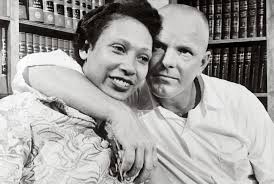
Today Is #LovingDay: 50th Anniversary of Nationwide Interracial Marriage Legalization


As someone in an interracial same-sex marriage who has taught students the details of the landmark 1967 U.S. Supreme Court case Loving v. Virginia  several times I can't let today go by without acknowledging that it is the 50th anniversary of the release of that unanimous ruling striking down laws banning interracial marriages (because such statutes seek to maintain "White Supremacy").

Happy #LovngDay!

Saturday, October 29, 2016

QUEER QUOTE: SCOTUS Agrees To Hear Important Transgender Rights Case From Virginia


The United States Supreme Court agreed to hear the case of Gavin Grimm, a 17-year-old transgender boy who (with the help of the ACLU) is suing the Gloucester County School Board in Virginia for the right to use the bathroom associated with his gender identity.

Today's Queer Quote is from the granting of certioari by SCOTUS in Grimm:
 (1) Whether courts should extend deference to an unpublished agency letter that, among other things, does not carry the force of law and was adopted in the context of the very dispute in which deference is sought; and (2) whether, with or without deference to the agency, the Department of Education's specific interpretation of Title IX and 34 C.F.R. § 106.33, which provides that a funding recipient providing sex-separated facilities must “generally treat transgender students consistent with their gender identity,” should be given effect.
SCOTUSblog describes the Grimm case in this way:
Although the controversy over the school board’s policy requiring students to use the restrooms and locker rooms that match the gender that they were assigned at birth instantly became the highest-profile case of the court’s term so far, the dispute actually centers on more technical (and, some would say, rather dry) legal issues. In this case, the district court ruled against G.G., relying on a 1975 regulation that allows schools to provide “separate toilet, locker room, and shower facilities on the basis of sex,” as long as those facilities are comparable to those provided to the opposite sex. But, in January 2015, the Department of Education’s Office of Civil Rights issued an opinion letter stating that, if schools separate students in restrooms and locker rooms on the basis of their sex, a “school generally must treat transgender students consistent with their gender identity.” In light of the 2015 letter, the U.S. Court of Appeals for the 4th Circuit reversed and ruled for G.G. It relied on the Supreme Court’s 1997 decision in Auer v. Robbins, which held that courts generally should defer to an agency’s interpretation of its own regulation. 
In granting review today, the justices sidestepped the most prominent issue they had been asked to take on: whether they should overrule their decision in Auer, which has been the target of criticism by conservative lawyers and jurists. Instead, they agreed only to weigh in on two other, lower-profile questions presented in the school board’s petition: whether courts should defer to a letter, like the Department of Education opinion letter in this case, that was issued as part of the specific dispute before the court; and whether the Department of Education’s interpretation of the federal civil rights laws and the 1975 regulation as requiring schools to treat transgender students consistent with their gender identity should be given effect. 
The school board’s case, as well as the others in which the justices granted review today, likely will be argued during the court’s February sitting, which begins on February 21.
Here at MadProfessah.com we will be  watching this case closely. The primary takeaway should be that although marriage equality is now the law of the land, the fight for full LGBT equality is clearly not over. And the United States Supreme Court will almost certainly play a role in accomplishing this.

Hat/tip to Kenneth in the 212

Tuesday, April 19, 2016

QUEER QUOTE: Democrats Praise 4th U.S. Circuit Ruling In Favor Of Transgender Student


The 4th U.S. Circuit has upheld the Obama Administration's Education Department non-discrimination policy in a dispute with a Virginia school district over the rights of a transgender student to access education according to their preferred gender identity. The ruling is in the case of transgender male student Gavin Grimm in his lawsuit against the Gloucester County School Board, who has enacted a policy that said that every student had to access restrooms and changing facilities based on their "biological sex at birth" and not their gender identity.

Chris Geidner of Buzzfeed reports:
The decision is a big victory for the Obama administration, which weighed in at the appeals court to support Grimm’s challenge, and the Equal Employment Opportunity Commission, which has been pressing the case for protecting LGBT people under existing civil rights laws since 2012.  
The appeals court had heard the arguments in January, and Tuesday’s ruling is the first such ruling on the Obama administration’s policy — which it also has advanced regarding the sex discrimination ban under Title VII of the Civil Rights Act of 1964. 
Among the states included in the 4th Circuit is North Carolina, which recently passed a law limiting restroom use in government facilities — including schools and universities — to that which corresponds with a person’s “biological sex.” The ACLU, which is backing Grimm’s suit, also has brought suit against the North Carolina law.
The Democratic National Committee sent the following statement praising the ruling:
“This court victory affirms that there is no commonsense reason to bar transgender students from using the restroom that aligns with their gender identity and that doing so is discriminatory and harmful. This ruling sets precedent in five states, including North Carolina, where Republican legislators and the Republican governor have embraced the exact type of discrimination that the court today has overruled. Republican legislators who continue to push anti-LGBT measures and the Republican presidential candidates who fan the flames of discrimination with ignorant rhetoric have been exposed by this ruling for what they’re truly peddling. Just this week, one of the Republican presidential candidates told victims of discrimination to ‘get over it.’ Well, it’s time for the Republican Party to get over their anti-LGBT bias and join the rest of the country in embracing the full equality of every American.”
 Congrats!

Friday, August 28, 2015

CELEBRITY FRIDAY: Vester Lee Flanagan, a Black Gay Man, Was The Live TV Shooter


On Wednesday August 26th Vester Lee Flanagan, 41, shot to death on-air reporter Alison Parker and her cameraman Adam Ward while they were conducting an interview on live television. Flanagan, who previously worked for the same television station (WDBJ in Roanoake, VA) as Bryce Williams, was apparently openly gay and was let go by the station more than a year ago because of his irascible personality. He sued his former employer for racial and sex discrimination seeking damages of $25,000 but the suit was thrown out for lack of evidence.


Right-wing websites are making a big deal of the fact that Flanagan was openly gay, as if that was te cause of his murderous rampage.

Monday, October 06, 2014

SCOTUS Refuses To Hear Marriage Equality Appeals From 4th, 7th and 10th Circuits!


Wow! The Supreme Court today surprised almost all legal observers by refusing to hear ("called denying certiorari") appeals from five states of decisions in three federal appellate circuits that said that bans on marriage equality violated the federal constitution. The nearly immediate effect of the Supreme Court action means that the fight for marriage equality in those states (Oklahoma, Indiana, Utah, Wisconsin and Virginia) is over. Once final orders are issued from the corresponding U.S. appellate circuits (which usually takes a month) same-sex couples will be able to get married in those states. Effectively, it means that as of today there are now 24 states that "have" marriage equality.

Very soon after those orders go into effect the number of states with marriage equality will include the other six states within the 4th, 7th and 10th circuits covered by the previously issued rulings in those marriage equality cases: Colorado, Kansas, Wyoming, North Carolina, South Carolina, and West Virginia.

Evan Wolfson Founder and President of Freedom to Marry issued the following statement:
Today’s decision by the Supreme Court leaves in force five favorable marriage rulings reached in three federal appellate courts, ensuring the freedom to marry for millions more Americans around the country. The Court’s letting stand these victories means that gay couples will soon share in the freedom to marry in 30 states, representing 60% of the American people. But we are one country, with one Constitution, and the Court’s delay in affirming the freedom to marry nationwide prolongs the patchwork of state-to-state discrimination and the harms and indignity that the denial of marriage still inflicts on too many couples in too many places. As waves of freedom to marry litigation continue to surge, we will continue to press the urgency and make the case that America – all of America -- is ready for the freedom to marry, and the Supreme Court should finish the job.
I wonder if this surprising result is an example of the Posner effect, i.e. Judge Richard Posner's evisceration of the arguments against marriage equality in oral arguments and then eloquently in his written decision (upheld today by the Supreme Court) overturning Indiana's and Wisconsin's bans on marriage equality.

Woo hoo!

Wednesday, September 10, 2014

SCOTUS TO Consider 7(!) Marriage Equality Appeals On Friday September 29


There are now seven(!) marriage equality cases from four different states pending before the United States Supreme Court. On September 29th the Court will likely consider how to dispose of thousands of writs of certiorari that include appeals from the 10th Circuit (Utah and Oklahoma), the 4th Circuit (Virginia) and the 7th Circuit (Indiana and Wisconsin). There currently is no circuit split, because every appellate court decision released since last year's landmark United States v Windsor decision has resulted in a win for the cause of marriage equality.

The 9th Circuit heard oral arguments in two cases on Monday (from Nevada and Idaho) and the 6th Circuit has already heard oral arguments earlier this summer and a decision from either court could be issued at any time. It is thought likely that the Supreme Court may hold over deciding any of the pending certs until the 6th and or 9th circuits release their decisions.

However, regardless it is unlikely the Court will be able to escape resolving the fundamental question of whether marriage equality is part of the United States constitution beyond the end of the 2014-15 term which ends in June.

Friday, August 22, 2014

SCOTUS Stays Virginia Marriages, Maintains Suspense On Its Position On Marriage Equality


While I was driving from Los Angeles to Albuquerque via Tucson on Wednesday, the Supreme Court issued a stay in the Virginia marriage equality case Bostic v Schaefer, preventing same-sex marriages from happening in that state the next day. This was not a surprise, as the Court has issued stays four other times this year in other similar cases. However, these actions don't really tell us much about what the Supreme Court will ultimately rule on the marriage equality question, says noted Supreme Court expert Lyle Denniston at SCOTUS blog:
Through all of this year, from January on, the Court could not help but be aware of what was happening in the lower courts, with a string of decisions nullifying state bans on same-sex marriage.  The fact that the Court has been drawn in on five occasions has kept it in the middle of the controversy, even if it has mostly kept its own counsel about what it is thinking. 
With a little more than five weeks until the Justices assemble in their first private Conference, in advance of the new Term starting October 6, it is by no means clear that any same-sex marriage case will be ready for the Justices to consider it on September 29.  That depends, in part, on whether the Court will have cases before it one at a time, as each is ready, or in a group., when several are ready. 
The last scheduled day for distributing a case for consideration by the Justices at the September 29 meeting is September 10 — now, just three weeks away.  The pending Utah case has a fair prospect of being ready then, but there is reason to doubt at this point that the pending Oklahoma and Virginia cases will be complete.  The lawyers involved have said they were working diligently to push matters along, but the clock is against them for action by the Justices at the outset of the new Term. 
There will be plenty of time, though, to get a case before the Court for decision during the new Term.  If a case is accepted for review by sometime next January, it is almost certain to be decided before the end of the Term, late next June. 
Is a grant of review a certainty in coming months?  There is never a sufficiently strong advance signal to predict that.

So, basically even if a critical mass of marriage cases is not ready by the September 10th deadline, almost certainly enough will be ready by the January deadline that the Court will have take a position (of whether they want to decide these cases outright, or to wait for a Circuit split and then a likely ruling in an election year instead of in 2015). I suspect we'll have an answer by June 2015 and it will be one that surprises most people.

Wednesday, August 13, 2014

4th Circuit Denies Request For Stay In Virginia Marriage Equality Case

The 4th U.S. Circuit Court of Appeals has refused to prevent its July 28th ruling opening up Virginia's discriminatory marriage laws to same-sex couples from going into effect next week.

The action by a 3-judge panel in the Bostic v. Schaefer case means that unless the U.S. Supreme Court intervenes, which it almost certainly will, Virginia same-sex couples could start getting married next Wednesday August 20.

This is unlikely to happen, as the U.S. Supreme Court has already ruled in the 10th Circuit case of Kitchen v. Herbert that a stay could be issued while Utah appeals its loss at the federal district and federal appellate levels.

Hat/tip to Joe Jervis


Monday, July 28, 2014

Fourth Circuit Strikes Down Virginia's Ban On Marriage Equality!


The U.S. Circuit Court of Appeals for the Fourth Circuit has affirmed a February 2014 district court decision that struck down Virginia's ban on marriage equality. The ruling puts the marriage bans in four sates covered by the 4th Circuit (Virginia, North Carolina, South Carolina and West Virginia) in question. However, it is likely that there will be stay on proceedings in the Fourth Circuit until the U.S. Supreme Court issues a final ruling in the case.

Just a  few weeks ago the Tenth Circuit issued rulings affirming that Utah's and Oklahoma's bans on marriage equality are unconstitutional but this did not stop the Attorney General of Colorado (the Tenth Circuit is physically housed in Denver!) from asserting that Colorado's ban on marriage equality is still intact (even though a state judge and a federal judge has struck it down).

In today's 2-1 decision from the 4th Circuit, the majority says:
We recognize that same-sex marriage makes some people deeply uncomfortable. However, inertia and apprehension are not legitimate bases for denying same-sex couples due process and equal protection of the laws. Civil marriage is one of the cornerstones of our way of life. It allows individuals to celebrate and publicly declare their intentions to form lifelong partnerships, which provide unparalleled intimacy, companionship, emotional support, and security. The choice of whether and whom to marry is an intensely personal decision that alters the course of an individual’s life. Denying same-sex couples this choice prohibits them from participating fully in our society, which is precisely the type of segregation that the Fourteenth Amendment cannot countenance.
Human Rights Campaign, the nations largest LGBT advocacy group helpfully noes that there have been nineteen consecutive ruling from federal courts affirming marriage equality since June 27, 2013 and lists the state of play in the pending federal lawsuits on marriage equality at the appellate level or higher:
Cases pending before federal appeals courts:
  • DeLeon v. Perry, Texas [Argument date at the Fifth Circuit not set]
  • Tanco v. Haslam, Tennessee [Arguments at the Sixth Circuit set for August 6]
  • Bourke vs. Beshear, Kentucky [Arguments at the Sixth Circuit set for August 6]
  • Obergefell v. Kasich, Ohio [Arguments at the Sixth Circuit set for August 6]
  • Henry v. Himes, Ohio [Arguments at the Sixth Circuit set for August 6]
  • DeBoer v. Snyder, Michigan [Arguments at the Sixth Circuit set for August 6]
  • Wolf v. Walker, Wisconsin [Arguments at the Seventh Circuit set for August 26]
  • Baskin v. Bogan, Indiana [Arguments at the Seventh Circuit set for August 26]
  • Sevcik v. Sandoval, Nevada [Argument at the Ninth Circuit set for September 8]
  • Latta v. Otter, Idaho [Argument at the Ninth Circuit set for September]
  • Jackson v. Abercrombie, Hawaii [Argument at the Ninth Circuit set for September 8]
  • Burns v. Hickenlooper, Colorado [Argument date at the Tenth Circuit not set]

Cases petitioned or likely to be petitioned to the U.S. Supreme Court:
  • Kitchen v. Herbert, Utah [Tenth Circuit struck down marriage ban June 25]
  • Bishop v. United States, Oklahoma [Tenth Circuit struck down marriage ban July 18]
  • Bostic v. Schaefer, Virginia [Fourth Circuit struck down marriage ban July 28]
Basically it's a race now to see if the Supreme Court will get the marriage cases in the 2014-15 term or in the 2015-16 term. Sooner is looking more likely, but maybe we'll need to get a circuit split (an actual federal appellate ruling where marriage equality loses) for that to happen.

Hat/tip to Chris Geidner

Sunday, June 15, 2014

WISCONSIN: Federal Judge Issues Stay and Injunction Halting Marriage Equality

Bad news out of Wisconsin! Federal judge Barbara Crabb finally issued a final order implementing her previously issued decision in the same-sex marriage case of Wolf v Walker in favor of marriage equality from last week and included a stay and injunction that makes it clear that no marriage licenses should be issued to same-sex couples while the matter is appealed to the U.S. 7th Circuit.

This means that the multiple counties and big cities like Madison and Milwaukee where same-sex couples were being issued marriage licenses have to stop doing so immediately.

The judge wrote in her final order that the Supreme Court's previous decision this past January to issue a stay in the case of whether Kitchen v. Herbert striking down Utah's ban on marriage equality should go into effect compelled her to do the same since the two cases are indistinguishable from each other. All this year federal judges in various jurisdictions have been striking down laws banning marriage equality in several states (Michigan, Oklahoma, Oregon, Pennsylvania, Texas and Virginia, and many others) usually issuing stays automatically preventing marriages from going into effect.

In some jurisdictions, notably Oregon and Pennsylvania, the state officials agreed with the ruling and thus did not appeal it, causing marriage equality to go into effect immediately in those states. However, in others, like Wisconsin, politicians have continued to battle in court to uphold their discriminatory marriage laws and are appealing to the appropriate federal appellate circuit. The 4th and 10th appellate circuits have heard oral arguments in their marriage equality cases and could issue decisions at any time, although most observers do not expect one to do so until much later this year at the earliest.

Hat/tip to Joe Jervis

Tuesday, May 13, 2014

4th U.S. Circuit Hears Oral Arguments in VA Marriage Equality Case

Today the 4th U.S. Circuit heard oral arguments in Bostic v. Schaefer (previously Bostic v. Rainey) which is better known as Virginia's marriage equality case. This past February a federal judge struck down Virginia's ban on marriage equality and today's oral arguments were the appellate circuit level appeal of this decision.

You can hear the audio of the oral arguments yourself at this link. The three judges on the panel are Paul Niemeyer (Appointed by President George H.W. Bush), Roger Gregory (Nominated by President Bill Clinton and then George W. Bush),  and Henry Floyd (Nominated by President Obama). The lawyers conducting the argument for the side of marriage equality were Ted Olson (on behalf of American Foundation for Equal Rights), James Esseks (on behalf of the ACLU) and Stuart Raphael (Virginia's Solicitor General).

Most observers seem to think that the panel will split 2-1 in favor of upholding the lower-court ruling, which would then be appealed to the United States Supreme Court, which could decide whether it wants to use this case to decide the question of marriage equality squarely in 2015 or let marriage equality go into effect in the 4th Circuit (Virginia, South Carolina, West Virginia and North Carolina).

Hat/tip to Equality on Trial

Thursday, April 24, 2014

NAACP Legal Defense Fund Files Brief In Favor Of Marriage Equality In Virginia Case

The briefs are starting to come in support of the plaintiffs in the Virginia marriage equality case Bostic v. Schaefer (previously Bostic v. Rainey) which will be heard before the 4th U.S. Circuit Court of Appeals next month. In a rare example of the NAACP and the NAACP Legal Defense and Education Fun (LDF) working together, the two have filed a joint brief in favor of marriage equality.

The groups call for marriage equality for lesbians and gay men by invoking the principles set forth in the Supreme Court's iconic 1967 decision in Loving v. Virginia,which struck down laws that prohibited marriage for interracial couples.
"More than fifty years ago, the Supreme Court unequivocally established the right of every individual to marry the person she or he chooses," said Ria Tabacco Mar, Assistant Counsel in the NAACP Legal Defense Fund's Economic Justice Group. "It's long past time to strike down laws that deprive lesbians and gay men of their constitutional rights," Ms. Tabacco Mar added. 
In the brief, the NAACP Legal Defense Fund and the NAACP make clear that Lovingwas not restricted to race: the freedom to marry has long been recognized as a fundamental right "essential to the orderly pursuit of happiness."


"Marriage is a civil right under state law," stated Kim M. Keenan, NAACP General Counsel. “In furtherance of our legacy of advocacy in Loving v. Virginia, we are proud to stand with the NAACP LDF to ensure that every person is treated the same and benefits the same under law."  The NAACP Legal Defense Fund and the NAACP argue that marriage discrimination violates the Equal Protection Clause of the Fourteenth Amendment. Furthermore, the same baseless and offensive accusations proffered by the proponents of Virginia’s marriage ban -- that prohibitions on marriage equality are necessary to protect children -- were also invoked by Virginia in 1967 in defense of its anti-miscegenation law.
The Virginia case is the one that has the involvement of Ted Olson and David Boies, who filed the federal suit that led to the demise of Proposition 8.

In other Virginia news, the senior U.S. Senator from Virginia has today published a joint editorial with his Harvard Law School classmate Evan Wolfson arguing why Virginia's ban on marriage equality needs to go.
When Thomas Jefferson wrote the words "all men are created equal" in the Declaration of Independence, he put in place a moral standard that will always challenge us to be better people. 
Our founders passionately believed in equality, but most saw no contradiction between that belief and slavery. It took 90 years and a civil war to correct that injustice.
The post-Civil War Congress that changed the Constitution to abolish slavery passionately believed in equality, but most saw no contradiction in women's inability to vote. It took nearly 70 years to remedy that injustice. 
Today, Virginians and Americans are advancing Jefferson's equality principle by re-thinking laws that limit the freedom to marry. 
The two of us first became friends in law school more than 30 years ago. Our career and personal paths have taken different directions. But we share a commitment to making people's lives better, their dreams more attainable and their families stronger. 
And we share a commitment to Jefferson's farsighted ideal. That's why we look forward to the day when all loving couples, regardless of sexual orientation, can marry. 
In recent months, 11 out of 11 federal judges have ruled against marriage discrimination. 
In February, a federal judge in Norfolk was one of them.

I think lots of people think the Virginia case is the one that the Supreme Court is going to use to decide the question of whether state bans on same-sex marriage violate the U.S. constitution.

Sunday, April 20, 2014

MAP: Spread of Marriage Equality, 2000-2014

Here's a cool map showing the spread of marriage equality since 2000. In 2000, there was only one state that had significant statewide recognition of same-sex relationships; Vermont, with civil unions. In 2014, there are 17 states with full marriage equality and another 5 whose bans have been struck down by federal judges.

Hat/tip to Mother Jones

Tuesday, April 15, 2014

QUEER QUOTE: VA AG Files Brief Arguing His State's Marriage Law Is Unconstitutional


The Democratic Attorney General of Virginia, Mark Herring, has made good on his statement that he did not think that his state's marriage law could survive constitutional scrutiny has filed a brief before a federal appellate court articulating this argument in no uncertain terms.

The following excerpt from the state's brief in Bostic v. Rainey filed with the 4th U.S. Circuit Court of Appeals is today's Queer Quote:
The ban cannot satisfy the rational-basis test, let alone more demanding scrutiny. McQuigg’s claim that the purpose of marriage is to channel couples into a procreative relationship for the benefit of children is belied by controlling Supreme Court authority that marriage protects those choosing not to procreate and those who are unable to. And the Clerks’ argument fails the rational-basis test because it is irrational to think that prohibiting gay people from marrying will make heterosexual couples more like to marry and have children.  
The Clerks’ position cannot be reconciled with the Supreme Court’s three decisions to date protecting the rights of gay people. Those decisions, among others, also show why the Supreme Court’s one-sentence dismissal in Baker v. Nelson, in 1972, cannot be read to trivialize the issue presented here.  
The Clerk’s slippery-slope arguments are the same ones used to oppose interracial marriage in 1967; they are no more persuasive today than then. And just as in 1967, the Court should not wait to protect the plaintiffs’ constitutional rights simply because political trends suggest that the public increasingly supports marriage equality.
Hat/tip to Equality on Trial 

Saturday, March 08, 2014

Virginia Legislature Unanimously Repeals State's Sodomy Ban

 The Virginia legislature is very closely divided along partisan lines in a purple state that appears to be trending blue but which has been controlled by conservatives (both Republican and Democrat) for  along time. So, it was pretty surprising that legislators in both houses have been able to pass a measure (any measure) unanimously. What was the topic that garnered such unanimity? Repealing the state's archaic Crime Against Nature law which purported to criminalize oral and anal sex among consenting adults (even married ones!) despite the 2003 U.S. Supreme Court decision Lawrence v. Texas which invalidated all such laws across the nation.

Repeal of the statute was necessary because the 4th U.S. Circuit explicitly rejected former Virginia Attorney General Ken Cuccinelli's bizarre notion that the sodomy ban was still able to used to criminalize oral or anal sex between consenting adults.

The Washington Blade reports:
Garrett and others pushing the bill said it was needed because a ruling last year by the Fourth Circuit U.S. Court of Appeals in Richmond declaring the sodomy statute unconstitutional and unenforceable made it unclear whether prostitution involving oral or anal sex could be prosecuted. 
Others, including former Virginia Attorney General Kenneth Cuccinelli, argued that the appeals court ruling, which was upheld by the U.S. Supreme Court, would prevent the prosecution of adults seeking to have consensual oral sex with minors between the age of 15 and 18. 
Virginia’s existing criminal code addressing prostitution and non-forcible sex was linked to the sodomy statute, which for years defined sodomy as a criminal felony regardless of whether the sex was between consenting adults in private.
It should be noted that there are several states that still have sodomy laws on the books, more than 11 years after Lawrence struck them all down as unconstitutional: Alabama, Florida, Idaho, Kansas, Louisiana, Michigan, Mississippi, North Carolina, Oklahoma, South Carolina, Texas, and Utah.

Hat/tip to Think Progress.

Friday, February 28, 2014

MAP: Current State of Marriage Equality In The States

Compiled by Andrew Turnbull, this handy graphic depicts the current state of marriage equality in the states. Look at all the ticking clocks, reflecting pending legal challenges to state bans on marriage equality, as well as the places where the ban has been struck down but is in abeyance due to a stay (Texas, Virginia, Oklahoma and Utah) as well as the two states where out-of-states same-sex marriage is recognized but you can't get married in the state (Kentucky and Oregon).

The map looks good!

Wednesday, February 26, 2014

Federal Judge Finds TEXAS Ban On Marriage Equality Unconstitutional!

A federal judge has just ruled that Texas's constitutional ban(s) on marriage equality, passed by voters in 2003 and 2005, violate the due process and equal protection clauses of the United States Constitution!

However, like judges in Virginia, Oklahoma and Kentucky, U.S. District Court judge Orlando Garcia put a stay on his ruling until the appellate court (in this case the 5th U.S. Circuit Court of Appeals) could review his ruling. Texas Attorney General Gregory Abbott is a well-known homophobe who is running for Governor and will almost certainly appeal the ruling to the bitter end.

However, it is striking that even in deep in the heart of deep red Texas, federal judge found that the arguments in favor of maintaining legal discrimination in marriage to be so lacking that he would say the following:
“Today’s court decision is not made in defiance of the great people of Texas or the Texas Legislature, but in compliance with the U.S. Constitution and Supreme Court precedent. Without a rational relation to a legitimate governmental purpose, state-imposed inequality can find no refuge in our U.S. Constitution.”
In other words, even under rational basis review, the judge ruled that a state constitutional ban on marriage equality fails to be upheld under the most deferential form of judicial review.

Hat/tip to Equality on Trial

Saturday, February 22, 2014

Oregon Becomes 6th State Where Attorney General Won't Defend Marriage Ban


Oregon Attorney General Ellen Rosenblum has announced that she will no longer defend that state's constitutional marriage ban in light of the recent 9th Circuit ruling in GlaxoSmithKline v Abbott that declared sexual orientation is a suspect class that requires the government to provide increased justification for laws that discriminate against LGBT people. Rosenblum said in a filing in the lawsuit Rummel v. Kitzhaber that:
State Defendants will not defend the Oregon ban on same-sex marriage in this litigation. Rather, they will take the position in their summary judgment briefing that the ban cannot withstand a federal constitutional challenge under any standard of review. In the meantime, as the State Defendants are legally obligated to enforce the Oregon Constitution’s ban on same-sex marriage, they will continue to do so unless and until this Court grants the relief sought by the plaintiffs.
Interestingly, Rosenblum joins at least 5 other attorneys-general who have refused to defend their state's laws banning marriage equality. California's Jerry Brown was one of the most prominent (and significant) to do so way back in December 2008 and the election of Kamala Harris in 2010 insured that California's attorney general would continue to support marriage equality. Others have been Illinois's Lisa Madigan in June 2012, Pennsylvania's Kathleen Kane in July 2013, Virginia's Mark Herring in January 2014 and Nevada's Catherina Cortez Masto in February 2014.

Oregon is an interesting case because signatures have been collected to go back to the ballot but the attorney general's switch, the state of law in the 9th circuit and the fact that the case is being heard before openly gay federal judge Michael McShane makes it likely marriage equality will come to Oregon sooner rather than later and that the ballot fight might not be necessary. Signatures do not have to be submitted until July 2014 for the November election.

In fact, Mike Marshall the campaign manager for Oregon United for Marriage issued a  statement responding to AG Rosenblum's action:
"If we get marriage (from the federal court) in the spring and nobody appeals and marriage licenses are being issued, nobody has any hunger for a ballot measure we don't need."
It should be noted that every federal judge who has ruled on a marriage equality lawsuit since last year's United States v. Windsor Supreme Court ruling has found in favor of equality, and this has often been under a rational basis level of review and not the heightened scrutiny required in the 9th circuit.

LinkWithin

Blog Widget by LinkWithin