Showing posts with label books 2014. Show all posts

Thursday, September 22, 2016

BOOK REVIEW: The Bone Clocks by David Mitchell


British author David Mitchell is most well-known for his seminal work 
Cloud Atlas (which is one of my favorite books of the 2000-2009 decade and was made into a fascinating, underrated 2012 movie by the Wachowski siblings starring Oscar winners Tom Hanks and Halle Berry).  His latest book is The Bone Clocks which I received as a present for Christmas in 2014 and I am ashamed it took me so long to pick it up and finally read  because in my opinion it's even more compelling than Cloud Atlas. The two books have a lot in common in that they are both written using the same structure, Mitchell's signature writing device (interlocking chapters or novellas set in various settings or styles featuring characters who are loosely related to others that appear in earlier chapters). Mitchell's books are often quite acclaimed by critics and are also recognized by fans and award nominating committees as belonging to the speculative fiction genre that encompasses science fiction and fantasy. For example, The Bone Clocks was the winner of the 2015 World Fantasy Award while Cloud Atlas  was nominated for the Man Booker, Nebula and Arthur C. Clarke awards. In Cloud Atlas, the interlocking chapters/novellas are written in various genres (a series of letters, historical love story, hardboiled detective mystery, far-future science fiction, etc) with very different characters in different times and places. However in The Bone Clocks, while several characters weave in and out of first-person perspective chapters, the setting moves from 1980s Thatcher's England to a near-apocalyptic 2034 United Kingdom and constantly revolves arounds a central science fiction-y mystery (involving the existence of creatures who can transfer their consciousness to achieve immortality). As with most of Mitchell's work, the writing is flashy but beautiful also.

If you liked Cloud Atlas  (and after 150,000 ratings on Goodreads it is above 4.0 on a 5-point scale) I am confident you will also love The Bone Clocks.

The central character in The Bone Clocks is Holly Sykes. In the beginning of the book she is a mindless teenage git but somehow she grows on you, even if she is not always front and center in the story.  (She's one of the characters that persist through the multiple novellas that make up the book). By the end of the tale she is a resourceful grandmother trying to insure a hopeful future for her extended family in a future dystopia. 

The book grabbed me on page 5 and never let me go for 600 pages and 48 hours later. It is divided into six sections set in six different years  over a half-century (A Hot Spell, 1984; Myrrh Is Mine, Its Bitter Perfume, 1991; The Wedding Bash, 2004; Crispin Hershey’s Lonely Planet, 2015; An Horologist’s Labyrinth, 2025; Sheep's Head, 2034). Some of these are not as successful as others but the last three (in particular) are absolutely sublime and the effect of reading them is entirely engrossing.

Overall, The Bone Clocks was one of my most enjoyable reads of 2015; a compelling, thought-provoking book whose characters and scenes resonate in the mind long after you turn the last page.

Title: The Bone Clocks.
Author: 
David Mitchell.
Paperback: 640 pages.
Publisher:
 Random House.
Date Published: September 2, 2014.
Date Read: June 25, 2015.

OVERALL GRADE: A+ (4.25/4.0).

PLOT: A+.
IMAGERY: A.
IMPACT: A+.
WRITING: A+.

Sunday, November 22, 2015

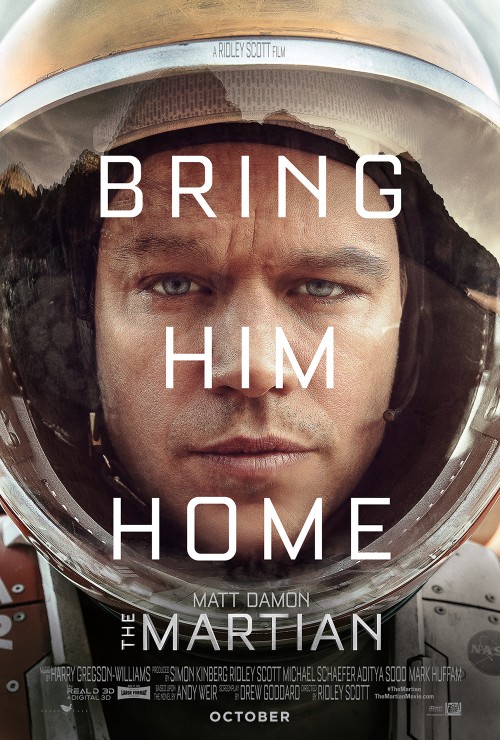
FILM REVIEW: The Martian


The book The Martian by Andy Weir is a publishing phenomenon, widely regarded as one of the best (and probably the best-selling) science fiction books of 2014. When I discovered that the movie adaptation was being directed by Ridley Scott (Alien, Prometheus, Gladiator) and starring Matt Damon as Mark Watney this film jumped to the top of my want-to-see list for 2015.

The Other Half and I saw it with another gay couple at our go-to place for watching movies in the theater, Arclight Pasadena. Since we saw it opening weekend the film has gone on to become a box-office smash (and is currently the #6  top-grossing film released in 2015, with well over $200 million in receipts in North America) as well as a critical smash, with 93% positive ratings at rottentomatoes.com from both critics and audiences. Director Ridley Scott is starting to appear on Best Director Oscar consideration lists.

I read the book at the end of 2014 and enjoyed it, but was not overwhelmingly enthusiastic about it. I actually think the movie is a better (more entertaining) version of the story. The cast is incredible. Jeff Daniels, Sean Bean and Chiwetel Ejiofor play bigwigs at NASA with Jessica Chastain, Kate Mara and Michael Peña as fellow astronauts on a Mars mission with Matt Damon. Donald Glover has a key role as a quirky NASA astrophysicist.

The movie is centered around science and the importance (and dangers) that are involved with space exploration and scientific progress. I complained to my fellow moviegoers that despite the centrality of science (especially, botany, biology, physics, astronomy and mathematics) to the plot there is not a single equation displayed in the film. They pointed out that for the vast majority of people who go to see the film, including a mathematical equation would be communicating something similar to including Chinese characters in the film. In other words, the symbols would have almost no inherent meaning to the audience, and would be communicating information that the audience is not intended to understand. I see their point, but I still think the filmmakers could have done a better job of indicating the mathematical calculations that must have occurred while all the science and engineering was being done to attempt to rescue Mark Watney on Mars.

That being said, the movie is not a geek-laden paean to NASA, but is instead a very suspenseful thriller which is exciting, emotionally gripping and inspiring.

Title: The Martian.
Director: Ridley Scott.
Running Time: 2 hours, 22 minutes.
MPAA Rating: Rated PG-13 for some strong language, injury images, and brief nudity.
Release Date: October 2, 2015.
Viewing Date: October 4, 2015.

Writing: A.
Acting: A.
Visuals: A+.
Impact: A.

Overall Grade: A/A+ (4.08/4.0).

Thursday, August 13, 2015

BOOK REVIEW: Hurricane Fever by Tobias Buckell


Tobias Buckell is a Caribbean-American writer who is most well known for his excellent Xenowealth series (kick-ass space operas featuring dreadlocked super-strong, dark-skinned heroes fighting freaky aliens science fiction spanning four books so far). In addition to his Xenowealth books, in 2012 Buckell wrote a fun little "eco-thriller" about a radically different geopolitical power structure reshuffled by the effects of global climate change that features a character which is basically a Black lesbian version of James Bond called Arctic Rising (see my generally positive B+ review). The book generally got excellent reviews and was nominated for the Prometheus Award in 2013.

Last year I found out that Buckell has now written another book set in the same world of Arctic Rising called Hurricane Fever, which this time features one of the more eccentric (but interesting) characters from the first book called Prudence Jones, or Roo for short. Roo is a dreadlocked, former Caribbean Intelligence agent (one of the interesting conceits of the Arctic Rising universe is that the Caribbean Islands have banded together to form a political unit that actually has some sway in the world) who after the events of the first book in the series is now the sole guardian for his orphaned nephew.

I was able to receive an ARC (author review copy) of Hurricane Fever in exchange for an unbiased review.

I actually like Hurricane Fever quite a lot (even more than Arctic Rising). It is a fast-paced, action-packed thriller with an interesting premise set in a foreseeable near-future; however I think that Buckell sort of squanders Roo's potential as a leading man by not making him as likeable or emotionally approachable as a character. I do appreciate Buckell's commitment to include diverse characters and the fact that his main character is a Black man presents the readers with situations and concerns which are not usually raised in your ordinary technothriller.

The basic plot of Hurricane Fever is reminiscent of something from James Bond (Ian Fleming), Jason Bourne (Robert Ludlum), Mission Impossible or even Die Hard. Despite swearing that he “left all that spy shit behind” Roo unsurprisingly gets sucked back in when one of his former agent friends (named Zee) is found dead and a message is automatically communicated to Roo with information about a plot that could lead to a worldwide catastrophe. Roo ends up in the Caribbean sea in the area between Barbados and Venezuela with a woman who calls herself Zee's sister just as a climate-change enhanced hurricane is approaching and a super-villain is trying to complete his dastardly scheme.

Overall, Hurricane Fever is a fun and compelling read, set in an interesting near future world which has been affected by climate change.

Title: Hurricane Fever (Arctic Rising, #2)
Author: Tobias Buckell
.
Paperback: 272 pages.
Publisher:
 Tor Books.
Date Published: July 1, 2014.
Date Read: September 8, 2014.


OVERALL GRADE: A- (3.67/4.0).

PLOT: A-.
IMAGERY: A-.
IMPACT: B+.
WRITING: A.

Thursday, August 06, 2015

BOOK REVIEW: The First Fifteen Lives of Harry August by Claire North


Claire North is the pseudonym of Catherine Webb, who although she is only 28 years old is already the author of sixteen(!) published novels, including two science fiction novels as Claire North: The First Fifteen Lives of Harry August in 2014 and Touch in 2015. The former won the John W. Campbell Memorial Award for Best Science Fiction Novel of 2014, beating out other higher profile books such as The Martian by Andy Weir (probably the best-selling science fiction book of 2014 and soon to be a major motion picture starring Matt Damon), Lock In by John Scalzi, The Peripheral by William Gibson, Annihilation by Jeff VanderMeer (winner of the 2015 Nebula award) and Station Eleven by Emily St. John Mandel (winner of the 2015 Arthur C. Clarke award).

I can see why The First Fifteen Lives of Harry August is considered one of the best works of speculative fiction published in 2014. The premise of the book is that when certain people die they live their life over again is a great one. In fact it is so good it has been used before, notably in Ken Grimwood's Replay (which won the 1988 World Fantasy Award.) I had forgotten about Replay but I do remember that although I loved the timeloop concept Grimwood's book seemed a bit dated. There's no question this would make a great movie. In Replay, the main character's time loop starts at age 18, and the loops get shorter and shorter as the story progresses. In Harry August, the time loops go back to birth, but awareness of all one's past lives does not occur until age 5 or 6.

The First Fifteen Lives of Harry August takes Grimwood's time loop premise and improves it in several, specific ways. First off, there is an organization of ouroborans (i.e. individuals like Harry who relive their lives after "dying" and are also known as kalachakras) called the Cronus Club whom Harry pretty quickly comes into contact with and serves as a support network for creatures like himself. Secondly, North introduces a thriller element to the story by including a megalomaniacal kalachakra who is apparently discovering the birth dates of fellow kalachakras and eliminating them before they can recover their memories or defend themselves. Unsurprisingly, most kalachakras tend to avoid others of their kind (and have low profiles in general), but Harry meets another kalachakra named Vincent Rankis who becomes a frenemy of sorts. The third aspect of the book which raises it to the upper echelon of speculative fiction is the way in which it deals with various aspects of time travel. Basically, kalachakra's repeatedly experience the same time period as they repeat their lives, so they have a limited foreknowledge of the future. By interacting with other kalachakras whose lifetime overlaps with theirs, but whose birth occurs later a kalachakra can obtain information about the far future. This is what happens when a very young girl comes to Harry towards the end of one of his lives and says "the world is ending." In fact, soon it becomes clear that the end of the world is coming about earlier in the future and as Harry continues to live his life (from about 1919 through to about 2010) he notices other changes, like technological advances starting to occur earlier and earlier.
He is pretty sure that Vincent Rankis is involved in making these changes because in addition to being a kalachakra, Rankis (like Harry) has an eidetic memory: he remembers everything that happens to him, in every life. The reader is faced with the question of what you would do if you discovered you were a kalachakra and could live your life over again and again knowing what events would be occurring

The First Fifteen Lives of Harry August ends up being a power struggle between Victor and Harry; the reader is exposed to Harry's thoughts and feelings so we are predisposed to be on Harry's side. (He has a wry wit.) In addition, Victor turns out to have a complete disregard for life, both human and ouroboran alike. He creates a device which when applied to a kalachakra, wipes their memory so that even when they are reborn, they are no longer able to access their memories of their past lives, essentially killing them.

Overall, The First Fifteen Lives of Harry August is a compelling, well-written, very entertaining work of speculative fiction which packs an emotional wallop while it amuses, thrills and challenges the reader.

Title: The First Fifteen Lives of Harry August.
Author: 
Claire North.
Paperback: 416 pages.
Publisher:
 Redhook.
Date Published: April 8, 2014.
Date Read: April 30, 2015.

OVERALL GRADE: A-/B+ (3.583/4.0).

PLOT: B.
IMAGERY: B.
IMPACT: A+.
WRITING: A.

Friday, July 31, 2015

2015 Hugo Awards: Voting Closes Today; Here's Excerpts Of My Ballot

Despite the coincidence that today is National Mutt Day, my final ballot in the 2015 Hugo Awards is delightfully Puppy-free. If you don't know what the heck I am talking about, go here and read up.

Anyway, here are my votes for the important categories of Best Novel and Best Dramatic Presentation (Long Form and Short Form).

Best Novel 
  1. The Three Body Problem, Cixin Liu, Ken Liu translator (Tor Books)
  2. Ancillary Sword, Ann Leckie (Orbit US/Orbit UK)
  3. NO AWARD
  4. Skin Game, Jim Butcher (Orbit UK/Roc Books)
  5. The Goblin Emperor, Katherine Addison (Sarah Monette) (Tor Books)
  6. The Dark Between the Stars, Kevin J. Anderson (Tor Books)
It should not come as a surprise that I placed the two books that got onto the short list due to the Puppy shenanigans below NO AWARD. I tried to read all the nominees for Best Novel and simply could not finish The Goblin Emperor and The Dark Between Stars. I did not expect to like Skin Game but I actually did enjoy it, even if it was the 14th book in the Harry Dresden books.  I think it was clever and engaging, but I wold rather no award get the nod instead. Actually I should be clear that I did not rank The Dark Beneath The Stars sith, I simply left it off my ballot completely.

My reviews for The Three Body Problem and Ancillary Sword can read at the link. I thought both of them were excellent works, with Three-Body really harkening back to late Asimov for me, while Leckie's second book was slightly less interesting than her blockbuster debut. That said, I fully intend to buy and devour both follow-ups to these books (The Dark Forest and Acillary Mercy, respectively) when they come out.

Best Dramatic Presentation, Long Form 
  1. Interstellar, screenplay by Jonathan Nolan and Christopher Nolan, directed by Christopher Nolan (Paramount Pictures, Warner Bros. Pictures, Legendary Pictures, Lynda Obst Productions, Syncopy)
  2. Guardians of the Galaxy, written by James Gunn and Nicole Perlman, directed by James Gunn (Marvel Studios, Moving Picture Company)
  3. The Lego Movie, written by Phil Lord & Christopher Miller, story by Dan Hageman, Kevin Hageman, Phil Lord & Christopher Miller, directed by Phil Lord & Christopher Miller (Warner Bros. Pictures, Village Roadshow Pictures, RatPac-Dune Entertainment, LEGO System A/S, Vertigo Entertainment, Lin Pictures, Warner Bros. Animation (as Warner Animation Group))
  4. Edge of Tomorrow, screenplay by Christopher McQuarrie, Jez Butterworth, and John-Henry Butterworth, directed by Doug Liman (Village Roadshow, RatPac-Dune Entertainment, 3 Arts Entertainment; Viz Productions)
  5. Captain America: The Winter Soldier, screenplay by Christopher Markus & Stephen McFeely, concept and story by Ed Brubaker, directed by Anthony Russo and Joe Russo (Marvel Entertainment, Perception, Sony Pictures Imageworks)
  6. NO AWARD
I saw all of these movies, and my reviews can be accessed at the link. I don;t usually review movies that I see on television (i.e. not at the theater) so that is why The Lego Movie and Captain America: The Winter Soldier do not have full reviews. My favorite movie of 2014 was Interstellar; I admit I am a full-on fanboy of Christopher Nolan. Edge of Tomorrow was surprisingly good (especially for a Tom Cruise movie!) but The Lego Movie astonished and delighted me in its cleverness.

Best Dramatic Presentation, Short Form 
  1. Game of Thrones: “The Mountain and the Viper”, written by David Benioff & D. B. Weiss, directed by Alex Graves ((HBO Entertainment in association with Bighead, Littlehead; Television 360; Startling Television and Generator Productions)
  2. Orphan Black: “By Means Which Have Never Yet Been Tried”, ” written by Graham Manson, directed by John Fawcett (Temple Street Productions, Space/BBC America)
  3. Doctor Who: “Listen”, written by Steven Moffat, directed by Douglas Mackinnon (BBC Television)
  4. NO AWARD
  5. The Flash: “Pilot”, teleplay by Andrew Kreisberg & Geoff Johns, story by Greg Berlanti, Andrew Kreisberg & Geoff Johns, directed by David Nutter (The CW) (Berlanti Productions, DC Entertainment, Warner Bros. Television)
  6. Grimm: “Once We Were Gods”, written by Alan DiFiore, directed by Steven DePaul (NBC) (GK Productions, Hazy Mills Productions, Universal TV)
I'm a huge fan of the Game of Thrones adaptation and since Season 3 have been blogging every episode. There is no question this is the cream of the crop. I binge watched Season 1 and Season 2 of Orphan Black and am not a card carrying member of the Clone Club but I am a fan. (The actor Dylan Bruce playing Paul is one of the best looking guys on television!) Doctor Who is barely my cup of tea any more but I would be fine with them winning an award even though I am not completely sure that I saw the specific episode in question. I have to admit that I have never seen an episode of Grimm and although I have seen parts of The Flash it does not interest me (I'm sort of surprised there was no Marvel's Agents of Shield on this list.

John W. Campebell Award (Not a Hugo)
  1. Wesley Chu
  2. Kary English
  3. NO AWARD
I have read and enjoyed the four books by Wesley Chu I read this year. I think he is an exciting author to watch. The Tao series is an incredible work, one I hope that he returns to soon or that Hollywood realizes that it there is even better Chu-related work than the one they have already optioned to become a movie.

For the other categories, like Best Novella,Best Novelette, Best Short Story, Best Graphic Story, Best Related Work and others you will just have to guess. Suffice it to say, Noah Ward appeared more than once!

Thursday, July 30, 2015

BOOK REVIEW: On The Steel Breeze (Poseidon's Children, #2) By Alastair Reynolds


On The Steel Breeze is the second book in Alastair Reynolds latest space opera saga called Poseidon's Children. The first book was titled Blue Remembered Earth. Sadly, these books are being released in America more than 6 months after their British/European release dates. The first book was released there in January 2012 but not in the USA until June 4, 2012. The second book was released September 26, 2013 but did not appear in the USA until June 3, 2014. Distressingly, the third and final book in the trilogy was released on April 30, 2015 but people in the USA will not have access to it until February 2, 2016. I suppose we Americans should be thankful that we don't have to wait until June 2016 to finally get our grubby little hands on the conclusion of the latest Alastair Reynolds trilogy!

On The Steel Breeze is set more than 200 years after the events of Blue Remembered Earth. The main characters are three clones of Chiku Akinya, granddaughter of Eunice Akinya, the macguffin from the first book, and in this story, the primary force behind humanity spreading out into interstellar space. In On The Steel Breeze we have Chiku Red, Chiku Yellow and Chiku Green, who split off and go have separate adventures, This is a very clever device to allow the author to use his prodigious imagination to dazzle us with compelling far-future scenarios. Chiku Yellow remains on Earth, which is in control by an all-seeing, all-powerful AI called the Mechanism (or the Mech) which monitors all human activity and prevents (or punishes) any forms of physical violence. Chiku Green is part of a fleet of generational colony ships (mined out asteroids under constant acceleration called with living space for several thousand people) aimed at the planet Crucible where signs of an intelligent structure called the Mandala have been detected. Chiku Red jumped on a ship in an attempt to follow and catch up with Eunice Akinya and has not been heard of since.

So, the story mainly follows Chiku Yellow and Chiku Green. Chiku Green's was the more compelling arc to me because there is plenty of action and intrigue as the long space journey to Crucible drags on and even though Chiku has the option of going into suspended animation, the situation on the colony ships change drastically as secrets are revealed about not just the ships themselves (hint: there are stowaways!) but also their destination (the data which the Mech showed humanity about Crucible turns out to have been selectively edited). This leads to a lot of political intrigue and exciting action.

That's not to say that Chiku Yellow's story is boring. She ends up interacting with the genetically modified humans called the merfolk who have formed an autonomous nation in Earth's seas (successfully minimizing surveillance by the Mechanism) and she goes on a somewhat meandering quest for information that will hopefully help Chiku Green that takes her to Venus, Phobos, the asteroid belt, the Akinya ancestral home in Africa and finally back to her home in Lisbon. She also has numerous unpleasant (and dangerous) run-ins with the Mech which lead to a cliffhanger showdown at the end of the book.

Reynolds includes a lot of interesting themes in the book: conflict between man and machine, the limit and consequences of human genetic modifications/adaptations, systems of governance among humans who are in an isolated society, the nature of familial and generational compulsions and responsibilities.

Overall, On The Steel Breeze is not Reynolds at his very best, but that still means that it is better (more interesting, more compelling, more complex) than the vast majority of science fiction out there and well worth a read. I am definitely looking forward to read Poseidon's Wake as soon as it is released domestically!

Title: On The Steel Breeze.
Author: 
Alastair Reynolds.
Paperback: 496 pages.
Publisher:
 Ace.
Date Published: June 3, 2014.
Date Read: June 21, 2014.


OVERALL GRADE: A- (3.67/4.0).
PLOT: A-.
IMAGERY: A-.
IMPACT: B+.
WRITING: A.

Thursday, July 16, 2015

BOOK REVIEW: The Abyss Beyond Dreams by Peter F. Hamilton


Peter Hamilton is one of my favorite authors; he has written and continues to write some of the most interesting and exciting space opera books around.  He is probably most well-known for his best-selling Naked God trilogy but he has also published many books in his Commonwealth Universe. His latest is the first of a duology called  The Chronicle of the Fallers, Book 1: The Abyss Beyond Dreams which is set in the Commonwealth Universe. (The second book in the duology is The Chronicle of the Fallers, Book 2: The Night Without Stars.)

The Abyss Beyond Dreams is a book that stands on its own but is also enriched by the stories Hamilton has written in the Commonwealth universe previously. Those stories begin in the Commonwealth saga, which consists of the duology Pandora's Star and Judas Unchainedand then continues in the Void Trilogy (The Dreaming Void, The Temporal Void, The Evolutionary Void) which is set in the same universe about 1200 years after the events of the Commonwealth Saga (around 3358). The events of The Abyss Beyond Dreams are set just a few decades (around 3326) before the events that happen in the Void Trilogy.

One of the aspects of the Void Trilogy that I appreciate is that it simultaneously takes place in the Commonwealth that we know and love as well as inside the Void, on the planet Querencia in the city-state of Makkathran. Since inside the Void there is very little technology (but for reasons we learn later, mental powers such as telepathy and telekinesis are commonplace and formidable) so that the Void parts of the story are effectively part of a fantasy novel, which is an interesting counterpoint to the advanced artificial intelligences, explosively powerful space ships and multiple human technological advancements that exist in the hard sci-fi tale being told outside the Void.

A specific highlight of The Abyss Beyond Dreams is the inclusion of Nigel Sheldon (who was an important character in the original Commonwealth saga) as a major character in this new story. Additionally, the Fallers (the terrifying new shape-shifting aliens that Hamilton introduces in an absolutely stunning prologue to the book) are another strong element of the book.

The primary action of the book, surprisingly, is political in nature. The main story takes places on a planet in the Void called Bienvenido, where, like Makkathran most technology does not work but mental powers are commonplace. The planet's population is being ruled by the family of the captain of the Commonwealth ship that crashed on the planet after wandering into the Void many, many generations before but who have extended life expectancies due to Advancer genes. Our main protagonists is named Slvasta, a country boy who loses an arm in a Faller attack and later becomes a folk hero of sorts to the people of the capital city of Varlan. One of the main threads in the story is how Slvasta and his friends instigate a revolution to take down the rule of the ruthless Captain Philious through a combination of electoral strategy and insurgent tactics. The other main thread involves Nigel and a quartet of genetically enhanced, Advancer clones infiltrating Bienvenido in order to investigate the Fallers and the even more inscrutable Sky Lords. The Sky Lords are aliens (we think) who also appeared in the Void trilogy. On both Void planets we have met (Querencia and Bienvenido) the Sky Lords are worshiped as gods who absorb the spiritual essence of loved ones when they die and take them to the Void.

This is Hamilton at very near the top of his game; I would say that  The Abyss Beyond Dreams is better than any of the books in the Void trilogy and very close to the quality of both books in the Commonwealth duology. This was one of my favorite reads of 2014, the second best science fiction book, finishing a close second behind James S.A. Corey's Cibola Burn.

Title: The Abyss Beyond Dreams.
Author: 
Peter F. Hamilton.
Paperback: 640 pages.
Publisher:
 Del Rey.
Date Published: October 21, 2014.
Date Read: December 25, 2014.

OVERALL GRADE: A/A- (3.83/4.0).

PLOT: A.
IMAGERY: A-.
IMPACT: A.
WRITING: A-.

Sunday, June 28, 2015

2015 LOCUS Awards: Ann Leckie and Katherine Addison Win Best Novel (For SciFi and Fantasy, Respectively)


In light of the ongoing Puppy kerfuffle around the Hugo awards, all awards for achievements in speculative fiction will be closely scrutinized this year, so thanks to File770.com I know that last night the 2015 Locus Awards were revealed. I am very pleased to report that Ann Leckie has won her second consecutive Locus Award for Best SF Novel (Ancillary Sword) while Katherine Addison has won her first Locus award for Best Fantasy Novel (The Goblin Emperor).

The Locus Awards (cleverly, in my opinion) separate Best Novel into Fantasy and Science Fiction categories, unlike the other major prestigious awards like the Hugo and Nebula, which both Ancillary Sword and The Goblin Emperor have also been nominated. They both lost this year's Nebula award for best Novel, to Jeffe VanderMeer's Annihilation. Ancillary Sword has already won this year's BSFA award but it failed to make the Arthur C. Clarke shortlist.

Interestingly, the Best Novella award went to Nancy Kress for Yesterday's Kin which earlier won the Nebula award in the same category. Alas, it is not nominated for the Hugo award because some idiots thought that novellas by one virulently homophobic guy named John C. Wright should take up not one, not two but three of the five slots in this category. We will not know until late August if Nancy Kress would have been nominated for a Hugo this year as well.

Thursday, June 25, 2015

BOOK REVIEW: The Secret Place by Tana French


Tana French is one of my favorite mystery authors, having written four related but arguably stellar murder mysteries in roughly seven years (In The Woods, 2007; The Likeness, 2008; Faithful Place, 2010; Broken Harbour, 2012). Her latest book is The Secret Place (2014) and it was one of (although not the) best mystery that I read in 2014. According to the users at goodreads.com, they think her books have been uniformly declining in quality since her stunning debut, but I actually liked her 2012 book, Broken Harbour probably as much as her very first, the iconoclastic In The Woods.

One of the reasons why I liked Broken Harbour was the appearance of Francis (Frank) Mackey and the introduction of his junior partner Richie Curran. Plus, as in all of French's books, it is the other things in the books besides the central mystery which really make the reading experience so compelling for me. In the case of The Secret Place, however, these "extra" things in the story that are distinct from the central "whodunnit?" are both what make and unmake the novel in the end.

In The Secret Place the Dublin Murder Squad representatives are Stephen Moran and Antoinette Conway. Moran was the sidekick character in Faithful Place (probably my least favorite of her books) while Conway is new to us. Frank Mackey becomes the first character to have an unprecedented 3rd showing in a Tana French mystery (albeit it is little more than a cameo since he mostly appears in his role as a father of one of the suspects, not as a detective). The central question this time is "Who killed Chris Harper?", a 16-year-old boy who was found dead on the grounds of an expensive all-girls school called St. Kilda's the year before the events that begin the book occur. That event, the appearance of the note "I know who killed him" as a caption to a picture of the dead boy in a semi-public confessional noteboard at the school called "the secret place" along with the report of this fact to Detective Moran by Frank's daughter Holly are how The Secret Place begins.

Moran sees Holly's visit as a chance to revive his stalled career from the cul-de-sac of the Cold Case and return him back into the advancement path of the Murder Squad by taking the new information to Conway, who as the only female detective on the team who has been unable to make any progress is solving a high-profile murder of a handsome, well-to-do minor in over a year has been experiencing her own career slowdown.

It's this kind of context of the murder investigation that French brings to her mysteries which generally give them that extra oomph, propelling them well above your average detective procedural.
In the case of The Secret Place, French raises the stakes even higher by making two significant structural decisions about the narrative: she splits it into two streams, one present day, and one a few months before the murder occurred, then advances both forward in time. The other, more controversial decision is to completely embed the reader in the lives, loves and lingo of the teenagers who are the primary actors in the drama that is unfolding. It is this second aspect of the book which makes The Secret Place feel special but also, ultimately, detracts from the book.

There are two cliques of girls at St. Kilda's, the one that the reader is intended to identify with (since we are given access to their internal monologues and Holly is a member) and the prototypical Mean Girls, who we are most definitely not intended to identify with. In addition to these two quartets of female teens there are also a group of teenage boys (from the neighboring all-boys school that the murdered Chris attended and was a leading personality). There are many, many examples of surly and incomprehensible teenage communication and behavior which after awhile as an adult one starts to winder if the anthropological novelty is worth the effort.

One does come to a point in the novel, like most excellent mysteries, where one realizes "oh my goodness, one of these characters that we have been introduced to and know pretty well at this point must be the murderer!" To me, that is almost always an exciting and thrilling rubicon, and yet in most cases it still does not provide me with enough information to suss out the criminal.

French's The Secret Place also has the advantage that in addition to wondering which of these teenagers is damaged enough to cave in the skull of another with a dull object, the reader has other interesting questions about what will happen to the other members of the clique, as well as the impact of the successful solution on the careers of the detectives involved. To me this proves that the authors has more than adequately fulfilled her duty of entertaining the reader.

I do have two quibbles with the book. The first quibble is, why call it The Secret Place when you already have a previously published novel using the word place? That just seems like somewhat lazy writing, in my opinion. (I would have gone with the title of The Secret or The Secret Spot or even I Know Who Killed Him as titles.) My second quibble is more specific, as it is directly related to content. For some reason the author decides to include actual supernatural activity into the story (i.e. behavior or phenomenon that can not be explained by scientific or logical observation). I can not stress enough how strongly opposed I am to including supernatural elements into mystery thrillers! Yes, I know I am reading fiction, but, to me, one of the aspects of teh genre is that things could have happened in the way that they are described, in order to give the readers a chance at figuring out the mysteries at the heart of the story. If there's some magical element involved then why couldn't the murderer be anyone and have used non-physical, inexplicable powers to complete their task? It's simply not a good idea to include this element. Happily, the supernatural element is not really a feature of the central mystery, it is really an embellishment of the interactions of the central characters (the teenage girls) in the book so in the end it did not dramatically deteriorate my enjoyment of the book. Your mileage may vary.

Title: The Secret Place.
Author: 
Tana French.
Paperback: 464 pages.
Publisher:
 Viking Adult.
Date Published: September 2, 2014.
Date Read: September 15, 2014.


OVERALL GRADE: A- (3.67/4.0).
PLOT: A.
IMAGERY: B+.
IMPACT: A-.
WRITING: A-.

Thursday, June 11, 2015

BOOK REVIEW: Ancillary Sword by Ann Leckie


Ann Leckie's debut novel Ancillary Justice was the most celebrated work of science fiction of the year, perhaps the most heralded science fiction debut of all time. In 2014 Ancillary Justice won the NebulaHugoBritish Science FictionLocus and Arthur C. Clarke awards. The follow-up is titled Ancillary Sword and has already won the British Science Fiction award and it has been nominated for the Locus, Hugo and Nebula awards. Surprisingly, it was not nominated for the Clarke award. UPDATE: we now know Annihilation won the 2015 Nebula Award for Best Novel so Ann Leckie will not be able to win back-to-back Hugo-Nebula awards.

There's some debate about whether Ancillary Sword  is better than Ancillary Justice or not. According to Goodreads, Ancillary Sword (4.07/5 from 6,693 ratings) is better than Ancillary Justice (3.97/5 from 18,595 ratings), while on Amazon.com Ancillary Justice (4.2/5 from 694 reviews) is better than Ancillary Sword (4.1/5 from 209 reviews). I suspect that as more people rate Ancillary Sword its ratings will start to slide. Then again, most sequels rate higher than the original because usually only people who liked the original even bother reading the sequel, so it is likely there is a selection bias at work.

While I liked Ancillary Justice quite a bit (A- on my 4.0 scale) I don't think it quite lives up to its reputation as "the most celebrated debut science fiction novel of all time." It's good, but it did not blow my mind. Ancillary Justice famously has a unique depiction of gender in a technologically advanced, galaxy-spanning civilization: The Radchaai do not see gender as a significant identifying characteristic (like eye or hair color) and the narrator Breq in Ancillary Justice uses the feminine pronoun to describe every character (both male and female) in the book.

Ancillary Sword follows Breq's story that started in Ancillary Justice. Breq used to be the artificial intelligence running the space ship Justice of Toren with thousands of partially cybernetic humans, called ancillaries, under her direct control but in the events that transpired before Ancillary Justice Breq had been reduced to existence in a single ancillary body. Ancillary Justice is about revealing Breq's backstory and following her as she navigates a complex, dangerous path to redemption.

In Ancillary Sword Breq has now been given the captaincy of her own ship, Mercy of Kalr and a mission to check out what is going on at a remote section of Radchaai space called Athoek Station. Athoek is near the border with the region of space known to be occupied by the secretive alien race known as the Presger.

The story told n Ancillary Sword is not as compelling to me as the one in Ancillary Justice. This time Breq seems to meander between various sub-plots that involve characters that I did not really feel invested in caring about. There's definitely a point about two-thirds through the book where I felt a lull and almost considered abandoning the book but I didn't out of respect for the author (and the first book). I'm glad that I persevered because the book ends strongly, with multiple exciting action scenes reminiscent of Ancillary Justice.

Overall, I'm glad that I read Ancillary Sword and think that it is a decent follow-up to the brilliant Ancillary Justice. I am anxiously looking forward to buying and reading Ancillary Mercy when it comes out later this year to see how Breq's story continues and whether Leckie can conclude the Imperial Radch trilogy successfully.

Title: Ancillary Sword.
Author: 
Ann Leckie.
Paperback: 400 pages.
Publisher:
 Orbit.
Date Published: October 7, 2014.
Date Read: January 8, 2015.

OVERALL GRADE: A-/B+ (3.5/4.0).
PLOT: A-.
IMAGERY: A-.
IMPACT: B+.
WRITING: A-.

Sunday, June 07, 2015

Annihilation by Jeff VanderMeer Wins the 2015 Nebula Award

In a year in which awards for science fiction are under enhanced scrutiny due to the kerfuffle about the Hugo Awards (see file770.com for more details) the Science Fiction Writers of America chose a book that has not been nominated for the Hugo to with the 2015 Nebula Award: Annihilation by Jeff VanderMeer.

Annihilation is Book 1 in what is known as the Southern Reach trilogy and is an example of what some people are calling the new Weird. I tried it but it didn't really do anything for me. The good thing about the book is that it is very short (barely over 200 pages) so it is a very quick read.

Last year Ann Leckie's Ancillary Justice basically dominated all the science fiction awards, becoming a rare Hugo-Nebula winner. The one thing we know for sure this year is that we will not have a Hugo-Nebula double winner since Annihilation was not nominated  for the Hugo. We won't know how close Annihilation was to being one of the Hugo nominees if there had not been shenanigans during this year's nominating process until the full tallies of the Hugo awards voting and nominations are released during the 2015 WorldCon (i.e. Sasquan) which is being held in Spokane Washington in late August.

Monday, April 20, 2015

2015 HUGOS: The Three-Body Problem Joins Best Novel List After Withdrawal

The drama around the 2015 Hugo awards continues to build, with mainstream media starting to pay more attention to the fracas. I myself have decided to buy a $40 supporting membership so that I can vote on the awards this year, something I would have never done if the machinations of the execrable Vox Day and others who are either willfully or witlessly pursuing similarly questionable goals of freeping the Hugo awards had not been brought to my attention by John Scalzi and others. Happily, this means that I will be able to participate in the process of nominating for the 2016 Hugo Awards as well. Anything I can do to stand with people like Scalzi, Martin and Connie Willis against people who think they need to "take back" something because those people think that we should "go back to the good old days" is something I am happy to contribute to.

Anyway, there are some silver linings to be had and one of them is that the great book The Three-Body Problem by Chinese author Cixin Liu (translated into English by Ken Liu) has been added to the list of nominees for Best Novel for the 2015 Hugo Awards with the withdrawal by Markos Kloos of his book from that category thanks to its inclusion on the Sad Puppies/Rabid Puppies slate and his aversion to being associated with them.

So, the final list of nominees for Best Novel are now:

  • Ancillary Sword, Ann Leckie (Orbit US/Orbit UK)
  • The Dark Between the Stars, Kevin J. Anderson (Tor Books)
  • The Goblin Emperor, Katherine Addison (Sarah Monette) (Tor Books)
  • Skin Game, Jim Butcher (Orbit UK/Roc Books)
  • The Three Body Problem, Cixin Liu, Ken Liu translator (Tor Books)
The winner will be announced on August 22. I would be fine with any of these winning, except for Kevin Anderson, who is responsible for the horrors that are the recent "XXX of Dune" books he coauthors with Brian Herbert.

Sunday, April 05, 2015

2015 HUGO AWARDS: The Nominees Are Announced, Controversy Ensues

The nominations for the 2015 Hugo awards were announced at 12noon PDT on Saturday and were immediately engulfed in controversy. The issue is that apparently some group calling itself Sad Puppies came up with a slate of how people should vote for the Hugo nominations and they have been overwhelmingly successful this year. They were able to get three of their five books on the best novel list and dominated several of the "lesser" categories. (Frank J.  Wright has three of the five nominations in the Best Novella category, for example.)

Regardless, for better or worse, these are the nominees for Best Novel:
  • Ancillary Sword by Ann Leckie (Orbit US; Orbit UK)
  • The Dark Between the Stars by Kevin J. Anderson (Tor Books)
  • The Goblin Emperor by Katherine Addison (Sarah Monette) (Tor Books)
  • Lines of Departure by Marko Kloos (47North)
  • Skin Game: A Novel of the Dresden Files by Jim Butcher (Roc Books)
Both Ann Leckie's Ancillary Sword and Katherine Addison's The Goblin Emperor are also on the list  of nominees for the Nebula award, which may be why they broke up what is apparently intended to be a hegemonic slate of straight white males. I have read and loved Leckie's Imperial Radch series and her  first book Ancillary Justice won last year. I tried to read The Goblin Emperor and just could not get into it enough to finish it. I hope Leckie gets the rare Hugo-Nebula win, again for the sequel. Since Kevin J. Anderson is half-responsible for the execrable faux Dune books co-written wit h Brian Herbert set in the universe of Frank Herbert's masterworks I seriously hope he doesn't win. I have heard great things about the Dresden Files books by Jim Butcher but never read any. I have never even heard of Marko Kloos.

The Hugo awards are voted on by the attendees of WorldCon and there is the very likely possibility that "No Award" will sweep categories where the list of nominees is identical to the Sad Puppies slate.

Saturday, February 21, 2015

2015 Nebula Award Nominations Announced!


The nominations for the Nebula Awards have been announced and there are some surprises:

  • The Goblin Emperor, Katherine Addison (Tor)
  • Trial by Fire, Charles E. Gannon (Baen)
  • Ancillary Sword, Ann Leckie (Orbit US; Orbit UK)
  • The Three-Body Problem, Cixin Liu, translated by Ken Liu (Tor)
  • Coming Home, Jack McDevitt (Ace)
  • Annihilation, Jeff VanderMeer (FSG Originals; Fourth Estate; HarperCollins Canada)
Nominations for Ann Leckie's Ancillary Sword was expected, since the first book in the series (Ancillary Justice) won the Hugo-Nebula double last year. Curiously the only fantasy book on the list is Katherine Addison's The Goblin Emperor (which I tried to read earlier this year and sadly I could not finish it.) I'm very surprised City of Stairs by Robert Jackson Bennett was not on the list. I've been thinking about getting The Three-Body Problem for quite awhile; it is hard science fiction and this nomination increases the odds I will buy it soon.

I have never even heard of Trial By Fire, which like Leckie's work, is Book 2 in a trilogy, called Tales of the Terran Republic.

I read Coming Home by Jack McDevitt and I don't think it is one of his better outings in the Alex Benedict/Chase Tolpath series, but apparently the guy is a Nebula favorite (this is his 12th Best Novel nomination!)

Jeff VanderMeer's Annihilation is the first book in his Southern Reach trilogy. It is very short but I read about half of the book and it did not grab me either.

My hope is that Leckie wins again, although I would be happy with Liu winning also.

Thursday, February 19, 2015

My Favorite Books Read In 2014 (Science Fiction, Fantasy, Mystery and Thriller)


In 2014 I read 70 books; they were all novels, in the genres of mystery/thriller and fantasy/science fiction. By far, the biggest fraction of books that I read are mystery/thrillers. I have recently made it through all 18 of Peter Robinson's DCI Alan banks mysteries and am currently making my way through Michael Connelly's Detective Harry Bosch series (which I think is quite good) and Leighton Gage's Chief Inspector Mario Silva's series, which is also good and tragically cut short by the author's untimely death.

I had previously read all of Henning Mankell's Inspector Kurt Wallander books and the Steig Larsson trilogy and now definitely consider myself a full-fledged fam of Scandinavian noir. I was unprepared for how good the Inspector Harry Hole thrillers by Jo Nesbø are and surprised by the level of suspense in the first Department Q novel by Jussi Adler-Olsen!

Overall, however, my favorite reads of the year were from authors familiar to me (James S.A. Corey, Peter F. Hamilton, Daniel Abrahams, Brent Weeks, Tana French) continuing to bring me joy with their work.

I'm always looking for good books and authors to start reading! Feel free to make suggestions of books or authors you think I would like in the comments.

Favorite Science Fiction Novel Read In 2014: Cibola Burn by James S.A. Corey


Cibola Burn is the fourth book in the best-selling space opera series known as The Expanse. I have been a huge fan of these books from day one, and am very excited that the television adaptation of the books is slated to come to SyFy as a 10-episode miniseries later this year. Cibola Burn follows events in a planet which has opened up outside of our solar system as a result of the events that occurred in Abaddon's Gate. Cibola Burn is space opera at its best, with interesting ideas about conflicts between corporations and colonists, all in the context of a visionary future for humanity combined with non-stop action and peril for the familiar characters of Holden, Nagata, Amos and Avarasala. Corey also introduces some new characters and resolves some plot points which have been developing since the very first book in the series (Leviathan Wakes). This was my favorite novel (of any genre) that I read in 2014. At this point, I fully expect that Book 5 in The Expanse, Nemesis Games, to be my favorite science fiction and overall read in 2015. And from what I can tell about the television series so far, I expect that to be one of my favorites as well.
Yes, these are really that good.


Runner-Up Favorite Science Fiction: The Abyss Beyond Dreams by Peter F. Hamilton.


The Abyss Beyond Dreams is a return to the Commonwealth Universe for British sci-fi maestro Peter F. Hamilton, whose earlier books like The Reality Dysfunction and The Neutronium Alchemist turned me on to space opera in the first place. This book is intended to be the first book in another Hamilton duopoly called The Chronicle of the Fallers. His first duopoly in this universe was the brilliant Pandora's Star / Judas Unchained books which he returned to, somewhat obliquely, with his Void Trilogy (which are set a few thousand years in the future from the events in the first two books and inside a space anomaly called The Void in which advanced technology is stifled but mental powers like telekinesis and telepathy are possible). Despite the intriguing setting, The Void Trilogy were not as successful as the original Commonwealth Saga books (in my humble opinion). However, in The Abyss Beyond Dreams Hamilton has been able to combine the best parts of both of these prior works to produce a work which, while not as groundbreaking as the classic sci-fi of his Night's Dawn trilogy, is still as enthralling and engaging as anything the genre has to offer. And it's fun and funny as well. That being said, I am pretty surprised (and somewhat pleased) that I have found an author in James S.A. Corey who I think produces space opera as good as anything Hamilton has produced, but on a much more frequent timetable. It was still nice to see that the old master was able to show that "he's still got it" with his latest book, and I look forward to the concluding book in the series an I hope that he does NOT follow his promise (threat?) of never writing in the Commonwealth Universe again after he finishes the Fallers duopoly. (Unless he does so because he goes into Confederation Space, because that would be awesome!)

Honorable Mention (Science Fiction): Neptune's Brood by Charles Stross.
I have had difficulty finishing Charlie Stross books before despite the fact that he regularly gets recognized as producing some of the best speculative fiction around (multiple consecutive Hugo and Nebula nominations in the last decade). I picked up Neptune's Brood because it was nominated even though this is the sequel to Saturn's Children which I had not read (and still have not). This book was a whole bunch of fun, brimming with exciting ideas and lots of action set in well-imagined universe. Exactly what I love to get out of reading science fiction. One of my favorite sci-fi genre reads of 2014.

Favorite Fantasy Novel Read In 2014: The Broken Eye by Brent Weeks


I actually read the all three of the currently available books in Brent Weeks Lightbringer series in 2014: The Black Prism (2010), The Blinding Knife (2012) and The Broken Eye (2014) and it's hard to say which of the three is the best. I think the third book has had the biggest impact on me of the three since now I have lived with these characters for well over 2,000 pages I am very invested as to what happens to them in the future. I believe that Weeks is improving as a writer; this series is already better than his Night's Angel series and there's (at least!) one more Lightbringer book to come. The main character is Kip, who is an out-of-shape, socially awkward 16-year-old who also happens to be the illegitimate son of the most powerful man in the world (Gavin Guile, known as The Prism for his powerful abilities to convert all spectra of light into solid objects and other forms of energy). Weeks has developed a fantasy series with a very interesting magic system  based on the seven colors of the rainbow and incorporated this into a complicated but intriguing political system and culture with many nuanced characters and exciting plot developments. The action is often breathless and the humor sometimes off-putting but once you start one of Brent Weeks novels they are often very hard to put down, and you are very glad that you didn't put it down until the end.

Runner-Up Favorite Fantasy: The Widow's House by Daniel Abrahams


I think of myself as someone who likes fantasy novels, but a review of my reading list in 2014 reveals I'm much pickier about titles in the fantasy genre than in the others that I consume. If I don't get caught up by a fantasy book early I am far more likely to give up on it than I would be if it were a mystery or science fiction book. One fantasy book I greatly enjoyed in 2014 was The Widow's House by Daniel Abraham. It is the penultimate book in the Dagger and the Coin series which is scheduled to be five books long. Amazingly, Abrahams has managed to keep to a schedule of releasing one book per year in the series for the last four years. Even more amazingly, he has been doing this while he has been adhering to the same schedule as one half of the writing team that produces The Expanse novels under the name of James S.A. Corey (see above). I don't know how they do it, but I am very happy that they do! The last book in the series will almost certainly come out this summer, and I expect The Spider's War to be awesome. Somehow Abrahams manages to have multiple strong female characters in a sword and sorcery tale that has monetary policy as one of its central organizing principles. If you are (or were) an economics major then this series is the one for you!

Favorite Mystery Novel Read In 2014: The Black Echo (and others) by Michael Connelly


Well over half the books I read last year were mysteries and 2014 was finally the year I discovered Michael Connelly. I'm not sure why it took so long; I like police procedurals and mysteries, and have read books of this genre set in Dublin (Tana French), Edinburgh (Ian Rankin), northern England (Peter Robinson) and London (Robert Barnard and Richard Galbraith) for years. I live in Los Angeles and love my adopted hometown. I knew intellectually that Connelly and Robert Crais set their books in this area but it wasn't until this past year that I discovered the joy of recognizing the setting in a book as a place I know in real life all too well (i.e. traffic on the 101 freeway, Griffith Park, Echo Park, et cetera). I still haven't read anything by Crais, but I expect that will happen eventually. I read twelve Harry Bosch books in 2014 and its hard to decide which is the "best" but I'm pretty confident the first one, The Black Echo, would be on the shortlist. I would also say that The Concrete Blonde, Trunk Music, The Last Coyote, A Darkness More Than Night and The Narrows are all excellent. I am only reading the Bosch series, not the other Connelly books featuring what I consider "side" characters (Mickey Haller, Terry McCaleb). I would say that The Overlook was not very good and so I hope that Connelly returns to form with the more recent books in the series. I'm not sure what I am going to do when I finish the last one, The Burning Room, published in 2014. I don't think I am interested in watching the Amazon series based on the books (called Bosch) but I am hopeful that regardless of its success as television fodder, Connelly will continue to produce more books featuring Harry Bosch.

Runner-Up Favorite Mystery: The Secret Place by Tana French


Tana French has long been my favorite mystery writer, (in)famous for her literate, genre-defying novels based around various detectives in the Murder Squad of the Dublin Police Department that began with stunning debut In The Woods (2007). Sadly, she has only written five books so far and some observers think that her first work was her best and things have gone downhill from there (I disagree). French's books are collectively known as the Dublin Murder Squad series and I think it is an interesting choice the author has made to not stick to a single main detective whom readers get to know more about and become comfortable with in book after book. (I think this may have been a problem with Peter Robinson's books--towards the end of that series the books were definitely declining in quality. However, my counterexample would be Ian Rankin's Inspector Rebus series, which I think got better as it went on, but that may have happened because Siobhan Clarke's role grew larger and so the cast of characters to care about was expanded.) Anyway, each of French's books is very different, and about very different mysteries. The Secret Place is about the death of a teenage boy on the grounds of a private girls school where one of the quartet of prime suspects is the teenage daughter of one of the few characters who has appeared in more than one of French's books: Francis Mackey. This ensures tha longtime fans of French's work are heavily invested in the outcome of the mystery in The Secret Place (could Mackey's daughter really be a killer?) The story involves digging into the tangled webs of deception and desire and envy and emotion that connect nearly a dozen hormonal teenagers and resulted in one of them on the ground with his head bashed in. The reader gets to see the investigation both from the perspective of the police investigators and from the student suspects; it is an interesting tightrope that French pulls off well. There are some aspects of the book which will not wear so well on some readers: much of the dialogue is in the argot of contemporary teenage girls and texts are central communication mechanisms to the story. In my opinion, the most glaring of these weaknesses is French's ill-advised decision to include actual supernatural elements as part of the narrative. Overall, The Secret Place is another unusual but memorable novel (with some flaws) from a superior mystery writer.

Favorite Thriller Novel Read In 2014: The Snowman by Jo Nesbø.
In addition to Harry Bosch, 2014 was the year that I discovered Harry Hole, the Norwegian alcoholic serial killer hunter. Hole springs from the creative mind of Jo Nesbø, who along with fellow Scandinavian authors Henning Mankell and Stieg Larsson is one of the creators of a subgenre of mystery/thrillers known as Nordic noir. I think it is true that if you liked Mankell's Kurt Wallander books you will enjoy Nesbø's Harry Hole books. However, I would say that Nesbø's series on a whole is superior to Mankell's. They are for more suspenseful and action-filled, for the most part. Hole is an even more self-destructive anti-hero of the books than Wallander, but somehow the reader becomes attached to Hole and the supporting cast of characters in the Oslo Police Department. I read the first eight of Nesbø's Harry Hole books in 2014: The Bat, Cockroaches, The Redbreast, Nemesis, The Devil's Star, The Redeemer, The Snowman and The Leopard. In general I would say that each book is better than the last with The Snowman perhaps edging out The Leopard for the most thrilling read I had in 2014. I would strongly recommend the Harry Hole books for anyone who likes detective mysteries with pulse-pounding action and suspense. Nesbø will give you that and have you gasping for more even while you despair for Harry's future.

Runner-Up Favorite Thriller: The Keeper of Lost Causes by Jussi Adler-Olsen.
This book was a complete surprise to me. The Department Q novels, of which this is the first one, were recommended to me because of my interest in Jo Nesbø books by amazon.com's algorithm. (I guess my attraction to Nordic noir was easy to suss out from my wishlist and browsing history.) Jussi Adler-Olsen sets his books in Copenhagen, and his main detective is Carl Mørck, a detective who has been relegated to his own department of cold cases, in the basement of the police station primarily because no one else wants to work with him and because his bosses feel sorry for what he went through when two of his colleagues were shot right in front of him. This was a tougher slog to get through than any of the Michael Connelly books because Carl is not a compelling character but his sidekick, a Syrian emigre named Assad is great and kept me coming back to the story through the initial slow bits. And the ticking time bomb plot device (which I don't want to spoil here except to say it involves an abduction and kidnapping) makes the book literally impossible to put down from about halfway through the book. I had previously grouped mysteries and thrillers together as one genre but now I see that books like The Snowman and The Keeper of Lost Causes are more than just about solving the mystery of who did the crime, but also about drawing in the reader so that they are honestly worried about the well-being of the characters and curious and concerned about their ultimate fates. The Keeper of Lost Causes had me almost skimming the pages in order to advance the story to find out what happens, and isn't that what one wants in a thriller?

Honorable Mention (Thriller): The Quiet Game by Greg Iles.   
This is the first book in the Penn Case series of mystery thriller written by Greg Iles set in Natchez, Mississippi. After reading the first one I quickly devoured the next three (Turning Angel, The Devil's Punchbowl and Natchez Burning) and am looking forward to the forthcoming The Bone Tree  with baited breath.

LinkWithin

Blog Widget by LinkWithin