ONE DAY, during this years March road trip, we dropped into the Australian Mint while we were in Canberra sightseeing. This robots name is Titan. Titan is a six-axis, three-metre tall robot who weighs a massive 4690 kg (4.6 tonnes). He is extremely strong, with the ability to lift up to 1000 kg.
Titan’s first job is to use his single, claw-shaped gripper to lift drums of blank coins (weighing about 750 kg) and pour them into a hopper.
This is the beginning of the production line. From the hopper, the coins are sent off to the coin presses.
When the blanks have been pressed into finished coins, they are put back into drums and delivered back to Titan. He lifts the drums of finished coins and tips them into another hopper. From here they are counted, bagged and sent off to banks throughout Australia.
By the way, I am $687 tall. They have a wall with $1 coins stacked up. Stand beside the stack and you get a reading of your height in dollars. My mate was worth only $668
What a difference May was to April. No longer hot and dry, the rains came and stayed for almost three weeks. Now of course the temperatures are dropping and the nights are a lot cooler.
Summers almost gone – your scrolling song
Due to the rain and damp conditions this is a short post with just a few photos this month. To be truthful, I didn’t actually feel like getting out and about anyway.
Lets begin as always with a sunrise. This was early in May as the next few weeks the morning skies were grey and uninteresting
The numbers of fungi that appeared after the rain and a warm day were far and few between. I did find a couple that were worse for wear but still looked interesting.
Goodness knows how long this fungi was there before I spotted it
Have a look underneath
There’s a few flowers starting to appear now the rain has gone and the sun is out. I like the Red Miniature Hibiscus
Most mornings, the Red-necked Wallabies are around the front of the house, out of the wind and in a warming sun. Here is the young female, the daughter of Mumma who is now around 18 months to 2 years old. She’s allowed to stay around Mumma as long as she doesn’t get too close or she’ll get a good growling at.
When you get your new joey, please read the assembly instructions before depositing the joey into your pouch.
A late in the month visitors were two Brown Cuckoo Doves. They found some bushes with berries and stayed for a couple of days snacking.
I did do a little bit of mowing in the afternoon when there was a dry day. As usual, the Butcherbirds came along hoping for the mower to disturb some insects in the grass.
A few days during the month the White-winged Choughs wandered through, kicking of leaves, sticks and bits of bark looking for insects. It was good to see that the Chattering of Choughs still has five birds.
The Golden Whistlers have been happy in the garden even though I found this little bloke a bit wet while looking for a snack.
In the afternoons, the bird bath seems to be the place to be. The Eastern Yellow Robins are always around the bird bath most of the day
For a few days a small flock of Striated Thornbills would come in for a good splash around
“Look out, I’m going in”
The White-naped Honeyeaters are a constant around the garden all year.
One afternoon a Grey Fantail put on a great show
The usual May visitors are the Rose Robins. They spent a week or so in the garden and enjoying the bird bath.
On Saturday night the Blue Moon shone bright. Luckily the first free of clouds night of the month
Did you enjoy your quick scroll through my May? Find anything interesting?
About The Changing Seasons
The Changing Seasons is a monthly project where bloggers around the world share their thoughts and feelings about the month just gone. We all approach this slightly differently, though generally with an emphasis on the photos we’ve taken during the month.
For many of us, looking back over these photos provides the structure and narrative of our post, so each month is different. Some focus on documenting the changes in a particular project — such as a garden, an art or craft project, or a photographic diary of a familiar landscape.
But in the end, it is your changing season, and you should approach it however works for you.
There are no fixed rules around post length or photo number — just a request that you respect your readers’ time and engagement.
Tags and ping-backs
Tag your photos with #MonthlyPhotoChallenge and #TheChangingSeasons so that others can find them
Create a ping-back to Ju-Lyn at Touring My Backyard or this post, so that we can update it with links to all of yours.
In Australia we mainly say track rather than trail. Therefore, come for a short walk on the track to Granite Lookout in the Gibraltar Ranges. Another wonderful spot up the mountain from my place. This time we’ll go to a lookout that looks the opposite way to Raspberry Lookout, a favourite here.
It’s a short 500metre walk which is undulating. There’s lots to see on the way.
Sometimes a butterfly like this Caper White will come flitting past
I like finding little blue stars along the track. This is a wahlenbergia graniticola I find it easier to say blue star
Not far not, just up the track a bit further
Masses of White Paper daisies look a treat
Almost there just about another 30metres or so
Now you take either take a seat and have a breather, taking in the view…..
…….across the Washpool wilderness….
….and ancient Gondwana Rainforest.
Or you could search the bush in case the Waratahs have flowered
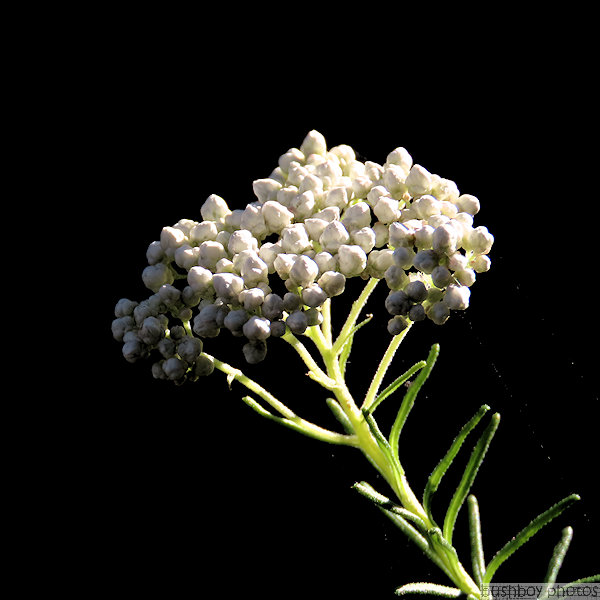
Terri posted her fabulous pink Dogwood flowers. I thought I would show the White Dogwood Ozothamnus diosmifolius, flowers that grow on my place.
Ozothamnus diosmifolius is usually a small, erect and open shrub to about 1.5 metres high but is sometimes larger. The leaves are small, linear in shape to about 15 mm long. The small flowers occur in clusters of 20 to 100 at the ends of the branches and are usually white but forms in varying shades of pink are also known. Flowering occurs in spring and early summer.
Not as showy as other Dogwoods but do look a treat when the flowers line the road to my place. The flowers are so small but this gives a general idea.,
I also have another Dogwood, a Jacksonia scoparia that is dotted throughout the bush on my place.
It is a small tree or large shrub to 3-4 metres high, with an open and often weeping habit of growth and greyish foliage. The leaves are usually usually reduced to scales although true leaves will sometimes be seen on young plants or on regrowth after damage to the plant.
Both plants have tiny flowers but in a mass, the bushes look quite lovely.
Last week was a door from Gerringong, the first place we stopped on a road trip. For the next few weeks, I’ll show some of the doors of the historic town of Kiama, a place I went on a few holidays with the scouts.
As the weather wasn’t the best, we had to go to the Blowhole as the swell was quite big. The Blowhole is a big cavern with a hole in the roof. A huge wave rushes in, smacks against the back wall and sends a huge spray of water into the air much to the oohs and ahhs of spectators.
What’s that to do with doors? Well, at the top of the cliff, just near the Blowhole is the Kiama Lighthouse. No night photos unfortunately as there was no where in Kiama that had a vacancy so we had to go to the next town down the coast.
The tower, built on Blowhole Point, is constructed of brick and rendered outside with concrete in 1886. The total cost for the tower and apparatus was £1,350. Situated on the round apex of Blowhole Point, the Kiama lighthouse stands from sea level to the light at a height of 121 feet. The foundation is concrete, 14 feet in depth and 12 feet in diameter; from the bottom of the foundation to the top of the entrance is 16 feet. The height of the building from the floor to the coping is 36 feet, to the light is 40 feet, and to the top of the weather vane is 50 feet.
The ascent is accomplished by means of three iron ladders, leading from one storey to another, the staircase being lighted by side lights. The original apparatus was an oil burner with a catadioptric fixed lens producing a 600 candela green light that was visible for nine miles. This was upgraded to the local town coal gas in 1908 with an intensity of 1,500 candelas and a range of fifteen miles. This was further upgraded to acetylene gas and group flashing in 1920. At this point the light was de-manned, though Brewis stated in 1913 that the light was unwatched, the keeper’s cottage being vacant. In 1969 the light was converted to 240v mains electricity with battery back up. In 2018 incandescent lamps were replaced with an LED array.




 bushboys world