
Lens-artists Challenge #402: Looking back at #1: Wonder




Bird of the Week: CLXXII
Yes, I didn’t look at the Wrens as I thought I had already posted the Wrens. Therefore, first Wren will be the smallest of the fairy wrens the
Red-backed Fairy Wren Malurus melanocephalus

Red-backed Fairy Wrens are endemic (found only there) to north and east Australia.

They are found in dense understorey dominated by tall grasses in tropical and sub-tropical areas.

This is their call. The call is a weak high-pitched reeling song, soft and unobtrusive, often only heard from quite close so listening ears needed..
REF: Marc Anderson, XC816320. Accessible at http://www.xeno-canto.org/816320.

Red-backed Fairy Wrens feed on small insects and arthropods, feeding in small groups among tall grasses and shrubs, sometimes in trees.

Little is known about their breeding habits. The small dome-shaped nest is well-hidden and placed close to the ground, often in grass tussocks. The nest is made of grasses, bark strips and spiders web, lined with fine grasses and feathers. The eggs are white, splotched and spotted with red-brown marks. The female mainly incubates and broods the young. Both parents feed the nestlings, sometimes helped by others in the group, and remove the faecal sacs.


Terri’s Sunday Stills: The Many Moods of #Water
You know I don’t usually post lots of photos knowing it takes a lot of your time. This time things just took over. So here’s a song to travel along this watery path
Looks like it’ll rain don’t you think?

Looks like it’s set in. How about we sit inside in the warm and have a cup of tea.

The dark clouds are retreating and a rainbow has appeared.

Aren’t rainbow marvellous. This rainbow and reflection on the Clarence River is a photo I took from my desk where I used to work

As the rain stops, left behind are the last of the rainwaters presence.

Nourishing all living things, washing yesterday away

and helping today to flourish.

Don’t foggy morning give an air of mystery

What lies below the mist

Perhaps a bit of a water logged garden

or puddles making art in the streets in town

In the headwaters, the run-off from the rain has started a flow in the creek

Some creeks send their water cascading down the mountains to join the waters flowing in the creeks

Which have joined into another larger creek starting their journey downstream

As more water enters the system, flows increase in their intensity

Sometimes increasing so much the water spreads up to the high bank and churns over the bridge

If there’s been a lot of rain upstream more water has to spread out far and wide. Compare the trees on the far bank.

Eventually the water makes it way to the towns and cities that have grown along the river bank.

Causing a lot of inconvenience. When the water recedes it leaves behind ankle deep mud, and yes it doesn’t smell all that nice after a week or so

Once at the coast the river changes again and the intrusion of salty sea water up the river mouth changes riverbank vegetation and there’s more recreational activities available

Eventually the water reaches the coast with little waterfalls tumbling from the cliffs

Our rainwater is now starting it’s life at sea. At first moving along the coastline until it’s picked up by a current and taken out to sea

or have some fun having a splash on the rocks
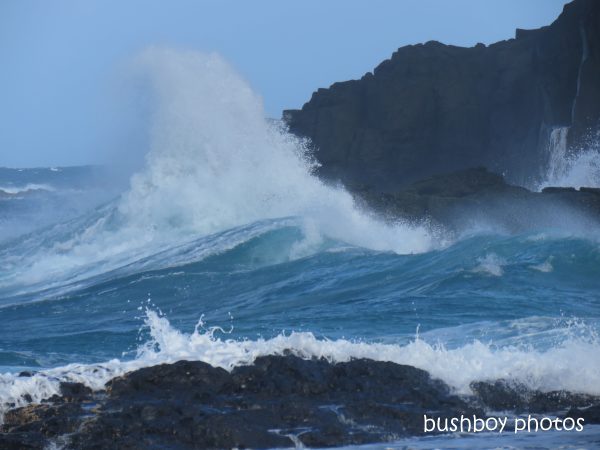
Sometimes our bit of water gets a chance to play

Giving everyone some pleasure

Judy’s Numbers Game #128
This weeks number is 745. There were lots to choose from and I did 😁
It’s a slideshow. The arrows will show the way


Bird of the Week: CLXXI
This weeks bird is the White-breasted Woodswallow Artamus leucorynchus

The White-breasted Woodswallow is found in eucalypt forests and woodlands, usually close to water, and in mangroves.
They are found from northern coastal Western Australia, across the Kimberley region into the Northern Territory, and through most of Queensland, New South Wales (but not on the south coast), western Victoria and north-eastern South Australia. It is also found from New Guinea to Fiji and the Philippines.

The White-breasted Woodswallow feeds on insects, catching them on the wing. Will also forage on the ground or in canopy. Like other woodswallows, this species has a divided, brush-tipped tongue that can be used to feed on nectar from flowers.
This is their call
REF: Marc Anderson, XC611269. Accessible at http://www.xeno-canto.org/611269.

This species can be seen in flocks of 10 to 50, even up to 100, birds. These flocks may cluster together day or night in roosts.

The White-breasted Woodswallow builds a shallow, bowl-shaped nest from grasses, roots and twigs, lined with fine grass. The nest is placed in a tree fork, hollow stump or inside the abandoned nest of a Magpie-lark, 4 m – 30 m off the ground. Both sexes build the nest, incubate the eggs and feed the young.
This is my last Bird of the Week post. I have finally run out of photos of birds. No bird names that start with a “Y” or a “Z”. Thanks for your kind words and enjoying my birds of Australia.

Last Photo for 31st May 2026
Your last photo doesn’t have to be on the very last day of the month if you didn’t take any photos on that day. Maybe it was earlier in the month when the last photo was taken.
So let’s see what you have for May.
The rules are simple:
1. Post the last photo on your SD card or last photo on your phone for the 31st or whenever your last photo was taken.
2. No editing – who cares if it is out of focus, not framed as you would like or the subject matter didn’t cooperate.
3. You don’t have to have any explanations, just the photo will do
4. Create a Pingback to this post or link in the comments
5. Use the tags The Last Photo and #LastOnTheCard
Here’s mine. My May photos were a good mix. No that is a different loaf to the last photo in April. This one was yummy
From my Samsung Galaxy S23FE

From my Canon PowerShot SX70HS

From my Canon EOS 1300D


CWWC: Any Which Way Along a Nature Trail
In Australia we mainly say track rather than trail. Therefore, come for a short walk on the track to Granite Lookout in the Gibraltar Ranges.
Another wonderful spot up the mountain from my place. This time we’ll go to a lookout that looks the opposite way to Raspberry Lookout, a favourite here.
It’s a short 500metre walk which is undulating. There’s lots to see on the way.

Sometimes a butterfly like this Caper White will come flitting past

I like finding little blue stars along the track. This is a wahlenbergia graniticola I find it easier to say blue star

Not far not, just up the track a bit further

Masses of White Paper daisies look a treat

Almost there just about another 30metres or so

Now you take either take a seat and have a breather, taking in the view…..

…….across the Washpool wilderness….

….and ancient Gondwana Rainforest.

Or you could search the bush in case the Waratahs have flowered


Hope you enjoyed the walk up to Granite Lookout
Bird of the Week: CLXX
This weeks bird is the Eastern Whipbird Psophodes olivaceus

Here is an underside view

Whipbirds live in wet habitats, including rainforest, eucalypt forest and dense scrub near watercourses, in dense vegetation near the ground on Eastern Australia.
A pair of Whipbirds in the garden

This is their call


REF: Eliot Miller, XC104805. Accessible at http://www.xeno-canto.org/104805.

Feeding takes place alone, in pairs or in small family groups. It feeds on insects and other small invertebrates, which are caught on the ground.

A breeding pair occupies a territory, which is defended year round, with the mates staying together for many years. The female makes a cup nest of sticks and bark, which is lined with finer grasses, and placed in dense vegetation near the ground. The female also incubates the eggs but the young birds are fed by both parents. The birds are secretive, but can be curious, and will be seen if the observer remains patient.

Just another Wordpress.com weblog
life through my lens
“There is no easy way from the earth to the stars” Seneca
Colorful~ imaginative ~ Contemporary Art
Passionate about Gardens and Flower Photography
🐘 Nancy is a storyteller, music blogger, humorist, poet, curveballer, noir dreamer 🐘
with John W. Howell
My view, tho' somewhat askew...
Or not, depending on my mood
Writer. Feminist. Historian. Person.
imperfect pictures
Moments in Bloom, Through My Lens
Reviews of burgers
Exploring and Encouraging a Healthy Life Marked with Joy … and Every Other Emotion
Inspiration and Spirituality **Award Free**
This blog is for my insights on life, the Bible, hiking adventures with my grandson and whatever is important to me
Capturing the beauty of God's creation through the lens of a camera
Musings, Photography, Writing, and More
Founder of the Three Things Method of Storytelling


 bushboys world