Urban Quebec is just a dim and distant memory after just a week or so on the road. We (foolishly) abandoned our original travel plans in favor of a route that would take us farther along the St. Lawrence River into northern Quebec. After all, we can see forests and rolling hills anywhere. But how many chances does one get to travel along a great shipping channel?
So, we headed out of Quebec City toward National Parc du Bic. Hello??? We knew there was a pet ban in nearly all Quebec National Parks, but did we confirm that for this location? Obviously not. After a scenic drive, we arrived at our destination, only to be reminded of the pet ban. We were chased northward to Rimuski Camping, a funky little motel/campground. We spend another night being pounded by rain, and departed to Sugarloaf Mountain Provincial Park the next morning.

Canada’s Provincial Parks are the equivalent to our State Parks. We’ve been in several now, and all have had huge, relatively private campsites with pristine bathrooms. All seem have extensive recycling programs, and superb maintenance. Camping here is a real pleasure. Sugarloaf has not only a ski hill, with challenging runs for all abilities, but also a popular bike park, full of twisty mountain bike trails with crazy jumps and long rickety narrow bridges, jammed with crazies sporting full face helmets and protective gear. The ski lift is equipped with special hooks for bikes to make the 800′ trip to the top effortless and quick. See that the chair ahead has a bike, but nobody in the chair. Attendants at the top snag the bikes and have them ready to go for the rider approaching in the next seat.

Although there weren’t any great vantage points from which to watch this spectacle, we saw lots of guys (only two women) risking life and limb to race down. Not for the faint of heart.
For us, we decided to hike to the top of Sugarloaf Mountain, which is totally separate from the ski area. The trail circled the base of the Mountain innocently, until we hit Trail #9. In less than a kilometer, we climbed about 800 feet! That’s steep. A portion that section had a vertical ladder-like thing to assist the assent. Here’s the view going up and down. Seriously steep.


The photos really don’t capture the grade of this ladder. At the top, we were rewarded with a fantastic view.

Across the River is the province of Quebec. We are in New Brunswick.
Our other day at Sugarloaf, we split up – I was dying for a bike ride, and John wandered on foot. I rode about 40 miles to Dalhousie and back, following the River. Several great views and farm market were my reward. These photos are from downtown Campbellton, near the Park. The green bridge connects Quebec to New Brunswick. Salmon fishing is the name of the game in these parts. The shoreline is beautiful, beginning to show fall colors (not very evident in these photos)
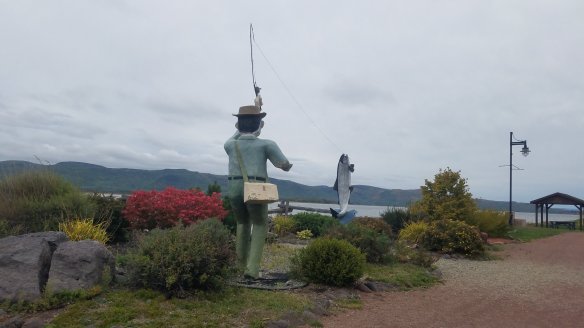
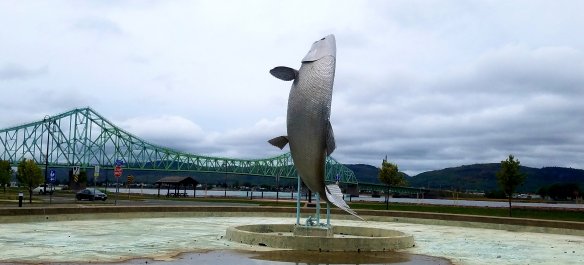
Our next stop is one we were excited about – our very first National Park of Canada – Kouchibouguac – pronounced koo-she-boo-gwach, meaning ‘river of the long tides’. Oh yeah….
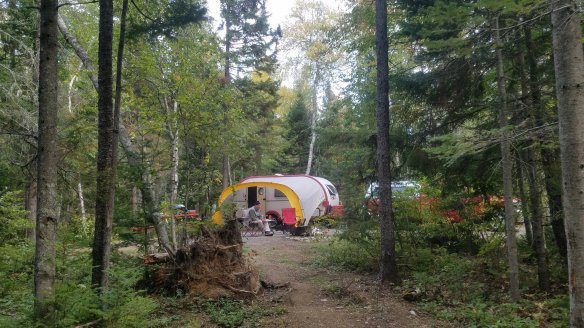
We had this great, 300-site campground nearly to ourselves. Our neighboring campsites are what they call oTENTiks. These are a cross between a lean-to and a cabin.

inside, they have built in bunks with mattresses, heat, and a beautiful sturdy fat wooden table/chairs. Outside, there’s a big gas grill, and a big overhang with Adirondack chairs. It’s so inviting. At Sugarloaf, they were even better – elevated on stilts – so each was about 5′ aboveground, with green metal roofs. As we were getting pounded by rain, all I could think of was how wonderful it would be inside, listening to the rain, safe and dry. Bring your sleeping bag, food, and you are camping! This seems like a great way to introduce families to camping without a big cash outlay. Most of these structures were designed to sleep up to six people comfortably.
We cycled around the 25 mile path at Kouchibouguac, packing regular shoes to get off our bikes to walk the scenic trails. By far, the best one was the boardwalk out to the Bay of St. Lawrence. It was calm and beautiful (it can NEVER hurt to have such a place all to yourself).


At the beach, we had custody of two perfect chairs. There was nobody else in sight.

Sadly, the rest of the day was down hill after this. We strolled the salt Marsh trail, surrounded by shoulder-high vegetation, then visited the Mi’kmaw Big Wagwam area where activities celebrating the indigenous culture are celebrated.

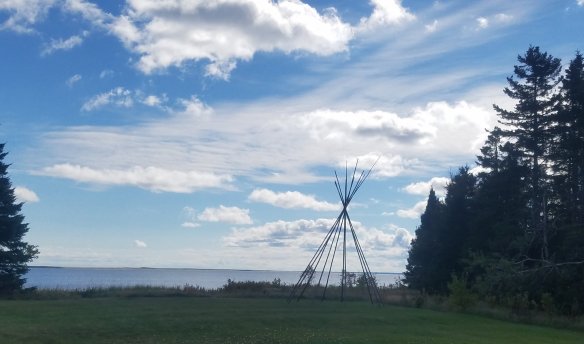
So, I’m a bit short of photos to account for a pretty great, albeit wet, week of camping in New Brunswick. We are still coming up short in our quest to sight a moose. Perhaps they are the mythical snipe of Canada. But, roadside warnings make you BELIEVE they do exist. Who wouldn’t be watchful after seeing this sign every few miles along the road? (Shot through the windshield, apologies for the photo quality).

Perhaps I really don’t want to see one! Our Vermont friends had an unfortunate nighttime encounter a few years ago when an 800 pound yearling moose darted into the front passenger side of their Prius. The moose died, their car was destroyed, but they escaped unscathed. So, maybe the mythical moose is best unseen.
We’re in Halifax now, battened down for more than 2″ of rain tonight. Looking forward to bike rides, ferry transit into the city, lobster and scallops. On to remote Cape Breton after that.
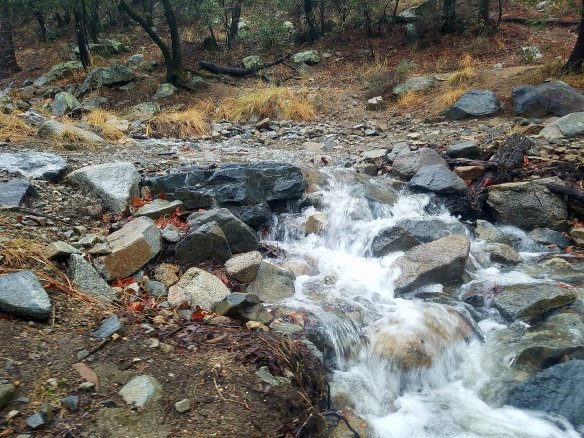
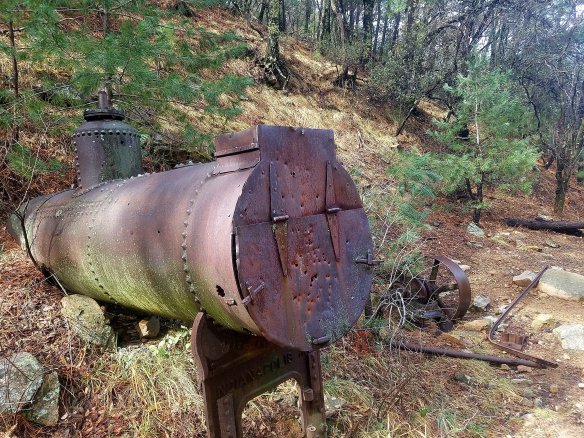
 Perhaps we should have been warned, but we forged ahead. The hike became difficult after these point – a sharp increase in elevation had us snaking around obstacles, and wedging toes into tiny footholds. We finally wound our way up then down to the tank area, which was worthy of the effort to get there. There was just a bit of brackish water in some of the deeper holes.
 After another mile or so, we decided to turn back, as we had drunk half our water, and the trip ahead was twice as far as the trip back. In hot/dry conditions, we don’t second-guess our water supply. All in all, it was a great hike.
 The drive up from the Phoenix area was filled with some spectacular rugged territory. This roadside project caught our eye as we passed – it’s hard to see, but that big shovel is very precariously perched as it moves dirt around.
  Not a job for the faint of heart!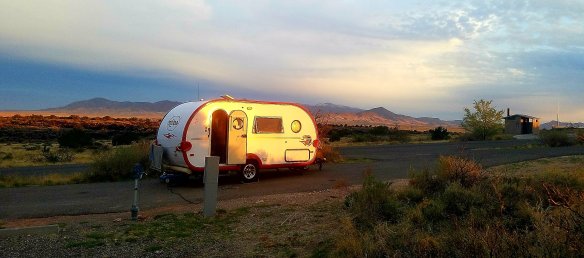
 And the fact that we’re perched on an island over the top of it – amazing.
  Lava has spewed from vents in the earth (as opposed to flowing down a mountain) on at least two separate occasions in the last 1500-5000 years, creating a mysterious, crusty spot to explore. A well-signed scenic walkway winds around a mile or so of the area, with many spots to walk off the path and onto the lava beds.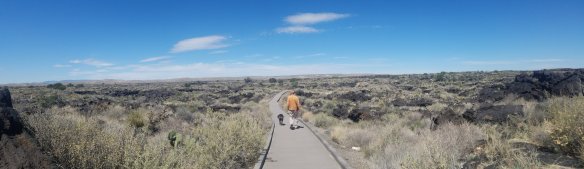
 Our campsite is right in the middle of the above photo. You can barely see the curve of the Campsh@ck to the right of the ramada which covers the picnic table.
 It’s fascinating. I can’t briefly explain the geology to you in a coherent way, but would encourage you to check out the above link if you’re interested. The pristine campground is small (about 25 sites), but inexpensive. We have a big site with water/electric for $9/night with our senior pass. Of course, there are superclean bathrooms and showers.






 On the way there, we stopped at the Wright Brothers National Monument in Kill Devil Hills, NC.
  Although the Visitor Center is undergoing restoration, a fantastic Ranger brought the Wright Brothers Kitty Hawk experience to life. Markers chart the distance of the first four flights on December 17, 1903. Flight one was 120 feet. The fourth flight was over 800 feet. That’s a pretty impressive improvement for a single day. One the edge of the area is a series of full-sized bronze statues of Wilbur, Orville, the plane, the photographer, and a few other spectators of that historic day. It’s an inspirational place to visit.

 Designated by Congress as the National Maritime Museum, there are exhibits to capture the imagination of anyone – young or old, landlubbers or sailors. If you’re of a ‘certain age’ like me, you learned about the battle of the Union’s
 Imagine these two ironclad ships pounding each other with cannons from a distance of a mere 100 yards. The unique revolving turret of the Monitor provided a difficult target for the Merrimack to hit, and the lighter artillery of the Monitor was unable to land disabling blows to the Merrimack.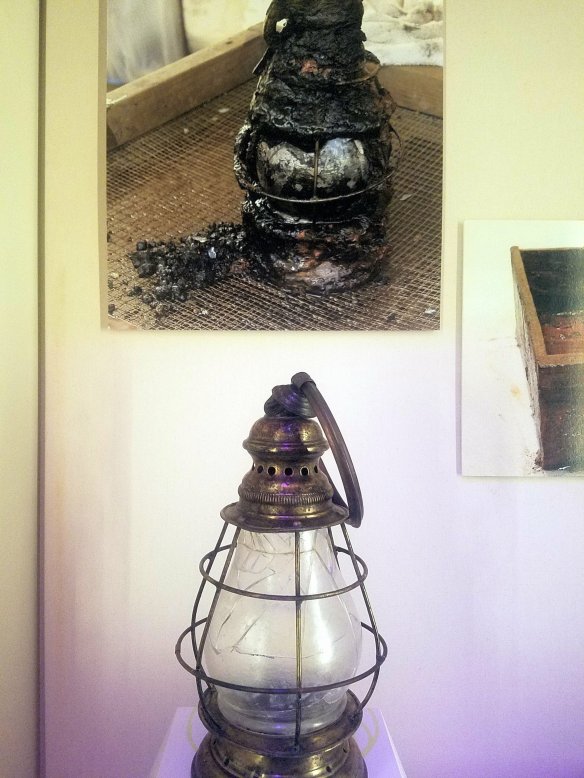


 Above is a full-scale model of the turret (complete with the guns inside) exactly as it looked when brought up from the bottom of the sea. Restoration is being done onsite at the Museum, and some pieces and parts are still submerged in a series of baths in order to stabilize the metal. Here’s a shot of the cannon in the above photo in its tank where it’s being rehabbed.
 It’s thrilling and chilling to see all of this. The photos don’t do it justice. There’s also a full-size model of the Monitor outside, which I visited briefly in the pouring rain (everyone else stayed inside).
 Films from these races are thrilling.
  You can test your own power output on a winch (a professional World Cup participant can generate 500+ watts of power.) I managed about 90 for a very short period of time.
 If you get a chance, go to The Mariner’s Museum. Plan to spend a whole day, then go back the next day to see everything you missed. It’s fantastic.
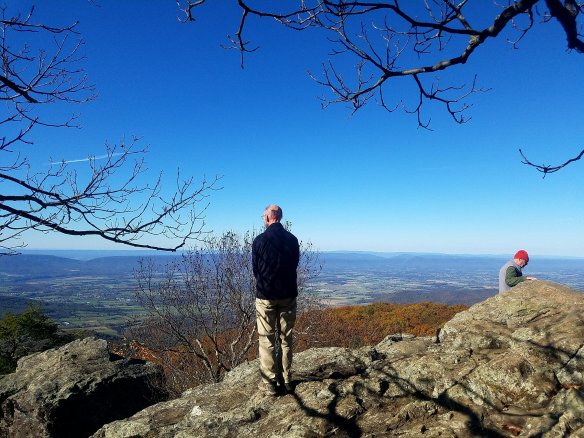
 They quickly packed up, and we all headed out to this amazing National Park in NW Virginia, along the Skyline Parkway. The Appalachian Trail runs through here, as well as many other trails.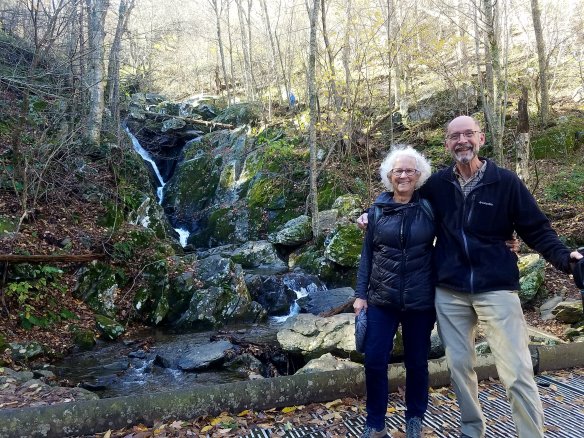
 We watched a fantastic demonstration/concert of a hammered dulcimer.
 We braved howling winds and the only really cold temps we had in our six weeks of camping to hike to a stunning waterfall. I can’t wait to go back – we hope to be able to camp at all of the Shenandoah campgrounds next year (four?) It looks like an intriguing place to explore.
 Our first impressions were not too positive. Hard rain the day before had left standing water everywhere. The entire campground is in need a several hundred trucks of fill to level out the low spots. The paved pads at each campsite were a few inches higher than the surrounding ground (at least on one side), leaving a mess of slick mud. Attemps had been made to cover up some of the low spots with bales of hay – we gathered up some excess hay from surrounding sites to try to keep us above the mess, with mixed results.


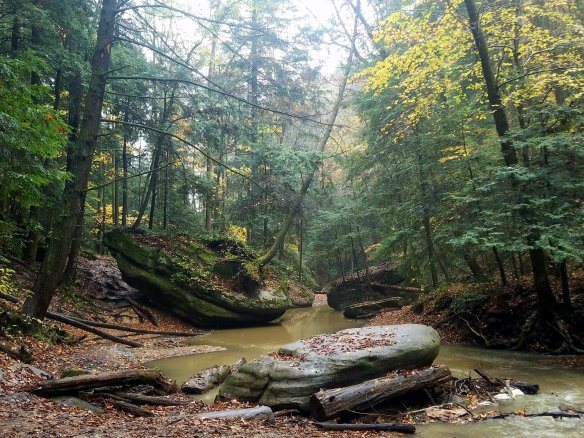

 Wow. The scale of these limestone caves is so impressive – for once, I was happy there were other people in the photos to get a size perspective. We were just sorry that we hadn’t been there a week or so earlier, because the best fall color seemed to have already passed. Sorry if I bombed you with photos, but I couldn’t decide which to post.
 Of course, we wanted to investigate all the UFO business that has been Roswell’s calling card for 70 years. And, we anticipated a really deep series of lakes. Um, not exactly.
 There was a reported
 Did it happen? Will we ever really know? But, the


 We spent a couple hours there, reading all the newspaper articles and looking at the photos. It’s all about self-promotion, and selling souviners. John bought an alien fly swatter, in the vain hope of helping to quash to invasion at the campground. We hiked, and wandered around a bit and enjoyed a bit of free WiFi in the campground – a rarity. After two days, it was time to move on.
 It’s spectacular, and mid-April is a gorgeous time to visit. Trees are budding, everything is greening up, and it’s generally pleasant. Two out of our four days did touch 90 degrees (unexpected), but the nights were cool and comfortable. We explored the Park on two great hikes – the Lighthouse Trail was the first.
 This unusual hoodoo is tucked away three miles from the roadway, so the only way to see it is to hike (or bike) in. It’s well worth the effort, which was really minor in the scheme of things).

 It really taxes my imagination to see all these enormous boulders strewn around. Did it all happen in one big explosion, or over the course of thousands (or millions) of years? It’s a crazy feeling to wander through this rock field, as we crawled up toward the canyon rim, about 700 feet above.
 What’s with that? It was in a back corner, and it occurred to us that it might have been placed there by a rogue State Park employee. I was also taken aback by this Unidentified TSM (Texas-sized Moth) which was hanging out in the women’s shower. Yikes!I had to run back and get my camera to get this photo.
 (I really didn’t need to rush – he was in the same spot for two days!)
 Although there isn’t a lot happening around here, this is a very pleasant campground, with great spacing between sites and crazy helmetlike shelters over each picnic table.
  We are especially pleasant to have nabbed a site with a shade tree. Although it’s been hot – nearly 90 today, we can sit in the shade and breeze and thoroughly enjoy being outside. (As I write this, it’s 9pm, and there’s a coyote party going on not too far away). We cycled the entire Park, and hiked a few of the trails, although there’s nothing really spectacular to see here. Probably the highlight of the hikes was this former shoreline, preserved in rock, a long way from any current water.
  This is the kind of stuff we really love to stumble across on any hike.
 campshaws