When we initially started planning for our trek into Canada, on the top of my Must See list was the Bay of Fundy. This basin between New Brunswick and Nova Scotia is known for having the highest tides in the world. Admittedly, the numbers don’t quite match up to the visual reality – a 12 meter tide (over 48 feet) is not like standing on the edge of a pool that is empty then 48 feet deep six hours later. Yet, it’s striking. Here are the commercial docks in Alma at low tide. And again, a bit later as the tide creeps in…


We watched them all sail at high tide a day later.

At low tide, we could walk out on the shoreline for about a quarter-mile.At high tide, the water extended all the way to the distant wall in the photo.

Low tide. High tide.


None of these photos were taken at the moment of highest or lowest tide, but it’s amazing to see. We were so lucky to be at Fundy on October 14, which was the start of the fall lobstering season. (Oct-Dec. The other season is April-July) That meant that at 2am (the first high tide of the day) the commercial fleet leaves the wharf. Fireworks! A bagpiper, dressed in a lobster suit and kilt! All the Alma townsfolk, some dressed in pajamas and blankets. We were happy to drag ourselves out late on a cold night to witness this event, the lifeline of the local economy.


The dock had been busy the day before, with boats being loaded with dozens of traps, each filled with fish guts, heads, and other assorted goodies that lobsters love. Some were strung together, as many as 20 to a single buoy. Smaller craft have traps/buoys on a 1/1 basis. It’s big business on any scale. Lobsters collected here supply not only the local market, but everywhere North Atlantic lobsters are available.

At 2am, the sleepy crews joined their ships, carrying backpacks with their personal stuff for a few days. A few obviously looked like they came directly from a warm bed to the dock. I inquired, and was told that the first run would last about three days. Ships would then return to port, empty traps, reload, and head back out. In and out as long as he season lasts. It must be extremely hard work in raw weather.
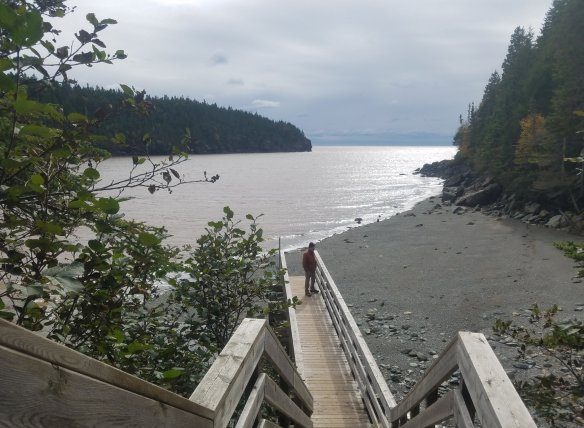
The stark beauty of the Fundy shoreline is special. We wandered from point to point (breaking our no-driving-in-the-truck rule) and found terrific views at every turn.



As you can tell. These were shot on different days. We did have one sunny day while we were there and it fortunately coincided with our visit to Hopewell Rocks. This would be a great sight anywhere, but being able to walk around the base of these spectacular formations at low tide was unworldly.


i can’t tell you how happy we were to have a sunny day for this excursion. We had thought about hanging out here for the six-hour, low-to-high tide experience, but just couldn’t swing it with Jezzy. By the time we included out travel time to the site, it would just have been too long of a day for our girl. So we elected to wander the base at low(ish) tide. I think we made the right decision.


They warn you about the mud there. I made a few mis-steps, and will probably be cleaning this out of my boots forever.

I’ll w up now. I took a hundred photos, and would still be sitting on the shore somewhere along this amazing coast if I could figure out how to do that. It is beautiful. Stark and rugged.
But one last note. Quietsolopursuits, this is for you. We wandered through some of the other campgrounds (we were at Headquarters Campground, the only one still open at this time). In the Point Wolfe Campground, we found this fabulous thing – I don’t know the name. Kind of like the oTENTiks we found in other Parks, but designed for one or two. I want one! Just another reason to return. Inside it had a sleeping platform, and kind of a gear trampoline suspended above. Or, perhaps you sleep on the trampoline and stow your stuff below??


We’re headed on to our last few days before plowing home. It’s hard to find open campgrounds, and we’ve developed another serious leak which is drowning our new floor somewhere from below. Time to shut off all water and head home. ☹️☹️☹️


 Reality set in, and my head swiveled from side to side to take in the extraordinaryness that is
  Our three-night stay in the North Campground turned into four, as we swiftly figured out that we couldn’t possibly drink in all the sights in such a short time. I don’t know how much time would be enough, but we didn’t reach that limit. At Bryce, the attraction is the hoodos, those tall skinny spires of rock that reach up from the Canyon bottom and are wind and weather eroded into spectacular formations.


 Some have names, such as Tower Bridge.
 Others set your imagination reeling with images from your own knowledge. Some days, we shuttled to trailheads on the amazing bus system, and bicycled back and forth other days when it suited us. It was always cold in the morning, warming up into the mid 60’s – 70’s during the day. Spectacular winds blow through the Canyon, swirling dust devils through the air. Parents clutched their kids, and everyone hung on to their hats. John convinced me to step out to precipice for a photo op. I had to brace myself from being blown off the edge, and hang on to my favorite hat at the same time.
 We hiked the northernmost trail (Fairyland Canyon) and the southernmost trail (Bristlecone), and several inbetween those two. The details of each day have already blurred, so I’ll just share a few of my favorite photos.


 Even the jet contrails above Bryce resemble hoodoos. I was sorely tempted to turn this photo upside down to make my point, but you’ll get it anyway.
 My quest for the Bristlecone Pine, the oldest living trees on earth was answered, but not in the manner that I had hoped.
 But we did observe many in varying stages of life, and felt privileged to do so. We saw some variety of spruce that was forming cones, and the branch tips were bright pink. Perhaps it was new branch growth, but it appeared to me to be cone formation with the striking color. A visit like this will remind you of all you do not know, and probably will never really understand.
 Now we have seen the oldest (Bristlecone), tallest (Coastal Redwood), and largest (Giant Sequoia) trees in the world. My heart still belongs to the Sequoias, but it quiets me to be in the presence of any of these giant trees.
 Hard to imagine the hard lives of the riders, and also of the men who manned the stations, maintaining fresh horses and supplies.

 But, some of the rocks have been defaced, and appear to have markings indicating that the petroglyphs had been chiseled off.
 We picked a site with a great view, and had our own sheltered picnic table and vault toilets. Bad point? The trash. All the bins were overflowing, and previous campers had left their trash on the ground, bagged up for the critters to get into. Idiots and jerks. It was the only low point of this great site. We hiked the interpretative trail, and totally enjoyed this unique BLM (Bureau of Land Management) campground.
 I can’t say enough positive things about camping here. It is spectacular. The Great Basin actually covers most of northern Nevada, although the National Park is just a small piece of it. The Great Basin is this huge area where the only water is what falls here, as a result of rain or snow. No rivers flow into or out or it. We’re camped at Baker Creek Campground, high desert at about 7500+ feet. We hear the creek roaring from snow melt from nearby Wheeler Mountain and other peaks, and the wind whistles through the spruce trees, which are everywhere. That’s the only sound. No cars, no generators, no voices. Lots of turkeys, although we never actually saw any of them.
 Some of the spruce trees here are bursting with pinecones. Many of them had thousands of budding cones – a sight I’ve never seen before.
 Again, we were the only ones here – how many people get to experience their own private National Park?
 The needles are short and thick with an extra resinous coating to reduce moisture loss. They are incredibly dense. Although I scoured the campground for more Bristlecones, I wasn’t able to find any. In the Park, they are all above the 10,000′ mark, which was inaccessible to us on foot. Photos of the ancient Bristlecones show windblown, hardy trees. It was so sad not to be able to see them, since this seems to be our Trip of Trees.
 Without any other footprints to keep us from wandering off the trail into the wilderness, we felt we had to turn back.We passed this grove of birch trees, which all had a sensuous bend near the ground. Tough to get a good photo, but I hope you get the idea.
 So, it was three miles up, three miles back. We passed through alpine meadows and followed the rushing creek, so it was a pleasurable hike in any case.
 It actually was a stone statue of a giraffe, although one of its horns was busted. Giraffe? Nevada? In the Visitor Center, there’s a 132 year old Winchester Rifle which was found leaning against a tree in a remote area in 2014. Imagining the story behind this sets my imagination racing. The rifle has been restored, and sits in a protective glass case.

 The old buildings, which have been updated somewhat to accommodate electricity and modern plumbing look like another fire waiting to happen.
 There are huge timbered facades and wooden sidewalks. Miners, cowboys, and saloon girls in period clothing wandering around.
  It was quiet when we wandered through on Sunday morning, but this is certainly a spot which would deserve a second visit.
 The area where the campground sits had been logged about 100 years ago, so many of the biggest, oldest trees were only stumps. No ordinary stumps, mind you.

 Everyday was full of new treasures – the forest explodes with every shade of green you can imagine, streaked with bits of sunlight that can make it through the dense canopy 200-300 feet above our heads. All of the biggest trees are not named or tagged, but we think we saw the best of them all.


 Redwoods have the ability to regenerate new shoots from old roots, creating ‘fairy rings’ of trees. Some are fused at the base, separating into separate trees many feet above the surface. They survive fires, floods and droughts. It’s the wind that generally bring them down, unless the timber companies have gotten to them first. Redwoods are still logged, but regulations say that only trees between 40-60 years old can be cut, and five new trees must be planted for each one cut. Big trees also grow from the tiniest pinecones – this photo shows (clockwise from top right) the eucalyptus seed pods, a pinecone from a large non-native cedar that was everywhere in the campground, a sequoia cone, and three redwood cones. Amazing, isn’t it? In the center is a quarter, for size comparison.
 The forest floor is full of white, pink, purple, and variegated trillium. The high rainfall (60-80 inches per year) also means that there are rhododendron everywhere, although we’re a few weeks early to see them in bloom.
 We saw the Dyersville Giant, which had been the third-largest Coastal Redwood in the world until a wind brought it down in March 1991. Unbelievably, it fell in one piece, so you can walk along the full length of this tree.
 One resident recalls the night it fell, saying that it sounded like a freight train – and she lived 15 miles from the site. It’s estimated that this tree weighed a million pounds. One favorite tree was an enormous specimen which had been girdled in 1901. About ten feeet of bark had been removed from the bottom, and shipped to San Francisco for an exhibition. Remarkably, more than a hundred years later, the tree still lives.
 I’ll leave you with a few other photos of our exploration of this magnificent Park and the area nearby. Their Visitor Center was wonderful – full of photos and newspaper articles of the Great Flood of 1964, which destroyed entire towns. In several spots, there are high water mark signs.


 If a State Park can be this incredible, then the Redwood National Park must be even better, right? In our minds, unfortunately not. The National Park is actually a combo State/National Park effort.. We get to use our Geezer Card for half-price camping, but the facilities are actually run by the State. Complicated, but I guess it works for everyone. So, our second stop (first within the National Park) was
  Recent slides are everywhere. From a distance, the shifting terrain is even more obvious. At the top of the dune are the cedars and pine trees that have been there forever. Below that, the lighter colors are all deciduous trees that have sprouted in the areas uncovered by the landslides. At the bottom, some of the cedars still hang on, with beach grasses leading to the ocean’s edge.
 We were happy to leave Skunk City and move to
  We’ve hiked to the grove where the biggest trees are, encountering an interesting stream crossing get there. John successfully navigated his way across the fallen logs, using a large branch as a walking stick.
 I wasn’t so successful – looking down at my feet on the log with all the swirling water caused a motion sickness sensation. So, to hell with it, I waded across. It wasn’t bad except for a section about five feet across where the rushing water was just up over my knees.
 Once again, my boots filled from the top – and we had just gotten them dried out from Fern Canyon. The Stout Grove was interesting in that it’s an ancient grove, having never been logged.


 But….our hearts still belong to the Humboldt Redwoods. They just seemed to be the biggest and most beautiful. I was disappointed to review my photos to date from J. Smith are all a bit fuzzy – probably due to my greasy fingers grabbing my camera out of my pocket all the time. Lesson learned. It’s been an amazing camping trip – real camping in a huge, quiet forest. Being among these ancient giants seems to make (most) campers behave respectfully. In the woods, there’s a hush. People talk in soft voices, with the occasional exuberant yell from an excited kid. It’s an awe-inspiring place to experience.

 Even on a Monday, there were dozens of cyclists making the 26 mile trek to the summit. This is not a climb for the faint of heart – even in a car, it’s a heart-pounding ascent. I’m not sure if I could do it on a bike – even on my very best day.
 The same campground host we’ve seen for the past years greeted us again.

 Near the peak, all the trees were blackened stumps from a fire. It’s sobering to see, especially in light of the fact that 19 firefighters from the Granite Mountain Hotshots had been killed fighting a fire in Yarnell, AZ in June 2014.


 There is so much beauty in this area – we’ve decided to come back again next year and stay for a week. A few days just isn’t long enough to check everything out.
 We camped at the Hole in the Wall campground, which refers not to its size, but to a gap in the mountains which border the campground. At just over 5000′ feet in elevation, it was cool and decidedly non-deserty. We even had 50mph winds and rain – go figure. But, what a beautiful spot for the Fireball…
 Naturally, our first stop was to the Visitor Center. We love seeing the National Park films, and this one had a fun twist. One of the Rangers there had a young pit bull who was enchanted with the animals in the film. When the desert tortoise first appeared on the screen, she hustled over and sat, transfixed and quivering, directly in front of the screen. Lizards, turtles, and all the little desert denizens had her full attention. Have to admit that she totally stole my attention away from the film! (This is not exactly Big Screen theater!)
 Although the Mojave National Preserve covers a huge area, there’s only one marked trail in this section, although free-hiking is permitted. So, the Spencer Loop Trail was our hiking choice for Day 2. We were anxious to hike through the Desert, around Spencer Mountain, and through a Canyon to the Hole in the Wall, where a narrow passageway was scalable only with a series of iron loops embedded in the wall. The film in the VC made it look easy. Ha! I think the folks in the film were professional stuntmen.
 But, all of the sudden, we rounded Spencer Mountain, and entered the canyon. It was eye candy.
 As promised, we entered the Hole in the Wall, complete with The Rings.
 It was narrow!
  John let me scramble ahead so that I could take a video…
  Then suddenly, everything gives way to an amazing lush green landscape.
  Tomorrow we roll on to the California coast, where we’ll wander for the next four weeks until we reach the Redwoods in Eureka. New adventures to come.
 campshaws