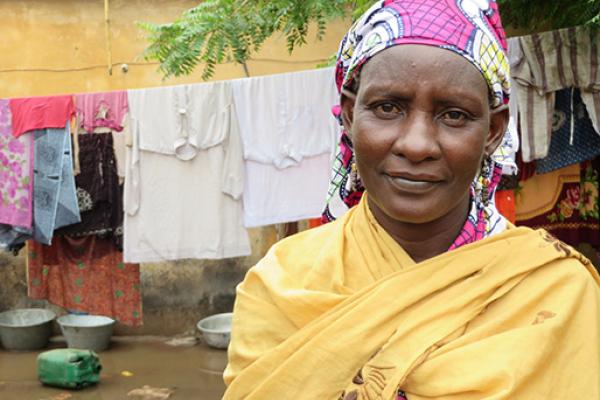
In any humanitarian crisis, children usually face the greatest hardships. Across conflict-affected areas, simple actions – such as walking to a neighbour’s house or reading a chalkboard – can become impossible hurdles for children living with disabilities. When families face displacement, insecurity and strained infrastructure, accessing specialised healthcare or assistive devices is often far out of reach.
Yet, the stories of 12-year-old Binta and 5-year-old Mu’azu remind us that targeted support does more than alleviate physical pain. It restores a child's dignity and unlocks their future through the power of education.

Binta’s journey: finding the light through learning
For 7 years, Binta lived with severe, worsening eye pain that kept her out of school and robbed her of the joys of childhood.
‘Before, I did not go to school and I was often unhappy’, Binta recalls, remembering the long years spent away from her peers.

The turning point came when community volunteers working with Save the Children International identified her case and connected her to the Children’s emergency fund. Supported by EU humanitarian aid, this critical fund covered all medical expenses, allowing Binta to undergo life-changing eye surgery at the Yobe State university teaching hospital.
To ensure Binta’s recovery would not burden her family's fragile finances, they also received multipurpose cash assistance. This flexible funding covered the household’s essential daily needs, proving that effective protection must support the whole family, not just individuals.

Today, Binta is back in the classroom, her confidence fully renewed.

After my eye surgery and the support, my life has changed. I now attend school every day and can read and write. I feel confident and happy again.

Mu’azu’s new beginning: moving towards a brighter future
Not far away, 5-year-old Mu’azu faced an entirely different barrier to his education: a severe mobility challenge that prevented him from walking, playing or attending school. For years, his grandfather, Mustapha, watched him struggle, deeply worried about his future.
The same network of community volunteers stepped in, providing Mu’azu with a specialised wheelchair designed to give him back his independence.
He is now learning to navigate his world on wheels, building the strength and confidence he needs to start school, where he has already been registered. For his grandfather, the intervention brought an overwhelming sense of relief after years of uncertainty.

The support gave me so much joy that I could not sleep. Knowing that my grandson now has an opportunity for education and a better future has filled our family with hope.
With his newfound mobility, Mu’azu is preparing to enter into a classroom for the very first time – a milestone his family once feared might never happen.
‘Because of this assistance, my grandson is now able to attend school and live with dignity’, Mustapha says, ‘just like every other child in our community.’

The bigger picture: protection and education in emergencies
The breakthroughs experienced by Binta and Mu’azu represent the localised impact of a much broader, strategic response across northeast Nigeria, where communities are weathering a persistent crisis driven by 16 years of conflict. Today, 5.9 million people in the region require urgent aid, and over 2.3 million remain internally displaced.
Due to intense violence and severe access constraints, an estimated 400,000 to 500,000 people are trapped in areas completely cut off from standard aid delivery, making the work of community-based mobile volunteers absolutely vital.


When insecurity fractures social safety nets, children living with disabilities are often the most exposed to severe risk, exclusion and acute vulnerability. This is where the partnership between EU humanitarian aid and its operational partners on the ground, such as Save the Children International, becomes a critical lifeline.

By channelling resources directly where they are needed most, the EU focuses heavily on integrated, multi-sectoral response pillars, notably:
- protection services – reaching vulnerable children through community-based case management, specialised medical referrals and psychosocial support
- education in emergencies – providing crisis-affected children with safe spaces to learn, basic education, and essential school supplies
- holistic survival support – combining specialised interventions (like Binta's surgery or Mu'azu's wheelchair) with direct cash relief so families can stabilise while children safely return to school
For Binta and Mu’azu, this timely aid not only addresses an acute physical barrier – it reclaims their right to education, safeguards their dignity, and ensures that even in the most fragile environments, the most vulnerable are not forgotten.
As 1 of the leading contributors of humanitarian aid in Nigeria, the EU has provided over €570 million since 2014, including an initial €33 million allocation in 2026.