
In this page we present a few other spiritual teachers who have bequeathed their respective legacies to us by their teachings and the schools and traditions they have passed on to us through their followers, disciples and students. You will also encounter other spiritual seekers who are adherents of nondualist oneness or who have enhanced our understanding of human consciousness and its evolution. At the end of the page is a list of recommended relevant source reading materials.
Alan Watts
Alan Wilson Watts (b. 6 January 1915 – d. 16 November 1973) was a British writer, cross-cultural spiritual teacher and brilliant speaker known for interpreting and popularising Buddhism, Taoism, and Hinduism for a Western audience. [Wikipedia]

Alan Wilson Watts (1915 – 1973), Modern Mystic of the 20th Century
Born in Chislehurst, England, he moved to the United States in 1938 and began Zen training in New York. He received a master’s degree in theology from Seabury-Western Theological Seminary and became an Episcopal priest in 1945. He left the ministry in 1950 and moved to California, where he joined the faculty of the American Academy of Asian Studies.
[Acknowledgment to Ambient Life for publishing the video on YouTube.]
By the late 1960s Alan lived on a ferryboat in Sausalito in a waterfront community of bohemians, artists, and other cultural renegades. Alan’s ferryboat became such a popular destination that to maintain his focus on writing, he moved into a cabin on the nearby slopes of Mount Tamalpais in northern California. There he became part of the Druid Heights artist community.
[Acknowledgment to Ambient Life for publishing the video on YouTube.]
Continuing to travel on lecture tours into the early 1970s, Alan was increasingly drawn to life on the mountain, where he wrote his mountain journals (published as Cloud Hidden, Whereabouts Unknown), penned his monograph The Art of Contemplation, worked on his autobiography In My Own Way, and wrote his final book, Tao: The Watercourse Way.
Soon after returning from a whirlwind lecture tour that took him through the U.S., Canada and Europe, Alan passed away in his sleep on November 16, 1973, at the mountain he loved. His legacy is preserved by the Alan Watts Organization under the guidance of his son, Mark Watts.

______________________________________________________________
Carl Gustav Jung
Carl Gustav Jung (b. 26 July 1875 – d. 6 June 1961) was a Swiss psychiatrist and psychoanalyst who founded analytical psychology. Jung’s work was influential in the fields of psychiatry, anthropology, archaeology, literature, philosophy, and religious studies.
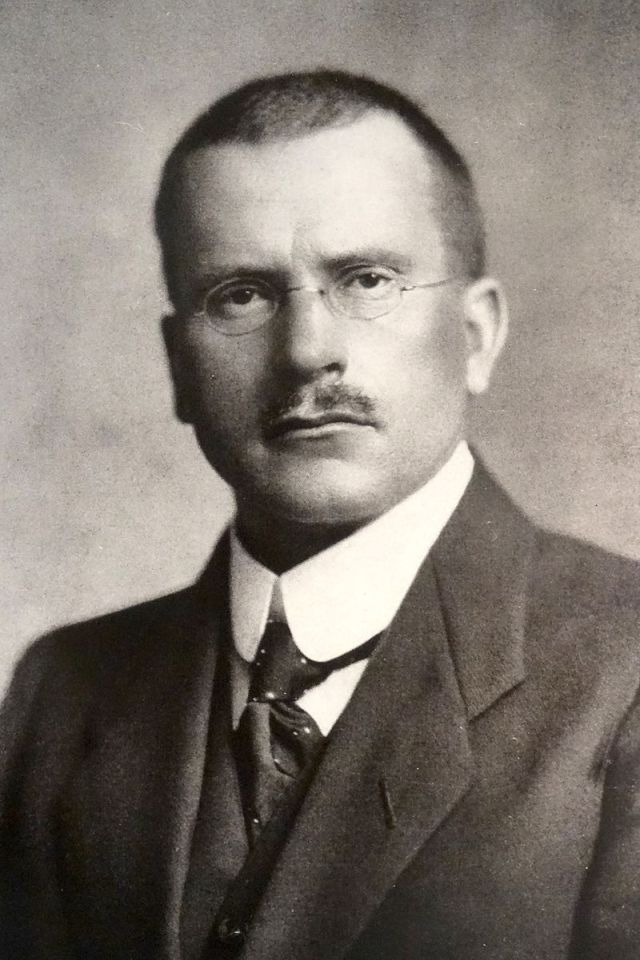
Carl Gustav Jung (1875 – 1961), Founder of Analytical Psychology.
Jung worked as a research scientist at the famous Burghölzli hospital, under Eugen Bleuler. During this time, he came to the attention of Sigmund Freud, the founder of psychoanalysis. The two men conducted a lengthy correspondence and collaborated, for a while, on a joint vision of human psychology. Freud saw the younger Jung as the heir he had been seeking to carry on his “new science” of psychoanalysis. Freud even named him the first head of his newly founded International Psychoanalytic Association.
Jung’s research and personal vision, however, made it impossible for him to bend to his older colleague’s doctrine, and a schism became inevitable. This division was personally painful for Jung, and it was to have historic repercussions lasting well into the modern day.
[Acknowledgment to KidMillions for publishing the above video on YouTube.]
[Acknowledgment to Psychology Library for publishing the above video on YouTube.]
Among the central concepts of Jung’s analytical psychology is individuation — the lifelong psychological process of differentiation of the self out of each individual’s conscious and unconscious elements. Jung considered it to be the main task of human development. He created some of the best known psychological concepts, including synchronicity, archetypal phenomena, the collective unconscious, the psychological complex, and extraversion and introversion.
[Acknowledgment to Think Neo, Think! for posting the immediately preceding three audiobook videos on YouTube.]
______________________________________________________________
Ken Wilber and The Theory of Integral Spirituality
Ken Wilber, pioneer of Integral Psychology and Integral Spirituality; co-host of The Great Integral Awakening. He is a preeminent scholar of the Integral stage of human development. (Read Wilber’s works if you are the type of person who likes to have your intellect mind tickled and picked a lot.)
Here is a simple introduction to Wilber’s Integral Spirituality and his basic theory of The Four Quadrants.
[Acknowledgment to Alan Seid for publishing the above video on YouTube.]
Listen to Ken Wilber himself, below, speak on his teachings, and how mystics are at the very leading edge of evolution and the difficulty which that entails.
[Acknowledgment to Integral Life for publishing the above videos on YouTube.]

The Spiral Dynamics of Ken Wilber’s Integral Theory Four Quadrants (Simplified)

Ken Wilber’s Integral Theory of “The Four Quadrants” in Detail

“The Higher Stages of Consciousness” Based on Ken Wilber’s Theory of Integral Spirituality
You can find a list of his published works at Amazon.com.
______________________________________________________________
Yogiraj Gurunath Siddhanath

Yogiraj Gurunath Siddhanath (b. 10 May 1944 in Gwalior, northern India) or simply “Yogiraj” (pictured above) is a Hindu mystic. He is a Master of Kundalini Kriya Yoga.
For over 40 years, Yogiraj has healed and transformed people all over the world with his transmissions of “kundalini shakti” energy and has shared freely his own Samadhi (enlightened state) of peaceful bliss-consciousness. Yogiraj has taught yoga and spirituality to world leaders and has given experiential discourse before the United Nations, yet he prefers nothing more than to sit in the simple pristine forests and mountains and meditate on God in tranquility.
In that spirit, Yogiraj together with his wife built the Hamsa Yoga Sangh Mother Center, his Siddhanath Forest Ashram in the gentle valley of Sita Mai southwest of the city of Pune, India, in the Simhagad region. His wife of 35 years, Gurumata Shivangini (affectionately called “Ayie” or Mother by Yogiraj’s students) is a powerful yogini in her own right. Together they have raised two children and are now proud grandparents, demonstrating by example that it is not necessary to live as a renunciate in order to meditate and achieve enlightenment.
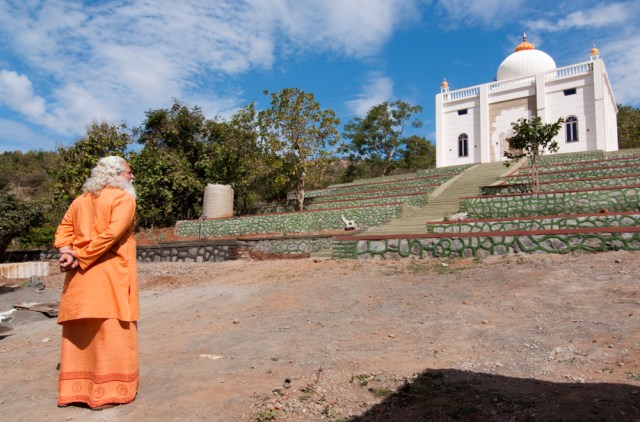
Yogiraj’s Siddhanath Forest Ashram Temple
They spend much time at the Siddhanath Forest Ashram, which is also available to all sincere seekers worldwide to come and rejuvenate spiritually. It is a Siddha Peeth (land spiritualized by the shakti of a spiritual master), a Tapo-Bhoomi (kundalini power center), and holds one of the earth’s most powerful Earth Peace temples. This temple houses the largest known solid parasmani (alchemical mercury) Shivalinga, which alchemically transmutes the mercurial mind which meditates upon it into a still mind of enlightened Consciousness.
Yogiraj is a teacher who awakens his students to the next level of spiritual experience, a function we similarly hold dear and pursue as our mission, too. Check out his videos below.
Here is a YouTube playlist of Yogiraj talks.
You can find more information about Yogiraj at his website.
______________________________________________________________
Maya Calendrics
Carl Johan Calleman, research scholar and authority on the Mayan calendar in relation to evolving human consciousness. He interpreted the Mayan calendar as a timeline for the evolutionary process underlying the development of human consciousness leading to its culmination in unity consciousness as the final phase. His timeline validated a similar timeline which unfolded within me from the Spirit years before, when I plotted and extrapolated the evolution of human consciousness based on the collaborative work of Fr. Thomas Keating and Ken Wilber.
On the basis of his understanding of the Mayan calendar and his corresponding timeline of developing human consciousness, Carl succeeded in outlining the divine plan behind creation, the completion and fulfillment of which we are presently experiencing in our world.
You can find a list of his published works at Amazon.com.
______________________________________________________________
Sufism and Sufis
If you are interested in learning Sufism, the mysticism in Islam, drink and learn from the Nimatullahi Sufi Order. There is a lot of information and resources available at their site.
The pivotal features of the Islamic belief are: Islam, Iman, and Ihsan. Islam is the outward practice of the religion. Iman is the belief in the unseen and what the prophets have informed us of. Ihsan is to worship Allah as though one sees him. Traditionally scholars were able to teach each of these essential parts of Islam. The Imams of Sharia or “sacred law” taught at the level of Islam. The Imams of Aqida or “tenets of faith” taught Iman. The Imams of Sufism taught at the level of Ihsan. (Taken from a BBC article on Sufism)
Rumi. If you are a fan or devotee particularly of Sufi mystic Jalāl ad-Dīn Muḥammad Rūmī, consider visiting The Threshold Society of the Mevlevi Order.
 Hafez (also Hafiz). If you like the poetry of Sufi mystic Hafiz (real name, Khwāja Šamsu d-Dīn Muḥammad Hāfez-e Šhīrāzī) as I do, who considered himself to be drunk with his love for God, you can read some of his poems at the Peaceful Rivers Web site. You can also check out the published paraphrased “renderings” of Hafiz’s poems by Daniel Ladinsky at Amazon.com or Barnes and Noble.
Here are other good Internet resources for learning Sufism:
- International Association of Sufism
- Sufism Journal
- BBC Religions
- The Sufi Heart of Fire
- Other Learning Resources and Practice Tools
- Rumi Quotes, a Facebook community dedicated to the sayings of the Sufi Rumi.
- Mystic Path to Cosmic Consciousness a Facebook page that features Sufi teachings and quotations from several classic Sufi masters.
______________________________________________________________
Statue of Lao Tzu in Quanzhou, China
Taoism and Taoists

The late Alan Watts, a modern-day mystic of the last century, provides a very good introduction to Taoism in his following lecture.
[Acknowledgement to YOUNIVERSAL WISDOM for posting the video above in YouTube.com]
Taoism is perhaps the simplest, clearest, most concise, and the noblest expression of the mystical teaching.

Yin and Yang
The Tao that can be told is not
the eternal Tao.
[Acknowledgement to harvardmr40 for posting the above animation videos at YouTube.com]
Below are audiobooks of the Tao Te Ching manuscript you can listen to.
[Acknowledgement to Vox Stoica for publishing the audiobook at YouTube.com]
[Acknowledgement to audiobook 10 for publishing the audiobook at YouTube.com]
[Acknowledgement to tranquility gateway for publishing the audiobook at YouTube.com]
[Acknowledgement to Ricky Longhill for publishing the audiobook at YouTube.com]
[Acknowledgement to Eric Dubay for publishing the audiobook at YouTube.com]
______________________________________________________________
Nondual Oneness
The following Web sites are owned or operated by advocates and proponents of nondual oneness. Visit their sites to discover how other individuals are realizing and living advaita or nondualist oneness in their lives.
Jeff Foster
Life Without A Centre is the official site for U.K.-based Jeff Foster.
Life Without A Centre is all about non-separation (‘nonduality’) between you and your world. It is about the origin of suffering, and the discovery of freedom within that very suffering. It is about the ways in which we try to run away from uncomfortable and painful experiences, and the possibility of discovering ease and relief right in the midst of those very experiences. It is about seeking, and the end of seeking. It is about seeing life as it is.– Jeff Foster –
Question: So this isn’t about ‘destroying the ego’, as some spiritual teachings require us to do?
Answer: No. Think about it: The attempt to destroy the ego, transcend the mind, kill the self, get rid of the ‘me’ – in other words, the spiritual search – is really just a war with life. It’s water fighting water.
Only an ego would want to get rid of an ego.
Only an ego would claim to have destroyed the ego.
– Jeff Foster –
Below is an interview of Jeff Foster you can watch. Here is the link to another interview of Jeff.
Kalki Bhagavan
OnenessForAll.com is a site maintained by followers of Kalki Bhagavan. They are known for the enlightenment movement that dispenses deeksha.
This site is a gift to the oneness phenomenon that is happening around the world in these times. As we see it, a real connection with the divine can never be organized…it is happening within. And OnenessForAll.com is a free space with no organization behind it. This site is dedicated to the divine…We pray for it to be full of grace and a portal for the divine to reach as many as possible with love, joy, bliss and freedom.
(From “OnenessForAll.com”)
______________________________________________________________
Religion and Comparative Religion Scholars
Karen Armstrong
Ms. Karen Armstrong is a very eminent scholar, researcher, author, and lecturer on the subjects of religion and comparative religion. She is truly remarkable, fabulously brilliant and wholly passionate with respect to her life’s work and accomplishments and her scholarly reflections and views. If you have not yet discovered her, here is your chance.
[Acknowledgement to University of California Television (UCTV) for posting the video at YouTube.]
[Acknowledgement to StPaulsLondon for posting the video at YouTube.]
[Acknowledgement to SFU Morris J. Wosk Centre for Dialogue for posting the video at YouTube.]
Elaine Pagels
Ms. Elaine Pagels has been fascinated with the Gospel of John since her youth, which she found to be “the most spiritual of the four gospels.” After joining an Evangelical church at the age of 13, she quit when the church announced a friend of hers would go to hell because he’d not been “born again”. Pagels remained fascinated by the power of the New Testament. She started to learn Greek when she entered college, and read the Gospels in their original language, which proved to be a new experience.
She graduated from Stanford University, earning a B.A. in 1964 and M.A. in 1965. After briefly studying dance at Martha Graham’s studio, she began studying for a Ph.D. in religion at Harvard University as a student of Helmut Koester and part of a team studying the Nag Hammadi library manuscripts.
[Acknowledgement to Trinity Church Boston for posting the video at YouTube.]
[Acknowledgement to Vanderbilt University for posting the video at YouTube.]
[Acknowledgement to Author Events for posting the video at YouTube.]
______________________________________________________________
Neuroscientists, Cognitive Psychologists, Quantum Physicists
The following noteworthy scientific pioneers and groundbreakers in the study consciousness are honored and recommended here for their pioneering contributions in using science to break new ground in our understanding and appreciation of higher spirituality.
Jean Bolte Taylor
Enjoy this TED Talk by brain stroke survivor Dr. Jean Bolte Taylor, a neuroanatomy expert, and the lengthy interview she had with with Oprah Winfrey.
[Acknowledgement to TED for posting the video at YouTube.]
[Acknowledgement to Instituto Brasileiro de Coaching IBC for posting the video at YouTube.]
You can read more about Dr. Taylor at our site’s The Science Connection on The Brain.
Donald D. Hoffman
Donald David Hoffman (b. 29 December 1955) is an American cognitive psychologist and popular science author. He is a Professor in the Department of Cognitive Sciences at the University of California, Irvine, with joint appointments in the Department of Philosophy, the Department of Logic and Philosophy of Science, and the School of Computer Science. [Wikipedia]
Professor Hoffman studies consciousness, visual perception and evolutionary psychology using mathematical models and psychophysical experiments. His research subjects include facial attractiveness, the recognition of shape, the perception of motion and color, the evolution of perception, and the mind-body problem.
[Acknowledgement to TED for posting the video at YouTube.]
A number of Hoffman’s video talks and interviews are posted in several of our site pages, and there is a recently published blog on cognitive science that prominently features his theories on consciousness.
______________________________________________________________
Recommended Readings
(The following list of reference reading materials is constantly being revised with additional book sources.)
Contemporary Mysticism
- The Infinite Way books (Joel S. Goldsmith)
- Books by Thomas Keating, OCSO
- Books by Alan Watts
- Books by Eknath Easwaran published by Nilgiri Press
- Books by William Johnston, SJ
- Books by Thich Nhat Hanh on Zen Buddhism
- Books by Willigis Jäger, OSB, on the Christian contemplative prayer tradition
- Books by Ken Wilber on Integral Spirituality
- Books by Karen Armstrong on religion and comparative religion
- Books by Elaine Pagels on religion and gnosticism
- Books by Chogyam Trungpa on Tibetan Buddhist spirituality
- Books by Evelyn Underhill on mysticism
The Mystical Experience
- The Ecstatic Journey: Walking the Mystical Path in Everyday Life (formerly subtitled “The Transforming Power of Mystical Experience”) by Sophie Burnham (Ballantine Books, N.Y.)
- The Common Experience by J.M. Cohen and J.F. Phipps
- Cosmic Consciousness: A Study in the Evolution of the Human Mind by Richard Maurice Bucke
- Mysticism: The Preeminent Study in the Nature and Development of Spiritual Consciousness (Image Classic) by Evelyn Underhill
Evolution of Human Consciousness
- Books by Carl Johan Calleman


Lao Tzu, Founder of Taoism
Allow yourself to yield, and you can stay centered.
Allow yourself to bend, and you sill stay straight.
Allow yourself to be empty, and you’ll get filled up.
Allow yourself to be exhausted,
and you’ll be renewed.
Having little, you can receive much.
Having much, you’ll just become confused.
(Lao Tzu, “Tao Te Ching,”
Brian Browne Walker translation)
Top of Page ↑
← Main Page Next Page →










 The Mystical Path

You must be logged in to post a comment.