
John 15:1-11 is the last of Jesus’ 7 “I am” sayings in John. As a declaration of His divinity, Jesus declared “Truly, truly, I say to you, before Abraham was, I am” (John 8:58; cf 8:24, 28; 6:20). He also said “I am the bread of life” (6:35, 48, 51), “I am the light of the world” (8:12; 9:5), “I am the door of the sheep” (10:7, 9), “I am the good shepherd” (10:11, 14), “I am the resurrection and the life” (11:25), “I am the way, the truth, and the life” (14:6), and finally “I am the true vine” (15:1).
Israel God’s Vineyard

In his description of Herod’s temple, Josephus notes “that gate which was at this end of the first part of the house was, as we have already observed, all over covered with gold, as was its whole wall about it; it had also golden vines above it, from which clusters of grapes hung as tall as a man’s height.” This visual may have instigated Jesus’ comments that night.
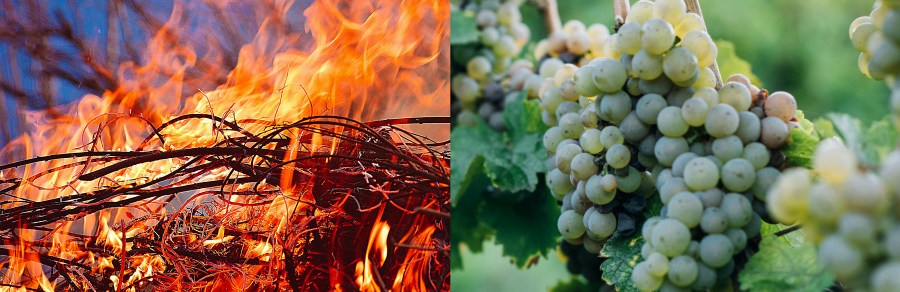
In calling Himself the true vine, Jesus compares himself to another vine: Israel, a vineyard planted by God. Israel was not faithful. In various passages God warned that he would destroy the vineyard because it did not produce fruit (Isa. 5:1-7; Ezk. 15; 19:10-14; Ps. 80:8ff; Jer. 2:21; 12:10ff; Hos. 10:1-2). But God also prophesied of a future vineyard that would bear fruit (Is. 27:2ff; Ezk. 17). “It is ultimately fulfilled in Jesus Christ, who replaces sour grapes with new fruit” (Reformation Study Bible).
God’s Judgment on the Vineyard
In John 15, speaking to Jews, members of the Old Covenant, Jesus references Ezekiel 15’s warning that the fruitless vine will be cast into the fire. He has in mind the nearing end of the Old Covenant (Heb 8:13), when its curses will be poured out upon Jerusalem for their violation of the covenant (70AD). The only hope they will have at that point is in Christ, the obedient son of God, the obedient Israel, the true and new Israel.
Most remarkable is the fact that whenever historic Israel is referred to under this figure it is the vine’s failure to produce good fruit that is emphasized, along with the corresponding threat of God’s judgment on the nation. Now, in contrast to such failure, Jesus claims, “I am the true vine’, i.e. the one to whom Israel pointed, the one that brings forth good fruit. Jesus has already, in principle, superseded the temple, the Jewish feasts, Moses, various holy sites; here he supersedes Israel as the very locus of the people of God… If the Jews wish to enjoy the status of being part of God’s chosen vine, they must be rightly related to Jesus [through faith].
D.A. Carson, The Gospel According to John, Eerdmans, 1991, p.514-16
For a much more in depth elaboration on Christ as the true vine and the nearing end of the Old Covenant, see these two very helpful sermons from Jim Butler:
Fruitless Branches in Christ?
A correct interpretation of John 15 must recognize that corporate Israel is the vine/vineyard. Is Jesus the true vine? Yes. Is Israel itself the vine growing in the vineyard? Yes. In this overlapping age of the Old Covenant and the New Covenant (which Jesus just introduced in this upper room discourse) both Jesus and Israel are the vine. National Israel under the Old Covenant (now reduced to those living in Judea – the Jews) is the vineyard of Is. 5:5-6 and Ezek. 15, the one burned up for lack of fruit. Jesus is the vine of Is. 27 that bears fruit.
“By the ‘branch’ that is separated from fellowship with Christ by being cut off by the Father, I think he means the people of the Jews who are not capable of bearing good fruit. The thrice-blessed John says that the ax will be brought against them and the tree that is cut down will be thrown into the fire” (Cyril).
These Old Covenant Jews are “in the vine” (vineyard) insofar as Jesus came as king of the Jews. Harrison Perkins explains that in the Davidic Covenant “the works principle for the whole nation becomes most focused upon the king as the people’s representative” (Reformed Covenant Theology, 358).
In the Davidic covenant, the king of Israel is the administrator and mediator of the Mosaic covenant, representing God’s rule to the people and representing the people as a whole (2 Sam. 7:22–24)… the ongoing debate regarding the identification of Israel as the servant of the Lord and an individual as the servant who delivers the nation [i.e. Is. 41:8-9; 44:1, 21 vs 42;1] is resolved if we realize that the Davidic king is a representative figure for the entire nation… [I]n Isaiah 55, we have a link made between the Davidic covenant and the new covenant, where it is announced that, on the basis of the work accomplished by the servant of the Lord, God will make an “everlasting covenant,” which is also grounded in the “faithfulness performed by David” (55:3).
Wellum, Kingdom through Covenant (p. 905, 923)
Jesus in himself marks the transition from type (kingdom of Israel) to anti-type (kingdom of heaven). Jesus himself was a literal, earthly offspring of Abraham, born as the literal, earthly, royal offspring of David, the king of the Jews. Yet the kingdom he establishes is not of this world. And only those who place their faith in Jesus will endure. Note that Jesus also expounded upon these OT vineyard passages in Matthew 21/Mark 12 – the parable of the vineyard where the removal of the tenants refers to “the transferal of the kingdom to a new people of God” (Reformation Study Bible).
[God] will put those wretches to a miserable death and let out the vineyard to other tenants who will give him the fruits in their seasons… Therefore I tell you, the kingdom of God will be taken away from you and given to a people producing its fruits. And the one who falls on this stone will be broken to pieces; and when it falls on anyone, it will crush him.
Jesus is making the same point in both John 15:1-6 and Matt 21:33-46/Mark 12:1-12. During this transition period from Old to New, to avoid being destroyed by the cornerstone and being cast into the fire, those in the vineyard must abide in the true vine (believe in Christ, the cornerstone).
“Every branch in Me that beareth not fruit:” the Jewish branch is primarily meant; as by the contrasted fruit-bearing branch we are to understand primarily the Apostles, and the Christian Church having its germ in them. That even the Jews were a branch in Christ the true vine, is as certain as that, according to ch. i. 11, when He came to the Jews, He came to His own property. Accordingly, they belonged to Him from God, and by absolute right. It was because the Jews, in spite of their not bearing fruit, their unbelief and their enmity, were still a branch in Christ, that a final attempt was to be made after the death of Christ, and through the sending of the Paraclete, to win them: ch. xv. 26, xvi. 7-9. Those with whom this final attempt was vain, and who persisted in their stiffnecked rebellion, were cut off. But the evidence that Jesus had primarily in view the Jews, when He spoke of the branches not bearing fruit, is found in the fact that the same thought recurs in ver. 6, where the reference to Ezek. xv. places the allusion to the Jews beyond doubt.
Further, that the general proposition, “Every branch in Me that beareth fruit,” etc., refers first of all to the Christian Church, as existing in the germ of the apostolic company, is shown by ver. 3. But it is manifest that the reference of the unfruitful branches to the unbelieving Jews goes on parallel with this. A comparison of Jer. viii. 13 leads to the same result: “I will surely consume them, saith the Lord: there shall be no grapes in the vine, nor figs on the fig-tree, and the leaf shall fade; and the things which I have given them shall pass away from them.” There also we have the taking away; and the reason, the not bearing fruit, is common to both. In regard to this latter, we may still further compare Deut. xxxii. 32, where it is said of the people of Israel, “Their grapes are grapes of gall, their clusters are bitter;” Isa. v. 2, “And He looked “that it should bring forth grapes, and it brought forth wild grapes;” Micah vii. 1. Speaking of the Jews, John the Baptist uttered the general declaration, “Every tree that bringeth not forth good fruit, is hewn down and cast into the fire.” The same words, with reference to the same people, are spoken by our Lord in Matt. vii. 19. For the αἴρει, we may compare Luke xiii. 7, 9. There the fig-tree which was to be cut down is the Jewish people; and the αἴρει has also its parallel in κακοὺς κακῶς ἀπολέσει αὐτοὺς, in Matt. xxi. 41. The branch bearing no fruit in our passage, is in Matt. xxi. 19 the fig-tree bearing only leaves. In Rom. xi., the olive-tree is another parallel to the vine; the ἐξεκλάσθησαν κλάδοι corresponds to the αἴρει αὐτό, as we find it stated of the Jews in Rom. xi. 19. The reference to the Jews in our present passage will hardly be misapprehended, if we bear in mind that the last discourses of Christ in the first Evangelists, and especially in Matthew, are predominantly concerned with the judgment which was to befall the Jews on account of their unbelief.
E.W. Hengstenberg, Commentary on the Gospel of St. John, 245-6
A Broken New Covenant?
In sum, “every branch in me that does not bear fruit” refers to members of the Old Covenant who do not believe in Christ. The branches that “abide” (believe) in the true vine are members of the New Covenant.
Since Christ is the true Israel, the true seed of Abraham, we who are in Christ by faith and the working of his Spirit are the true Israel, the Israel of faith, not of mere natural descent… Gal. 3:7-9, 26-27, 29… Too often in meditating on this wonderful truth, we omit the all-important link in the chain of redemption that Christ himself is. We say: `Yes, the nation of Israel was the people of God in the old covenant. Now in the new covenant the believing church is the people of God.’ And thus we quickly run past (or we miss the blessed point entirely) the fact that we Christians are the Israel of God, Abraham’s seed, and the heirs to the promises, only because by faith, we are united to him who alone is the true Israel, Abraham’s one seed (not Paul’s emphasis on the singular in Gal. 3:16).
Strimple, “Amillennialism,” in Bock, ed., Three Views of the Millennium and Beyond, 89
Note very well: When Isaiah and Jeremiah, etc say that God planted Israel as a vine in His vineyard, they are not referring to Christ as the vine. Israel itself constituted the vine apart from Christ. Israel was not the vineyard because they were united to Christ by faith. Israel was the vineyard because of their connection to Abraham, not Christ. Christians are the vine/vineyard only through faith union with Christ who supersedes Israel as the true vine. “The nation of Israel was the people of God in the old covenant” on a very different basis (natural descent) than “the believing church is the people of God” in the new covenant (faith). Our interpretation of this passage must account for that.
John 15 does not refer to someone who has been baptized, is “in the New Covenant,” and later apostatizes (thus “breaking the covenant”), but rather to the replacement of the Old Covenant with the New, the transfer of the promised kingdom from Israel (Old Covenant) to those in Christ (New Covenant). Any interpretation of this passage that does not take into account Jesus transforming Israel and the transferal of the kingdom has missed the point. Any interpretation that does not see here a radical difference between the Old and the New has missed the point. Any interpretation that puts Christians today on par with Israel in Isaiah 5 has missed the point.


 Contrast