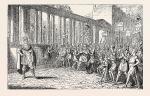
A Woman for all Seasons

The Right Reverend Bishop Mariann Budde of the Episcopal Diocese of Washington has received much attention and praise for her dressing down of President Trump at the interfaith service held at the Washington National Cathedral.

During a prayer service at Washington’s National Cathedral Tuesday, the Episcopal bishop of Washington directly confronted President Trump while he and Vice President J.D. Vance were seated in the front row.

“Let me make one final plea, Mr. President,” Bishop Mariann Budde said in her 15-minute sermon. “Millions have put their trust in you. And as you told the nation yesterday, you have felt the providential hand of a loving God. In the name of our God, I ask you to have mercy upon the people in our country who are scared now,” said Budde, as she appeared to look towards the president.

Many have praised the Reverend Budde for her courage in speaking out against the president. Others have criticized her for injecting politics into what is generally a nonpolitical event held after a presidential inauguration. I do not know whether it was appropriate for her to address specific policies of the incoming president. Rev. Budde can, I presume, say what she likes at her own pulpit. I do question whether her confrontation with the president was really an act of such great courage.

I wonder what the people lauding Budde for bravery believe precisely what danger she is facing. President Trump does not have the power to have her arrested. He cannot have her burned at the stake or thrown into a concentration camp for her insolence. He cannot even have her relieved of her position. The confrontation between Trump and Budde is not exactly of the same import as King Henry VIII and Thomas More. This is not Dietrich Bannhoffer against the Nazi regime, however, much-deluded leftists insist Trump is Hitler reincarnated.

There is a certain degree of hypocrisy among those who commend Rev. Budde for her courage. In answer to concerns about introducing partisan politics into religion, they have said that Rev. Budde is simply expressing Christian principles. I wonder if these same supporters would say the same of a clergyman who rebuked a Democratic president for his support of abortion or same-sex marriage. Millions of Christians opposed both policies with as much scriptural warrant as anything Rev. Budde has opposed. Doubtless, these same people would be screaming,  “Christan Nationalism!” and “Separation of church and State!”.

What if a bishop had reminded his audience of the core message of Christianity: that salvation comes only through Jesus Christ? That clergyman would be branded a bigot. Any indignity heaped upon him would be justified in the minds of the left for such intolerance. It seems, then, in the current atmosphere, it might require considerably more courage to preach orthodox Christianity than to mouth the syncretistic leftist pieties of the liberal apostate clergy.

It also seems to me that there is a certain dishonesty in the bishop’s statement. Consider the words she used to reprimand Trump.

In the name of our God, I ask you to have mercy upon the people in our country who are scared now. There are gay, lesbian, and transgender children in Democratic, Republican and Independent families, some who fear for their lives. And the people, the people who pick our crops and clean our office buildings, who labor in poultry farms and meat packing plants, who wash the dishes after we eat in restaurants and work the night shifts in hospitals. They, they may not be citizens or have the proper documentation, but the vast majority of immigrants are not criminals.

First, there is no reason for anyone who is homosexual or transgender to fear for their lives and safety because of Donald Trump. If anyone is afraid it is because of the hysteria created by the left. The Rev. Budde would have done better to call out the ones promoting this panic. There is also the question of whether children can be, or should be identified as, gay or transgendered. Perhaps we should let the little children be children.

Like many others on the left, she is intentionally fudging the distinction between legal and illegal immigration. There are indeed many legal immigrants who have work hard and pay taxes. They are an asset to the country and we are glad to have them. Many illegal immigrants are not such an asset. The fact is that anyone who is in this country in defiance of our immigration laws is a criminal. It is a crime in every nation to enter that state without the permission of the government of that state.

Perhaps the good Bishop is familiar with Chapter thirteen of Paul’s letter to the Romans.

Let everyone be subject to the governing authorities, for there is no authority except that which God has established. The authorities that exist have been established by God. Consequently, whoever rebels against the authority is rebelling against what God has instituted, and those who do so will bring judgment on themselves. For rulers hold no terror for those who do right, but for those who do wrong. Do you want to be free from fear of the one in authority? Then do what is right and you will be commended. For the one in authority is God’s servant for your good. But if you do wrong, be afraid, for rulers do not bear the sword for no reason. They are God’s servants, agents of wrath to bring punishment on the wrongdoer. Therefore, it is necessary to submit to the authorities, not only because of possible punishment but also as a matter of conscience.

A person who enters a country without obeying the necessary immigration laws is defying the governing authorities of that country. As the President, he must see that the laws are enforced. As President of the United States, his first duty is the welfare of the citizens of the United States. Bishop Budde has no business demanding that the President abdicate the clear duties of his position.

Reverend Budde does not deserve the approbation she has been receiving. She has spoken neither honestly nor courageously. She has inserted partisan politics into what was supposed to be a nonpartisan event. And she has distorted the Christian message to promote her political ideology. I do not believe we are under any obligation to welcome the stranger who shows contempt for our laws, particularly when the people behind the migration do not mean us well.

Our Democracy

If you are the sort of liberal who likes triggering conservatives, you know that the best way is to refer to the United States of America as a democracy. The conservatives who have memorized the Constitution and Federalist Papers will angrily reply that the United States is not a democracy. It is a republic.

So, is the USA a democracy, a republic? What is the difference? Are the two words just different ways of saying the same thing? Let’s begin with “republic”. What is a republic? The word republic is derived from the Latin res publica, the public or common thing. Perhaps the most precise English translation is “commonwealth”.  The Romans used the phrase res publica or republic to refer to the things the city and community of Rome had in common, especially its government.

The Romans did not use the word republic to refer to any particular form of government. Res publica was simply the Roman government. We are used to dividing Roman history between the time of the Republic when the Senate and Consuls ruled Rome and the Empire when the Caesars acted as quasi-monarchs. The Romans made no such distinction. Rome was a Republic even under the reign of the last Byzantine Emperor Constantine XI in 1453.

Over time, the meaning of the word republic became more precise, A republic was defined as a state ruled by representatives of the people instead of a hereditary or divinely appointed monarch. Italian city-states such as Genoa, Venice, and Florence were Medieval republics as were the free cities of the Hanseatic League. Switzerland and the Netherlands were nations that opted for a republican form of government in Early Modern times. And, of course, the Founding Fathers declared the United States would be a republic.

Today, most of the countries in the world are republics. The word republic seems to cover a wide variety of different kinds of governments. Single-party totalitarian states such as the People’s Republic of China and the Democratic People’s Republic of Korea are republics. So are multi-party democratic states such as the Republic of France and the Federal Republic of Germany. The theocratic Islamic Republic of Iran is a republic. The term republic does not seem to be especially useful as a description.

To learn more about government, we should turn to the Greeks. The ancient Greeks were the first people to seriously think about political philosophy. Res publica is a Latin translation of the Greek word  Πολιτεια (Politeia) which means something like “of the Polis”.  Πολισ (Polis) is the Greek word for the city-states that most Greeks lived in during classical times. Polis doesn’t quite mean city in the same sense the English word does. We use the word city to refer to both the physical infrastructure of a city and the community that lives in that city.  The ancient Greeks used the word αστυ (asty) to refer to the buildings and infrastructure of a city. Polis referred to the community that lived in the city. Politeia, then, refers to the matters that concern the polis. Politeia is the source of English words like politics and police.

According to the Greeks, there were basically three forms of government: rule by one (monarchy), rule by the few (oligarchy), or rule by the many or the people (democracy). Some Philosophers like Plato and Aristotle devised somewhat more elaborate schemes, but these three forms are the basis for Greek thinking about politics.

Monarchy could be rule under a king or by a tyrant. A tyrant was a man who seized power by force. This did not necessarily mean the tyrant was a bad ruler. Many tyrants were good rulers, in fact, It was only later that the word tyrant developed the connotation of an oppressive ruler. An oligarchy could mean rule by a hereditary aristocracy or by the wealthy. Democracy meant, of course, by the δεμος (peoplε).

So, would the Greeks consider America a democracy? Probably not. For the Greeks, democracy was the rule by all the people, at least the adult free men of the city. Everyone gathered together in the marketplace to pass legislation and make decisions. There was no body of representatives.  The Greeks might have considered our government a sort of elected oligarchy. Or maybe not. There was another political system known to the Greeks that might be closer to our own system of government.

The Roman political culture differed from the Greeks in that the Romans seemed to be more stable, The Greeks found it difficult to get along with each other. No Greek city ever established itself as a ruler over the others for longer than a very brief period. Even within the poleis, the Greeks were contentious. The poleis were forever shifting between democracy, oligarchy, and tyranny as classes and factions contended.

The Romans were different. The Romans managed to create a form of government that could reconcile classes and factions more or less peacefully, without resorting to despotism. The Romans were able to unite the surrounding Latin cities and then conquer first Italy, and then the known world.

The Greeks were impressed with Rome’s triumphs and wondered how the Romans could accomplish what no Greek could. They decided the secret to Rome’s success was that Rome had a balanced government. The Roman Republic was not a monarchy, oligarchy, or democracy. It was a mixture of all three forms of government.

The two consuls, elected annually, represented the monarchical element in Roman government. The Senate, composed of the Roman aristocracy was the oligarchical component. Roman democracy was represented by various popular assemblies. Neither the monarchical, oligarchical, or democratic elements dominated the Roman government. Instead, Rome enjoyed the advantages of all three systems as each element balanced the others and provided a check on the other’s defects.

If all this seems somehow familiar, it should. The men who wrote the constitution of the American Republic deliberately copied the unwritten constitution of the Roman Republic. We have an elected President who is almost a monarch. The Senate was meant to act as an aristocracy, restraining the popular passions that might sway the democratic House of Representatives. The constitution of the United States differs from the Roman example chiefly by the introduction of representative government, a concept unknown to the classical world.

The American Senate. Note the fasces, the symbol of the Roman Republic

So is the United States a democracy. No, we are not. There are decidedly undemocratic features in our constitution deliberately placed there by the founding fathers who distrusted the tyranny of the majority as much as the tyranny of a monarch or a council of oligarchs. We are a republic with some elements of democracy in our constitution. This may seem a bad thing. Everyone believed in democracy in our time. But too much of a good thing can prove to be bad. The founding fathers were wise not to create a pure democracy.

New Year’s Day

I think that New Year’s Day must be my least favorite holiday. The problem is the date, January 1. This has to be the worst time to start off the new year. It is only a week after Christmas. All the excitement of the Christmas season has dissipated and there is a general impression of anti-climax. The holidays are over and it is time to go back to the general routine of everyday life. In addition, January is the coldest, dreariest month of the year and January 1 is right in the middle of winter. I know that winter officially begins on the winter solstice, December 21 or 22, but in midwestern North America, the cold weather begins about a month or more before the solstice. It is possible to forget the dreariness of winter during the Christmas season, but by January, it feels that winter has been here forever and will never end.

It seems to me that it would be better to start the new year at the transition between one season and the next, preferably when winter becomes spring. What would be more appropriate than to start the new year at the beginning of Spring, when the cycle of nature is renewed and new life springs up? Spring is a time of new hopes and beginnings, so why not start the new year at the vernal equinox, March 21? If starting the new year at the beginning of a month seems weird, why not start the new year on March 1 or April 1? Well, maybe starting the new year on April Fool’s Day is not such a good idea. Why do we start the new year on January 1 anyway?

We have the Romans to thank for the date of New Year’s Day. as well as for our calendar, which is derived from the ancient Roman calendar. Originally, the Roman calendar did have March as the first month of the year. According to Roman legend, Rome’s founder Romulus established a ten-month calendar, beginning in March and extending to December. This is why our ninth through twelfth months, September to December have names meaning seventh through tenth months. Obviously, this ten-month calendar didn’t work out at all, so Romulus’s successor, Numa Pompilius, the second king of Rome, added the months of January and February.

It is not clear how true these legends are, but the twelve-month calendar attributed to Numa was used until Julius Caesar reformed the calendar in 46 BC. At first, the year continued to start in March, but during the republic, new consuls began their terms of office on the kalends, or first day, of January, named for Janus the double-headed god of new beginnings. The Romans did not number their years forward from a past year, as we do, Instead, they named each year after the consuls who served for that year. So, instead of a particular year being 132 since whatever, it would be the year Titus Maximus and Gaius Flavius were consuls. For this reason, it seemed to make sense to start the new year with the beginning of the consuls’ terms, and January first gradually became accepted as the first day of the new year, and when Julius Caesar introduced his Julian calendar, the first of January was officially established as the new year.


The Roman god Janus

After the fall of the Roman Empire in the West, New Year’s Day began to be seen as a holdover from Rome’s pagan past, and a variety of dates were used as New Year’s Day, including Christmas, March 1, and March 25. Calendars still began with January, however, leaving the actual date the new year began up to whoever had the calendar. January 1 was restored as New Year’s Day when Pope Gregory XIII promulgated the Gregorian Calendar in 1582. As the Gregorian Calendar became established as the most widely used calendar in the world, January 1 became the first day of the year worldwide. This means thanks to the Romans and Pope Gregory XIII we are stuck with the new year starting in the dead of winter, instead of spring, and there is nothing I can do about it.

Design a site like this with WordPress.com
Get started