Slavery in the Constitution

I wrote this discussion of slavery in the Constitution as part of my post, America’s DNA. That post began to get too long and I thought the subject deserved its own post given that slavery occupies an ambiguous position in the Constitution, so I spun it off to make this post. Slavery was an established institution throughout the United States at the time of the Constitutional Convention; many of the delegates were themselves slaveholders, so it would not be surprising that they would be anxious to protect the institution vital to their economic welfare. The most curious thing about the Constitution, however, is that it does not mention slavery even once, even in the sections that deal with slavery. The framers use euphemisms and circumlocutions to avoid the subject. It is as if they were ashamed that slavery existed in their new country and wished they could make it go away. An extraterrestrial ignorant of American history might never guess slavery was a part of American society.

I think it is true that most of the men who assembled in Philadelphia in 1787 were, to some degree, embarrassed by the existence of slavery and would have ended it if they could have figured out some way of abolishing slavery without upending the economic and social system in the South. They must have hoped that slavery would eventually die out in succeeding generations. They had some reason for this hope. The northern states were already emancipating their slaves, and the Northwest Ordinance banned slavery in the Northwest Territory. Nevertheless, the framers of the Constitution do seem to have missed the opportunity to fatally weaken slavery at the onset. Still, while the Constitution does contain provisions designed to protect slavery, it does set the grounds for eventually ending slavery.

The first part of the Constitution that deals with slavery in an indirect fashion is Article I Section 2, which deals with the apportionment of Congressional representatives of the states. Paragraph 3 reads in part:

Representatives and direct Taxes shall be apportioned among the several States which may be included within this Union, according to their respective Numbers, which shall be determined by adding to the whole Number of free Persons, including those bound to Service for a Term of Years, and excluding Indians not taxed, three fifths of all other Persons.

American Indians would not be represented in Congress because as members of their own tribes, they were considered citizens of sovereign nations under their own government and laws. Those “other persons” were, of course, slaves. Those ignorant of history believe that the three-fifths compromise is a racist measure that defined African-Americans as three-fifths of a person. The truth is precisely the opposite. During the constitutional debates, the delegates from the southern states wanted slaves to be counted along with free persons to determine the number of representatives each state was entitled to. The northern delegates disagreed, pointing out that slaves would not be allowed to vote and, therefore, should not be counted. The three-fifths compromise gave the slave states less representation than they otherwise would have enjoyed in Congress and ultimately decreased the influence the slave owners had in American politics. It would have been better if the slaves had not been counted at all, but the three-fifths compromise was necessary to ensure the ratification of the Constitution.

Next, Article I section 9 paragraph 1 also deals with slavery without mentioning slavery:

The Migration or Importation of such Persons as any of the States now existing shall think proper to admit, shall not be prohibited by the Congress prior to the Year one thousand eight hundred and eight, but a Tax or duty may be imposed on such Importation, not exceeding ten dollars for each Person.

A person not knowing the history of the United States might imagine this paragraph has something to do with immigration. In fact, it is referring to the trans-Atlantic slave trade. The Constitution did not allow the slave trade to be prohibited until 1808, twenty years after the adoption of the Constitution. The slave trade was duly outlawed in 1807 with surprisingly little controversy, although the illegal transport of slaves from Africa continued up to the Civil War.  The framers of the constitution clearly wanted to end the slave trade, and again, seemed to be embarrassed by the fact that slavery even existed in the United States. It would have been far better if they had abolished the slave trade right away, but the delay was necessary for the slave owners to adjust to a diminished supply of slaves. The Constitution might not have been ratified without the twenty-year delay.

The final section concerning slavery can be found in Article IV Section 2 paragraph 3:

No Person held to Service or Labour in one State, under the Laws thereof, escaping into another, shall, in Consequence of any Law or Regulation therein, be discharged from such Service or Labour, but shall be delivered up on Claim of the Party to whom such Service or Labour may be due.

Without saying the word slave, this paragraph requires escaped slaves to be returned to their owners. Article IV generally describes the relationship each state has other the other states and requires that:

Full Faith and Credit shall be given in each State to the public Acts, Records, and judicial Proceedings of every other State.

That is why a driver’s license issued in one state is valid in every other state. It also means that property acquired in one state remains a person’s property even if he moves into another state. Unfortunately, at the time, the word property included slaves. Just as a cow that wandered across a state line did not become the property of the first farmer that found her, a slave that fled into another state could not become free. Like the other concessions concerning slavery, the men who drafted the Constitution did not have much choice about including this provision.

If there are provisions in the Constitution designed to protect or regulate slavery, even if expressed only indirectly, the last word of the Constitution is decidedly anti-slavery. The Reconstruction Amendments, the Thirteenth, Fourteenth, and Fifteenth Amendments, ended slavery, made the former slaves citizens, and granted them the right to vote, respectively. These Amendments finally ended the terrible injustice of slavery that the founders ought to have ended, but perhaps couldn’t. Going back to my post, America’s DNA, if slavery and racism were in America’s DNA, these amendments were an act of genetic engineering that excised them from our genes.

The United States is not a perfect country, but we have been trying to live up to the noblest ideals ever expressed. Don’t let the America haters get away with their lies.

America’s DNA

I sometimes hear it said by American-hating leftists that racism and White supremacy are encoded in America’s DNA.  As the America-hating leftist Barack Obama put it:

The legacy of slavery, Jim Crow, discrimination in almost every institution of our lives. You know, that casts a long shadow and that’s still part of our DNA that’s passed on. We’re not cured of it. Racism we are not cured of, clearly.

Is this true? Are slavery and racism part of America’s DNA? If so, does this not imply that racism will always be present in American life just as the fact that the eye color encoded in our DNA will always be a part of our life? Is racism really part of our collective DNA? What is DNA anyway?

The last question is the easiest to answer. DNA or deoxyribonucleic acid is:

A nucleic acid, usually of very high molecular weight, consisting of a linear sequence of monomer units of deoxyribonucleotides, occurring in most organisms in pairs of strands, wound together in the form of a double helix; it is the main component of chromosomes and contains the genetic information which is the basis of heredity, transmitted from parent to progeny, and found in all living organisms except for certain viruses which have RNA as their basic genetic material

Simply put, DNA is the molecule that encodes the genetic information that determines the development of an organism. To put it even more simply, DNA is the blueprint for an organism.

What is America’s DNA? America is not an organism and does not literally have DNA, so the expression is obviously metaphorical. That being the case, what could we say determined the development of the United States of America? I would say the founding documents made the United States into the nation it is today. Our country was born when Congress adopted the Declaration of Independence on July 4, 1776. The Declaration sets out why the American colonies felt it necessary to separate from Great Britain and what sort of nation we hoped to create. The Constitution establishes the government under which the people of the United States would rule themselves. The Bill of Rights, a necessary part of that Constitution, set forth the natural rights our government was created to protect.

If racism is indeed part of America’s DNA, it would be detected in these founding documents. If the United States of America was a nation conceived in racism and dedicated to the proposition of White supremacy, these principles would be seen throughout the Declaration and the Constitution. Let us then examine them and see if we can find them.
We’ll begin with the Declaration of Independence. It begins with these paragraphs.

       WHEN in the Course of human Events, it becomes necessary for one People to dissolve the Political Bands which have connected them with another, and to assume among the Powers of the Earth, the separate and equal Station to which the Laws of Nature and of Nature’s God entitle them, a decent Respect to the Opinions of Mankind requires that they should declare the causes which impel them to the Separation.
  We hold these Truths to be self-evident, that all Men are created equal, that they are endowed by their Creator with certain unalienable Rights, that among these are Life, Liberty, and the Pursuit ofHappiness—-That to secure these Rights, Governments are instituted among Men, deriving their just Powers from the Consent of the Governed, that whenever any Form of Government becomes destructive of these Ends, it is the Right of the People to alter or to abolish it, and to institute new Government, laying its Foundation on such Principles, and organizing its Powers in such Form, as to them shall seem most likely to effect their Safety and Happiness.

Please note the words I highlighted. These are words that inspired Abraham Lincoln to strive to end slavery. These are the words that Martin Luther King described as a promissory note guaranteeing equality that had not yet been fulfilled. These are the words that promised to put an end to inequality of all kinds, including inequality based on race. The Declaration of Independence is one of the most anti-racist documents ever written.

The Constitution of the United States is a more prosaic work than the Declaration. It is mainly concerned with the practical aspects of the establishment of a new government and has less of the aspirational language found in the Declaration. Nevertheless, the preamble declares:

We the People of the United States, in Order to form a more perfect Union, establish Justice, insure domestic Tranquility, provide for the common defence, promote the general Welfare, and secure the Blessings of Liberty to ourselves and our Posterity, do ordain and establish this Constitution for the United States of America.

Note that “we the people” are establishing the new government for ourselves. This was not a government created by an aristocratic elite to rule over a nation of serfs. This was a government created by the people for the people; a government for the whole people, not just the white or black people. The fact that the framers never conceived the idea that the descendants of their slaves could possibly stand alongside their own descendants doesn’t matter. The ideals of the government they created could not tolerate such injustices as slavery or racial discrimination forever. The government they created had the means within it to end such injustices.

Rather than racism and White supremacy being part of America’s DNA, our country’s DNA is decisively anti-racist. Despite the dark moments in its history, the United States of America is the most anti-racist nation ever created. America is a nation based on a particular race or ethnicity that France or China might be, but it is a nation founded on the belief that all men are created equal. It is a nation that has made all its people from every corner of the earth, every race and creed into one people. It is a nation that has established a government ruled by that people for themselves.

If is the case that America is fundamentally anti-racist in its ideals, how do we account for the fact that racism has been very much a part of the history of America, from slavery to Jim Crow to the anti-White racism of Black Lives Matter? Well, an organism’s DNA is not the only factor in its development. The environment in which an organism is conceived and grows also plays a role. The environment determines to what extent an organism will flourish and how it will make use of the potential provided by its genetic heritage. An organism’s environment can even influence which traits encoded in its DNA will be expressed and which will remain dormant.
There is no denying that the United States was born in a world that took for granted ideas of racism and white supremacy. That is the environment that influenced the development of our country.

Despite the unpromising environment of its beginning, the history of the United States has been one in which its people have tried to live up to the ideals of equality and justice, however imperfectly, often against the tide of custom and expediency. The United States of America is far from a perfect country, no nation created by man can be, but we have a history of fighting for the right second to no other country. We have no reason to be ashamed of our history, or our country. Don’t ever let the America haters tell you otherwise.

Chronological Snob

I saw this posted somewhere on the internet.

This is a prime example of what C. S. Lewis called chronological snobbery. Chronological snobbery is the idea that because people in earlier times were less knowledgable than we are about natural science, they must have been less intelligent and less knowledgeable about everything than we who live in these more enlightened times. The person who created this meme is suggesting that because the men who wrote the constitution were ignorant about the developments in scientific understanding after their time, they have nothing worthwhile to say to us. The constitution they drafted must be based on their ignorance and should perhaps be discarded as a product of an earlier, benighted era.

The meme isn’t entirely true, even in a real sense. The men of the eighteenth century did not regard women as literal property, except for their Black slaves, but that is another matter. If anything, they probably had a more realistic view concerning men and women than the average gender studies major of our times. At least they knew what a woman was. No educated person at the time would have viewed a light bulb as the product of witchcraft. They would have easily understood the principles of the workings of an incandescent light bulb if someone had explained it to them. Benjamin Franklin and perhaps Thomas Jefferson could have deduced these principles by observation. In fact, Franklin could have invented the light bulb if he had lived a half-century later. These were not ignorant men.

As for the rest, it may be true that the framers did not know about atoms or dinosaurs, though Jefferson at least was aware of the fossils that suggested large animals had existed in the past. They only knew about the prevailing scientific views of their time, just as the creator of this meme only knows about the common views of xir time. It is true that the average college or even high school graduate knows more about the natural world than the most educated persons in the eighteenth century. That is hardly to their credit, however. They had no hand in developing modern scientific theories. They are only repeating what their teachers tell them. It is not to the framers’ discredit they didn’t know better. They could not have known about advancements in knowledge that occurred decades or centuries after their deaths.

In any case, a knowledge of modern physics or medicine is not what is needed to establish a new and lasting government. What is needed is a knowledge of human nature and political history. This sort of wisdom the founding fathers possessed in abundance much greater than the average woke college graduate of today. These men had all read Plutarch, Polybius, and Plato. They were familiar with the works of Locke, Burke, and Montesquieu. Men the woke would dismiss as dead White males with nothing to say to us in these more enlightened times. The men who drafted our constitution had studied the constitutions of many states ancient and modern and had managed to create a political system that has provided the American people with an unparalleled degree of freedom for more than two hundred years. I doubt if any system of government devised by our woke contemporaries would do so well. Indeed, if the history of the twentieth and twenty-first centuries is any guide, we still have a lot to learn from the wise men who wrote that allegedly outdated constitution. We should not dismiss the people who lived in the past as ignorant because they did not have the knowledge we have gained since their time. We should learn from their wisdom that we have perhaps lost.

Vote Reparations

Vote reparations are the newest idea from the loony left that every conservative is talking about. What is vote reparations? We’ll let Brandon Hasbrouck explain in his article in the Nation.

Black votes in this country are worth less than white votes. Joe Biden won the Electoral College because Black voters in Atlanta, Detroit, Milwaukee, and Philadelphia turned out in significant numbers. But even with overwhelming Black support—94 percent of Detroit voted for Biden!—the outcomes in Georgia, Michigan, Wisconsin, and Pennsylvania were worryingly close.

We’ll skip over the very real possibility that those close votes were the result of fraud for the sake of the argument. 

One core problem is the Electoral College. Wyoming, which has just 580,000 residents and is 93 percent white, gets three electors because of its two senators and one representative in the House. By comparison, Georgia’s Fifth Congressional District—which includes Atlanta, has 710,000 residents, and is 58 percent Black—has no dedicated electors or senators and can only occasionally overcome the mostly white and conservative votes from elsewhere in the state. This devaluation of Black votes allows our political system to ignore Black lives, and the consequences are devastating. Unequal representation has led to unequal health care outcomes, which the Covid-19 pandemic has only worsened. Without sufficient voting power, Black communities receive substandard education, and politicians are free to appoint judges who sanction mass incarcerationabusive policing, and electoral disenfranchisement.

This is all by design. The Constitution’s framers set up the Electoral College to protect the interests of slave states. Along with the Senate, the Electoral College was critical in the endurance of slavery and its continuation by other means. Abolishing this system would mean that ballots cast by Black voters—or any voters, for that matter—would count the same.

But there’s another way to undo the damage of the Electoral College and other structurally racist political institutions: We can implement vote reparations by double-counting ballots cast by all Black residents. The poisonous legacy of slavery applies to Black people regardless of when we or our ancestors arrived in this country. Vote reparations should also extend to Native Americans. Slavery is rightly called America’s original sin, but so too was the United States’ genocidal seizure of land from its original inhabitants. Various legal forms of disenfranchisement have applied to them. It wasn’t until 1962 that all Native Americans were allowed to vote, and even then they faced—and still face—electoral obstacles. These are not the only examples of American oppression; we should include in vote reparations others who have suffered similar disenfranchisement.

Basically, the idea that Blacks, and perhaps other people who have suffered from past and present discrimination should get two votes to make up for past wrongs. 

There is a lot to object to in this idea, not least of which is the old maxim that two wrongs do not make a right. You cannot remedy injustice against one group by practicing injustice against the other. I will have more to say about that in a moment, but first, I think it is worth observing that the whole idea of vote reparations is based on a false premise, the idea that the constitution and particularly the electoral college were designed to perpetuate slavery. Logically, if the premise is false, the conclusion must also be false.

Contrary to what the architects of the 1619 Project contend, the constitution was not designed to perpetuate slavery. The framers of the constitution wanted to create a republican government that would preserve liberty for themselves and their descendants. The founding fathers drew from many sources, both ancient and modern for inspiration, including the greatest political philosophers throughout history, particularly Aristotle, Polybius, John Locke, Edmund Burke, and Montesquieu. These thinkers generally believed that the best way to preserve liberty was to create a mixed government, that is, a government that included elements of monarchy, aristocracy, and democracy, all in balance with a separation of powers. The framers of the constitution wanted a system that was somewhat democratic, but not too democratic, so they included undemocratic features, like the Electoral College into the constitution. The founding fathers did not want the president to be elected by the people, the people might not know the candidates very well. They wanted the president to be elected by representatives of the people, selected by the state legislatures. None of this had anything to do with slavery. In fact, the Constitution, and especially the Declaration of Independence, with its declaration that all men are created equal had rather a corrosive effect on the institution of slavery. 

Getting back to the subject of vote reparations, then. Aside from the obvious injustice of awarding differing numbers of votes based on race and color, the problem I have with this sort of restorative justice is that I wonder when does it all end. At what point are the previously oppressed and the previous oppressors even? If we embark on a policy of privileging the descendants of the oppressed at the expense of the descendants of the oppressors? If Blacks get reparations paid by Whites today, do Whites have a claim on reparations a hundred years from now based on the oppression their ancestors endured at the hands of privileged Blacks? 

It may seem ludicrous to consider Whites being oppressed by Blacks today, but how do people like Mr. Hasbrouck think Whites are going to react when they see their Black neighbors getting two votes? Probably the same way they think about any government policy that shows preference to Blacks at the expense of Whites. Few Whites are going to simply shrug their shoulders and say, well they deserve the extra votes because our grandfathers oppressed their grandfathers. The Whites are inevitably going to feel discriminated against, with some justification. Dismissing their just grievances as simply as more racism will only make them angrier. 

So, where does it end? Do we simply continue on an endless cycle of discrimination, flipping back and forth between the races, or do we put an end to discrimination and treat everyone as equal? Do we continually revisit the injustices of the past to foster an endless sense of grievance or do we move forward into a brighter future? Vote Reparations would only take us back to an endless pattern of racism today, racism tomorrow, and racism forever. I think it is better to aim for a future of liberty and equality. 


Impeachment

Now that the Donald Trump impeachment saga has come to an ignominious end, I thought it might be interesting and informative to take a look at the previous presidential impeachments and compare them to the present effort. So far, there have been three presidents impeached by the House of Representatives, Andrew Johnson in 1868, Bill Clinton in 1998, and Donald Trump in 2020. While the precise circumstances of each case have been dissimilar, with various specific accusations being made against each president in diverse historical and political contexts, there have been similarities in the three presidential impeachments, as we shall see. In no case, so far, has the president actually been convicted and removed from office. In each case, the charges made against the president, the conduct of the trial in the Senate and the ultimate outcome has been a matter of politics rather than the law. Impeachment, then, is more of a political matter than a strictly legal one.

The constitution mentions impeachment in several clauses. Article I Section 2 Clause 5 states:

The House of Representatives shall chuse their Speaker and other Officers; and shall have the sole Power of Impeachment.

The House of Representatives impeaches a government official, including the president. Impeachment is simply bringing charges of misconduct against the officeholder, rather like a prosecutor bringing charges against a person accused of committing a crime. Contrary to what many of Donald Trump’s critics seem to believe, impeaching an official does not mean that that official is actually guilty of any crime, nor is he automatically removed from office. The Senate tries impeachments, acting as a sort of jury, as stated in Article I Section 3 Clauses 6 and 7 of the constitution.

6: The Senate shall have the sole Power to try all Impeachments. When sitting for that Purpose, they shall be on Oath or Affirmation. When the President of the United States is tried, the Chief Justice shall preside: And no Person shall be convicted without the Concurrence of two thirds of the Members present.

7: Judgment in Cases of impeachment shall not extend further than to removal from Office, and disqualification to hold and enjoy any Office of honor, Trust or Profit under the United States: but the Party convicted shall nevertheless be liable and subject to Indictment, Trial, Judgment and Punishment, according to Law.

According to Article II Section 4 of the constitution:

The President, Vice President and all civil Officers of the United States, shall be removed from Office on Impeachment for, and Conviction of, Treason, Bribery, or other high Crimes and Misdemeanors.

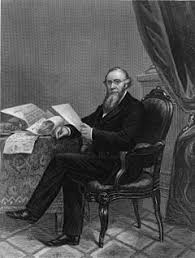
Andrew Johnson was impeached in 1868, as a result of the conflict between Johnson and Congress over Reconstruction. It is not necessary to get into the details of that conflict here.

Andrew Johnson

Simply put, President Johnson favored a more lenient treatment of the defeated south than the Republicans who controlled Congress. Johnson was a Southern Democrat who had been added to Lincoln’s ticket in the election of 1864 as a gesture of national unity. After Lincoln’s assassination, Johnson found himself opposed by both Congress and his own Cabinet, particularly his Secretary of War Edwin M. Stanton. To prevent Johnson from replacing Lincoln’s cabinet with his own men, Congress enacted the Tenure of Office Act of 1867 which prevented the president from dismissing cabinet officials without the consent of the Senate. Johnson demanded Stanton’s resignation anyway, Stanton barricaded himself in his office, and Congress proceeded to impeach President Johnson.

Edwin Stanton in his office.

On February 24, 1868, the House of Representatives voted 126 to 47 to impeach the president. The following week, the House presented eleven articles of impeachment, accusing President Johnson of violating the Tenure of Office Act by firing Edwin Stanton and appointing a new Secretary of War without the consent of the Senate, challenging the authority of Congress to legislate reconstruction, and using  “with a loud voice, certain intemperate, inflammatory, and scandalous harangues, and did therein utter loud threats and bitter menaces … against Congress [and] the laws of the United States duly enacted thereby, amid the cries, jeers, and laughter of the multitudes then assembled and within bearing”.

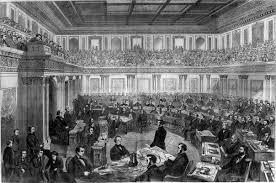
The case then went to the Senate on March 4. The trial began on March 23 and the voting took place on May 16 and 26. This was not really the case of a somber Senate carefully considering each article. There were reports of political pressure and even outright bribery to persuade the Senators to vote to acquit or convict. In each case, the Senate voted 35 to 19 for conviction, just one vote short of the two-thirds necessary to convict.

President Johnson remained in office but was a lame duck for the rest of his term and did not run for reelection. He was, however, vindicated in the end. The Tenure of Office Act was repealed in 1887 and the Supreme Court declared a similar act unconstitutional in 1920, noting that the Tenure of Office Act of 1867 was also likely to be unconstitutional. Andrew Johnson was not a very good president, but he should not have been impeached. His impeachment was little more than a partisan attempt to remove a president that the Republicans saw as standing in the way of Reconstruction and divided a country that needed to be united in the wake of the most destructive war in its history.

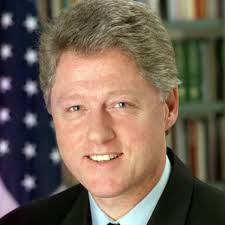
I think that it is fair to say that the Republicans hated President Bill Clinton more than they had any previous Democratic president. Part of this hatred was personal, a sort of moral outrage against a president seen to be immoral. As his nickname, Slick Willie might suggest, Bill Clinton had a reputation for sleaze and corruption, and for escaping the consequences for his actions. Part of the dislike stemmed from thwarted political hopes. When the Republicans took control of Congress for the first time in forty years, after the 1994 midterms, the Republican congressional leaders, particularly Newt Gingrich, believed that they would be setting the national agenda, with President Clinton reduced to irrelevance. Clinton was more politically adroit than the Republicans expected, however, and was able to portray the Republicans as obstructionist extremists, by triangulating to the center, infuriating the Republicans, and easily winning reelection against the uninspiring Bob Dole.

Slick Willie

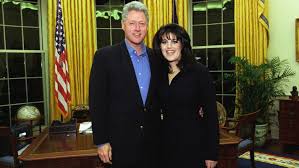
The Republicans spent most of Clinton’s term investigating Clinton’s various scandals, without making much headway with the public. The country was prosperous and at peace and Clinton was slick, so the people did not much care about his misdeeds. By 1998, however, the Republicans believed they had their chance with Paula Jones’s sexual harassment lawsuit against Clinton. I would rather not get into the sordid details about Clinton’s affair with Monica Lewinsky as well as the exhaustive report by Ken Starr on Clinton’s numerous transgressions. It is sufficient to point out that Clinton made false statements to a grand jury and in a deposition in the Paula Jones lawsuit.

He did not have sex with that woman.

On December 19.1998, the House of Representatives voted, largely along party lines to send two articles of impeachment, perjury to a grand jury and obstruction of justice, to the Senate. The Senate trial lasted from January 7. 1999 to February 9. The Senate then considered the charges in a closed session until February 12 when they emerged ready to vote on the verdict. On the first charge, perjury, the Senate voted not guilty 45 to 55 and on the second charge, obstruction of justice, they voted not guilty 50 to 50, well short of the 67 guilty votes needed to convict. In each case, the 45 Democratic Senators voted not guilty with five Republicans defecting on the second charge.

Should the Republicans have impeached Bill Clinton? From a legal viewpoint, yes. Clinton was unquestionably guilty of the charges made against him, and more. He was a sleazy, corrupt man who was guilty of serial sexual assault. From a political viewpoint, no. Impeaching the president was a foolish act, considering that the Republicans did not have the sixty-seven votes needed to convict and there was no chance of convincing ten Democratic Senators to break ranks with their party. The impeachment of Bill Clinton was not popular with the American people. Neither were the investigations leading up to Clinton’s impeachment. This public dislike of Ken Starr’s investigations was certainly a factor in the Republican loss of five Congressional seats in the election of 1998 when the opposition party usually gains seats in midterm elections. Clinton’s impeachment may well have a cause for the closeness of the 2000 presidential election. Normally, it is not easy for one party to hold onto the White House and Al Gore wasn’t a particularly appealing candidate. If the Republicans had not impeached Clinton, George W. Bush might have won the election by a decent margin. A great deal of subsequent partisan acrimony would likely have been avoided.

Karl Marx once wrote, “History repeats itself, first as tragedy, second as farce.” I do not know how that statement might apply generally, but it certainly applies to the history of impeachment in the United States. The impeachment of Andrew Johnson was a high tragedy, based on fundamental constitutional questions on the relationship between the executive and legislative branches. The impeachment of Bill Clinton was tragi-comic, based as it was in the titillating details of Clinton’s sexual exploits and deceptions. The impeachment of Donald Trump has been simply a farce.

The Democrats have hated Donald Trump, probably even more than the Republicans hated Bill Clinton. Part of this is undoubtedly Trump’s brash and uncouth personality. Part of this might be due to dashed hopes. Most observers, including myself, expected Hilary Clinton to win the 2016 election, and the Democrats were looking forward to sweeping Congress and forming a permanent Democratic majority. Donald Trump’s unexpected victory enraged the Democrats.

Donald Trump

Whatever the reason, the Democrats began seeking causes for impeaching Trump even before he took office, but it was only after they gained control of the House of Representatives in the 2018 midterm elections that they had any chance of impeaching him. A July 2019 telephone call between President Trump and Ukrainian president Volodymyr Zelensky gave the democrats their pretext. In this conversation, Trump asked Zelensky to investigate corruption charges against Joe Biden’s son, Hunter, allegedly threatening to withhold military aid to Ukraine if Zelensky did not comply. The Democrats seized on this story to begin an impeachment inquiry in October.

Donald Trump talking to Zelensky?

On December 17. 2019 the House of Representatives voted, along partisan lines, to send two articles of impeachment to the Senate, Abuse of Power and Obstruction of Congress. Speaker Nancy Pelosi delayed actually presenting the articles of impeachment until January 15, 2020, and the Senate trial began on January 22 and on February 5, the Senate voted to acquit Trump 48 to 52 on the first charge and 47 to 53 on the second charge, along partisan lines with Senator Mitt Romney the only Republican voting guilty on the first charge.

The impeachment of Donald Trump was a supreme act of folly by the Democrats. Not only did the Democrats not have the sixty-seven votes needed to convict President Trump, but they also did not even have a majority in the Senate, so they had no control over how the Senate trial was to be arranged. Under the circumstances, Trump’s acquittal was a foregone conclusion, and the whole impeachment was a waste of time and money. The Democrats in the House of Representatives were so eager to appease their base by impeaching Trump that they didn’t bother to make much of a case against him. The impeachment investigation was hasty and partisan, without much of an attempt to include Republicans in the process. The Senate trial was a joke since the Republicans didn’t take the charges seriously. The whole affair was a trivialization of the impeachment process. I expect that the Republicans will take revenge by impeaching the next Democratic president over similarly trivial charges until impeachment becomes a regular part of politics and presidents are being impeached for jaywalking or tearing the tags off mattresses.

Over the Edge

While I was writing on how close we, as a country are, to stepping off the edge of a cliff into the abyss of political confusion, the Democrats in the House of Representatives took us a step closer by voting to impeach Donald Trump. This attempt at removing the president from office is foolish because there is no conceivable way that the Democrats will get the sixty-seven votes needed to convict the president and remove him from office. Given that at present there are fifty-three Republican Senators, it is unlikely that even a majority of the Senate will vote to convict. The most likely outcome of this farce is that the Senate will vote to acquit Trump with at least one or two Democratic Senators defecting. Trump and his supporters will announce that he has been vindicated of any wrongdoing, and Trump will campaign on the basis that the impeachment was nothing less than a coup by the swamp he had been trying to drain. Trump will make the 2020 election between himself as the tribune of the people fighting against the deep state elite which tried to unseat a duly elected president on specious charges and he will win, if not by a landslide, then by a comfortable margin. Already, the Republicans are setting records in fundraising.

If the only outcome of the Democrats’ attempt to impeach the president was to reelect the president they are trying so desperately to get rid of, it would not be a serious matter, more amusing than anything else. This impeachment is a serious matter, however, because of the dangerous precedent, the Democrats are setting. This attempt at impeaching the president is not motivated by any particular wrongdoing discovered. The Democrats have been stating their intention to impeach Trump even before his inauguration. The telephone call between President Trump and President Zelensky is only a pretext. This impeachment, unlike previous presidential impeachments, was done solely for political purposes, to undo the results of the 2016 election. Politics did play a role in the impeachments of Andrew Johnson and Bill Clinton, to be sure, but these two men actually did commit violations of the law. Donald Trump is a victim of a witch hunt, an unceasing pursuit to impeach him for anything. The impeachment of Donald Trump could best be described as an attempted coup.

Since this impeachment is being done simply to remove a president the Democrats do not like, what is there to stop the Republicans from retaliating by impeaching the next Democratic president? Some Republicans are already threatening to do so. Why shouldn’t they, since those are the new rules? And, what is to stop the Democrats from replying in kind against the next Republican president? Do we really want to have a situation in which every president from here on out is impeached the instant the opposition party takes control of Congress? What happens if a president really does commit a serious crime or abuse of power? Would anyone take an attempt to impeach him seriously? Why should they, if the last five times the president was impeached were simply politics? What happens if a president impeached on specious grounds in convicted, and simply refuses to leave the White House? Half the country might back him in the ensuing constitutional crisis.

There is a way to remove a president you don’t like. It is called an election. The Democrats would have done better to have prepared to make their case to the voters that Trump should be removed from office next November. Instead, they chose to take that decision away from us and to take the country a few steps closer to the edge. We really don’t want to go over that cliff.


New Constitutional Convention

Over at Daily Kos, they are really worried about the possibility of a National Convention to amend the constitution. They explain their concerns in a typically classy and well mannered way in a email I received.

I know many of you don’t pay much attention to the right-wing noise machine, and when you do dismiss what you hear for obvious reaons — like they’re generally full of shit.

Well, that’s all true, but that doesn’t mean they’re not dangerous.  After all, many liberals and progressives laughed at and dismissed Rush Limbaugh and the other right-wing talk radio shock jocks as clowns, back in the 90s, but look how much influence he has had and how much damage he’s done to our civil discourse.  These things have a way of flying under the radar until they reach a critical mass, then they explode to cause no end of trouble.

Reaons? What’s spell check? If they really want to know who has done the most damage to our civil discourse I would recommend they read The Real Radio Hatemongers,  a publication put out by the Media Research Council. It’s a little old but I doubt if the vile rhetoric of the left has changed much.

That’s why I’m writing today about a growing movement in far-right circles that sounds like a bunch of crackpots, but could actually pose a serious danger to our democracy.  Spurred on by Mark Levin and others, there is a grass-roots conservative movement to convene an Article V convention of the States to amend the Constitution by enacting so-called “Liberty Amendments” that would eliminate the popular election of Senators, require a balanced federal budget, prohibit the federal government from any activity conducted by the states (including healthcare), effectively eliminate the commerce clause and the general welfare clause, enact term limits on judges and enable the States to overturn judicial decisions, impose nation-wide voter id laws, and enshrine several other far-right hobbyhorses as Constitutional imperatives.  And this movement has support from people who should know better, like state representatives from Indiana and Georgia.  While obviously on the fringe now, these sorts of things have a tendency to become mainstream conservative thought if unchecked.  Follow me below the squiggle for more details.

There is a meeting of representatives from at least 30 states scheduled just three days from now, Saturday, December 7, at the library in Mount Vernon.  (Is nothing sacred?  George Washington is probably spinning in his grave even as we speak.)  Elected officials will be among the attendees: David Long, President of the Indiana State Senate; and Jason Spencer, Georgia state representative.

In fact, the state of Indiana has actually enacted legislation to facilitate the appointment of delegates to such a convention, and to govern their activities.

To take a step back, I should explain that Article V of the Constitution provides two ways to amend the Constitution.  The first, with which we are familiar because it is the way all amendments have been enacted to date, is for two-thirds of the House and Senate to vote for an amendment, which is then sent to the States for ratification (which requires approval by three-fourths of the States).  But alternatively, if two-thirds (34) of the States so request to Congress, Congress must then call a convention to propose amendments (which must then be ratified, again, by three-fourths of the States).  Although the procedures for such a convention are unclear, the folks currently pushing this take the position that such a convention would be a creature of the State legislatures, with delegates appointed by the legislatures and bound by their instructions.

Yea Indiana! Actually I suspect that George Washington would approve of most of these “right wing hobby horses”. It is important to remember that the men who made up the Constitutional Convention did not really intend to create a “democracy”. The word democracy did not have the positive connotations it has today. Instead it meant something closer to mob rule. One of the fears of the founding fathers was of a tyranny of the majority, the idea that a majority could vote away the rights and property of a minority.

English: Painting, 1856, by Junius Brutus Stea...
Time to meet again? (Photo credit: Wikipedia)

The intent of the framers was a balanced system based on an idealized view of the British constitution and the government of the Roman Republic. This system was to include a monarchical element, a president elected by an electoral college, an aristocratic element, a Senate with senators selected by state legislatures and functioning as representatives from the states to the federal government, and a democratic element, the House of Representatives which was elected by and represented the people. Over time, this system has become more democratic and yet has functioned less well to guarantee liberty, especially in recent years.

The procedure that Daily Kos paints as somehow illegitimate is completely constitutional though it has not been done before. It is less irregular than the Senate changing centuries old rules to suit the political party in the majority or amending the constitution through judicial reinterpretation by activist judges. Despite their description of the liberty amendments as far right fringe, I suspect that a large plurality of people would support many of them, perhaps even a majority. If this were really a crack-pot fringe movement, I seriously doubt this movement would be any particular threat to anybody. I don’t think that very many people believe the country is heading in the right direction and more and more are coming to the opinion that some kind of drastic action is needed to halt and even reverse our slow slide into despotism. That, of course, is precisely what Daily Kos fears most.

Impeach President Obama

M. Northrop Buecher at Forbes.com has written an article arguing for impeaching Barack Obama. Put simply, a president with his sort of contempt for the constitution and the rule of law ought not to be permitted to serve out two terms without some sort of consequence lest a precedent be set for future presidents. He makes a very good case. A president who can simply ignore Congress and the Courts is not a president of a democratic republic but a dictator, even if political realities do not yet allow him to wield dictatorial power.

Here are a few excerpts. Read the whole thing. It is worth it.

Since President Obama signed the Affordable Care Act into law, he has changed it five times. Most notably, he suspended the employer mandate last summer. This is widely known, but almost no one seems to have grasped its significance.

The Constitution authorizes the President to propose and veto legislation. It does not authorize him to change existing laws. The changes Mr. Obama ordered in Obamacare, therefore, are unconstitutional. This means that he does not accept some of the limitations that the Constitution places on his actions. We cannot know at this point what limitations, if any, he does accept.

By changing the law based solely on his wish, Mr. Obama acted on the principle that the President can rewrite laws and—since this is a principle—not just this law, but any law. After the crash of Obamacare, many Congressmen have implored the President to change the individual mandate the same way he had changed the employer mandate, that is, to violate the Constitution again.

The main responsibility the Constitution assigns to the President is to faithfully execute the Laws. If the President rejects this job, if instead he decides he can change or ignore laws he does not like, then what?

The time will come when Congress passes a law and the President ignores it. Or he may choose to enforce some parts and ignore others (as Mr. Obama is doing now). Or he may not wait for Congress and issue a decree (something Mr. Obama has done and has threatened to do again).

If the President can ignore the laws passed by Congress, of what use is Congress? The President can do whatever he chooses. Congress can stand by and observe. Perhaps they might applaud or jeer. But in terms of political power, Congress will be irrelevant. Probably, it will become a kind of rubber-stamp or debating society. There are many such faux congresses in tyrannies throughout history and around the globe.

Mr. Obama has equal contempt for the Supreme Court. In an act of overbearing hubris, he excoriated Supreme Court Justices sitting helplessly before him during the 2010 State of the Union address—Justices who had not expected to be denounced and who were prevented by the occasion from defending themselves. Mr. Obama condemned them for restoring freedom of speech to corporations and unions.

The most important point is that Mr. Obama does not consider himself bound by the Constitution. He could not have made that more clear. He has drawn a line in the concrete and we cannot ignore it.

Those who currently hold political office, and who want to keep our system of government, need to act now. Surely, rejection of the Constitution is grounds for impeachment and charges should be filed. In addition, there are many other actions that Congressmen can and should take—actions that will tell Mr. Obama that we have seen where he is going and we will not let our country go without a fight.

At the close of the Constitutional Convention of 1787, Benjamin Franklin was asked what form of government had been created. “A republic,” he replied, “if you can keep it.”

We are losing it. If Mr. Obama’s reach for unprecedented power is not stopped, that will be the end. Everyone who values his life and liberty should find some way to say “No!” “Not now!” “Not yet!” “Not ever!”

The problem is that the Democrats in the Senate will not vote to impeach a Democratic president under any conceivable circumstances, no matter what crimes he may commit, especially a president who is as committed to expanding the role of government as much as the present one is. Party loyalty and statist ideology trump honor and integrity every time for the Progressives. In any case, this is not entirely Obama’s doing. Obama is the culmination of trends that have been growing in influence in our politics for almost a century. Presidents of both parties have tended to exalt the Presidency at the expense of the other two branches of government. Congress has been increasingly lazy about defending its prerogatives. Probably the best chance we have had to rein in the imperial presidency was in the aftermath of the Watergate scandal. But, the Democrats, at least, were not really interested in reining in the power of the presidency. They only wanted to destroy a Republican president

It may not do much good to impeach Obama, even if the effort is successful. It is  obvious that there is a large number of people who don’t have a problem with a dictatorial president, as long as the president is on their side. Democrats are worse about this, but if the tables were turned a large number of Republicans wouldn’t have a problem with a Republican president who followed the exact same policies as Mr. Obama. There seem to be too many people who believe that the proper role of Congress is to rubber stamp whatever the President wants and if Congress actually has different ideas they believe members of Congress should be punished for daring to obstruct the President’s sacred will. There is one idiot who is actually demanding that leading Republican members of Congress should be arrested for sedition for opposing the President.

Our future?
Our future?


It may be,then, that we are already too far on the road to Caesarism and an American Principate is only a matter of time. I hope not. Maybe Obama’s current troubles and unpopularity will cut him down to size. But, what will we do with the precedents he has set?

Doing Their Job

I have been wondering how the recent scandals involving the IRS, Benghazi,  and others were going to be spun by the Democrats who send me fund raising e-mails. At first I didn’t think they would mention the scandals at all, but then they sent this one the other day.

David —

Getting in President Obama’s way has been the top priority for Republicans in Congress since day one. But now they’ve gone too far.

They’ve been caught red-handed making up so-called ‘scandals’ out of thin air to stir up false rumors of vast ‘cover-ups’ happening in the White House.

Did they find a single shred of evidence to back up their outrageous claims? No.

But rather than let the truth stand in their way, Republicans actually doctored emails between administration officials about Benghazi. Then, they released them to the press, trying to pass them off as real in order to create their scandal. Fortunately, they got caught in the act when the White House released all of the actual emails.

Tell President Obama you’ve got his back right now, no matter what Republicans come up with next.

While Republican leaders were focused on stirring up controversy, Michele Bachmann was talking about impeaching President Obama for absolutely no reason, and Republicans in the House voted to repeal Obamacare — for the 37th time.

That’s how they think they should be spending their time and your money.

Make sure the President knows that you stand behind him and his agenda right now — and that you won’t let Republican games distract you from advocating for real change that will benefit all Americans.

Stand with President Obama today — and send the message to Republicans that it’s time to stop playing political games and get back to work for the American people:

http://my.democrats.org/Stand-With-The-President

Its time for them to do their damn jobs.

Thanks,

Brad

Brad Woodhouse
Communications Director
Democratic National Committee

They’re starting to use profanity in their appeals. I suppose Brad is trying to show that he is a tough guy rather than a typical liberal beta male wimp. (Science has shown that weaker men tend to be liberals while stronger men are more likely to be conservatives. You don’t want to deny the findings of Science, do you?)

In any event, I thought was the Republicans’ job to obstruct and investigate the president. They are the opposition party, after all. And, Congress, as a whole, is supposed to provide a check on the executive branch. I wonder if Mr. Woodhouse is really familiar with the concepts of opposition parties and checks and balances. Perhaps he, and people like him, would prefer a legislature that simply rubber-stamps the Leader’s policies like the old communist Supreme Soviet or of the Soviet Union, or the Chinese National People’s Congress. For myself, I prefer the government set forth in the constitution.


The Government is the Only Thing We All Belong To

One of the themes coming out of the Democratic National Convention last week is the idea that government is the one institution that unites us all as one nation. The idea being, that we go to different churches, work for different employers, have different racial or ethnic origins, speak different languages, and so on, but we all have the national government in common. I think this short video put out by the DNC illustrates what they are trying to say.

Conservatives have generally interpreted this to mean that the Democrats believe that we belong to the government in the sense that we are all slaves or serfs of the government. This is not accurate. What they seem to mean is that the government is the one institution that all Americans have in common and the one institution that makes us Americans. This confuses the difference between the nationality and the government or the state. In fact, our shared culture and history is what makes all of us part of the American nation, the idea that we are a separate and unique people, distinct from every other nation. We would all still be Americans even if our government were changed or destroyed, so long as we had that shared feeling of nationhood.

I dealt with this sort of idea once before when I explained that Barack Obama’s statement, “you didn’t build that” seemed to ultimately be derived from the philosopher Georg Wilhelm Friedrich Hegel’s ideas that the state embodies the hopes and aspirations of the people and nation and even creates the nation. The statement that we all belong to the government is another expression of that mode of thought and while I do not believe that the Democrats mean that we should all be enslaved by the state, this is an idea alien to the ideals of the founding fathers.

The men who wrote the Constitution saw government as a tool. The purpose of that tool was to protect our rights given to us by our Creator. Consider Thomas Jefferson’s words in the Declaration of Independence.

We hold these truths to be self-evident, that all men are created equal, that they are endowed by their creator with certain unalienable rights, that among these rights are life, liberty and the pursuit of happiness.

That to secure these rights governments are instituted among men, deriving their just powers from the consent of the governed, that when any form of government becomes destructive of these ends, it is the right of the people to alter or abolish it, and to institute new government, laying its foundation on such principles and organizing its powers in such forms, as to them shall seem most likely to effect their safety and happiness.

And the Preamble to the Constitution.

We the People of the United States, in Order to form a more perfect Union, establish Justice, insure domestic Tranquility, provide for the common defence, promote the general Welfare, and secure the Blessings of Liberty to ourselves and our Posterity, do ordain and establish this Constitution for the United States of America.

If government is just a tool or a social contract for the purpose of protecting the rights we already possess than a government that does not do its job can or should be replaced. If government is some overarching entity that we all belong to and which gives our lives meaning, than we have no rights, except what the collective grants us and we certainly cannot work against the institution we all belong to. I don’t think the Democrats mean any harm by expressing these kinds of sentiments, but this really is another step on the road to tyranny.

Design a site like this with WordPress.com
Get started