Showing posts with label Gray Sloop. Show all posts

Thursday, May 14, 2015

Mooresville, North Carolina's Gray Sloop - Episode #34

May 14, 2015
Updated - May 20, 2015

By: David L. Morrill
@MototiqueRacing
Sylacauga, Alabama


Mooresville, North Carolina's Gray Sloop
Specht's Harley-Davidson Birmingham, Alabama
O.V. Hunt Collection - July 1914 (cropped)

Several years ago, I was researching the 1913 & 14 Savannah 300 Road Races for another episode.   I ran across O. C. Stonestreet's article Gray Sloop, Motorcycle Racer.  Gray Sloop of Mooresville, North Carolina was one of two riders killed in racing accidents during the 1914 Savannah 300 Mile Road Race. Mr. Stonestreet incorporated the article as a Chapter in his book They Called Iredell County Home, and it is shared here with his permission. Thank you, Mr. Stonestreet, for sharing your work.

Gray Sloop, Motorcycle Racer

By: O. C. Stonestreet

After referring to itself as "Port City of Lake Norman," for some time now Mooresville, North Carolina, has taken to calling itself "Race City, USA."  Nearly a century ago there was a Mooresville man whose life and achievements might serve to bolster Mooresville's new sobriquet. His name was Gray Sloop.


Gray Sloop was born in Mooresville in August of 1889, the only son of Augustus J. and Dovie Ann Sloop. Gray's father passed away in July of 1904, leaving the 15-year-old as the man of the family.

Parade in Downtown Moooresville, N.C. - 1911
Gray Sloop with Indian Motocycle (far right)
O. C. Stonestreet Collection
It is unclear just when young Sloop began making a name for himself in racing circles, but he was well-established as a motor sportsman by 1913. In late June of that year he left for Elgin, Illinois, just outside of Chicago, to participate in the Elgin Motorcycle Race to be held on the Fourth of July.

This race was described as a 250-mile contest over an eight-mile course and was billed as the first nationally sanctioned motorcycle race and also the first 250-mile motorcycle race in the United States.

At the time of the Elgin race Sloop was riding a Reading- Standard cycle, specially built for him by the company in Reading, Pa. Mooresville's weekly newspaper, The Enterprise, noted, "Mr. Sloop is the only man from the South entering the [Elgin] races, so far, and we predict for him one or more of the capital prizes." First prize in the Elgin Race was $500 in gold and a two-foot-tall trophy, the “V Ray Cup.”

The Statesville Landmark carried more information about the coming race. "The Motorcycle, a magazine published in Springfield, Mass., in its latest issue, speaking of the unusually strong line-up for the national motorcycle race at Elgin, Ill., on July the Fourth, said, after giving a list of the most important entrants, ‘One of the latest entries to be received is from Mooresville, N.C., and is signed “Gray Sloop.” This entry puzzled the contest committee for some time and Chairman Hill was inclined to believe that someone had worked in a yacht by mistake until he looked into the matter. Then he learned that Gray Sloop is a youngster who sprang from nowhere this year and romped off with the motorcycle championship of North Carolina. Sloop will ride a Reading Standard machine in the Elgin race, and he is being talked of as a dark horse who is likely to spring surprises.’"  Sloop didn't win at Elgin, but that didn't stop him.

Motorcycle illustrated - June 1914

The race was won by a Texan, Charles "Fearless" Balke, who, with a blistering average speed of 55 mph over public roads, led an Indian Motorcycles sweep of the first five finishing positions. Out of 45 cyclists who had registered for the Elgin race, 43 began it and just ten completed it.

Sloop was not among those completing the course. According to a Chicago newspaper, Sloop had to make the eighth-mile qualifying run three times before he qualified, this due to brake malfunctions. His troubles continued during the actual race.  “Sloop dropped out of the race,” reported the paper, “in the twentieth lap, after breaking over ten chains on his machine. The chains were the cause of many falls of the different riders, none of whom were injured.”

On June 8, 1914, just short of his 23rd birthday, “Fearless” Balke was killed in an accident at the Hawthorne dirt track near Chicago. Motorcycle racing was a dangerous business.

Chicago Tribune - June 6, 1914

In early July of the next year Gray Sloop did very well in what was billed as the "Southern Championship Race" from Birmingham to Atlanta and back, an endurance race. 

Gray Sloop - July 1914
Chris Price@Georgia Motorcycle History
By this time Sloop was not only riding Harley-Davidson motorcycles, but he was also selling them in Mooresville.

Gray Sloop Harley-Davidson Ad
Mooresville, N.C. Enterprise - 1914

 Reported The Enterprise, "Mr. Gray Sloop returned Tuesday night from Birmingham, Ala., where he participated in the Fourth of July motorcycle races. He won not only first place, but the world's championship, making the total distance of 462 miles from Birmingham to Atlanta and return in 12 hours and 20 minutes. While in route he had twelve changes of tires and changed one wheel. His part of the prize money was considerable."

Entrants in the 1914 Birmingham Ledger Endurance Run
O. V. Hunt - 1914 

Later that same month Sloop and his modified Harley took on Charlotte's Archie Templeton, piloting an Indian motorbike, in a two-contestant, 226-mile race from Charlotte to Columbia, S.C., and back, for a $200 prize 
Templeton completed the second half of the race, about 113 miles, in 2 hours and 56 minutes, whereas Sloop had trouble with his French racing motor just four miles short of the finish line in downtown Charlotte.

It is interesting to note that both Templeton and Sloop were "on their own" when it came to avoiding speeding tickets, other traffic and other "unforeseen difficulties." At the Charlotte finish line, where about a thousand spectators had gathered, Templeton graciously remarked to Sloop, "Hard luck, old man. You raced a good race."  Sloop replied in kind, "Same back at you. A little hard luck on my part, but you deserve full glory for the race."
  
Next, we hear of Sloop as the big winner of the professional 50-mile race held on Labor Day, 1914, on the Isle of Palms, near Charleston, S.C. 

Gray Sloop - Isle of Palms, SC. - September 8, 1914
Chris Price@Georgia Motorcycle History

  "Riding against time on a Harley-Davidson," reported The Enterprise of September 10, 1914, "he rode one mile at the speed of 92 miles an hour. His winning time was 55 minutes and 45 seconds, with 20 hairpin turns, which gives him the championship of North and South Carolina."

Motorcycle Illustrated - September 17, 1914

It is a wonder that Sloop did so well, as about a week prior to the Isle of Palms race, Sloop was in an accident with his motorbike and two-horse surrey wagon in Mooresville. 
"Mr. Sloop," The Enterprise informed its readers, "was knocked senseless to the ground by the impact from the tongue of the surrey. His left arm struck the pole, and the muscles were cut pretty severely. While down, a horse stepped on his hip. "After regaining consciousness, Sloop somehow managed to get back on his cycle, which was relatively undamaged, and get medical help. The young man certainly had grit.

Harley-Davidson Ad featuring Gray Sloop
Bicycling World and Motorcycle Review - September 22, 1914

Sloop's last race was run on Thanksgiving Day, 1914. It was the Savannah 300 Road Race in Savannah, Georgia. This was only the second time the race had been held, and Sloop had ridden in the previous year’s race. 

Harley-Davidson Racing Team - 1914 Savannah 300 Mile Road Race
Bicycling World and Motorcycle Review - December 1, 1914

The course wound through the city and consisted of 27 laps of 11 miles. 
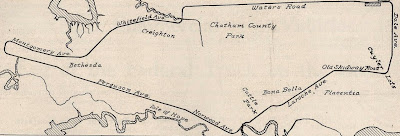
1913/14 Savannah 300 Race Course

Holding third place, Sloop had just completed the third lap when he lost control of his Harley, the same machine on which he had won the Isle of Palms Race and ran over a small embankment was hurled through the air. He broke his back, neck, hip and leg and was dead when assistance reached him.
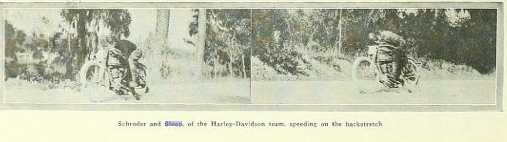
Gray Sloop (right) on the backstretch shortly before his fatal crash
Bicycling World and Motorcycle Review - December 8, 1914

Thus ended the life of the 25-year-old motorcycle racing enthusiast from Iredell County.
Motorcycle Illustrated - November 26, 1914


  The Enterprise quoted a Savannah newspaper:

  "An examination made after the race showed a broken handlebar had been the cause of the accident which cost the life of Sloop. It was found Sloop had fallen on Norwood Avenue and cracked the right side of his handlebar. On Dale Avenue the bar had cracked completely off and Sloop entered the dangerous curve at Waters Road and Estill Avenue with only the left half of the handlebar to his machine. "When he ran into the rough ground, this caused him to lose control. He was thrown from his machine and went into the air. "When descending the back of his neck struck a guy wire with such force as to cause a fracture of the neck. He then dropped between the machine and the tree. During the investigation after the race the piece of broken handlebar which had fallen from Sloop's machine was found on Dale Avenue by members of the Harley-Davidson racing stable."
  
 His death fell like a pall over his hometown. Twenty-five young men of the town met the train carrying his body from Savannah to Charlotte and from the Queen City escorted his remains home to Mooresville. His grave in Willow Valley Cemetery was covered with flowers.

Gray Sloop's Headstone
Willow Valley Cemetery - Mooresville, N.C.

   "For many years he had been the dependence of his widowed mother and his [two] sisters, and the burden of grief falls heavy upon them," reported The Enterprise, which also referred to his handsome appearance, his affable and congenial spirit, and his simple life of purity and nobility.

His racing skills and potential in the new sport were known and admired to such an extent that an article reporting his demise was carried in the New York Times

New York Times - November 27, 1914
Although his name is unknown there today, Gray Sloop was the first to make Mooresville, “Race City, USA.”

Epilogue:

Zeddie Kelly of the Savannah Motorcycle Club, sponsor of the race, lead the first five laps of the race, when he stopped for a spark plug problem.  Kelly quickly reentered the race, but was severely injured on lap nineteen, when his Harley-Davidson left the track, and struck a tree. He died of his injuries the next day and was buried at laurel Grove Cemetery in Savannah.  Kelly's death brought the death toll of the race to two, and the bad publicity in newspapers around the country, led to the cancellation of a proposed 1915 race.

Savannah's Zeddie Kelly shortly before his fatal crash
Bicycling World and Motorcycle Review December 15, 1914

Wilmington, N.C. Morning star - November 28, 1914

About the Author:

O. C. Stonestreet, is an Iredell County, North Carolina native, is a Navy Veteran and a retired public-school history and social studies teacher. He lives in Statesville, N.C., with his wife Judy, and writes a regular column for the Statesville Record & Landmark newspaper. Mr. Stonestreet is also the author of They Called Iredell County Home, which is available through Amazon.com.


References:

      "Will Enter the Big Race" Mooresville Enterprise, June 5, 1913.
      "Will Enter Big Race" Mooresville Enterprise, June 26, 1913.
      "To Be in Motorcycle Race" The Landmark, June 27, 1913.
      "An Election Next Monday" The Landmark, July 1, 1913.
      Day, Donald S., "Balke, on Indian, Wins Elgin Race" The Inter-Ocean Newspaper (Chicago, Ill.), July 5, 1913.
      "Local Briefs" Mooresville Enterprise, July 10, 1913.
      "Won First Prize and World's Championship" The Landmark, July 10, 1914.
      "Gray Sloop Accepts Challenge" Mooresville Enterprise, July 23, 1914.
      "Archie Templeton Won Motorcycle Race from Gray Sloop" Mooresville Enterprise, July 30, 1914.
      "Motorcycle Collided with Surrey" The Landmark, September 1, 1914.
      "Motorcycle and Surrey Collided" Mooresville Enterprise, September 3, 1914.
      "Gray Sloop Wins Races at Charleston" Mooresville Enterprise, September 10, 1914.
      "Killed in Cycle Race" The New York Times, November 27, 1914.
      "Met Death in Savannah" The Landmark, November 27, 1914.
      "Lee Taylor Wins Motorcycle Race" Atlanta Constitution, November 28, 1914.
      "Instantly Killed at Savannah" Mooresville Enterprise, December 3, 1914.
      Stonestreet, O. C., "Gray Sloop: A Man Ahead of His Time" Mooresville Tribune, July 13, 2005.


Attachment Sources:

Bicycling World and Motorcycle Review

Chris Price@Georgia Motorcycle History

Mooresville, N. C. Enterprise

Motorcycle Illustrated

New York Times

O. C. Stonestreet Collection

Wilmington, N.C. Morning Star


Sunday, July 06, 2014

O.V. Hunt - Birmingham's Photographer - Episode #25

July 6, 2014
Updated - May 28, 2017

By: David L. Morrill
@MototiqueRacing
Sylacauga, Alabama


O. V. Hunt (rear) and Robert Stubbs (front) - Birmingham, AL. ca. 1913
Birmingham, Alabama Public Library Archives - O.V. Hunt Collection


If you've ever picked up a book on the history of Birmingham Alabama, you have very likely seen an O.V. Hunt. photograph. Beginning in the early teens, Mr. Hunt photographed Birmingham's rapidly rising skyline, and recorded the events of daily life in the Magic City. Mr. Hunt was also a motorcycle enthusiast and recorded many significant motorcycle events held in Birmingham in the teens and twenties.

My own involvement with Mr. Hunt's photographs began, when Johnny Whitsett sent me a DVD containing scans of several of Hunt's Birmingham motorcycle event photographs, he received from one of Mr. Hunt's relatives. Over the next several years, I attempted to identify, both the events depicted, and the subjects in those photographs.

                                                                                                                                                       
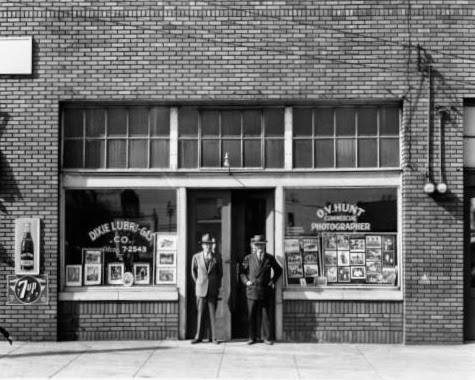
Oscar Virgil Hunt was born in Bowden, Georgia in 1881. By 1900, Hunt's family had relocated to Birmingham, Alabama, and the eighteen-year-old Hunt was working as a day laborer. In the next few years, his passion for photography, developed into a career, and he opened a photography studio on 4th Avenue North in Birmingham.  He also worked as a photographer for the Birmingham Ledger Newspaper.


O.V. Hunt Photographic Studio - Birmingham, AL.
Birmingham, Alabama Public Library Archives - O.V. Hunt Collection

Mr. Hunt developed a reputation of taking great risks to get his photographs. In 1912, climbed on to an early Biplane in the infield of the Alabama State Fairgrounds racetrack, and he took to the air above Birmingham to take aerial photos of the city. Mr. Hunt, who had mastered self-promotion, often appears in photographs taken by his firm.

Eugene "Wild Bill" Heth (left) O.V. Hunt (right)
Alabama State Fairgrounds ca. 1912
Birmingham, Alabama Public Library Archives

O.V. Hunt Collection
In July 1913, Hunt, and his camera, were suspended from a steel beam suspended from the top of the Tutwiler Hotel, which was under construction in downtown Birmingham.

Birmingham, Alabama Public Library Archives
O.V. Hunt Collection - 1913
The Alabama State Fairgrounds in Birmingham had a one-mile dirt oval racetrack, which held its first motorcycle race in 1906. Mr. Hunt was a friend of Robert Stubbs, the Birmingham dealer for the Hendee Manufacturing Company, which produced Indian Motorcycles. Stubbs, was a motorcycle racing enthusiast, having been a member of the Indian Factory racing Team.

Amateur Motorcycle Race Alabama State Fairgrounds - ca. 1912
Birmingham, Alabama Public Library Archives - O.V. Hunt Collection

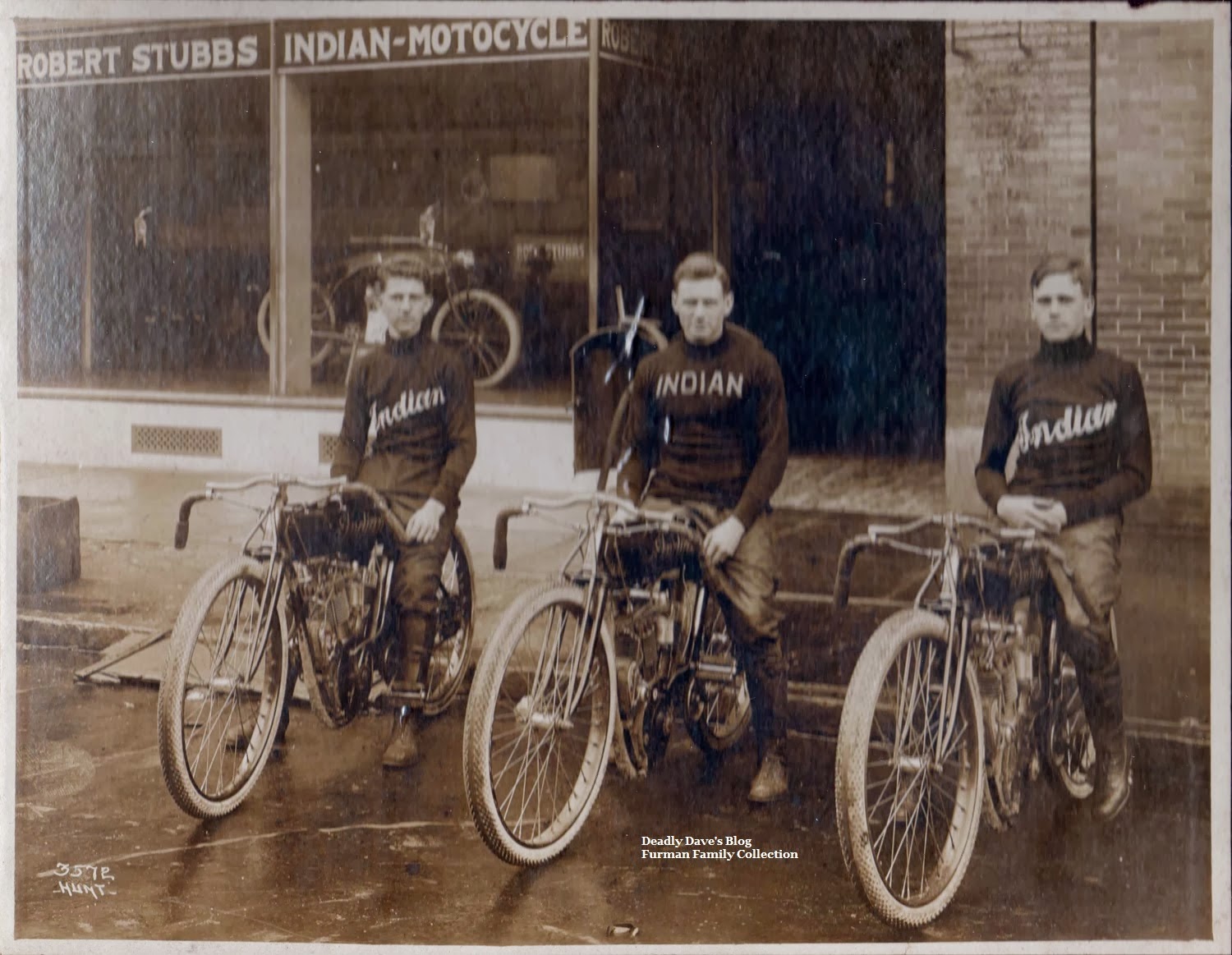
Stubbs had retired from track racing, but sponsored local riders Gail Joyce, Richard Gayle, and Eugene Walker. Joyce and Gayle were experienced riders having competed in races around the state for several years. Gene Walker worked for the Post Office delivering mail on his motorcycle, and was making a name for himself competing in races at the Fairgrounds racetrack. Stubbs riders were photographed by Mr. Hunt in front Stubbs Dealership in 1913.

Richard Gayle (left), Gail Joyce (center), Gene Walker (right)
Furman Family Collection - O.V. Hunt ca. 1913

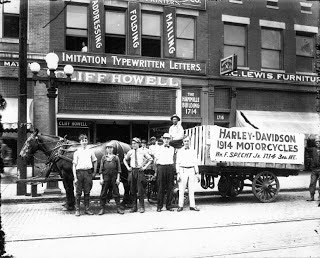
In early 1914, Hunt was hired by the new Birmingham Harley-Davidson Motorcycle dealer, William F. Specht Jr. to record the opening of his dealership at 1714 3rd Avenue North. Mr. Hunt captured the first load of ten Harley-Davidson motorcycles arriving by horse drawn wagon at Specht's dealership.

William F. Specht Jr. (far right) Specht Harley-Davidson - Birmingham, AL.
Johnny Whitsett Collection - O.V. Hunt - 1914


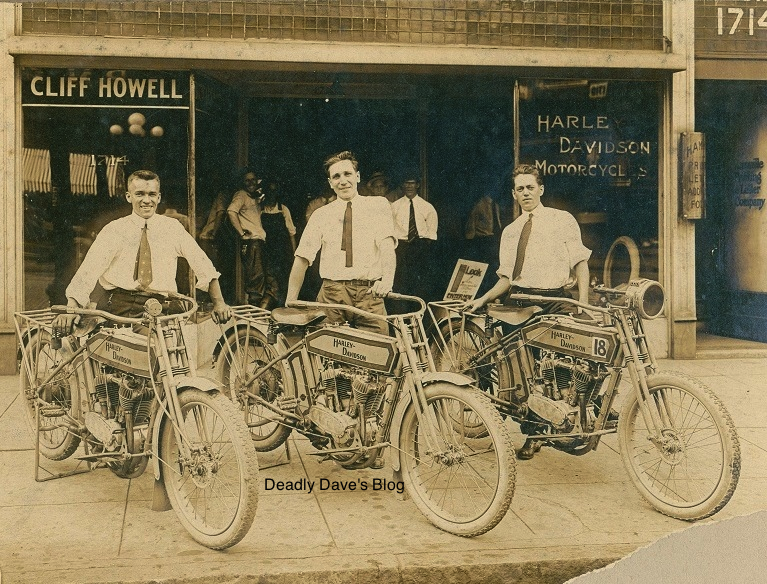
Hunt took a photograph of Harley-Davidson Racing Team members Johnny Aiken (Atlanta), Bill Specht Jr. (Birmingham), and Gray Sloop (Mooresville, NC.) in front of Specht's dealership. Sadly, Gray Sloop was killed, along with Savannah, GA. rider Zeddie Kelly, while competing in the 1914 Savannah 300 Mile Road Race.

Johnny Aiken (right), Bill Specht Jr. (center), Gray Sloop (right)
Johnny Whitsett Collection - O.V. Hunt - 1914


Interior of Specht Harley-Davidson in Birmingham, AL.
Birmingham, Alabama Public Library Archives 

O.V. Hunt Collection 1914

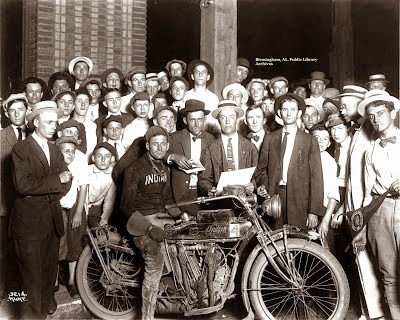
Mr. Hunt was the official photographer for the July 14, 1914, Birmingham Ledger Motorcycle Endurance Run. This grueling event took place over several days on the public roads between Birmingham and Atlanta, Georgia.  This a pre-race photograph of some of the thirty-one of race competitors in from of the Birmingham Ledger Offices in downtown Birmingham.

1914 Birmingham Ledger Endurance Run Competitors
Johnny Whitsett Collection - O.V. Hunt - 1914
The race, which was run over the next two days on the public roadways between Birmingham, and Atlanta, Georgia began at 3:00 am on the morning of July 4th. The start/finish line was in front of the Birmingham Ledger office at 1st Avenue North and 21st Street.

Start/Finish Line - Birmingham, AL. - July 1914
Birmingham, Alabama Public Library Archives - O.V. Hunt Collection

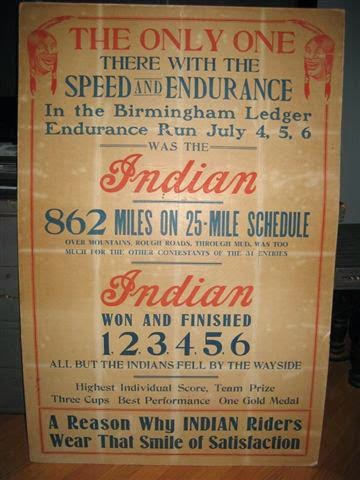
There was great controversy with the results of the1914 race, and a protest was filed by the Harley-Davidson Team. When the referee ruled against them, the Harley-Davidson team withdrew from the race leading to an Indian sweep for Robert Stubbs' Birmingham Indian race team. Team rider Gail Joyce was declared the winner.

Gail Joyce - Birmingham, AL.  - July 1914
Johnny Whitsett Collection - O.V. Hunt

1914 Indian Motorcycle Promotional Poster
Scott Bashaw Collection

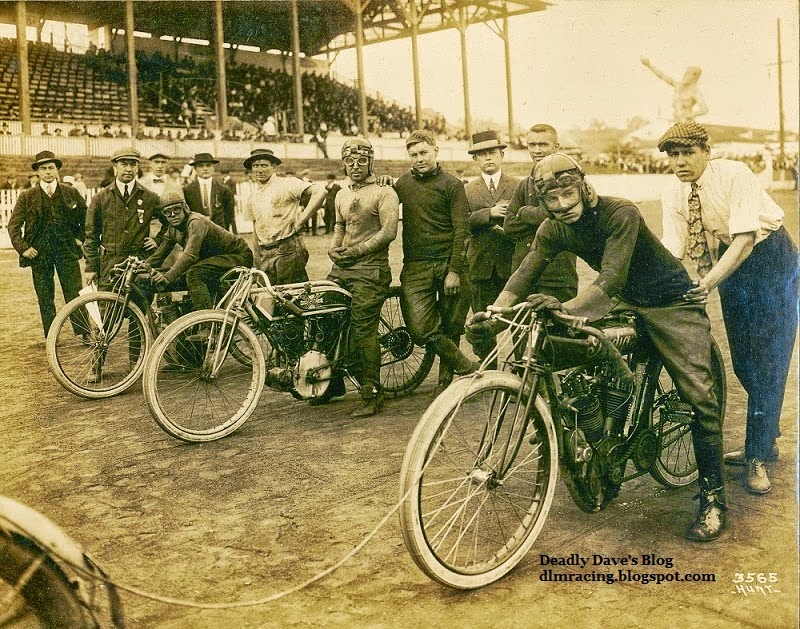
In October 1914, a race took place at the Alabama State Fairgrounds track that became an important part of Harley-Davidson's early racing history, and O.V. Hunt was there. Two of the photographs Hunt took that day have survived, and they are the only photographs of the event known to exist. The one-hour Federation of American Motorcyclists race became the Harley- Davidson Racing Teams First National Championship race win. It also launched the professional racing career of a young man from Birmingham, who became one of the greats of early American motorcycle racing.

Alabama State Fairgrounds F.A.M. One Hour Championship Race
Johnny Whitsett Collection - O.V. Hunt 1914
This starting line photograph of the Alabama State Fairgrounds racetrack shows the riders preparing to take to the track. The young man with the focused look seated on his Indian racer on the right of the photo is John Eugene Walker. This was the Birmingham natives first professional motorcycle race.

As a side not, you can see this photograph also captures the iconic Vulcan statue, buy Giuseppe Moretti, to the right of the grandstand. The Vulcan statute remained at the Fairgrounds until the 1930's, when it was moved to its current location on the top of Red Mountain and became the symbol for the City of Birmingham.


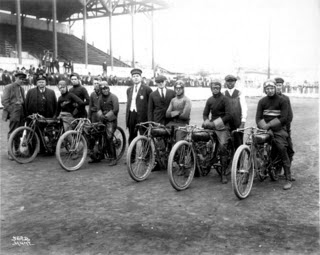
Alabama State Fairgrounds F.A.M. One Hour Championship Race
Birmingham, Alabama Public Library Archives - O.V. Hunt 1914
 

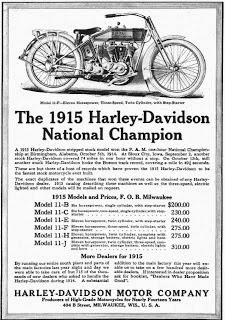
At the end of the one-hour race, Harley-Davidson's Red Parkhurst was declared the winner, with Joe Wolters finishing second, Gail Joyce finishing third, and Gene Walker fifth.  Two protests were filed, but the race results were upheld. The race went down as the newly formed Harley-Davidson Racing Team's first Championship Race win and became a key part of their advertising campaign for their 1915 model.


1915 Harley-Davidson Ad

It was also a big day for Gene Walker.  Walker briefly lead the race and set a new track lap record. This attracted the attention of the Indian Racing Team, and Walker joined their team for the 1915 racing season. Walker went on to become one of the great riders of the late teens, and early twenties.

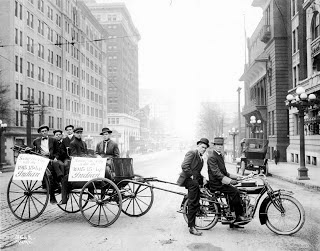
In early 1915, Mr. Hunt's firm took a publicity photo for Robert Stubbs' Indian dealership. The photograph touted the release of the 1915 Indian motorcycle and appears to have been staged as a satire of Specht's Harley-Davidson 1914 horse drawn wagon photo.

Robert Stubbs Indian Publicity Photo - Birmingham, AL.
Johnny Whitsett Collection - O.V. Hunt 1915
In this photo, Stubbs pulls a wagon full of dapper young men on a new 1915 Indian motorcycle. The message is clearly, that while Harley-Davidsons arrive in a horse drawn wagon, the new Indian can pull the wagon. O.V Hunt stands behind Robert Stubbs, who is seated on the motorcycle.

In April 1915, the second annual Birmingham Ledger Endurance Run was staged, and once again the Mr. Hunt photographed the contestants for the Birmingham Ledger.

Birmingham Ledger - April 3, 1915
O.V.  Hunt

The 1915 event also had it's share of controversy. At the end of the second days run from Atlanta to Birmingham, Harley-Davidson rider Willard DeGroat, and Indian rider Robert Horton were tied for the top horns. A third day run was scheduled as a tie breaker but was rained out. Horton failed to show for the agreed-on tie breaker, and DeGroat was award the overall win. 

Willard DeGroat - Birmingham, AL.
Jessica DeGroat Hayes Collection - O.V. Hunt 1915

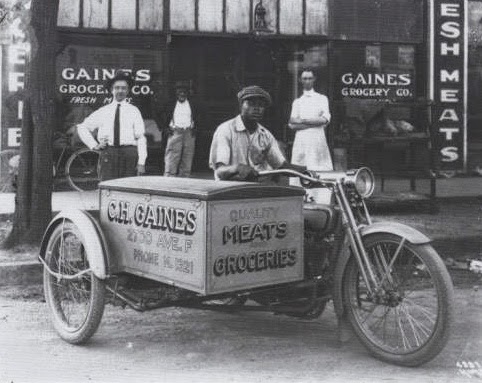
During this period, Mr. Hunt also took several photographs of sidecar equipped motorcycles. These bikes were used by local businesses to deliver goods and provide roadside assistance to stranded motorists. The riders of the bikes were often African American.

Birmingham, Alabama Public Library Archives - O.V. Hunt Collection ca. 1916

With the approach of America's involvement in World War 1, motorcycle shops across the country faced hard times. The Military purchased most of the production of new motorcycles, spare parts, and tires. These were going overseas, and motorcycle dealers across the country really felt the pinch. Many dealers found it difficult to keep their doors open. In 1917, many of the young men, who had been customers of the shops were drafted.  This was the final blow, and countless shops closed their doors.

While the Birmingham Harley-Davidson and Indian dealers remained in business through the war, big changes to the motorcycle business in Birmingham came in 1919. Robert Stubbs closed his Indian dealership and took a job managing a motorcycle shop in Montgomery, Alabama. William F. Specht Jr. returned to Atlantic City.

Gail Joyce opened the Gail Joyce Motor Company at 1709 3rd Avenue North. Although the records are sketchy, the Joyce Motor Company appears to have handled both Indian, and or Harley-Davidson sales in Birmingham during this period. Mr. Hunt continued photographing Joyce's dealership, and several motorcycle events for Joyce. After the war, motorcycles began the shift from basic transportation to recreational use. The novelty of motorcycle events faded in Birmingham.


Gail Joyce Motor Company (center) - Birmingham, AL. ca. 1931
Birmingham, Alabama Public Library Archives - O.V. Hunt Collection

On June 24, 1924, the Birmingham News reported the death of Gene Walker form injuries received while practicing for a race in East Stroudsburg, PA. During his career, Walker won 19 Championship motorcycle races, and set track records across the country. During the winters, he returned to Birmingham, where he worked as a Motorcycle Police Officer for the city. 1920, Walker set the first official motorcycle land speed record at Ormond Beach Florida.

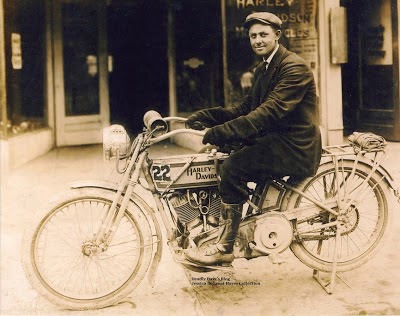
Under the headline "Motorcycle Riding Has Lost Its Greatest Star in Death of Walker" Birmingham News sports reporter Zipp Newman detailed Walker's career, and the circumstances of his death. The article was accompanied by a photograph of Walker taken by O.V. Hunt in 1913.

Birmingham News - June 24, 1924
Birmingham, Alabama Public Library Archives - O.V. Hunt ca. 1913 

The Birmingham Police Department Motorcycle Unit, and a large contingency of local motorcyclists, escorted Walker's funeral procession to Birmingham's Elmwood Cemetery. It was a fitting remembrance of the young man, who put Birmingham, Alabama on the map for sports fans across the country.


Indian Motorcycle Company's Memorial Ad - 1924

In 1934, Gail Joyce died in Birmingham. His family continued to operate the Gail Joyce Motor Company and were still the Birmingham Harley-Davidson dealer in the 1950s.

Oscar V. Hunt continued to photograph Birmingham's event's big, and small, for several more decades, retiring in 1953.  He passed away at age eighty-one in Birmingham, Alabama in 1962. His legacy to the Magic City is his photographs.

Birmingham The Magic City Sign - Birmingham, Al.
Birmingham, Alabama Public Library Archives - O.V. Hunt Collection ca. 1926
Through the time machine of his lens, O.V. Hunt instantly transports us back to the streets of Birmingham one hundred years ago, and we view can the early days of Birmingham motorcycle sport. What better legacy, could he have left us?

Sources:

Birmingham Ledger

Birmingham News

Birmingham, Alabama Public Library Archives - O.V. Hunt Collection

Clay Nordan - A Minor Mystery Solved

Chris Price - www.Georgia Motorcycle History.com

Hunt Family Collection

Jessica DeGroat Hayes Collection

Johnny Whitsett Collection

Kelly Stewart - Barber Vintage Motorsports Museum

Scott Bashaw Collection


Sunday, December 08, 2013

Atlanta's, Johnny Aiken - Episode #20

December 8, 2013
Updated - April 28, 2015

By: David L. Morrill
Deadly Dave's Blog
Sylacauga, Alabama


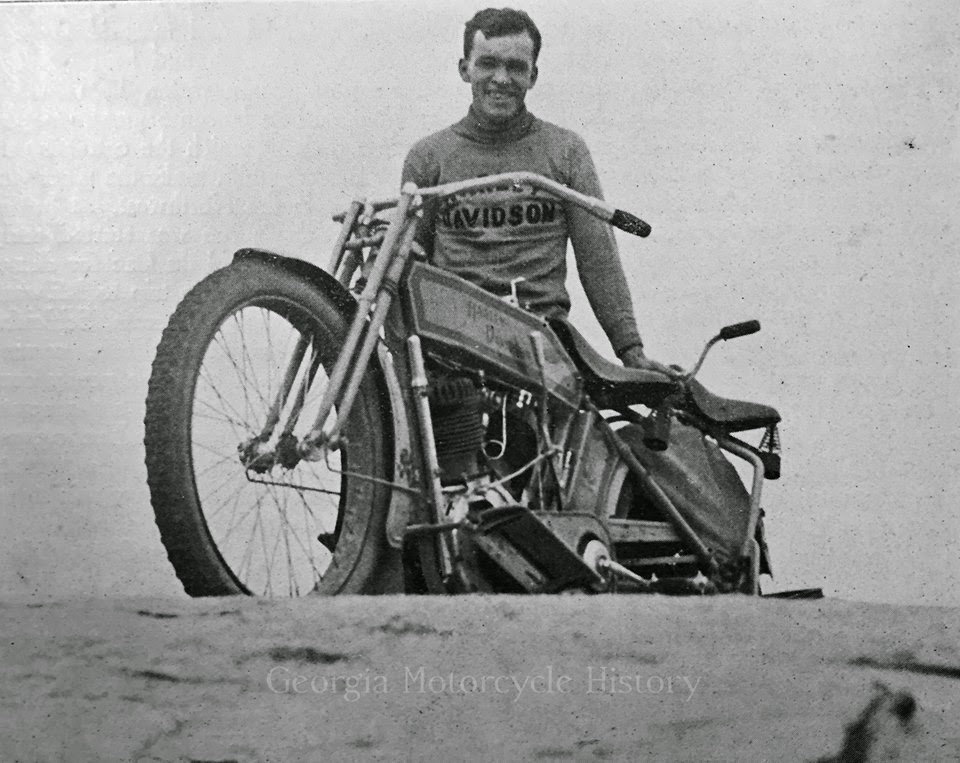
Johnny Aiken - Birmingham, AL.
O.V. Hunt 1914 - Johnny Whitsett Collection

As, I've said in other stories, my interest in early Southern motorcycling started with some old motorcycle photos taken in 1914 and 1915 by Birmingham, Al. photographer O.V. Hunt. Over the past few years, I've tried to identify many of the riders in these photos. One Harley-Davidson rider appeared in several photos, and I was finally able to identify him, as Atlanta Harley-Davidson dealer/racer Johnny Aiken. Since Johnny played a part in many of these stories, it's time to share his part in early Southern racing history.

John D. Aiken was born in North Dakota in 1887. When and why, he came to Atlanta, Georgia, has been lost to time, but by the early teens he was living in Atlanta, and was a dealer for Thor and Jefferson motorcycles.

In August 1913, word got out that the Atlanta Motordrome was planning a race for black riders. On September 5, 1913, the planned race was the subject of a full page highly critical article under the headline was "Dealers Condemn Atlanta's Colored Races" in Motorcycling magazine.

Motorcycling - September 5, 1913
Scott Bashaw Collection

The article quoted local Atlanta Harley-Davidson dealer Gus Castle, and Johnny Aiken.  Aiken's stated:
"Except that it will popularize motorcycling among Negros and in that way cheapen the sport in the eyes of white men."
After holding the race on October 28, 1913, the tracks race sanction was withdrawn, which caused the track to close, and file for bankruptcy.

1913 Savannah 300 Road Race

Johnny Aikens first appears in the early motorcycle press, as a competitor in the 1913 Savannah 300 Mile Road Race. For some reason early in his career, the S was removed from the end of his name in many early newspaper reports. This continued through most of his motorcycle racing career.

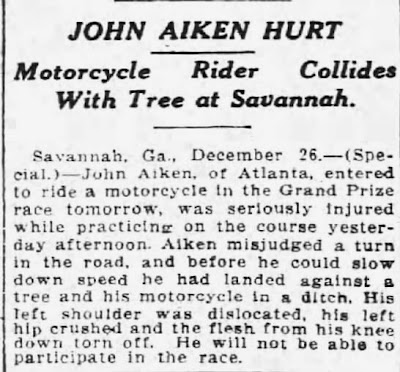
The Savannah 300 was a grueling 5-hour race, held on part of the old Grand Prize Auto Racing Course, used 11 miles of public roads outside Savannah, Georgia.  Aiken was one the riders representing Harley-Davidson. During one of the practice sessions, Aiken was thrown from his motorcycle, and crashed into a tree. His injuries kept him from competing in races for the next several months.

Atlanta Constitution - December 27, 1913

By 1914 Johnny Aiken had gone to work for Gus Castle's as a salesman at the Harley-Davidson Southern Branch at 224 Peachtree Street in Atlanta.

Atlanta Constitution - 1914


Georgia Endurance Runs

While recovering from his Savannah injuries, Aiken became involved in promoting motorcycle endurance runs in Georgia as a member of the Atlanta Motorcycle Club. These races were generally run between major cities on the public roads, with daily runs lasting 5 to 6 hours. By March 1914, Aiken had recovered sufficiently to also compete in the races.

Atlanta Constitution - March 22, 1914

Aikens, riding a Harley-Davidson, was one of only four riders of the original 33 entrants to complete the March 1914 run. Aiken was also mentioned in an Atlanta Constitution article on the upcoming Memorial Day Endurance Run.

Atlanta Constitution - March 29, 1914


Atlanta Harley-Davidson Dealer

Aiken was also a very successful Harley-Davidson dealer. His notoriety, as one of the top endurance riders in the south, drew many customers to the Peachtree Street dealership causing sales to soar. An early example of "Win on Sunday, Sell on Monday."


Atlanta Constitution - April 5, 1914

Aiken continued his endurance riding, when time allowed.


Atlanta Constitution - April 12, 1914
                
The 1914 Stone Mountain Run

In late April 1914, Johnny Aiken made a run up Georgia's Stone Mountain on a Harley-Davidson V twin. This was said to have been the first time a gasoline powered vehicle made it to the top of Stone Mountain's extremely steep 50% grade. The Atlanta Constitution article on the event did not identify the rider as Johnny Aiken.


Johnny Aiken - Stone Mountain, Georgia
Chris Price@Georgia Motorcycle History
Atlanta Constitution - April 26, 1914

 The 1914 Birmingham Ledger Endurance Run

In April 1914, the Birmingham Ledger Newspaper announced they would be sponsoring a Motorcycle Endurance Run from Birmingham, Al. to Atlanta, GA., and back. The race was billed as the Southern Championship Race. It started at the Ledger Office in downtown Birmingham at 4 am on July 4th. Aiken was one of the riders selected by Harley-Davidson to ride for them in the race.

Atlanta Constitution - June 14, 1914

O.V. Hunt photographed a group of the Harley-Davidson and Indian riders entered in the Ledger Endurance Run in front of the Birmingham Ledger Office as part of the pre-race publicity. Johnny Aiken is the Harley-Davidson rider at the far left of the photo.

O.V. Hunt 1914 - Johnny Whitsett Collection

At the end of the first day's 211-mile leg from Birmingham to Atlanta, Aiken was one of eight Harley-Davidson riders to arrive in Atlanta, with a perfect score. A controversy arose on the next day's return leg to Birmingham. The Harley-Davidson Team accused the Indian Team of using trained mechanics, who followed their riders in an automobile, and assisted their riders with needed repairs.

A protest was filed, which Harley-Davidson lost. Harley then withdrew their riders from the final legs of the race. Harley claimed they won the race, and ran several ads, which appeared in newspapers around the country.

Atlanta Constitution - May 3, 1914


With the withdrawal of the Harley-Davidson Team, Indian rider Gail Joyce won the race, and his Indian teammate, Gene Walker, finished 2nd.


The 1914 Birmingham F.A.M. Championship Race


In October 1914, Johnny Aiken, and his friend William F. Specht, Jr. played a small, but important part in an important event in the Harley-Davidson Racing Team's early history.

Prior to 1914, Harley-Davidson had limited it's racing to mostly endurance runs, and hill climb competitions. These events required production motorcycles, which were available to the general public. Harley felt these races were a better marketing tool for the strength and endurance of their motorcycles. They avoided the costly dangerous world of professional track racing popular at the time. These board, and dirt track races, required special purpose-built racing machines in the hands of the best professional riders of the era.

Harley reversed course, in 1914. They built special 11-K racers and hired several professional riders to ride them. Their first major race was the Dodge City 300 Mile Road Race. The July 4th race did not go well for Harley, and mechanical problems forced most of the bikes to retire. The Harley Team returned to Milwaukee and re-evaluated their racing efforts.

In October, Harley dispatched a single factory rider, Red Parkhurst, to Birmingham, Alabama for the F.A.M. One Hour Championship Race. They also supplied riders, Johnny Aiken, and Arthur Mitchell, the new Harley racers through the Birmingham dealer. Aiken suffered mechanical problems, and did not compete in the Championship race, but he and William F. Specht, Jr. acted as Parkhurst's pit crew for the Championship race.

Johnny Aiken - William F. Specht Jr. - Gray Sloop 
 Specht Harley-Davidson - Birmingham, AL.
O.V. Hunt 1914 - Johnny Whitsett Collection

The pre-race activities at the Alabama State Fairgrounds Raceway in Birmingham were captured by local photographer O. V. Hunt. In the photo below, Birmingham's Gene Walker on his Indian 8 Valve racer, is on the far right. Johnny Aiken is seen with his arms crossed standing behind, and to the left, of Gene Walker. This was Walker's first professional race, and O. V. Hunt was a close friend of Walker's sponsor, Birmingham Indian dealer Robert Stubbs.

Alabama State Fairgrounds Raceway - Birmingham, AL.
O. V. Hunt 1914 - Johnny Whitsett Collection

Walker led the first few laps of the race and set a new track record. Parkhurst later took the lead and won the race.  Joe Wolters on an Excelsior finished second, while Gail Joyce finished third, and Walker fifth on Indians.

After the race, protests were filed by both Joe Wolters of the Excelsior Team, and Walker's Indian teammate Gail Joyce, who finished fourth.  Wolters claimed he had been shorted a lap and had actually won the race. A later check of the scoring revealed Wolters had been scored correctly. It was also found his protest had not been filed in a timely manner, and it was dismissed.  Gail Joyce claimed Parkhurst had received assistance from a spectator in cleaning his goggles during a pit stop.

The investigation into Joyce's protest stated, that Johnny Aiken, and Bill Specht, were refueling Parkhurst's bike during the pit stop. Parkhurst attempted to clean his dirt caked goggles, with a handkerchief, which was tied to his handlebars. He asked a spectator to borrow a clean handkerchief, and the excited spectator, helped Parkhurst in clean his goggles.

The F.A.M., who sanctioned the race, determined the spectator had provided a clean handkerchief to Parkhurst, and assisted him with cleaning his glasses. They ruled Parkhurst needed to see to race safely and dismissed Joyce's protest. This was the Harley-Davidson Racing Team's first Championship Race win.


1914 Savannah 300


The Savannah 300 was scheduled for Thanksgiving Day 1915. Harley-Davidson announced they were sending a full team of riders to compete in the race. Maybe it was the more experienced competition, or the memory of his painful injuries he sustained in the 1913 race, but Johnny Aiken decided not to enter the race.

Aiken's friend, Mooresville, NC. Harley-Davidson dealer Gray Sloop was chosen for the Harley-Davidson Team. Gray Sloop appears in the O.V. Hunt photo taken in front of the the Birmingham Harley-Davidson dealership in 1914, along with Aiken, and Specht.

Sadly, in an accident eerily similar to Johnny Aiken's 1914 crash, Sloop Gray was thrown from his bike at high speed on the second lap of the race. Gray stuck a tree and was instantly killed. Later in the race another of Aiken's friends, Savannah ride Zeddie Kelly, also hit a tree, and was severely injured. He died in the hospital the next day.

Gray Sloop
O. V. Hunt - Johnny Whitsett Collection

New York Times - November 27, 1914

1914, was the final year for the Savannah 300 Mile Race. Accounts of the deaths in the race appeared in newspapers around the country. The Savannah City Fathers cancelled any further motorcycle races on the course.

Wild and Woolly Georgia - 1915

In March 1915, Johnny Aiken, and five other riders, were involved in an event, none would forget. They were on their regular 150 ride, when a local farmer accused them of frightening his mule. The farmer pulled a gun on them and forced each of them to cough up five dollars in compensation. Motorcycling in Georgia back then, could be a very dangerous business!


Atlanta Constitution - March 30, 1915

The 1915 Birmingham Ledger Cup Race

The 1915 Birmingham Ledger Cup Endurance Run would take place on Easter Sunday. The race would follow the same course between Birmingham and Atlanta as the 1914.  Once again, Johnny Aiken was one of several riders representing Harley-Davidson in the race. When the first day's run to Atlanta was finished, Aiken was one of 22 riders with a perfect score.

Atlanta Constitution - April 5, 1915

Aikens's time of 5 hours and 30 minutes broke the previous record by 30 minutes. Aiken's Harley-Davidson teammate, W. E. DeGroat of Birmingham, took the overall win in the race, and claimed the Birmingham Ledger Cup.

Atlanta Constitution - April 11, 1915


World War I

As the United States became involved in World War 1, Johnny Aiken enlisted in the Army. His skills as both a motorcycle rider, and mechanic, were badly needed by the Army's Motorcycle Dispatch Unit. First Lieutenant John Aiken, served in a Motorcycle Dispatch Unit overseas from March 1918 until August 1919. He was then assigned to Camp Jesup, GA. Lt. Aiken was honorably discharged at the end of January 1920.

Automobile Racer

Upon his return to Atlanta, Johnny Aiken went to work at the Dodge Brothers garage. Aikens also began to race a Dodge race car on the one-mile oval dirt track at Atlanta's Lakewood Speedway.

Atlanta's Lakewood Speedway

Atlanta Constitution - August 6, 1921

Bob Luton. Glenn, who was also Atlanta's Indian Motorcycle dealer, had started racing cars in 1918, but continued to ride motorcycle races at the Speedway.

Atlanta Constitution - June 16, 1918

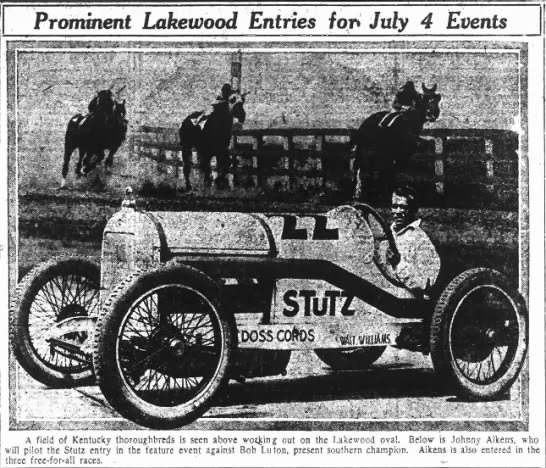
Aiken, Glenn, and Luton would compete against each other in automobile races for the next several years. In July 1922, a photo of Aiken at the wheel of the Stutz racer he was going to drive at the Speedway appeared in the Atlanta Constitution.

Atlanta Constitution - July 2, 1922

Aiken won the five-mile race, on July 4th, but was involved in a crash with fellow competitor Joe Lancaster, in which his car's rear axle was bent, and was unable to complete the race.

Atlanta Constitution - July 5, 1922


In September 1922, a match race was scheduled at Lakewood Speedway pitting Johnny Aiken against his rival Bob Luton. The race consisted of three heat races and The American Legion, who was sponsoring the day's events, put up a $1000. winner takes all purse.

Atlanta Constitution - October 15, 1921

Atlanta Constitution - September 10, 1922

Luton won the first three lap race, and Aiken won the second race. When the dust settled on the final race, Johnny Aiken crossed the finish line first, and walked away with the $1000. purse.

Atlanta Constitution - September 18, 1922


Epilogue:

After his automobile racing career, Johnny Aiken owned and operated an automotive garage in Atlanta for many years. He passed away in Atlanta in May 1973, at the age of 86.

Sources:

Ancestry.com

Atlanta Constitution

Birmingham, Alabama Public Library Archives

Chris Price@Georgia Motorcycle History

Johnny Whitsett Collection

Newspapers.com

New York Times