Gustave Eiffel, his Tower and the Statue of Liberty

On 15 December, in 1832 an extraordinary French civil engineer and architect was born: this was Alexandre Gustave Eiffel.

Eiffel was a graduate of the École Centrale des Arts et Manufactures of Paris, and he made a name with various bridges for the French railway network, most famously the Garabit viaduct.

He is best known for the world-famous Eiffel Tower, built for the 1889 Universal Exposition in Paris, France. The design of the Eiffel Tower was originated by Maurice Koechlin and Emile Nouguier, who had discussed ideas for a centerpiece for the Expo. And since May 1884 that Koechlin, working at his home on an outline drawing of their scheme until the beginning of 1886 very little happened. On 12 May of the same year a commission was set up to examine Eiffel’s system and its competitors and on 12 June it presented its decision, which was that only Eiffel’s proposal met their requirements. After some arguments about the exact site for the tower, a contract was signed on 8 January 1887.

eiffel

The tower had been a subject of some controversy, attracting criticism both from those who did not believe it is feasible and from those who objected on artistic grounds and looks.

But before that, in 1881 Eiffel was contacted by Auguste Bartholdi who ha a need of an engineer to help him to realize another huge order, this time from the other side of the Atlantic, the Statue of Liberty. Eiffel was nominated because of his already involvement with wind stresses. Eiffel invented a structure consisting of a four-legged pylon to support the copper sheets that they made up the body of the statue. The entire statue was created at the Eiffel works in Paris before being pull to pieces and shipped to the United States.

Eiffel is a star through his extraordinary engineering works he accomplished in his time. This tower finally became the symbol of Paris and a huge touristic attraction for the whole France! Let’s go to the top guys and gals!

Some paper ideas from the same date from the past!

KO for eCharta

On Wednesday for a Saturday Night Fever!

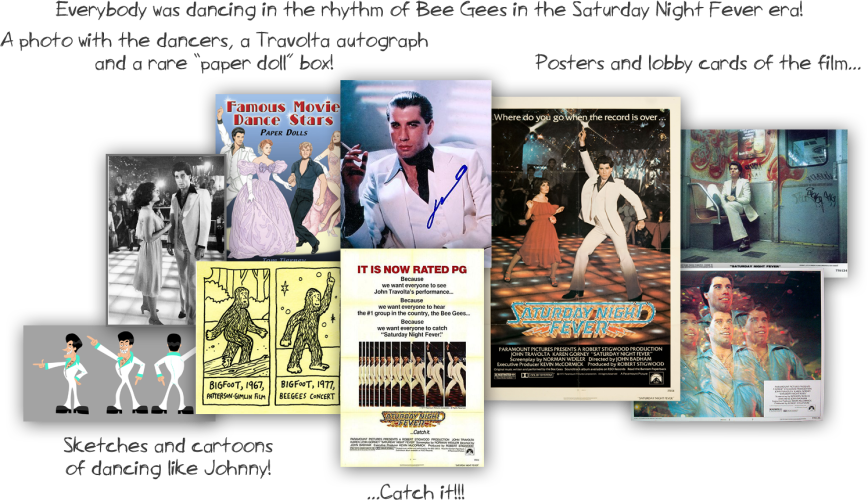
On Wednesday and not on Saturday 14 December, in 1977 premiered the big hit dance film Saturday Night Fever!

saturdayNightFevermickeyThe film was directed by John Badham and starring John Travolta as Tony Manero, an adolescent young man whose weekends are spent visiting a local Brooklyn discotheque (night club of the time); While in the disco, Tony is the king.

This dance care-free weekend helped Tony to forget the problems of his real life. No job, racial pulls in the local community, his links with the neighborhood gang of macho friends, and of course the continued fights with his uncooperative and backbiting parents.

This film because of its huge commercial success, was the reason of popularizing disco music around the world and made Travolta a big name. The soundtrack of the film featuring disco songs by the Bee Gees, is one of the best-selling soundtracks of all time.

fever

The film also showcased new “entries” in the film music culture: symphony-orchestrated melodies, haute-couture clothing, and beautiful choreography. The story is based upon a 1976 New York magazine article by British writer Nik Cohn. In the late 1990s, Cohn acknowledged that the article had been fabricated.

Let’s dance folks in the Bee Gees rhythm! On a Saturday night of course!

Some paper ideas from the same date from the past!

KO for eCharta
An American in Paris by George Gershwin!

Some Parisian taxi horns were blowing on December 13, 1928 in New York! It was in the Carnegie Hall premiere of George Gershwin’s symphonic tone poem An American in Paris”.

Gershwin completed the orchestration on November 18, less than four weeks before the work’s premiere! He composed An American in Paris on commission from the New York Philharmonic. He scored the piece for the standard instruments of the symphonic orchestra plus celesta, saxophones, and automobile horns. That explains the Parisian taxi horns in premiere!

Gershwin on the original program notes, noting that: “My purpose here is to portray the impression of an American visitor in Paris as he strolls about the city and listens to various street noises and absorbs the French atmosphere.” And when the tone poem moves into the blues, he explains “our American friend … has succumbed to a spasm of homesickness.” But, “nostalgia is not a fatal disease.” The American visitor “once again is an alert spectator of Parisian life” and “the street noises and French atmosphere are triumphant.”

american_paris

Gershwin based An American in Paris on a melodic piece called “Very Parisienne”, written in 1926 on his first visit to Paris as a gift to his hosts, Robert and Mabel Schirmer. Gershwin explained in Musical America, “My purpose here is to portray the impressions of an American visitor in Paris as he strolls about the city, listens to the various street noises, and absorbs the French atmosphere.”

In 1951, MGM released the musical An American in Paris, featuring Gene Kelly and Leslie Caron. Winning the 1951 Best Picture Oscar and numerous other awards, the film was directed by Vincente Minnelli.

A part of the symphonic composition is also featured in the film starring Jack Nicholson As Good as It Gets, released in 1997.

Some paper ideas from the same date from the past!

KO for eCharta

With few wise words Joe DiMaggio announced his retirement

“When baseball is no longer fun, it’s no longer a game, and so, I’ve played my last game.”

With these words Joe DiMaggio announced his retirement on December 11, 1951.

A three-time MVP winner and 13-time All-Star, DiMaggio is the only player to be selected for the All-Star Game in every season he played. During his thirteen years with the Yankees, the club won ten American League pennants and nine World Series championships. He is perhaps best known for his 56-game hitting streak (May 15 – July 16, 1941), a record that as of today still stands. DiMaggio was inducted into the Baseball Hall of Fame in 1955.

joe-dimaggio2

DiMaggio made his major league debut on May 3, 1936, batting ahead of Lou Gehrig. The Yankees had not been to the World Series since 1932, but they won the next four Fall Classics. In 1939, DiMaggio was nicknamed the “Yankee Clipper” by Yankee’s stadium announcer Arch McDonald, when he likened DiMaggio’s speed and range in the outfield to the then-new Pan American airliner.

In January 1937, DiMaggio met actress Dorothy Arnold. They married at San Francisco’s St. Peter and Paul Church on November 19, 1939, as 20,000 well-wishers jammed the streets. Their son, Joseph Paul DiMaggio III, was born at Doctors Hospital on October 23, 1941. In the September 1949 issue of SPORT magazine, Hank Greenberg said that DiMaggio covered so much ground in center field that the only way to get a hit against the Yankees was “to hit ’em where Joe wasn’t.” On February 7, 1949, DiMaggio signed a record contract worth $100,000 and became the first baseball player to break $100,000 in earnings.

joe-dimaggio

Marilyn Monroe? Yes of course! According to her autobiography, Marilyn Monroe originally did not want to meet DiMaggio, fearing that he was a stereotypical arrogant athlete! Their marriage was filled with “violence”. One typical forceful incident occurred immediately after the skirt-blowing scene in The Seven Year Itch, the very known Marilyn’s pose. The couple had a “yelling battle” in the theater lobby. A month later, she filed for divorce on grounds of mental cruelty. That was exactly 274 days after the wedding.

DiMaggio was a heavy smoker for much of his adult life. After a lung cancer operation he returned to his Florida home on January 19, 1999, where he died on March 8.

Joe, “Joltin’ Joe” or “The Yankee Clipper” was an american baseball hero. You can find tones of memorabilia about him. And people love them!

Some paper ideas from the same date from the past!

KO for eCharta

Spartacus, Vincent van Gogh, General George Patton or …Kirk Douglas?

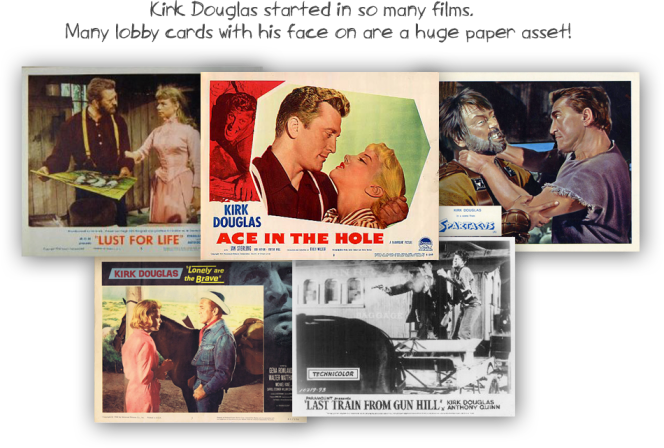
One of the legendary Hollywood “Gold Era” actors was born today December 9, in 1916!

Douglas was born Issur Danielovitch in Amsterdam, New York. His mother Bryna “Bertha” (née Sanglel) and his father Herschel “Harry” Danielovitch, a businessman were Jewish immigrants from Gomel, Belarus.

His family was poor and as a boy Douglas sold snacks to mill workers to gain some money to buy milk and bread. Later, he delivered newspapers and worked at more than forty jobs before becoming an actor. During high school, he acted in school plays, and discovered “The one thing in my life that I always knew, that was always constant, was that I wanted to be an actor.”kirk douglas

Douglas grew up as Izzy Demsky (one of his father’s brother adopted this name when moved to the States before them) and legally changed his name to Kirk Douglas before entering the Navy during World War II.

After the war, Douglas returned to New York City and found work in radio, theater, and commercials. Lauren Bacall helped him get his first screen role in the Hal B. Wallis film The Strange Love of Martha Ivers in 1946. Wallis was on his way to New York to look for new talent when Bacall suggested to go and see Douglas, who was rehearsing a play called The Wind Is Ninety. Douglas after the play’s run and, with no follow-up work in sight, headed to Hollywood. He was immediately cast in one of the leading roles in Wallis’ film and his immense Hollywood fate just started!

kirk douglas lobby cards

Douglas married twice. The first marriage was with Diana Dill, in 1943. The couple had two sons, the known actor Michael Douglas and producer Joel Douglas. They divorced in 1951. Then he married German American producer Anne Buydens in 1954. They had two sons, producer Peter Douglas and actor Eric Douglas who died young.

kirk douglas posters

In February 1991, Douglas survived a helicopter crash in which two people died. This led Kirk, after much study, to embrace the Judaism in which he was raised. He documented this long spiritual journey in his book Climbing the Mountain: My Search for Meaning (2001).

An impressive career from an impressive man! Keep walking Mr. Kirk Douglas! And happy birthday…

Some paper ideas from the same date from the past!

KO for eCharta

Duke in Cotton Club Premiere!

In 1927, a band started to perform at Harlem’s Cotton Club. With a weekly radio broadcast, famous white clientele nightly poured in to see them. The Band belonged to young Duke Ellington and the first night at Cotton Club was on December 4, 1927!

Edward Kennedy “Duke” Ellington, this American composer, pianist, and big-band leader wrote over 1,000 compositions. According to Bob Blumenthal’ s of The Boston Globe opinion, “In the century since his birth, there has been no greater composer, American or otherwise, than Edward Kennedy Ellington.” A major figure in the history of jazz, Ellington’ s music stretched into various other genres, including blues, gospel, film scores, popular, and classical.

Duke-Ellington

In Cotton Club period “Duke Ellington and his Kentucky Club Orchestra” grew to a ten-piece organization; they developed their own sound by displaying the non-traditional expression of Ellington’ s provisions, the street rhythms of Harlem, and the exotic-sounding trombone snarls, high-squealing trumpets, and muggy saxophone blues licks of the band members.

Amazing Duke!

Some paper ideas from the same date from the past!

KO for eCharta

Maria Callas: La Divina!

Maria Callas, was an American-born in New York City from Greek parents soprano and one of the most famous opera singers of the 20th century.

That day the calendar was on December 2, 1923.

Callas combined an imposing bel canto performance, a wide-ranging voice and great dramatic gifts. She was a tremendously adaptable singer, and she performed a repertoire ranged from classical opera to the bel canto operas! She sung Donizetti, Bellini, and Rossini further, to the works of Verdi and Puccini; and, in her early career, to the music dramas of Wagner. Her extraordinary musical and theatrical talents led to her being hailed as La Divina.

She was raised by an overbearing mother; she received her musical education in Greece and established her career in Italy. Forced to deal with the constraints of wartime poverty and with myopia that left her nearly blind onstage, she endured struggles and scandal over the course of her career. She turned herself from a heavy woman into a graceful and glamorous one after a weight loss, which might have contributed to her vocal decline and the premature end of her career.

callas

The press exulted in publicizing Callas’s supposedly temperamental actions, her supposed rivalry with Renata Tebaldi and her love affair with Greek tycoon Aristotle Onassis. Her dramatic life and personal tragedy have often overshadowed Callas the artist in the popular press.

However, her artistic accomplishments were such that Leonard Bernstein called her “The Bible of opera”!

Some paper ideas from the same date from the past!

KO for eCharta
Bingooooo!

Bingo, the famous paper game can be traced back to a lottery game called “Il Giuoco del Lotto d’ Italia” played in Italy in c.1530. In the nineteenth century, Bingo was widely used in Germany for educational purposes to teach children spelling, animal names, and multiplication tables. The game was involved…

Hugh J. Ward standardized the modern game called Beano then, at carnivals in and around the Pittsburgh and Western Pennsylvania areas in the early 1920s.

The game was further popularized when at a traveling carnival near Atlanta in December 1929, toy merchandiser Edwin Lowe noticed how engaged the players were of a Beano game using Ward’s rules and dried beans, a rubber stamp, and cardboard sheets.

It was the 1st of December, 1929.

bingoHis friends loved the game. One theory on the origin of the name is that one of his players made bingo history when he was so excited to have won that he yelled out “Bingo” instead of “Beano”. The Lowe produced Bingo Game with two versions; the first a 12-card set for $1.00, the second a $2.00 set with 24 cards. Bingo was a wild success. By the 1940s Bingo games were all over the country. Lowe had many competitors he requested that they pay $1.00 a year to conduct the games and to use the name Bingo!

Some paper ideas from the same date from the past!

KO for eCharta

Polaroid captured human moments instantly

The instant camera is a type of camera that generates a developed film image. The most popular types to use self-developing film were formerly made by Polaroid Corporation.

Polaroid Corporation is an American-based international consumer electronics and eyewear company, originally founded in 1937 by Edwin H. Land. It is most famous for its instant film cameras, which reached the market in 1948, and continued to be the company’s flagship product line until the February 2008 decision to cease all production in favor of digital photography products.

On November 27, 1948 the 1st Polaroid camera sold!

Then the colossal story of this magnificent, human moment “recorder” began to reflect instantly upon billion small pieces of paper!

Some paper ideas from the same date from the past!

KO for eCharta

Baby Face Nelson

Lester Joseph Gillis was born on December 6, 1908. He was known under the pseudonym George Nelson and he was a bank robber and murderer in the 1930s. Gillis was better known as Baby Face Nelson, a name given to him due to his youthful look and his small stature. He was usually referred by criminal associates as “Jimmy”.  Nelson entered into a partnership with John Dillinger, helping him escape from prison in the famed Crown Point, Indiana Jail escape, and was later considered along with the remaining gang members as public enemy number one.

Nelson was blamable for the murder of several people, and has the uncertain distinction of having killed more FBI agents in the line of duty than any other person. Nelson was shot by FBI agents and died after a shootout often called “The Battle of Barrington”. The Barrington gun battle exploded as Nelson, with Helen Gillis and John Paul Chase as passengers, drove a stolen V8 Ford South towards Chicago on State Highway 14.

The date was November 27, 1934 in a street in Barrington outside of Chicago.

Some paper ideas from the same date from the past!

KO for eCharta