
I’m continuing my read-through of every Nebula-nominated novel, having already completed my reading of all the Hugo nominated novels. I present my reviews, a grade for each, and my own pick for the winner each year.
The Gods Themselves by Isaac Asimov (Winner)- Grade: B-
Another proof that Asimov is capable of at least somewhat interesting characters. The first part of the story is the most compelling, as an apparently free source of energy is revealed to have dire consequences and pretty much nobody cares. Free energy is free, right? So who cares if everyone will die billions of years in the future? It’s the exact kind of reasoning that would probably be used, to the end of us all. But that dire feeling is mostly lost at the end of the book as Asimov changes its tone into a kind of future look at human colonization of the moon and the problems that might face. Yes, there are still references to the earlier portions of the book, and the solutions offered are interesting, but it lost something of the truly bleak and all-too-reasonable feel of the beginning chapters.
The Book of Skulls by Robert Silverberg- Grade: B
I feel extremely torn about this book. It has some of Silverberg’s best (that I’ve read, anyway) atmospheric writing. He writes with whit and foreboding, sometimes together, often apart. But it is also filled with some really awful comments about women, disabilities, and more. As is often the case, it’s difficult to tell whether these last aspects are all truly representative of Silverberg’s view, or whether they are his own satirical attack on the same. If the former, I would downgrade the book significantly. If the latter, it hovers maybe a touch higher. For better or worse, The Book of Skulls is a book that is still making me think about it, weeks after reading it. It has staying power, and it wriggles its way under your skin. It’s strange, compelling, repulsive, alluring, haunting, disturbing–it needs a lot of adjectives to describe it! I’d recommend it to readers who want to dig deeply into New Wave sci-fi, warts and all.
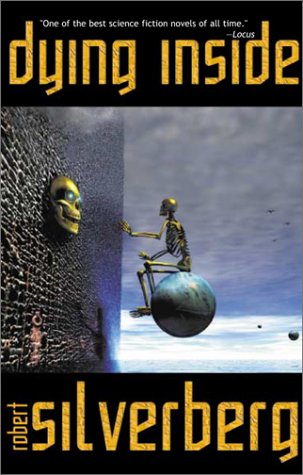
Dying Inside by Robert Silverberg (My Winner)- Grade: A+
Considered Silverberg’s masterwork by many, I initially read this book at the beginning of my attempt to appreciate older science fiction and this is definitely not the book I would recommend to try to sell someone on vintage sci-fi. It’s dense. The prose is awkward at times. It doesn’t have the bells and whistles that at lot of people tend to expect when they hear “science fiction.” My first read of this was a disaster. I didn’t catch any of its themes. I didn’t really understand it at all. Since then, I’ve grown in appreciation of older science fiction and of Silverberg in particular. On a third reading, now, I finally understood some of its core themes. In particular, that of “Dying Inside.” This is truly a haunting tale about loss that everyone experiences, set in the mind of a telepath who is losing his abilities. The main problem I had the first time reading the book is that the main character isn’t particularly likable–he’s not. But when considered in light of this central interpretation–as a kind of metaphor or allegory of loss through aging or other loss, it becomes transformed into a thing of beauty. It haunts me. Dealing with my own loss recently, it helped me reflect on that more and come to see some of the light at the end of the tunnel. I loved this book. Give it a try… or three.
The Iron Dream by Norman Spinrad- Grade: A-
The premise of this one is incredibly important: the central idea of the novel is that Adolph Hitler’s rise to power failed and he self-exiled to the United States where he became a pulp science fiction novel. In this book, we’re reading Hitler’s “greatest” novel, Lord of the Swastika, framed by an invented critical review of the invented novel. The novel–Hitler’s, that is–is terrible, and purposely so. But Spinrad manages to walk that very fine line of intentionally writing something poorly in a thought-provoking manner so that it achieves its purposes, and it largely does. The “hero” of Lord of the Swastika is a trueman, whose genetic lineage marks him as one of the few remaining true humans in a land full of “mongrels”–animalistic humanoids who can barely lift their knuckles off the ground. The entire novel–the fictitious novel–is so over-the-top in its fascistic and racist sincerity that it becomes a mockery of its themes–the very thing Spinrad was trying to achieve. When we finally get the framing narrative of the critical review, Spinrad hammers it home, eviscerating Hitler’s fascism and phallic tendencies while also assassinating his character in other ways. It’s a masterful satire, and seems to be in the same vein as Spinrad’s Bug Jack Barron, which I found much less successful. Here, because of the idiot-proofing (yes, me being the idiot here) framing devices, the satire hits home more effectively. The novel-within-a-novel does overstay its welcome. Readers will get the basic points pretty quickly. But that the book is overlong doesn’t take away its forceful critique not only of fascism but also of science fiction fandom’s tendencies to forgive the same.
The Sheep Look Up by John Brunner- Grade: A
Brunner is in his element in this kaleidoscopic, dystopic novel of rampant consumerism and climate emergency. Brunner wasn’t necessarily trying to be predictive here; instead, like some of his other novels (eg. Stand on Zanzibar), the point seems to lean more towards that of warning. Nevertheless, it’s hard not to observe the predictive moments here, and also the impending sense of doom that readers today may feel that perhaps wasn’t quite as immediate 50 years ago. There’s barely a central plot here, as the story is told through a number of vignettes, told over the course of a year, through various methods of storytelling. (Side note: because of the style of telling the story both this and Zanzibar were, I found, nearly impossible to listen to as audiobooks–too much jumping around.) It’s an achievement both of storytelling and of science fictional warning.
What Entropy Means to Me by George Alec Effinger- Grade: B+
What the hell did I just read? I say this in a good way. Effinger’s debut is firmly in the New Wave of sci-fi in a way some of his other works were not. I didn’t love this one as much as I love the Marîd Audran series. The latter is a cyberpunk detective-ish series. This one is… something else. It’s a testimony to storytelling and the way we tell our stories and how that can impact the reader and storyteller. It’s a somewhat insane take on a fantasy journey. It’s… completely unique and different from just about anything I’ve ever read. Effinger is a master.
When HARLIE Was One by David Gerrold- Grade: B-
Apparently this is one of the first books ever that is strictly about AI and emergent intelligence. It was fascinating in many ways, especially as the designers interacted with HARLIE and came to appreciate the difficulties of doing anything with AI. Frankly, the book may have been better if Gerrold didn’t even bother trying to put characters into it. Where it bogs down is entirely in the places where characters interact with each other, and Gerrold attempts to tie the human interactions into the AI/human interactions. Thus, the love story that is central to the characters ultimately seems nothing more than a foil for trying to explain love to HARLIE, the AI. It seems to cheapen the overall effect. Nevertheless, for a “first ever” effort in this field, this is a great, imaginative book that lays out some of the questions we’re still asking about now: like how to tell if a machine is intelligent, what that might mean, and how parameters that we set for such intelligence may be bent or broken.
1972- I mean… what is there to say? This is a simply fantastic year at the Nebula Awards, even if the weakest of all the novels is the one that ended up winning. Silverberg got robbed, let’s just acknowledge that. Dying Inside is absolutely an all-time great work of science fiction, and it got missed by both the Hugo and Nebulas that year. ’72 is well entrenched in the New Wave science fiction, with Silverberg x2 novels, and the absolutely bonkers What Entropy Means to Me. But there’s also Spinrad’s masterful satire, Brunner’s incredible, dreadful work, and more. It’s one of the best years at the Nebulas.
Links
Nebula Awards- check out my other posts on the Nebula nominees and winners here. (Scroll down for more).
Hugos– I have read every single Hugo-nominated novel. Click here to read through all my posts reviewing them (still in progress).
SDG.


 Eclectic Theist