My Read-Through of the Hugos: 1994

I’m a huge science fiction fan, and, having read a list of what are alleged to be the top 200 science fiction novels, I decided to next tackle a read-through of all the Hugo Award winners and nominees for best novel. Let me know your thoughts and favorites. I’ve marked the winner as well as my own choice for which novel would win, had I the choice among the nominees. I’ve also dropped a short reflection on the year’s Hugo list at the end.

Beggars in Spain by Nancy Kress (My Winner)- Grade: A
There’s a certain kind of dread involved in the inhumanity of humanity. We look upon evil deeds and think “Ah! That is inhuman.” And we say this, even as we know that it is very much human to perpetrate evil. We see people being cast out and spat upon because they are different, and we pontificate about our shared humanity. We don’t like to look in the mirror and say to ourselves, “Yes, you, too, are capable of wickedness.” Nancy Kress’s phenomenal Beggars in Spain forces those uncomfortable thoughts very much near the surface. In the novel, we learn of the Sleepless, an intentional genetic mutation that has made some people who never sleep. Going along with a few changes to demeanor, these Sleepless people are capable of far more than the “normal” human being. Think about it–never a minute lost to sleep, or even being tired! How much more could be accomplished. Then, the dark side of humanity quickly approaches, and the Sleepless are scorned for their success. But the Sleepless themselves are forced to wonder–what do they owe to humanity at large? What do they owe to the titular beggars in Spain? But Kress plays with that theme far more than expected, creating competing philosophies that hearken to Ayn Rand and Ursula K. Le Guin (my thanks to Wiki for this insight for the inspirations), and showing how the most unexpected–even the vaunted Sleepless–may become beggars at times. Its a stunning achievement.

Green Mars by Kim Stanley Robinson (Winner)- Grade: B
I was surprised by this novel. I did not expect to like it after thinking Red Mars was okay at best. But the faults of the first book in the series have largely been rectified here. There is much better characterization, and less frequent utilization of women as tools rather than characters. The plot moves along more swiftly and can actually stand on its own feet. The hard sci-fi elements are just as entertaining as in the first book. I love books about Mars gaining independence–a niche trope for sci-fi, but it’s there nonetheless. This book has that as well. The main flaw is that it feels overly bloated. The plot moves along at a clipping pace but because of how frenetic parts of it are, it becomes exhausting at times. Then, when it slows down, it starts to lose interest. It’s a good read, though not my winner.

Moving Mars by Greg Bear- Grade: B-
The third entry in a hard sci-fi/cyberpunk mashup series by Bear, Moving Mars focuses a bit more on the political side of the ramifications of what has happened on Mars at this point. This book changes tone again. While the first two books had the kind of frenetic firehose of ideas that is common in cyberpunk novels of the time, this third novel slows things down and reads honestly quite a bit more like Kim Stanley Robinson’s own Mars series (above). It’s fascinating to see these two quite different takes on Martian futures. Bear takes the novel in an unexpected direction, though, as the conflict leads characters to success literally moving Mars elsewhere to avoid Earth-Mars conflict. It’s kind of a strange turn of events, and certainly one that calls forth ideas of other vaguely science-magic-y novels. I didn’t hate the tonal change, though, and the wacky ideas weren’t awful so much as occasionally off-putting. The series concludes on a decent note, though I think Robinson’s Mars series is perhaps a bit better overall.

Glory Season by David Brin- Grade: C-
What an absolute slog. This overly-bloated work tells the story of a colony founded with an emphasis on attempting a kind of utopia by manipulation of human sexuality and reproduction. We follow the story as it plays with people who are either cloned or made in the “original way” (sexual reproduction). And it goes on, and on, and on. While some of the story vignettes are interesting enough, they are interspersed throughout actually hundreds of pages of… not much happening. Interludes between chapters share some thoughts about human sexuality and other topics, aligned with what might be expected from a slightly left leaning work in 1993. They’re of interest, and honestly some of the more thought-provoking parts of the book. Indeed, the book apparently garnered attention both as a feminist utopia and as a post-feminist critique of feminism (according to Wikipedia). I could see that, as the Wiki states, the complexity of the society lends itself to either reading. Like all of Brin’s works, this is a cerebral read. Unfortunately, it massively overstays its welcome.

Virtual Light by William Gibson- Grade: C-
Doubting your own perception and even reading ability is part of reading any William Gibson novel in my experience. Virtual Light is no different, bombarding readers with numerous concepts and pieces of world building that go totally unexplained. Here, we have a pair of stolen glasses becoming the centerpiece for the plot a these apparently contain some super secret important and awful plans. And the plot flies by like it’s a scene from some lost 1980s cyberpunk flick, looking out of the window while the world flies past on aircars. It’s tough to get into a Gibson book, in my opinion, and this one was no different.

1994- If there’s a year that exemplifies the 90s for the Hugos more than any other, it may be 1994. The 90s were absolutely dominated by hard sci-fi in the Hugo Awards–something I’ll be writing about–and this year is no different. 3/5 nominations are straight up hard sci-fi. Thankfully, they all do a pretty good job on the character and plot side of things as well. Beggars in Spain, my choice for the winner, is one of those novels I think any fan of sci-fi should at least try. Green Mars is a better book than the prior novel, and Greg Bear pretty much always brings something unique to the table. Then, to round the year out, we have cyberpunk–because what else would the 90s have, and a strange attempt to form a utopic society. It’s just… this is 90s sci-fi, largely. It would be nice to have some other stuff represented here, though. Iain M. Banks published Against a Dark Background, another in the Culture series, each of which is an absolute must-read. And, of course, I have to mention the all-time great, Parable of the Sower by Octavia Butler, which absolutely stands among the best-ever science fiction novels ever written. Overall, while I think those were definite misses from the nominating ballot, this was still a pretty good year at the awards.

Links

Science Fiction Hub– I have scores of reviews of Hugo nominees, Vintage Sci-Fi, modern sci-fi, TV series, and more! Check out my science fiction related writings here.

Be sure to follow me on Twitter for discussion of posts, links to other pages of interest, random talk about theology/philosophy/apologetics/movies/scifi/sports and more!

SDG.

My Read-Through of the Hugos: 1989

I’m a huge science fiction fan, and, having read a list of what are alleged to be the top 200 science fiction novels, I decided to next tackle a read-through of all the Hugo Award winners and nominees for best novel. Let me know your thoughts and favorites.  I’ve marked the winner as well as my own choice for which novel would win, had I the choice among the nominees.

Red Prophet by Orson Scott Card- Grade: D-
The second book in the Alvin Maker series turns out to be even more problematic than the first book. In Seventh Son, Card turned those with differing religious beliefs into (literal) tools of the devil. With Red Prophet, Native Americans are in his sights, and through the use of Ta-Kumsaw, among other Native characters, it is revealed that the Native people of the Americas have special spiritual powers from the land which are thwarted when they do things like put on white man’s clothes and the like. Yeah… and it gets worse throughout the book. Whiskey is the Native Americans’ main enemy, because it thwarts some of their innate magic as well. One character goes to find his “dream beast” to heal his hurting soul. Alvin Maker Jr.’s brother, Measure, is able to be used as a white savior narrative towards the end of the novel, of course. No caricature of interaction with Native Americans would be complete without that, right? The heck of it is that Card still manages to make the whole thing interesting enough to not make it an entirely loathesome experience all the way through. I initially read these books as a teenager and loved them, but on a re-read, with even the slightest awareness of the problematic elements, it becomes essentially unreadable.

Falling Free by Lois McMaster Bujold- Grade: B
The Vorkorsigan saga is one of my favorite reads. Falling Free takes place a few hundred years before the main action of that series. It centers on the Quaddies, a group of humans genetically engineered to have arms instead of legs, so that they are ideally suited to life in null-g space. It’s a story that is largely about corporate interests and experiments gone awry. The corporation that developed the Quaddies attempts to make them totally dependent upon the corporation for everything, even as they exploit their labor. Leo Graf, an engineer hired to train the Quaddies, ultimately helps to free them. The book is a fine adventure. It’s not terribly deep, but I enjoyed my time in the world.

Islands in the Net by Bruce Sterling (My Winner)- Grade: B
Sterling has created a complex, interweaving novel that is as steeped in the time in which it was written as it is imaginative and even challenging for the future. In the future of Islands…, corporations are independent entities with the power of nations, in a sense. The story ranges across multiple continents and countries as these corporations vie with nations for power. This setup might make it seem like the novel is a vast political epic–but it’s quite the opposite. It is a fairly focused novel following Laura Webster–an employee of one of these global corporations–as she tries to make sense of the world-changing events around her. And, indeed, she is directly involved in some of these events herself. Sterling throws a dizzying array of details at the reader right away, and the world building never quite settled down enough for me to feel I got my bearings. Moreover, the character-driven plot didn’t work as well as it could have with a more dynamic character. Laura seems more to be carried along by events than she does a driving force in the plot. The book is much more about ideas than it is about the central plot, but the ideas are startling–even prophetic–and looking back on them more than 30 years later doesn’t take any of the freshness and weirdness away. The book stands up superbly.

Cyteen by C.J. Cherryh (Winner)- Grade: C+
Cyteen is a book that can be and probably has been used as a doorstop. At times, I contemplated relegating it to that exact use going forward. It’s a hugely dense book that reads almost as an overview of political, economic, and societal history of the Cyteen system. The core plot follows the goings on of some of the most privileged of this society, and it reads as such. It becomes tedious at many points along the way. Cherryh’s skill with interpersonal drama is one of the driving forces that keeps it going. I  would classify this one as a slog, though not always a bad one.

Mona Lisa Overdrive by William Gibson- Grade: C
Another Gibson novel, another baffling array of plot points, strange names, and mind-bending ideas. Gibson wearies me. Each time I read something from him, I come out on the other end feeling physically tired. Mona Lisa Overdrive ostensibly “only” has 4 plots going on in parallel, each with a number of people, confusing terms, and sometimes baffling human activity. Of course, they align eventually with each other, but the climax is surprisingly predictable. I don’t even try guessing endings of books (just not something that helps me enjoy them, usually) and I saw this one coming. That surprised me more than anything. I guess it’s an okay novel. It’s just not my cup of tea.

1989

I found this year to be among the less notable years for the Hugo nominees. Nothing really rises above the pack. It’s also one of those years you can definitely look at what was eligible and exclaim, “Wow! That didn’t make it?” For example, The Player of Games by Iain M. Banks was eligible for a 1989 Hugo, and despite being in my opinion one of the best science fiction novels ever written, it didn’t even end up on the ballot. David Zindell’s Neverness is another that has achieved cultic popularity later on, but didn’t make the ballot. So… I kinda wish the awards had been different this year. Islands in the Net is a fine novel, but quite flawed for me to choose it as a winner among the nominees. Falling Free is also… fine. It’s a decent story, but not one of my favorites in the lengthy Vorkorsigan Saga. And Cyteen, the winner, is obviously an extraordinarily ambitious novel, but it’s also quite difficult to read. Nevertheless, it’s not the worst year for the Hugos. Hopefully 1990 will be better!

Links

Science Fiction Hub– I have scores of reviews of Hugo nominees, Vintage Sci-Fi, modern sci-fi, TV series, and more! Check out my science fiction related writings here.

My Read-Through of the Hugos– Read more posts in this series and follow me on the journey! Let me know your own thoughts on the books.

Be sure to follow me on Twitter for discussion of posts, links to other pages of interest, random talk about theology/philosophy/apologetics/movies/scifi/sports and more!

SDG.

My Read-Through of the Hugos: 1985

I’m a huge science fiction fan, and, having read a list of what are alleged to be the top 200 science fiction novels, I decided to next tackle a read-through of all the Hugo Award winners and nominees for best novel. Let me know your thoughts and favorites. Here are the nominees and the winner of the 1985 Hugo Awards. I’ve marked the winner as well as my own choice for which novel would win, had I the choice among the nominees.

1985

The Peace War by Vernor Vinge- Grade: B-
Vernor Vinge has huge ideas, and that is fully on display here. A hard sci-fi combination with dystopia and superweapon (almost a play on “Red Scare” type vintage sci-fi) fears comes together into this story of humanity imploding and coming out of the rubble. I have such mixed feelings after having read it. The first 100 pages or so are an amalgam of confusing data, breathtakingly cool ideas, and characters being thrown around in ways that are difficult to follow alongside everything else going on. As a reader, you’re very much just plopped in the middle of this story without much ground to figure out what’s going on. Why does the Peace Authority go full on totalitarian so quickly? What motivates the central players here? Why does the dude who created the superweapon manage to escape? In the midst of all this we have, as I said, some hard sci-fi ideas like quantum decay, parallel universes, and the like being thrown together in what is a stunning but confusing mess of a novel. I alternately was enthralled and confused by this. I think I liked it?

Neuromancer by William Gibson (Winner)- Grade: B-
I have a lengthy relationship with Neuromancer. I first bought it as a teenager and tried to read it and was completely confused. I’d only really read Star Wars novels for sci-fi before this point, and the complexity of this cyberpunk world was beyond me. I tried again later, and then again when a friend at work recommended it. I finally got through it then. I’ve since read it in total 4 times, with numerous false starts. I still don’t think I understand the book, and at this point, I’m becoming more willing to blame Gibson than myself for it. Although Gibson writes an in introduction to one of the versions I read that he was not out to try to predict the future, this novel seems almost prophetic in some ways as Gibson coined a number of terms and used ideas that have since become reality. The dialogue-to-action ratio is off. The world and characters feel somewhat empty and lifeless. There’s a great hook at the beginning, but we then spend an enormous amount of time just following one guy around as he follows a hacking job down a rabbit hole. Though there are characters with all kinds of cool backgrounds, they never seem much more than cutouts put there to help the plot along. There is very little characterization, and as a reader, that’s something I look forward to most. The thematic details are, I am okay admitting at this point, totally lost on me. I often feel I don’t get this novel, but I can admire what’s going on from a distance. There’s no denying that Neuromancer is one of the best examples of Cyberpunk, but that’s more for its ideas than for its excellence of plot or character development. People looking for big ideas in their sci-fi will love this. I’m still trying to decide.

Emergence by David R. Palmer (My Winner)- Grade: B+
Emergence will be a polarizing book. The novel is told from the viewpoint of a young super-genius who writes in shorthand. That means grammatical rules largely don’t apply. I am usually annoyed hugely by that, but Palmer manages to use the backstory of the character and still make it work. And what a character she is! Candidia Maria Smith-Foster–or “Candy”–is 11 years old and at first seems to merely be a precocious character who possibly has a heavy overdose of being too good at everything. But as you read her story, you discover why she is the way she is. The earliest part of the novel–the first 1/4 or so–is the best part by far in my opinion. Here, you spend all your time with Candy and her “twin brother” (a bird, Terry) as you peel away the layers of a disaster and how to survive. Of course, Candy has a huge leg up as she starts off with an almost embarrassingly well-equipped bomb shelter. But again, this is all part of the story and it makes sense. Revealing too much more would give away some of the better parts of the plot, and I have to admit Candy is such a wonderful character that I couldn’t not love the book for that. That said, there are some scenes that grossed me out. (SPOILER: specifically, when she runs into an older boy and they think they may be the only human-ish people left so he tries to convince her, not even a teenager, to have sex or give him some kind of relief. It’s gross and the way he keeps pushing on the topic makes it even worse. This alone, along with another similar scene later in the book, is what leads me to mark it down. I can see the argument for people would really act that way, but it didn’t prevent me from feeling extremely awful about the scenes anyway. /SPOILER.) Aside from those, this is a pretty fantastic post-apocalyptic story that has a heartwarming, almost comfort-food type of feel to it that only a few books can truly grasp.

Job: A Comedy of Justice by Robert A. Heinlein- Grade: F
Reading this was an absolute chore. If I had to choose a single word to describe this novel, it would be “pretentious.” In the hands of a humbler author, an exploration of the end times going along with corruption of a main character in a fall from grace type narrative could be a wonderful, tongue-in-cheek adventure. Here, it reads as projection. There are so many ideas about Christianity thrown together here in a mishmash of ecumenical soup that it doesn’t even make sense. Is Heinlein trying to offer a critique of Christianity? Is he trying to say there’s something more going on? I doubt it, and if he is, his combination of Roman Catholic ideas, American millenarianism, folklore masquerading as theology, and various other branches of beliefs into one is done with all the deftness of using a dump truck to spread mulch around your flowers. It’s incredibly frustrating to read, and set alongside a central plot that is a yawn-inducing reflection on (surprise, surprise) a man choosing to reason by means of sexual desire instead of any sort of character drive (I’m not surprised–this is Heinlein), it becomes unbearable. It’s not the worst Heinlein book I’ve read, but it’s mighty close.

The Integral Trees by Larry Niven- Grade: C
The Integral Trees is milquetoast to me. It wasn’t offensive or terrible enough to make me downgrade it, but it wasn’t captivating or thought-provoking enough to make me feel anything more than a general sense of… “meh.” The core idea of some trees that can move and have changed how humans evolve and interact once they’ve crash landed on some planet is okay, and may have been more exciting at the time the book came out. But as it stands it just doesn’t really have any single point that makes it worthy of recommendation or any effort to critique it beyond this review. The characters are bland; the societies are bland; the tension is almost nonexistent; and the overarching plot is barely enough to engage with. Even as the characters faced various perils, I just wasn’t engaged. It’s a novel for which the offhanded remark of “fine” seems entirely appropriate.

1985- The nominees here are a banner year for some heavy hitters past and present at this point. We’ve got yet another Heinlein, who continues to show up due to a voracious fan base; Larry Niven, William Gibson, and Vernor Vinge. I don’t think I’d read anything from Palmer before, but found Emergence one of the more unique narrative voices I’ve experienced. I’m sure there are many who would be upset by my picks and grades here, but that’s the joy of diverse opinions, right? If we all liked the same thing, it’d be pretty boring out here.

Links

My Read-Through of the Hugos– Read more posts in this series and follow me on the journey! Let me know your own thoughts on the books.

Be sure to follow me on Twitter for discussion of posts, links to other pages of interest, random talk about theology/philosophy/apologetics/movies/scifi/sports and more!

SDG.

Reading Through the [Alleged] Best 100 Science Fiction Books- #6-10 scores and comments

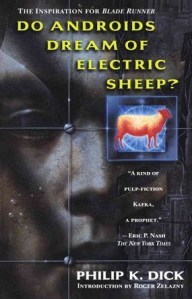
do-androids-dreamI’m a huge science fiction fan, but realize I haven’t read a lot of those works considered classics or greats. I decided to remedy that, and found a list online of the Top 100 Science Fiction Books. The list is determined by vote from sci-fi fans online, so it may change over time. I am going off the order of the list as it was when I first saw it. Each book will receive a grade between F and A+ as well as very brief comments. I’m interested to read what you think about these books as well. There will be very minor spoilers in some of these.

6. 1984 by George Orwell A
“We live in an age of dystopias, but Orwell’s remains head and shoulders above the rest. It is chilling in ways that few books manage to approach. People of varied political backgrounds continue to point to it as a warning, and than in itself is a kind of fulfillment of Orwell’s vision of the future. An excellent work.”

7. Fahrenheit 451 by Ray Bradbury Grade: B-
“There’s almost no character development, and there is way too much inner dialogue vs. action. It was a solid premise, and I definitely understand how it received its status as a classic. I just felt it was a little unfulfilling.”

8. 2001: A Space Odyssey by Arthur C. Clarke Grade: B
“I actually liked the first half a lot more than the second half. Watching the development of human thought and technology over time was more interesting than reading about some guy going on an acid trip by means of alien encounter. It got too weird.”

9. Do Androids Dream of Electric Sheep by Philip K. Dick Grade: A
“It bears little resemblance to the film ‘Blade Runner,’ but that wasn’t a bad thing. It’s surreal, entertaining, and befuddling all at once. One of the few novels to balance well a combination of suspense and humor. It has its share of action and surprises. I loved it. Also, it spawned a whole lot of cool book covers.”

10. Neuromancer by William Gibson Grade: A-
“Gibson predicted much of the future and coined a number of terms and ideas in his prophetic novel. However, the dialogue-to-action ratio is too high and the world and characters feel somewhat empty and lifeless. It’s well-worth the read, though I think other books in the cyberpunk genre are better, even though they do rely on Gibson for inspiration.”

What do you think? Which are your favorites? Are you surprised at any of the scores or what is on the list? Share your thoughts in the comments.

Links

J.W. Wartick- Always Have a Reason– Check out my “main site” which talks about philosophy of religion, theology, and Christian apologetics (among other random topics). I love science fiction so that comes up integrated with theology fairly frequently as well. I’d love to have you follow there, too!

Be sure to follow me on Twitter for discussion of posts, links to other pages of interest, random talk about theology/philosophy/apologetics/movies/scifi/sports and more!

Reading through the [Alleged] Best 100 Science Fiction Books- Check out more posts in this series as I continue.

SDG.

Reading Through the [Alleged] Best 100 Science Fiction Books- #1-5 scores and comments

duneI’m a huge science fiction fan, but realize I haven’t read a lot of those works considered classics or greats. I decided to remedy that, and found a list online of the Top 100 Science Fiction Books. The list is determined by vote from sci-fi fans online, so it may change over time. I am going off the order of the list as it was when I first saw it. Each book will receive a grade between F and A+ as well as very brief comments. I’m interested to read what you think about these books as well. We’re kicking off here with the top 5 science fiction books according to the fans. There will be very minor spoilers in some of these.

1. Dune by Frank Herbert Grade: A+
“Certainly one of the best novels ever written, Dune’s depth is astonishing. The characters are captivating, and the reader is put directly into their minds frequently. The book’s message is also thought-provoking on many levels–theological, scientific, ecological, and more. A true masterpiece of the genre.”

2. Ender’s Game by Orson Scott Card Grade: A+
“Card manages to make you get inside characters’ heads in ways no other author can. There is a reality to the characters that leads to empathy even for the ‘bad guys.’ A shocking twist at the end makes you want more. It’s science fiction at its best.”

3. The Foundation Trilogy by Isaac Asimov Grade: C-
“The overall plot is good, but my toddler’s board books have deeper characters than are featured here. It is extremely hard to care about any of the goings-on when not a single character is given depth or even has energy directed towards them by the writer. I know it’s a classic, but I’ve read them twice and don’t think I’ll bother again.”

4. Hitchhiker’s Guide to the Galaxy by Douglas Adams Grade: A
“Hilarious and wry, Adams presents a shockingly nihilistic view of the universe. Although we laugh for the whole ride, the implications make me want to weep. It’s a vision of the future that is funny–yes–but it is also horrifying, in its way. It envisions a universe in which we don’t matter, nor does anything else, really.”

5. Stranger in a Strange Land by Robert A Heinlein Grade: A
Stranger in a Strange Land manages to capture the feeling of ‘alien-ness’ utterly, but stumbles slightly at the end, when Heinlein allows his own time period to take control of the plot too completely. It takes some digesting. The small stumble does little to take away from the overall power of the book.”

What do you think? Which are your favorites? Are you surprised at any of the scores or what is on the list? Share your thoughts in the comments.

Links

J.W. Wartick- Always Have a Reason– Check out my “main site” which talks about philosophy of religion, theology, and Christian apologetics (among other random topics). I love science fiction so that comes up integrated with theology fairly frequently as well. I’d love to have you follow there, too!

Be sure to follow me on Twitter for discussion of posts, links to other pages of interest, random talk about theology/philosophy/apologetics/movies/scifi/sports and more!

Reading through the [Alleged] Best 100 Science Fiction Books- Check out more posts in this series as I continue.

SDG.