Most important characteristics of a fighter aircraft?...It depends upon ‘when’ you ask the question
(Part 1
here)
Updated and Bumped: Part 2 is now complete.
Before any discussion about whether or not a fighter is ‘good enough’ to be an ‘effective’ and therefore ‘successful’ fighter design, there has to be a discussion on WHAT makes a fighter aircraft design effective and successful in the first place. While many may think they know the ‘magic mix’ that makes a fighter design a good one, the problem with the ‘many’ thinking they ‘know something’ is that the ingredients, and to be more precise, the mix of ingredients have been evolving continuously under pressure of technological and operational developments that span the entire history of fighter design. As I indicated in Part 1, for this part of the series we will use “
The Characteristics of a Fighter Aircraft”, a 1977 paper by Prof. Gero Madelung to guide us through fighter development into the 1970s. At the time of his preparing this paper, Prof Madelung was the Managing Director of
Panavia, the company formed expressly to develop and build the Panavia
Tornado aircraft.
The First ‘Characteristic’ Emerged Quickly
Prof. Madelung tells the history of fighter development in terms of the development and application of technology in response to the operational requirements over time, beginning with the first ‘challenge’ that had to be overcome (all text in [brackets] throughout this post are mine):
The initial generation of fighter aircraft (in W.W.I) had first to solve the problem of developing an effective armament, the art of maneuvering flight having been provided by the Wright Brothers only a few years earlier. The unarmed early airplanes were nevertheless providing effective reconnaissance and were as such already "fighters”. The Wright Brothers thus delivered probably also the world’s first actual fighter to the U.S. Army Signal Corps. The "armed fighter" was only a reaction to an earlier airborne threat [Zeppelins] to the land and naval forces.
The initial armament by hand-held guns was soon overtaken by the aircraft-mounted machine gun, but it was difficult for the pilot to control the airplane with one hand and to point the gun with the other, especially if a propeller in the front was in the way of the natural line of sight.
The solution of taking a weapons operator or "gunner" along was detrimental to the fighter’s rate of climb and speed. The other solution of reverting to a "pusher installation'' of the engine also resulted in a heavier airplane.
The truly ingenious solution was that of firing through the tractor-propeller with a rigidly mounted gun and to accurately point and aim by controlling the direction of flight and attitude of the aircraft. The propeller was protected first by local armour and later by a synchronizing system.
This system was, I believe, invented by R. Garros of France in 1915, met instant success and set a pattern which is still [as of 1977] valid. I am recounting this well known history because I believe that it really started the fighters as a special breed of airplanes.
Prof. Madelung further observed that the thrust of fighter design for the next two decades appeared to be maximizing the fighter’s “1g SEP” (Specific Excess Power) or Rate of Climb to get higher than your opponents as a priority over other parameters, which drove increasing engine horsepower by an order of magnitude (10 times the WWI horsepower ratings) during that time while increasing weight only by a “factor of 3.5”. The size of the aircraft changed little during this period and most were sized around the pilot it would carry. Prof Madelung observed that the aerodynamics of the aircraft were held “subordinate” to structural load-carrying considerations, which meant that external bracing, and fabric covering over wood and steel tubing structure remained the norm.
To summarize this era, we find that (aside from getting as much climb performance out of the spindly early fighter designs) the single dominant characteristic of a fighter during this rather extended timeframe was ‘a machinegun aligned to the direction of flight’.
The alignment of gun and plane simplified the attacker’s problem of ‘attack geometry’ by reducing the variables involved. This simplification of the problem enabled the fighter pilots of the era to methodically plot and execute a path of attack, within some predictable level of certainty, that would at least enable him to fire his gun(s) in a direction that would place bullets on target.
Aerodynamics, Propulsion and Structural Design Matures
Prof. Madelung continues:
By the early 30's however the designers of airliners and bombers started to really apply aerodynamics including retractable landing gears and combined this with higher wing loadings and stress-skin aluminum structures. They were outspeeding the contemporary fighters which did only about 230 mhp [sic] with an engine of 600 hp. The fighter community had to react since it could not justify its existence for long by pointing out how excellent they remained in fighting their own kind. This started a revolution in fighter requirements and for the next 25 years these were reoriented towards excelling in maximum speed. It also started the introduction of mechanical complexity with all sorts of variable geometry features: retractable landing gear, hydraulic system, flaps and slats - soon used as maneuver devices, cooling flaps and variable pitch propellers.
The first fighter coming -very close to this new concept in 1939 was, I believe, the Russian Polikarpov “Rata”, which was only lacking the aluminum stress-skin and the closed canopy. In the following year appeared the ME-109 and the Curtiss P-36 followed shortly by the Spitfire… …all of which had without much increase in engine power a speed advantage of some 30% over the previous fighters. Early combat encounters proved the superiority of the new design [approach] despite its higher wing loadings.
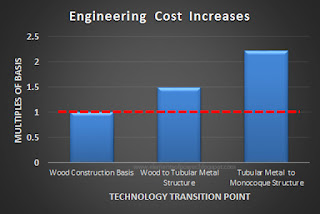 |
Complexity Drives Engineering Costs.
(Pg 20)
|
So it was the advancements in larger aircraft design that drove a “revolution” in fighter aerodynamics and structural design before WWII. Ever-increasing speeds in turn drove increased complexity of systems and structures to achieve those speeds and control the aircraft at those higher speeds. Implied here is also the fact that to fly faster, the aircraft also had to fly higher as well. As an illustration of the kind of investment in time and money the increase in complexity required, we need look no further than the relative engineering costs that came with technology changes of the era. Where we find that by the time airframe construction techniques moved to widespread use of monocoque construction, aircraft engineering costs were approximately 2 ¼ times higher than for an aircraft in the ‘wood and fabric’ days.
If there is a recurring theme in this history, it is that requirements have, and do, drive complexity. That complexity has impacted design in different ways over time, including (in general) an increase in wing-loading as a by-product of the necessary complexity. We will see that the trend persisted to at least up until the F-15/F-16 era.
The Jet Fighter Arrives
Madelung now tells us that the constantly increasing ‘need for speed’ made the next pivotal point in fighter design recognizable beforehand:
Once the philosophy of maximizing fighter speed had been accepted, it was soon recognized that propulsion by propellers (and reciprocating engines) would be limiting this to some 450 mph. [propeller efficiency plummets as tip speed approaches the speed of sound.] Work on the first jet engines started at about the same time when the second generation fighters emerged, and took only 10 years, to the mid-40’s, to completely take over the propulsion of fighters. In this period the reciprocating engines were developed to high performance up to about 2800 hp and with turbo-supercharging for altitude performance.
Yet the first operational jet aircraft in 1944, the ME-262, immediately had a speed advantage of about 100 mph with two jet engines of only 2000 lbs thrust each. Relative to the fastest bomber, the B-29, the advantage was almost 200 mph. The airframe and aerodynamics of these first jet fighters were at that not really advanced over the contemporary aircraft apart from the thinner symmetric airfoil, tapered spar caps made of steel and a nose landing gear with a breaked [sic] wheel. I was an apprentice at Messerschmitt when production of the ME-262 had started and I recall that the advent of the jet engine was welcomed as a move towards mechanically more simple fighters. The reciprocating engines with their increasing number of cylinders, already 48 cylinder engines were under discussion, their supercharging and their cooling system were getting increasingly more complicated. The jet engine had fewer moving parts and bearings, and the podded engine installation of the twin jet was mechanically very neat.

Madelung noted also that the new engines were not so ‘neat’ for the operators who had to learn a whole new way of managing their operation and power output. Today,
FADEC-equipped jet engines are simpler to operate than many light sport propeller-driven aircraft. The sudden jump in speed achievable by the jet engine performance drove fighter design right into the next technical developments that were necessary:
Again combat experience of the speed advantage was positive, despite another increase in wing loading. The associated disadvantage of requiring longer runways for these fighters was accepted by the Air Forces.
It was evident that further development of the jet engine would soon push the aerodynamic design concept to its mark under limit. The propulsion break-through was however followed by an aerodynamic breakthrough with the discovery of effect of wing sweep in the early 40’s. Again this technology reached the users first with fighter aircraft, that is with the F-86 and the Mig-15 in 1948. The speed was pushed right up to M 0.9, the limit of the thick swept wing, another step of about 160 mph.
…
Many people thought that fighter speed performance would settle for a while at that, and this may have been better in the long run…
…
However, the aviation world and in particular the fighter community, was in a speed craze and daring experimental airplanes in the U.S. had demonstrated by 1947 that the sonic barrier could be overcome by brute force and skillful design in terms of thrust, reduced wing thickness and powered control surfaces.
The increased thrust requirement could be met by the jet engine by reheat, which in turn required variable nozzles and resulted in additional complexity. Wing loading had to be further increased and so were the airfield requirements. Brake parachutes were required to shorten the landing run.
Speed Limits
Prof. Madelung’s wistfulness over increasing speeds and ‘paths not taken’ is recognition that the military utility of increasing top speed past a certain point in the end provided a smaller return on time and dollars invested than it was worth, but we didn’t know it at the time:
The fighter community lost its innocence [sic] at this stage and only the major military powers, the U.S. and Russia, entered this round in the early 50’s with the introduction into service of the NA-F100 and the Mig-19, one and a half years later. The thrust of these magnificant [sic] fighters was about 3 times that of their predecessors, their speed at Mach-1 .3 about 40% higher. The single engine, single seat F-100 had about twice the take-off weight of its predecessors, at 30000 lbs equal to the twin engine medium bomber "NA-62 [North American Aviation Project Number for the B-25] Mitchell" with a crew of 4 only 12 years earlier…
So Prof Madelung observed that, for the first time, the fighters’ size and weight due to the increasing complexity grew
out of proportion with the speed increase. The increases in propulsion, structure, and systems complexity needed just to be able to fly at supersonic speeds drove the weight and size growth. Let us note here that as of this time in fighter development history that the ‘day-fighter’ sub-type was the norm for fighter design and that the need to make all fighters all-weather, 24-hour weapon systems was not yet the norm.
The aviation world of Britain, France and Sweden however followed suit with prototypes which were demonstrated in the mid 50’s, capable of Mach-2 and introduction into service of these fighters started 1958 to 1960. From the technology of the F-100 and the Mig-19 it was a matter of air intake development and further refinement of engine and airframe to reach the limit speed for aluminum airframes. The first fighter prototype to reach this limit was, I believe, the Lockheed F-104, with a thin unswept wing. A wing concept which was to gain prominence in future fighter designs, particularly in the U.S. "Mach-2" was to be the limit of the fighter communities’ speed craze and only special purpose aircraft, such as the Lockheed YF-12, SR-71 and the Mig-25,· were developed for yet higher speeds. The fighters which were developed in the :mid-50’s are however still now [1977] dominating in quantity in the world’s forces, and inflation makes these complex airplanes appear inexpensive relative to anything we do in the 70’s.
A Rebalancing
It would be hard to find a better illustration that all the handwringing these days over increased costs and complexity is not a ‘new’ sport and that things will always look simpler and less expensive in retrospect than what Prof. Madelung wrote here in 1977. He then discussed the state of fighter design drivers in the 1977 milieu:
The question arises why, having reached the “ultimate performance" in terms of speed, new fighter designs were actually required. It is not surprising that the requirements picture was at first hazy for the follow-on generation, the development of which only started toward the end-60’s sand early 70"s with one notable exception [AV-8 and STOVL].
The following new requirement areas were however becoming apparent:
1. In the late 50’s concern was mounting relative to the vulnerability" of fighter forces relying on these long 9000 ft runways...
2. Another new requirement which became important to the fighters in their fighter-bomber role was that of low level/high speed penetration. In fact, most of the early Mach-2 fighters are usable in this role due to their high wing loading. The F-104 with appropriate navigation equipment and plenty of external fuel is [1977] still widely in service for this task, a task which is of particular importance in Central Europe.
Under ‘area .2’, Prof Madelung discussed the technology developments that came out of this new requirement including “
fan-jet engines with greatly improved fuel consumption and the terrain following radar system”. He also made a point to emphasize the importance of, a practical scheme for the variable sweep wing” that “
allowed the retention of optimum high speed/low level dash performance with a gain in cruise performance at all altitudes and greatly improved air-field performance.” Prof Madelung continued:
3. Another new requirement which emerged in the late 60"s called for a better balance of performance in air-to-air combat. The high speed capability of the Mach-2 fighters of the mid-50’s turned out to be of little practical use as there were no bomber and recce aircraft flying at such speeds (apart from special purpose aircraft which. could not be intercepted anyway by a tactical fighter), and air-to-air combat could actually be sustained only in the lower transonic regime with these airplanes. A better balance of performance could be achieved mainly by a decrease in wing loading, which would provide for higher turn rates in the speed and altitude regime of dog-fights, at the expense of increased wetted surface and of a heavier airframe, i.e. trading rate of climb and low level dash performance. It is a tribute to aviation technology that the new generation of fighters actually improve also the latter two performance regimes while making a big step forward in turn rate and as a fallout in airfield performance.
4. Finally the new fighters would require a "look-down" capability of the radars in their air-to-air role in order to be able to fight the low level intruders. …
So the trend shifted for the first time in decades to not a more ‘maneuverable’ and ‘balanced’ fighter design, once the practical upper limit of aircraft speed was reached:
The four U.S. designs, the F-14, F-15, F-16 and F-18 and the Viggen have low wing loadings (50 to 70 lbs/ft2·) to optimize turn rate. The latest three U.S. designs, the F-15, F-16 and F-18 have at the same time thrust to weight ratios in excess of one, resulting in a big step forward in dog-fight capability. They employ advanced materials including composites and very advanced engines. The latter two designs are introducing a new aerodynamic feature, the "strake", to improve the lift of the thin, unswept wings at high angles of attack. In the case of the F-15 this dog-fight capability is combined with fairly long range air-to-air missile intercept capability which results in a very big fighting machine, with a wing area of 650 ft2, as big as the F-14 fleet defence fighter….…In Europe most of the forces have emphasized the requirements (1) and (2), that is low level/high speed penetration capability associated with excellent airfield performance. The defence environment of these countries requires instant and effective response, day and night and all weather in the land battle. The latest fighter engine technology with the magnificant [sic] thrust to weight of about 8.0 and variable sweep with considerable use of titanium were applied in the Tornado to improve payload-range by a factor of about two for this mission, and to cut runway requirements to 60%. This twin engine fighter with plenty of avionics, a crew of two and a wetted surface of only about 1850 ft2 is smaller than an F-4 Phantom, about in-between the big and new U.S. fighter with wetted surface of about 2800 ft2 and the small fighter of about 1400 ft2. At the same time this aircraft will provide first-class long range air-to-air capability with an air defence avionics fit and long range missiles.
What Was to Come after 1977?
Prof. Madelung then ruminated on what would be the NEXT developments in fighter aircraft design, and as it happens he was largely prescient, foreseeing most developments that have since occurred or are emergent at this time, I see only one complete ‘miss’, a tail-sitting fighter did not come about. But that may have been due to the collapse of the Warsaw Pact as much as anything else. Who knows what would have happened otherwise? But I’d say he had an amazingly complete vision of what would be the major requirements that would drive those developments.
The outlook into the more fighter-specific areas is difficult because of the attendant operational trade-offs which depend upon projected structures of threat and friendly forces. The "haze'' obscuring the real future requirements is still very thick, apart from the broad scope of ECM, the air-to-ground weapons area and the requirement to reduce unit cost.
In any case it will be increasingly necessary to “destill" [sic] the essentials for future combat effectiveness, rather than relying on the simple formulas like maximizing rate of climb or speed or turn rate. We have already seen two breaks in such simple and general formulas. The trade of quality versus quantity will remain most difficult.
Prof Madelung predicted increased use of the post-stall flight regime:
In fighter aerodynamics and control we will probably open up the post-stall regime for another increase in dog-fight maneuverability….
But he also saw under what conditions that post-stall maneuverability might not be so important: recognizing other development could obviate the advantage:
…As long as weapons remain installed in the classic fighter style requiring turning of the whole aircraft for pointing of the weapons, this post-stall maneuverability may also be of interest to other than dog-fight missions….
He recognized the potential of thrust vectoring in exploiting the post-stall maneuvering capability:
…Post-stall maneuvering will require some form of auxiliary control such as used on VTOL aircraft or missiles, for example by thrust vectoring. It will also require an air intake and engine suitable for angles of attack of 90°. Both techniques are basically available…
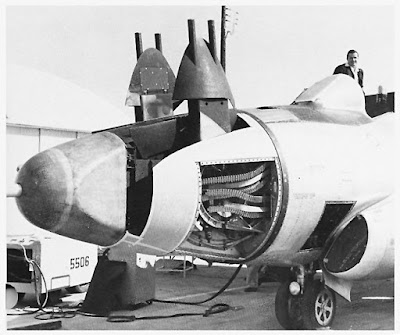 |
Project GunVal Concept: Cannon Turret on F-89.
The turret rotated and the guns elevated 90 degrees. Sanity
inserted itself before the system ever flew. (Northrop Photo) |
Madelung reluctantly (based upon past experiences) brings up the possibility of Off-Boresight Capabilities (OBC) AND helmet mounted sights:
…Another next generation fighter may be (the return of) some form of pointing the weapons other than by the pointing of the entire aircraft. I hesitate to put this forward since all earlier attempts involving some form of weapons-turret and a gunner have been failures when used on fighters. The fixed guns operated by the pilot have been a tremendous success due to the light weight and low volume and due to the accuracy of firing achieved with this installation. However the rate of pointing of the fixed weapons is slow, even a fighter with a turning rate of 18°/second will take some 6 seconds for 90° change of directions. Modern weapons installations on ships and cars will do 90° in less than one second. One approach to overcome this problem is to program, with the aid of a helmet sight, the projectile or missile to turn at very high “g” after being fired from a conventional fixed launcher. It may be rewarding to find a simple way of achieving this with a gun since this form or armament is still the most economic one.
Helmet Mounted Sights may not have required all that much of a leap in imagination given the then state of the art and the known initial goal of employing them on what would become the F-15, but taken in context of all his thoughts on the future it is still impressive that he thought them significant.
Stealth Was Seen as Too Hard for Aircraft
Madelung recognized the advantages of reduced RF and IR signatures, falling short in his vision only because he was not aware of the revolution in stealth that was underway as he spoke:
Yet another design feature may be that of reduced signature for radar and IR missiles. For a full-fledged fighter with all its other requirements these appear to me pretty difficult additional ones.However one should bear in mind the advantages of small aircraft size in this context as well as for reduced probability of visual detection and last but not least for a better chance of not being hit. The next generation of fighters should, and not only for these reasons, be of moderate size.As the control of UAVs by manned aircraft seems to be brought up more and more as ‘the future’ Prof. Madelung’s observations on the topic seem particularly ‘timely’:Finally this outlook has to cover the prospects of unmanned fighter aircraft: adding up all the interface design features which are required to allow the pilot to control an aircraft, as well as the features to provide for the appropriate environment and safety, a lot of sensors and computing capacity could be provided instead, using microprocessor technology. The ''cruise missiles" are paving the way in this direction and I expect that the fighter aircraft designers will have to take this development very serious. The manned fighter will have to concentrate on the more difficult tasks which cannot be readily programmed. One could imagine combined systems of manned fighters and unmanned aircraft like a hunting party with hounds, the latter being "programmed" to track and harass under the command of the former.
Recognizing the limits to the return on investment from increasing aircraft capabilities, he foresaw a shift to more capable weapons such as AMRAAM and ASRAAM etal. And the interest in even
more advanced weapons continues unabated.
The future of both the manned and unmanned fighter may however depend largely on the development of more effective weapons and methods for the air-to-ground battle in order to achieve a better balance of cost effectiveness.
Prof Madelung then concluded:
Some 75 years ago the Wright Brothers had the vision, skill and persistence to develop the prototype of powered aircraft, and gave birth to a new dimension of mobility and spirit of mankind. The fighter aircraft is one of the grim but magnificant [sic] outgrowths of this new dimension and will continue to participate in a lead role of aeronautics if the "fighter community" will maintain and develop its vision, skill and persistence offering-new and cost effective qualities and performance rather than retiring to marginal improvements.
To Recap the Part 2 'SoFar'
Operational requirements other than ‘maneuverability’ drove fighter design for far longer than post-stall ‘Supermaneuverability’ has been part of the definition, and ‘maneuverability’ was and still remains only
one of the required hallmarks of fighter design.
Further, while ‘maneuverability’ has
always been a requirement, the definition of same evolved over time. ‘Maneuverability’ only increased in importance relative to top speed and ability to climb after the option of increasing the top speed and climb rates for fighter aircraft reached their practical operational limits.
Most important to the current and near-term future of fighter design considerations are:
1. ‘Maneuverability’ as it is currently interpreted to include post-stall controllability is a relatively new construct in the history of fighter design development and even in 1977, the limitations of post-stall maneuvering, and developments that could render it less effective or even ineffective were already foreseen.
2. Low Observable aircraft were seen as unachievable by a noted aircraft designer at the same time the US was developing the first Low Observable (LO) aircraft in the form of the F-117. We do not have Prof. Madelung’s thoughts on the ramifications of this development, but he obviously grasped the significance of LO in even mentioning the possibility of LO weapons (a couple of examples of same I was supporting or flight testing by the early-mid 1980s’.)
Update:
Supermanueverability
Given that ‘supermaneuverability’ appears to be the current ‘top dog’ requirement in the general public’s mind and that misperception seems to be running amok in the background of any public discourse on what defines ‘maneuverability’, in the coming paragraphs we will discuss ‘supermaneuverability’ by leveraging a series of technical papers written by W.B. Herbst in the 1972 and early 80s’. As Dr. Herbst
coined the term ‘supermaneuverability’ in the first place, his thoughts should provide a solid basis for further discussion on the benefits and limits of post-stall maneuverability.
Supermaneuverability: The Roots
In 1972 W.B. Herbst coauthored a paper titled “
Design for Air Combat” [1]. In it the authors recognized and demonstrated there were limits to the pursuit of conventional maneuverability and an increasing need to trade off various metrics of performance to define individual combat effectiveness. This raised the prospect of broadening the scope of the very definition of maneuverability (aka ‘agility’) as a phenomena under examination:
[P. 7] Thus far we have considered the air vehicle maneuverability only. The simulations were based on short range air-to-air missiles of equal maneuverability. An increase of missile maneuverability would improve the aggressive capability of kill. However, would it allow to relax the maneuverability of the air vehicle and thus allow to lower the cost of the weapon system at constant weapon system effectiveness?
The authors found a diminishing return on improving missile maneuverability at that time however:
[P. 8] The engagement of equal opponents (aircraft maneuverability 1:1) with equal weapons {relative weapon maneuverability = 1) results in a ratio of firing opportunities equal to one. A weapon improvement by a factor of 10 increases the system combat capability only by a factor of 5.
[P. 9] Improved weapon maneuverability pays off only to a limited extend because a superior missile is of little use in a defensive combat situation. Air vehicle maneuverability is still required to neutralize a position advantage of the opponent.
I find the authors’ conclusions in this case premature but informative nonetheless. They provide sufficient information that with the additional knowledge we have from certain developments that actually occurred since their limited exploration to see that they were using excessively conservative missile characteristics and using a far too crude approach to modeling the impact of improved missile capabilities.
To explain what I mean, let us first look at the author’s technical approach to describing missile maneuverability:
Realtive [sic] weapon maneuverability was expressed as the ratio of the areas behind the target in which the weapons considered can be successfully launched [‘successfully’ means launch and actually hit the target]
This is the graphic that accompanied the discussion:
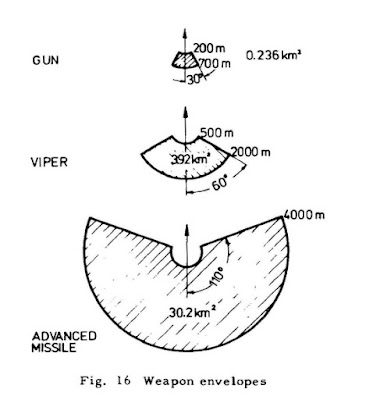 |
| Only Rear-Aspect attack was considered |
The authors attempted to measure the relative lethality of the gun against two ‘advanced’ missile systems. One was an IR missile with ‘better’ characteristics than a then state of the art AIM-9 (Presumably the AIM-9D or E):
Viper is a medium-range/dogfight missile with a motor burn time about double that of Sidewinder and a minimum effective range of 200m-300m. The motor is a new unit being developed by Kongsberg Vapenfabrik. The missile's launcher is equipped with an infra-red search unit to acquire targets and then point the Viper IR head in the correct direction. The launcher also houses a cooling unit for the IR heads. Viper is designed to lock on to targets within a squint angle of ±15° while on the launcher, compared with Sidewinders ±2°. [Ref. 5]
The prototype Viper was to be ready by the end of the year and service entry was scheduled to occur around 1975-76. It never materialized. The AIM-9L with its all-aspect engagement technology and even larger ‘look-angle’ greatly surpassed the Viper’s capability. While Germany continued it for a short while as a hedge against the AIM-9L program failing, it was ultimately cancelled. So the short range missile used in the authors’ study significantly under-represented the short-missile capability that did emerge.
The ‘Advanced Missile’ referenced may have been an early study concept for what eventually became the AIM-120 AMRAAM, but even in its earliest forms the AMRAAM had a range far in excess of the numbers Herbst and Krogull modeled, So the engagement envelope for the ‘Medium Range’ missile can be seen to have been hyper-conservative as well.
Aside from the over simplification of a rear aspect engagement by resolving it into a 2 dimensional area instead of a three-dimensional volume for comparison, the limitation to a ‘rear aspect only’ problem disregarded any capability to attack from a forward hemisphere.
This speaks to the possibility of a far greater increase in a fighter-weapon system effectiveness increase than the authors perceived in 1972, and from what we know about how air combat has evolved in the interim, the real difference in the effectiveness that was modeled and what actually fielded is found in the ability to attack from regions around the target that were never anticipated.
Herbst and Krogull, in looking at combat capability of various fighter design approaches also found:
“At equal thrust/weight ratios the SEP [Specific Excess Power] concept with its higher wing loading yields lighter and consequently cheaper aircraft at the penalty of decreased close-in combat performance.”[P. 8]
This led the authors to consider the importance of combat capability as a ‘fleet’ measurement rather than a unit measurement. This led further to the observation that because of the diminishing return of increased maneuverability compared to the costs of achieving that maneuverability, from a TOTAL fleet capability, at the time of the writing it
MAY have made sense for a nation to procure larger numbers of less-capable ‘SEP-concept’ aircraft than an insufficient number of more-capable aircraft.
In the paper’s Summary and Conclusions [P. 10] several points come to the fore. First:
Increasing thrust/weight and decreasing wingloading has a progressive effect on weight and cost. This leads to combinations of T /W [Thrust to Weight] and W/S [Wingloading, Weight/Wing Reference Area] which cannot be realized with the present state of technology.
 |
Asymptotic Limits: the diminishing
return and infeasible regions. |
Within the paper, the authors repeatedly refer to the pursuit of ‘higher’ performance in terms of inevitably reaching the ‘asymptotic limit’ of same. While the authors used a very specific, and by today’s standards rather conservative ‘baseline’ configuration and threat (Mig-21 ‘like’), to model the effects of different technical approaches, 4th generation aircraft that have appeared in the interim look to be only further along essentially the same curves.
So when you hear or read of despair over the fact that ‘traditional’ combat aircraft kinematic performance hasn’t advanced much in the last 40 plus years, you know those spreading the ‘woe’ have no idea there really hasn’t been any value (capability/cost) driving a universal need to go faster, turn harder, or fly higher. Nor do the same people ever seem to grasp the relative value of the advances that have been pursued instead (computational power, sensors, radars, precision weapons, stealth, etc.). There’s an irony in this mix, as the same people who complain about how expensive weapon systems are seem to be oblivious to the cost avoidance achieved by resisting the frivolous pursuit of unnecessary speed, maneuverability, and operating altitude.
The authors at the time concluded that lowering a design wing loading seemed to trump increasing thrust to weight ratios, but I note here that the advantage seems to be viewed as one of lower cost and, as the authors noted, a DEFENSIVE advantage was seen:
Defensive capability - as opposed to offensive capability calls for lower wing loading rather than higher thrust to weight ratio.
As noted earlier, the authors saw some limited advantages to increasing missile maneuverability to allow relaxation of aircraft maneuverability, but in their conclusion they pointed out (again) that even so, it was seen as of use “if decreased aircraft survivability is acceptable.” As we will see further along in this series, this conclusion from the authors’ fairly limited early exploration was in retrospect, a ‘flag’ warning us to look for an emerging, greater truth.
Supermaneuverability: The Realization (From a European Perspective)
Eight years after he coauthored Design for Air Combat, Dr Herbst published a more ‘tailored’ paper, '
Future Fighter Technologies' [Ref. 2]. This paper was tightly focused on the application of his (and others’) lessons-learned towards the fielding of a new European Fighter design (We’ll call it a ‘Eurofighter’ for convenience –wink,wink, nudge, nudge).
In the introduction of his paper he was quite assertive in stating that going forward, there was not much sense in pursuing better Energy Maneuverability than the 1980 state of the art, and that close in combat was perhaps becoming obsolete as a viable tactic:
The design of fighter aircraft used to be a race for performance. There was the race for maximum speed, followed by the aim for maximum climb performance, and eventually concluded with the emphasis on sustained turn capability. As a result, the installed thrust-to-weight ratio (T/W) continuously increased and has now exceeded the value of 1. Unfortunately, there is a progressive effect of T/W on weight and cost and even an asymptotic limit. Though this limit is shifting with airframe technology, more thrust per engine has to be paid for by more cost per unit of thrust, thus further accelerating the price for increased performance. The analysis of war games indicates that the cost-effectiveness of a fighter fleet would suffer from the introduction of aircraft employing T/W ratios of more than 1.2. In Fig. 1, fleet deterioration is presented against increasing vehicle performance at constant budget, e.g., against decreasing fleet size. Beyond a performance level equivalent to T/W=1.2, the red fighters-assumed to employ a T/W of 0.7-would outnumber the higher performance blue aircraft. This performance level, however, is already achieved by current fighter aircraft. The race for energy-performance has reached its limits.
There is also competition to the airframe designer by the new generation of medium range missiles (MRM) to be introduced soon. MRM's plus multi-target and shoot up/down capabilities of radar weapons may even tend to make the classical fighter concept questionable. [p.561]
Dr. Herbst identified three key requirements a ‘future’ Eurofighter must satisfy:
In Central Europe there is a need for a new fighter concept which would have to satisfy the following three largely contradicting requirements: 1) interception of intruders under all-weather conditions beyond visual range with MRM's [Medium Range Missiles], 2) air superiority against a superior number of maneuvering offensive targets with short-range weapons, and 3) short field performance for base survival...
Note the automatic default to unavoidable short-range combat within requirement number 2. This is a pretty solid ‘tell’ that “Stealth” was, unsurprisingly NOT going to be a prime design driver at the time the paper was published. Dr. Herbst expanded on the requirements and what they meant to the design under consideration:
The driving airframe parameter to satisfy requirement 1 turns out to be high-speed maneuverability in particular. In a MRM environment with multi-target capability on both sides, supersonic performance is important to achieve an advantage…
…The air superiority requirement leads to a requirement for superior close combat capability with short-range weapons, e.g., for subsonic maneuvers performance. Unfortunately, there is that contradicting problem with conventional aircraft which achieve their maximum rate of turn at a speed very different from that constituting a smallest turn radius. Also, it is well known from many manned and unmanned combat simulations that it takes about 3 deg/s rate of turn* advantage to be superior; however, the current level of about 25 deg/ s (maximum sustained) is very difficult to exceed by conventional means. Without any thrust support, short field performance primarily is a matter of wing loading. Optimum maneuver and cruise performance prohibits low wing loadings for trapezoidal wing aircraft. Low-aspect ratio delta wings lend themselves to, and are even dependent upon, considerably low wing loadings. However, a low wing loading may constitute a problem for low-level high-speed penetration missions (ride quality).
*See here for my reliance on a similar figure in evaluating possible F-35 sustained turn performance. Dr. Herbst’s reference is a mere 1 degree/sec different (approximately) from our other references.
Dr Herbst identified three technologies that offered a solution in
“combining diverging requirements such as high supersonic speed, subsonic combat capability, and short field performance.” They were Digital Fly-by-Wire Control, Delta Wings, and Supermaneuverability. Only the last is of interest to us in this discussion. This is the first known reference to the term Supermaneuverability, in English anyway [Ref. 4?], and so we defer to Dr. Herbst’s description for our definition thereof:
This is a term for combined post-stall (PST) and direct force (DFM) capability. PST represents the ability of the aircraft to perform controlled tactical maneuvers beyond maximum lift angle of attack up to at least 70 deg; DFM represents the ability of the aircraft to yaw and pitch independently of the flight path, or to maneuver at constant fuselage attitude. DFM has been the subject of various analysis, design studies, simulations, and even flight tests. DFM has been developed by McAIR in conjunction with the vectored lift fighter (VLF) concept. PST has been developed and analyzed by MBB. PST and DFM are tactically related, supplement each other, and constitute a combined new and superior air combat feature.
Dr. Herbst dropped a few of what was then ‘new’ tidbits for use in Supermaneuverable designs:
...In particular, high yaw rates and high pitch down rates are required to perform PST maneuvers of tactical value...
...Beyond about a 30-deg angle of attack, an additional reaction control system becomes necessary at least for pitch and yaw. The most suitable solution would be the deflection of engine thrust, e.g., a vectored nozzle, since any PST-maneuver is flown at high-power settings...
...The most difficult design problems prevail in the 30-50-deg angle-of -attack regime. Beyond 50 degrees, flight and control conditions are primarily ruled by thrust rather than aerodynamic support or disturbances...
In its earliest conceptual design stages, the EF2000 had that ‘reaction control system’ planned, but the vectored thrust feature was dropped when BAE took over the design lead as the other governments involved dropped interest in the project. I understand the feature is being looked at again for the plane as a retrofit.
Dr. Herbst summarizes his 1982 paper's findings thusly:
The design of a new fighter has become more challenging since a pure increase of conventional performance does not seem to pay off any more. However, a new concept evolves from the combination of three key technologies: electronic digital control, the aerodynamic advancements of delta wings, and "supermaneuverability." Such fighter concept would feature excellent supersonic performance, thus improving the use of future MRM's, a conventionally unachievable level of short-range air combat capability, and extremely short field performance combined in one design.
The differences in Dr. Herbst’s research between 1972 and 1980 reveal a change in perspective as to the lethality and 'worth' of fielding advanced A2A missiles. He found in 1980 that if the combatants’ conventional agility were equal, the ‘Supermaneuverable’ fighter would dominate a ‘conventional’ fighter by a factor of "3 to 1" if missiles, or missiles and guns, were the armaments used. This later research was performed in the wake of the AIM-9L development and recognition of the future MRM developments that brought us the AMRAAM and others--and it shows.
We now include excerpts from Dr. Herbst’s third paper (1983’s “Dynamics of Air Combat”) on the subject of fighter aircraft design and agility, mostly because the findings and observations in the paper are more assertive and expansive than the 1980 paper on the evolving nature of A2A combat and the advantages of Supermaneuverability. Again, there will be no recognition of the impact of Low Observable design on air combat as this paper comes well before the known existence of America’s Stealth programs. I will keep commentary on these excerpts to a minimum as they are largely more of the same or expansion on that we’ve already discussed. First:
New short and medium-range air-to-air weapons have been analyzed by means of computerized and manned air combat simulation. As a result of their peculiar capabilities, air combat maneuver characteristics are expected to change significantly. The all-aspect capability of new short-range weapons leads to a dominance of head-on engagements and thus to an increase of importance of instantaneous maneuver capability over the classical sustained performance.
Typical flight conditions are analyzed in terms of turn rates, rates of climb and rates of longitudinal acceleration and in terms of the resulting power and energy management. The guidance and performance capabilities of new medium-range weapons lead to a maneuvering-type combat in the supersonic speed regime...
...Significant changes in air combat characteristics will occur owing to the development of the following new air-to-air weapons and fire control systems: 1) all-aspect capability SR missiles; 2) all-aspect capability** guns in conjunction with unorthodox aircraft maneuvers and coupled fire/flight control systems; and 3) new radar guided MR missiles...
** Dr. Herbst uses the term ‘all aspect’ in relation to ‘guns’ to mean they can be effectively employed against a target flying towards, away, or across in relation to the firing aircraft.
Note the change in importance of Thrust to Weight by 1983 compared to 1972:
How will these new weapon capabilities influence the combat characteristics and thus the design requirements of fighter aircraft, in particular the requirements for maneuverability? The analysis of future air combat and fighter design requirements has been the subject or several years of work at MBB. The results are based on extensive computer combat modeling and on manned combat simulation and even on flight testing. SR combat with rear aspect weapons was characterized by sustained turns. Conversion to a firing solution was a matter of sustained turn rate margin vs the opponent. Combat effectiveness, therefore, tended to be very sensitive with regard to a variation of T/W and also to wing aspect ratio and wing loading. With all-aspect weapons, however, combat effectiveness proves to be significantly less sensitive to classic energy maneuverability parameters and more sensitive to attained unsteady performance.
[For medium range combat] Aircraft maneuverability was considered to be of minor importance and high speed was sometimes a penalty in a head-on situation against a similar armed target. Air combat modeling using the new generation of MR missiles indicates that combat effectiveness can be significantly improved if maneuvers at high supersonic speed are employed. The change in SR combat characteristics toward unsteady maneuver performance in the low subsonic speed regime and the need for supersonic maneuverability in MR combat are contradicting design requirements. This presents a design challenge if both missions have to be satisfied with the same fighter aircraft...
…The significant observation throughout a large number of simulated engagements with all-aspect weapons is the dominance of frontal firing opportunities…
… Predominantly, the most effective prelaunch maneuvering tends to lead to an almost head-on firing situation, independent of the initial condition (except tail-on initial conditions). There is a small difference between duels and multiple engagements. There is also an influence on actual missile hits; beam attacks tend to yield a smaller probability of target hits. Direct, head-on passes happen rarely because of missile seeker characteristics and missile off-bore sight capability….
…The ability to aim the aircraft fuselage independently of the flight path provides a very effective way of solving the gun, snap shooting problem, and permits successful frontal hemisphere firing opportunities. Fuselage aiming-if properly designed and mechanized-makes the gun a very effective frontal hemisphere weapon and thus compatible with future missiles.
Contemplate how the following paragraph would be affected if High Off Boresight missiles had been imminent in 1983:
With all-aspect weapon capability there are no sanctuary spaces remaining around the target. There is a certain level of kill probability whenever the target is within range and within a certain off-bore sight cone. In this situation a pilot may not have a choice of maneuvering defensively or offensively. In many cases the only way to survive is to respond aggressively and to achieve an earlier firing opportunity. As a result, both opponents would engage in a sequence of head-on passes. After each pass, provided a mutual weapon exchange was unsuccessful, both aircraft would try to reverse as quickly as possible, even at the expense of energy. Any loss of energy could be replaced as appropriate later on.
We may use this structure/description of A2A combat in future F-35 capability discussions and so it is included here:
Starting at high subsonic speed, it has been observed in many simulated engagements that SR combat develops in the following three phases:
a) by slowing the aircraft into a better turning speed regime and thereby maneuvering into a head-on situation (this may be accomplished by gaining altitude, by throttling the engine, or by means of speed brakes, or by a combination of all three means);
b) by repetitively turning into each other at lower speed, with a possible loss of altitude; and
c) in proximity to the ground, by low-speed clinch or target pursuit depending on the outcome of phase b.
…Its [short range combat’s] most significant feature is the continuous change of flight conditions throughout the entire engagement and the repetition of a typical cycle with 1) conversion of kinetic energy into altitude (if possible) and a simultaneous buildup of turn rate; 2) loss of speed for even higher (instantaneous) turn rates; and 3) conversion into firing position at decreasing rate of turn and increasing speed.
Herbst did not ignore medium range combat in his discussion. I intend to refer to this part later as well in any F-35 discussions :
MR missiles are frontal hemisphere weapons by design and definition. In comparison with SR combat, firing ranges are much larger than aircraft radii of turn. Therefore fighter aircraft would not pass each other and would not reverse their position. However, they would employ very dynamic maneuvers in order 1) to achieve a firing position (with regard to aspect, speed, and altitude) which provides a target hit with a minimum counterhit [sic] probability; 2) to stay out of, or maneuver out of, the opponent's missile envelope after their own launch while maintaining the required look angle for midcourse guidance; and 3) to sustain sufficient energy after the initial combat maneuver for reattack [sic] and to continue fighting against other opponents in a multiple situation…
…Of course, opponents would employ similar tactics. Thus a combat develops which is characterized by dynamic high-speed ·maneuvers in a relatively large airspace….
…There is no loss of energy, and therefore no need for a recovery of energy. This is a result of the relatively small maneuver power margin and the high basic thrust demand for supersonic flight…
Any increase in T/W would significantly improve the maneuver capability and contribute to combat success, respectively….
Herbst summed up his most important major points as follows:
New short- and medium-range weapons must be expected to change air combat characteristics significantly. Short- and medium-range combat maneuvers are very dynamic in terms of a continuous interchange of speed, rate-of-turn, and rate-of-climb. Short-range combat is drifting to lower speed; it is characterized by extensive use of attained maneuvers and a fluctuation of total energy. Medium-range combat takes place at supersonic speed. It is characterized by very careful energy management and constant total energy. Consequently, design requirements for fighter aircraft will change. …
Thus even in its earliest heyday, the Supermaneuverability concept’s contributions to a successful air combat engagement was already being affected by the advances of newer, more capable air weapons that were changing the rules of the game before the first fighters leveraging same were fielded.
In our next installment (Part 3) we will take a hard look at what by 1996 was seen as the ‘Practical Limits of Supermaneuverability’. Post 1982-3, the advancements in computer modeling permitted far more sophisticated and higher-fidelity examination of the problems under examination. It should be interesting to review the more modern findings.
Refs:
1. Design For Air Combat; W. B. HERBST, B. KROGULL; AIAA 4th Aircraft design, flight test, and Operations Meeting,AUGUST 7-9, 1972; AIAA Paper 72-749
2. Future Fighter Technologies; W.B. Herbst; AIAA Journal of Aircraft, Vol 17, No. 8, August 1980, Article 80-4077; pp 561-566.
3. Dynamics of Air Combat; W.B. Herbst; AIAA Journal of Aircraft, Vol 20, No. 7, July 1983; pp 594-598
4. Herbst, W.B., "Zur Beurteilung des taktischen Nutzens von PST/DFM fUr die Luftkampffabigkeit eines zukiinftigen TKF,"MBB Rept. VF 1477, 1978 (“To assess the tactical benefits of PST / DFM for the air combat ability of a Future TKF) TKF= Taktisches Kampfflugzeug aka Tactical Combat Fighter?.
5. FLIGHT International, 7 June 1973, p. 871.
NOTE:
Nowhere in this series of posts, or in any other posts the reader will find here, is the assertion made that ‘maneuverability’ (however one defines it) is "unimportant"-- in the past, modern day or immediate future . This must be stated unambiguously up front because I've seen the tiresome broad-brush accusation of same made too-often when anyone dares challenge some closely held belief as to maneuverability’s relative importance to fighter design or dares challenge the vague reasons why many of the uninitiated think “maneuverability” is important.