
Written by Clare Ferguson with Olga Dunderberg.
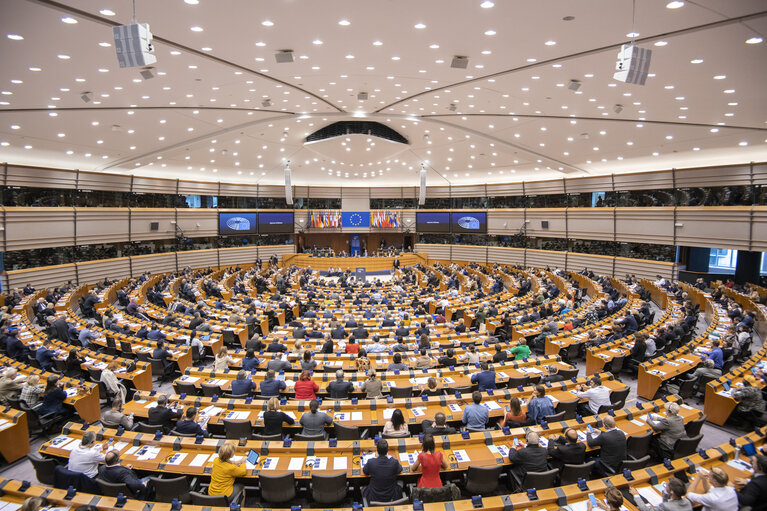
Members participate in the second plenary session of May this week, with an agenda featuring a number of the current hot topics in Europe, including Council and European Commission statements on the situation in Gaza. The session opens on Wednesday, with Nataša Pirc Musar, President of the Republic of Slovenia, to address Parliament in a formal sitting.
Continued single market fragmentation constrains EU companies’ ability to scale up and compete internationally, and many of the issues remain the same as they were 20 years ago. Following a Commission statement on Wednesday, Members are due to debate the new strategy, which should bring new impetus to the single market. While reaffirming Parliament’s role in the process, Parliament has emphasised Member States must play their part in implementing and enforcing existing single market legislation. It also demands renewed commitment from Member States and other EU institutions to strengthen and further develop the single market, particularly in the services, digital and energy sectors.
As tackling climate change remains an urgent priority, the EU has set stringent rules on greenhouse gas emissions. As the rules make carbon-intensive activities more costly, this leads to a risk that some companies try to increase their profits by moving their carbon-heavy activity outside the EU. To level the playing field for businesses, the EU carbon border adjustment mechanism (CBAM) ensures prices fairly reflect the carbon emitted during production of imported goods such as cement, iron and steel, aluminium, fertilisers and electricity. Before it comes into full operation in 2026, the Commission is proposing to simplify the CBAM. On Wednesday, Members are set to debate a report from Parliament’s Committee on the Environment, Climate and Food Safety that largely endorses the Commission proposal to simplify and strengthen the CBAM, pending clarifications on electricity generation and embedded emissions. If approved, the vote will set Parliament’s position for negotiations with the Council on the proposal.
Following Council and Commission statements on Wednesday on ending Europe’s dependency on Russian energy by phasing out imports, Members are due to debate plans to increase the EU’s energy sovereignty. The Commission’s recent roadmap – addressing the security and economic risks of continued reliance on Russian energy – is expected to provide an answer to Parliament’s repeated calls for measures to provide alternatives to imported Russian energy, to abandon Nord Stream 1 and 2, and to secure a reliable supply of medical radioisotopes.
Academic freedom is increasingly coming under attack in many parts of the world. Following Council and Commission statements on attracting scientists, researchers and academics to Europe, particularly to contribute to the development of new, cutting-edge technologies, Members are set to debate the Commission’s ‘Choose Europe for Science‘ initiative on Thursday. Parliament already called for increased Horizon Europe funding for researchers in its resolution on the 2026 budget guidelines
With estimates suggesting that more than 84 million people struggle with mental health problems, mental health issues have a considerable impact on society and the economy across the EU. Parliament strongly supports the promotion of good mental health and its inclusion in EU policymaking. It has called for an EU strategy for mental health and legislation on the use of artificial intelligence at work. Parliament also urged the Commission to propose minimum requirements for telework; legislation on psychosocial risks and wellbeing at work; and a ‘long-term, comprehensive and integrated European mental health strategy’. On Wednesday afternoon, Members are due to debate EU initiatives to improve mental health at work.


Comments are closed for this post.