
In Jonesboro Cemetery of Jonesboro, Louisiana, one might barely notice a plain military headstone that reads: William L. Barnes, To Know Him Was To Love Him. It is not fancy, nor does is catch the eye but the story of how poor William Barnes ended up in his early grave is a peculiar and frightening tale, with him being the sole casualty of a disaster of epic proportion.
On the night of January 16, 1936, William and his wife, Ona were working late at the courthouse in Jonesboro, Louisiana. They had their daughter Judith with them as well. There were a few other folks working in the building that night but it was not as heavily occupied as it would have been during the daytime. Being January, the weather had become quite chilly and the new gas heaters were running.
As William was waiting downstairs, his wife and daughter were working on the second floor. Two other men were working in their offices on the second floor as well: P. Z. Boyd (age 24) and Arthur Shows (age 35). As it was getting late, everyone was about to head out for the evening. One other employee, James Whittemore, had gone down to the basement to retrieve some land documents that were stored in the filing cabinets below. As he flicked the light switch, he saw what he described as a “red flare” before being hurled backwards 20 feet into a wall. Although quite stunned by the explosion, he realized he needed to get moving quickly and get out. Whittemore was able to escape before the collapse of the building.
The explosion was heard and felt for seven miles. Windows of local businesses were shattered. The collapse of the building was witnessed by several local townspeople. Most notably was the lack of a bright light from the explosion which would come into play later during the investigation. The folks of Jonesboro have never been ones to run for cover, instead they ran to help and were able to get everyone safely out of the building except for for Williams Barnes who was trapped beneath the rubble and already dead. Ona Barnes was taken to Hodge Clinic with severe scalp lacerations and internal bruising but would make a full recovery. Their daughter Judith was scratched up but not seriously injured.
It would take several days for Williams Barnes’ body to be located. The day after the explosion, his hat and coat were found ominously. Eventually his body was carefully extracted from the rubble and buried.
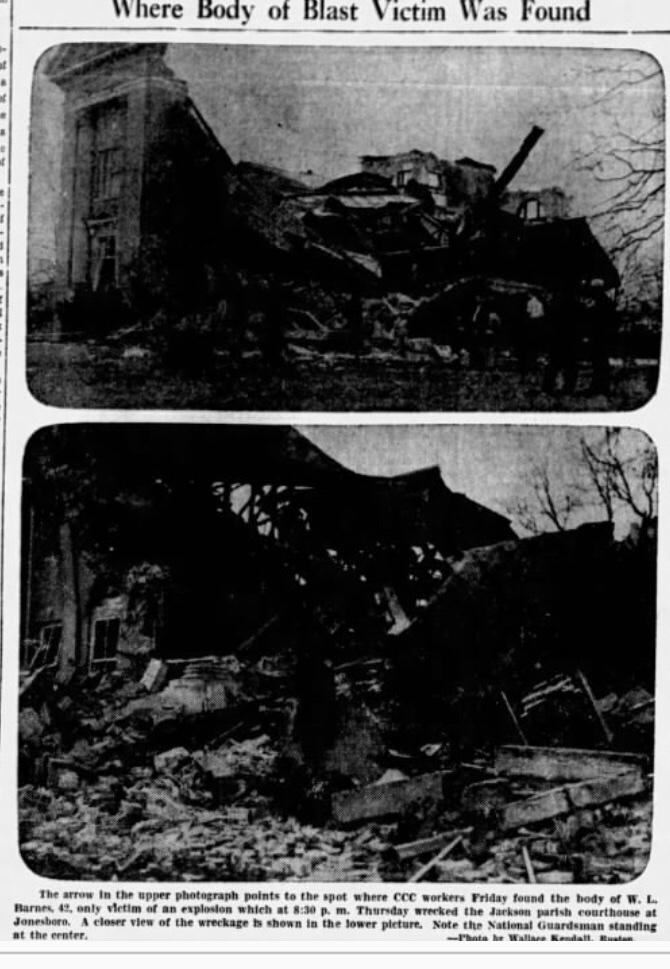

But what caused the explosion? During this time frame, the Democratic Primary loomed and there was much tension in the area regarding Huey Long’s campaign. Many felt that the courthouse had been bombed purposely to prevent voters from casting ballots in the upcoming primary. But eventually the investigation yielded a simpler explanation.
The courthouse had recently undergone some renovations which removed the old radiators and replaced them with newer natural gas heaters. In those days, natural gas was in its infancy in use in homes and buildings, it was still odorless! The smell that we now associate with natural gas is an additive to detect the presence of gas leaks, but it was not present in those days! So a gas leak had developed and the basement had filled up with the odorless natural gas. When Whittemore flipped the light switch, it set off the explosion! Witnesses in town reported seeing no great explosion like would have been seen with dynamite so the investigation was closed. And work began to tear down the mangled remains of the courthouse.
I stated above that Barnes was the sole victim of the explosion…and he was. But the courthouse would claim one more during demolition. On February 4, 1936, nineteen-year-old Jack McCain was crushed to death by an overhanging balcony as he was helping to tear the remains of the building down. Jack was an orphan who had been raised by his Aunt, Mrs. Howard Kenner. Jack was also buried in Jonesboro Cemetery, although it appears that his grave has now become unmarked.


 For The Love of History