Talking Movies

June 13, 2026

The Nice Guys: 10

Somehow The Nice Guys has reached the 10 year marker at which we can look back and say, yes, this is a classic. Well, duh.

I gave it 5/5 on release almost exactly ten years ago, and then placed it no 2 in my Top 10 Films of 2016. It’s just taken ten years for people to apparently realise, oh hey, this is a pretty good movie. Yes, it is. I’ve watched it not quite ten times, I would say, and it has the re-watchability of the later Mission: Impossible movies. Jackson Healy (Russell Crowe) is the laconic heavy you hire to rough up a creepy pot-dealer, or the PI who’s dogging your footsteps. The PI in question being Holland March (Ryan Gosling), ethically challenged since California introduced no-fault divorce; in that he now searches for missing husbands while their ashes are on prominent display on their widow’s mantelpiece. And when they reluctantly join forces it is a comic double act for the ages.

The Nice Guys probably was the funniest film of 2016. Writer/director Shane Black almost seems to have lost his vim since its undeserved failure, but he was on top form here when it came to absurdist comic routines. There are a number of set-piece bickering arguments that would not be out of place in a Martin McDonagh script; a joy being March’s refusal to give up on the possibility of romance when all the evidence is staring him in the face that he chose a wrong un. The physicality of Crowe and Gosling quite obviously recalls Laurel & Hardy, with Gosling’s scream a particular joy, as well as his attempt to maintain his dignity in a piece of business involving awkward manoeuvres with a toilet door and a gun, and his later attempt to draw attention to a dead body.

In 2021, as it reached its half-life, I compared this film to the work of David Lynch, particularly Lynch’s description of a screenplay as hoarding ideas like a squirrel collects acorns: when you have gathered forty conceits that’s the guts of an eighty minute movie. And it seems to be oddly applicable to Shane Black’s screenplay, where there are many memorable single moments; like discreetly dumping a dead body over a fence only for it to land on an alfresco dinner party in a lower level mansion; that seem like just such conceits. Strung together they make for a very lively movie, if a very un-Lynchian one. Although there is a giant talking bumblebee at one point…

Who knows, maybe the cinematic gods will see fit to grant us a sequel some decade. Until then, may you never see former President Nixon rushing to tell you that everything’s going to be okay.
April 19, 2024

Gresham’s Law and 1930s cinema

Gresham’s Law Strikes Again! That sounds not unlike the title of a pulpy 1930s B-movie. Which is somehow entirely appropriate.

I’m kind of a big deal…

I can’t be the only one who with monotonous regularity sees Ghostbusters pop up on the TV schedule, goes ‘Oh cool!’, and then when clicking to set a reminder discovers it is not the beloved 1984 comedy but instead the 2016 movie that has been universally memory-holed without most of us even having to suffer thru the indignity of watching it first. In the distant past I always wondered why on earth TV channels, with the gamut of cinema to choose from, insisted on showing bad new films instead of good old films. The Film Editor had to sit me down and explain the concept of bundling. A studio knew the networks wanted to show the big new film, so they insisted that if they wanted to show the big new film they must also show their lame new film.

And so we get ‘Ghostbusters’ floating around TV schedules like a spectre of such low-level irritation that nobody is even bothered capturing it in a trap. Pick any godawful flop (RIPD) that mooches around mysteriously and you have the explanation; it is there because it has to be so Top Gun: Maverick can draw in viewers for the network. The only problem is that there is only so much space, and there are a lot of films competing for it. Every time a bad movie is legally obliged to be shown, a good movie cannot be shown in its stead. There is a good business reason, from the studio side, for this. But it might be self-harming. If people only saw good movies, wouldn’t it make them more interested in movies per se? Is that not worth accepting flops flopped?

And from the 1990s to the 2020s we have added a lot of stuff to the list of circulating titles. It is getting harder to watch 1960s titles on TV, because that decade is now as distant as the 1930s were to the 1990s. As for getting 1930s movies on TV right now… It’s getting harder to even see the Marx Brothers on TV after the loss of TCM. As specialty movie channels shutter, and the competing walled-garden streaming services simply will not host old movies, all we have left are the networks – who are swamped with dreck. Off the top of my head these are the 1930s movies I actually expect to see on TV over a year: Gone with the Wind, The Wizard of Oz, The Adventures of Robin Hood, King Kong, The 39 Steps, The Lady Vanishes.

It’s not enough. It shouldn’t be the case that Back to the Future is considered a very old film and The Lord of the Rings is viewed as an old trilogy. (Not least because LOTR somehow has better VFX than nearly all current blockbusters). In the late 1990s the Man with No Name trilogy of Sergio Leone from the 1960s held considerable cultural cachet, the way that the great 1990s flowering of crime movies still holds much esteem now. But this is something that should be compounding not substituting; For a Few Dollars More and Heat should both have a place in the firmament, not just Heat. And the further we get away from the beginning of cinema the worse this problem is going to get. We also move further from a recognisable conception of cinema, but that’s another piece.

In 2007 I saw Zodiac in the cinema and M on DVD from the college library, and as a result the two movies are bound together in my memory; because of the great continuity displayed between Fritz Lang and David Fincher working in the same territory. The dearth of 1930s movies on television deprives us of that sense of continuity. Which I fear leads to the contempt I witnessed in the 2016 screening of Halloween at the Lighthouse, which has now been referenced so many times on this blog as to constitute its own Boogeyman. In this instance I think it is lack of familiarity that breeds contempt. People are too used to sitting in smug judgement of the past, which increasingly seems to mean the first thing they encounter that they don’t remember personally. Because they don’t know it.

February 18, 2016

Juno and the Paycock

The Gate is first out of the traps in the curious case of the duelling Sean O’Casey productions to mark the 1916 centenary, as his 1924 classic is here directed by Crestfall playwright Mark O’Rowe.

image

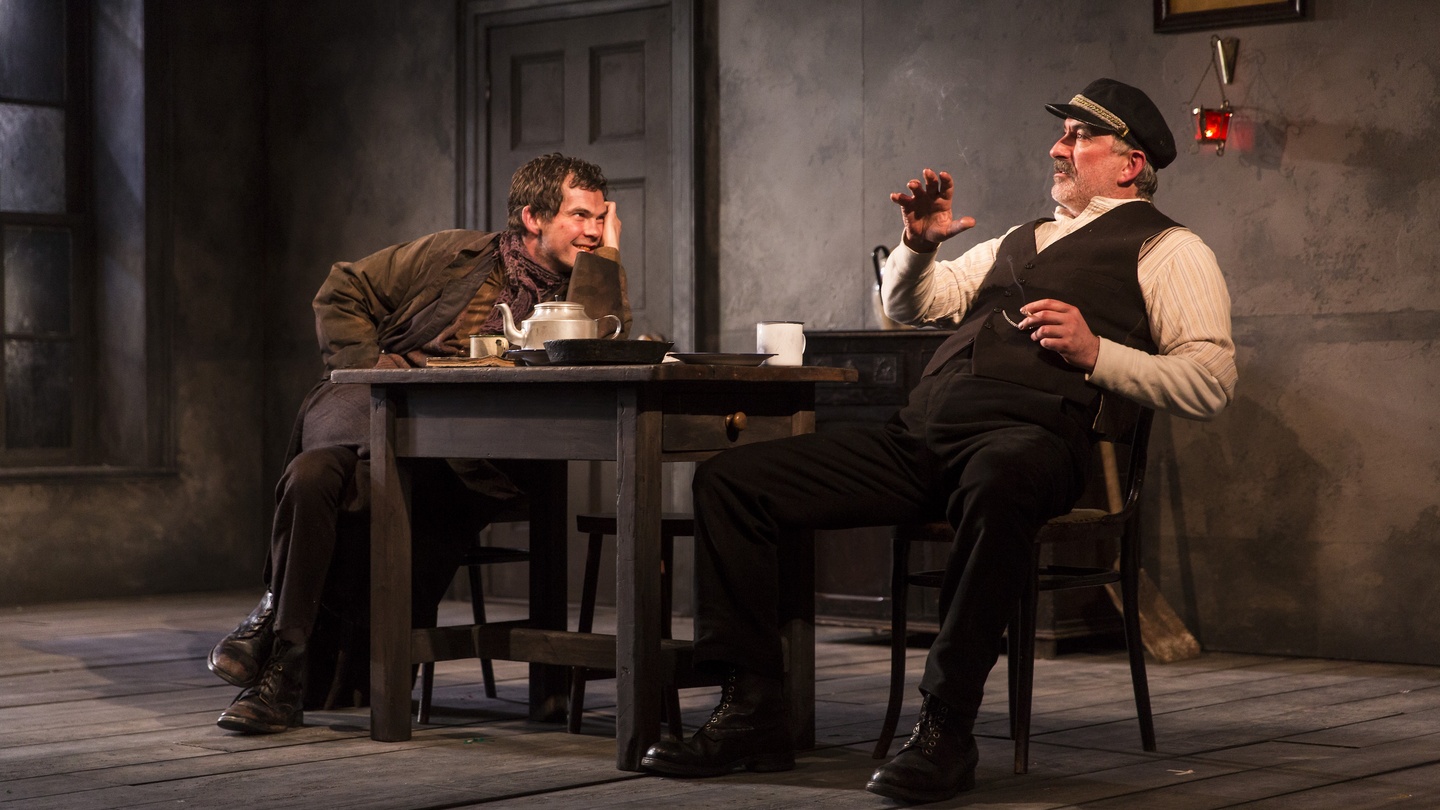
Declan Conlon and Marty Rea are a formidable pairing as O’Casey’s inimitable self-deluding male comedy double-act. Conlon is the self-proclaimed nautical veteran ‘Captain’ Boyle, a work-shy layabout who once crewed a boat to Liverpool and now infuriates his long-suffering wife Juno (Derbhle Crotty) by continually carousing with ne’er-do-well neighbour Joxer (Rea) and pleading medically mysterious pains in his legs whenever the prospect of a job appears. Juno’s uphill battle to maintain the family’s dignity takes place in a starkly decaying gray tenement room, with a staircase visible whenever the front door is left open. O’Rowe exploits this bleak space with increasingly dim lighting as the Boyle family is torn asunder by its own complexes of self-delusion, social climbing, and self-destructiveness; a matrix which O’Casey uses to skewer middle-class mores, the Catholic Church, Civil War Republicans, and the Trade Union movement.

It’s startling that in just 14 years Conlon has reached the age where people would think of him not for Hotspur but for Henry IV or Falstaff. He provides a Paycock long on voluble self-pity and contempt, but short on self-awareness and compassion. Conlon is terrific at waspish contempt, but his performance suffers by O’Rowe’s directorial choices. O’Rowe, possibly reacting to Howard Davies’ 2011 Abbey production of Juno, reins in the slapstick. Davies conjured business to emphasise O’Casey’s vaudeville clowning, but Ciaran Hinds’ self-deluding bombast made his later self-righteous fury truly scary. O’Rowe’s stricter fidelity to the text narrows Conlon’s range. And so Rea’s performance stays in the memory longer. He plays Joxer with an impish quality (as if he had flitted in from a Shakespearean fantasy to laugh at mortals), shrinking into as little space as possible, legs always coiled around each other, darting in and out of windows and across the stage startlingly quickly, and extending his final refrain of ‘A Daaaarlin book’ into an almost serpentine hiss.

Paul Wills’ austere set design tracks O’Rowe’s approach, a drab room with sparse and meagre furnishings in comparison to Bob Crowley’s sprawling 2011 Abbey set, whose vivid crumbling was akin to Tyler’s brownstone in Fight Club. In this setting Crotty’s turn as Juno is characterised by exhaustion above exasperation, not the Fassbendering turn one might have anticipated; instead Ingrid Craigie’s Maisie Madigan steals scenes. Juno’s valedictory ‘It’ll what have what’s far better, it’ll have two mothers’ is hollowed by Crotty’s hapless resignation towards crippled Republican son Johnny (Fionn Walton) and synchronicity with Union daughter Mary (Caoimhe O’Malley). O’Malley elevates Mary from cipher, layering cruelty towards her ex-boyfriend (Peter Coonan) with an initial startled adherence to and a later dogged rebellion against sexual morality that seems self-destructive compulsion. Given Juno’s self-pitying matrimonial rebukes that are both loudly performed and ineffectual O’Rowe hints at matrilineal failings that bode ill for Mary’s child.

The 2011 Abbey co-production with Southbank’s National Theatre remains the recent gold standard, but O’Rowe’s more subdued take features sufficient fresh unexpected insights to render it an interesting companion piece to Davies’ exuberant interpretation.

3.5/5

Juno and the Paycock continues its run at the Gate Theatre until the 16th of April.


Blog at WordPress.com.

Design a site like this with WordPress.com
Get started