ITV 4 may or may not have committed to running all the Bond films in order. In any case after five Connery classics they were obliged to air On Her Majesty’s Secret Service this week. Le sigh. Discussing the possibility of Oliver Reed reprising his 1969 performance in The Assassination Bureau with Diana Rigg and Telly Savalas alongside them in OHMSS, the Engineer objected that the actor would’ve been bigger than the role; always a dangerous position of leverage for a studio, cf Robert Downey Jr is Iron Man. And so to the Amazon Bond, which is is still looking for a Bond. Balloons go up from time to time; Jacob Elordi, Callum Turner. But with Denis Villeneuve as director, what about this insane for the Broccolis choice – Robert Pattinson? If he and Villeneuve got on well working together on Dune: Messiah, why not? Considerable star power. A huge spike of interest. The insouciant turn in Tenet as proof of concept. And, more importantly, the crossing of the streams, the unified theory of heroism the 21st Century didn’t know it needed – one man would be simultaneously both 007 and Batman.
Mental Maps: Update Failed
Trading off the cuff lists with Graham Price some months back he muttered that I had furnished not a best of the 80s but a best of Hollywood 80s.
The Empire Strikes Back.
Blade Runner.
Ghostbusters.
Back to the Future.
Clue.
Ferris Bueller’s Day Off.
Aliens.
The Mission.
Wall Street.
The Last Crusade.
And yet, it is a list of films I would happily spend a weekend watching while gorging on pizza. Indeed while he was commenting on it, I had already written a second off the cuff list. Equally valid.
Stardust Memories.
The Blues Brothers.
Fitzcarraldo.
Betty Blue.
Au Revoir Les Enfants.
The Untouchables.
Die Hard.
Heathers.
Crimes and Misdemeanours.
Field of Dreams.
The second list featured foreign films, and some less overtly statement movies. The difference, I think, might be attributable to the difficulty in updating the mental maps we have of the world. If I am twirled around and asked to orient myself in the 1940s in my dizziness I will still remember the North Stars of The Maltese Falcon and The Third Man at either end of the decade. Similarly with the 1970s I will fix my position between the imposing monoliths of The Godfather and Apocalypse Now. But, can you update these maps? As you add more details can you fill in the rivers and the valleys and the smaller mountain ranges so that you can barely see the landmarks anymore? I don’t think so. As much as I treasure a clutch of mid-1950s French crime movies if you ask me about the 1950s my first thoughts will always be Hitchock, Ealing and musicals. After I get on to B-movies in my mind, the French classics will pop up too. And the same holds true for the likes of Strategic Air Command and The Bridges at Toko-Ri. As much as I esteem them, they have been viewed too late in the day to update the map. They can pop up in other contexts, propaganda, alien cultures, but they will never dominate my mental map of the 1950s the way the films Grace Kelly and James Stewart made with Alfred Hitchcock will.
Batman Begins is 20 years old, but is as fresh now as it was on release.
How to relaunch a dead franchise in two easy steps. Hire Christopher Nolan. Don’t get in his way. This set up the best Batman film ever made, in fact probably the best superhero film ever made. But this is more than just a foundational step, it is a deeply satisfying story in its own right. It is very quotable and has a cast of highly recognisable faces in almost every role. No film ever made it clear before just how much of a hero Bruce Wayne was in choosing not to live in luxury but to go out and fight for people who’ll never thank him or know him. That was the brilliance of doing a movie in the Richard Donner vein of verisimilitude about a superhero with no powers beyond discipline and will.
Some films stand towering above the others of their decade as a monument to be approached with awe; after 30 years we can say Heat is one of those films.
The Oscars, hilariously and customarily, did not think it worthy of a single nomination because it would not be influential; the way Il Postino would be. Snarf. The Dark Knight obviously borrows an actor William Fichtner to stage a bank job as its opening sequence, and Christopher Nolan has admitted the interrogation scene between Batman and Joker and the sense of urban combat were indebted to Heat. Key to the success of Heat is its sense of reality. From the deafening sound of “WW2 on the streets” when LA’s finest interrupt the getaway of the best crew in the business, to the care with which writer/director Michael Mann has small charges set off to simulate cars being peppered with bullet holes, to the intricacies of metals research and planning that characterise the work of Robert De Niro’s Neil McAuley.
Mann’s 1989 TV movie LA Takedown has the same basic outline as Heat, for which it acts as perhaps the most outrageously developed proof of concept in history, but what it is missing isn’t just the charisma of A-list Hollywood stars but the blockbuster budget that buys Time and Space. The coffee scene in Heat works, not just because it has the fabled first onscreen dialogue between Al Pacino and Robert De Niro, but because it has Time: for thoughtful silences, shifting facial expressions, dramatic pauses – in a word, nuance. Heat is nearly three hours long, and it uses every second of it to really immerse you in the world of these characters. And Mann paints on the broadest of canvasses, from aerial views of Los Angeles, and emptying hotels, to military grade street gun battles, and deserted lot ambushes.
And yet, Space isn’t simply the ability to fill the screen with vast cityscapes, it is the freedom to tell the story thru tense close-ups that rival those of Sergio Leone’s Spaghetti Westerns. Look at the first (sic) stand-off between Pacino and De Niro. Mann shoves the camera into Pacino’s face as he holds his breath hoping that the suddenly tipped-off De Niro does not call off the metals heist. We feel the characters reacting to each other, though they have not yet both become aware of each other. Later the tension of Val Kilmer’s attempted rendezvous with his wife is conveyed thru a closeup of Pacino on a phone waiting for word on whether he’s got his man. But neither Pacino nor De Niro is simply a lone wolf. Mann richly fleshes out two opposing forces, and their connections.
Mann paints a Greek tragedy in a crime thriller: a man who lives by a code is home free, bathed in beatific light as he drives thru a tunnel, and then his face flickers from its contentment, and the light fades, as the urge for revenge surges and undoes him.
Before it left Netflix recently I took the opportunity to give The Batman a second viewing, having suffered thru the first encounter with its gargantuan length. Two thoughts predominated. First, it is too damn long. An entire thirty minutes could be cut out with very little damage. Second, Paul Dano is just as bad as I’d thought. His Riddler is an awful performance. He is insanely over the top, but without any trace of joy. He sing-songs and randomly shouts his words like he’s doing Nicolas Cage doing the Riddler. But I can say with certainty Simon Helberg on Studio 60 doing Nicolas Cage doing the Riddler would be a better performance. I came to like more and more the ponderous nature of Michael Giacchino’s Bat-theme, even if it seems like he was deliberately trying to achieve the opposite of Zimmer and Howard’s endless ostinato. For some reason I also kept feeling that it was about to lurch into Chopin’s Piano Sonata No 2. But that may just be me. This time round I appreciated more what Zoe Kravitz was doing as Catwoman. However, it becomes ever more clear that Colin Farrell’s Penguin could be eliminated from the film with great ease, which is worrying, given how little he really does beyond justifying a Batmobile chase sequence and a moment straight out of 1960s Batman where Gordon and Batman realise the clue was beyond their awful knowledge of Spanish. But having not really had much of a lasting impression after the first marathon viewing, this time I was paying close attention to Robert Pattinson as the Dark Knight. And was quite impressed by his stoicism. I hadn’t noticed the first time round (because of all the hype about his emo eyeliner) that his Batman is given to standing, very still, and staring, very long, and that this unnerves the hell out of the people around him. He is self-possessed to a superhuman degree. He speaks when he needs to, acts as the situation requires, and relentlessly journals his day. Or rather his night. Pity there’s no sequel.
Who should play a man named Doll?
This has been occasionally bugging me since I read Jonathan Ames’ delicious slice of LA noir. I thought at first that this would be a great role for Robert Downey Jr, recapturing some of his Kiss Kiss Bang Bang energy, but in an older, sadder role. But then he mooched off for mucho money with a return to Marvel, God Help Us. So then who? Ames’ previous alter egos Jason Schwartzman and Patrick Stewart are no use in the part of a perma-stoned 6 foot ex-cop with an unfortunate habit of killing hired goons by the handful in a short space of time. Ryan Gosling? (In a few years?) Russell Crowe? It feels like this is something that Shane Black should be aware of. And yet, it also seems like it would be karmically wrong to ask Shane Black to direct something that is so well written already that it does not need his input as a writer.
What is the point of Shoah?
Claude Lanzmann died recently and so everyone was obliged to rave over his magnum opus Shoah. But what exactly is the point of Shoah? It purports to be a film, but it is 9 ½ hours long. The Israeli government withdrew their funding for his project when they realised that this man was incapable of bringing in a two hour documentary as requested. And quite right. Ken Burns and Lynn Novick used a TV series format for their recent documentary on the US and the Holocaust. Steven Spielberg kept Schindler’s List to 3 and a quarter hours. If the point of addressing the Holocaust is to raise awareness, to ensure it never happens again, and nobody ever sees your work because of your self-indulgence, then what was the point of tracking down and interviewing perpetrators? It’s not just likely, it’s demonstrably true that more people saw James Woods and Meryl Streep in The Holocaust in 1978 on American network television in the golden age of miniseries than have ever seen Shoah. Or probably will ever see Shoah. BBC Four tried to show it recently, and ended up splitting it in two, and broadcasting it mostly after midnight both nights. I want to watch Shoah. But the monumental difficulty of logistics of watching or recording it has thus far stopped me. So, again, why so much praise for a man who so very deliberately chose to make an unwatchable documentary on such an important subject?
The death of Shelley Duvall, and some appearances by Nicole Kidman to promote the 25th anniversary of the unloved Eyes Wide Shut, have thrown a spotlight back onto Stanley Kubrick’s excruciating working methods. Many people in the media are oddly invested in defending his excesses as a perfectionist artistic process. But there is a much simpler way to interpret them.
David Fincher is the only director working right now who is notorious for doing a hundred takes of a scene. But as Fincher does not set himself up as a recluse we know more about his methods. We have heard Ben Affleck, an accomplished director himself, say that Fincher warned him they were going to explore the script on a fractal level. We have heard Rooney Mara say that when he did ninety-nine takes of her intense scene with Jesse Eisenberg some of the takes had barely run ten seconds before he said cut, as he was trying to disorient the actors, to create a more jagged energy. We have also heard how Neil Patrick Harris had to park a car dead centre to please Fincher’s sense of three point symmetry, and nailed it on take three, to everyone’s surprise, and a delighted Fincher called that a wrap because it was perfect. We also have the extremely valuable behind the scenes footage of Mara and Fincher, and his long suffering cinematographer, trying to light a scene forwards and backwards for a computer controlled elaborate camera movement that Fincher wants to do. And the scene changes before our eyes. Mara has the injunction to make her face reflect that Lisbeth is ‘thinking evil sh-t’. But Fincher doesn’t love her outfit, so the costume is changed. The set is cold, and a space heater has been brought in. Fincher notices it is affecting the lighting, and then falls in love with the effect it creates, so integrates it into the scene. And so on… The scene changes, he is not simply doing a hundred takes without any instructions. Then we turn to the cast of The Shining, and Jack Nicholson, Shelley Duvall, and Scatman Crothers in tears of frustration – lacking any instructions.
Years ago for the University Observer I wrote a lengthy piece critiquing the over-praising of Kubrick. Critics would get hung up on a single image, and not see that was the problem – cinema is moving pictures. They were praising a former photographer for creating a memorable still frame. Whereas you should be thinking in sequences when praising great directors. You could defend Kubrick’s lack of instructions by looking to his photographer past. The photographer stands in the right place to frame the picture, and then takes many shots, hoping the elements he cannot control will come into the perfect mix if he waits long enough. But on a film set, you can control the elements – it’s literally your job. Even George Lucas, who was never going to be defended as a great director of actors, would tell his players his notorious two ‘directions’: ‘Faster’, ‘More intense’. Woody Allen is famously hands off with actors, regarding casting the right people and furnishing them with the script and some initial guidance most of the work needed. Christopher Nolan, according to Gary Oldman, only gave him one note over three Batman movies. Asking for another take, he told Oldman, ‘There’s more at stake here’. And that was it. But these directors who don’t get involved in epic discussions with their actors about motivations, don’t do a hundred takes without changing anything. Because what would be the point? If the point is to get hammy performances from actors, which seems code for coaxing deliberately bad acting from good actors, you could just ask them to “GO BIG!” Or hire bad actors, they’re not hard to find if you know where to look. Kubrick’s films have some of the worst acting you will ever see in a reputable filmography. And that’s after scores of takes.
Kubrick’s party line for his endless takes was that he was forced into it by the awfulness of actors, who never knew their lines. It’s become a rule of thumb for me over the last six years or so that if you have to start lying to make your case, then you have no case to make. There is, unfortunately for Kubrick, behind the scenes footage of a typical shooting day on The Shining. Shelley Duvall is getting her makeup done and trying to run her lines, Jack Nicholson is sitting at a table trying to run his lines off a suspiciously thin amount of script, and perched at the end of the table is Stanley Kubrick happily bashing away at a typewriter to produce the pages they are about to shoot in today’s version of the shooting script. Kubrick’s actors never knew their lines because Kubrick never locked their lines. That’s why Jack Nicholson eventually refused to learn any lines until he was in front of an imminently rolling camera because he’d got wise to Kubrick’s guff. So, why lie? It’s revealing, in that it attributes unprofessional lack of preparation to the actors, when actually the unprofessional lack of preparation is all on the director. If you were to see an entire crew standing idle, and actors rolling their eyes waiting for a shooting script of the scene slated for right now to be typed up, you would assume the director was totally incompetent. Clearly the director of Dr Strangelove is not totally incompetent. And so I suggest that all the unprofessional chaos going on in his sets, excused under the name of ‘perfectionism’, and burnished into legend by the media, could be better understood as the consistent reactions of a man battling an almost unbearable weight of insecurity.
Kubrick parted ways with his producer James B. Harris during pre-production of Dr Strangelove because he wanted to approach the material as a comedy and Harris wanted to approach it as a suspenseful drama. On his very next movie he discarded the entire score that Alex North had written for 2001: A Space Odyssey in order to curate classical music selections, some of them without seeking permission. And then when Anthony Burgess wrote a screenplay for A Clockwork Orange, he condemned it as simply the book in screenplay format. Kubrick then made the cast act out pages from the book while he filmed them, which is, of course, entirely different. He would later write up each day’s improvisations by the ensemble, passing it off as his adapted screenplay, something about which star Malcolm McDowell was not well pleased. There is a trend here, of a man increasingly desperate not to share any credit with anyone. Not only can he direct, he can produce, and he can write! There is something of Tarantino about the move away even from a composer, because Kubrick can now claim the credit for music he didn’t write by glorying in his very apposite choices. And, just like Once Upon A Time… in Hollywood being elongated because of pointless scenes there purely to showcase Tarantino’s obscurantist music choices from 1969, Kubrick’s insecurity would start to warp his work. Alfred Hitchcock didn’t mind people noticing the oomph Bernard Herrmann’s scores gave to his films. Christopher Nolan doesn’t feel slighted by the fact that Hans Zimmer is such a vital part of the success of Inception, Interstellar and Dunkirk. But Kubrick had to let everyone know that he had curated the melding of photographs of many hotel interiors to create the Overlook. Roy Walker, back in your box.
Gotham Inc.: Warner Brothers and their intellectual property – Part II
Warner Bros is preoccupied right now with trying, via casting announcements, to stoke excitement for their relaunch of the DCEU. (Not helped by Matthew Vaughn wondering aloud what director would be happy to have their Supergirl cast for them) But the clock is literally ticking. This is 2024 – Superman and Lois Lane will enter the public domain in 2034. They will be followed by Batman in 2035, the Joker in 2036, and the final member of the DC Trinity, Wonder Woman, in 2037. That bears repeating – in ten years anybody with an iPhone and a Halloween Supes costume can make and release their own Superman movie, and there is not a damn thing that the WB can do to stop them. A Variety article discussing the upshot of this legal cliffhanger saw trademarks as an obstacle to marketing, and also noted that certain elements would remain out of touch for longer. (So my idea for a Superman movie goes on the back burner for an additional five years until kryptonite is available) That article also blithely suggested that quality control would prevent the emergence of rival cinematic Supermen. Which struck me as unintentionally funny. Zack Snyder had Superman murder Zod, with the neck snap heard around the world. If Jon Favreau was to direct a knock off Superman movie in which Kal-El imprisoned Zod in the Phantom Zone, which of these cinematic Supermen would be the one that was the true keeper of the flame? Because in truth these characters should be in the public domain because they are, in part, public creations at this time. It’s not just Jason Todd that died by popular vote, audiences also effectively downvoted the 1990s filmic Batman. And, indeed, despite much protestation by some loud voices, they delivered the same thumbs down to the Snyderverse. When audiences can dictate what happens to characters aren’t they starting to flex their muscles as co-creators of the current iteration? Also, by 2034 who knows how far AI and CGI might have advanced? Perhaps the dream of 1930s Bat-movies will be attainable once the Gable estate comes round to the idea.
Maestroandhistrionicconducting
“What do I do? I play the orchestra” – Jobs to the Woz, SteveJobs
I was taken aback at the big bow wow finale of Maestro, with Bradley Cooper practically bent backwards, eyes closed – ‘conducting’ the orchestra in Mahler’s second symphony. The damndest thing is that it accurately captures how Leonard Bernstein conducted that piece on that occasion in Ely Cathedral. Performing the part of the conductor rather than just conducting. It reminded me of the unintentionally funny egomania that eventually saw Herbert von Karajan insist all footage of the Berliner Philharmoniker should include him. I find such histrionics desperately insecure and lament their legacy in gurning conductors of the moment. At a recent concert in the front row I was astonished to hear a swooshing sound was the conductor’s grimaces and exhortations to the musicians. This is conducting that draws attention to itself. And it’s not necessary to get the job done. Karina Canellakis is noticeably controlled on the podium. And then there is the Zen stillness of the conductor of this performance of the Oppenheimer score; which one would’ve thought a godsend for huffing and puffing. If it’s more important to be seen doing the job very hard than actually doing the job well then have at it. After all this is a perfect match: if Cooper wins the Best Actor Oscar it will be because he hammered us all over the head with how hard he was trying to win an Oscar for this damn performance.
I remember vividly some people moaning about Inception, claiming that because it didn’t have lashings of nudity and wildly explicit sex it was totally invalid as an exploration of dreams. The film that should have made oodles of money rather than Inception, in the eyes of these latter-day Freudians, was Vanishing Waves a couple of years later, which had lashings of nudity and wildly explicit sex. But are all dreams about running naked in sand dunes at night, chasing someone else who’s naked, and sometimes being chased by them, and never quite catching up or being caught up to? Or are all dreams about meeting someone for the first time and having naked sex in an empty sun-drenched room? Surely there are other kinds of dreams… And Christopher Nolan has a perfect right to explore those other kinds of dreams. Fast forward to this summer, Nolan surprises everyone with an R rating for Oppenheimer. His first sinceInsomnia in 2002. The reason? Lashings of nudity and wildly explicit sex, particularly striking in his depiction of Oppenheimer’s reveries. And these people … moan about him not showing The Bomb dropping on Hiroshima and Nagasaki. And also moan about him not devoting a subplot to the clearance of Native Americans from the Los Alamos site. You cannot win. If complaining is both a valid method and a criteria for criticism then, pffft. Somebody will always have something to complain about, regarding anything and everything. This is why Leonard Bernstein’s children decided to tell these people to STFU about how “problematic” it was for Bradley Cooper to don a prosthetic nose to play him in Maestro. Much like Nicole Kidman did to Oscar-winning effect in The Hours when playing Virginia Woolf. Bernstein’s children were happy for Cooper to don the nose and felt “any strident complaints around this issue” were perhaps “disingenuous attempts to bring a successful person down a notch — a practice we observed all too often perpetrated on our own father.” Given that this chorus of complaining had started months before anybody had even seen the film it was a very necessary and deserved strike, and seems to have had the desired effect. People are curious to see what writer/director/star Bradley Cooper is going to do with the life of an American titan. As they should be. And instead of obsessing over Nolan’s problematic treatment of whatever, perhaps the moaners should appreciate what he actually did – the father of The Bomb hears the news of Hiroshima on the radiolike everyone else, because once the science is done, he is not needed by the powers that be anymore, and his brainchild is taken away.
Warners,getyourGunn
This is the way the Snyderverse ends, not with a bang but a whimper. Why did The Flash, Blue Beetle and (it looks likely) Aquaman 2 all bomb? There are various reasons, (comically bad CGI, notorious actors, calling Batman a fascist…) but I’m fairly sure James Gunn publicly canning the entire DCEU before any of these films had even been released sure helped. Was he, in his new role as guardian of the DC flame for Warner Bros, seriously unaware of the doom loop noted on Netflix whereby cancelling shows without a resolution makes people hesitant to commit to new shows? People afraid to commit to new shows lest they also go nowhere leads to poor ratings because of this hesitancy which leads to those shows then being cancelled, proving the hesitaters right, so that more people join their ranks next time, and so on and so on in an unstoppable Kessler syndrome. Again, it is worth noting the power law that applies to American cinema. You could lose 47% of your box office takings by alienating just 11% of cinemagoers. And those cinemagoers are probably the ones who are extremely online; hyper aware that Gunn had cancelled Wonder Woman 3 with Gal Gadot, and prevented Henry Cavill returning as Superman, while simultaneously committing to his wife Jennifer Holland’s much loved (cough) Harcourt character continuing on into the new DCU. Alienate this group at your peril…
Last Orders in Soho
It now seems likely that Last Night in Soho was not just the swansong of the late Diana Rigg but also the final film of her fellow 1960s icon Terence Stamp. Which is a terrible disappointment, because director Edgar Wright shamefully wasted both of their talents on his misguided time-travel horror. I was excited to see this movie before Covid scuppered its September 2020 release, but when I finally caught up with it on Netflix in the company of The Engineer, a fellow devotee of The Avengers, it was a huge let down. For all the world it seemed like Wright had gone down the same rabbit hole as Tarantino had just before him when curating movies for Sony Movies Classics – assuming everyone has seen as many obscure 1960s films as he has. Wright, from interviews, seems to believe he was interrogating the attitudes of 1960s films that were beloved and problematic. Actually he’s preaching about God knows what in films that nobody’s seen in sixty years, and then wondering why we aren’t responding to his homily in the way he expected. The obscurantist imperative strikes again. I mean what is the point of making a film in 2020 to castigate the 1960s? Won’t someone else make a film in 2080 to castigate the 2020s? For heaven’s sake even now there is plenty to castigate in Wright’s muddled movie. The level of unapologetic misandry on display takes the breath away. To complain about prostitution dehumanising women, Wright, without irony, puts a blurred facemask on all of the clients to dehumanise them. Before blithely endorsing the villain’s justification for murdering them all and hiding their bodies for sixty years, because they deserved it for paying a prostitute for sex. Uh, okay. A late revelation about a character not being evil after all is undermined by him being nicknamed ‘Handsy’, so he cannot be redeemed. And the barman who gave him that nickname, instead of confronting him over his behaviour, is also not good because he is therefore complicit in the power structures of (cough) “toxic masculinity”. There is only one male character in the entire movie who is portrayed at all positively, and he is a manic pixie dream boy so painfully lacking in any level of believability that he barely makes it to being one-dimensional. With all this intrusive lecturing and terrible writing (and thinking) it is little surprise that, almost from the off, I noticed that this film was entirely lacking in the directorial vim one expects from Edgar Wright. My jaw dropped when I saw how he depicted Thomasin McKenzie arriving in London. Tony Zhou once made an entire video essay about how Wright was so much more visually interesting than the boring movie cliches of establishing that we are arriving in a new location. He used to be…
Mark O’Rowe returned to the Abbey as writer/director almost a decade after his interpretation of HeddaGabler for another spare version of an Ibsen.
Ghosts documents an endless day at the Alving estate as Helena Alving (Cathy Belton) prepares to open an orphanage in honour of her late husband. But what should be a valedictory day for a dead pillar of the community instead becomes a traumatic nightmare as the sins of the father are literally visited upon the son, Oswald (Calam Lynch). An artist returned from bohemian Paris Oswald clashes with the pieties of Pastor Manders (Declan Conlon), and romances the servant Regina (Simone Collins). But her father Jacob Engstrand (Lorcan Cranitch) is not the only one with a secret in this Norwegian community obsessively concerned with maintaining appearances. Regina’s disdain for her father will be shaken by revelations that Jacob has been acting as a scapegoat for the community. And Helena will be confronted with an almost imaginably bleak choice of actions.
Frank McGuiness at a plenary address some years ago bemoaned that Irish theatre in the last two decades had trained its audiences to expect a big laugh early in a play in order to settle themselves. He felt this was inimical to serious theatre. This naturally comes to mind with Ibsen. In university lectures Ibsen was presented as melodrama; the ‘well-made play’ into which he awkwardly but doggedly inserted societal ills. And few genres, save sentimental comedy, are as removed from modern sensibilities as melodrama. So it was a revelation to later encounter Ibsen in performance as black comedy, as David Hare, Brian Friel and McGuinness himself brought out the satire in his attacks on convention. Such as Pastor Manders absurdly setting his face against fire insurance because he was afraid his parishioners might think he was doubting God’s goodness.
Francis O’Connor’s elegant set design presents a drawing room whose period detail edges towards abstraction with its vast back windows; that allow for a range of weathers, times, and moods to be displayed courtesy of Sinead McKenna’s lights. O’Rowe plays with the flexibility of this space; a setting equally for flirtation and devastation as Ibsen crashes the most unpalatable aspects of late nineteenth century reality into a setting for more genteel carry on. Belton and Conlon give excellent performances as individuals constrained by their society’s strictures, while Cranitch rivals Cillian Murphy’s donning of the fedora in Oppenheimer for the most unlikely Batman moment of the year. But, par Graham Price, it is entirely possible that this is not as selfless an act as it seems, and that Engstrand is manipulating Pastor Manders into his eternal debt rather than saving him.
Lean and devastating, this was a most welcome throwback to a mini-Ibsen surge around 2015, and Pre-Covid theatre. Let us hope O’Rowe does not wait as long again.
What an emotional few days it was last week catching up with network television shows bowing out… Martin Gero has been on a veritable rampage killing established characters in the final (half a) season of Blindspot: Reade, Brianna, Keaton. But to then take out Patterson in a hail of thermite. Hoist on the petard of her own MacGyver’d cleverness, trapped in Rich’s own mini-Pompeii of a self-destructing server silo, incinerated in falling flames while Rich looked on at her slow motion death helplessly. I had to rewind this a few times to actually believe that they had really killed Patterson, the heart of the show, much as Joss Whedon had enraged fans when he killed the heart of his show Firefly in the resolving movie. I understand that Gero is building the stakes ever higher as Madeline Burke becomes ever more monstrous, but there is a point at which you simply tip into excess, and arguably Blindspot has long passed it with her unpunished supervillainy: did we really need this gut-punch?
The Death of Dean Winchester
And then just two days after Sky Witness had inflicted that trauma on us 4Music aired as a triple bill the final ever episodes of Supernatural. And Dean Winchester; lover of bacon, killer of Hitler, eater of pie, vessel of Apocalypse World Michael to kill Lucifer hopped up on Nephilim grace, Scooby-Doo aficionado, and occasional Batman; died on a sharp piece of rebar sticking out of a barn post… Who knows why exactly showrunner Andrew Dabb chose Medium as his model on how to end a series, but the influence was obvious.
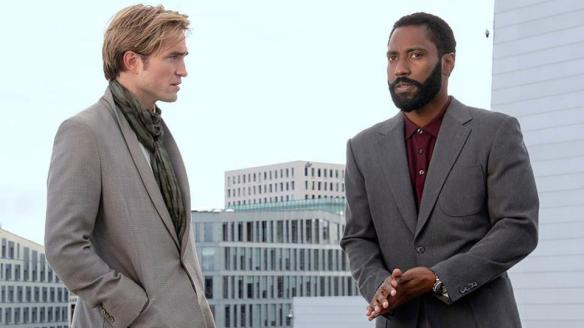
I tell you R-Patz, I just can’t stop washing my hands lately. You’d think I’d been reading Heidegger or something.
The End of Cinema, or at least American-led cinema
And so Tenet is here. Eventually. The most anticipated summer blockbuster of 2020 might also be the only summer (or autumn or winter) blockbuster of 2020 that actually gets released in cinemas. But not in America. I am still tentative about venturing to a cinema for the first time since the coronavirus arrived, but it’s a dilemma. There is no such dilemma Stateside, because Tenet is not being released in America. In some senses this merely makes painfully obvious what was already to be gleaned from statistical analysis of say Transformers or Fast and Furious: major American movies make more money overseas than in America. But the risk, to simply cut off the American market and throw it away as unnecessary, is still breathtaking on the part of Christopher Nolan and Warner Bros. And it seems, in this week of make-believe by Donald Trump that everything is rosy in the Rose Garden, that the pandemic has been defeated by his amazing leadership, that the roaring economy is now roaring again in a V shaped recovery, to take on an almost mythic cultural and political heft. The free world has given up on America providing any sort of leadership, and now even America’s own dream factory has given up on America. Americana still sells overseas, but the country itself is no longer a viable market.
There is an idea of a United States of America, some kind of abstraction, but there is no real country, only an entity, something illusory, and though it can hide its cold heart and you can see its flag-waving and hear its anthem deafening your ears and maybe you can even sense its values are probably comparable: it simply is not there.
Tarantino misreads 1960s television
When I returned home last August from watching Quentin Tarantino make shameful pigswill of reality with his nonsense version of the Manson Family Murders I watched the end of Kill Bill: Volume 2 randomly playing on TV and then turned on True Movies for their late night re-runs of The Man from UNCLE, and this only increased my annoyance with QT for also shamefully calumning late 1960s TV. Cinematographer Robert Richardson has noted that Tarantino deliberately included camera moves in the Western pilot that our hero Rick Dalton appears in that would have been utterly impractical for the era. Taken beside how he presents Rick’s appearance in the real show The FBI as a bad joke, you’d be hard put not to think that Tarantino is implying 1960s television was a waste of time. Which is odd given how he’s been perpetually circling a movie based on a 1960s TV show – Star Trek. The truth is that 1960s television was actually pretty good: The Prisoner, The Avengers, The Fugitive, The Man from UNCLE, Star Trek, The Twilight Zone, Voyage to the Bottom of the Sea, Thunderbirds, Mission: Impossible, Hawaii Five-O, The Monkees, Batman, The Invaders, Lost in Space, The Time Tunnel, Doctor Who, I Dream of Jeannie, Bewitched, Hogan’s Heroes, Rawhide, The Champions, Land of the Giants, Gilligan’s Island, Get Smart, The Munsters, My Favourite Martian, The Addams Family, Flipper, The Flinstones, Joe 90, Stingray, Captain Scarlet and the Mysterons, Dad’s Army, Steptoe and Son. Ask yourself why pop culture would still be in thrall to so many of these shows if they were all a bad joke…



 Talking Movies