Talking Movies

May 31, 2025

Miscellaneous Movie Musings: Part LVIII

As the title suggests, so forth.
Homework reading

I’ve had in my possession a copy of Chapman’s Homer for nearly a decade now, but have yet to look into it. But now my Keatsian epiphany is almost upon me, because I have to read it before Christopher Nolan’s new film comes out next year. The same thing happened in 2012 when I found myself crashing thru Charles Dickens’ A Tale of Two Cities before The Dark Knight Rises after Jonathan Nolan mentioned in interviews that he had drawn inspiration from it for the Fall of Gotham. I also read Gone Girl rapidly before David Fincher’s adaptation came out, after having read The Girl with the Dragon Tattoo when it was the book du jour before he was even attached to bring it to cinematic life. I feel like I should do something of the same for Paul Thomas Anderson’s somehow blockbuster One Battle After Another and blast thru Thomas Pynchon’s Vineland very fast in late summer. In some respects this way of reading makes me think of the old days of HMV, when they had, beside mugs and t-shirts, what one might dub rock and roll books – Fear and Loathing in Las Vegas, Trainspotting, A Clockwork Orange. It is a pretty daft way to decide what to read next. But frankly how I decide what to read next is usually barely a conscious decision and frequently quite daft, so why not? At least this way I can see what great directors do to their source material. And it usually is quite interesting to appreciate what they’ve cut and what they’ve elaborated – like reading Empire of the Sun and noting that Tom Stoppard heightens the trauma of JG Ballard’s first half by making everything that more personal.

The CGI Feint

It is very revealing that Disney’s publicity machine is hyping up the practical effects and sets used for The Fantastic 4: First Steps, as if setting it in the 1960s had led them to a revelation, and everything was now going to be executive supervised by Doug Trumbull beaming in from production on 2001: A Space Odyssey courtesy of Zoom and a handy wormhole. But we have been down this road before, and we know exactly where it leads. Remember JJ Abrams talking up the practical magick that was going to characterise his rip-off reimagining of Star Wars to get back to the true Spirit of ‘77. One cute BB-8 puppet does not outweigh multiple entirely CG’d characters and obvious great washes of CGI -just- everywhere. And l have no doubt The Fantastic 4: First Steps will be wall to CGI, with the occasional showy physical prop or effect for show. And this CGI will not be good: witness the worse than 2007 digital render of the Silver Surfress in the trailers. But why lie? Disney and Marvel want us to believe that this is them not shooting everything on greenscreen in Atlanta, with actors who are so addled from the Brechtian alienation of the process that they don’t remember what film they’re in, all adding up to people running around in drab grey CGI backgrounds in confused action scenes against vague welters of swirly destruction. If the audience is fed up with that, perhaps stop doing that. CGI has become a crutch for not knowing what you’re doing. If you build a model you have a clear idea for a sequence in which it will be used. Having a clear idea would also avoid effectively shooting your film three times, Captain America 2.0. Everyone wins.

Dead on the Money

To prepare for The Final Reckoning the other week I revisited Dead Reckoning, and must sheepishly admit to having a patented The Lord of the Rings: The Two Towers reaction to it. Back in 2002 I was somewhat miffed by the changes that Peter Jackson had made to the book when I first saw The Two Towers. I then went to see it twice more in the cinema. The second time I saw it I was curious to see if I was wrong about it, now that I knew the changes; I was. The third time I saw it was to enjoy it unabashedly for what it was, which was masterful. Dead Reckoning is not masterful, but it is far better than I remembered, because I was so annoyed at Ilsa Faust being written out of the story. (Is that Ilsa at the end of the Inception-like coda in The Final Reckoning? Isn’t it pretty to think so) I hadn’t really appreciated that Hayley Atwell delivers a performance of calculated flirtatiousness. In nearly every scene of the first two acts she is smiling, half-smiling, or simply has her mouth open. Around her Pom Klementieff’s Paris is a very good henchwoman, especially her absolute Fassbendering in the Rome chase sequence. The gripes about The Entity versus Samaritan in Person of Interest remain, but each Mission: Impossible film is different from its predecessor, and I have a terrible habit of underrating their rewatchability. The Final Reckoning suffers from less colour in its palette and sophistication in its globetrotting compared to Dead Reckoning, which also has the effect of dialling down the comedy. And yet who knows if I won’t appreciate that very tone for its own sake in the future? The three 2010s Mission: Impossible movies are constantly on TV for a reason – they are supremely rewatchable. And each is very different. Rogue Nation ends, compared to Ghost Protocol, on a muted note – a foot chase thru London rather than the visceral fist-fight in a mobile multi-level car park to prevent a nuclear strike. But that more muted note is the perfect note, chiming with Solomon Lane’s introduction. And while there is less sophistication and comedy in Fallout, the action sequences are stellar, and the ending is a nail-biting exercise in gruelling suspense. The mission is to rewatch.

May 31, 2024

The Drone Aesthetic was betrayed and murdered by Green Screen

Hollywood, the land of make-believe, has always walked a tightrope between reality and illusion. However, in recent years, the balance seems to have shifted dramatically.

I remember when this was a real picture of Ian McKellen saying I remember when this was all forced perspective

My jaw dropped when I saw a YouTube video showcasing VFX work done on The Wolf of Wall Street. I would have thought that Martin Scorsese was more or less immune to the world of green screen, but no, here were imaginary locations stitched together or created wholesale out of CGI. I had much the same reaction towards the vaunted grittiness of Joker, when behind the scenes footage showed great swathes of CGI being painted on the cityscape in the background because it wasn’t gritty enough. Physical sets, meticulously crafted by production designers like Guy Hendrix Dyas, and even costumes, painstakingly imagined by costume designers like Kym Barrett, are facing an existential threat: the ubiquitous green screen. This raises a crucial question – is the capturing of physical reality becoming a relic of the past in filmmaking? The allure of green screen is apparently irresistible because of its supposed cheapness. (This depends on outrageous working conditions for VFX artists as has become widely known now) It allows for the creation of fantastical worlds, impossible locations, and dazzling visual effects. Blockbusters like Avatar and Inception wouldn’t exist without it. However, this reliance comes at a cost. The meticulously built sets, painstakingly researched by production designers, become relegated to concept art that is inexpertly realised by stressed software jockeys. The tangible textures, subtle interplay of light and shadow on a physical costume: these elements that add key depth and realism to a scene are sacrificed for the sterile “perfection” of the green screen.

This decline in the importance of physical sets puts the future of production designers in question. Their skillset – the ability to translate a script’s vision into a tangible space, to breathe life into a fictional world through physical construction; to create, as Alex McDowell did for Fight Club, a building that appears to be decaying from the inside out, even as the narrator’s psyche similarly implodes –  may seem increasingly redundant. But before we write their obituary, let’s consider a new technology that this seachange has almost made obsolete before it even arrived: drone photography. Drones offer a unique opportunity to capture breathtaking cinematic landscapes. Smaller and more nimble (and safer) than helicopters, they can get remarkably close to actors and then soar with astonishing speed into wide vistas. Imagine soaring above a rugged mountain range, or weaving between towering skyscrapers, in a low budget production that could never dream of hiring a helicopter rig: drone footage can add a sense of epic scale and immersive sweep to any scene. Recently the TV show Catch Me a Killer utilised drone photography to great effect. Showcasing the varied landscapes of South Africa as Micki hunted serial killers in several provinces,  it helped give a sense of the geography of crime scenes, as well as providing great emotional impact to her nervous arrival at a particularly intimidating new police headquarters. These are the two uses I first wrote about when the BBC started using drones in documentaries: explaining geography, and depicting emotional isolation.

I remember when this was all forced perspective

This application of drone technology isn’t new. Shows like Supernatural and the second revival of The X-Files were using drones almost a decade ago to capture startling establishing shots, and provide a cinematic sweep to the simplest scenes of characters moving thru locations. Low budget feature films gratefully embraced them too. The enigmatic opening sequence of Don’t Breathe wouldn’t be the same without the drone’s unsettling slow descent through the dilapidated Detroit setting. So, why has drone cinematography seemingly stagnated in cinema since? The answer, much like the almost total abandonment of 3-D, lies in the extreme overreliance on green screen. When everything is shot on a green screen soundstage, there’s no physical location for a drone to showcase. The actors are adrift in a sea of pixels, and the vast landscapes they traverse are likely just as digitally generated as their weightless capes. (I’m looking at you, Doctor Strange) There’s a distinct difference between the visceral thrill of a drone soaring through a real canyon and the weightless, sterile feeling of a digitally created CGI simulation. Drone footage, when used judiciously, could ground the most fantastical story with a sense of physical reality. Just look at the difference between The Lord of the Rings, with its sweeping aerial photography locating its characters in rugged mountain landscapes hiding from a flock of Saruman’s scouting birds, and the overlit wall to wall CGI madness of The Hobbit’s escape in barrels down a river, leaving a thoroughly wasted potential tour de force.

The opening episodes of season 3 of SEAL Team set in Serbia set a new bar for action choreography with drone photography. But that was October 2019 and Covid prevented anyone really rising to its challenge for a while. Until Michael Bay, bored out of his mind during lockdown, decided to make one of his small personal movies, and went wild with drones. Ambulance can use drones because for the most part it is not shot on a green screen soundstage. At times Bay’s use of drones is vertigo-inducing as they dash across rooftops, start an establishing shot by falling down the side of a building and twisting about. (It also seems at times damn unsafe, as the drones shoot past actors in enclosed spaces at the speed of sound) But it is extremely telling that a man who loves to roll cars and blow stuff up is the one who rises to the challenge of using drone photography in cinema, because he can; because he is doing a lot of this stuff for real, in a physical location. The future of cinema must be about a return to reality. Green screen may allow for fantastical worlds, but without the foundation provided by physical sets or locations, those worlds feel hollow and derivative. A copy of a copy of a copy, so many swirling trash cans in the sky. Production designers are not digital set builders. Their irreplaceable skill set lies in crafting tangible worlds, imbued with texture and detail.

Costume designers too have a vital role to play in creating physical garments that translate to the screen with a depth and authenticity that CGI simply cannot match. People have spoken of the magical moment when an actor puts on the cape for the first time and the set goes silent as people suddenly behold Superman in their midst. By contrast poor old Benedict Cumerbatch is walking around with the knowledge that a weightless cape will be hurriedly added in post-production because that’s a better idea than actually designing and manufacturing and fitting a real cape for him to work with as Doctor Strange. And Tom Holland has been playing Spider-Man without the benefit of actually being able to look down at his body and see a red costume with a black spider logo. Ultimately, the magic of cinema lies in its ability to transport us – to make us believe in worlds both real and imagined. The point of Hollywood trickery was to fool the eye. Now our eyes are not fooled, but we are taken for fools by an industry that insists this is good enough. Nope. By embracing physical artistry and real locations, film-makers can continue to create experiences that resonate on a deeper level. The future of Hollywood may involve pixels, but it shouldn’t come at the expense of capturing the physical world that has always been the wellspring of cinematic truth. Without a return to reality, cinema risks becoming a mere shadow of its former self.

May 12, 2024

60s TV/90s cinema: Mission: Impossible

FilmFour has been showing the first Mission: Impossible movie a lot recently and I decided to check it out after watching two seasons of the original television series on Legend.

Brian De Palma’s 1996 blockbuster shows that the idea of alienating your built-in audience by subverting expectations has been going for quite some time now. I only recently discovered that Peter Graves was offered the opportunity to reprise his already once-reprised role as the team leader Jim Phelps, and not only refused when he realised he would be playing the villain, but then went on CNN to decry the film-makers’ for their disrespect. It is quite the slap in the face for fans of the show for Phelps to die along with all but one of his team (sic) in the first half hour of the movie. Especially given that Phelps’ team hardly ever had someone caught or killed during the lengthy run of the 60s show and its shorter 80s revival. But to then resurrect the character, just to unmask him as the villain who killed his own team, and have Henry Czerny’s spymaster drip irony all over the sentence “Good morning Mister Phelps” is a slap in the face with a wet fish.

With the distance of nearly thirty years it’s noteworthy that the standout sequence of the movie is also the most practical. In a series now renowned for its practical stunts it’s hard to imagine the helicopter in the Chunnel sequence being imagined and shot in the same way as in the 90s when CGI was only enhancing reality rather than replacing it outright. The influence of the show is felt most in the cold open, which calls back to many moments where someone is broken by faking a reality around them, and then in the Langley heist. This is where a double mirror comes into play. The intricate planning sequences, complete with technical demonstrations and lengthy largely silent capers, evoke the style of mid-century French crime thrillers. Think Rififi and Le Cercle Rouge, and in between the Rififi director’s English language Topkapi. And as the heist in the film Topkapi was a major influence on Mission: Impossible creator Bruce Geller’s thinking on how to present intricate heists, switches, and escapes every week in the limited time available on television it is quite something to see the film adaptation of his work so directly return to the source with Topkapi‘s heist which is also derailed by a small animal running amok.

The film’s score, composed by Danny Elfman, is another interesting point of comparison to later installments. Elfman, as is so often the case, has rhythm, but not a truly memorable melody. And he stubbornly refuses to use the memorable melody he has as part of the IP he’s working on. In the big ‘trailer moment’ when Tom Cruise dynamites an aquarium to make good his escape from a Prague restaurant the music swells to Elfman’s original melody. Much in the way that Jon Ottman’s score for Superman Returns and Michael Giacchino’s music for the Star Trek reboot shy away from utilising the iconic themes already associated with those franchises in favour of their own patently inferior melodic inventions. In Mission: Impossible‘s case, Elfman incorporates Lalo Schifrin’s legendary television theme at the end of the Langley sequence and the Chunnel sequence but is otherwise reluctant to engage with one of the greatest melodies of the past sixty years. By contrast Lorne Balfe opted to showcase Schifrin’s incredibly versatile secondary theme ‘The Plot’ in Mission: Impossible – Fallout.

But is the film confusing? Knowing the twists and having it seen a number of times it doesn’t seem that confusing. But at the time certainly it was perceived as such. And it was incredibly unnecessary. It’s an artefact of a 90s sub-trend for over-plotting what should be remarkably simple enterprises. The Phantom Menace and its gibberish about trade treaties is another lowlight. Oscar Wilde said that plot existed to give characters the opportunity to say witty things. In a Mission: Impossible film the plot only needs to make enough sense to get from one elaborate set piece to the next. Something that really only seemed to be realised when Christopher McQuarrie started writing for the franchise. And then you realise that Mission: Impossible – Ghost Protocol, his first uncredited contribution, has two people being fooled into believing a meeting took place between them that never occurred. While in the 60s show Martin Landau’s master of disguise Rollin Hand plays both an assured molehunter and a nervous whistleblower to convince two people that they have been working together when they in fact have never even met thanks to his intercepting the crucial briefing document and switching out a photo for his own. A fan of the show has entered the building!

It could be said the film series came into its own only when it showed love for the television show.

February 8, 2024

Miscellaneous Movie Musings: Part XLIX

As the title suggests, so forth.

Gotham Inc.: Warner Brothers and their intellectual property – Part II

Warner Bros is preoccupied right now with trying, via casting announcements, to stoke excitement for their relaunch of the DCEU. (Not helped by Matthew Vaughn wondering aloud what director would be happy to have their Supergirl cast for them) But the clock is literally ticking. This is 2024 – Superman and Lois Lane will enter the public domain in 2034. They will be followed by Batman in 2035, the Joker in 2036, and the final member of the DC Trinity, Wonder Woman, in 2037. That bears repeating – in ten years anybody with an iPhone and a Halloween Supes costume can make and release their own Superman movie, and there is not a damn thing that the WB can do to stop them. A Variety article discussing the upshot of this legal cliffhanger saw trademarks as an obstacle to marketing, and also noted that certain elements would remain out of touch for longer. (So my idea for a Superman movie goes on the back burner for an additional five years until kryptonite is available) That article also blithely suggested that quality control would prevent the emergence of rival cinematic Supermen. Which struck me as unintentionally funny. Zack Snyder had Superman murder Zod, with the neck snap heard around the world. If Jon Favreau was to direct a knock off Superman movie in which Kal-El imprisoned Zod in the Phantom Zone, which of these cinematic Supermen would be the one that was the true keeper of the flame? Because in truth these characters should be in the public domain because they are, in part, public creations at this time. It’s not just Jason Todd that died by popular vote, audiences also effectively downvoted the 1990s filmic Batman. And, indeed, despite much protestation by some loud voices, they delivered the same thumbs down to the Snyderverse. When audiences can dictate what happens to characters aren’t they starting to flex their muscles as co-creators of the current iteration? Also, by 2034 who knows how far AI and CGI might have advanced? Perhaps the dream of 1930s Bat-movies will be attainable once the Gable estate comes round to the idea.

Maestro and histrionic conducting

“What do I do? I play the orchestra” – Jobs to the Woz, Steve Jobs

I was taken aback at the big bow wow finale of Maestro, with Bradley Cooper practically bent backwards, eyes closed – ‘conducting’ the orchestra in Mahler’s second symphony. The damndest thing is that it accurately captures how Leonard Bernstein conducted that piece on that occasion in Ely Cathedral. Performing the part of the conductor rather than just conducting. It reminded me of the unintentionally funny egomania that eventually saw Herbert von Karajan insist all footage of the Berliner Philharmoniker should include him. I find such histrionics desperately insecure and lament their legacy in gurning conductors of the moment. At a recent concert in the front row I was astonished to hear a swooshing sound was the conductor’s grimaces and exhortations to the musicians. This is conducting that draws attention to itself. And it’s not necessary to get the job done. Karina Canellakis is noticeably controlled on the podium. And then there is the Zen stillness of the conductor of this performance of the Oppenheimer score; which one would’ve thought a godsend for huffing and puffing. If it’s more important to be seen doing the job very hard than actually doing the job well then have at it. After all this is a perfect match: if Cooper wins the Best Actor Oscar it will be because he hammered us all over the head with how hard he was trying to win an Oscar for this damn performance.

January 22, 2024

Any Other Business: Part LXXX

As the title suggests, so forth.

So Help Me Todd Season 1 Episode 19 86'd

So Help Me Todd and the John Hughes imperative

There has been quite a bit of chatter over the last months about the disappearance of the Hollywood comedy; sacrificed on the altar of the international appeal of special effects laden superhero movies which require no linguistic comprehension. I thought of this when I was watching a hilarious sequence in an episode of So Help Me Todd recently and was put in mind of John Hughes. Whereas in a season 4 episode of Westworld I had despaired at how they were throwing away a conceit that a De Palma would have wrung much suspense out of, in the need to not blink when the robots are near even if a fly crawls over your eyeball, here I was almost spitting tea out as Todd, extremely bedraggled from eating precisely the wrong thing in an off the books bakery, could not attend for undercover work as a dishwasher so his mother Margaret had to stand in for him, leaving her bright yellow jacket draped over him, so that, combined with the spiffy car, dark glasses and air of ennui, he was mistaken by the head chef for a famous food critic, notorious for attending restaurants in disguise, and violently hustled indoors as a honoured guest to be presented with some truly barfworthy fussy cuisine which he promptly (but discreetly) barfed into the handily positioned handbag of a diner at the next table … his mother’s exacting boss Beverly. I thought of Ferris Bueller versus the snooty maitre d’, and of the Griswold house’s Christmas lights draining the Illinois power grid. John Hughes was never afraid to unexpectedly go big and break the bounds of reality when he saw a good payoff coming from it.

Luke Skywalker, a Balliol man

In the justified outrage about a Rey film being greenlit despite the opposite of public demand, I saw someone on YouTube scathingly compare her angry screaming while rampaging about with a lightsaber to a canonical description of the Zen calm which the Force is meant to imbue an actual Jedi master. And then followed directions to see Luke Skywalker’s CGI cameo in The Mandalorian. Which indeed was just such a Zen calm; a no drama dispatching of hordes of enemies, without haste, without concern, without anger or emotion. And of all things I thought of the Liberal Prime Minister Asquith and the Balliol College motto coined by him – “Tranquil Consciousness of Effortless Superiority”.

December 24, 2022

Miscellaneous Movie Musings: Part XLV

As the title suggests, so forth.

The Way of All Flesh

It’s been thirteen years since Avatar was released, and here comes the sequel. That is a preposterous delay, but one of the most interesting things for me is that it pinpoints a seachange that I missed because of my general checking out of the MCU. At one point in the 2010s it seemed like 3-D was the defaut mode for blockbusters. Not real properly planned and photographed 3-D of course, just post-production conversion. There was a time when I had to carefully scan the cinema listings so I could boycott 3-D, and its outrageous surcharge, and just see films in glorious 2-D. And, because I stopped going to see the increasingly bland Marvel movies and their ilk, I didn’t notice when it happened but clearly that situation flipped, and suddenly most screenings were 2-D again, and it was 3-D screenings you had to seek out. I would like to think that some of this was simply people voting with their feet, but equally with Disney’s monopoly/monopsony power it could simply be that they dropped 3-D conversion because with their increasing affinity for last-minute CGI VFX there simply was no finished product to convert. And so everybody had to adjust to that, studios and audiences alike. In the same way that the 2010s have seen audiences inured to sloppy fight editing, vague and incomprehensible action sequences, with frankly embarrassing CGI blighting all. But for a whole generation that’s normal; cinema is CGI capes that look crap.

Unseen & Unheard

Talking of things that are frankly embarrassing, ahem, my first reaction to seeing Vertigo toppled in the Sight & Sound poll because of incredibly obvious vote-rigging was to laugh out loud. I don’t have much time for the Sight & Sound poll, so I’m not hugely invested in defending its integrity. I genuinely feel it’s sheer good luck that Vertigo ever got the accolade. Back in 2012 I was just nonplussed by the results. I felt that people weren’t genuinely voting on what they thought were the greatest films of all time after much thought and prayer. They weren’t even voting for their own personal favourite films in a spirit of adorable idiosyncracy. They were not voting for anything they actually liked or thought good, but voting with an eye to impressing other people, to try and outdo other critics with their obscure choices in a spirit of too cool for film school. At the time I said the amount of silent films that had popped up was akin to someone saying I love the theatre but it’s all been downhill since they stopped wearing the masks. A statement that would not make it immediately obvious that this person actually does love the theatre. And this time round the process has been even more transparently absurd. But who cares? Whatever the intention was, it has surely backfired.

January 20, 2020

That Was The 2010s

The first Sunday Breakfast with Patrick Doyle of 2020 unveiled the pick for best film of 2019 as well sober reflections on the changing meaning of cinema in the 2010s.

511ec57c414ae_gandalf_green

I remember when this was all forced perspective sets

If you regard The Dark Knight as being the last great film of the 1990s, owing to its use of CGI as building upon spectacular practical special effects shot in real locations, then there are few better indicators of how the 2010s shook itself free from the 1990s than comparing The Lord of the Rings with The Hobbit.  The Lord of the Rings began production in the 1990s and so had location shooting, armoury and costumes and prosthetics by the truckload, and huge miniatures to complement CGI on top of these practical special effects. The Hobbit did not, as the above picture shows.

As the decade wore on the voice that spoke up for practical effects disappeared. It was unusual when George Nolfi decided to build a men’s bathroom in a baseball stadium in The Adjustment Bureau rather than use a CGI backdrop for when Matt Damon and Emily Blunt use a magic fedora to transport from one location to another. By the time we got to the fiasco of Cats there was no left to ask – why can’t we just use make up and costumes like the stage show?

As cinema ceased to be photography of actors in real locations or dressed sets with practical effects to be projected on a big screen in the dark for a communal experience with an audience of strangers gathered for a two hour experience did the term cinema cease to exist in continuity with a century of development?

https://m.mixcloud.com/patrickdoyle/5120-the-sunday-breakfast-show-with-patrick-doyle/

December 22, 2019

From the Archives: Enchanted

From the pre-Talking Movies archives.

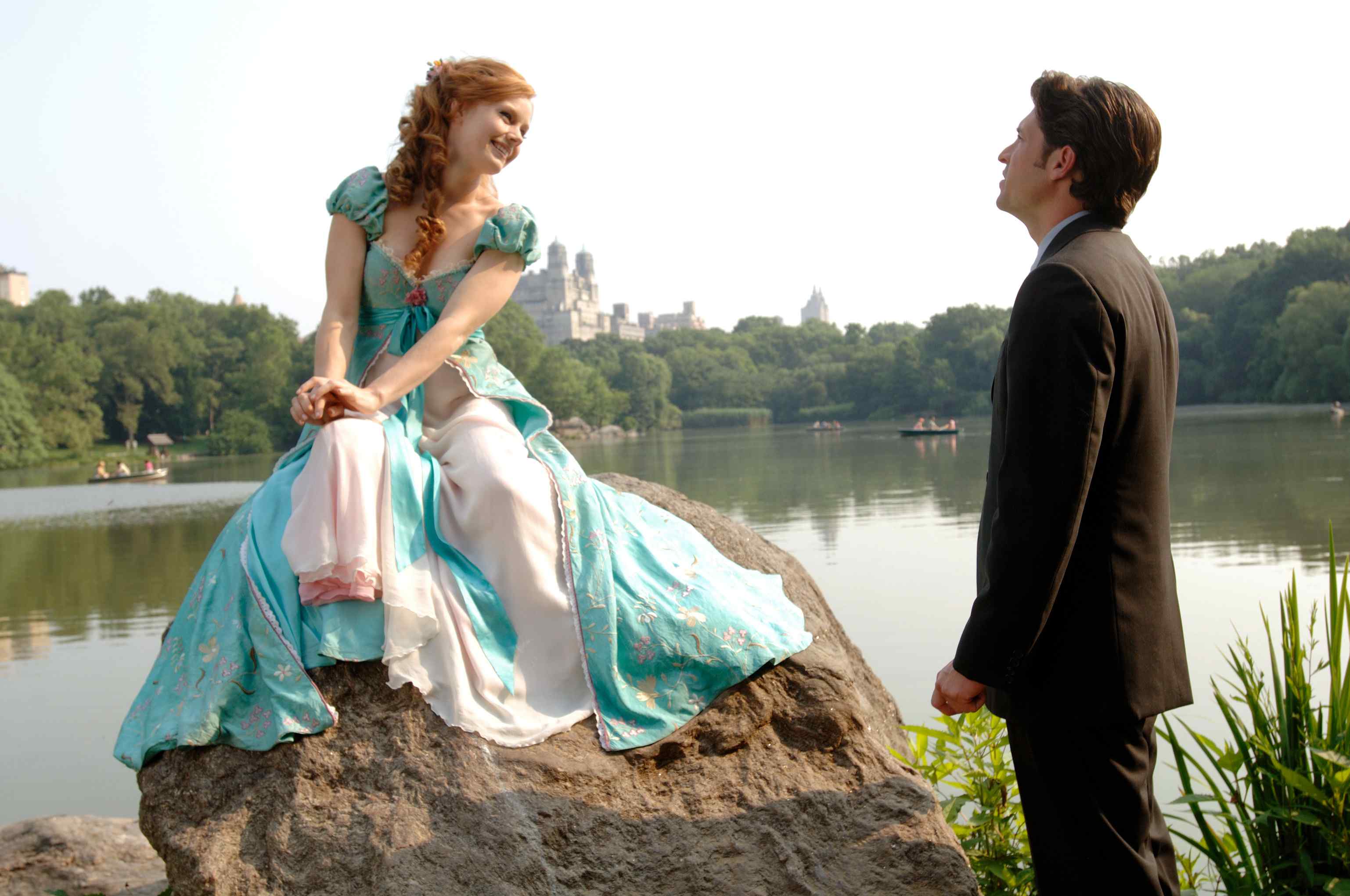
Disney does self-parody, and it’s awesome. Shrek is exposed as the under-achieving mean-spirited wretch it always was by Disney’s generous ribbing of their own fairytale animations. This is one of the best films of the year, in which the flaws (such as the hilariously confused message about marriage and romance) do not matter as they are mere quibbles beside everything that is done superbly. The cast is even littered with cameos by voice actors who worked on old Disney films to announce that the Empire of the Mouse is striking back. The hilarious trailer tells you all you need to know about the plot. Amy Adams (who’ll always be a meteor-freak-of-the-week on Smallville to me) is perfect casting as the hopelessly naïve animated fairytale princess-to-be Giselle of Andalasia, who gets a harsh reality check when thrown down a well from which she emerges into live-action NYC, even if she does succeed in getting cockroaches to help with household chores by singing to them.

McDreamy, I mean Patrick Dempsey, plays Robert Phillip, the archetypal hard-hearted New York divorce lawyer. His calculated wooing of Nancy (played by Broadway star Idina Menzel) is chaotically upset by the arrival of Giselle in his life and the obvious bond between Giselle and his young daughter. The big musical number in Central Park doesn’t have the greatest tune but it’s performed with enough energy to make up for it as, much to Phillip’s embarrassment, buskers start to help out Giselle’s spontaneous singing. The song ‘True Love’s Kiss’ though has a great melody and also provides one of the best gags in the film, of course it involves James Marsden. Marsden as Prince Edward is an absolute scream in this film. His prince is dashing in animated Andalasia but a snobbish, misogynist ninny in NYC. He scoops up most of the film’s best lines including the priceless “Thank you for taking care of my bride, peasants!”

Sometimes progress isn’t all it’s cracked up to be, compare the grotesque humans of CGI animation with the traditional method here which perfectly renders Timothy Spall’s Nathaniel, servant of the evil Queen who helps her in her quest to stop Giselle marrying Prince Edward and so taking her throne. Spall follows Edward into the real world and dons ‘disguises’ and a series of increasingly ludicrous/racist foreign accents as he tries to feed a poisoned apple to Giselle. He’s such a failure at being evil that eventually the wicked queen herself makes the leap into NYC. Susan Sarandon as her physical incarnation is so heavily fright-made up that she looks like her old Rocky Horror co-star Tim Curry’s Dr Frank-N-Furter. Her grand entrance at the film’s finale in the style of General Zod trashing NYC in Superman II is to be relished, but then so is everything in Enchanted. Truly essential viewing.

5/5

From the Archives: Bee Movie

From the pre-Talking Movies archives.

This is a bit of a conundrum to review. Don’t get me wrong, this is a good movie that features some hilarious gags. It is certainly several leagues above Dreamworks’ previous animated feature this year, the dire Shrek the Third. Jerry Seinfeld, who finally stopped doing stand-up to make this film, has really thought out the internal logic for his epic about bee society. The depiction of the worker bees that leave the hive to collect pollen is hilarious as they’re all jocks in a Top Gun style fighter squadron valorised by the rest of the hive. The sequence where Barry B Benson (voiced by Seinfeld) finally achieves his dream and flies with them on a sortie through the city is genuinely exciting. The problem is that while there are a number of great gags which are truly of the calibre you expect from a Seinfeld script the movie overall feels somewhat flat. This oddly deflating vibe is exemplified by the use of Chris Rock, who is hilarious but appears in just three scenes as the voice of a mosquito.

Despite the spirited protestations of Dreamworks Animation supremo Jeffrey Katzenberg there is no doubt that this film is less in thrall to celebrities than previous Dreamworks fiascos like Shark Tale. The presence of Patrick Warburton, who voices ultraviolent bodyguard Brock Samson in cult animated show The Venture Brothers, is testament to that. I have no idea what Warburton looks like, he’s a voice actor, and he’s hilarious as Ken, Vanessa’s jock boyfriend who has absurd self-confidence. In Shark Tale celebrities whose voices aren’t particularly memorable were made obvious by making all the anthropomorphic fish look exactly like the person voicing them. The characters were then made exactly like the screen persona of these stars. Which it must be admitted is about as far removed from the idea of an actor bending themselves into a role as is possible to imagine. Here Seinfeld is recognisable as a bee but no one else really is bar real human characters like Ray Liotta and Sting (both mocking themselves with gusto) and a gag about B Larry King.

The plot is very similar to Antz with an extremely neurotic Jewish insect (seriously, the amount of Jewish references here would appear excessive in a Woody Allen film) agonising over his life and his attempts to become an individualist in a conformist society. This is done in typically melodramatic Hollywood fashion by suing humans for stealing honey. The bees are helped by Renee Zellweger’s kind-hearted florist Vanessa for this showdown which should theoretically enable Barry’s hive to have more time for leisure and a life outside of work. But that’s not the end of the story. Seinfeld cleverly subverts the clichés established by Dreamworks’ ‘subversive’ films but it still doesn’t make this essential viewing.

3/5

December 15, 2019

From the Archives: The Golden Compass

From the pre-Talking Movies archives.

A shockingly humourless bore that is even more tiresome than 2005’s Narnia. The first thing to go with fundamentalists, whether they are religious fundamentalists or atheist fundamentalists like Philip Pullman and Richard Dawkins, is always the sense of humour. It should come then as no surprise that there is only one gag, involving Sam Elliott’s daemon rabbit, in The Golden Compass. Philip Pullman fans have whinged that the message of the book has been neutered. One can only wonder how stridently didactic the book’s Anti-Catholicism is if that’s true, because it is painfully obvious here that The Magisterium is the Catholic Church, which must be EVIL because all the actors playing its members have adopted the camp Nazi mannerisms of ’Allo, ’Allo. Beating the mortal crap out of Catholicism is of course socially acceptable, we just shouldn’t hold our collective breath waiting for Pullman to do a similar hatchet job on Islam or Judaism. Such bigotry makes the posturing of the Oxford dons about ‘tolerance’, and the existence of the daemons as the incarnate souls of each person, preposterously illogical.

Director Chris Weitz thinks that if he throws enough CGI at the screen and sets the orchestral bombast at a (noticeably) ear-piercing volume he can distract from the pathetic script. He’s badly mistaken and the result is just plain boring. Heroine Lyra Belacqua’s carefully cultivated Mockney accent, despite being the niece of Lord Asriel (played by Daniel Craig, for literally 7 minutes), is incredibly irritating and newcomer Dakota Blue Richards lacks the acting chops to overcome such a fatal character detail. At no point do we care about Lyra’s fate, even when imprisoned by Nicole Kidman’s typically anaemic villain. Some actors do salvage something from the wreckage though. Ian McKellen is clearly enjoying himself far too much voicing an armoured polar bear, as is Sam Elliot in a reprise of his Big Lebowski role as an Old West character comically out of place, while Eva Green’s cameo as a flying witch queen should convince everyone that she needs to play the lead in the new Wonder Woman movie.

The final showdown at an arctic Magisterium facility that is half mental hospital, half convent school, is the occasion for some more deeply confused Catholic-bashing as children are separated from their daemons. ‘Dust’ and Sin are hilariously equated before a comically inept Empire Strikes Back style “No Lyra. I am your mother!” revelation occurs, which is then ignored in the rush to get to the badly choreographed ‘epic battle’ and much speechifying to set up the plotline for a sequel or two.

1/5

Next Page »

Create a free website or blog at WordPress.com.

Design a site like this with WordPress.com
Get started