Batman Begins is 20 years old, but is as fresh now as it was on release.
How to relaunch a dead franchise in two easy steps. Hire Christopher Nolan. Don’t get in his way. This set up the best Batman film ever made, in fact probably the best superhero film ever made. But this is more than just a foundational step, it is a deeply satisfying story in its own right. It is very quotable and has a cast of highly recognisable faces in almost every role. No film ever made it clear before just how much of a hero Bruce Wayne was in choosing not to live in luxury but to go out and fight for people who’ll never thank him or know him. That was the brilliance of doing a movie in the Richard Donner vein of verisimilitude about a superhero with no powers beyond discipline and will.
Inception continues to stand as a singular film as time goes by, with no other blockbuster since coming near it.
Inception endures not just for the tremendous redemptive emotional kick the whole movie builds to, when you read the film on its most superficial level where it’s too neat structurally for its own good, but because once you look deeper you realise that this is a puzzle piece worthy of a UCL English graduate; it supports many contradictory readings, none of them definitive. See a loose thread and pull and the garment does not unravel, it changes pattern and remains coherent. ‘Ariadne is too obviously an expositional device’. Yes, unless her insistence on talking through the plot with Cobb is because she’s a therapist hired by the rest of the team to exorcise Mal from his memory… This is a blockbuster rubik’s cube of a caper movie combined with sci-fi thriller, which exploits the ability give physical reality to subconscious emotional scars, in order to dazzle both eyes and mind with spectacle, ideas, and meaty drama.
Some films stand towering above the others of their decade as a monument to be approached with awe; after 30 years we can say Heat is one of those films.
The Oscars, hilariously and customarily, did not think it worthy of a single nomination because it would not be influential; the way Il Postino would be. Snarf. The Dark Knight obviously borrows an actor William Fichtner to stage a bank job as its opening sequence, and Christopher Nolan has admitted the interrogation scene between Batman and Joker and the sense of urban combat were indebted to Heat. Key to the success of Heat is its sense of reality. From the deafening sound of “WW2 on the streets” when LA’s finest interrupt the getaway of the best crew in the business, to the care with which writer/director Michael Mann has small charges set off to simulate cars being peppered with bullet holes, to the intricacies of metals research and planning that characterise the work of Robert De Niro’s Neil McAuley.
Mann’s 1989 TV movie LA Takedown has the same basic outline as Heat, for which it acts as perhaps the most outrageously developed proof of concept in history, but what it is missing isn’t just the charisma of A-list Hollywood stars but the blockbuster budget that buys Time and Space. The coffee scene in Heat works, not just because it has the fabled first onscreen dialogue between Al Pacino and Robert De Niro, but because it has Time: for thoughtful silences, shifting facial expressions, dramatic pauses – in a word, nuance. Heat is nearly three hours long, and it uses every second of it to really immerse you in the world of these characters. And Mann paints on the broadest of canvasses, from aerial views of Los Angeles, and emptying hotels, to military grade street gun battles, and deserted lot ambushes.
And yet, Space isn’t simply the ability to fill the screen with vast cityscapes, it is the freedom to tell the story thru tense close-ups that rival those of Sergio Leone’s Spaghetti Westerns. Look at the first (sic) stand-off between Pacino and De Niro. Mann shoves the camera into Pacino’s face as he holds his breath hoping that the suddenly tipped-off De Niro does not call off the metals heist. We feel the characters reacting to each other, though they have not yet both become aware of each other. Later the tension of Val Kilmer’s attempted rendezvous with his wife is conveyed thru a closeup of Pacino on a phone waiting for word on whether he’s got his man. But neither Pacino nor De Niro is simply a lone wolf. Mann richly fleshes out two opposing forces, and their connections.
Mann paints a Greek tragedy in a crime thriller: a man who lives by a code is home free, bathed in beatific light as he drives thru a tunnel, and then his face flickers from its contentment, and the light fades, as the urge for revenge surges and undoes him.
I’ve had in my possession a copy of Chapman’s Homer for nearly a decade now, but have yet to look into it. But now my Keatsian epiphany is almost upon me, because I have to read it before Christopher Nolan’s new film comes out next year. The same thing happened in 2012 when I found myself crashing thru Charles Dickens’ A Tale of Two Cities before The Dark Knight Rises after Jonathan Nolan mentioned in interviews that he had drawn inspiration from it for the Fall of Gotham. I also read Gone Girl rapidly before David Fincher’s adaptation came out, after having read The Girl with the Dragon Tattoo when it was the book du jour before he was even attached to bring it to cinematic life. I feel like I should do something of the same for Paul Thomas Anderson’s somehow blockbuster One Battle After Another and blast thru Thomas Pynchon’s Vineland very fast in late summer. In some respects this way of reading makes me think of the old days of HMV, when they had, beside mugs and t-shirts, what one might dub rock and roll books – Fear and Loathing in Las Vegas, Trainspotting, A Clockwork Orange. It is a pretty daft way to decide what to read next. But frankly how I decide what to read next is usually barely a conscious decision and frequently quite daft, so why not? At least this way I can see what great directors do to their source material. And it usually is quite interesting to appreciate what they’ve cut and what they’ve elaborated – like reading Empire of the Sun and noting that Tom Stoppard heightens the trauma of JG Ballard’s first half by making everything that more personal.
The CGI Feint
It is very revealing that Disney’s publicity machine is hyping up the practical effects and sets used for The Fantastic 4: First Steps, as if setting it in the 1960s had led them to a revelation, and everything was now going to be executive supervised by Doug Trumbull beaming in from production on 2001: A Space Odyssey courtesy of Zoom and a handy wormhole. But we have been down this road before, and we know exactly where it leads. Remember JJ Abrams talking up the practical magick that was going to characterise his rip-off reimagining of Star Wars to get back to the true Spirit of ‘77. One cute BB-8 puppet does not outweigh multiple entirely CG’d characters and obvious great washes of CGI -just- everywhere. And l have no doubt The Fantastic 4: First Steps will be wall to CGI, with the occasional showy physical prop or effect for show. And this CGI will not be good: witness the worse than 2007 digital render of the Silver Surfress in the trailers. But why lie? Disney and Marvel want us to believe that this is them not shooting everything on greenscreen in Atlanta, with actors who are so addled from the Brechtian alienation of the process that they don’t remember what film they’re in, all adding up to people running around in drab grey CGI backgrounds in confused action scenes against vague welters of swirly destruction. If the audience is fed up with that, perhaps stop doing that. CGI has become a crutch for not knowing what you’re doing. If you build a model you have a clear idea for a sequence in which it will be used. Having a clear idea would also avoid effectively shooting your film three times, Captain America 2.0. Everyone wins.
Dead on the Money
To prepare for The Final Reckoning the other week I revisited Dead Reckoning, and must sheepishly admit to having a patented The Lord of the Rings: The Two Towers reaction to it. Back in 2002 I was somewhat miffed by the changes that Peter Jackson had made to the book when I first saw The Two Towers. I then went to see it twice more in the cinema. The second time I saw it I was curious to see if I was wrong about it, now that I knew the changes; I was. The third time I saw it was to enjoy it unabashedly for what it was, which was masterful. Dead Reckoning is not masterful, but it is far better than I remembered, because I was so annoyed at Ilsa Faust being written out of the story. (Is that Ilsa at the end of the Inception-like coda in The Final Reckoning? Isn’t it pretty to think so) I hadn’t really appreciated that Hayley Atwell delivers a performance of calculated flirtatiousness. In nearly every scene of the first two acts she is smiling, half-smiling, or simply has her mouth open. Around her Pom Klementieff’s Paris is a very good henchwoman, especially her absolute Fassbendering in the Rome chase sequence. The gripes about The Entity versus Samaritan in Person of Interest remain, but each Mission: Impossible film is different from its predecessor, and I have a terrible habit of underrating their rewatchability. The Final Reckoning suffers from less colour in its palette and sophistication in its globetrotting compared to Dead Reckoning, which also has the effect of dialling down the comedy. And yet who knows if I won’t appreciate that very tone for its own sake in the future? The three 2010s Mission: Impossible movies are constantly on TV for a reason – they are supremely rewatchable. And each is very different. Rogue Nation ends, compared to Ghost Protocol, on a muted note – a foot chase thru London rather than the visceral fist-fight in a mobile multi-level car park to prevent a nuclear strike. But that more muted note is the perfect note, chiming with Solomon Lane’s introduction. And while there is less sophistication and comedy in Fallout, the action sequences are stellar, and the ending is a nail-biting exercise in gruelling suspense. The mission is to rewatch.
Ralph Fiennes is Odysseus, at long last home from the Trojan War, but this bitter nostos to Ithaca and Penelope will be the real battle.
Something is rotten on the island of Ithaca. The land is ravaged by the (ahem) suitors of Queen Penelope (Juliette Binoche), who steal the food of the land, kill the natives without provocation, and abuse her son Telemachus (Charlie Plummer). Into this cesspit comes Odysseus, who washes up naked on the beach, and is cared for by faithful slave Eumaeus (Claudio Santamaria), who, along with the faithful hunting dog Argos, recognises his master when nobody else does. The machinations of the avaricious suitors, led by the duplicitous Antinous (Marwan Kenzari), see the aggressive boors Pisander (Tom Rhys Harries) and Polybus (Jamie Andrew Cutler), tire of Telemachus’ existence, and Penelope’s stalling, and decide to put an end to both. Can the now aged Odysseus overcome his survivor’s guilt, his post-traumatic stress disorder, and Penelope’s disdain, and violently reclaim his rightful throne?
Who cares? The Return is hands down one of the most boring films I have ever suffered thru in a cinema. I spent a good chunk of time wondering if this was the most unengaged I had been since The Killing of John Lennon in late 2007. Possibly. Director Uberto Pasolini shears Homer of gods and monsters, no doubt he’ll say for reasons of relevance to the contemporary concern with trauma and war. More likely it’s the general can’t-be-bothered-ness that characterises modern culture’s attempts to grapple with religion ancient and extant, and the even more likely reason of having no budget. The screenplay Pasolini wrote with John Collee and Edward Bond stretches out to nearly two hours a treatment that makes you feel you are watching The Scouring of the Shire but without getting The Lord of the Rings first.
The bar has been set very bloody low for Christopher Nolan to clear with next year’s blockbuster treatment of the foundational story of Western Civilisation. He’s got money.
I recently rewatched The Green Hornet in the company of The Engineer. He had never seen Seth Rogen’s take on the character before. And we both noted that it fell into the 1996 Mission: Impossible pitfall of taking a beloved character from the original and making them the surprise villain in order to subvert expectations. But this unloved trend of disrespect towards the characters that are the reason a film has been made in the first place goes back a long time. I was watching The Mummy’s Tomb from 1942 during the year on Legend and was baffled at how it was structured, until I realised that our narrator telling us his past was in fact a shameless means to smuggle in stock footage from The Mummy’s Hand. And then they killed off said narrator of past heroism to start the new adventure. I was outraged. I haven’t even built up that much emotional investment in a fun 1940s B-movie, but the slap in the face was undeniable, and I just thought anew of how much a slap in the face “Good Morning, Mr Phelps” in the third act of 1996’s Mission: Impossible really was after seven seasons and a revival of the original television show. If you are being given the opportunity to play with toys because of previous successes, please treat them as if they are precious and don’t think you’re cool or clever by stomping on them and losing access to the sandbox.
TenetRevisited
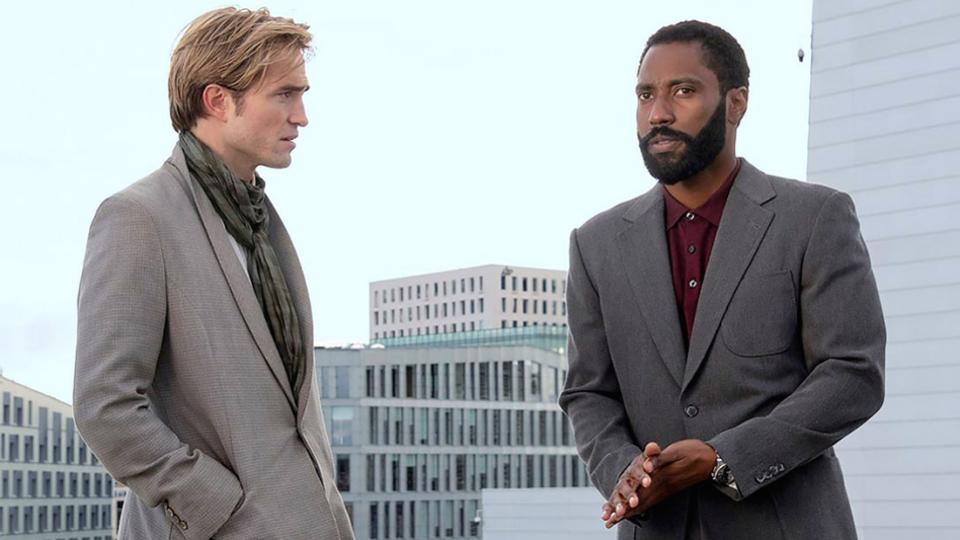
Tenet is a film that it is infinitely easier to admire than it is to like. I have now watched it again a few times on television after seeing it once in 70mm during the pandemic. There are things I’ve noticed on repeat viewings that somehow I didn’t notice during my cinema experience. Such as what have to be oblique tributes to David Lynch. When all the tussling over the suitcase in inverted car chases is going on we find the mystery finally being explained (sic) by seeing characters walking backwards in a room, a psychotic man wearing an oxygen mask while physically assaulting a tall woman, and a sinister dark reddish light cast over all these proceedings. Who knows if Nolan was consciously or unconsciously darting magpie like into Blue Velvet and Twin Peaks? A better question is – did the move to Oppenheimer’s unusual and extended nude sequences come as a result of this dipping a toe in the mysterious, sexual and enigmatic waters of Lake Lynch?
It’s hard to believe that Quentin Tarantino’s high water mark Pulp Fiction is really turning 30 years old this year.
Writing about David Lynch almost three years ago I made a reference to 1990s Tarantino as a dead-end, or, more accurately, such a singular creative explosion that, while he at first might appear liberating and invite people to join him in his explorations, he actually leaves a Tunguska-like blast radius around him which nobody else can ever enter. Tarantino is probably more inviting than Lynch in that respect because his exploding of story structure has had a lasting effect. In theatre Marina Carr and Martin McDonagh’s late 1990s work is unimaginable without his liberating effect, where the main character can become a cameo character, die, and then return for a happy ending – even though we know what awaits them. It is hard to imagine Christopher Nolan and Alejandro Gonzalez Inarritu’s early temporal adventures in storytelling getting financed without its precedent.
Pulp Fiction was a game-changer in terms of independent cinema; its ubiquitous posters, soundtrack CD and readily available screenplay became an R-rated analog to the action figures of Star Wars and the movie tie-in hit soundtrack of a Bruckheimer/Simpson blockbuster. Its screenplay Oscar was a win not just for its tricksy structure but above all for its quotable dialogue. It wasn’t the first film with great conversations, but it built on Reservoir Dogs which had featured dialogue sequences prominently on its soundtrack CD. Pulp Fiction had a dance sequence, a suspense sequence with a hypodermic needle, a car crash, and a lot of shooting, but it also had dialogue set pieces the way an action film had action setpieces. Witty exchanges, philosophical musings, and pop-culture references didn’t advance plot or character, they were just there for their own sake.
This, though, was a rabbit hole that Tarantino himself fell down. He had gone maximalist in a minimalist format. Screenplay dialogue should be so sparse on the page as to resemble haikus. Instead he was writing Shakespearean chunks of dialogue about nothing. And as time went on his films became more and more bloated because of the inability of the characters to speak in haikus when they could speak in sonnets.
The death of Shelley Duvall, and some appearances by Nicole Kidman to promote the 25th anniversary of the unloved Eyes Wide Shut, have thrown a spotlight back onto Stanley Kubrick’s excruciating working methods. Many people in the media are oddly invested in defending his excesses as a perfectionist artistic process. But there is a much simpler way to interpret them.
David Fincher is the only director working right now who is notorious for doing a hundred takes of a scene. But as Fincher does not set himself up as a recluse we know more about his methods. We have heard Ben Affleck, an accomplished director himself, say that Fincher warned him they were going to explore the script on a fractal level. We have heard Rooney Mara say that when he did ninety-nine takes of her intense scene with Jesse Eisenberg some of the takes had barely run ten seconds before he said cut, as he was trying to disorient the actors, to create a more jagged energy. We have also heard how Neil Patrick Harris had to park a car dead centre to please Fincher’s sense of three point symmetry, and nailed it on take three, to everyone’s surprise, and a delighted Fincher called that a wrap because it was perfect. We also have the extremely valuable behind the scenes footage of Mara and Fincher, and his long suffering cinematographer, trying to light a scene forwards and backwards for a computer controlled elaborate camera movement that Fincher wants to do. And the scene changes before our eyes. Mara has the injunction to make her face reflect that Lisbeth is ‘thinking evil sh-t’. But Fincher doesn’t love her outfit, so the costume is changed. The set is cold, and a space heater has been brought in. Fincher notices it is affecting the lighting, and then falls in love with the effect it creates, so integrates it into the scene. And so on… The scene changes, he is not simply doing a hundred takes without any instructions. Then we turn to the cast of The Shining, and Jack Nicholson, Shelley Duvall, and Scatman Crothers in tears of frustration – lacking any instructions.
Years ago for the University Observer I wrote a lengthy piece critiquing the over-praising of Kubrick. Critics would get hung up on a single image, and not see that was the problem – cinema is moving pictures. They were praising a former photographer for creating a memorable still frame. Whereas you should be thinking in sequences when praising great directors. You could defend Kubrick’s lack of instructions by looking to his photographer past. The photographer stands in the right place to frame the picture, and then takes many shots, hoping the elements he cannot control will come into the perfect mix if he waits long enough. But on a film set, you can control the elements – it’s literally your job. Even George Lucas, who was never going to be defended as a great director of actors, would tell his players his notorious two ‘directions’: ‘Faster’, ‘More intense’. Woody Allen is famously hands off with actors, regarding casting the right people and furnishing them with the script and some initial guidance most of the work needed. Christopher Nolan, according to Gary Oldman, only gave him one note over three Batman movies. Asking for another take, he told Oldman, ‘There’s more at stake here’. And that was it. But these directors who don’t get involved in epic discussions with their actors about motivations, don’t do a hundred takes without changing anything. Because what would be the point? If the point is to get hammy performances from actors, which seems code for coaxing deliberately bad acting from good actors, you could just ask them to “GO BIG!” Or hire bad actors, they’re not hard to find if you know where to look. Kubrick’s films have some of the worst acting you will ever see in a reputable filmography. And that’s after scores of takes.
Kubrick’s party line for his endless takes was that he was forced into it by the awfulness of actors, who never knew their lines. It’s become a rule of thumb for me over the last six years or so that if you have to start lying to make your case, then you have no case to make. There is, unfortunately for Kubrick, behind the scenes footage of a typical shooting day on The Shining. Shelley Duvall is getting her makeup done and trying to run her lines, Jack Nicholson is sitting at a table trying to run his lines off a suspiciously thin amount of script, and perched at the end of the table is Stanley Kubrick happily bashing away at a typewriter to produce the pages they are about to shoot in today’s version of the shooting script. Kubrick’s actors never knew their lines because Kubrick never locked their lines. That’s why Jack Nicholson eventually refused to learn any lines until he was in front of an imminently rolling camera because he’d got wise to Kubrick’s guff. So, why lie? It’s revealing, in that it attributes unprofessional lack of preparation to the actors, when actually the unprofessional lack of preparation is all on the director. If you were to see an entire crew standing idle, and actors rolling their eyes waiting for a shooting script of the scene slated for right now to be typed up, you would assume the director was totally incompetent. Clearly the director of Dr Strangelove is not totally incompetent. And so I suggest that all the unprofessional chaos going on in his sets, excused under the name of ‘perfectionism’, and burnished into legend by the media, could be better understood as the consistent reactions of a man battling an almost unbearable weight of insecurity.
Kubrick parted ways with his producer James B. Harris during pre-production of Dr Strangelove because he wanted to approach the material as a comedy and Harris wanted to approach it as a suspenseful drama. On his very next movie he discarded the entire score that Alex North had written for 2001: A Space Odyssey in order to curate classical music selections, some of them without seeking permission. And then when Anthony Burgess wrote a screenplay for A Clockwork Orange, he condemned it as simply the book in screenplay format. Kubrick then made the cast act out pages from the book while he filmed them, which is, of course, entirely different. He would later write up each day’s improvisations by the ensemble, passing it off as his adapted screenplay, something about which star Malcolm McDowell was not well pleased. There is a trend here, of a man increasingly desperate not to share any credit with anyone. Not only can he direct, he can produce, and he can write! There is something of Tarantino about the move away even from a composer, because Kubrick can now claim the credit for music he didn’t write by glorying in his very apposite choices. And, just like Once Upon A Time… in Hollywood being elongated because of pointless scenes there purely to showcase Tarantino’s obscurantist music choices from 1969, Kubrick’s insecurity would start to warp his work. Alfred Hitchcock didn’t mind people noticing the oomph Bernard Herrmann’s scores gave to his films. Christopher Nolan doesn’t feel slighted by the fact that Hans Zimmer is such a vital part of the success of Inception, Interstellar and Dunkirk. But Kubrick had to let everyone know that he had curated the melding of photographs of many hotel interiors to create the Overlook. Roy Walker, back in your box.
“We finally really did it. You maniacs! You blew it up!”
Well now, my eyes see that the 2024 Oscar for Best Picture went to Oppenheimer. I am surprised. I really did think they would find a way to give it to PoorThings instead. Clearly they were itching to; with Poor Things getting 4 Oscars and Oppenheimer getting 7 Oscars. Because this really does represent the Academy dynamiting everything they’ve been doing for two decades. It’s been widely noted that Oppenheimer is the most popular film at the box office to triumph since The Lord of the Rings: The Return of the King won the Oscar for Best Picture in 2004. As opposed to say, PoorThings, the 104th most popular film of 2023 at the North American Box Office. By a startling coincidence the ratings for this Oscar ceremony were the highest since 2020. Hmmm. It’s almost, now follow me closely here, as if people watch the ceremony only if they’ve seen some of the films that got nominated. Now, if you were to repeat this trick next year, and create, say, a trend, like in the 1990s, where the Best Picture Oscar repeatedly goes to popular movies, you might get back to a floor of over 20 million viewers, because people might start tuning back in when they no longer feel they’re going to be baited and switched every damn year. For the record the Best Picture winners of this decade; Parasite, Nomadland, CODA, Everything Everywhere All at Once; made a combined 134 million at the North American Box Office. Oppenheimer made 329 million. And that is how you actually get viewers.
“I am not a number, I am an Oscar winner!”
There seems to be an increasing amount of chatter that Christopher Nolan is going to follow up Oppenheimer with a film version of Patrick McGoohan’s mind-bending 1960s TV show ThePrisoner. There is actually some fire behind the smoke here. Nolan famously doesn’t write screenplays anymore unless he’s sure he can get them made, after being badly burned when his already scripted Howard Hughes biopic starring Jim Carrey got cancelled after Scorsese’s bloated TheAviator beat him into production. The major project thereafter from which he reputedly walked away was a film version of The Prisoner. There it seemed the well was poisoned by the ill-conceived Ian McKellen/Jim Caviezel TV reboot of 2009 going ahead (and sullying the brand). But, Universal own the film rights to ThePrisoner, and Nolan made Oppenheimer at Universal. So, perhaps he now has the inclination to write something which he knows he can definitely get made. And it is definitely very much within his zone. After all, the ‘A, B, and C’ episode of ThePrisoner in which Number Two creates dream scenarios for Number Six in an attempt to get him to confess clearly must have been an influence on Inception. ThePrisoner is about intrusive surveillance (TheDarkKnight), a man of iron will and integrity resisting a corrupt establishment (BatmanBegins), and any number of trippy conceits that distort the nature of reality (Tenet). Also we never learn Number Six’s real name, he’s just The Protagonist… And dear uncle John Nolan had a cameo appearance in the original series. He’d make a good Number Two.






 Talking Movies