Talking Movies

February 8, 2024

Miscellaneous Movie Musings: Part XLIX

As the title suggests, so forth.

Gotham Inc.: Warner Brothers and their intellectual property – Part II

Warner Bros is preoccupied right now with trying, via casting announcements, to stoke excitement for their relaunch of the DCEU. (Not helped by Matthew Vaughn wondering aloud what director would be happy to have their Supergirl cast for them) But the clock is literally ticking. This is 2024 – Superman and Lois Lane will enter the public domain in 2034. They will be followed by Batman in 2035, the Joker in 2036, and the final member of the DC Trinity, Wonder Woman, in 2037. That bears repeating – in ten years anybody with an iPhone and a Halloween Supes costume can make and release their own Superman movie, and there is not a damn thing that the WB can do to stop them. A Variety article discussing the upshot of this legal cliffhanger saw trademarks as an obstacle to marketing, and also noted that certain elements would remain out of touch for longer. (So my idea for a Superman movie goes on the back burner for an additional five years until kryptonite is available) That article also blithely suggested that quality control would prevent the emergence of rival cinematic Supermen. Which struck me as unintentionally funny. Zack Snyder had Superman murder Zod, with the neck snap heard around the world. If Jon Favreau was to direct a knock off Superman movie in which Kal-El imprisoned Zod in the Phantom Zone, which of these cinematic Supermen would be the one that was the true keeper of the flame? Because in truth these characters should be in the public domain because they are, in part, public creations at this time. It’s not just Jason Todd that died by popular vote, audiences also effectively downvoted the 1990s filmic Batman. And, indeed, despite much protestation by some loud voices, they delivered the same thumbs down to the Snyderverse. When audiences can dictate what happens to characters aren’t they starting to flex their muscles as co-creators of the current iteration? Also, by 2034 who knows how far AI and CGI might have advanced? Perhaps the dream of 1930s Bat-movies will be attainable once the Gable estate comes round to the idea.

Maestro and histrionic conducting

“What do I do? I play the orchestra” – Jobs to the Woz, Steve Jobs

I was taken aback at the big bow wow finale of Maestro, with Bradley Cooper practically bent backwards, eyes closed – ‘conducting’ the orchestra in Mahler’s second symphony. The damndest thing is that it accurately captures how Leonard Bernstein conducted that piece on that occasion in Ely Cathedral. Performing the part of the conductor rather than just conducting. It reminded me of the unintentionally funny egomania that eventually saw Herbert von Karajan insist all footage of the Berliner Philharmoniker should include him. I find such histrionics desperately insecure and lament their legacy in gurning conductors of the moment. At a recent concert in the front row I was astonished to hear a swooshing sound was the conductor’s grimaces and exhortations to the musicians. This is conducting that draws attention to itself. And it’s not necessary to get the job done. Karina Canellakis is noticeably controlled on the podium. And then there is the Zen stillness of the conductor of this performance of the Oppenheimer score; which one would’ve thought a godsend for huffing and puffing. If it’s more important to be seen doing the job very hard than actually doing the job well then have at it. After all this is a perfect match: if Cooper wins the Best Actor Oscar it will be because he hammered us all over the head with how hard he was trying to win an Oscar for this damn performance.

December 24, 2023

Miscellaneous Movie Musings: Part XLVII

As the title suggests, so forth.

Some people are never happy

I remember vividly some people moaning about Inception, claiming that because it didn’t have lashings of nudity and wildly explicit sex it was totally invalid as an exploration of dreams. The film that should have made oodles of money rather than Inception, in the eyes of these latter-day Freudians, was Vanishing Waves a couple of years later, which had lashings of nudity and wildly explicit sex. But are all dreams about running naked in sand dunes at night, chasing someone else who’s naked, and sometimes being chased by them, and never quite catching up or being caught up to? Or are all dreams about meeting someone for the first time and having naked sex in an empty sun-drenched room? Surely there are other kinds of dreams… And Christopher Nolan has a perfect right to explore those other kinds of dreams. Fast forward to this summer, Nolan surprises everyone with an R rating for Oppenheimer. His first sinceInsomnia in 2002. The reason? Lashings of nudity and wildly explicit sex, particularly striking in his depiction of Oppenheimer’s reveries. And these people … moan about him not showing The Bomb dropping on Hiroshima and Nagasaki. And also moan about him not devoting a subplot to the clearance of Native Americans from the Los Alamos site. You cannot win. If complaining is both a valid method and a criteria for criticism then, pffft. Somebody will always have something to complain about, regarding anything and everything. This is why Leonard Bernstein’s children decided to tell these people to STFU about how “problematic” it was for Bradley Cooper to don a prosthetic nose to play him in Maestro. Much like Nicole Kidman did to Oscar-winning effect in The Hours when playing Virginia Woolf. Bernstein’s children were happy for Cooper to don the nose and felt “any strident complaints around this issue” were perhaps “disingenuous attempts to bring a successful person down a notch — a practice we observed all too often perpetrated on our own father.” Given that this chorus of complaining had started months before anybody had even seen the film it was a very necessary and deserved strike, and seems to have had the desired effect. People are curious to see what writer/director/star Bradley Cooper is going to do with the life of an American titan. As they should be. And instead of obsessing over Nolan’s problematic treatment of whatever, perhaps the moaners should appreciate what he actually did – the father of The Bomb hears the news of Hiroshima on the radiolike everyone else, because once the science is done, he is not needed by the powers that be anymore, and his brainchild is taken away.

Warners, get your Gunn

This is the way the Snyderverse ends, not with a bang but a whimper. Why did The Flash, Blue Beetle and (it looks likely) Aquaman 2 all bomb? There are various reasons, (comically bad CGI, notorious actors, calling Batman a fascist…) but I’m fairly sure James Gunn publicly canning the entire DCEU before any of these films had even been released sure helped. Was he, in his new role as guardian of the DC flame for Warner Bros, seriously unaware of the doom loop noted on Netflix whereby cancelling shows without a resolution makes people hesitant to commit to new shows? People afraid to commit to new shows lest they also go nowhere leads to poor ratings because of this hesitancy which leads to those shows then being cancelled, proving the hesitaters right, so that more people join their ranks next time, and so on and so on in an unstoppable Kessler syndrome. Again, it is worth noting the power law that applies to American cinema. You could lose 47% of your box office takings by alienating just 11% of cinemagoers. And those cinemagoers are probably the ones who are extremely online; hyper aware that Gunn had cancelled Wonder Woman 3 with Gal Gadot, and prevented Henry Cavill returning as Superman, while simultaneously committing to his wife Jennifer Holland’s much loved (cough) Harcourt character continuing on into the new DCU. Alienate this group at your peril…

Last Orders in Soho

It now seems likely that Last Night in Soho was not just the swansong of the late Diana Rigg but also the final film of her fellow 1960s icon Terence Stamp. Which is a terrible disappointment, because director Edgar Wright shamefully wasted both of their talents on his misguided time-travel horror. I was excited to see this movie before Covid scuppered its September 2020 release, but when I finally caught up with it on Netflix in the company of The Engineer, a fellow devotee of The Avengers, it was a huge let down. For all the world it seemed like Wright had gone down the same rabbit hole as Tarantino had just before him when curating movies for Sony Movies Classics – assuming everyone has seen as many obscure 1960s films as he has. Wright, from interviews, seems to believe he was interrogating the attitudes of 1960s films that were beloved and problematic. Actually he’s preaching about God knows what in films that nobody’s seen in sixty years, and then wondering why we aren’t responding to his homily in the way he expected. The obscurantist imperative strikes again. I mean what is the point of making a film in 2020 to castigate the 1960s? Won’t someone else make a film in 2080 to castigate the 2020s? For heaven’s sake even now there is plenty to castigate in Wright’s muddled movie. The level of unapologetic misandry on display takes the breath away. To complain about prostitution dehumanising women, Wright, without irony, puts a blurred facemask on all of the clients to dehumanise them. Before blithely endorsing the villain’s justification for murdering them all and hiding their bodies for sixty years, because they deserved it for paying a prostitute for sex. Uh, okay. A late revelation about a character not being evil after all is undermined by him being nicknamed ‘Handsy’, so he cannot be redeemed. And the barman who gave him that nickname, instead of confronting him over his behaviour, is also not good because he is therefore complicit in the power structures of (cough) “toxic masculinity”. There is only one male character in the entire movie who is portrayed at all positively, and he is a manic pixie dream boy so painfully lacking in any level of believability that he barely makes it to being one-dimensional. With all this intrusive lecturing and terrible writing (and thinking) it is little surprise that, almost from the off, I noticed that this film was entirely lacking in the directorial vim one expects from Edgar Wright. My jaw dropped when I saw how he depicted Thomasin McKenzie arriving in London. Tony Zhou once made an entire video essay about how Wright was so much more visually interesting than the boring movie cliches of establishing that we are arriving in a new location. He used to be…

December 3, 2020

The WB to release Wonder Woman in Irish cinemas

In a bold move Warner Brothers is taking advantage of the relaxing of restrictions over the Christmas period to release one of 2020’s most anticipated blockbusters – Wonder Woman 1984.

December 16th will see the release of Patty Jenkins’ sequel which fast-forwards 70 years in the immortal life of Wonder Woman (Gal Gadot) to a clash with two new foes; Maxwell Lord (Pedro Pascal) and the Cheetah (Kristen Wiig); and the mysterious reappearance of her dead (for generations) lover Steve Trevor (Chris Pine). Patty Jenkins directs again from a screenplay she wrote with Geoff Johns & David Callaham, from her story with DC comics legend Johns. A world removed from the desaturated colour palette of the WWI-set original, this seems to be surfing the same cultural wave as Stranger Things and AHS: 1984. And who knows but this may be just the day-glo blast of unabashed fun and pop nostalgia that everybody needs at this particular moment in time after a relentlessly grim plague year.

July 28, 2019

Notes on The Current War

The late 19th Century duelling engineers drama The Current War was the film of the week much earlier today on Sunday Breakfast with Patrick Doyle.

Benedict Cumberbatch adds another name to his roll call of Sherlock Holmes, Alan Turing, and Dominic Cummings, playing another character with poor social graces and a conceited regard for their own high ability. Except that in this instance of course Thomas Edison is wrong. Simply wrong. As Michael Shannon’s George Westinghouse puts it if Edison gets his way and insists on direct current being the standard used then America will become a checkerboard of power plants as Edison constructs one every square mile because he refuses to use the superior system of alternating current. The film doesn’t hold back from how unpleasant Edison was in blackguarding Westinghouse’s AC because he lacked the mind necessary to solve the problem of its high voltage. The man, who once worked for him, possessed of that mind was Nikola Tesla; played here by Nicholas Hoult, and used sparingly, almost as if, like the Nolans with The Prestige, Tesla can only be a minor character in a film because there really is simply too much of the wizard about him.

Listen here:

https://soundcloud.com/patrickseandoyle/the-sunday-breakfast-show-film-review

June 9, 2019

Notes on X-Men: Dark Phoenix

The last chapter in 20th Century Fox’s X-Men saga was the film of the week today in a return to Sunday Breakfast with Patrick Doyle.

This is the way the X-world ends, not with a bang but a whimper. Simon Kinberg first arrived as X-screenwriter with the awful X-3, and now he rehashes X-3 as X-writer/director and makes it even worse, which is perversely impressive. X-3 has some rather nice music from John Powell, strong acting even in minor roles, and a number of upsetting moments (that were doubly upsetting for how badly Brett Ratner handled them) that leaned on the good work of the first two movies. This movie has A-list composer Hans Zimmer only occasionally elevating the material with emotive minimalism, some of the worst acting outside of X-Men: Origins – Wolverine, and absolutely no memorable moments whatsoever in part because there has been no good work done in previous movies to establish anything. Cyclops was killed off 20 minutes into X-3 by Jean Grey to establish she was out of control, and here Mystique is killed off 40 minutes in by Jean Grey to establish she is out of control. Kinberg shamelessly reuses dialogue and the ideas of X-3, but doubles down on them to make what was once annoying now insufferable.

Prior to her merciful death Mystique spends her screentime whingeing about Professor X, after she dies Beast takes up the whingeing baton to the point where you just want to shout at the screen “Why don’t you just move out of the mansion you’ve been living in rent-free for 30 years if you feel that strongly about him being a bad man?” Professor X is the villain of this piece. Somehow. I’m not nearly as sure as Kinberg is that hiding from a girl, who just murdered her mother because she wouldn’t stop listening to Glen Campbell, that her father regards her as a monster and wants nothing to do with her is a morally evil act. How does he think Jean would react to hearing that? Badly? Would she kill many people in her rage? Oh, the rage. In a scene where Jean is moody at a bar one longs for Sarah Snook in this role as Sophie Turner renders Jean Grey’s transformation into Dark Phoenix the temper tantrums of a petulant teenager. Jessica Chastain barely acts as the emotionless alien Vuk, and Jennifer Lawrence projects only deep boredom.

J-Law may be the audience avatar in that respect, fed up so much talent could be squandered on a twice-told tale. Kinberg has Christopher Nolan’s regular editor and composer, and yet there is a cut with the X-jet arriving and the team appearing as jarring as the scene John Ottman apologised for in Bohemian Rhapsody. The cinematographer of Avatar is on hand to, well, hide the action under cover of darkness and big swirly CGI. Watching X-Men and X-2 in recent days they really are films of the 1990s rather than the 2000s with their emphasis on practical effects to which CGI is added; a quaint notion long abandoned by Marvel and DC films that superpowers are more impressive interacting with tangible physical reality rather than being a welter of CGI battling a big swirly thing of CGI in a CGI landscape populated by CGI extras. There is some pleasing practicality here, but this is not a movie to stand beside Guy Hendrix Dyas’ amazing sets for X-2. And let’s remember the big swirly thing CGI that reached its nadir in X-Men: Apocalypse began in X-3 for Dark Phoenix’s powers.

Kinberg reprises it here in another display of creative bankruptcy. What exactly is the point of filming the Phoenix storyline? To plonk an actress down in mauve garb to stare moodily/blankly at everything for two hours while everyone stands around agonising over killing her while repeating that she’s unstoppably powerful and therefore can’t be killed unless she wishes it? Does that sound at all interesting? At this point it seems safe to say that the writing credits strongly suggest that the only X-screenwriters worth a damn were David Hayter, Zak Penn, Matthew Vaughn, and Jane Goldman, and everyone else was just coasting off their story ideas. It seems perilously close to the truth to say that, as set up by Bryan Singer’s original decisions, these films rarely worked without Hugh Jackman as Wolverine – the best of the bunch were X-Men, X-2, X-Men: First Class, X-Men: Days of Future Past. Maybe the reason for X-Men: First Class succeeding was that the charismatic turn by Michael Fassbender as vengeful hot-headed Magneto stood in for Wolverine. This is a terrible way for the X-Men to end given that they started the Marvel era.

It’s especially bad given that Disney will fold them into the MCU and a Marvel executive seems to think the signal problem with the X-Men was not their farrago of continuity, their revolving door of writers and directors, their recycling of the same stories, their failure to properly establish characters, their over-reliance on one actor, their ever-escalating budgets, their out of control CGI, their limited palette of character motivations and plots, but the fact that they were called the X-Men.

Listen here:

https://www.mixcloud.com/patrickdoyle/9619-the-sunday-breakfast-show-with-patrick-doyle/

July 20, 2018

From the Archives: The Dark Knight

On this day ten years ago I saw The Dark Knight on the biggest IMAX screen in the world. Yeah…

“Where do we begin?” The Dark Knight is a sequel that expands upon and darkens an existing cinematic universe so successfully and unsettlingly that it ranks far above what one would think of as the obvious reference point The Empire Strikes Back and instead starts advancing menacingly towards The Godfather: Part II…

Director Christopher Nolan and his screenwriter brother Jonathan are very clever, as evidenced by their last collaboration The Prestige, and see greatness where others do not, as evidenced by reading the original novel of The Prestige. In The Dark Knight they have constructed a story that takes the mythology of the DC comic books and turns it into both high tragedy and violent mayhem.

Christian Bale is superb as Bruce Wayne who is quickly becoming a physical and emotional wreck after one year of being the Batman. What was intended as a short-term project to clean up corruption looks to be nearing its end with a final audacious swoop on the mob’s money-men. Bruce’s only chance of a normal life is slipping away though as his sweetheart Rachel Dawes (Maggie Gyllenhaal at her most winning), tired of waiting for Bruce, is dating the idealistic new District Attorney Harvey Dent (a wonderfully charismatic Aaron Eckhart who also communicates an underlying instability that could lead Harvey to places of great moral darkness). Bruce can only compete against Dent for Rachel if he can trust Dent enough to retire Batman and leave the crime-fighting to the legitimate forces of Lt. Gordon (Gary Oldman) and his Major Crimes Unit. However such plans are wrecked when the mob in their desperation at Batman’s success decide to fight back by hiring, in the Don Sal Maroni’s own words, “a two bit whack-job in a cheap purple suit and make up”…The Joker.

Heath Ledger’s Joker, physical and unhinged – licking his lips like a snake sensing its prey, blows away the inert Jack Nicholson performance and retires the role for a generation if not all time. Oscars don’t go to films like this but Ledger’s performance here is worthy of consideration. His Joker is blackly hilarious and utterly terrifying, usually at the same time, and even his musical theme is chilling. The Nolan brothers cross many lines in depicting his psychopathic unpredictability. One of the taglines for this film was “Welcome to a world without rules”. Batman cannot understand Joker.  Carmine Falcone wanted power, Scarecrow wanted money, Ras Al’Ghul wanted order, The Joker? –  “I’m an agent of chaos”… His escalating mind games in the film move from straight crime with a superbly staged opening heist against a Mob bank, to terrorist attacks, to sick mass murder and beyond…

The Dark Knight is fiercely intelligent, ingeniously structured (to reveal plot details would be a sin) and gives memorable lines and moments to each member of a large ensemble, while the twisted bond between Batman and Joker that exists in the comics finally receives a cinematic depiction. This is all incredibly realistic looking with 60% of the film shot on location and if seen on an Imax screen, as Christopher Nolan indeed shot it especially for, Gotham becomes a character in its own right with its cityscape lovingly captured in vertiginous shots. Written, played and directed with supreme assuredness this is one of the most gut-wrenchingly suspenseful films of the year that looks to 1970s crime thrillers like Serpico rather than superhero films for its modus operandi with its theme of police corruption. Indeed this is unlike any previous Bat-sequel, as can be seen by the difference between the grisly Two-Face in this film compared to previous camp interpretations, and is even tonally different in many ways to Batman Begins. Wanted may be the most fun blockbuster this summer but the Bat has captured the classy end of the spectrum with a film that combines meaty drama with explosive action.

You need to see The Dark Knight. Repeatedly…

5/5

January 31, 2018

Any Other Business: Part XIII

What is one to do with thoughts that are far too long for Twitter but not nearly long enough for a proper blog post? Why round them up and turn them into a thirteenth portmanteau post on television of course!

Dangerous, Handle With Care.

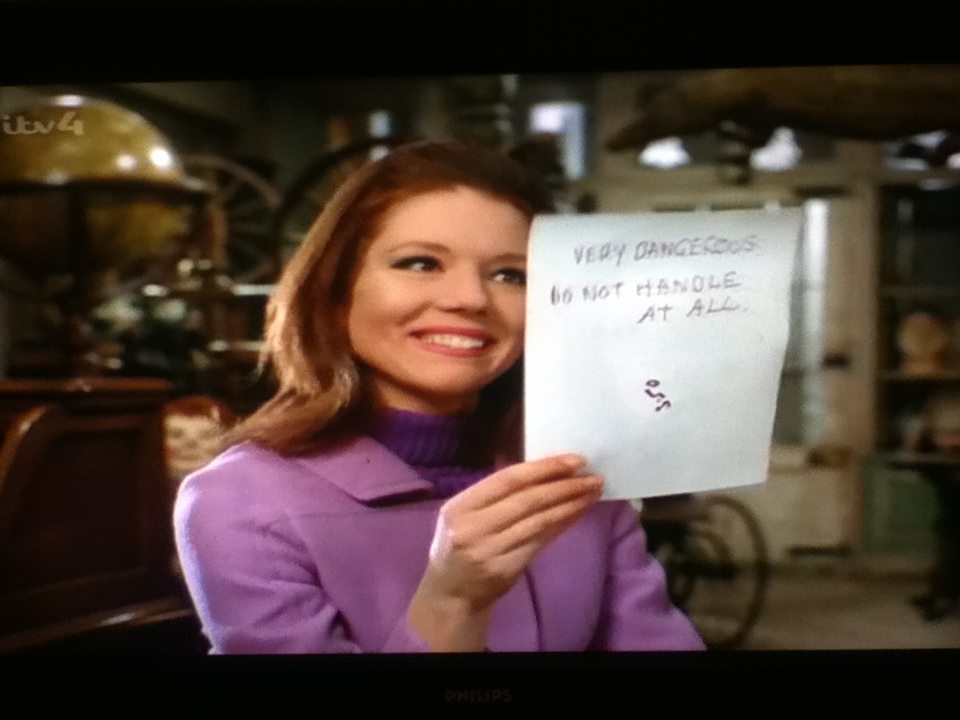
Very Dangerous, Do Not Handle At All.

Watching re-runs of The Avengers (in colour!) on ITV 4 over a few months before Christmas it was hard not to be struck by two things. It was better than most current TV shows, and it made the soapbox posturing of the CW’s Berlantiverse look utterly inane. The ludicrous blackmail episode, ‘You Have Just Been Murdered’, is so hilarious, as the blackmailers repeatedly mock-murder their wealthy victims and leave a calling card just to prove how easy it would be to do it for real, so pay up, was one of the best episodes I saw on TV in 2017. The sustained ninja attacks on Steed’s friend; a car almost runs him over, he is attacked with a fake katanna, and finally shot with an arrow that imprints ‘You Have Just Been Murdered… Again!” on his shirt; floored me. And there were many other episodes almost at the same level in Diana Rigg’s 25 colour episodes, and some equally wonderful in the subsequent 32 episodes with Linda Thorson. The Rigg episodes were very telling in their writing of Renaissance woman Mrs Peel: painter, sculptor, chemist, journalist, mathematician published on the subject probability as applied to Bridge, and amateur secret agent. Nobody makes any deal out of Steed’s partner being a woman, apart from a doddery Colonel back from the tropics in ‘The Hidden Tiger’; “Highly unusual to have a woman on a hunt, Steed” “Highly unusual woman, Colonel”. And Mrs Peel, expert in judo, wins most of the fights she gets into, hence her amusement in ‘The Correct Way To Kill’ when she finds two photos with handwritten annotations in the local KGB HQ. Steed is described as ‘Dangerous, Handle With Care’. She then discovers that ‘Very Dangerous, Do Not Handle At All’ refers to her. This is a fictional universe where many of the villains have women as their most ruthless lieutenants, and any daffy woman is very possibly a ruthless lieutenant hiding in plain sight by playing up to bimbo stereotypes. In ‘The Living Dead’ the village hospital is run by a woman doctor, and nobody mentions her gender; she’s just the doctor who runs the village hospital. Steed and Mrs Peel almost co-opt her as a third agent in their investigations, but Mrs Peel doesn’t make a big deal of it. It would be literally impossible for a woman to run a small-town hospital in a Berlanti show without a plethora of dialogue about it, and if she were to aid Supergirl we would get girl power dialogue about the sisterhood working together in a man’s world. It is disconcerting when a 1967 show assumes equality, entertains, and provides an indomitable heroine with a delightfully light touch, while 2017 shows talk endlessly, needlessly about equality, as if trying to convince themselves.

The Berlantiverse was once highly praised on this blog but as time has gone on it has become more and more obviously flawed. So let’s try and isolate the good, the bad, and the ugly.

Berlantiverse: The Good

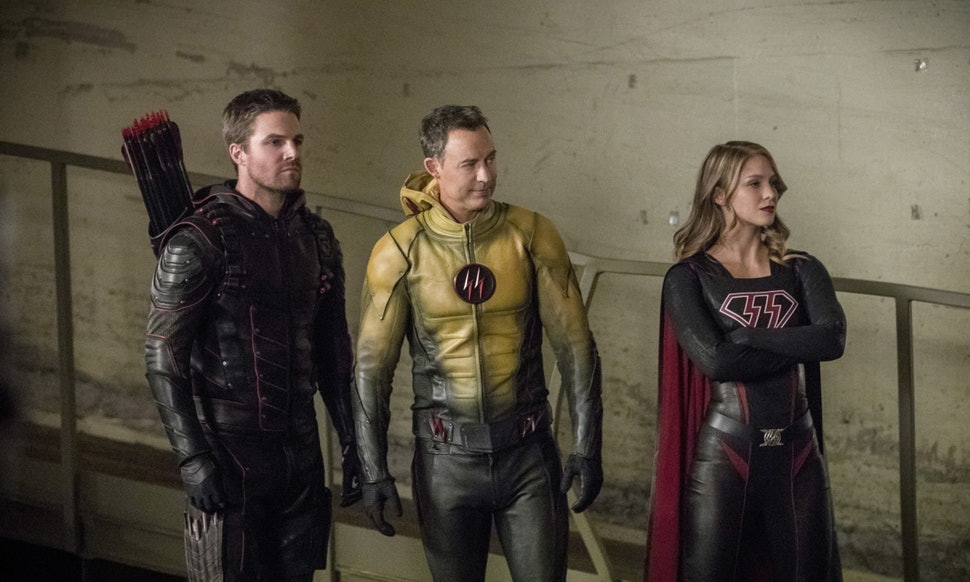
Tony Zhou amusingly gutted the MCU a while ago for its complete, deliberate absence of memorable music. Their copy of a copy of a copy elevator muzak approach seems to be a determined attempt to free cinema from the Wagnerian leitmotifs that composer Erich Wolfgang Korngold had in the 1930s made the convention for scoring the fates of characters and the progress of action. As a result of Marvel’s decision no matter how many Avengers assemble there will never be any music that can announce the arrival of a single one of them. What is lost by that? Well, look at what Blake Neely was able to pull off in the Supergirl/Flash/Arrow/Legends crossover extravaganza for the final fight against the alien Dominators. When Green Arrow is shooting the Dominator the jagged Arrow theme is heard, when he is thrown off the roof the music hangs in the air with him with a sustained note on strings, only for a roar of brass to announce the arrival of Supergirl to catch him from plummeting to his death. That is what leitmotifs are for. Why Marvel would want to pass on that sort of emotional punch is a mystery.

Berlantiverse: The Bad

There are elements; such as 24’s lack of humour; that you forgive so long as the show is good. But once you stop enjoying a show you remember those flaws, and notice new ones. I never made 10 episodes of Arrow, but I was surprised the same creators brought forth the fun that was The Flash. I also watched Legends of Tomorrow and Supergirl until the recent crossover. Then I ditched all three shows. My problems with Arrow I’ve outlined. The Flash became idiotically repetitive; “My name is Barry Allen, and I am the fastest man alive!” – apart from Reverse Flash, and Zoom, and Savitar…; emotionally manipulative; Barry watches his mother die again, watches his father die, gets them back sort of only to give them up, gives up Iris, how much damn angst does one character need; and eventually unwatchable despite maintaining a comic edge. Supergirl from the get-go had problems, which started to converge with the problems of Legends. Legends degenerated from a fun show in which time-travellers screwed up their mission, to a less fun show in which they took George Lucas in Love as their ur-text and applied it to Lucas, Tolkien, and Arthurian legend, to the E.T. episode where they re-did E.T. in 40 minutes with their characters, like House or CSI: NY saw writers take off a movie they saw, just with less self-awareness. Supergirl’s characters kept getting on soapboxes; Jimmy Olsen on black men not being allowed show anger, Cat Grant on being a woman leader, Kara on being a woman and a superhero; rather than having comic-book adventures. Moving network for season 2 Berlanti decided that Alex should be gay now, an abrupt character reboot handled with the grace of an Austin Powers skit. But then he doubled down by beginning season 3 with Alex and Maggie engaged. Wow, that was quick! They break up because they never had a discussion about having children before getting engaged. Berlanti’s political imperatives were trumping his aesthetic imperatives with a vengeance. Legends’s characters arrive in the 1950s with an injunction not to attract attention; so they set up Ray and Kendra as a married couple, with Sara as a nurse. Berlanti castigates Jim Crow racism and has Sara liberate a repressed nurse. This makes nonsense of the injunction not to attract attention. The way to do that would have been to have Ray and Sara play house, with Kendra as a nurse. But internal logic was starting to be damned if it got in the political way.

Berlantiverse: The Ugly

Can you tell who Don Siegel voted for in 1956 and 1972 from watching Invasion of the Body Snatchers and Dirty Harry? Adlai Stevenson? Maybe? Richard Nixon? Maybe?? It’s not easy. Can you tell who Greg Berlanti voted for in 2016? … It seems Berlanti was traumatised by the failure of America to be with her. Now, art and politics don’t need a Jeffersonian wall of separation, but there ought be some artistic guile cast over political intent, like Arthur Miller addressing Senator McCarthy at three centuries’ remove. Berlanti has a beef with Trump. He could silently showcase heroic, adorable, and honourable minority characters like The Blacklist. [Navabi, Aram, Dembe] He does not. Instead, to stick it to Trump, he introduces to Legends the rather insufferable Zari, and reminds us repeatedly that she’s a Muslim American. He probably needs to remind us because she doesn’t wear a hijab, or have a prayer mat, nor use it 5 times a day, worry about keeping halal, or attending a mosque. Given previous complaints about American artists’ inability to take faith seriously this shouldn’t surprise, but ironically it makes Zari the kind of Muslim Trump might endorse – invisible. Berlanti could espouse meritocratic ideals like Bernie Sanders’ support for basic income. He does not. Instead Berlanti has gone down the rabbit-hole with Hillary. Her failure was due to misogyny, homophobia, and xenophobia. Ignore that she was as historically awful a candidate as if the Republicans had nominated Robert A Taft in 1948, and that she called ¼ of the eligible voters “a basket of deplorables”. Pushing Hillary’s apologia is killing the Berlantiverse. It would be clumsy and obvious to try and push basic income. But it couldn’t be worse than the gender studies harangue when Helen of Troy appeared in Legends, or when The Flash had a stripper lecture her clients on her critique of the male gaze. That same episode a female supervillain was taken down by the female characters working together and Iris said “Hashtag Feminism”. This, along with insisting “We are The Flash”, is Iris’ new thing. The abandoning of all pretence of artistic guile over political intent in attacking Trump came in the recent crossover, with this interchange: “Make America White Again” “Which it never was” “Hashtag Melting Pot”. But the nadir was Nazi Arrow proudly announcing “We’ve created a meritocracy”. … … … One should not have to point out that Nazis did not believe in meritocracy, but in its exact opposite, aristocracy. It is self-evident.

If you’re looking for the brightest and the best, you get Einstein, and then, if you’re a Nazi, mutter, damn, a Jew, and issue another call for the brightest and the best, but Aryans only please. Whereas if you’re not a Nazi you say, Welcome, Mr Einstein, I hear you are a very brilliant genius. Meritocracy advances people on the basis of ability. Aristocracy advances people on the basis of bloodlines, rather than their ability.

Berlanti wasn’t being ironic, none of the superheroes protested about this calumny of meritocracy. That degradation of meritocracy, the one true guarantor of equality, shows Berlanti pursuing a political agenda that while thinking itself liberal is not. The Berlantiverse no longer entertains because so many artistic decisions are clearly suborned to a political agenda, and it troubles because that political agenda is clearly Hillary not Bernie. Meritocracy doesn’t see colour, gender, or religion. It sees ability. And it only sees ability. Attempt to attach secondary considerations to it and it is gone. You can’t grade a test on correct answers and ensuring a diversity quota.

November 22, 2016

Re-Routh Superman!

The guest appearance of Superman on Supergirl for 2 episodes; which displayed more wit, swagger, and simple sure grasp of the character than Zack Snyder’s 2 movies; led me back to thinking about a couple of unrelated moments this summer.

Brandon_Routh_Superman_Retu

I was watching Legends of Tomorrow, the audacious episode where three of our heroes are left behind in 1950s America, and Dad walked past, stopped, and asked “Is that Superman?” And yes, it kind of was. Brandon Routh, bespectacled, waistcoated, and jacketed, was lecturing excitedly on physics and slightly bumbling in keeping the space-time continuum free of catastrophic paradoxes. I have always considered that Routh in Superman Returns was a fine Superman, but I was less sold on his Clark Kent. His sensational cameo in Scott Pilgrim Vs the World, effectively playing Bizarro for extra meta-laughs, served notice that the still young Routh was developing his comedy chops apace. But with Legends of Tomorrow there is no doubt that the secret identities Ray Palmer and Clark Kent are starting to become interchangeable on occasion, and if Routh is secretly auditioning to get his cape back (Hell, Routh’s superhero guise still involves wearing a suit largely composed of red and blue), he’s certainly won me over regarding his ability to play Clark. So, with Snyder now having failed miserably, twice, to show that he understands in the slightest the character of Superman, has any coherent vision of how to direct Super-action, or has any sense of humour, might it not be time to simply pretend the whole thing was a fever dream and make a semi-sequel to Superman Returns, bringing back Routh to the role he only got one shot at?

DC's Legends of Tomorrow -- "Left Behind" -- Image LGN109A_0220b.jpg -- Pictured: Brandon Routh as Ray Palmer/Atom -- Photo: Dean Buscher/The CW -- © 2016 The CW Network, LLC. All Rights Reserved.

Photo: Dean Buscher/The CW — © 2016 The CW

And the second unrelated moment… Watching Olivia Munn in X-Men: Apocalypse after watching her in season 3 of The Newsroom I was once again disappointed at how an actress who dominates a television screen ended up standing around like a mislaid prop on the big screen. If there was only some role in a superhero movie that would be as juicy for Munn as Sorkin’s creation Sloan Sabbith was… If only she could again play a journalist, someone with an overpowering hunger for nailing a scoop. Someone like… Lois Lane. In 2010 I wrote on this blog that Lois “lives for breaking news and will do anything to get it first – she’s not a particularly nice person but she’s charismatic, tough as nails and you’d always want her on your team rather than playing against you. Writing Lois as nastier than recent anodyne versions of her also helps solve the ‘problem’ of Superman’s uncomplicated morality about which essays of unsympathetic comparisons to Batman and Wolverine have been written. The meaner you make Lois, the harder it becomes for Superman to melt her cynicism, and the better the film will be as a result in selling audiences on his Boy Scout ethics.” Take a look at Munn in action as Sloan in the clip below, and imagine a Lois whose breath-taking abrasiveness in the service of the Daily Planet becomes perversely loveable.

The Snyderverse demonstrably is not working, and the Berlantiverse demonstrably is; surely it’s time for DC to acknowledge reality, reverse the reboot, and give Brandon Routh back his cape and give Olivia Munn another charismatic vinegary role.

September 28, 2016

So long, and unthanks for all the Fish

It’s been a very long wait for RTE 2 to screen season 2 of Gotham, and that might say much about the state of popular opinion towards the misfiring show.
gotham06

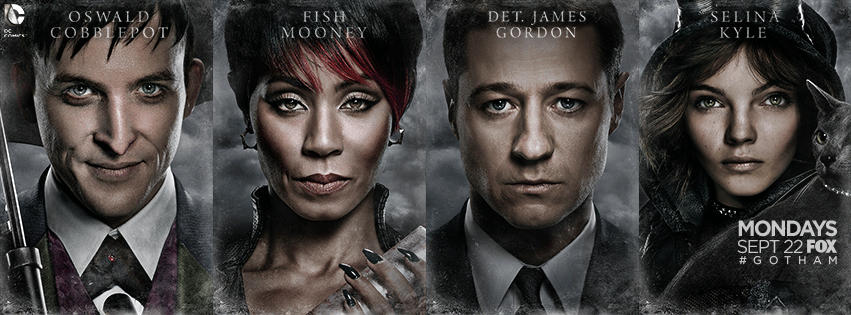
The first season of Gotham arrived with much more fanfare in January 2015, down to the WB organising a cinema screening of the pilot which I covered for HeadStuff.org. On the big screen Gotham’s cold open was undeniably arresting, tracking a teenage Selina Kyle (Carmen Bicondova) across the rooftops of the absurdly begargoyled city until she happened upon a certain dark alleyway just in time for murder of the Waynes. Catwoman’s presence intriguingly made Batman’s formative trauma a random incident in someone else’s life. But showrunner/writer Bruno Heller and director Danny Cannon also upped the gore, and salvaged the now-pardoic crane swoop by young Bruce Wayne (David Mazouz) not giving the expected “NOOOOO!!!” but an ear-splitting pre-pubescent shriek.

It would be cruel to say it was all downhill from there, but not entirely untrue. Danny Cannon and director of photography David Stockton had previously brought Nikita to TV on the CW, but Gotham is on Fox, and from the beginning lacked the slick coherence of a CW show. The pilot was all about the young James Gordon (Ben McKenzie), starting work at Gotham PD as the new partner of corrupt Harvey Bullock (Donal Logue). They bungled investigating the Waynes’ murder, and got investigated by Renee Montoya (Victoria Cartagena) and Crispus Allen (Andrew Stewart-Jones), who already disliked Bullock because of his deal-making friendship with mobster Fish Mooney (Jada Pinkett-Smith). Gordon felt compelled (perhaps by the dramatic imperative) to promise Bruce and his guardian Alfred Pennyworth (Sean Pertwee) that he would throw away his badge if he didn’t solve the case. But with the squirrelly behaviour of his fiancé Barbara Kean (Erin Richards), the obvious madness of his CSI Edward Nygma (Cory Michael Smith), and the menacing warnings of his father’s old acquaintance Don Carmine Falcone (John Doman), it was questionable if Gordon would live long enough to throw away his badge a la Dirty Harry…

But that set-up promised a clear path of plot that Heller simply did not possess. Montoya’s presence on the show became increasingly sporadic and tokenistic until eventually she and Allen simply disappeared from the story, while Barbara’s lost little rich girl antics were worthy of Smallville at its very worst, and eventually an extended hiatus produced the desperate gambit of bringing in Milo Ventimiglia as a serial killer for a short and trumpeted mini-arc to give the show some semblance of purpose as it staggered toward the finishing line. Reviewing Gotham‘s pilot I said there was to much to like: specifically the look of Nolan’s Gotham having Gothic elements added to it, Pertwee’s tough Alfred, Logue’s amiably shady Bullock, and Doman’s revelatory avuncular Falcone – the force for order against the chaos enveloping Gotham. There were further praiseworthy elements as the season progressed, the outre villainy of the Balloon Man serial killer felt like it stepped from the pages of early 1990s Batman comics, a flashback heavy episode in which Bullock faced off against the same possibly supernatural murderer at either end of a decade felt like late 1980s Grant Morrison Batman material, and the siege of GCPD in which Gordon was left alone to face off against a team of assassins led by Victor Zsasz was stirring enough to be Nolan-worthy.

gotham-gordon-and-bullock

But this is not a show about Gordon and Bullock fighting weird crime, and more’s the loss. It’s a show about…

Well, what is it about?

The adventures of the young Bruce becoming Batman at the unusually young age of say 15 at the end of season 3? No.

Well, maybe, after all don’t forget the cliffhanger finale of Bruce discovering, deep sigh, his father’s Batcave; in a transparent riff on the LOST season 1 finale, despite the fact that finale enraged people.

The adventures of young Bruce meeting literally everyone he will meet again ‘for the first time’ 17 years later when he dons the cape at the age of 29? No.

Well, sort of. I accused Heller of having a veritable ‘Where’s Wally?’ of future super-villains: Riddler, Penguin, Catwoman, Ivy. He then added in Joker for good measure, and Colm Feore’s Dollmaker, as well as lumbering under the lamentable weight of Fish Mooney, a placeholder original villain, twirling her extravagant nails to hide lack of actual character.

The adventures of all of Batman’s supervillains sans the Bat but with Gordon, in a move worthy of Hamlet without the Dane? No.

Well, yes, that’s sort of where this is all heading. But as ever, only sort of. Gotham’s split focus has been its downfall. Gordon and Bullock are never allowed to do their thing, instead we have to head off and agonise over Barbara’s latest idiocy, or check in on the budding romance of Bruce and Selina; mixing tortured romance with grittier crime procedural as if Heller is confused as to both genre and what network he’s on. But this problem; that Gotham is trying to be about four different shows at once, failing in its whirling dervish act to dance between four stools, and giving everyone a nosebleed into the bargain; is in the ha’penny place to the real flaw bedevilling the show – some of the very worst writing since Smallville‘s lowest points.

the-gotham-tv-show-3

It was hard reviewing Anthropoid a few weeks ago not to make a connection between it, Green Room, and Gotham. The connection to be traced between them goes to the heart of why Gotham rapidly became a chore to watch. Anthropoid saw Nazis take a hammer to a violinist’s hand to break him in interrogation; they’re Nazis, that sort of cruelty is their way. Green Room saw Neo-Nazis take a machete to a guitarist’s hand to break a siege; they’re Neo-Nazis, they want their gun back so they can kill the band. Gotham saw The Penguin take charge of breaking up a romance to curry favour with a possible crime partner. The problem was a musician. As soon as the word ‘musician’ was mentioned you knew what was coming next. A beating doesn’t work on the guy, so Penguin steps in with some handy hedge-clippers, “He’s a musician, lose the fingers.” And the director obliged with a huge close-up of a bejewelled severed finger hitting the ground as the editors debated which to make louder, the scream of agony or the satisfying plop sound. It’s not just that it’s part of a wider problem with the violence on Gotham, which we’ll get to, but as with so much of Penguin’s psychopathy it doesn’t really make any sense. What exactly happened next? Something like this?

INT.ITALIAN PIZZA PLACE-NIGHT.

THE GIRL is looking at her watch, and looking out the window. Where is her boyfriend musician already? Her cellphone rings.

GIRL: Where the hell are you?

MUSICIAN: (O/S) (muffled voices in background) We should break up.

GIRL: What? Why? What’s that sound?

MUSICIAN: (O/S) I’m in the hospital.

GIRL: Oh my God! That’s horrible. Which one? Gotham General? I’ll come now. Why are you in the hospital?

MUSICIAN: (O/S) Someone cut off my fingers.

GIRL: Oh my God! Oh my GOD! Will you still be able to play the guitar?

MUSICIAN: (O/S) Of course I won’t be f****** able to play the f******guitar! THEY CUT OFF MY F****** FINGERS!!

GIRL: (sobbing) Oh God! Who? Why? Baby, why would anyone do such a horrible thing to you?

MUSICIAN: (O/S) I don’t know. I forgot to ask them as they took away my identity and career with a hedge clippers. But in totally unrelated news, babe, totally unrelated, I think we should break up.

This is the kind of nonsense that drove Smallville into inanity; that you could watch Lex bump someone off, and just wonder ‘Why on earth did he do that?!’ Gotham has fallen into the LOST trap of inserting Quentin Tarantino’s ‘really bitching torture scene’ whenever they run out of dramatic oomph and can’t be bothered to let conflict grow organically from characters. A sort of amped-up version of Raymond Chandler’s dictum that you have a guy with a gun walk into the room whenever you get stuck in your writing. It is of course, if done week after week, scene after scene, incredibly lazy writing. It makes things predictable despite the aim being to make things unpredictable: ‘psychopaths be crazy’ and all that. When you just ping pong from hideous double-cross to hideous double-cross, with bodies and eyeballs flying everywhere it actually becomes tiresome, and the cumulative effect is to make the whole show faintly ridiculous. All the maneuvering between Penguin, Fish, and Falcone to be King of Gotham Crime seemed like a pantomime via the Grand Guignol. At times, such as Fish’s imprisonment on Dollmaker’s island laboratory, you could literally fast-forward through the action without missing anything so poor was the dialogue and telegraphed the action. And that is to say nothing of the outrageous gore that Heller seemed in love with; Catwoman gouging out a goon’s eyes in the 2nd episode, Penguin maiming and killing half Gotham and environs, Fish gouging out her own eye to spite Dollmaker, and, in a Smallville moment, Dollmaker responding to that by giving his inept henchman an unwanted sex change and granting Fish a new eye because… Um, because that’s what was written down in the script.

The exhausted retirement of Falcone in the finale almost serves as a metaphor for the audience. We did at least get to see Fish being dropped off a large building to allow Penguin have his “Made it Ma! Top of the World!” moment, but how a show run by experienced people could’ve misjudged everything that led to the point quite so hugely is baffling. I don’t know if a radical shake-up like James Cameron and Charles H Eglee gave Dark Angel season 2 can redeem Gotham, but let’s see if having got rid of its most annoying original character it can start to become a bit more sensible.

Gotham season 2 starts on RTE 2 at the less than desirable time-slot of 10.55pm today.

April 13, 2016

CinemaCon 2016

Burbank, CA was the location for Warner Bros. Pictures’ CinemaCon 2016, announcing developments in the studio’s wide-ranging slate. Chairman and CEO Kevin Tsujihara announced the headline confirmation that Ben Affleck—who will reprise his Batman in the upcoming Justice League movie—will direct, as well as star in, a new stand-alone Batman.

batman-v-superman-dawn-of-justice

The WB’s presentation was illustrated by trailers and film clips—including some never-before-seen footage—and appearances by major stars and film-makers involved in the movies.  Tsujihara’s has talked about basing the WB’s future on the key franchises of DC, animated LEGO® features, and Fantastic Beasts and Where to Find Them, but the current slate also encompasses dramas, action adventures, horrors, and comedies. Sue Kroll, new President of Worldwide Marketing and Distribution, and Veronika Kwan Vandenberg, new President of Worldwide Distribution, also spoke. Kroll said, “CinemaCon is always one of the high points of our year: when we get to introduce our upcoming slate to our partners in the exhibition community who are responsible for bringing our films to audiences worldwide,” while Kwan Vandenberg added, “We appreciated the enthusiastic participation of actors and filmmakers from every title, who added tremendous star power to the presentation.”

Ben Affleck and Amy Adams kicked off the presentation with a bang, introducing a reel spotlighting the studio’s ambitious slate of DC films.  The roster includes the new Justice League film, as well as stand-alone Wonder Woman, The Flash, Aquaman, and Cyborg features. Embattled Batman v Superman director Zack Snyder closed the reel with a greeting from the Justice League film set, surrounded by his stars. The DC preview also included a glimpse of the summer’s hotly anticipated super-villain team-up Suicide Squad before its writer/director David Ayer took the stage and introduced the main ensemble cast, led by Will Smith, Jared Leto, Margot Robbie, and Joel Kinnaman.  The extended version of the Suicide Squad trailer was met with loud applause and the buzz surrounding the film was palpable.

Host Mario Lopez went through the rest of the summer line-up, with advance footage from the wide range of titles, introduced by stars and filmmakers including Russell Crowe for Shane Black’s action comedy The Nice Guys, Emilia Clarke for the drama Me Before You, director James Wan and stars Vera Farmiga and Patrick Wilson for the supernatural thriller The Conjuring 2, Teresa Palmer and David F. Sandberg for the horror thriller Lights Out, Kevin Hart and Rawson Marshall Thurber for the action comedy Central Intelligence, Alexander Skarsgård, Margot Robbie, Samuel L. Jackson, and Christoph Waltz for the adventure The Legend of Tarzan, and director Todd Phillips and his Hangover star Bradley Cooper reuniting for the comedic drama War Dogs based on real events.

WB then unveiled films on the drawing board from the Warner Animation Group.  Chris Miller, Phil Lord, and Nicholas Stoller introduced titles in the pipeline, anchored by The LEGO®Batman Movie, The LEGO® Movie 2, and Ninjago.  Stoller, who co-directed the next film on the slate, Storks, was joined by fellow director Doug Sweetland and voice talents Andy Samberg and Katie Crown to present new footage from the family adventure.  The animation portion wrapped with never-before-seen footage from The LEGO® Batman Movie, presented by producers Lord and Miller, and the voice of ‘Batman’ himself, Will Arnett. The presentation closed with a look Warner Bros. closed the presentation with a look at Fantastic Beasts and Where to Find Them, written by Harry Potter creator J.K. Rowling.  Four of the film’s stars; Eddie Redmayne, Alison Sudol, Dan Fogler and Colin Farrell; introduced the new teaser trailer and a look behind the scenes of the film.

It is a keen irony that the WB is currently taking flak for launching the Cinematic DC Universe with the humourless dourness of Batman v Superman, while the TV DC Universe is universally beloved for its lightness of touch, almost as if two prime directives are colliding. The need to maintain the WB’s vaunted position as a home for cinematic artists that respects directorial vision – whether that be Kubrick, Nolan, or Affleck – becomes self-defeating when the artist in question is Zack Snyder, and when an entirely less sombre vision, exemplified by writer/producer Greg Berlanti’s roster of Arrow, The Flash, Legends of Tomorrow, and Supergirl, is available free to air weeknights.

Next Page »

Blog at WordPress.com.

Design a site like this with WordPress.com
Get started