Talking Movies

May 5, 2025

Any Other Business: Part CIII

As the title suggests, so forth.

Yes, and/No, because

GK Chesterton in The Crimes of England spoke of the spirit that affirms and the spirit that denies, and averred that Prussia was very much the spirit that denies – made flesh. I’ve come to think that when it comes to people these truly are the animating spirits. And not, unlike improv, the spirit that affirms says “Yes, And” to any and all propositions presented. The natural predisposition is to action, to adventure, and to figuring out solutions to problems. On the other hand is “No, Because” which magicks up multiple problems without any interest in ever finding solutions, because the problems are never real. They are after the fact rationalisation of the natural predisposition to veto, to shut down any hint of fun or progress. Why? Because. And in our time it has morphed from “Because, Health & Safety” to “Because, GDPR”. There is never further explanation offered, which is convenient because there wouldn’t be any behind the bullsh-t facade of respectability. The dynamic is familiar from watching bullies at play, if one can call it that: Whenever you see a larger child take something away from a smaller child, not because they want to play with it themselves but expressly to deprive the smaller child of it. The pleasure is gained entirely in causing someone else pain by capriciously depriving them of something they want; Shakespeare might put it as robbing someone “of that which enriches you not but makes him poor indeed”. When these people grow up, if they enter positions of power they are very recognisable by their words and deeds as people whose only positive pleasure in life is inflicting suffering on others and denying pleasure to others. I think the agreeable/disagreeable split is a precursor towards this affirming/denying dynamic, possibly interventions in childhood can prevent disagreeable people entering adulthood as brazenly cruel jobsworths. Instead they become disagreeable wretches, who could find quarrel in a straw.

Living by a Mann Code

“And what cheese-eating yahoo of a Governor signed that idiot bill into law? … … … It was me, wasn’t it?” – The West Wing

“Hoist on his own petard”.That’s what happened to Jed Bartlett there. And it’s not a phrase that is much heard these days, despite its applicability. It is something that, say, the French rugby coach at the Six Nations refused to do: if it happens to his player it should result in after the fact official complaints and hell and damnation for the entire Ireland team, if his players do it -well, rugby is a contact sport after all, and if you can’t take the rough and tumble of it… Hypocrisy! And yet, it is easy. The rules shouldn’t apply to us because we meant well, or, more accurately the rules shouldn’t apply to us – because we’re us. It makes me think of something The Engineer came across some years ago. Across many different cultures a survey found that men most deeply admired men who lived by a code. This is the point of the Mann Code. Across many films Michael Mann has portrayed characters who are men of their word, men of honour, who believe, par Chesterton, that people avoid making vows not because they are silly but because they lack the faith in themselves to be true to them. De Niro’s master thief tells Pacino’s cop in Heat that the discipline of the job is not forming any attachments that you will not be willing to walk out in thirty seconds flat if you feel the heat around the corner. Kilmer and De Niro’s characters then do exactly that later in the film. It is not easy, but that’s the point of living by a code – it requires self-abnegation. Pete Hegseth, alleged macho man who is going to bring back masculine values to the Pentagon, does not live by a Mann code.Though he would care for you to think he does. He lives by the weasel code, which is far more common. He lambasted Hillary Clinton’s emails, but he’s allowed send classified information to every group chat. After the Six Nations I thought of Trevor Sargent. He swore that he would not lead the Greens into Government with Fianna Fail, and then resigned his leadership when it became clear that the party willed it. That seems … anomalous. Imagine a politician keeping their word, at such considerable cost. And yet it is admirable. Certainly compared to the ABBA parties in Downing Street during COVID-19 lockdown. So why did people just sort of snigger and raise eyebrows at the time rather than celebrating it? Perhaps the answer is from another moment in The West Wing: “No one expects.” “No one expects! Toby, more and more it seems to be that we’ve come to expect less and less from each other” Living by a code is damn hard. That’s why Mann has built such a distinctive filmography from interrogating it. Just look at 2020, as a recent Jon Stewart podcast had me thinking, and the clash between COVID-19 and BLM. Gatherings were bad. You couldn’t pray together. You couldn’t eat together. You couldn’t even walk on a beach or a moor alone. But if you wanted to protest together, well, that’s different. At which point the idea “of listening to the science” became defunct. Because the virus sure as hell could not tell the difference between good gatherings and bad gatherings. If it was bad for evangelicals to gather and shout and sing because that would spread the virus, then it was also bad for activists to gather and shout and sing because that would spread the virus. But, to their eternal shame, 1288 medicos signed an open letter saying the opposite, because it was easier. It’s always hard to tell your friends they are in the wrong: Imagine being the NIH person instructed to tell his political cohort that they aren’t allowed to do what they want, and being shunned socially for it. You can see the same dynamic at work with Bishop Barron of Minnesota who rightly castigated the Paris Olympics for their sacrilege last summer, which they didn’t have the decency of admitting was a deliberate impiety. But he is lamentably silent now as President Trump posts an AI image of himself as Pope, which is also sacrilege; and galling during the official mourning for Pope Francis. Trump also doesn’t have the decency of admitting it was a deliberate impiety. But it’s hard to tell your friends they are in the wrong. Perhaps this is another reason that Mann’s characters are so often lone men – living with someone who lives by a code is challenging, it’s as exasperating as trying to be friends with an actual saint.

Holy Generational Age Gap, Druid!

I still, from time to time, think of moments from DruidShakespeare’s Richard III back in 2018. Indeed it semi-poisoned my very belated viewing of Laurence Olivier’s 1955 film of Richard III because I had been trained to expect the black comedy of the White Boar’s race for the throne to be brought out, and it was not. So, I should be very excited that Druid are now tackling Macbeth for the Dublin Theatre Festival in September. And with Marty Rea as the bloodsoaked Thane, no less! And Marie Mullen as Lady Macbeth. … Wait, what? And there’s the rub. Marie Mullen is 72 years old. I don’t know what exactly Garry Hynes is thinking here, but it means that this dynamic will not be that of an imperious Ciara Gough in a 2007 Astra Hall production of Macbeth; sexually toying with her returning husband till he agrees to her ambitious desires. For context the historical Eleanor of Aquitaine was 12 years older than Henry II, and it was much discussed at the time, and ever since, as an unusual age gap in a marriage intended, as many medieval monarchical matches were, to unite dynasties thru the getting of children. What exactly is this casting aiming for? The (cough) Freudian interpretation of Hamlet has been more or less erased from the repertoire because it never did very much except show how 20th Century the director was. But Freudians never really went for Macbeth. Why start now?!

October 31, 2019

The Beacon

Druid return to Dublin with another premiere in their year of new writing, but this underwhelming show at the Gate is less successful than Epiphany.

Colm (Marty Rea), the estranged son of feminist artist Beiv (Jane Brennan), has dropped in to her island retreat, with new American wife Bonnie (Rae Gray). This is a surprise to both Beiv and local friend of the family Donal (Ian Lloyd Anderson), who is working on renovating her cottage. Beiv is surprised because Colm never mentioned he was getting married, and so pointedly didn’t invite her, unlike Bonnie’s parents. Donal is surprised because he and Colm were lovers during Colm’s many summers at the island. But unpleasant surprises abound on this Cork island as a true crime podcast is dredging up the mystery of what exactly happened to Colm’s father; the rich divorced husband of Beiv who willed everything to her, and promptly, despite renown for seamanship, set off for a midnight yachting jaunt never to be seen again…

Francis O’Connor deserves enormous credit for his showy set design for what Colm decries as Beiv living in a glass box; vividly creating a living space dominated by the rushes, the nearby sea, and the glory of the long summer sun. The other elements of this show are far from as confident, even Rea struggles to maintain top gear with the material he is given. There is a great sucking sound shortly after the interval as all the momentum drains out of the play, never to return. Colm and Donal never remotely convince as ex-lovers, despite the script’s best attempts to make us believe in their halcyon summers. Scenes go on too long, far too often to no purpose, and neither the characters nor the twin mysteries of Colm’s father and Bonnie’s disappearance ever feel developed to their full potential.

You feel you are watching a script that needed workshopping before it was good to go. The ending monologue by Colm as he looks at his mother’s ambiguous painting and talks about splodges of colour, before thinking of his father and rhapsodising on this theme of splodges, is not as revelatory as Harris and Hynes seem to believe. In fact it rebounds on to the play: splodges of plot, splodges of character, splodges of comedy, but nothing that coheres. The valorisation of Beiv as ur-feminist is replete with wrong notes; if a male artist was depicted as being this dismissive towards his daughter her entire life he’d be held up as a monster. An air of self-satisfaction pervades proceedings: true crime podcast, gay romance – check, check. Contemporary, progressive. As if Odets characters endorsed FDR, and that’s all they had going.

This is a handsome production, there are some good moments throughout, and the performances carry the script over its longueurs, but this is not a play you could recommend.

2.5/5

July 19, 2019

Epiphany

Druid take over the Town Hall Theatre for their premiere of a transatlantic offering for the Galway International Arts Festival.

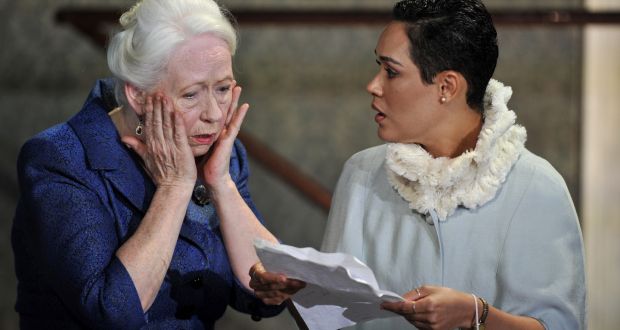
Morkan (Marie Mullen) is hosting a dinner party with the assistance of Loren (Julia McDermott).  The perpetually drunken Freddy (Aaron Monaghan) is the first to arrive, to the disappointment of Morkan who is awaiting her celebrated nephew Gabriel Conroy, a critic for the Review, who has promised to make a speech. Her old friend Ames (Bill Irwin) slips and slides in from the snow, as do Marty Rea and Jude Akuwudike’ musicians, and the supercilious couple of Rory Nolan’s marketer Rory Nolan and Kate Kennedy’s psychiatrist. It quickly becomes clear that nobody has read the attachments to the invitation, or indeed done more than scan the invitation, and all Morkan’s plans for elaborate festivities will come to naught. And then Aran (Grace Byers) unexpectedly arrives, bearing the news that her partner Gabriel will not be joining them. And so the party begins…

Director Garry Hynes stages proceedings deliberately chaotically, so much so that at a few points I thought of all the guests roaring about the mansion after Tim Curry in Clue. There are some comic tours-de-force: Rea’s attempt to get Mullen to feed him the words and music of a song he is pretending to know, his brilliantly performed piano piece that to paraphrase John McGahern at every moment has as much reason to stop as to go on (to the consternation of Nolan’s attempts to applaud it out of existence), Irwin’s injury with a carving knife which leads him to decline coffee beans being applied to the wound because he’d be up all night, and Kennedy’s 11 probing questions that Akuwudike furiously claims to have permanently shattered Rea’s mind by making him ask of his remaining lifespan – is it enough?

But these frivolities sit uneasily beside the fact that Brooklyn playwright Brian Watkins is clearly meditating on James Joyce’s ‘The Dead’, not that that was highlighted in publicity. Francis O’Connor’s impressive set with its multiple staircases creates a sense of a beloved brownstone with snow constantly seen falling thru the windows, and, in the end, of course, thru the strange black hole in the roof of the living room; that the snow might fall on all the living and the dead. Watkins has borrowed from Joyce occasion, character names and traits, and, rather astonishingly, the singing of the ‘The Lass of Aughrim’ for an epiphanic moment. And these are characters badly in need of an epiphany as they struggle sans schmartphones to remember just what Epiphany is meant to celebrate, and flail around confusedly trying to create a secular celebration.

Epiphany has a number of memorable set-pieces, its muted ending with old friends Irwin and Mullen seeing out the night is affecting, but it’s not as revelatory as hoped.

3.5/5

Epiphany continues its run at the Galway Town Hall Theatre until the 27th of June.

October 9, 2018

Richard III

DruidShakespeare finally makes it to the capital having (it almost seemed pointedly) kept the Henriad away, and yes, the wait has been well worth it.

Photo: Robbie Jack

Richard (Aaron Monaghan) has been sent into this world before his time. And in a time of peace after the Wars of the Roses he embraces the role of villain. With gusto, informing us of his scheming before he undertakes each deceit. For Edward IV (John Olohan) is ailing, and Richard is determined to usurp the line of succession to take the hollow crown for himself. His machinations against his brother Clarence (Marty Rea) are only the beginning of an escalating palace intrigue that will undo Buckingham (Rory Nolan), Hastings (Garrett Lombard), Rivers (Peter Daly), Lady Anne (Siobhan Cullen), and the little Princes in the Tower (Zara Devlin, Siobhan Cullen again), before this reign of terror brings back a time of war and undoes Richard himself. The White Boar of Gloucester must not let the Plantagenets end at Bosworth Field…

This is not a short production but its 150 minutes around an interval gallops by so gripping does director Garry Hynes make the action. There are numerous moments throughout that will change forever how you read the text, like the deliriously joyful hypocrisy of the ‘praying’ Richard acceding to (cough) popular demand to seize the crown.  I was disappointed that Marty Rea had such a minor role as Clarence only for him to double up in an incredible turn as Catesby, the fastidious assassin with a bowler hat and ritualised use of a captive bolt gun. Then there is Garrett Lombard’s unexpected and sublime ‘Woe…. to England’ rendered as a ‘Whoa’ worthy of Keanu Reeves as Hastings suddenly realises the doors have shut, the extractor fan and fluorescent light has come on, and he’s the only one left on the stage along with Catesby – bogus…

Set designer Francis O’Connor and lighting designer James F. Ingalls have outdone themselves with this imagining of the court as a playing space covered in loose earth surrounded by pillars which can be supplemented by rotating grey panels to create an enclosed cube, and with the help of Gregory Clarke’s sinister sound design realise the space as the abattoir Richard’s bloodbath makes it – complete with an open grave to roll bodies into. Flags handed out to audience members on returning from the interval allow us to wave our public support for Richard’s claim, as Conor Linehan’s music blares forth triumphantly. And there are flags for those rooting for Henry VII. Nearly all the ensemble double save Jane Brennan (Queen Elizabeth) and Ingrid Craigie (Duchess of York), with Sean McGinley and Marie Mullen Fassbendering as Archbishop of York and Lord Mayor.

Hynes expertly marshals a large ensemble, brings out the black comedy in Shakespeare’s text, and maintains an impeccably brisk pace thru all the scheming.

5/5

Richard III continues its run at the Abbey until the 27th of October.

May 16, 2018

RIP Tom Murphy

I attended Dancing at Lughnasa at the 2015 Dublin Theatre Festival mere days after the death of Brian Friel. That production served almost as a wake, and Graham Price and I mused then that Tom Murphy was now Ireland’s greatest living playwright. Alas, now he is taken from us too.

I studied The Gigli Concert for my MA in Anglo-Irish Literature & Drama. I didn’t really get it, nor did I think that, despite patches of undoubted brilliance, it really worked overall. Only for Frank McGuinness to pronounce that often Murphy’s work didn’t read very well, it had to be performed to really come alive. I remember scratching my head at the time about that. My unspoken objection was: how would you ever know something was worth performing if you had to perform it first to see its quality? Frank McGuinness, of course, knew best. 2012 saw a feast of Murphy on the Dublin stage and I reviewed three of those productions here. First out of the blocks was Annabelle Comyn’s revival of The House, which dripped Chekhov, and a savagery in characterisation and theme when tackling emigration. But savagery in Murphy hit its high water-mark at the very beginning with A Whistle in the Dark, which formed part of DruidMurphy’s repertory at the Dublin Theatre Festival. The primal violence of A Whistle in the Dark brutalised the Gaiety’s substantial capacity into a stunned silence. It still remains one of my most vivid theatrical memories. And then, in a marvel of repertory, the same cast turned their hands to the serious comedy Conversations on a Homecoming; with Rory Nolan and Garrett Lombard morphing from the two scariest brothers in Whistle to an amiable duffer and the village intellectual scrapper respectively.

Druid returned to the Murphy well for a striking production of Bailegangaire a couple of years later. President Michael D Higgins was in attendance when I saw it with Graham Price and Tom Walker who summed it up perfectly as ‘Happy Days as Irish kitchen sink drama’. It is startling to think in retrospect that Murphy’s classic was packing out the Gaiety, when it represented such a collision of the avant-garde with the popular mainstream. When the Gate finally broke its duck and presented The Gigli Concert as its first foray into Murphy’s oeuvre the same thing happened: packed audiences, to the extent that the play was brought back for a second run. Graham Price reviewed it on the second run, to add a corrective to what he felt was my insufficiently admiring review from the first time round. I realised that it did work better in performance than it read, but still didn’t think it was the ne plus ultra of Irish drama. And then I ended my belated exploration of Murphy’s work where I began, with Annabelle Comyn directing on the Abbey stage in the summer. But The Wake was a very different proposition than The House.  Comyn threw practically every Bat-tool in the director’s utility belt at it but Murphy’s rambling script proved ungovernable. But for all that there was still much brilliance shining thru the wreckage. Not bad for a play written in his early sixties.

I have a personal hit-list of key Murphy plays left to see: A Crucial Week in the Life of a Grocer’s Assistant, The Morning after Optimism, and The Sanctuary Lamp. Now, whether anyone other than Druid will put them on in this current cultural climate is sadly quite another matter.

The House

A Whistle in the Dark

Conversations on a Homecoming

Bailegangaire

The Gigli Concert

The Gigli Concert

The Wake

February 27, 2018

Sive

Druid return to John B Keane after 2011’s coruscating Big Maggie, and the result is another potent blend of riotous comedy and barbed social commentary.

Tommy Tiernan as Thomasheen Sean Rua. Image Ros Kavanagh

Before I saw this show I had wondered if Garry Hynes could tame Tommy Tiernan. But it turns out he was perfectly cast as Thomasheen Sean Rua. There was no need to tame him, merely to wind him up and point him in the right direction. The way Tiernan played the character was positively Dickensian, a creepy moment in which he moves his head closer to Sive akin to Uriah Heep and the vim he displayed the rest of the time two steps from Fagin.

5/5

August 16, 2017

Dublin Theatre Festival: 5 Plays

This is the 60th anniversary of the Dublin Theatre Festival, but this year’s programme is not very good; in fact it’s the weakest I can remember since I started paying attention back in 2007 and the 50th anniversary iteration when Druid presented James Cromwell in Long Day’s Journey into Night.

Tribes 28th September – October 14th Gate

English playwright Nina Raine’s acclaimed work about a deaf youngster’s emotional battles with his highly-strung family gets a puzzling relocation from Hampstead to Foxrock, as if Hampstead was in a faraway country of whose people we knew little. Fiona Bell, Clare Dunne, Nick Dunning, and Gavin Drea are among the familiar faces throwing around hyper-articulate insults while director Oonagh Murphy makes her Gate debut.

Melt 28th September – October 8th Smock Alley Theatre

Lynne Parker directs a new script by Shane Mac an Bhaird which has attracted an impressive cast of Owen Roe, Rebecca O’Mara, Roxanna Nic Liam, and Charlie Maher. Set in Antarctica it follows rogue Irish ecologist Boylan, his young colleague Cook, his love interest Dr Hansen (ex-wife of Boylan), and their discovery from a sub-glacial lake – Veba. Rough Magic promise a fairytale!

The Second Violinist October 2nd – October 8th O’Reilly Theatre

Composer Donnacha Dennehy and writer/director Enda Walsh reunite following their opera The Last Hotel with Crash Ensemble again providing the music, while the chorus of Wide Open Opera and actor Aaron Monaghan join the fun. Jamie Vartan again provides a set on which for 75 minutes physical madness of a presumably ineffable nature can play out, to a Renaissance choral backdrop.

Her Voice October 10th – October 11th Samuel Beckett Theatre

A Japanese riff on Samuel Beckett’s Happy Days sees Keiko Takeya and Togo Igawa directed by Makoto Sato; who has also designed the set and stripped away all the words from Beckett’s scripts save his numerous stage directions to get to a new kernel of the piece as Takeya conveys Winnie’s rambling monologues of memory purely through gesture and facial expression.

King of the Castle October 11th – October 15th Gaiety

Director Garry Hynes and frequent collaborators designer Francis O’Connor and lighting maestro James F. Ingalls tackle Eugene McCabe’s 1964 tale of rural jealousy. Sean McGinley’s Scober MacAdam lives in a Big House in Leitrim, with a large farm and young wife, played by Seana Kerslake. But their childless marriage sees rumours swirl amidst neighbours Marty Rea, John Olohan, and Bosco Hogan.

August 12, 2017

Crestfall

Druid returns to the Abbey for the second time this summer, with a revival of Mark O’Rowe’s controversial 2003 monologue play on the Peacock stage.

DGtzbsHXUAAe4UP

Crestfall sees three actresses deliver three monologues, which overlap in places, deepening our understanding of the various characters and viewing events from multiple and thus revelatory perspectives. Olive Day (Kate Stanley Brennan) is a nymphomaniac as a result of childhood sexual abuse. She has a particular dislike for Alison Ellis (Siobhan Cullen) who she thinks sanctimonious, and a situational dislike for drug-addicted prostitute Tilly McQuarrie (Amy McElhatton); who calls her a whore for her sexual promiscuity after a less than compassionate response to Tilly’s Jonesing. These three women’s lives collide in violent (,very violent, really you won’t believe how violent it is,) ways on a day of sunshine and sudden rainstorms. A cuckolded husband reaches his breaking point, a one-eyed man with a three-eyed dog does unspeakable things, and a horse is punished for kicking a child in the head.

O’Rowe has done a second tinkering with the text after a 2011 rewrite. The infamous bit with the dog that provoked walkouts at the Gate in 2003 is gone, but the crudity of Olive’s monologue is still remarkable. Quite what attracted director Annabelle Comyn to this script is unclear; as the rhyming couplets quickly become limiting rather than a euphoric torrent of language. This is very far from Tom Vaughan-Lawlor’s tour-de-force playing both roles in Howie the Rookie in 2015. That physicality is purposefully absent from this play, where the vigour is supposedly in the language, but it lacks the exuberance that O’Rowe is capable of and often it just seems vulgar for the sake of vulgarity; a judgement I was surprised to hear delivered to me as I left the theatre but which on reflection I have to endorse.

Aedin Cosgrove has designed a crimson playing space that resembles a corrugated container, in which three women prowl in gowns that look like a cross between psychiatric hospital garb and prison uniforms. Stanley Brennan gives a swaggering performance, but the memory lingers on Cullen as the most normal of the trio, delivering her lines with maternal concern and disgust for the squalor surrounding her that almost seems to stand-in for the audience. If Crestfall’s 75 minutes were punctuated by an interval, would the obviously restless members of my audience have melted away?… As details of the various monologues accumulate you can start to hear the clicks of O’Rowe’s larger plot fitting together, but that is not the most rewarding of theatrical experiences. If I want accumulating details to fit together into a suddenly comprehensible whole I usually read Kathy Reichs.

There’s a certain pleasure to be had in the mechanics of the storytelling, but it lacks the vim O’Rowe simultaneously brought to his similarly gradually interweaving 2003 Intermission screenplay.

2.5/5

Crestfall continues its run at the Peacock until the 12th of August.

May 20, 2017

Waiting for Godot

The Abbey, in its new baffling role of an Irish Wyndham’s Theatre, hosts Druid’s hit 2016 production of Samuel Beckett’s debut; and it’s incredibly impressive.

Broken down gentlemen Vladimir (Marty Rea) and Estragon (Aaron Monaghan) find themselves in a desolate landscape, waiting beside a blasted tree for a meeting with possible benefactor Godot. Their attempts to pass the time; or hang themselves, whichever seems more practicable; are aided by the unexpected arrival of the pompous domineering Pozzo (Rory Nolan) and his silently suffering servant Lucky (Garrett Lombard). Vladimir is outraged by Pozzo’s treatment of Lucky, hauled about roughly on a leash, but Lucky’s speech soon puts paid to his sympathy… And then night falls and a small boy appears and tells them Godot will not be coming, but that he will certainly see them the next day; if they would be so good as to wait again. Which they obligingly do, not without grumbling at the futility of their lot; and then nothing happens, again.

Waiting for Godot, like Hamlet, is a play full of quotes; especially if you’ve studied Irish literature. Yet for all our familiarity with this text, this production offers surprises. Director Garry Hynes slows proceedings down to allow Beckett’s comedy take centre stage, with Rea very deliberate over the care of his boots and hat; as proud of his meagre wardrobe as Chaplin’s Little Tramp. There is also some very funny business as three hats circulate with increasing rapidity and exasperation; Beckett as slapstick. Nolan unexpectedly plays Pozzo as first cousin to his Improbable Frequency John Betjeman, and it works incredibly well; the preening behaviour culminating in a self-tickled ‘Managed it again!’ to Rea, on sitting down again, which deservedly brought the house down. Lombard, meanwhile, stands up from his whimpering to achieve a career highlight: delivering Lucky’s insane, fast-paced monologue.

Designer Francis O’Connor displays his recent fascination with presenting action within a monumental white frame having also used that motif for the Gate’s The Father. On the playing stage there is an artfully wretched tree, stones akin to a Zen garden’s denizens, and a comically wonderful moon that suddenly rises when night falls. Indeed James F. Ingalls’ lighting design not only casts the play into night in a manner that is both haunting and subdued, it also makes the very landscape of the set seem to change quality; a properly Zen effect. If Barry McGovern, Johnny Murphy, Stephen Brennan, and Alan Stanford, immortalised in Beckett on Film, represented a company personally endorsed by Beckett, then these Druid repertory players are affirmed by their own passion and soulfulness; Monaghan’s shattered vulnerability and anguish seems to physically embody post-war guilt and questioning.

It is hard not to feel watching this production that something remarkable has happened before your eyes: the torch has passed triumphantly to a new generation of Irish actors.

5/5

Waiting for Godot continues its run at the Abbey until the 20th of May.

November 30, 2016

Helen & I

Druid returned to the Dublin Theatre Festival with a heavyweight cast and director tackling a new play by Meadhbh McHugh.

2016-10-02_ent_25109350_i1

Helen is Cathy Belton, and the ‘I’ is Rebecca O’Mara’s Lynne; who we first meet nervously plastering on make-up in the kitchen where she is waiting to meet her estranged sister as they keep a vigil over their dying father. Their nervous rapprochement is complicated by the arrival first of Lynne’s husband Tony (Paul Hickey), and then Helen’s daughter Evvy (Seána O’Hanlon’s).

This feels in thrall to Tom Murphy’s ouevre, most particularly the paralysing grip of the past which can simultaneously not be acknowledged in Bailegangaire, but never truly catches fire. Perhaps it was an unfortunate coincidence of casting that led to an unwarranted feeling of a perfectly good play not quite achieving the heights of greatness: Belton and O’Mara having previously played estranged sisters keeping a vigil over their dying father in Aristocrats at the Abbey in 2014.

Belton dominates the stage, conveying the emotional meltdown Helen endures in a sweltering Galway summer, but this feels like it could have been more than it is.

3/5

Next Page »

Blog at WordPress.com.

Design a site like this with WordPress.com
Get started