Talking Movies

December 24, 2025

Any Other Business: Part CVII

As the title suggests, so forth.

I can’t believe it’s not House

Watson, currently airing on Sky Witness in double bills, is a curious beast. Transparently a rip off of House, it purports to be inspired by Arthur Conan Doyle, but blatantly lifts from the 2010s series Elementary on which showrunner Craig Sweeny used to be an esteemed writer. One wonders who is more baffled looking at this oddity? David Shore? As he looks at a maverick doctor running a specialist clinic that only deals in diagnosing the trickiest of cases who encourages his hand-picked staff to root in patient’s houses to find out what they’re hiding and kind of has a thing going with the ball-busting head of the hospital? Robert Doherty? As he rummages thru his notes for later seasons of Elementary and finds post-concussion syndrome and Shinwell Johnson circled in red? And what is Craig Sweeny up to? How did a man responsible for the gleeful insanity of Limitless find himself shepherding such a bland creation as a Watson who is both a Watson without a Holmes, and a House without a personality. The only real reasons to watch this show are – a morbid fascination in to just how much they can rip off from others shows without getting into trouble – a curiosity as to what elements must always appear even when Holmes is nowhere to be found (Moriarty, Lestrade, Mrs Hudson, Irene Adler, Shinwell Johnson, Sebastian Moran). I’m honestly amazed it’s been renewed.

Who’s going to celebrate you, tonight?

People often rave about the bravura scene in Miami Vice where Tubbs and Crockett simply drive while “Can you feel it coming in the air tonight?” is sung repeatedly. So it’s surprising that nobody seems to mention in the same vein an extended sequence in the final season of Magnum PI. Magnum PI is a show with some exceptional transitions between scenes. Indeed one might say the showcase episode “Home from the Sea” that opens season 4 is built around transitions from character to character via chiming dialogue. The sort of showy and amusing trick, where a question is ‘answered’ in a different context, that Aaron Sorkin used to introduce all his characters in The Trial of the Chicago 7. But in “Unfinished Business”, as Magnum comes to terms with unimaginable loss, the dialogue stops. Magnum is bent on vengeance. And with the doggedness and methodical savvy of an intelligence officer he tracks down his target, then prepares his weapon and approach. All to the sound of the Genesis instrumental “The Brazilian”.

“Marcus Aurelius has already relieved you of the obligation to have a take!”

I came across that celebrated gloss on a passage of the Meditations earlier this year, and have been thinking of it a lot recently. The deaths of those titans of 1970s cinema Robert Redford and Diane Keaton should probably each have been marked by a piece on this blog, if I was invested in doing that kind of thing in defiance of Aurelius. Neither meant as much to me as Donald Sutherland though, who I had already written about elsewhere, so I didn’t attempt a timely piece to grab eyeballs because I felt I didn’t have enough extant knowledge to do it justice. Sometimes I come in late with off-kilter pieces like I did on Gene Hackman, or will at some point in the near future do so for Terence Stamp. Which is all prefatory to saying when Charlie Kirk died, I was stunned. To me he was a constant popping up presence on YouTube shorts as they vainly tried to imitate TikTok. I had read the Atlantic’s lengthy profile of him, but above all he was a voice. Which made the shock of seeing him being shot in the throat mid-debate all the greater, literally a voice silenced forever.  I thought about writing something, but I didn’t feel I had anything to add. Not so other people… If you think that it is not disgusting and weird but in fact very moral and indeed charitable of you to say that it is regrettable someone died only because it robbed them of the chance to repent their life’s work, well, unless they are a war criminal or habitual denizen of the prison system, which Charlie Kirk was not, then you reveal only your narcissism and moral bankruptcy.
March 16, 2016

Sing Street

Writer/director John Carney builds on his American debut Begin Again’s success with another funny can-do tale of musical swashbuckling, this time set in 1980s Dublin.

image

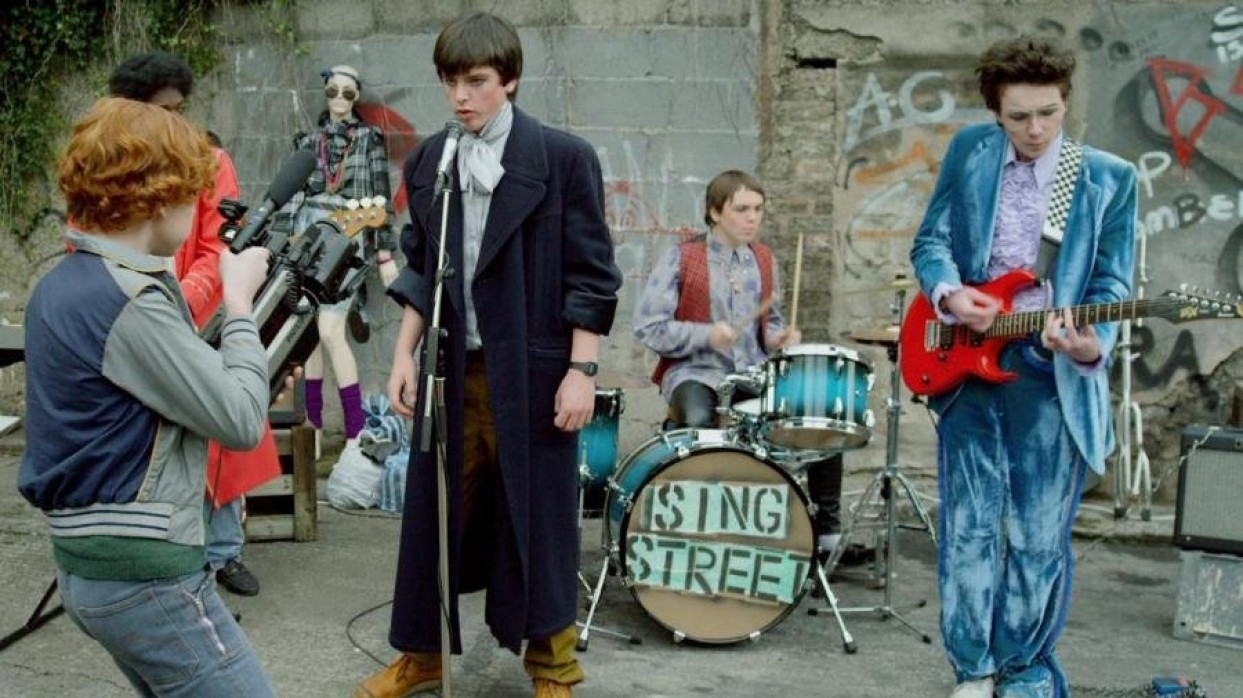
Conor (Ferdia Walsh-Peelo) is a rich kid whose cosy private school adolescence comes to a crashing halt when parents Robert (Aidan Gillen) and Penny (Maria Doyle Kennedy) announce an austerity drive. A fish hopelessly out of water at Synge Street CBS he is viciously bullied, but after being befriended by entrepreneurial fixer Darren (Ben Carolan) he meets aspiring model Raphina (Lucy Boynton) and ascends the pecking order at school after forming a band to impress her. Older brother Brendan (Jack Reynor) provides sardonic mentoring while multi-instrumentalist Eamon (Mark McKenna) provides the musical foundations over which Conor, soon renamed Cosmo, lays lyrics about Raphina. Cosmo increasingly clashes with school Principal Brother Baxter (Don Wycherley) as the band ‘Sing Street’ become increasingly disruptive in their appearance and attitude. But will Conor’s increasingly ambitious efforts be enough to stop Raphina emigrating to London?

“But is there a difference between liking a thing and thinking it good?” – Brideshead Revisited

Bridey’s question is extremely pertinent for Carney’s movie. The original music is great, especially the band’s first song ‘The Riddle of the Model’. Carney’s script is very funny, and Reynor is on terrific form as the stoner older brother. But this feels like a backward step from Begin Again on a number of fronts. Reynor’s character is almost a mash-up of Philip Seymour Hoffman and Zooey Deschanel’s roles in Almost Famous, and, though Sing Street captures elements of the period perfectly; school exercise books, constant smoking; there is also an air of total fantasy (doubly odd in a film which so obviously wants praise for its grittiness) which has Brendan as its focal point. He’s almost a time-traveller from 2015 landed in 1985 in the social critique he lays on his parents’ marriage and the Christian Brothers’ ethos. His dismissal of Genesis makes a nonsense of his affection for Duran Duran, and then you realise his taste is temporally inconsistent. Brendan ought to be agonising over whether Bowie, Springsteen and The Clash have sold out on their latest albums, and avidly listening to The Smiths and REM, not watching Top of the Pops. And then there’s U2… Never mentioned, never listened to, in 1985 Dublin.

Raphina never convinces as a real person, she is merely an object of desire, and the film has so little interest in Conor and Brendan’s sister; especially her reaction to their parents’ separation; that you wonder why she’s there at all. But while the female characters fare poorly, compared to Conor and Brendan, they’re not alone. Ngig (Percy Chamburuka) is also sidelined, and Larry (Conor Hamilton) and Garry (Karl Rice) are interchangeable comic relief. Sing Street’s set-up recalls The Inbetweeners but pretty boy Cosmo, living in a three storey house, is not likeable. He humiliates the school bully; fully aware said bully is a victim of abuse; and aggravatingly ‘rebels’ against Brother Baxter; who has to contend with regular students’ violent behaviour without Cosmo’s New Romantics nonsense; with Carney stacking the deck by creating an uncomfortable unfounded expectation of molestation.

Sing Street is an entertaining film made with much confidence, but that doesn’t excuse its many puzzling artistic choices and the most ridiculous ‘upbeat’ ending since The Way Back.

3.5/5

January 8, 2016

Bret Easton Ellis: Page to Screen

Bret Easton Ellis has written seven books, four have been filmed, and two of those have been set in Los Angeles. And yet they are by far the weakest of the Ellis adaptations… Here’s a teaser of my piece for HeadStuff on those adaptations.

9vsm9htzegx2r1nlusmxvrr8z.1000x667x1

“I stand back from the unfinished canvas. I realise that I would rather spend my money on drugs than on art supplies” – The Rules of Attraction (novel)

While Hollywood was premiering his debut, mangled to appeal to perceived Reaganised teenagers, Ellis published his sophomore novel The Rules of Attraction, in which the influence of Reaganism is present in the Freshmen wanting a weight room and vetoing Louis Farrakhan as a speaker. Camden College life in the 1985 Fall term is narrated in short vignettes by Sean Bateman, Paul Denton, Lauren Hynde, and some secondary characters. An unreliable picture emerges from their overlapping experiences at parties, cafeteria lunches, hook-ups, classes, and trips to town. Denton narrates a secret affair with Bateman, Bateman narrates a minor friendship with Denton, Bateman and Lauren hook up for a disastrous relationship which both record very differently, and Bateman’s secret admirer (who he thought was Lauren) kills herself when he sleeps with Lauren. STDs and abortions are the frequent price of the casual sex merry-go-round of Camden’s never-ending party, and Lauren pays in full. Ellis’ dialogue is a marvel, with one-liners aplenty in concisely captured conversations, while the trademark pop culture references (everybody is listening to Little Creatures) are married to more nuanced narration. Denton, the most self-aware and self-critical character, eschews auditioning for the Shepard play because his life already is one. Spielberg is memorably critiqued for being secular humanism not rigorous modernism, but mostly these intelligent characters play dumb because excess is what’s expected.

“What does that mean? Know me? Know me? Nobody knows anyone else. Ever. You will never, ever know me” – The Rules of Attraction (film)

Pulp Fiction co-writer Roger Avary adapted and directed the novel, and Ellis dubbed the 2002 film “the one movie that captured my sensibility in a visual and cinematic language.” The rise of independent cinema meant Avary could cast James Van Der Beek as Bateman without bowdlerising the novel. The film is alternately shocking (it opens with the rape of Shannyn Sossamon’s Lauren), hilarious (Denton [Ian Somerhalder] and Dick [Russell Sams] perform an entirely improvised dance to ‘Faith’ in their underwear), and romantic (an extended split-screen sequence shows Bateman and Lauren finally meeting at their Saturday morning tutorial). Avary stylishly plays out the climactic ‘End of the World’ party from three viewpoints before winding back to the start of term, and situates Camden in a temporal twilight zone; with broadband internet but a 1980s soundtrack of The Cure and Erasure. Avary radically changes Lauren’s character, by throwing many of her traits onto loose roommate Lara (Jessica Biel). Lauren is now a virgin, waiting for Victor to return from Europe, whereas in the book she waited on Victor while sleeping with Franklyn. From being a mirror of Bateman, who sleeps with her friend while being in love with Lauren, she becomes a Madonna. There’s no longer an alienated road-trip with Sean ending with an abortion, just as Sean’s affair with Denton is reduced to one split-screen scene implicitly showing Denton’s fantasy. Avary’s changes make more violent and consequential Bateman’s successive breaks with Lauren and Denton, when she tells Bateman he will never know her, and he repeats her lines to Denton. Denton and Lauren’s snowy encounter after the ‘End of the World’ party, scored by Tomandandy with electronic eeriness, becomes a haunting summation: “Doesn’t matter anyway. Not to people like him. Not to people like us.” Lauren’s momentary self-condemnatory thought, unsaid in the novel, is spoken and brings things close to Gatsby’s “careless people … they smashed up things and creatures and then retreated back into their money.”

Click here to read the full piece on HeadStuff.org.

September 21, 2009

Creation

A biopic of Charles Darwin that a creationist and Dawkins could go see and both happily leave halfway thru, agreeing that something so boring and utterly wretched wasn’t worth arguing over.

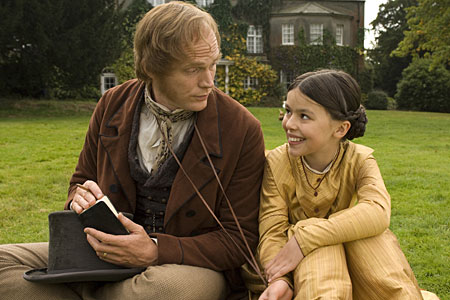
Creation opens with a caption proclaiming Darwin’s idea to be the single greatest in the history of thought, and then, for 109 minutes, casts doubt on whether cinema can communicate ideas at all. Creation is the worst of a biopic sub-genre (Shakespeare in Love, A Beautiful Mind) where great works are reduced to inanity by focusing not on the work, but, to paraphrase Creation’s captions, how the person came to write that work. You would think Darwin came to write his work by years of painstaking research, the formulation of a revolutionary hypothesis, and then months of hard graft writing up his findings by hand – but no! Darwin wrote his work addled on laudanum and guided by conversations with his dead daughter.  This conceit, like the flashbacks to his daughter’s life, is at first preposterous, then annoying, and finally unbearable.

The always capable Paul Bettany, bald but eschewing the beard of popular imagination, seems to be playing his own greatest hits. Darwin is a laudanum fiend and naturalist, like Bettany’s character in Master & Commander, who writes his great idea due to conversations with people who aren’t there, just as Bettany inspired Russell Crowe in A Beautiful Mind. Jennifer Connelly as Darwin’s religious wife is under-served by the script, although she and Bettany shine in the best scene of the film when they finally confront the possibility that their daughter’s poor health was because they married, despite being first cousins. Connelly’s character though is under-served because she is religious and this is a fatal weakness.

If you want true dramatic conflict you must give each character in an argument the possibility of winning or the scene is predetermined and therefore pointless. This holds even ethically – witness the astonishing scene in Sophie Scholl where Sophie is questioned for her anti-Nazia propagandising by a Gestapo officer in an intellectual debate in which every point Sophie makes is eloquently contradicted by him, and he makes points she can’t refute: the scene positively hums with dramatic tension even though he represents genocidal evil. In Creation poor Jeremy Northam as Reverend Innes is given dialogue which is comically bone-headed – his preaching on Genesis’ most absurd passages drives Darwin to walk out of service, while his approach to bereavement counselling for the Darwins involves endless references to God’s wise plan. This loading of the dice dramatically makes these scenes deeply idiotic, and matters are not helped by TH Huxley (Toby Jones appearing for five minutes) being more Dawkins than Huxley in his startling belligerence. Indeed his effect on Darwin in the film leads Innes to deliver his only good line, “I had always regarded you as one of those rare mortals with whom it is possible to disagree without a shade of animosity. I see that is no longer true”.

Evolution is, as Thomas Jefferson might have put it, a self-evident truth, but writers John Collee and Jon Amiel seem to think it so specious that they need a straw-man construction of religion. Ignore this bizarre farrago and instead try to watch the two BBC documentaries Darwin by David Attenborough and Did Darwin Kill God?

1/5

Blog at WordPress.com.

Design a site like this with WordPress.com
Get started