Talking Movies

May 5, 2025

Any Other Business: Part CIII

As the title suggests, so forth.

Yes, and/No, because

GK Chesterton in The Crimes of England spoke of the spirit that affirms and the spirit that denies, and averred that Prussia was very much the spirit that denies – made flesh. I’ve come to think that when it comes to people these truly are the animating spirits. And not, unlike improv, the spirit that affirms says “Yes, And” to any and all propositions presented. The natural predisposition is to action, to adventure, and to figuring out solutions to problems. On the other hand is “No, Because” which magicks up multiple problems without any interest in ever finding solutions, because the problems are never real. They are after the fact rationalisation of the natural predisposition to veto, to shut down any hint of fun or progress. Why? Because. And in our time it has morphed from “Because, Health & Safety” to “Because, GDPR”. There is never further explanation offered, which is convenient because there wouldn’t be any behind the bullsh-t facade of respectability. The dynamic is familiar from watching bullies at play, if one can call it that: Whenever you see a larger child take something away from a smaller child, not because they want to play with it themselves but expressly to deprive the smaller child of it. The pleasure is gained entirely in causing someone else pain by capriciously depriving them of something they want; Shakespeare might put it as robbing someone “of that which enriches you not but makes him poor indeed”. When these people grow up, if they enter positions of power they are very recognisable by their words and deeds as people whose only positive pleasure in life is inflicting suffering on others and denying pleasure to others. I think the agreeable/disagreeable split is a precursor towards this affirming/denying dynamic, possibly interventions in childhood can prevent disagreeable people entering adulthood as brazenly cruel jobsworths. Instead they become disagreeable wretches, who could find quarrel in a straw.

Living by a Mann Code

“And what cheese-eating yahoo of a Governor signed that idiot bill into law? … … … It was me, wasn’t it?” – The West Wing

“Hoist on his own petard”.That’s what happened to Jed Bartlett there. And it’s not a phrase that is much heard these days, despite its applicability. It is something that, say, the French rugby coach at the Six Nations refused to do: if it happens to his player it should result in after the fact official complaints and hell and damnation for the entire Ireland team, if his players do it -well, rugby is a contact sport after all, and if you can’t take the rough and tumble of it… Hypocrisy! And yet, it is easy. The rules shouldn’t apply to us because we meant well, or, more accurately the rules shouldn’t apply to us – because we’re us. It makes me think of something The Engineer came across some years ago. Across many different cultures a survey found that men most deeply admired men who lived by a code. This is the point of the Mann Code. Across many films Michael Mann has portrayed characters who are men of their word, men of honour, who believe, par Chesterton, that people avoid making vows not because they are silly but because they lack the faith in themselves to be true to them. De Niro’s master thief tells Pacino’s cop in Heat that the discipline of the job is not forming any attachments that you will not be willing to walk out in thirty seconds flat if you feel the heat around the corner. Kilmer and De Niro’s characters then do exactly that later in the film. It is not easy, but that’s the point of living by a code – it requires self-abnegation. Pete Hegseth, alleged macho man who is going to bring back masculine values to the Pentagon, does not live by a Mann code.Though he would care for you to think he does. He lives by the weasel code, which is far more common. He lambasted Hillary Clinton’s emails, but he’s allowed send classified information to every group chat. After the Six Nations I thought of Trevor Sargent. He swore that he would not lead the Greens into Government with Fianna Fail, and then resigned his leadership when it became clear that the party willed it. That seems … anomalous. Imagine a politician keeping their word, at such considerable cost. And yet it is admirable. Certainly compared to the ABBA parties in Downing Street during COVID-19 lockdown. So why did people just sort of snigger and raise eyebrows at the time rather than celebrating it? Perhaps the answer is from another moment in The West Wing: “No one expects.” “No one expects! Toby, more and more it seems to be that we’ve come to expect less and less from each other” Living by a code is damn hard. That’s why Mann has built such a distinctive filmography from interrogating it. Just look at 2020, as a recent Jon Stewart podcast had me thinking, and the clash between COVID-19 and BLM. Gatherings were bad. You couldn’t pray together. You couldn’t eat together. You couldn’t even walk on a beach or a moor alone. But if you wanted to protest together, well, that’s different. At which point the idea “of listening to the science” became defunct. Because the virus sure as hell could not tell the difference between good gatherings and bad gatherings. If it was bad for evangelicals to gather and shout and sing because that would spread the virus, then it was also bad for activists to gather and shout and sing because that would spread the virus. But, to their eternal shame, 1288 medicos signed an open letter saying the opposite, because it was easier. It’s always hard to tell your friends they are in the wrong: Imagine being the NIH person instructed to tell his political cohort that they aren’t allowed to do what they want, and being shunned socially for it. You can see the same dynamic at work with Bishop Barron of Minnesota who rightly castigated the Paris Olympics for their sacrilege last summer, which they didn’t have the decency of admitting was a deliberate impiety. But he is lamentably silent now as President Trump posts an AI image of himself as Pope, which is also sacrilege; and galling during the official mourning for Pope Francis. Trump also doesn’t have the decency of admitting it was a deliberate impiety. But it’s hard to tell your friends they are in the wrong. Perhaps this is another reason that Mann’s characters are so often lone men – living with someone who lives by a code is challenging, it’s as exasperating as trying to be friends with an actual saint.

Holy Generational Age Gap, Druid!

I still, from time to time, think of moments from DruidShakespeare’s Richard III back in 2018. Indeed it semi-poisoned my very belated viewing of Laurence Olivier’s 1955 film of Richard III because I had been trained to expect the black comedy of the White Boar’s race for the throne to be brought out, and it was not. So, I should be very excited that Druid are now tackling Macbeth for the Dublin Theatre Festival in September. And with Marty Rea as the bloodsoaked Thane, no less! And Marie Mullen as Lady Macbeth. … Wait, what? And there’s the rub. Marie Mullen is 72 years old. I don’t know what exactly Garry Hynes is thinking here, but it means that this dynamic will not be that of an imperious Ciara Gough in a 2007 Astra Hall production of Macbeth; sexually toying with her returning husband till he agrees to her ambitious desires. For context the historical Eleanor of Aquitaine was 12 years older than Henry II, and it was much discussed at the time, and ever since, as an unusual age gap in a marriage intended, as many medieval monarchical matches were, to unite dynasties thru the getting of children. What exactly is this casting aiming for? The (cough) Freudian interpretation of Hamlet has been more or less erased from the repertoire because it never did very much except show how 20th Century the director was. But Freudians never really went for Macbeth. Why start now?!

December 22, 2020

You Have Been Listening To: Part V – An A to Z of Great Moments in Film

As we throw our hands up in despair and wait for the Grinch-timed return of lockdown it seems a good point to look back at a 2020 project that is nearing completion. There has been a lack of reviews by me of new releases on 103.2 Dublin City FM this year, and what was personally an injury-enforced sabbatical from studio and cinema was made a general cinema sabbatical for all for most of the year. But if you’re eager to explore the back catalogue here’s a list of the films we discussed as the film links morphed into an A to Z of Great Moments in Film that attempted to tip the hat as often as possible to films that had an anniversary of some kind in 2020.

All About Eve

Back to the Future

Cast Away

Les Diaboliques

The Empire Strikes Back

The Falcon Takes Over

Goodfellas

Top Hat

The Ipcress File

Jane Eyre

Kelly’s Heroes

The Lavender Hill Mob

Memento

Nosferatu

Othello

Psycho

The Quiller Memorandum

Rififi

The 39 Steps

Tremors

The Usual Suspects

Vertigo

Westworld

X-Men

Yojimbo

Dr Zhivago

August 27, 2018

From the Archives: Eden Lake

Another dive into the archives pulls up a Michael Fassbender horror movie that announced a new British director.

Eden Lake may be the first entry in an entirely new sub-genre, the socio-economic horror film, as this film might be more accurately and threateningly re-titled The Chavs

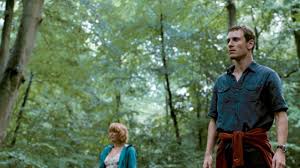
Michael Fassbender and Kelly Reilly play a polite middle-class London couple who travel to Eden Lake in the depths of the English countryside with the help of their sat-nav. Steve (Fassbender) plans to propose to Jenny (Reilly) over the course of a romantic weekend camping by its idyllic lapping waters. However the surroundings really are a place where every prospect pleases and only man is vile because a group of hoodie wearing teenagers mercilessly harass them for the day, and then the next day steal their jeep. An attempt by Steve and Jenny to get it back sees events very realistically spiral totally out of control.

Eden Lake is relentlessly tense from the first time you hear a voice announcing government proposals to deal with under-age offenders on the car radio as the couple drive out of London. Fassbender (a personal hero of mine) breaks his own rule of always obviously enjoying himself far too much in his work, as, after initially grinning like an idiot, his character Steve is sucked into the nightmare of dealing with this chillingly realised teen gang. Be warned that Eden Lake features a nigh unwatchable scene where, following the accidental killing of a vicious dog belonging to the gang leader Brett (a terrifying Jack O’Connell), Steve is tied up with barb wire and slashed and stabbed by every member of the gang, who of course all have knives like box-cutters, while the sole girl in the gang films the torture on her mobile phone.

Believe it or not things actually get even worse after that; being burnt alive, having a spike driven through your foot and being stabbed in the neck with a shard of glass are horrors still to come for the characters. It’s easy to see why Kelly Reilly was cast as Desdemona in Ewan McGregor’s West End production of Othello last year as her character Jenny is a frustratingly helpless victim until the incredibly bleak final reel.

The writing, directing and acting are as taut as can be and the shlock horror make-up is exemplary. Eden Lake is technically a superb achievement that belies its small budget and announces writer/director James Watkins as a notable talent. I cannot, however, think of a single reason to see this film. It is horror without humour, without the supernatural, without hope or relief. It is horror that could actually happen, and to you. Jack O’Connell’s surly Brett is the worst school bully you ever feared, on crack. Eden Lake would make you feel unsafe walking the streets of England with anything less than a Samurai sword strapped to your waist. Too close to the bone…

3/5

June 11, 2016

Othello

The Abbey joins in the Shakespeare 400 celebrations with its first ever production of Othello and it’s a vibrant cracker

othelo-1200-1200x520

Beware my lord of jealousy, it is the green-eyed monster that doth mock the meat it feed on

Respected soldier Othello (Peter Macon) has secretly married Desdemona (Rebecca O’Mara), to the dismay and fury of her father Brabantio (Peter Gowen) when he is roused with the news by failed suitor Rodrigo (Gavin Fullam). But the support Brabantio initially receives from his peers on the Council; Lodovico (Barry Barnes), Gratiano (Michael James Ford), and the Duke (Malcolm Douglas); evaporates when they realise his righteous indignation is directed at Othello, for the Ottomans are moving against Cyprus, and Othello is Venice’s indispensable man. Little does Othello realise that Cyprus will turn out to be a psy-ops front rather than a naval engagement. For despite being governed by his friend Montano (Des Cave) Cyprus will prove no home as his ensign Iago (Marty Rea) whispers poison in his ear in an attempt to usurp Cassio (John Barry O’Connor) as Othello’s lieutenant.

Director Joe Dowling seems to dispense with Coleridge’s celebrated ‘motiveless malignity’ of Iago for a fascinating interpretation; that Iago himself is acting throughout under the spell of the same species of madness he casts over Othello. While he is resentful of being passed over for promotion, his true anger seems to circle around his wife Emilia (Karen Ardiff) having betrayed him with the Moor. Iago’s cold treatment of Emilia thus seems a parallel to Othello’s rough abuse of Desdemona – having been turned against her. And his wail at the result of his handiwork adds to this impression; a man suddenly waking from a fugue state horrified at what he’s done. Macon’s performance is extremely impressive, and surprising. Instead of ‘the noble Moor’, dignifying every syllable, he gives us a soldier whose early scenes of camaraderie are rambunctious bordering on rowdy, and whose descent into madness involves howling, screaming, and an epileptic fit. Othello’s modesty about his linguistic skills can seem farcical given his poetic eloquence, but here it signals insecurity because English is his second language, as the American Macon delivers Shakespearean verse with some acutely noted notes and flourishes of sub-Saharan African speech. Rea, in a rare occurrence, is asked to act in his own Northern Irish accent, and this also strips away posturing. Instead of grandstanding in his own villainy in RP, Iago is a street-corner slouch of bored contempt and hidden spite; in which each soliloquy seems to expose a man trapped in his own world of hatred – given memorable visual expression by Sinead McKenna’s lights spotlighting a wordless conversation between Cassio and Desdemona while Iago creeps closer to them, railing at them, lost in solipsistic hate.

Desdemona’s passivity works best as a sheltered girl’s naivety about the world, but O’Mara is too old for the role. Desdemona is thus infuriatingly clueless, but O’Mara does gives full impact to James Cosgrove’s fight direction by selling one of the most shocking stage-punches I’ve seen. Ardiff is a highlight in support making Emilia a beacon of common sense and proto-feminist, but rendering Bianca (Liz Fitzgibbon) as an O’Casey streetwalker is a cheap and mean gag. Dowling’s staging is less naturalistic than previous returns from Minneapolis like 2003’s All My Sons or 2011’s The Field. Indeed Act 3’s celebrated temptation scene takes place against what becomes a blood-red backdrop of ocean upon which vast shadows are cast as Iago corrupts Othello. Before that Venice has been represented by a massive suspended plaque, and as Othello descends into psychosis the walls almost literally close in on him, as the ocean backdrop is truncated by successively closing over more and more of the wooden panelling of Riccardo Hernandez’s set which is identical to the Abbey’s off-stage decor.

It remains bizarre to have chosen this play because of one line, which elicited sustained tittering heedless of the dead and maimed littering the stage during its delivery, but Dowling affords the Bard’s tragedy of jealousy a bold debut.

4/5

Othello continues its run at the Abbey Theatre until the 11th of June.

November 10, 2015

An Alternative Abbey 2016 Programme

I’d been waiting for the Abbey’s new season, and was disappointed by it. I didn’t think much of their commission choices, and felt their other selections betrayed a peculiarly apologetic and almost self-loathing attitude towards a celebration of our independence. So I thought about what I might have programmed instead…

ABB1113RP31-800x534

Here are the essentials of the Abbey’s 2016 programme to September:


*Cyprus Avenue by David Ireland

(dir: Vicky Featherstone)

The Plough and the Stars by Sean O’Casey

(dir: Sean Holmes)

*New Middle East by Mutaz Abu Saleh

(dir: Bashar Murkus)

*Tina’s Idea of Fun by Sean P Summers

(dir: Gerry Stembridge)

Othello by William Shakespeare

(dir: Joe Dowling)

*Town is Dead by Philip McMahon & Ray Scannell

(dir: TBC)

The Wake by Tom Murphy

(dir: Annabelle Comyn)

Observe the Sons of Ulster Marching Towards the Somme by Frank McGuinness

(dir: Jeremy Herrin)


Here are the essentials of my alternative Abbey 2016 programme:


*Commissioned Work by Mark O’Rowe

(dir: Mark O’Rowe)

John Bull’s Other Island by George Bernard Shaw

(dir: Roisin McBrinn)

*Not I by Samuel Beckett, Play by Samuel Beckett, On Baile’s Strand by WB Yeats, Riders to the Sea by JM Synge

(dir: Annie Ryan)

*Delirium by Enda Walsh

(dir: Conall Morrison)

Making History by Brian Friel

(dir: Patrick Mason)

*The Effect by Lucy Prebble

(dir: Annabelle Comyn)

Commissioned Work by Marina Carr

(dir: Selina Cartmell)

The Wake by Tom Murphy

(dir: Annabelle Comyn)


*Plays marked with an asterisk are on the Peacock stage.

This alternative programme is of course a fantasy, because it takes no account of the availability of directors and playwrights, but it does utilise people who have done fine work at the Abbey in recent years. It commissions new plays from two of our finest playwrights, Mark O’Rowe and Marina Carr, and gives Enda Walsh’s exuberant Dostoevsky adaptation from 2008 the chance of a subtler interpretation. The Shavian elephant in the room is finally tackled, and what better time for Shaw’s exuberant interrogation of our capacity for self-government? The late Brian Friel is honoured with a timely production of his exploration of exile and myth-making in Irish history, while Tom Murphy’s more recent dissection of exile and return ends the summer season. The Abbey’s fullest spectrum is utilised: Revival classics are paired with two of Beckett’s trickiest works, and Comyn returns to her beginnings in directing a contemporary English play.

The Abbey perhaps stands at an odd angle to 1916. It is after all a national theatre older than its politically constituted nation, led in its early days by Anglo-Irish writers with a gift for enraging their Irish audience, and its seminal engagement with the decade of revolution was by a writer whose corrosive scepticism spared no institution. The Plough and the Stars is the obvious choice for marking the Rising, perhaps too obvious a choice. It has been staged too frequently to too little effect in the last decade to be wheeled out once again to throw cold water over Pearse’s dream. Not least when Observe the Sons of Ulster Marching Towards the Somme is deliberately programmed against it, as if we’re apologising to Unionists for rebelling when we could have been nobly dying for the British Empire instead. As for Othello, one quote deployed by Haughey does not a state of the nation play make. Serious engagement with Shakespeare’s quatercentenary would be a post-colonial take on The Tempest.

1916 is to be celebrated like 1776 or 1789, not apologised for, agonised over, or disparaged. The only way to discuss a programme of plays is to parse it qualitatively play by play, because that’s how people choose to go to the theatre: play by play, depending on their particular artistic cost-benefit analysis of the actors, the playwright, the director, and the subject matter. I’ve felt compelled in disliking so many of the Abbey’s individual picks to present an alternative programme of plays. Consonant with my banishing O’Casey I say there’s little use tearing down everything and building up nothing.

September 17, 2014

Wish I Was Here

Zach Braff finally follows up Garden State, but his second film as director suggests he needed Kickstarter money for reasons other than control of casting…

o-ZACH-BRAFF-WISH-I-WAS-HERE-facebook

Braff plays Aidan Bloom, an actor who hasn’t worked for quite some time. His wife Sarah (Kate Hudson) supports his dream financially with her boring job, and his disappointed father Gabe (Mandy Patinkin) pays the tuition to send Aidan’s children Tucker (Pierce Gagnon) and Grace (Joey King) to a private school. The catch is it’s a Hebrew private school, leading to a religious divide between the three generations with Aidan and Sarah out in the non-kosher cold. When Gabe’s cancer returns Aidan is forced to attempt to simultaneously home-school his children to save money, reconcile his equally underachieving brother Noah (Josh Gad) with Gabe while there’s time, defend his wife against her sleazy co-worker Jerry (Michael Weston), defeat rival actor Paul (Jim Parsons) for a lucrative role, and deal with the infuriating Rabbis Twersky (Allan Rich) and Rosenberg (Alexander Chaplin)…

It’s been nine and a half years since Garden State was released here, but all those skills are still there. The indie musical cues, the deadpan comedy, the unexpected drama – all stand present and correct, but the novelty and charm are gone. Braff’s script with his brother Adam is terribly muddled. Wish I Was Here, despite an unlikely Othello gag, isn’t very funny, and some sequences (Braff pretending to be an old Hispanic…) are just uncomfortable, because, shockingly, Braff’s not very likeable. There’s a crudity to these Brothers Bloom, and even Noah’s crush Janine (an unrecognisable Ashley Greene), that is quite off-putting; and which makes the sub-plot with Jerry problematic, despite a delightfully unexpected touch, because it needs more context for us to understand why only his ribaldry is unacceptable. In fact everything feels like it needs more context, but the film already feels far longer than its 106 minutes; it is that unenviable paradox – both too short and too long. And it also rehashes scenes we’ve seen done better in Studio 60 (the unexpected positive result of a disinterested mitzvah) and Modern Family (the underprepared casual adult teacher being supplanted at the blackboard by his smarter driven student relative).

Wish I Was Here attempts to deal with heavy themes, but Gabe’s terminal illness is terribly manipulative, to the point that you’d reject Aidan and Noah reconciling with him as a mere plot contrivance, because it doesn’t feel earned. Braff is no Michael Chabon when it comes to scrutinising American Jewish identity. The glibly sarcastic agnosticism of Braff and Hudson’s characters is largely the reason they’re acted off the screen by Patinkin and King. Braff seems unaware that proudly reminiscing to the sincere and kindly Rabbi Rosenberg about how he had a double bacon cheeseburger right after his Bar Miztvah is more likely to make us sympathise with Gabe’s disappointment than cheer on Aidan. Aidan and Sarah admit they have no identity, no advice, no metaphysical certainty; all Tucker has learnt is Aidan’s flip attitude. Gabe has bequeathed Grace the Jewish faith, language, and cultural identity. Aidan belatedly ripostes by reciting ‘Mending Wall’ by Robert Frost and ‘The Love Song of J Alfred Prufrock’ by TS Eliot… Joyce wanted applause for his Jewish hero in Ulysses, but his Bloom ate a pork kidney because Joyce, like Braff, lacked the imaginative empathy to create a hero who took his faith seriously.

Garden State was an unexpected gem, but Wish I Was Here suggests that Braff has actually emotionally regressed as a writer since even as his ambition has soared ahead.

2/5

September 5, 2014

The Actor’s Lament

Actor Steven Berkoff returns to writing verse drama for the first time in decades with this entertaining if slight production.

4cd5751a-0041-11e3-_439251c

Berkoff is an actor recovering from hostile reviews of his first outing as a playwright. Licking his wounds, he is comforted by the kind words of his playwright friend played by Jay Benedict, who insists he is a fantastic actor and the critics could not forgive his presumption. And the mutual flattery escalates even further when their actress friend played by Andree Bernard arrives, to be told what a great artiste she is; even if she is understudying a soap star on the West End. And then things kick off into not so much a lament as a tirade, at the state of the West End, the cult of theatre directors, the arrogance of playwrights, and, above all, the agony of the actor’s life and the importance of what they do night after night; for themselves and for the audience.

That might sound a bit off-putting, but this splenetic hour is filled with humour and self-awareness. Berkoff knows that an actor turned playwright moaning about revivals in the West End, and how directors like them because they get a cut of the proceeds, will seem dangerously like personal carping by Berkoff himself. And so he turns it up to 11: we get Berkoff moving himself to tears over the West End being a morgue; “Poor Chekhov dragged out again, leave the poor bloody sod alone”; full of clueless screen actors; “If you don’t remember your lines you do it fifty more bloody times. But in theatre there is only one take, and it goes on all night, every night, until you get it right!”; while dedicated actors like Berkoff and Bernard are left on the scrapheap, abandoned even by Benedict.

Berkoff’s use of verse is not like Joss Whedon’s use of rhyme in his musicals. You’re rarely waiting for a pay-off from a Berkoff line, instead it sounds like normal speech with the occasional unexpected rhyme. And, performed on a bare stage, with only an ornate chair for decoration, the focus is on the physical theatre Berkoff perfected after studying at the Lecoq school in Paris; so well displayed in Ballyturk some weeks back by a younger veteran of that school, Mikel Murfi. Imaginary cigarettes are lit with hands where the thumb waggles for the flame of a lighter. Othello, Macbeth, and Lear come to life for a few lines by dint of a change in posture and tone of voice. Berkoff ages himself by stooping and playing deaf. Indeed by the end Berkoff, age 77, was drenched in sweat…

The Actor’s Lament is a late and almost disappointingly short work from a master, but, while his age precludes the full powerhouse style of his youth, his physical theatre is still to be revered.

3/5

The Actor’s Lament continues its run at the Gaiety Theatre until September 6th.

November 19, 2013

Potentials: Francis Lawrence

In this, the first of a series of occasional features, I’m going to argue the case for Francis Lawrence having the potential to be a great director of the future.

Francis-Lawrence-Camera

Who the hell is Francis Lawrence? Glad you asked. Francis Lawrence is the director of ConstantineI Am Legend and Water for Elephants. He came from music videos, just like David Fincher. He had a happier initial time of it in mainstream commercial movies than Fincher’s Alien 3 nightmare debut, even if the ending of I Am Legend got completely changed in post-production on him, but it appears that that bruising experience was enough to send him into mini-exile. Lawrence took some time after I Am Legend before helming another movie. Before 2011 IMDb at one point listed him as being involved in developing 7 different projects simultaneously – all with the same proposed release date… While this exercise in development hell or development indecision was going on in Hollywood, Lawrence turned to TV; directing Ian McShane in the drama Kings, a modern re-telling of the rise of King David in the Torah. Kings was inevitably cancelled and so Lawrence hitched a lift on the Twilight bandwagon with 2011’s period romance Like Water for Elephants starring Reese Witherspoon and Robert Pattinson.

I’m a bigger fan of Lawrence’s three films than most. I’d rate Constantine as Keanu’s best film since The Matrix, at that time. I’d rank I Am Legend very highly as an exercise in suspense, until the dog dies and everything goes to pieces. And I actually think Water for Elephants is a good film, despite its critical mauling. But more importantly I think all three films display some qualities that bode well for Lawrence really imposing his style on Hollywood. Water for Elephants is as measured in its pacing as Lawrence’s previous two films, even if it seems a world away in content. In an age of action editing that reduces everything to a CGI Impressionist swirl, Lawrence is willing to hold shots, wring the suspense out of his sequences, and make the geography of action legible. But his liking for restrained CGI in his two blockbusters explains the joy he found in working with animals, his visual style does convey magic at times; even managing to impart beauty into night-vistas glimpsed from the train which are obviously CGI.

Another strong point derived from his liking for sustained shots and measured sequences is that he has a neat eye for framing, a skill declining rapidly in a world of steadicam. And framing to a large extent is what lies behind an ability to do stomach-churning suspense that Hitchcock would have appreciated. Just think of the expert lengthening of the shadows when Will Smith is suspended in a street with vampire dogs waiting to rip into him when he falls into shade. Lawrence also has a genuine skill for getting fine performances from his actors, especially in supporting roles. Jim Norton is genuinely affecting in what should be a walking cliché of a role in Water for Elephants, much as pre-Oscar Tilda Swinton made her mere handful of scenes immense in Constantine. Then there’s villains…

Lawrence does villains exceedingly well. Christoph Waltz’s August in Water for Elephants is as nuanced a villain as previous Lawrence antagonists. Socrates says that no man would knowingly do evil. Gabriel in Constantine thought she was doing good, that mankind was not worthy of the gift of salvation and needed to be truly tested. The vampires in I Am Legend are the next evolution of humanity, they have bonds of kinship and leaders that motivate their actions. August is a man desperate to escape the Great Depression by pushing his animals and performers, and when he whips the elephant he is overcome with remorse, and offers all his whisky to soothe her wounds as well as explaining that he was enraged by his wife’s endangerment. The fact that we see August commit animal cruelty but only hear about him red-lighting people makes his end rage seem like an Othello-like product of jealousy rather than motiveless malignity. The subtlety of August’s portrayal was not obvious from the trailer. And even Touch, the unloved Kiefer Sutherland TV show had a pilot directed by Lawrence in which Titus Welliver’s villain was revealed to be a damaged hero rather than a true villain. Lawrence didn’t write that, but it’s hard not to think that such a reveal attracted him to Tim Kring’s script. Such an ability to invest villains with real complexity is unusual, and it would be refreshing to see it in a blockbuster where another quality he’s displayed finds a natural home. If August’s nuances were not obvious from the trailer for Water for Elephants then neither was the chasteness, a few stolen kisses, of the romance between Jacob and Marlene until they literally jump. It echoes the chaste relationships in Constantine and I Am Legend, and it seems tailor-made for PG-13-land…

Hunger Games sequel Catching Fire is Lawrence’s next movie, and it’s out on Thursday, with Lawrence already committed to directing its two sequels. I think Lawrence has the potential to be a future great. Whether he realises that potential is largely down to whether he’s brought his skills truly to bear on his greatest opportunity.

May 23, 2013

The Moth Diaries

American Psycho director Mary Harron returns with a Carmilla-indebted horror of female vampires at an upstate New York private school starring Irish actress Sarah Bolger.

the-moth-diaries09

Our heroine Rebecca (Sarah Bolger) is inseparable from her best friend Lucy (Sarah Gadon). Indeed, haunted as she still is by the memory of her father’s suicide, Lucy may have been the only thing that kept Rebecca from spiralling out of control a few years previously. However, their bond is tested with the arrival of ethereal new student Ernessa (Lily Cole). The growing friendship between Ernessa and Lucy is resented by Rebecca, especially as other girls in their close-knit circle seem to self-destruct in various ways after getting too close to Ernessa’s baneful influence. And then Mr. Davies (Scott Speedman) starts to teach them about Gothic fiction and Rebecca realises that Ernessa is undoubtedly a vampire, slowly draining the life out of Lucy. But is Rebecca merely suffering from nightmarish hallucinations as she slides towards the fate of her father?

I’m reviewing this film from the odd perspective of having attended the screening at JDIFF which featured a Q&A with Harron, and Jeff Bridges’ insistence that ‘the intentions are always good’ in film-making is true with a vengeance here. Harron’s explanation of the ambiguity she wanted to imbue the film with make it fit perfectly beside American Psycho in her canon. But… The Moth Diaries doesn’t actually possess that intended ambiguity. This is partly because you can see the twist a mile off as Ernessa isolates Rebecca by breaking up her social circle. But mostly it’s because Lily Cole does not look remotely human. Dressed in flowing black clothes that accentuate her height and porcelain doll head she might as well sport an “Hello, I’m a vampire” nametag on her first appearance. And a muted horror without ambiguity is dubious.

The Moth Diaries was a nightmare to finance because of its female focus, and, unlike Orson Welles’ Othello, which is stunning despite many jarring effects caused by its interrupted shooting, it feels as if Harron simply fell over the finishing line with relief rather than with the confidence that buoyed The Notorious Bettie Page. There’s some very clunky dialogue, especially in Speedman’s scenes, and many of the characters are clichés, though Valerie Tian does stellar work with a tokenistic role. But Bolger is a very sympathetic lead and Cronenberg favourite Gadon is a good foil for her. There’re some beautiful touches by DP Declan Quinn in varying the drab colour scheme of the school with vivid torrents of blood, ghostly moonlight walks, and disruptive flashbacks and sex scenes that drip bright colours, while Harron’s final Apollonian image is also impressive.

Harron is an interesting writer/director but this film is a disappointment. It outstays its welcome despite its short running time, largely because it never emerges from cliché’s comforting cocoon.

2.5/5

June 29, 2011

Michael Caine cock(ney)s up shakespeare

INT.HOLLYWOOD DIOGENES CLUB-DAY
MICHAEL CAINE is sharing a brandy in the sedate library of this fabled haven of civility in an oftentimes torrid city with his agent, the celebrated MONTGOMERY MONCRIEFF MICAWBER-MYCROFT. Micawber-Mycroft though is wary. He knows only too well the fixed eye of the man with a grievance…

CAINE: You’ve been there ’aven’t you?
MICAWBER-MYCROFT: What, the rebuilt Globe? Yes, of course I’ve been there. I saw Macbeth there a few years ago, they had posters everywhere proclaiming ‘This is a bloody production of an extremely brutal play’; I had to stop myself from cackling with delight. That should draw in the crowds in Sarf London I thought to myself.
CAINE: And you’ve been around the exhibition part of it as well, yeah?
MICAWBER-MYCROFT: Yes, of course I have.
CAINE: So you know the booths where you can listen to all the old geezers speaking Shakespeare?
MICAWBER-MYCROFT: Um, yes I tried out the sound booths where you can listen to choice speeches, scenes and sonnets being performed by RADA’s finest graduates.
CAINE: And?
MICAWBER-MYCROFT: And what?
CAINE: Wha’ did you notice?
MICAWBER-MYCROFT: Well, I was rather surprised that the earliest recordings, of Edwardian era actors doing Henry V’s big speeches, made Larry Olivier sound like he was being restrained by contrast when he popped up later. In fact he sounded positively subdued, and, whisper it, naturalistic, when we both know he was an enormous ham.
CAINE: No, Mycroft, you’re missing my point. Wha’ did you notice, did you ’ear a lot of regional accents in them booths?
MICAWBER-MYCROFT: Eh, no.
CAINE: Yeah, Eh, No. And why is tha’, eh? Do all the people in England sound like Laurence bloody Olivier when they open their mouth? Not bloody likely. So why can’t someone who sounds like me be featured in the recordings in them booths?
(Mycroft quickly puzzles out in his head what this meeting is really all about…)
MICAWBER-MYCROFT: Do you want me to try and get your voice into those booths?!
CAINE: Yeah!
MICAWBER-MYCROFT: But, you’ve never really done Shakespeare…
CAINE: How bloody ’ard it can be? I’m not going to record a whole bloody play, I’ll just replace the one track they’ve go’ with Olivier doing Othello. Daft bastard shouldn’t be there doing that anyway, it’s an insult. Putting on blackface at age 58, in 1965 for Christ’s sake, what was he thinking? Until Chiwetel Eijofor remembers to record his bloody vocals for that fantastic exit scene he did with Ewan McGregor a few years ago I’ll ’ave a go.
MICAWBER-MYCROFT: Oh! That speech? The final soliloquy?
CAINE: Yeah, tha’ one.
MICAWBER-MYCROFT: I’m not sure that’s a very good idea, Michael.
CAINE: Why? Wha’? Do you think I can’t measure up to Larry?
MICAWBER-MYCROFT: No, we both know you can, it’s just I have grave fears that that particular speech might sort of, well, send you looping off in another direction, almost against your will, as it were.
CAINE: Nonsense, it’s easy. (not really listening to Micawber-Mycroft anymore….)
MICAWBER-MYCROFT: (shuddering) And then I might have to deal with an angry Nolan again. And I don’t like dealing with Nolan when he’s angry, especially not now when he’s already simmering at mildly furious with me for telling Delaney I fed him a pivotal line of dialogue for Batman Begins.
CAINE: I’ll go in, knock it ou’, and be back in time to film a cameo in a remake of Jaws IV.

INT.ABBEY ROAD STUDIOS, LONDON-DAY
MICHAEL CAINE and BORIS, a sound engineer, stand on either side of the glass in a recording studio. Boris gives Caine the thumbs up thru the glass, and Caine picks up a battered old Penguin Popular Classic copy of Othello from the studio floor, bent open at the right page with a huge amount of annotation of the speech in question. He then proceeds to deliver a performance and a half; he invests the text with sub-text, pathos, nobility, nuance, and even that thing where his voice breaks when he gets very emotional – very emotional, indeed…

CAINE: Soft you; a word or two before you go:
I have done the Sta’e some service, and they know’t:
No more of tha’. I pray you in your le’’ers,
When you shall these unlucky deeds rela’e,
Speak of me, as Oi am. Nuffin’ extenua’e,
Nor se’ down augh’ in malice.
Then you must speak,
Of one that lov’d no’ wisely, but too well:
Of one, no’ easily jealous, but being wrough’,
Perplex’d in the extreme: Of one, ’ose ’and,
Like the base Judean threw a pearl away
(Twitches; self-restraining, then forlornly) The size, of a tangerine…
BORIS: CUT!
(Boris shakes his head, walks to the door, and opens it. Looks pityingly at Michael Caine and quietly says–)
BORIS: Get out.
CAINE: Yeah, alrigh’.

Next Page »

Create a free website or blog at WordPress.com.

Design a site like this with WordPress.com
Get started