Posts Tagged ‘Malaysia’
Posted by feww on April 30, 2016
Record temperatures reported in India, Malaysia, Thailand and Vietnam
Deadly heatwaves have scorched vast swathes of South Asia claiming hundreds of lives, exacerbating the drought and destroying or damaging crops in India, Malaysia, Thailand and Vietnam.
The largest number of heat-related deaths have occurred in India, and weather forecasters have warned the recurring heatwave would persist and intensify into May, traditionally the hottest month in the sub-continent.
Related Links
Posted in News Alert | Tagged: Drought, heat wave, heatwave, India, Malaysia, record temperatures, South Asia, Thailand, Vietnam | Leave a Comment »
Posted by feww on September 15, 2015
Malaysia closes schools as blanket of smoke covers Kuala Lumpur, adjacent states
Malaysian schools have been ordered closed as a hazardous smog from Indonesian forest fires blankets the capital, multiple states and neighboring Singapore.
At least 34 of Malaysia’s 52 air quality stations were recoding unhealthy air levels on Tuesday, according to local reports.
Meanwhile, Indonesian authorities declared a State of Emergency in Sumatra’s Riau province as hazardous levels of pollution were reported in multiple regions, including Sumatra and Borneo.
“Tens of thousands of people in smoke-choked regions of Sumatra and Borneo have fallen ill, while air travel there has also been disrupted due to poor visibility,” said a report.
Posted in News Alert | Tagged: air quality, forest fires, Indonesia, Malaysia, Singapore, smog, smoke, state of emergency, Sumatra | Leave a Comment »
Posted by feww on June 5, 2015
M6.0 quake strikes near Mount Kinabalu, Borneo
Centered at 6.014°N, 116.563°E, about 54km (34mi) E of Kota Kinabalu, capital of the Malaysian state of Sabah, the quake occurred at a depth of 10.0 km (6.2 mi), USGS/EHP reported.
EQ Details
Magnitude: 6.0Mw
Location: 6.014°N, 116.563°E; depth = 10.0km
Time: 23:15:43 (UTC) on 2015-06-04
Nearby cities:
- 12km (7mi) WNW of Ranau, Malaysia
- 40km (25mi) SSE of Kota Belud, Malaysia
- 52km (32mi) ENE of Donggongon, Malaysia
- 54km (34mi) E of Kota Kinabalu, Malaysia
- 214km (133mi) NE of Bandar Seri Begawan, Brunei
Posted in Earthquake news, earthquake report | Tagged: Borneo, Crocker Range, Kota Kinabalu, Low's Peak, M6.0, Malaysia, Sabah | Leave a Comment »
Posted by feww on May 24, 2015
Global Disasters/ Significant Events
Islamic State Terrorists massacre 400 people in Syria’s ancient city of Palmyra (modern city of Tadmur, Homs Governorate), mostly women and children, said Syrian state television Sunday, media reported.
About a third of Palmyra’s population of 200,000 have fled the city since earlier this week, when the ISIS terrorists overrun the historic city, said the UN refugee agency (UNHCR).
The city was reportedly captured from the Syrian army on Wednesday.
Gaza Economy on the Verge of Collapse
Blockades, war and poor governance have strangled Gaza’s economy and the unemployment rate is now the highest in the world according to the latest World Bank economic update.
The youth unemployment is highest in the region at more than 60 percent.
Mass graves of suspected migrants found in Malaysia near Thai border
Police have discovered at least 30 mass graves containing the remains of hundreds of people in two location in the northern state of Perlis, near the Thai border, reported the Utusan Malaysia newspaper .
About 100 bodies were found in one grave alone, said another report.
“I reckon it was a preliminary finding and eventually I think the number would be more than that,” said the Malaysian Home Minister when asked about the number of mass graves discovered.
Posted in News Alert | Tagged: Gaza Economy, ISIS terrorists, Malaysia, Palmyra, Refugees, Rohingya, syria, Tadmur, Thailand, world bank | Leave a Comment »
Posted by feww on December 27, 2014
CLIMATE CHANGE DISASTERS
EXTREME WEATHER EVENTS
DEADLY FLOODS
MASS DISPLACEMENT
CROP DISASTERS
STATE OF DISASTER DECLARED
SCENARIOS 900, 888, [500,] 477, 444, 117, 111, 071, 070, 066, 047, 027, 025, 023, 022, 012, 011, 09, 02
.
Disaster hits Thailand again!
Deadly floods triggered by Extreme rain events have inundated thousands of villages and communities across southern Thailand, affecting tens of thousands of people and leaving more than a dozen dead or missing, said reports.
The head of military junta in Thailand has declared states of disaster for eight southern provinces of Pattani, Songkhla, Surat Thani, Nakhon Si Thammarat, Phatthalung, Narathiwat, Trang, and Yala, which have been submerged since mid-December, with at least 200,000 households affected.
Deadly floods have forced about 250,000 people out of their homes in Thailand and Malaysia so far this month.
Related Links
Posted in Climate Change, environment, Global Disaster watch, global disasters | Tagged: deadly flood, flood, Malaysia, Mass Evacuations, state of emergency, Thailand | Leave a Comment »
Posted by feww on December 25, 2014
CLIMATE CHANGE DISASTERS
EXTREME WEATHER EVENTS
DEADLY FLOODS
MASS DISPLACEMENT
CROP DISASTERS
SCENARIOS 900, 888, [500,] 477, 444, 117, 111, 071, 070, 066, 047, 027, 025, 023, 022, 012, 011, 09, 02
.
Will someone declare state of emergency in Malaysia?
Deadly floods have killed at least 4 people and forced more than 90,000 others to flee their homes across six states in northern Malaysia since last week.
The worst affected areas are the states of Kelantan, Terengganu, Pahang, Perak, Perlis and Kedah.
The Malaysian Prime Minister Najib Razak is “facing heavy criticism over the timing of his holiday abroad amid the worst floods in the country,” said the Malaysian Insider.
He is in Hawaii playing golf with the U.S. Disaster President, according to reports.
“[A]s floods worsen in the country, there has been almost no demonstration of urgency and leadership from the National Security Council chaired by the Prime Minister,” said Malaysia Chronicle, describing the floods as Malaysia’s “worst natural disaster in recent history.”
Related Links
Posted in Climate Change, environment, Global Disaster watch, global disasters, News Alert | Tagged: flood, Malaysia, Mass Evacuations, Najib Razak, state of emergency | Leave a Comment »
Posted by feww on February 26, 2014
EXTREME CLIMATIC EVENTS
DRY SPELL
LARGE SWARMS OF WILDFIRES
WATER FAMINE
“STATE OF CRISIS”
.
Water rationing enforced as thousands of wildfires plague Malaysia
The state of Selangor, Malaysia’s wealthiest state, began water rationing on Tuesday as their reservoirs dipped to critically low levels.
“We pledge that every consumer will receive water, but it will be rationed to ensure supply every two days,” the state chief minister was reported as saying.
“In a week, consumers will receive water for four days.”
Meanwhile, authorities revealed more than 7,000 forest and bushfires had been reported throughout the country since early February, five times the normal.
The state of Negeri Sembilan, near the Malaysian capital of Kuala Lumpur, has already declared a “state of crisis” due to water shortage.
“In peninsular Malaysia, 15 areas have not had rainfall in more than 20 days, with some of them dry for more than a month, according to the Malaysian Meteorological Department. The dry weather is expected to run for another two weeks,” reported Reuters.

SE Asia 30-day precipitation anomaly (mm) for 27 Jan. – 25 Feb. 2014. Source: cpc.ncep.noaa
Singapore
The city-state of Singapore has experienced its longest dry spell on record, between January 13 and February 8, and has received little rain since.
Authorities say the dry weather contributed to the death of fish stocks at offshore aquaculture facilities. More than 160 tons of fish have perished recently due to a lack of oxygen in the water.
Indonesia
Governor of Riau declared a province-wide state of emergency as forest-clearing fires raged out of control due to drought.
Smog caused by record air pollution has enveloped a large region of Sumatra, forcing the pollutants standard index (PSI) to climb to a hazardous 778, and prompting authorities to close schools and urge residents to stay at home.
Forest-Clearing Fires in Indonesia
Many of the fires, started intentionally to clear the forests, have been raging since early February, engulfing forests in six provinces on Sumatra Island.

Smoke rises from a burning forest in Sumatra. Credit: Antara/FB Anggoro. Image may be subject to copyright.
Satellite images showed more than 700 hotspots in Sumatra alone on February 15, nearly twice the number the previous day, with at least 600 of the blazes in Riau Province , said a report.
“We have asked the central government to help with fighting fires by sending aircraft,” said the newly-sworn-in governor of Riau.
“If it’s just helicopters, we won’t be able to cope.”
Posted in 2014 disaster diary, 2014 Disaster Forecast, Climate Change, environment, Global Disaster watch, global disasters, Global Disasters 2014, significant events | Tagged: Drought, Fish Mass Die-off, forest fires, Indonesia, Malaysia, Singapore, smog, state of emergency, Sumatra, water rationing | Leave a Comment »
Posted by feww on December 4, 2013
EXTREME WEATHER EVENTS
Rising floodwaters in Malaysia force thousands to evacuate
At least 20,000 people have been displaced after severe flooding triggered by extreme rain events inundated multiple regions across Malaysia.
Extreme Rain Events dumped more than 640mm (two feet) of rain in less than 36 hours unleashing massive flooding across eastern, northeastern and southern Malaysia .
In the eastern state of Pahang about 10,000 people fled their homes after floodwaters submerged vast areas across 4 districts.
Extreme rain and the rising tide caused the water level to rise 3.3 meters (11 feet) in Pahang early Tuesday, according to a senior police official.
In the southern state of Johor, about 10,000 residents were evacuated from six flooded towns and dozens of villages.
At least 1,000 others were forced to abandon their homes in the north-eastern state of Terengganu, according to local reports.
More rain is forecast across the affected areas, said the Malaysian Meteorological Department.
Related Links
Posted in Climate Change, global deluge, Global Disaster watch, global disasters, global disasters 2013, Significant Event Imagery, significant events | Tagged: extreme rain event, Extreme weather events, flooding, Johor, Malaysia, Pahang, Terengganu | Leave a Comment »
Posted by feww on December 3, 2013
EXTREME WEATHER EVENTS
Extreme Rain Events trigger severe flooding, landslides in Indonesia
A landslide triggered by flooding in North Sumatra, Indonesia, has left at least a dozen people dead and many injured, officials said.
a low-pressure zone residing over southern Thailand and northern Malaysia has dumped more than 300mm of rain in some areas, causing flash flooding.
Thailand
Several southern provinces in Thailand have been ravaged by heavy rains and flash floods since Sunday. Many residents have been evacuated.
Malaysia
In Malaysia, torrential rains since Sunday have caused floods in the oil palm growing states of Johor and Pahang, forcing about a thousand evacuations so far, Reuters reported local media as saying.
Sri Lanka
Sri Lanka’s Department of Meteorology has issued a severe weather warning, as high winds and heavy rains batter the island country.
“The atmospheric disturbance has intensified into a low pressure area and is located very close to the East coast of Sri-Lanka. Under it’s influence, Showery and windy weather is expected over the country and the suburb sea area.
“Very heavy rain falls (more than 150mm) are also likely at some places.”
Extreme Rain Events Battering Southern and Central Italy
Storms and flooding in central and southern Italy have killed at least two people and forced thousands of evacuations since Sunday.
A train jumped tracks near the town of Cervaro in Italy’s central Lazio region, critically injuring several people.
Other affected regions included Abruzzo, Basilicata, Calabria, and Pescara, reported ANSA.
A migrant boat was reportedly adrift in rough seas off the Calabrian coast with more than 140 people aboard.
Related Links
Posted in global deluge, Global Disaster watch, global disasters, global disasters 2013, significant events | Tagged: Extreme weather events, flooding, Indonesia, Italy, Landslide, Lazio, Malaysia, Mass Evacuation, migrant boat, monsoon season, North Sumatra, Southern Italy, SRI LANKA | Leave a Comment »
Posted by feww on June 23, 2013
Malaysia declares state of emergency as API reaches 746
The Malaysian government has declared a state of emergency in two parts of the southern state of Johor—Muar and Ledang— as smoke from land-clearing fires in Indonesia forced air pollution way above the level considered hazardous.
The Air Pollution Index (API) in Muar skyrocketed to 741 Sunday morning.
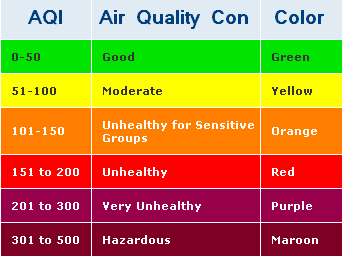
AQI Chart
API of >300 is considered as “Hazardous,” at which level everyone could experience very serious health effects, thus requiring the health authorities to issue a “Health Alert.”
Posted in environment, Global Disaster watch, global disasters, global disasters 2013 | Tagged: air pollution, API, AQI, Johor, land-clearing fires, Malaysia, Pollutant Standards Index, Singapore, singapore air pollution, Singapore government guidelines, Singapore PSI, singapore sling, singapore smog, state of emergency | Leave a Comment »
Posted by feww on June 17, 2013
Deadly flooding and landslides triggered by extreme rains wreak havoc across northern India
Earliest ever monsoon rains has covered the entire India, according to the country’s Met Office, triggering sever flooding that have inundated hundreds of towns and villages, sweeping away homes, businesses and public infrastructure.
At least 50 people are known to have died, as of posting, and many more are missing.
Footage shows apartment blocks in Uttarkashi in Uttarakhand surrounded by flood waters, before one is swept away.
Mumbai has been crippled by torrential rains and high winds, with many low-lying areas in the city and suburbs flooded.
“The situation is very grim. The meteorological office has predicted that the rain will continue for another three days at least,” said a government spokesman.
-oOo-
Singapore, Malaysia suffocate as Indonesia forest fires intensify
The air quality index in Malaysia and Singapore fell to unhealthy levels on Monday, as smoke from illegal forest clearing in Indonesia blanketed the region.
Singapore government has advised people to stay indoors, as the pollutant standards index climbed to its highest level in seven years, said a report.
“Given the current hazy conditions, it is advised that children, the elderly and those with heart or lung diseases reduce prolonged or heavy outdoor activities… Everyone else should limit prolonged or heavy outdoor activities,” said Singapore’s National Environment Agency.
-oOo-
Black Forest Fire: Initial Home Assessment
Updated: June 16, 2013 at approximately 7:30 p.m. (DST) – El Paso County Sheriff’s office
The extent of damage caused by the Black Forest Fire to homes in the region is as follows:
- Total Loss: 483
- Partial Damage: 17
Note: This is a preliminary home assessment. Due to continuous and dynamic fire activity the information could change.
The blaze was reportedly 65 percent contained, as of posting.
-oOo-
Red Flag Warning Issued for Most of Alaska
NWS has issued for most of Alaska, as several fires rage across the states, including a lightning-caused fire near Lime Village in the central Kuskokwim River, which grew rapidly Sunday evening. “It had more than doubled, to 12,260 acres, in 48 hours, according to a news release issued at 7:45 p.m. Sunday,” said a report.
Fire danger is expected to be extreme over the next 5 days, forecasters said.
-oOo-
High and Low Temperature for the Contiguous U.S.
High Temperature for Sunday, June 16, 2013 (as received by 8 am EDT June 17)
- 114 degrees (45.6ºC) recorded at Ocotillo Wells, CA
Low Temperature for Monday, June 17, 2013 (as received by 8 am EDT June 17)
- 30 degrees (-1.1ºC) recorded at Stanley, ID
World’s High and Low Temperature
Max Temp. June 17, 2013 at 15:00 UTC
- 126.5 degrees (52.5ºC) recorded at Socotra, Yemen
Min Temp. June 17, 2013 at 15:00 UTC
- -101.4 degrees (-74.1ºC) recorded at Concordia, Antarctica
[Source: National Weather Service/NCEP]
Related Links
World Record High Temperature Could Be Broken This Year
-oOo-
Posted in Global Disaster watch, global disasters, global disasters 2013 | Tagged: air-quality index, Alaska, Black Forest Fire, Black Forest Fire Map, Colorado wildfire, El Paso, Extreme Monsoon Rains, forest fire, High temp U.S., India, Indonesia forest clearing, Landslide, Low Temperature U.S., Malaysia, Missing in India, Monsoon, ndonesia Forest Fire, Ocotillo Wells, Red Flag Warning, Singapore, Uttarakhand | Leave a Comment »
Posted by feww on December 1, 2009
ENSO Cycle: Recent Evolution, Current Status and Predictions
The following UPDATE is prepared by
Climate Prediction Center / NCEP – 30 November 2009
The latest weekly SST departures are:
- Niño 4 ~ 1.6ºC
- Niño 3.4 ~ 1.7ºC
- Niño 3 ~ 1.3ºC
- Niño 1+2 ~ 0.2ºC

El Niño Map. [SOURCE: NOAA/ Climate Prediction Center / NCEP]
SST Departures (°C) in the Tropical Pacific During the Last 4 Weeks
During the last 4-weeks, SSTs were at least 1.0°C above average across much of the equatorial Pacific and more than 2.0°C above average between 180°and 130°W.

[SOURCE: NOAA/ Climate Prediction Center / NCEP]
Global SST Departures (°C)
During the last four weeks, equatorial SSTs were above-average across the Pacific and Indian Oceans. Also, above-average SSTs covered large areas of the Northern Hemisphere subtropics.
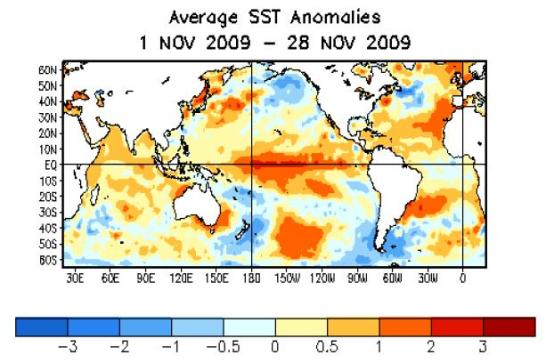
[SOURCE: NOAA/ Climate Prediction Center / NCEP]
Weekly SST Departures (°C) for the Last Four Weeks
- During the last four weeks, positive SST anomalies persisted across the central and eastern equatorial Pacific Ocean.
- During the last 30 days, equatorial SST anomalies increased in some parts across the eastern Pacific.
 |
|
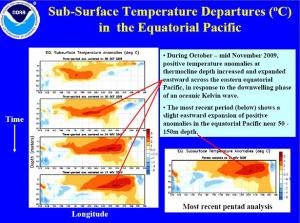
Tropical OLR and Wind Anomalies During the Last 30 Days
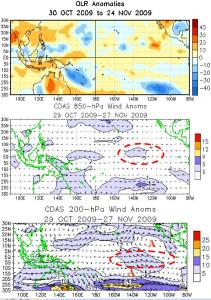
TOP: Positive OLR anomalies (suppressed convection and precipitation, red shading) were present over Indonesia, Malaysia, Papua New Guinea, and Australia. Negative OLR anomalies (enhanced convection and precipitation, blue shading) were located over the western tropical Pacific Ocean just southeast of Papua New Guinea.
Middle: Low-level (850-hPa) westerly anomalies remained over the east-central equatorial Pacific.
Above: Upper-level (200-hPa) easterly anomalies were observed across the eastern equatorial Pacific. An anticycloniccouplet was evident in the subtropics of both hemispheres, which is consistent with El Niño.
Atmospheric Circulation over the North Pacific & North America During the Last 60 Days
During October, a nearly zonal pattern of below-average heights over the mid-latitudes was observed with an anomalous ridge over Alaska and the higher latitudes. This pattern contributed to below-average temperatures across Canada and much of the U.S. During November, the anomalous zonal pattern of below-average heights at mid-latitudes had been replaced by strong anomalous ridges across the N. Pacific and much of N. America with below-average heights across Alaska. This pattern has led to above-average temperatures across much of Canada and the United Statesand below-average temperatures in Alaska.
Intraseasonal Variability
- Intraseasonal variability in the atmosphere (wind and pressure), which is often related to the Madden-Julian Oscillation (MJO), can significantly impact surface and subsurface conditions across the Pacific Ocean.
- Related to this activity
- Significant weakening of the low-level easterly winds usually initiates an eastward-propagating oceanic Kelvin wave.
- Several Kelvin waves have occurred during the last year (see next slide).
Summary
- El Niño is present across the equatorial Pacific Ocean.
- Sea surface temperatures (SST) are at least 1.0ºC-2.0ºC above-average across much of the central and east-central equatorial Pacific.
- Based on current observations and dynamical model forecasts, El Niño is expected to last through at least the Northern Hemisphere winter2009-10.
Information and images on this page are sourced from Climate Prediction Center/NCEP/NOAA. Edited by FEWW
Related Links:
El Niño Updates:
Posted in Climate Prediction, El Niño, ENSO, Pacific SST Outlook, Uncategorized | Tagged: australia, El Niño update, El Niño weekly report, Global SST anomalies, Indonesia, Malaysia, Oceanic Niño Index, Papua New Guinea, Tropical Pacific SST | 2 Comments »
Posted by feww on November 17, 2009
ENSO Cycle: Recent Evolution, Current Status and Predictions
The following UPDATE is prepared by
Climate Prediction Center / NCEP – 16 November 2009
The latest weekly SST departures are:
- Niño 4 ~ 1.5ºC
- Niño 3.4 ~ 1.7ºC
- Niño 3 ~ 1.2ºC
- Niño 1+2 ~ 0.5ºC
El Niño Map. [SOURCE: NOAA/ Climate Prediction Center / NCEP]
SST Departures (°C) in the Tropical Pacific During the Last 4
During the last 4-weeks, SSTs were at least 1.0°C above average across much of the equatorial Pacific and more than 2.0°C above average between 175°E and 140°W.
Global SST Departures (°C)
During the last four weeks, equatorial SSTs were above-average in the Pacific and Indian Oceans. Also, above-average SSTs covered large areas of the Northern Hemisphere subtropics.
Weekly SST Departures (°C) for the Last Four Weeks
- During the last four weeks, equatorial SST anomalies strengthened across the central and eastern Pacific Ocean.
- During the last 30 days, equatorial SST anomalies increased across much of the central and eastern Pacific.
Central & Eastern Pacific Upper-Ocean (0-300 m) Weekly Heat Content Anomalies
Since April 2009, the upper-ocean heat content has been above average across
the eastern half of the equatorial Pacific Ocean. The heat content was previously below-average from mid-August 2008 through March 2009, with a minimum reached in late December 2008.
Sub-Surface Temperature Departures (°C) in the Equatorial Pacific
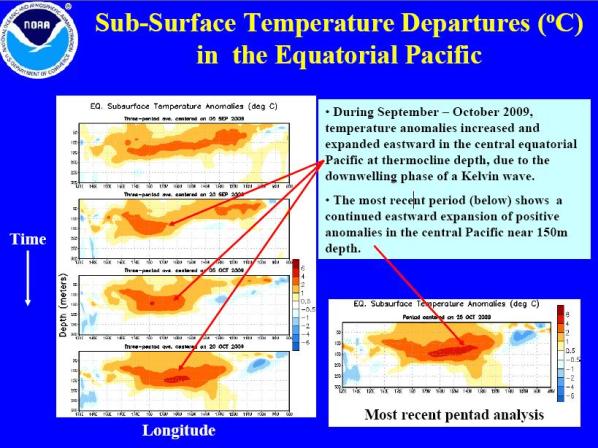
- During late September – early November 2009, temperature anomalies at thermocline depth increased and expanded eastward across the central and east-central equatorial Pacific, in response to the downwelling phase of an oceanic Kelvin wave.
- The most recent period (below) shows a continued eastward expansion of positive anomalies in the equatorial Pacific near 50 – 150m depth.
Tropical OLR and Wind Anomalies During the Last 30 Days
- Positive OLR anomalies (suppressed convection and precipitation, red shading) were present over Indonesia, Malaysia, Papua New Guinea, and Australia. Negative OLR anomalies (enhanced convection and precipitation, blue shading) were located over the western tropical Pacific Ocean just southeast of Papua New Guinea.
- Low-level (850-hPa) westerly anomalies were observed over the east-central equatorial Pacific.
- Upper-level (200-hPa) easterly anomalies were observed across most of the equatorial Pacific. Anomalous anticyclones were evident in the subtropics of both hemispheres, which is consistent with El Niño.
Atmospheric Circulation over the North Pacific & North America During the Last 60 Days
From mid-September through October, anomalous troughing was prevalent over the North Pacific Ocean. During October, the pattern of below-average heights became more zonal over the mid-latitudes and an anomalous ridge developed over the higher latitudes. This pattern contributed to below-average temperatures across Canada and much of the U.S. Since early November, the anomalous zonal pattern of below-average heights at mid-latitudes has been replaced by anomalous ridges with below-average heights across the northernmost latitudes. This pattern has led to above-average temperatures across much of Canada and the United States.
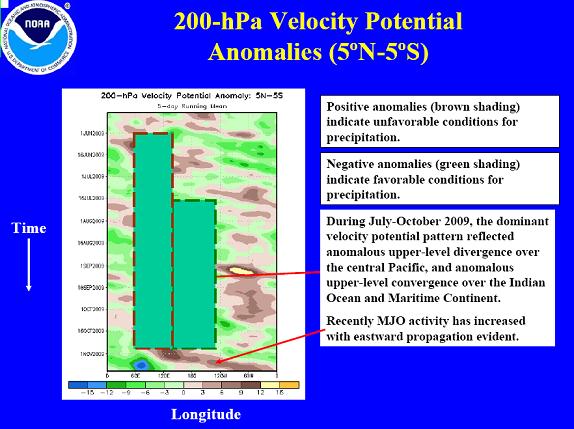

Summary
- El Niño is present across the equatorial Pacific Ocean.
- Sea surface temperatures (SST) were at least 1.0ºC above-average across much of the central and east-central equatorial Pacific.
- Based on current observations and dynamical model forecasts, El Niño is expected to continue to strengthen and last through at least the Northern Hemisphere winter 2009-10.
Information and images on this page are sourced from Climate Prediction Center/NCEP/NOAA. Edited by FEWW
Related Links:
El Niño Updates:
Posted in Climate Prediction, El Niño, El Niño weekly report, ENSO, Ocean SST | Tagged: australia, eastern Pacific, equatorial Pacific Ocean, equatorial SSTs, Global SST anomalies, Indian Ocean SST, Indonesia, Malaysia, Negative OLR anomalies, North Pacific Ocean, Oceanic Kelvin waves, Pacific Ocean, Papua New Guinea, positive OLR, Positive SST, suppressed convection and precipitation, Tropical Pacific SST, western tropical pacific ocean, wind anomaly | 1 Comment »
Posted by feww on November 11, 2009
ENSO Cycle: Recent Evolution, Current Status and Predictions
The following UPDATE is prepared by
Climate Prediction Center / NCEP – 9 November 2009
The latest weekly SST departures are:
- Niño 4 ~ 1.6ºC
- Niño 3.4 ~ 1.7ºC
- Niño 3 ~ 1.3ºC
- Niño 1+2 ~ 0.4ºC
El Niño Map. [SOURCE: NOAA/ Climate Prediction Center / NCEP]
SST Departures (°C) in the Tropical Pacific During the Last 4 Weeks
During the last 4-weeks, SSTs were at least 1.0°C above average across much of the equatorial Pacific and more than 2.0°C above average between 175°E and 160°W.
Global SST Departures (°C)
During the last four weeks, equatorial SSTs were above-average in the Pacific and Indian Oceans. Also, above-average SSTs covered large areas of the Northern Hemisphere subtropics.
Weekly SST Departures (°C) for the Last Four Weeks
- During the last four weeks, equatorial SST anomalies strengthened across the central and eastern Pacific Ocean.
- During the last 30 days, equatorial SST anomalies increased in much of the central and eastern Pacific.
Tropical OLR and Wind Anomalies During the Last 30 Days
- Positive OLR anomalies (suppressed convection and precipitation, red shading) were present over Indonesia, Malaysia, and Australia. Negative OLR anomalies (enhanced convection and precipitation, blue shading) were located across the northern Philippines and over the western tropical Pacific Ocean.
- Low-level (850-hPa) westerly anomalies were observed over parts of the western and east-central equatorial Pacific.
- Upper-level (200-hPa) easterly anomalies were observed across most of the equatorial Pacific. Anomalous anticyclones were evident in the subtropics of both hemispheres, which is consistent with El Niño.
Sub-Surface Temperature Departures (°C) in the Equatorial Pacific
- During mid September –October 2009, temperature anomalies increased and expanded eastward in the central equatorial Pacific at thermoclinedepth, due to the downwelling phase of a Kelvin wave.
- The most recent period (below) shows a continued eastward expansion of positive anomalies in the central Pacific near 100-150m depth.
Atmospheric Circulation over the North Pacific & North America During the Last 60 Days
In late September and early October, an anomalous ridge developed over the Gulf of Alaska, with a downstream trough and below-average temperatures over parts of the U.S. During mid October, the pattern became more zonal with an anomalous trough evident over the mid-latitudes and an anomalous ridge over the higher latitudes. This pattern contributed to below-average temperatures across Canada and the eastern half of the U.S. Recently, anomalous ridges emerged over the eastern North Pacific and eastern U.S. leading to above-average temperatures over the western and eastern U.S.
Low-level (850-hPa) Zonal (east-west) Wind Anomalies (m s-1)
- Since April 2009, the MJO has been weak.
- Since May 2009, westerly wind anomalies have covered large portions of the equatorial Pacific, except near the Date Line.
- Recently, the largest westerly wind anomalies have been observed across the eastern Pacific Ocean.
Information and images on this page are sourced from Climate Prediction Center/NCEP/NOAA. Edited by FEWW
Summary
- El Niño is present across the equatorial Pacific Ocean.
- Sea surface temperatures (SST) were at least 1.0ºC above-average across much of the central and east-central equatorial Pacific.
- Based on current observations and dynamical model forecasts, El Niño is expected to continue to strengthen and last through at least theNorthern Hemisphere winter 2009-10.
Related Links:
El Niño Updates:
Posted in Climate Prediction, El Niño, El Niño weekly report, ENSO, Ocean SST | Tagged: eastern Pacific, equatorial Pacific Ocean, equatorial SSTs, Global SST anomalies, Indian Ocean SST, Indonesia, Malaysia, Negative OLR anomalies, North Pacific Ocean, Oceanic Kelvin waves, Pacific Ocean, Papua New Guinea, Philippines, positive OLR, Positive SST, suppressed convection and precipitation, Tropical Pacific SST, western tropical pacific ocean, wind anomaly | Leave a Comment »
Posted by feww on November 3, 2009
ENSO Cycle: Recent Evolution, Current Status and Predictions
The following UPDATE is prepared by
Climate Prediction Center / NCEP – 2 November 2009
The latest weekly SST departures are:
- Niño 4 ~ 1.6ºC
- Niño 3.4 ~ 1.5ºC
- Niño 3 ~ 1.2ºC
- Niño 1+2 ~ 0.4ºC
El Niño Map. [SOURCE: NOAA/ Climate Prediction Center / NCEP]
SST Departures (°C) in the Tropical Pacific During the Last 4 Weeks
During the last 4-weeks, equatorial SSTs were at least 1.0°C above average between 165°E and 140°W and in small areas in the eastern Pacific.
Global SST Departures (°C)
During the last four weeks, equatorial SSTs were above-average in the Pacific and Indian Oceans. Also, above-average SSTs covered large areas of the Northern Hemisphere subtropics.
Weekly SST Departures (°C) for the Last Four Weeks
- During the last four weeks, equatorial SST anomalies strengthened across the central and eastern Pacific Ocean.
- During the last 30 days, equatorial SST anomalies increased in much of the central and eastern Pacific.
Tropical OLR and Wind Anomalies During the Last 30 Days
- Positive OLR anomalies (suppressed convection and precipitation, red shading) were present over Indonesia, Malaysia, and Australia. Negative OLR anomalies (enhanced convection and precipitation) were located across the northern Philippines, Papua New Guinea, and over the western tropical Pacific Ocean.
- Low-level (850-hPa) westerly anomalies were observed over parts of the western and central equatorial Pacific.
- Upper-level (200-hPa) easterly anomalies were observed across most of the equatorial Pacific.


Pacific Niño 3.4 SST Outlook
- Most ENSO models indicate El Niño will continue through the Northern Hemisphere winter 2009-10.
- The models disagree on the eventual strength of El Niño (SST anomalies ranging from +0.5°C to greater than +2.0°C), but a majority indicate at least a moderate strength El Niño (greater than +1.0°C) during November-December-January 2009-10.
SST Outlook: NCEP CFS Forecast Issued 1 November 2009
The CFS ensemble mean predicts El Niño will last at least through Northern Hemisphere spring 2010.
Summary
- El Niño is present across the equatorial Pacific Ocean.
- Sea surface temperatures (SST) were at least 1.0ºC above-average across much of the central and east-central equatorial Pacific.
- Based on current observations and dynamical model forecasts, El Niño is expected to strengthen and last at least through Northern Hemisphere spring 2010.
Information and images on this page are sourced from Climate Prediction Center/NCEP/NOAA. Edited by FEWW
Related Links:
El Niño Updates:
Posted in Climate Prediction, El Niño, ENSO, Indian Ocean SST, Ocean SST, Pacific Ocean | Tagged: Climate Prediction, eastern Pacific, El Niño weekly report, equatorial Pacific Ocean, equatorial SSTs, Global SST anomalies, Indonesia, Malaysia, Negative OLR anomalies, North Pacific Ocean, Oceanic Kelvin waves, Papua New Guinea, Philippines, positive OLR, Positive SST, suppressed convection and precipitation, Tropical Pacific SST, western tropical pacific ocean, wind anomaly | Leave a Comment »
Posted by feww on October 28, 2009
ENSO Cycle: Recent Evolution, Current Status and Predictions
The following UPDATE is prepared by
Climate Prediction Center / NCEP – 26 October 2009
The latest weekly SST departures are:
- Niño 4 ~ 1.4ºC
- Niño 3.4 ~ 1.1ºC
- Niño 3 ~ 0.8ºC
- Niño 1+2 ~ 0.1ºC
El Niño Map. [SOURCE: NOAA/ Climate Prediction Center / NCEP]
SST Departures (°C) in the Tropical Pacific During the Last 4 Weeks
During the last 4-weeks, equatorial SSTs were at least 1.0°C above average between 165°E and 140°W and in small areas in the eastern Pacific.
Global SST Departures (°C)
During the last four weeks, equatorial SSTs were above-average in the Pacific and Indian Oceans. Also, above-average SSTs covered large areas of the Northern Hemisphere subtropics.
Weekly SST Departures (°C) for the Last Four Weeks
- During the last four weeks, equatorial SST anomalies strengthened across the central Pacific Ocean.
- During the last 30 days, equatorial SST anomalies increased over the central Pacific.
Tropical OLR and Wind Anomalies During the Last 30 Days
- Positive OLR anomalies (suppressed convection and precipitation, red shading) were present over Indonesia, Malaysia, and Australia. Negative OLR anomalies (enhanced convection and precipitation, blue shading) were located across the Philippines, Papua New Guinea, and in the western tropical Pacific Ocean.
- Low-level (850-hPa) equatorial winds were near-average over the central and eastern Pacific. Westerly anomalies were observed in the western Pacific.
- Upper-level (200-hPa) easterly anomalies were observed across most of the equatorial Pacific.

Pacific Niño 3.4 SST Outlook
- Most ENSO models indicate El Niño will continue through the Northern Hemisphere winter 2009-10.
- The models disagree on the eventual strength of El Niño (SST anomalies ranging from +0.5°C to greater than +2.0°C), but a majority indicate at least a moderate strength El Niño (greater than +1.0°C) during during November-December-January 2009-10. Figure provided by the International Research Institute (IRI) for Climate and Society (updated 15 Oct 2009).
SST Outlook: NCEP CFS Forecast Issued 18 October 2009
The CFS ensemble mean predicts El Niño will last through Northern Hemisphere winter 2009-10.
Summary
- El Niño is present across the equatorial Pacific Ocean.
- Sea surface temperatures (SST) were at least 1.0ºC above-average across much of the central and east-central equatorial Pacific.
- Based on current observations and dynamical model forecasts, El Niño is expected to strengthen and last through Northern Hemisphere winter 2009-10.
Information and images on this page are sourced from Climate Prediction Center/NCEP/NOAA.
Related Links:
El Niño Updates:
Posted in El Niño, ENSO, Gulf of Alaska, Indian Ocean, North Pacific Ocean, Ocean SST, Pacific Ocean, positive OLR, Positive SST, suppressed convection and precipitation, wind anomaly | Tagged: australia, Climate Prediction, El Niño weekly report, equatorial Pacific Ocean, Global SST anomalies, Indonesia, Malaysia, Oceanic Kelvin waves, Papua New Guinea, Philippines, western tropical pacific ocean | Leave a Comment »
Posted by feww on December 12, 2008
Colombia devastated by heavy rain worsened by indiscriminate deforestation
“The problem is not nature; nature is not deliberately out to get anyone” —Meteorologist
Colombia’s rainy season has already seen 600 disasters caused by gale-force winds and heavy rainfall. Rivers have burst their banks, and landslides and avalanches of all kinds have occurred, said meteorologist Max Henríquez.
The rainy season began in September and normally continues to mid-December, because of La Niña. “Throughout 2007 and for several months this year we have experienced this climate phenomenon, caused by the cooling of the surface waters in the Pacific ocean, which brings above normal rainfall,” he said.
The National Disaster Prevention and Response System (SNPAD) reported 50 people killed, 85 injured, nine missing and 735,000 left homeless as a result of the flooding and landslide.
“The problem is not nature; nature is not deliberately out to get anyone, as some people think. Human beings are the problem, because we don’t do the right things,” Henríquez said.
“Cutting down trees in the river basins means that the rains are not contained, but sweep down rapidly into streams and rivers, which rise and overflow. Deforestation causes problems by accelerating the water cycle on land,” he said.
Who is responsible for Colombia’s deforestation?
It seems just about everyone! The expert believes those responsible for uncontrolled deforestation include
- Coca farmers
- Home builders (building luxury 2nd homes in the forests)
- Campesinos, or small farmers who fell trees for firewood
- Carpenters who use illegally logged trees to make furniture
- Especially, cattle ranchers extending their pasture lands
“Sixty percent of deforestation in Colombia is due to cattle ranching,” the meteorologist said. The additional demand for agricultural land has resulted in the loss of 312,000 hectares of forests since about 1990, while illegal crops like coca and opium poppies have invaded another 30,000 hectares.
“‘The relatively young geological age of the Andes mountain chain’ is also a factor in disasters, with its propensity to volcanic eruptions and earthquakes, and so is poverty, as people with no other options settle in places unsuitable for habitation, and the ambition and greed of construction firms that do not carry out the necessary studies and build in an irresponsible manner.” IPS reported.
In El Poblado, Medellín’s most exclusive district, a landslide buried 10 people and six houses under 65,000 cubic meter of earth on Nov. 16, 2008.
Many of Colombia’s cities are built on unstable soil. Those include “Manizales, the capital of the central province of Caldas, Armenia, the capital of nearby Quindío province, and even Bogotá,” Henríquez said. The risks are ever-increasing, “although they would diminish if the proper controls were in place,” he said.
Botanist Jesús Orlando Rangel, of the National University of Colombia’s Institute of Science, estimates that Colombia is losing 598,000 hectares of forest every year.
putting 500 species under threat. The Alexander von Humboldt Institute, however, estimates the endangered plants at 2,500 species.
“Species unique to the high altitude grasslands are also suffering harm, such as flowering bushes and spongy mosses which grow only one centimetre a year. This vital but fragile ecosystem is being encroached on by coal mining, potato growing and cattle grazing. ”
“The situation is terrible for any country, but more so for Colombia, which possibly has the richest biodiversity in the world, but the government doesn’t take proper preservation measures,” Rangel said.
“The National University’s Institute of Science has been working for over 60 years, without resources and with great difficulties, but all the Environment Ministry does is repeat our work, instead of devoting itself to compiling the information and enforcing regulations. It omits the most important thing, which is monitoring,” the expert said.
Landslide buries affluent estate north of Kuala Lumpur, Malaysia
Landslide in an affluent hillside suburb north of Kuala Lumpur, Malaysia’s largest city killed four people, injuring at least 15 more with one person, a Sri Lankan maid, reported missing. The land slide reportedly buried several housing states destroying dozens of homes, and forcing thousands of people to flee. Source

Soldiers help survivors of a landslide in Kuala Lumpur December 7, 2008. A landslide killed four people in a suburb of the Malaysian capital early on Saturday, tearing down houses and forcing the evacuation of thousands of people, police and local media said. REUTERS/Zainal Abd Halim (MALAYSIA). Image may be subject to copyright.
More than 15,000 people flee homes after floods in Aceh, Indonesia
More than 15,000 people have escaped their homes Thursday, as consecutive days of torrential rains caused floods in southern parts of Aceh province, according to local authorities. The rains caused the overflowing of some riverbanks, submerging 3,532 houses since Dec. 5. Xinhua reported.
Head of Indonesian Health Ministry’s crisis center said that the rain had also caused some landslides in the area, but no casualties have yet been reported. Indonesia has been frequently hit by floods and landslide due to deforestation. Illegal logging and land use change, clearing forests to plant crops, especially for biofuel, are responsible forthe deforestation.
Aceh tsunami in December 2004 claimed at least 170,000 lives. detailed map of Indonesia. PDF file
Landslide buried at least 15 people in Indonesia: Red Cross
Rescue crews have recovered five bodies, and 10 people remain missing, said Heri Hidayat, a Red Cross coordinator. The landslide happened in Cianjur, a town in the province of West Java, after days of torrential rain. Mud buried about 54 houses, and authorities have evacuated 351 people. Source
Since January 2008, floods and landslides have killed several thousand people, destroyed thousands of homes, displacing more than a million people.
Related Links:
Posted in Andes mountain chain, Armenia, cattle ranching, Medellín, mudslides | Tagged: colombia, Extreme Rain Events, Indonesia, landslides, Malaysia | Leave a Comment »
Posted by feww on June 2, 2008
Posted in Bangladesh, Climate Change, energy, environment, food, Global Warming, health, politics, Tourism, Travel, war | Tagged: Africa, agriculture, americas, Asia, basic needs, biocapacity, Bolivia, Buffett the Poor, Cameroon, China, collapse, demonstrations, ecosystems, Egypt, El Salvador, Emerging Food Crisis, environment, food, food riots, food shortages, Fueling Food Shortages, garment workers, government, Haiti, India, Indonesia, Ivory Coast, Kenya, Malaysia, Mauritania, money, Mozambique, Oil Chaos, Pakistan, Philippines Senegal, politics, Poverty Index, protests, Singapore, Somalia, staple diet, strikes, Uzbekistan, Vietnam, Yemen | Leave a Comment »


 Fire Earth