Posts Tagged ‘Pacific Ring of Fire’
Posted by feww on September 29, 2017
Mass Evacuation: 140,000 people flee Bali town of Amed turning it into a ghost town
Mt Agung Volcano continues to exhale a large column of steam, smoke and ash, while ominously eying the town of Amed.
The normally bustling tourist town, located about 4km outside Mt Agung volcano’s exclusion zone, has been experiencing more than 1,000 tremors per day, prompting residents and tourists to abandon the town.
More than 100,000 others are expected to abandon nearby villages as fears of an “imminent eruption” mount.
Authorities has set up about 500 temporary shelters outside the exclusion zone around the volcano, said the National Disaster Management Agency.
However, the shelters may prove unsafe, if a large, explosive eruption occurs.

Vanuatu Volcano: State of Emergency Declared
Meanwhile, most of 11,000 residents in Vanuatu’s Ambae island have abandoned the volcanic island under evacuation orders, as the Manaro Voui volcano continues emitting ash, smoke and volcanic gases, stoking fears of an imminent eruption.
Posted in News Alert | Tagged: Amed, Bali, Indonesia volcanoes, Manaro Voui volcano, map of Indonesian Volcanoes, Mass Evacuation, Mt Agung Volcano, Pacific Ring of Fire, Vanuatu, Vanuatu Volcano, volcanism | Leave a Comment »
Posted by feww on January 11, 2016
Sent by a reader… edited by FEWW-JMC
“Atoms for Peace”
The International Atomic Energy Agency (IAEA) was set up in 1957 supposedly to promote the peaceful use of nuclear energy, and to prevent its use for military purpose, including nuclear weapons. It’s based in Vienna, and has “Regional Safeguards Offices,” one in Toronto and the other in Tokyo. The IAEA also has liaison offices both in New York City, and in Geneva. Additionally, it has three laboratories in Vienna, Seibersdorf, and Monaco.
Despite being established independently of the United Nations through a separate international treaty, the IAEA Statute, the “Atoms for Peace” reports to both the United Nations General Assembly and Security Council.
The organization describes itself as follows:
The IAEA is widely known as the world’s “Atoms for Peace” organization within the United Nations family. Set up in 1957 as the world’s center for cooperation in the nuclear field, the Agency works with its Member States and multiple partners worldwide to promote the safe, secure and peaceful use of nuclear technologies.
How Safe are the Nuclear Power Plants in Japan?
Japan sits near major tectonic plate boundaries, in a volcanic zone situated on the Pacific Ring of Fire. It has had a long history of seismic activity, with powerful, destructive earthquakes that often result in tsunamis.
If there were a 101 on where not to build your nuclear power plants, Japan would fill all criteria as the experts’ top choice for the most dangerous example.
Yet the crowded country of 130 million has 54 nuclear reactors.
On 11 March 2011, Japan experienced the strongest and most destructive earthquake in its history, followed by a deadly tsunami. The magnitude 9.0 Tōhoku earthquake generated a tsunami about 14 meters high. The quake and tsunami, followed by hundreds of aftershocks, including some measuring 7.0Mw or larger, killed thousands of people, razing entire towns and villages, destroying or damaging more than 120,000 buildings. The giant tsunami also crippled the Fukushima Dai-ichi I nuclear power plant, resulting in a nuclear disaster with multiple core meltdowns and large scale radioactive fallout.
-
If the IAEA was effective, it would have shut down all nuclear power plants in Japan, long before the Fukushima meltdowns, to prevent such disasters.
-
If the IAEA was NOT corrupt, it would have permanently shut down all nuclear power plants in Japan after Fukushima meltdowns, to prevent repeat disasters.
Meanwhile, back in Japan…
IAEA Begins Evaluating Japan’s Alleged Efforts on making Nuclear Power Plants Safe (!)
On Monday, IAEA began evaluating Japanese government’s alleged improvement work on ensuring “safety” of nuclear power plants, according to a report.
“A group of experts of the International Atomic Energy Agency (IAEA) began on Monday its planned assessment of the Japanese government’s efforts to ensure safe use of nuclear power plants.”
“This mission will assess the new regulatory framework established in Japan after the Fukushima Daiichi [disaster,]” Philippe Jamet, the IAEA delegation’s head, told reporters.
“The IAEA mission to Japan includes representatives from 24 countries, according to the organization’s website. They are expected to visit nuclear facilities to inspect the infrastructure, to meet with representatives of the Japanese nuclear power industry. The mission will end on January 22. Based on the results, the IAEA will produce a report on the country’s nuclear safety,” the report said.
WE WILL SEE!
Posted in News Alert | Tagged: Atoms for Peace, Fukushima Dai-ichi, IAEA, Japan, nuclear power, nuclear safety, Pacific Ring of Fire, Tōhoku earthquake | Leave a Comment »
Posted by feww on June 12, 2015
Strong earthquake strikes near Hihifo, Tonga
Centered at 15.685°S, 173.056°W, about 79 km ENE of Hihifo, the quake occurred at a depth of 41.0 km (25.5 mi), USGS/EHP reported.
Latest quakes in the region
M6.0, 79km ENE of Hihifo, Tonga 2015-06-12 11:07:06 UTC, depth=41.0 km
M4.4, 67km NNE of Ndoi Island, Fiji 2015-06-12 04:47:59 UTC, depth=624.9 km
M4.3, 61km NE of Ndoi Island, Fiji 2015-06-12 03:37:51 UTC, depth=572.5 km
M5.0, 99km NE of `Ohonua, Tonga 2015-06-12 02:36:24 UTC, depth=10.0 km
M4.7, 21km NE of Hihifo, Tonga 2015-06-11 20:23:45 UTC, depth=37.5 km
Related Links
Posted in Earthquake news, earthquake report, significant events | Tagged: Apia, earthquake, FIRE-EARTH earthquake FORECAST, Hihifo, Pacific Ring of Fire, Samoa, Tonga | Leave a Comment »
Posted by feww on June 10, 2015
CJ Members
Diagnostic Discussion: Tectonic Unrest in the Pacific Ring of Fire
Tune into FIRE-EARTH Channel for FEWW Model diagnostic discussion on Thursday June 11, 2015 at the following times
- 06:32, 16:32 and 22:32UTC.
Posted in FIRE-EARTH Bulletin | Tagged: CJ Members, Diagnostic Discussion, Pacific Ring of Fire, Tectonic Unrest | Leave a Comment »
Posted by feww on May 5, 2015
M7.5 quake strikes 130km SSW of Kokopo, Papua New Guinea (PNG)
Centered at 5.465°S, 151.886°E the quake occurred at a depth of 42.0 km, reported USGS/EHP.
The quake had been preceded buy strong foreshocks and was followed by at least 9 significant aftershocks, as of posting.
See also FIRE-EARTH Forecast on HEIGHTENED SEISMICITY and ENHANCED VOLCANISM in the Pacific Ring of Fire March 31, 2015 concerning
EQ Details
Magnitude: 7.5Mw [USGS/EHP]
Depth: 42.0 km
Location: 5.465°S 151.886°E
Time: 2015-05-05 01:44:05 UTC
Nearest Cities:
- 130km (81mi) SSW of Kokopo, Papua New Guinea [pop: ~30k]
- 193km (120mi) E of Kimbe, Papua New Guinea [pop: ~20k]
- 341km (212mi) SSE of Kavieng, Papua New Guinea [pop: ~15k]
- 412km (256mi) WNW of Arawa, Papua New Guinea [pop: ~35k]
- 680km (423mi) NE of Port Moresby, Papua New Guinea [pop: ~375k]
Recent foreshocks and aftershocks
5.0 147km S of Kokopo, Papua New Guinea 2015-05-05 08:47:08 UTC 61.1 km
5.3 129km S of Kokopo, Papua New Guinea 2015-05-05 08:16:58 UTC 42.8 km
4.9 126km S of Kokopo, Papua New Guinea 2015-05-05 06:11:04 UTC 51.6 km
4.9 143km SSW of Taron, Papua New Guinea 2015-05-05 05:07:29 UTC 40.0 km
5.2 86km S of Kokopo, Papua New Guinea 2015-05-05 05:03:01 UTC 55.7 km
5.2 130km S of Kokopo, Papua New Guinea 2015-05-05 03:55:51 UTC 51.8 km
5.2 124km SSW of Kokopo, Papua New Guinea 2015-05-05 02:40:23 UTC 33.9 km
5.6 103km S of Kokopo, Papua New Guinea 2015-05-05 01:58:20 UTC 57.5 km
5.9 109km SSW of Kokopo, Papua New Guinea 2015-05-05 01:54:05 UTC 64.5 km
7.5 130km SSW of Kokopo, Papua New Guinea 2015-05-05 01:44:05 UTC 42.0 km
5.1 143km SSW of Kokopo, Papua New Guinea 2015-05-04 08:09:14 UTC 60.8 km
4.6 102km SSW of Kokopo, Papua New Guinea 2015-05-04 01:04:48 UTC 63.3 km
5.2 132km SSW of Kokopo, Papua New Guinea 2015-05-03 23:40:56 UTC 35.1 km
5.1 133km SSW of Kokopo, Papua New Guinea 2015-05-03 22:50:47 UTC 46.1 km
5.5 142km SSW of Kokopo, Papua New Guinea 2015-05-03 22:35:11 UTC 67.9 km
5.6 144km SSW of Kokopo, Papua New Guinea 2015-05-03 22:32:42 UTC 35.0 km
5.2 150km SSW of Kokopo, Papua New Guinea 2015-05-03 20:21:56 UTC 76.0 km
4.8 148km SSW of Kokopo, Papua New Guinea 2015-05-03 19:28:54 UTC 61.0 km
5.0 93km SSW of Kokopo, Papua New Guinea 2015-05-02 10:53:06 UTC 103.4 km
4.9 124km ESE of Kimbe, Papua New Guinea 2015-05-01 19:55:56 UTC 44.5 km
6.8 106km SSW of Kokopo, Papua New Guinea 2015-05-01 08:06:04 UTC 57.0 km
6.7 125km SSW of Kokopo, Papua New Guinea 2015-04-30 10:45:05 UTC 48.9 km
5.0 60km WSW of Panguna, Papua New Guinea 2015-04-24 02:51:07 UTC 83.5 km
5.3 80km W of Panguna, Papua New Guinea 2015-04-21 19:10:18 UTC 68.0 km
5.3 32km ENE of Kandrian, Papua New Guinea 2015-04-21 11:21:12 UTC 53.5 km
4.5 74km SW of Taron, Papua New Guinea 2015-04-21 08:14:36 UTC 54.9 km
4.9 80km SE of Kimbe, Papua New Guinea 2015-04-20 20:02:07 UTC 67.8 km
4.6 112km S of Taron, Papua New Guinea 2015-04-19 12:48:42 UTC 36.6 km
4.5 103km S of Taron, Papua New Guinea 2015-04-19 12:17:42 UTC 42.2 km
5.2 66km NW of Rabaul, Papua New Guinea 2015-04-15 10:22:08 UTC 10.0 km
Related Links
Posted in News Alert | Tagged: earthquake, East New Britain, Global Seismicity, Magnitude 7.5, New Britain Trench, Pacific Ring of Fire, PNG | Leave a Comment »
Posted by feww on May 1, 2015
Chile’s Calbuco erupts for the third time in 8 days
The Chilean volcano, located about 1,000km south of the capital Santiago, erupted for the third time in eight days on Thursday, sending yet another column of volcanic matter up to 4km into the air.
The 2,015-meter high Calbuco, an extremely explosive andesite volcano, ejected about 200 million tons of ash into the atmosphere last week, blanketing multiple towns and communities, damaging the nearby salmon farms and forcing flight cancellation as far as the Argentine capital Buenos Aires, about 1,400 km away.
However, Thursday’s eruption was notably less powerful than the previous two explosions, which prompted the evacuation of thousands of nearby villagers.
The red alert and a 20-km exclusion zone remains in effect, said Chile’s ONEMI emergency office, as officials evacuated an additional 1,580 people.
The total number of evacuees in the Los Lagos region now stands at 6.685 people.
ONEMI has posted the following update (Spanish) on its website:
Related Links
Posted in News Alert | Tagged: Calbuco, Calbuco volcano, Chile volcano, Fire-Earth Alert, Los Lagos, Mass Evacuation, Pacific Ring of Fire, volcanic eruption, volcanism | 1 Comment »
Posted by feww on April 23, 2015
Thousands evacuated as Calbuco volcano explodes
Located in southern Chile, about 1,000km south of the capital, Santiago, the extremely explosive andesite volcano finally erupted, sending a massive column of ash, smoke and lava up to 20km into the atmosphere.
Chile’s ONEMI emergency office declared a red alert and evacuated more than 4,000 people within a 20km (12 mile) radius of the 2,015-meter high volcano.
Residents of the nearby town of Ensenada and two other communities have been ordered to abandon their homes.
Calbuco’s last major eruption occurred in 1961.
Villarrica volcano, also in southern Chile, erupted in March.
ONEMI has posted the following update (Spanish) on its website:
Related Links
Latest Significant Seismic Activity in the PRF:
Magnitude: 6.3Mw
Location: 12.025°S, 166.424°E depth=72.0 km (44.7 mi)
Time: 2015-04-22 22:57:15 (UTC)
Distances:
- 158km SSE of Lata, Solomon
- 396km (246mi) NNW of Luganville, Vanuatu
Posted in News Alert | Tagged: Calbuco, Calbuco volcano, Chile volcano, Fire-Earth Alert, FIRE-EARTH FORECAST, Los Lagos, Mass Evacuation, Pacific Ring of Fire, Villarrica | 2 Comments »
Posted by feww on April 17, 2015
HEIGHTENED SEISMICITY in the Pacific Ring of Fire (Forecast)
Centered at 15.907°S, 178.585°W the quake struck at a depth of 10.0 km (6.2 mi), USGS/EHP reported.
The event followed a magnitude 4.7Mw foreshock, that occurred about 5 hours earlier.
Tsunami Evaluation
NO threat of Pacific-wide, destructive tsunami by this event.
EQ Details
Magnitude: 6.5Mw
Location: 15.907°S, 178.585°W depth=10.0 km (6.2 mi)
Time: 2015-04-17 @ 15:52:51 (UTC)
Distances:
- 183km SSW of Sigave, Wallis and Futuna
- 224km (139mi) ENE of Lambasa, Fiji
- 401km (249mi) NE of Suva, Fiji
- 474km (295mi) ENE of Nadi, Fiji
- 679km (422mi) NNW of Nuku`alofa, Tonga
Related Links
Posted in News Alert | Tagged: earthquake, Fiji, Lambasa, Pacific Ring of Fire, Tonga, Wallis and Futuna | Leave a Comment »
Posted by feww on March 30, 2015
Strong quakes occur SW of Apia, Samoa
The quakes may have signaled the start of a new phase of heightened seismicity in the Pacific Ring of Fire, according to FIRE-EARTH models.
EQ Details [USGS/EHP]
M6.5; 99km ENE of Hihifo, Tonga 2015-03-30 at 08:48:26 UTC, depth=15.5 km
[99km (62mi) ENE of Hihifo, Tonga; 224km (139mi) SW of Apia, Samoa]
M6.4; 109km NE of Hihifo, Tonga 2015-03-30 08:18:00 UTCd depth=11.5 km
[109km (68mi) NE of Hihifo, Tonga]
M5.6; 90km NE of Hihifo, Tonga 2015-03-30 07:56:54 UTCd depth=10.0 km
Tsunami Evaluation
NWS PACIFIC TSUNAMI WARNING CENTER EWA BEACH HI SAID:
BASED ON ALL AVAILABLE DATA A DESTRUCTIVE PACIFIC-WIDE TSUNAMI IS
NOT EXPECTED.
Other Significant Seismicity
M4.9; 88km S of Taron, Papua New Guinea 2015-03-30 11:43:21 UTC 35.0 km
M4.8; 69km SSE of Kokopo, Papua New Guinea 2015-03-30 11:23:11 UTC 72.6 km
M5.5; 179km SSE of Amsterdam Island, France 2015-03-30 10:34:53 UTC 10.0 km
4.0; 12km NW of Ludlow, California 2015-03-30 09:21:56 UTC 2.5 km
M6.5 See above.
5.3; 42km SE of Kokopo, Papua New Guinea 2015-03-30 08:31:47 UTC 35.0 km
M6.4 See above.
M5.6 See above.
Related Links
Posted in News Alert | Tagged: Apia, earthquake, Hihifo, Pacific Ring of Fire, Samoa, Tonga, Tonga Trench | Leave a Comment »
Posted by feww on April 19, 2014
SEISMIC HAZARD
.
M6.6 Strikes 59km SW of Panguna, PNG
The aftershock follows a M7.1 quake that struck 57km SW of Panguna, on April 11, 2014.
The latest aftershock was the third to strike the region, measuring 6.5Mw or greater.
EQ Details
Event Time: 2014-04-19 01:04:03 UTC
Location: 6.679°S 155.085°E depth=24.4km (15.2mi)
Nearby Cities:
- 59km (37mi) SW of Panguna, Papua New Guinea
- 71km (44mi) SW of Arawa, Papua New Guinea
EQ Location Map

30 Days, Magnitude 4.5+ regional earthquakes. Source: USGS/EHP
Related Links
Posted in Global Disaster watch, Significant Event Imagery, significant events | Tagged: Bougainville, earthquake, North Solomons, Pacific Ring of Fire, Panguna, PNG | Leave a Comment »
Posted by feww on April 11, 2014
SEISMIC HAZARD
.
M7.1 quake strikes 57km SW of Panguna, Papua New Guinea
Centered at 6.625°S, 155.064°E, the quake struck at a depth of 50.0km (31.1mi) on Friday, April 11, 2014 at 07:07:21 UTC.
The mainshock was followed by at least four significant aftershocks measuring 4.8Mw or greater. The largest aftershock measured 6.5Mw and was centered at 6.855°S 155.017°E, occurring at a depth of 39.4km.
Tsunami Evaluation
The quakes did NOT produce a widespread destructive tsunami.
Latest Seismicity Around PRF
Related Links
- CHILE MEGA EARTHQUAKE WARNING – REVISION 3 April 7, 2014
- MEGA EARTHQUAKE WARNING – REVISION 2 April 3, 2014
- Two Powerfull Aftershocks Rock N Chile Coast April 3, 2014
- Disaster Declared for Chile Quake Zone on April 2, 2014
- M8.2 Strikes Coast of Chile April 2, 2014
- Enhanced Seismicity Continues Along Peru-Chile Trench on March 24, 2014
- Significant Seismic Activity Continues Along Peru-Chile Trench March 22, 2014
- FIRE-EARTH Forecast: Large Earthquake Could Strike Peru-Chile Trench March 17, 2014
- Another Significant Aftershock Strikes Coastal Chile March 17, 2014
- Intense Seismicity Along Peru-Chile Trench March 16, 2014
Posted in Earthquake Hazard, Earthquake news, earthquake report, Global Disaster watch, significant events | Tagged: earthquake, Pacific Ring of Fire, Panguna, PNG, tsunami | Leave a Comment »
Posted by feww on March 10, 2014
SEISMIC HAZARD
.
Strong Earthquake Strikes 81km West Of Eureka, California
Magnitude 6.9 earthquake struck offshore 81km west of Eureka, California (population: 27,000) at 2014-03-10 05:18UTC.
The quake was preceded by at least 3 foreshocks and followed by 10 aftershocks, with the largest measuring 4.6Mw, as of posting.
Earthquake Location Map

Approximate location of the Eureka quake, fore- and aftershocks, as of 07:10UTC March 10, 2014. Source: USGS/EHP
Earthquake Details
Event Time: 2014-03-10 05:18:12 UTC
Location: 40.821°N, 125.128°W depth=7.0km (4.3mi)
Nearby Cities:
- 77km (48mi) WNW of Ferndale, California
- 81km (50mi) W of Eureka, California
- 85km (53mi) WNW of Fortuna, California
- 87km (54mi) W of McKinleyville, California
- 398km (247mi) NW of Sacramento, California
- Source: USGS/EHP
TSUNAMI EVALUATION
NO Tsunami threat to ALASKA/ BRITISH COLUMBIA/ WASHINGTON/ OREGON AND CALIFORNIA
A WIDESPREAD DESTRUCTIVE TSUNAMI THREAT DOES NOT EXIST BASED ON HISTORICAL EARTHQUAKE AND TSUNAMI DATA.
THE U.S. NATIONAL TSUNAMI WARNING CENTER WILL ISSUE INFORMATION REGARDING ANY LOCAL TSUNAMI THREAT TO COASTS NEAR THE EARTHQUAKE EPICENTER.
Other Significant Quake(s)
M5.8 – 37km SW of Santiago Pinotepa Nacional, Mexico
Event Time: 2014-03-10 00:38:15 UTC
Location: 16.080°N,98.267°W; depth=10.0km (6.2mi)
Nearby Cities:
- 37km (23mi) SW of Santiago Pinotepa Nacional, Mexico
- 68km (42mi) SSE of Ometepec, Mexico
- 131km (81mi) WNW of Puerto Escondido, Mexico
- 140km (87mi) SE of San Marcos, Mexico
- 381km (237mi) SSE of Mexico City, Mexico
Related Links and Recent U.S. Quakes
- Another Swarm of Shallow Quakes Strikes Close to Oklahoma City February 18, 2014
- More Quakes Strike Oklahoma February 11, 2014
- Significant Earthquakes Strike Oklahoma December 29, 2013
- M4.5 Quake Strikes NE Edmond Oil and Gas Field, Oklahoma December 8, 2013
- 41 Earthquakes Strike Oklahoma in November December 1, 2013
- Earthquake No. 19 Strikes N. Texas November 29, 2013
- Two More Quakes Strike North Texas November 29, 2013
- Oil Drilling Likely Caused Texas Earthquake Posted on May 17, 2009
- M3.3 Quake Strikes Azle, Texas Posted on November 25, 2013
- FEWW Earthquake Links
Posted in earthquake, Earthquake Hazard, earthquake report, Eureka, Eureka quake | Tagged: California earthquake, earthquake 2014, Mexico, Pacific Ring of Fire, Santiago Pinotepa Nacional, tsunami, U.S. | Leave a Comment »
Posted by feww on November 16, 2013
5 Indonesian volcanoes remain on the 2nd highest state of alert, “orange,” 17 others on “yellow”
The alerts follow the latest eruption at Mt Sinabung, which saw the volcano ejecting ash to a height of about 7 km above the summit, forcing the authorities to evacuate about 5,600 people in several villages, according to Indonesia’s Center for Volcanology and Geological Disaster Mitigation (PVMBG).
Indonesian authorities have established a 3-km exclusion zone near the volcano following the Tuesday eruption for the second time in 9 days.
PVMBG had issued a “level three,” or “orange alert,” recommending villagers to stay out of the 3-km danger zone on November 3, 2013, followed by a 7-day state of emergency declared by the local authorities.
The explosive activity follows a series of most recent eruptions exhibited by the 2,460-meter high volcano that began in September 2013, leading to a significant eruption on October 24, which saw the volcano spewing smoke and ash to a height of about 3km above the crater summit, followed by other eruptions, especially the explosive eruption that occurred on Sunday, November 3.
Mt Sinabung is one of 130 or so active volcanoes in the Indonesian archipelago, whose 18,307 islands (922 of the islands are permanently inhabited) straddle the Pacific Ring of Fire (PRF).
PRF, aka the circum-Pacific seismic belt, is home to 452 volcanoes, or more than 75% of the world’s active and dormant volcanoes.
About 90% of the global seismicity and 82% of the largest quakes occur along PRF [FIRE-EARTH data.]

Mt Sinabung erupted explosively again on November 12, 2013 for a second time in 9 days. Image credit: CRIonLine via Xinhua. More images…
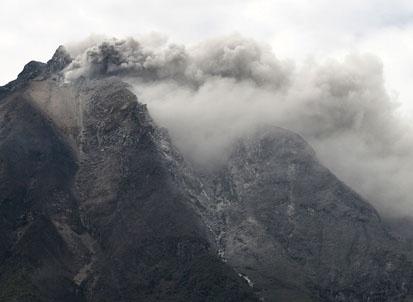
Mount Sinabung spewing volcanic ashes as seen from Simpang Empat Village in Karo, North Sumatera (September 15, 2013). Credit: ANTARA/Septianda Perdana.
Mt Sinabung erupted in August 2010 after 410 years of dormancy. The eruption claimed a dozen lives and displaced thousands of others. The eruption which occurred on August 29, 2010 was followed by a more powerful explosion the next day, and much stronger blast on September 7, 2010.
Sinabung spewed ash to a height of about 2km in its second eruption in two days on August 30, 2010.

Mount Sinabung volcano spews smoke in Suka Nalu village in the district of Tanah Karo, in Indonesia’s North Sumatra province August 30, 2010. The Indonesian volcano that erupted for the first time in centuries on Sunday spewed fresh plumes of smoke early on Monday morning, causing panic in nearby villages and delaying local flights, officials said on Monday. Credit: Reuters/Tarmizy Harva. Image may be subject to copyright. More photos …

Approximate location of Sinabung is marked on the map by FEWW. Mount Sinabung is one of Indonesia’s 130 active volcanoes
Sinabung Volcano: Summary of Details
Country: Indonesia
Region: Sumatra
Volcano Type: Stratovolcano
Volcano Status: Holocene
Last Known Eruption: Unknown [1600?]
Summit Elevation: 2,460m
Latitude: 3.17°N Longitude: 98.392°E
Source: GVP
Sinabung is located in Group K Volcanoes
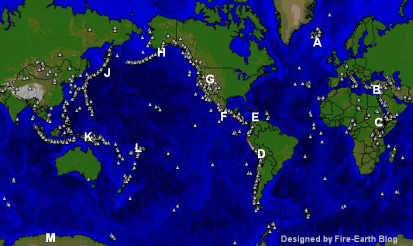
Map of Volcanoes. Background Map: University of Michigan. Designed and enhanced by Fire Earth Blog. Click image to enlarge.
The PVMBG categorizes Sinabung as a type A volcano, or those that have erupted since 1600. Type B volcanoes have not erupted since 1600 but show signs of activity, and type C are those that have not erupted in recorded history.

Mount Sinabung ejected tephra into the air as seen from Tanah Karo, North Sumatra, Indonesia, Friday, Sept. 3, 2010. (AP Photo/Dedy Zulkifli). Image may be subject to copyright.
Indonesian Volcanoes
Indonesian Volcanoes have been responsible for a number of cataclysmic explosions in modern history.
Krakatoa [Krakatau] Cataclysmic Eruption 1883

William Ashcroft painting “On the Banks of the River Thames” in London, November 26, 1883 [Exactly three months after Krakatoa’s cataclysmic 1883 eruption.]
The Krakatoa eruption affected the climate driving the weather patterns wild for the next 5 years. Average global temperatures fell by about 1.2 °C in the following years, returning to normal only in 1888.
The eruption ejected about 21 cubic kilometers of volcanic matter and destroyed two-thirds of the Krakatoa island. The explosion also spawned giant tsunamis killing an estimated 40,000 people.

An 1888 lithograph of the 1883 violent explosion of Krakatau.
Based on their models, our colleagues at EDRO forecast that the collapse of Singapore may occur as a result of volcanic activity on the island of Sumatra. However, they have not disclosed any further detail.
Indonesia Volcano Alerts
PVMBG has placed five volcanoes on the second highest level of activity “Level III, Orange Alert,” and 17 others on third highest alert level “Level II, Yellow Alert.” Following table shows the alert level designations, as of November 16, 2013.

Indonesia Volcano Alerts as of November 16, 2013. Source: PVMBG. Image enhanced by FIRE-EARTH Blog.
Related Links
Posted in Significant Event Imagery, significant events, volcanic activity, volcanic eruption, volcanic event, volcanic hazard, volcanism report | Tagged: Global Volcano Watch, indonesia volcano, Krakatoa, Mount Sinabung, Pacific Ring of Fire, Sinabung erupts, sinabung volcano, Sinabung Volcano Explodes, Singapore, sumatra volcano, volcano alert, volcano news, Volcano Watch | Leave a Comment »
Posted by feww on November 3, 2013
Mount Sinabung in North Sumatra erupts explosively
North Sumatra’s Sinabung volcano erupted explosively early Sunday, ejecting a column of smoke and ash up to 7,000 meters above the summit on November 3, according to Indonesia’s Center for Volcanology and Geological Disaster Mitigation (PVMBG).
Authorities have established a 3-km exclusion zone and are evacuating 4 villages, according to local reports.
The explosive activity follows a series of most recent eruptions exhibited by the 2,460-meter high volcano that began in September, 2013, leading to a significant eruption on October 24, which saw the volcano spewing smoke and ash to a height of about 3km above the crater summit.
Mt Sinabung is one of 130 or so active volcanoes in the Indonesian archipelago, whose 18,307 islands (922 of the islands are permanently inhabited) straddle the Pacific Ring of Fire (PRF).
PRF, aka the circum-Pacific seismic belt, is home to 452 volcanoes, or more than 75% of the world’s active and dormant volcanoes.
About 90% of the global seismicity and 82% of the largest quakes occur along PRF [FIRE-EARTH data.]
Mount Sinabung spewing volcanic ashes as seen from Simpang Empat Village in Karo, North Sumatera (September 15, 2013). Credit: ANTARA/Septianda Perdana.
Mt Sinabung erupted in August 2010 after 410 years of dormancy. The eruption claimed a dozen lives and displaced thousands of others. The eruption which occurred on August 29, 2010 was followed by a more powerful explosion the next day, and much stronger blast on September 7, 2010.
Sinabung spewed ash to a height of about 2km in its second eruption in two days on August 30, 2010.
Mount Sinabung volcano spews smoke in Suka Nalu village in the district of Tanah Karo, in Indonesia’s North Sumatra province August 30, 2010. The Indonesian volcano that erupted for the first time in centuries on Sunday spewed fresh plumes of smoke early on Monday morning, causing panic in nearby villages and delaying local flights, officials said on Monday. Credit: Reuters/Tarmizy Harva. Image may be subject to copyright. More photos …
Approximate location of Sinabung is marked on the map by FEWW. Mount Sinabung is one of Indonesia’s 130 active volcanoes
Sinabung Volcano: Summary of Details
Country: Indonesia
Region: Sumatra
Volcano Type: Stratovolcano
Volcano Status: Holocene
Last Known Eruption: Unknown [1600?]
Summit Elevation: 2,460m
Latitude: 3.17°N Longitude: 98.392°E
Source: GVP
Sinabung is located in Group K Volcanoes
Map of Volcanoes. Background Map: University of Michigan. Designed and enhanced by Fire Earth Blog. Click image to enlarge.
The PVMBG categorizes Sinabung as a type A volcano, or those that have erupted since 1600. Type B volcanoes have not erupted since 1600 but show signs of activity, and type C are those that have not erupted in recorded history.
Mount Sinabung ejected tephra into the air as seen from Tanah Karo, North Sumatra, Indonesia, Friday, Sept. 3, 2010. (AP Photo/Dedy Zulkifli). Image may be subject to copyright.
Indonesian Volcanoes
Indonesian Volcanoes have been responsible for a number of cataclysmic explosions in modern history.
Krakatoa [Krakatau] Cataclysmic Eruption 1883
William Ashcroft painting “On the Banks of the River Thames” in London, November 26, 1883 [Exactly three months after Krakatoa’s cataclysmic 1883 eruption.]
The Krakatoa eruption affected the climate driving the weather patterns wild for the next 5 years. Average global temperatures fell by about 1.2 °C in the following years, returning to normal only in 1888.
The eruption ejected about 21 cubic kilometers of volcanic matter and destroyed two-thirds of the Krakatoa island. The explosion also spawned giant tsunamis killing an estimated 40,000 people.
An 1888 lithograph of the 1883 violent explosion of Krakatau.
Based on their models, our colleagues at EDRO forecast that the collapse of Singapore may occur as a result of volcanic activity on the island of Sumatra. However, they have not disclosed any further detail.
Indonesia Volcano Alerts
PVMBG has placed five volcanoes on the second highest level of activity “Level III, Orange Alert,” and 6 others at the third highest alert level “Level II, Yellow Alert.” Following table shows the alert level designations together with the last date of eruption, as of November 3, 2013.
Indonesia Volcano Alerts as of November 3, 2013. Source: PVMBG. Image enhanced by FIRE-EARTH Blog.
Related Links
Posted in Significant Event Imagery, significant events | Tagged: indonesia volcano, Krakatoa, Mount Sinabung, Pacific Ring of Fire, Sinabung erupts, Sinabung Volcano Explodes, Singapore, sumatra volcano | Leave a Comment »
Posted by feww on September 7, 2013
Strong quake strikes near Mexico-Guatemala border
The quake was centered at 14.7°N, 92.1°W and struck at a depth of about 68km, according to USGS/EHP.
The quake was felt strongly in the capital Guatemala City, about 170km to the east of the epicenter, but there were no immediate report of damage, as of posting.
The mainshock was followed by at least one significant aftershock measuring 5.4Mw.
Quake Details
Time: 2013-09-07 09:13:30 UTC+09:00
Location: 14.668°N 92.075°W
Depth: 67.7km
Nearby Cities
- 6km (4mi) SW of Pajapita, Guatemala
- 8km (5mi) E of Ciudad Tecun Uman, Guatemala
- 20km (12mi) NE of Suchiate, Mexico
- 22km (14mi) W of Coatepeque, Guatemala
- 168km (104mi) W of Guatemala City, Guatemala
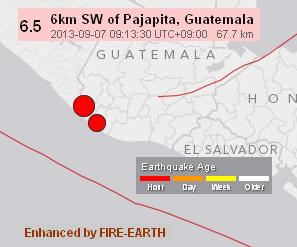
Earthquake Location Map. Source: USGS/EHP. Map enhanced by FIRE-EARTH
Related Links
Posted in Earthquake Hazard, Earthquake Information, Earthquake news, earthquake report | Tagged: earthquake 2013, GUATEMALA CITY, Guatemala quake, Pacific Ring of Fire, Philippines, strong quake, Uyugan | Leave a Comment »
Posted by feww on September 4, 2013
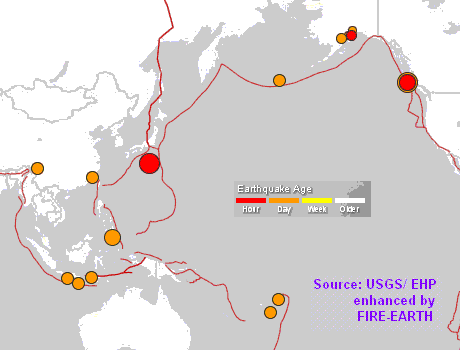
M6.5 quake strikes near Atka, Alaska
Strong quake measuring 6.5Mw struck about 77km (48mi) SSW of Atka, Alaska at 02:32 UTC, Wednesday, September 4, 2013.
The quake was centered at 51.592°N 174.760°W, and struck about 39.9km (24.8mi) deep, USGS/EHP reported.
NO tsunami reported.
Two significant aftershocks followed the mainshock, as of posting.
- 5.5Mw + 78km SSW of Atka, Alaska 2013-09-04 13:16:31 UTC+09:00 D=34.6 km
- 5.2Mw + 80km SW of Atka, Alaska 2013-09-04 14:15:56 UTC+09:00 D=44.8 km
The quake followed similar size shocks that struck Izu Islands, Japan Region and Bella Bella, Canada since late Tuesday.
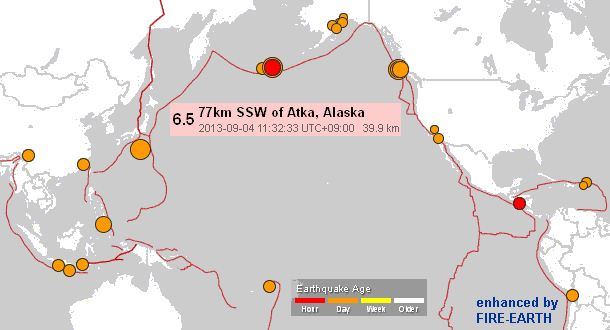
Pacific Ring of Fire – Earthquake Location Map No. 2, Sept. 4, 2013. at 06:10UTC. Image source: USGS/EHP.
Pacific Ring of Fire – Earthquake Location Map No.1, Sept. 4, 2013 at 01:20UTC. Image source: USGS/EHP.
Related Links
Posted in Alaska Earthquake forecast, Canada Earthquake, Significant Earthquakes, Significant Event Imagery, significant events | Tagged: Alaska quake, Aleutian arc, Aleutian Trench, Atka, Denali Fault, earthquake 2013, Japan earthquake 2013, Japan quake, North America plate, Pacific Plate, Pacific Plate subduction, Pacific Ring of Fire, prf quakes | 2 Comments »
Posted by feww on September 4, 2013
M6.9 Strikes Izu Islands, Japan Region
The quake, measuring 6.9MW and centered at 29.8°N, 139°E, struck at a depth of about 400km, according to Japan Meteorological Agency (JMA). NO tsunami expected.
The event occurred at about 00:18UTC on Wednesday September 4, 2013.
Pacific Ring of Fire – Earthquake Location Map, Sept. 4, 2013. Image source: USGS/EHP.
M6.0 quake strikes 191km WSW of Bella Bella, Canada
A magnitude 6.0 quake struck offshore about 191km (119mi) WSW of Bella Bella, Canada, USGS/EHP reported.
The shallow quake occurred at a depth of about 1km, centered at 51.2°N 130.4°W, said USGS.
The mainshock was followed by several significant aftershocks, the largest of which measured 5.9Mw as of posting.
- 5.9Mw + 163km SW of Bella Bella, Canada 2013-09-04 09:23:12 UTC+09:00 Depth of 9.9 km
- 5.0Mw + 188km SW of Bella Bella, Canada 2013-09-04 07:29:32 UTC+09:00 9.8 km
Posted in Canada Earthquake, Earthquake Hazard | Tagged: earthquake 2013, Eurasi, Izu Island, Japan earthquake 2013, Japan quake, Pacific Plate subduction, Pacific Ring of Fire, Philippine Plate, prf quakes, Sunda Trench | Leave a Comment »
Posted by feww on August 10, 2013
Restive Mount Rokatenda on Palue, Indonesia, finally erupts
Mount Rokatenda, located on the small island of Palue about 2,000km east of Jakarta, erupted spewing ash and rocks more than 2,000 meter into the air.
Hot ash and lava from the eruption fell on a nearby beach, killing at least 6 people including 2 children, officials said.
Rokatenda has been restive since last October, forcing the evacuation of hundreds of villagers.
The eruption started at 04:27 on Saturday (20:27 UTC Friday) and lasted for about 4 hours, according to the National Disaster Mitigation Agency.
=================
Mount Rokatenda is one of about 130 active volcanoes in Indonesia, an archipelago of more than 17,000 islands. Much of the country sits along the Pacific “Ring of Fire,” an area crisscrossed by numerous fault lines and prone to earthquakes and volcanic activity.
Mount Merapi’s 2010 eruption in central Java left up to 400 people dead and more than 250,000 others displaced.
Posted in active volcano, Indonesia volcanoes, volcanic activity, volcanic eruption, volcanic event | Tagged: indonesia volcano, Mount Merapi, Mount Rokatenda, Pacific Ring of Fire, Palue | Leave a Comment »
Posted by feww on May 10, 2011
Latest Shocks Point to a Potentially Catastrophic Phase of Seismicity in PRF: FIRE-EARTH
-
USGS downgraded the mainshock from a Magnitude 7.1 to M6.8
-
The Mainshock followed by at least a half dozen aftershocks, the largest of which measured 5.8MW
-
NO Pacific-wide Tsunami reported.
Earthquake Details
- Magnitude: 6.8
- Date-Time: Tuesday, May 10, 2011 at 08:55:09 UTC
- Location: 20.252°S, 168.273°E
- Depth 14.9 km (9.3 miles)
Region: LOYALTY ISLANDS
- Distances:
- 134 km (83 miles) SW of Isangel, Tanna, Vanuatu
- 149 km (92 miles) NNE of Tadine, Loyalty Islands, New Caledonia
- 276 km (171 miles) S of PORT-VILA, Efate, Vanuatu
- 1,741 km (1081 miles) ENE of BRISBANE, Queensland, Australia
- Location Uncertainty: horizontal +/- 13.2 km (8.2 miles); depth +/- 2.5 km (1.6 miles)
- Source: USGS NEIC (WDCS-D)
Earthquake Location Map (Source: EMSC)

Related Links
Global Disasters
Earthquake and Volcano Links
Posted in earthquake 2011, earthquake forecast | Tagged: Isangel, Loyalty Islands earthquake, New Caledonia, Pacific Ring of Fire, Tadine, Vanuatu | Leave a Comment »
Posted by feww on May 6, 2011
LARGE SCALE TECTONICS LOOM
Earthquakes Strike Ryukyu Islands, East Honshu, Alaska Peninsula, Guerrero Mexico, Sumatra Indonesia and Fiji Islands
- Magnitude 5.6 – RYUKYU ISLANDS, JAPAN 2011 May 05 at 23:21:22 UTC [USGS]
- Magnitude 6.2 – ALASKA PENINSULA 2011 May 05 at 16:57:38 UTC [GFZ Potsdam]
- Magnitude 5.4 – SOUTH OF THE FIJI ISLANDS 2011 May 05 at 16:15:20 UTC
- Magnitude 5.6 – ANDREANOF ISLANDS, ALEUTIAN IS., ALASKA 2011 May 05 at 15:06:11 UTC[GFZ Potsdam]
- Magnitude 6.1 – OFF THE EAST COAST OF HONSHU, JAPAN 2011 May 05 at 14:58:21 UTC [USGS]
- Magnitude 5.8 – ALASKA PENINSULA 2011 May 05 14:13:01 at UTC [USGS]
- Magnitude 5.7 – GUERRERO, MEXICO 2011 May 05 13:24:06 at UTC [USGS]
- Magnitude 5.6 – SOUTHERN SUMATRA, INDONESIA 2011 May 04 at 17:38:37 UTC [USGS]
- Magnitude 5.6 – FIJI REGION 2011 May 04 at 16:13:28 UTC [USGS]
Related Links
Global Disasters
Posted in destructive interplate earthquakes, japan earthquake | Tagged: 2011 disaster forecast, 2011 Disasters, Alaska earthquake, Earthquakes, LARGE SCALE TECTONICS, Pacific Ring of Fire, PRF Earthquakes, Super-destructive events | 1 Comment »
Posted by feww on December 24, 2010
Kamchatka Volcanoes May Be Instrumental to the ‘Epilogue’
Activity at Kamchatka Volcanoes Could Increase Dramatically in the Period Leading to Collapse
There are about 165 volcanoes on Kamchatka Peninsula, 29 of which are still active. About 120 of the volcanoes are believed to have erupted during the Holocene Epoch (approximately 12,000 years ago to present time).

Klyuchevskaya, the highest and most active volcano on Kamchatka peninsula, ejects a thin plume of steam and ash on December 23, 2010, when this false-color image was taken by the ASTER instrument on NASA’s Terra satellite. Source: NASA-EO

ISS astronaut photograph of volcanoes on Kamchatka Peninsula (ISS025-E-17440) was acquired on November 19, 2010. Source: NASA-EO
Related Links:
Volcano Links:
FEWW Volcanic Activity Forecast
Other Related Links:
Posted in active volcano, Kamchatka peninsula, Kamchatka volcanoes, Klyuchevskaya Volcano, Volcano News | Tagged: Epilogue, first wave of collapse, first wave of collapsing cities, Klyuchevskaya, Pacific Ring of Fire | Leave a Comment »
Posted by feww on December 15, 2009
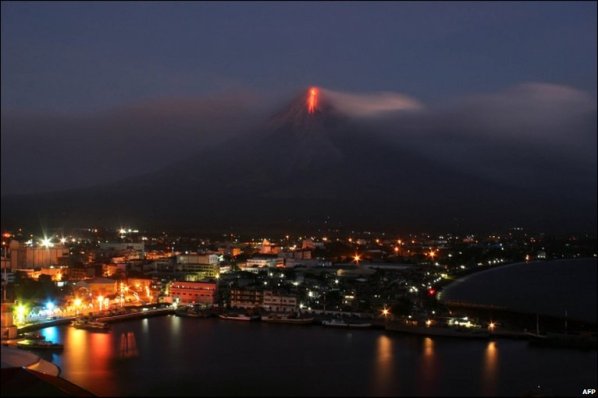
Mayon, Philippines most active volcano, oozes lava and ejects plumes of ash into the air
The Philippines Institute of Volcanology and Seismology, PHIVOLCS, raised the five-step alert to 3 after increased activity at Mayon volcano.
The authorities have evacuated thousands of residents from the 6-km (4 miles) permanent danger zone, which is now declared a prohibited area.
About 50,000 people live in an 8km (5 mile) radius of the mountain.

Lava cascades down the slopes of Mayon volcano in Legazpi city, Albay province, Monday Dec. 14, 2009. (AP Photo/Nelson Salting). Image may be subject to copyright.
About 30,000 people were evacuated from the foot of Mt Mayon after the volcano spewed ash and lava in Albay province, the Philippines. Photo:AFP. Image may be subject to copyright. Click image to enlarge.
Magma had been steadily rising at Mayon since late November and finally oozed out of the crater late Monday, and the activity at the volcano is expected to intensify, said PHILVOC.
If magma continues to push up the crater at a steady rate there would be lava flows, and “the possibility of an explosion.” PHILVOC reported.

Major Volcanoes of the Philippines Location Map. Click image to enlarge.
The 2467-meter Mayon Volcano is a stratovolcano [it is renowned for its almost perfectly conical shape] islocated about 15 kilometres northwest of Legazpi City [about 500 kilometers south of the capital, Manila,] in the province of Albay, Bicol Region, on the island of Luzon, in the Philippines.
Mayon is one of the 22 or so active volcanoes in the Philippines, and has caused the deaths of thousands of people and devastated several towns and villages in three major eruptions since its 1814. In 2006, after several eruptions, typhoon Durian triggered mudslides of volcanic ash on November 30, which buried several villages near the foot of the mountain, killing about 1,000 people.
Fire Earth Moderators believe more volcanic activities at other Philippines volcanoes are highly probable in the near future. The volcanoes located on the island on Mindanao are particularly liable to erupt in the next 12 to 36 months.
The moderators also believe a large eruption may occur at Taal volcano. For other related forecast, see links below and search blog contents.
Related Links:
Posted in Taal Volcano, volcanism, volcano, Volcano Hazard | Tagged: Mayon, Pacific Ring of Fire, Philippine volcano | 10 Comments »
Posted by feww on November 9, 2009
Another powerful earthquake strikes Fiji – more intense seismic activity could occur in the region this year
A powerful quake measuring up to 7.3 Mw struck Fiji at 17.212°S, 178.413°E or about 100 km north of the capital, Suva and at a depth of 585 km on Monday, November 09, 2009 at 10:45 UTC.
The mainshock was followed by at least one aftershock measuring 5.3 Mw.
On August 19, 2009 FEWW Moderators posted the following entry:
Following the powerful 7.8 magnitude earthquake that struck the tip of the Fiordland, South island, New Zealand, followed by a large cluster of aftershocks, another round of geo-assault appears to be gearing up at the southern end of the Kermadec trench.
The Fiordland quakes occurred as a result of a large reverse faulting motion caused by the subduction of the Australian subplate under the Pacific plate, on which Fiordland rests, in Puysegur Trench, at the Alpine Fault.
The new wave of earthquakes would instead be caused by the ‘mirror image’ action, with Pacific plate subducting beneath the Australian protoplate.
A magnitude 6.3 earthquake that struck south of the Fiji Islands on August 18, 2009 at 21:21 UTC may herald a new round of intense [and unprecedented] seismic activity at Kermadec Trench to the north, NE, and East of the North Island, as well as the north, NE, and east of the South Island, New Zealand.
10-degree Map Centered at 15°S,180°E

Earthquake location Map. Source: USGS/EHP. Enhanced by FEWW
Earthquake Details:
- Magnitude: 7.2 [Maximum quake magnitude estimated by FEWW at 7.0 Mw]
- Date-Time:
- Monday, November 09, 2009 at 10:44:54 UTC
- Monday, November 09, 2009 at 10:44:54 PM at epicenter
- Location: 17.212°S, 178.413°E
- Depth: 585.1 km (363.6 miles)
- Region: FIJI
- Distances:
- 100 km (65 miles) N of SUVA, Viti Levu, Fiji
- 135 km (85 miles) SW of Lambasa, Vanua Levu, Fiji
- 485 km (300 miles) NW of Ndoi Island, Fiji
- 2205 km (1370 miles) N of Auckland, New Zealand
- Location Uncertainty: horizontal +/- 7 km (4.3 miles); depth +/- 9 km (5.6 miles)
- Source: USGS NEIC (WDCS-D)
- Event ID: us2009nuam
Seismic Hazard Map

Major Tectonic Boundaries: Subduction Zones -purple, Ridges -red and Transform Faults -green- USGS/EHP
Seismic Hazard Map

Major Tectonic Boundaries: Subduction Zones -purple, Ridges -red and Transform Faults -green- USGS/EHP
Tsunami Info:
NOAA Pacific Tsunami Warning Center reported NO destructive tsunami as a result of this event.
Related Links:
Other Related Links [Including FEWW forecasts]
Posted in earthquake, earthquake forecast, Earthquakes, eww earthquake forecast, Fiji earthquakes, seismic activity report | Tagged: FIJI earthquake, FIJI quake, intense seismic activity, Java, Kermadec trench, Lambasa, Pacific Plate, Pacific Ring of Fire, Sumbawa earthquake, SUVA, Tambora volcano, tsunami warning, Vanua Levu, Viti Levu | Leave a Comment »
Posted by feww on October 8, 2009
Large Earthquakes Measuring Up to 8.2 Mw Strike Vanuatu, Santa Cruz Islands
Large earthquake measuring up to 8.2 Mw struck Vanuatu region, south of Lata, Santa Cruz Islands, on Wednesday, October 7, 2009 at 22:03 UTC immediately followed by another shock measuring up to 8.1 Mw, and at least seven aftershocks, with the largest two measuring up to 7.6 Mw and 6.3 Mw respectively.
-
FEWW Moderators believe many more massive aftershocks could occur in the region.
-
Megaquakes should also be expected in this and other regions.
10-degree Map Centered at 15°S,165°E

Earthquake Location Map. Source: USGS/EHP. Enhanced by FEWW
Earthquake Details
- Magnitude: 8.2 as estimated by FEWW [downgraded by USGS/EHP to M7.8]
- Date-Time:
- Wednesday, October 07, 2009 at 22:03:15 UTC
- Thursday, October 08, 2009 at 09:03:15 AM at epicenter
- Location: 13.052°S, 166.187°E
- Depth: 35 km (21.7 miles)
- Region: VANUATU
- Distances:
- 260 km (160 miles) S of Lata, Santa Cruz Islands, Solomon Isl.
- 295 km (180 miles) NNW of Luganville, Espiritu Santo, Vanuatu
- 785 km (490 miles) ESE of HONIARA, Guadalcanal, Solomon Islands
- 2100 km (1310 miles) NE of BRISBANE, Queensland, Australia
- Location Uncertainty: horizontal +/- 7.6 km (4.7 miles); depth fixed by location program
- Parameters NST=169, Nph=169, Dmin=>999 km, Rmss=1.32 sec, Gp= 50°, M-type=teleseismic moment magnitude (Mw), Version=6
- Source: USGS NEIC (WDCS-D)
- Event ID: us2009mlcf
Tsunami Warning
NOAA/NWS/West Coast and Alaska Tsunami Warning Center said “a tsunami IS NOT expected along the California, Oregon, Washington, British Columbia, or Alaska coast. NO tsunami warning, watch or advisory is in effect for these areas.”
NWS PACIFIC TSUNAMI WARNING CENTER EWA BEACH HI had issued a tsunami watch which was later canceled with the following evaluation:
BASED ON ALL AVAILABLE DATA THERE IS NO DESTRUCTIVE TSUNAMI THREAT TO THE STATE OF HAWAII. THEREFORE THE TSUNAMI WATCH FOR HAWAII IS CANCELED.
HOWEVER, SOME COASTAL AREAS IN HAWAII COULD EXPERIENCE SMALL NON-DESTRUCTIVE SEA LEVEL CHANGES AND STRONG OR UNUSUAL CURRENTS LASTING UP TO SEVERAL HOURS. THE ESTIMATED TIME SUCH EFFECTS MIGHT BEGIN IS 0650 PM HST WED 07 OCT 2009
THIS WILL BE THE FINAL MESSAGE ISSUED FOR THIS EVENT UNLESS ADDITIONAL DATA ARE RECEIVED.
FEWW Forecast the seismic events
Posted in earthquake forecast, Earthquakes, Ewa Beach, feww earthquake forecast, santa cruz islands quake, santa cruz quake, tsunami warning, vanuatu earthquake, vanuatu quake | Tagged: Earthquakes, Espiritu Santo, large earthquakes, Luganville quake, Pacific Ring of Fire, prf quakes, South Pacific earthquakes | 2 Comments »
Posted by feww on October 2, 2009
Sumatra Double Earthquakes
FEWW Moderators believe it’s highly probable that another 2 or more strong to powerful quakes could strike the region in the coming days. Padang and other coastal towns in Sumatra and Java must also prepare for a possible tsunami.
At least 1,200 bodies have been recovered following widespread damage after a magnitude 7.9 quake struck southern Sumatra, Indonesia, on Wednesday, according to the officials.
The Death Toll Could Reach Many Thousands
There are no reports of deaths from the 6.8 magnitude quake that struck southern Sumatra on Thursday. However. a local radio station reported that a dozen 12 people had been injured and up to 75 building damaged in the town of Jambi.
“People are trapped and screaming for help but they are below huge slabs which will take heavy equipment to move,” an aid worker said.
“I saw dozens of the biggest buildings collapsed in town. Most of the damage is concentrated in the commercial center market, which was fully packed,” he said.
Images that will be repeated throughout the world, again, and again

Residents stand near the bodies of earthquake victims at a hospital in Padang on Indonesia’s Sumatra
island October 1, 2009. REUTERS/Muhammad Fitrah/Singgalang Newspaper
Regional Economy
West Sumatra, a major producer of crude palm oil, is also affected economically.
Indonesia’s finance minister Sri Mulyani said: “This region has been damaged seriously, including its infrastructure,” adding that her government has allocated $25 million over two month for emergency operations.
Related Links:
Posted in Jambi, Padang Quake, palm oil production, Southern Sumatra quake, Sri Mulyani, sumatra quake | Tagged: earthquake forecast, Earthquakes, Indonesia quake, large earthquakes, megaquakes, Pacific Ring of Fire, sumatra tsunami | 1 Comment »


 Fire Earth