Rewilding ourselves

Following on from the last post but one (and heavily informed by my recent reading, Braiding Sweetgrass by Robin Wall Kimmerer and The Sixth Extinction by Elizabeth Kolbert):

What might rewilding humans, rewilding ourselves, consist of?

Releasing ourselves into the wild?

Releasing the wild in ourselves and in the spaces we inhabit – re-greening the city, re-embodying movement.

But also re-rooting ourselves – re-embedding in our places – reconnecting to the material sources of our subsistence (where ‘material’ means not monetary but physical and living systems).

Globalisation and financialisation have led to negligence or ignorance of our place in the biosphere. We have come to imagine our human world as a detached (virtual?) layer, sliding like silk, weightless, frictionless, over the planet’s grittiness. We rarely need to understand or even think about the complexities that underlie our lives, except those of the getting and spending of money. Anything you might need or want is available anywhere, anytime, as long as you have the cash. And any problem is presumed to be solvable with enough money, the universal solvent, the perfect lubricant. (And anything that can’t be, that falls outwith the realm of money, is thereby ruled out – in the world of supply and demand, demand is only expressible in terms of spending; if I have no money to spare, my ‘demands’ are invisible, if the thing ‘demanded’ is not marketable, it too is invisible.) This unanchored worldview will tend to lead to oversimplistic ‘solutions’ to narrowly constrained problems, ignoring the real interconnections that cause unintended consequences.

This is not new: consider the colonial powers’ presumptions that overriding natural boundaries was harmless, indeed, desirable, that taking livestock or crops around the world for our own convenience, would not adversely affect their new environment – rabbits and cats to Australia, etc. But this disruption is ever more all-pervasive in our click-and-collect lives. Blithely, unthinkingly, we and our consumer goods travel the world, breaking links or making new ones, slicing up habitats with ‘development’ and roads or transporting invasive hitchhikers into long-established ecosystems.

Consumer society trains us in a kind of mass attention-deficit disorder – adverts, news stories, fashion – what’s the next big thing we need to see, to get, to know, to wear…? Social media exacerbate this – swipe swipe swipe – keeping your hands and eyes occupied with ever more quickly changing stimuli, changing but also more or less the same – a canalised flow of repeating images, catering to a directed and tailored gaze. And when it comes to our homes, we are supposed to strive to get on the housing ladder where, in spite of the mantra, ‘location, location, location’, the goal is always to move up, move on. Don’t put down roots, don’t plan for the long-term care of this home, this ground; it’s only a step on the way to a bigger, better, more expensive property – property, not place. That is, we don’t live in homes so much as invest in a market (if we are lucky enough to take that first step up from the rootlessness of renting).

But this unending stream of busy-ness, consumption and acquisition is paradoxically passive – we receive the products of a system we are largely oblivious of and which we do not control. Our principal form of agency is purchase/consumption of things, ideas, media. (NB, when the consumer carousel screeches to a halt because of a pandemic, it seems that some people find the time to look harder at their lives and to want a different way to be…)

When speed and convenience are the order of the day, they enable or even enforce lack of thought, lack of sustained, deep attention. Think of the difference between walking through a natural landscape – where you might need to pick a careful path or choose to stop and look at a beetle or the sky or any number of unexpected things – and driving along a motorway, where the path is smooth and stopping is only allowed in an emergency. Or the difference between ordering online with a click and going to the shops on the bus, or even growing/making what you need yourself. Between ‘just-eat’-ing a take-away, guaranteed to be the same wherever in the world you are, versus local food cooked to a recipe developed over generations to suit the particulars of soil and season.

The rooted, the slow, the repeated being in a place, the walk to school, the tending of the garden – such things allow for, or rather demand, observation of details, of changes large or small, with time of year or time of day. (Compare the ‘city break’, flitting in and out, ‘doing’ a tourist destination in a day.)

Sustainability needs to include sustainability of thought, of feeling, of attention –

So: walk – give yourself time to be in the world

Be still – give yourself time to listen

Draw – give yourself time to look

Write – give yourself time to think

Plant a seed or a tree and take time to see how it grows

Rewilding ourselves means existing actively, engaging with our places, being transported by our own limbs and moved by our experiences of the uncurated, the unedited, the unmarketed, the undomesticated, the unfiltered world. And learning from those experiences – learning how we depend on and affect the more-than-human world, how we subsist in its webs and how easily we can disrupt them if we’re not careful.

Releasing ourselves into the wild means escaping from a worldview, a technology of being, an abstraction, a myth of freedom as disconnection, as carelessness, as self-containment, as indifference, as anyplace, floating like a Sim in an artificial, domesticated nowhere; it means stepping into the reality of connection, of mutuality, of uncontrollability, in this place, on this ground, among these living others.

Books worth reading

(PS there’s more on this chain of thought in a later post)

Deconsumption? Demonetisation?

I’m not sure ‘deconsumption’ is a word, but how about this:

Let’s stop talking about ‘sustainable [economic] growth’, stop worrying about looking after ‘the economy’ as if it is a counterweight to looking after ‘the environment’, and instead look for ways to live which respect the fact that we are just part of a living system, and acknowledge that we do not have to try and control it. Let’s find ways to re-wild ourselves – to let go of the colonial, extractivist, consumerist mind.

We have allowed the fantasy that money is the ‘bottom line’ to dominate our relations with each other and the world. People say things like ‘it’ll cost too much to make the changes you want to address the climate crisis – you have to be realistic!’ And we try to answer in their terms by pointing out it’ll cost more not to address the climate crisis. Or we call for putting a price on carbon, as if the only tool to change anything is money. But it’s only the fictional nature of money that enables the fantasy of endless ‘growth’. The fact is that however much money (=debt) the banks ‘create’, the world and its intricate systems are finite, and finely balanced. (Amusingly, the richest people in the world seem to think the answer is to colonise another dead world, using the money they have extracted from the rest of us to pay for it, and wreaking yet more destruction on our living planet in the process – infinite growth is their bottom line.)

The real bottom line is that complex human social systems (civilisations) developed during a period of climatic stability (the 11,700 years of the Holocene) and now we are quickly heading for (to us) unprecedented, probably catastrophic, change. Making a foil hat out of money won’t save us or our fellow inhabitants of Earth.

birdskull painting
Watercolour study of bird skull 2021

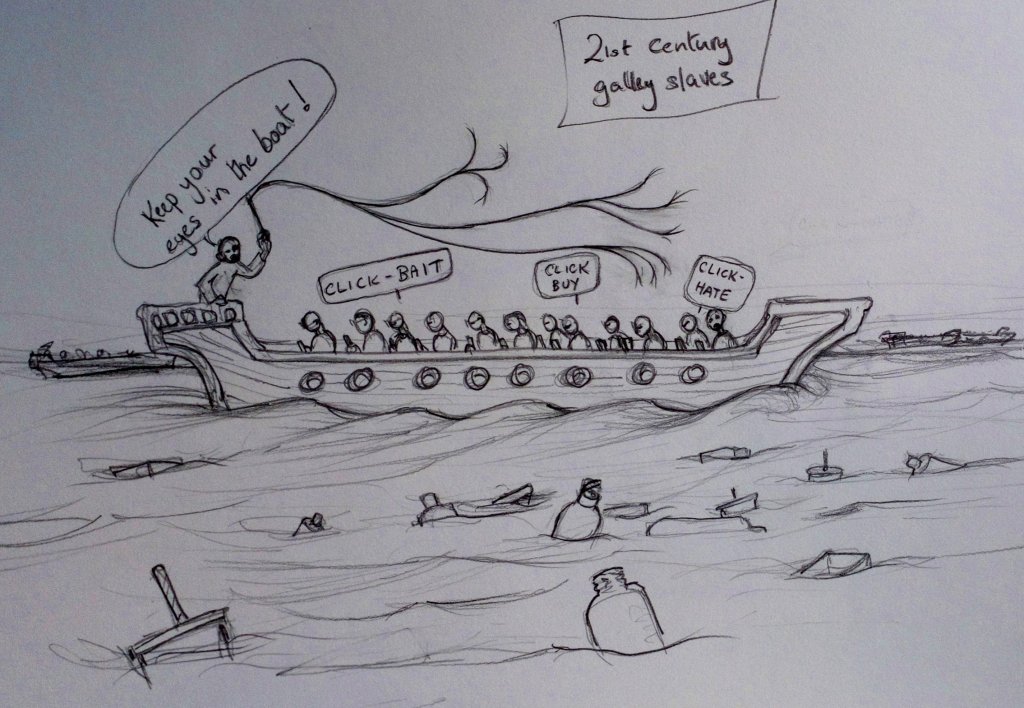
Anti-mantra (to grease the wheels of consumer-capitalism)

Keep your head down

Just got to make it to the end of the month

just got to make it to the end of the week

just got to make it to the end of the day

Keep your head down

Don’t stop

Keep your head down

Don’t stop

Don’t look up

don’t look ahead

don’t look down

don’t look

don’t wonder why

you mustn’t stop

don’t wonder what

it’s all for

don’t wonder where

it all ends

Just got to make it to the end

Keep your eyes in the boat!

Some (half-baked) thoughts about ‘growth’

We live in an econo-system based on infinite ‘growth’. But we also live in a finite ecosystem. This is a problem, a problem barely acknowledged in the old buzzword ‘sustainable growth’.

But what is it that is supposed to do this necessary and desired economic growth? Population? No – obviously endless population growth is a problem – even before we run out of space, population growth implies spreading limited resources ever more thinly. Material goods? No again – there is a physical limit to how much stuff we can ‘produce’ (the inverted commas are to remind us that ‘production’ is actually transformation of what already exists – nothing comes from nothing), at least as long as we remain on this finite planet. Living standards? Well theoretically, yes, but that is not what the economic tables measure – and when the pursuit of growth is allowed to outweigh preservation of a liveable environment or provision of social services it seems that generally improved living standards are not the point anymore, if they ever were.

It comes down of course to money, or to the exchange of ‘value’ in an easily quantifiable form. The economy is growing as long as more money is generated by our activities, and money only really exists when it is in motion, moving from buyer to seller, from lender to borrower and back again. So endless growth implies endless increase in monetary transactions; the more times money changes hands the better. And whether those exchanges are of goods and services that are actually good is beside the point.

Endless growth requires both consumerism and debt – consumerism being the endless purchasing of more things, mostly to be thrown away and replaced by more things, debt being the endless growth of money from money. We are sometimes told that lending, and hence indebtedness, is a way of making the unused capital of savers useful, funding investment in new productive businesses, enabling the heroic entrepreneurs who drive ‘progress’ to realize their ideas. Of course most of those ideas are not ways to improve lives, but ways to generate more things to spend money on. Value is turned on its head: instead of making a thing because it is of use to us, and then attaching a monetary value to it when we need to exchange it, the thing is made purely because it can be exchanged for money. And the making is performed because it produces wages and profits, regardless of the usefulness of the thing made. (So you can justify preserving a destructive industry because it ‘creates jobs’.)

Photo3405
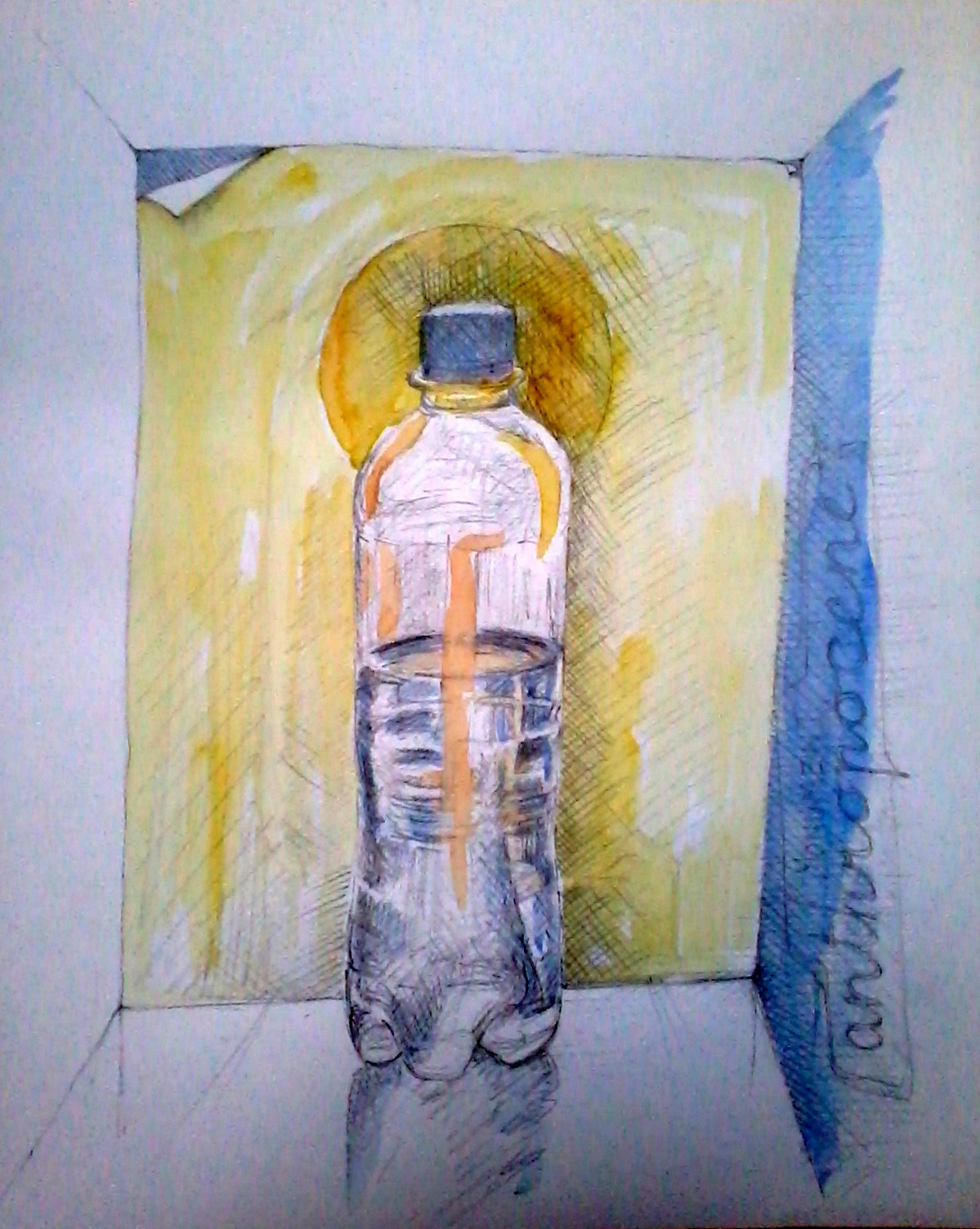
21st century icon/relic

But consumer debt is even better than consumption or investment in new production, because it creates/moves money (grows the economy) without actually having to make any corresponding things (‘nothing comes from nothing’ – except money?), and the faster the money moves the better. So let’s cut the transaction costs, deregulate the movement of money (though not of people) – create as near as possible a frictionless system of finance where buying and selling is done in a nanosecond by algorithmic traders, and so on and so on. In this system, if robots were to replace us all as workers, we would still be needed as consumers and more importantly borrowers, to feed the spinning growth machine.

Meanwhile, averages and totals hide that other growth – increasing inequality, and the concentration of wealth in a smaller and smaller and more obscenely rich few, hiding their self-perpetuating wealth away so it can’t be ‘stolen’ by the taxman to help those huddled masses who have the bad judgement to be poor and, fortunately for the rich, in debt.

The unbearable persistence of plastic

crisp packet Photo1756

My neighbours have recently been archaeologising on their smallholding, finding ancient worked flints, iron age pottery, old horse shoes, a beautiful embossed lead spindle whorl and now this crisp packet, buried in a field.

The packet can be dated to around 1971 (when the UK introduced decimal currency) because the price is given in both old pence (7d) and new pence (3p). It is in remarkably good condition, showing little sign of its 43 years of existence, just one example of the uncountable similar items we have been filling the world up with for the last few decades.

It also exemplifies the perfidiousness of the marketing industry – ‘now with added protein!’ If you look closely at the back of the packet, it claims that the ‘goodness of protein’ has been added to the flavouring: ‘the flavouring in this packet contains 15% protein’. This smacks of homeopathy. (Though you will be glad to know that they used ‘edible’ vegetable oil as the second ingredient after potatoes.)

No doubt future archaeologists will have tons of these supposed ephemera to sort through when they are studying the great anthropocene extinction event.