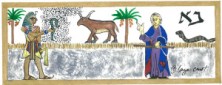
Tag Archives: Egypt

The Song at the sea and building of the temple under Solomon

Then will Moses sing, and the sons of Israel, this song to Jehovah; and they will speak, saying, I will sing to Jehovah, for exalting himself, he was exalted: the horse and his horsemen he threw into the sea.

2 Jehovah my strength and song, and he shall be to me for salvation: this my God, and I will cause him to rest; the God of my father, and I will exalt him.

3 Jehovah, a man of war: Jehovah his name.

4 The chariots of Pharaoh and his army he threw into the sea; his chosen rulers sank in the sea of sedge.

5 The depths will cover them: they will go down into the deep as a stone.

6 Thy right hand, Jehovah, was magnified in strength: thy right hand, Jehovah, will break in pieces the enemy.

7 And in the multitude of thy majesty thou wilt destroy those rising up against thee: thou wilt send forth thine anger; it shall eat them as straw.

8 And by the spirit of thine anger the waters shook them off, the flowings stood up as a heap: the depths were contracted in the heart of the sea.

9 The enemy said, I will pursue, I will enclose, I will divide the spoil: my soul shall be filled with them: I will draw out my sword, my hand shall dispossess them.

10 Thou didst blow with thy spirit; the sea covered them: they rolled down as lead in the great waters.

11 Who like thee among the gods, O Jehovah? who like thee magnified in in holiness, wonderful in praise, doing a wonder?

12 Thou didst stretch forth thy right hand, the earth will swallow them.

13 Thou didst lead in thy kindness this people thou didst redeem: thou didst conduct with thy strength to thy holy dwelling.

14 The peoples heard, and they will be angry: pain took those inhabiting Philistia.

15 Then the chiefs of Edom trembled; the mighty of Moab, trembling, shall take them; all those dwelling in Canaan melted away.

16 Dread shall fall upon them and terror: by the greatness of thine arm they shall be dumb as a stone; till thy people pass over, O Jehovah: till this people pass over, thou didst buy.

17 Thou shalt bring them in and shalt plant them in the mountain of thine inheritance, into the place of thy Sabbath, thou didst make, O Jehovah: a holy place, O Jehovah, which thy hands prepared.

18 Jehovah shall reign forever and yet.

19 For the horse of Pharaoh went in with his chariots and with his horsemen, into the sea, and Jehovah will turn back over them the water of the sea: and the sons of Israel went on the dry land in the midst of the sea.

20 And Miriam the prophetess, the sister of Aaron, will take the drum in her hand; and all the women will go forth after her, with drums and with lutes.

21 And Miriam will sing to them, Sing ye to Jehovah, for being lifted up, he was lifted up: the horse and his horseman he threw into the sea.

Exodus 15:1–21

Original Meaning. This song is a poetic rendering of the narrative of the death of Egypt’s army described toward the end of chapter 14. Perhaps more importantly, it is also the gateway to what will be the focus of attention for the remainder of the book. It reminds the reader not only of what has just transpired but gives a glimpse of what will soon take place. It is the bridge that closes the first half of the book and begins the second half. After we leave this passage, Egypt will remain in Israel’s rearview mirror and her desert wandering will have begun.

Verses 1–12 recount the destruction of the Egyptians. Verse 13 introduces the purpose for which the Israelites have been permitted to escape the doomed Egyptian army: God “redeemed” his people in order to lead them to his “holy dwelling.” What is the identity of this dwelling? We can say that God is bringing his people out of Egypt in order that he might be present with them, and that presence will be manifest in “sacred space” that takes three forms. God’s self-revelation at Sinai, although itself a frighteningly powerful reality, is a prelude to the permanence of his presence in the land and the temple.

The building of the temple under Solomon is the culminating stage in which God’s presence will abide with his people. For the ancient Israelites, the building of the temple was not an afterthought, nor was it, like church buildings today, “a nice thing to have but you don’t really need it.” Jerusalem and the temple are where God chooses to make his dwelling. It is his house. As we will see with respect to the tabernacle (the forerunner to the temple), it is more than simply a place where God chooses to dwell. It is constructed in such a way that brings to mind God’s first earthly dwelling with his people, Eden — the first “temple.” And Eden itself represents God’s heavenly throne room, where God’s presence is most full.

The allusion to the temple raises another issue. Is this reference not anachronistic, since the temple will not be built until several hundred years after the crossing of the sea? This has led some scholars to conclude that the Song at the Sea was written either in whole or in part well after the events themselves. Such a theory also seems to be supported by 15:14–16. One should not glance over the fact that 15:14–15 mention the Philistines, Edomites, Moabites, and Canaanites. These are peoples with which Israel will not come into contact until well after they leave Sinai. In fact, the Philistines and Canaanites will not be encountered for at least another forty years.

To make such an assertion is not to deny the reality of prophecy in the Old Testament. What I am suggesting is that the written version of the poem as we have it is the product of the mature reflection on the crossing of the sea from the point of view of those who have not only the exodus but also the conquest behind them. Moses and the Israelites did sing the Song at the Sea, but the inspired version


The NIV Application Commentary on the Bible: One-Volume Edition; by Christopher A. Beetham; Nancy L. Erickson

The statements, views and opinions expressed in this article are solely those of the authors of ‘the NIV Application Commentary on the Bible’ and do not necessarily represent those of the Christadelphians


+

Preceding


++

Additional reading

  1. Questions about Learning about God
  2. Matthew 23:16-22 – The Nazarene’s Commentary: Woe 3: Blind Guides and Gold
  3. Today’s Thought “To whom will ye liken me, and make me equal, and compare me, that we may be like? ” (June 22)
  4. Music to transcend language barriers
  5. The Soul not a ghost
  6. Cognizance at the doorstep or at the internet socket

Leave a comment

Filed under Religious affairs

About Joseph giving to his father and his brethren possession in the land of Egypt and about days drawing near to die

Genesis chapter 47

47:11 11 And Joseph will place his father and his brethren, and will give to them possession in the land of Egypt, in the best of the land, in the land of Rameses, according to what Pharaoh commanded.

district of Rameses. At this period Rameses was not a common name and no city was yet so named. The pharaohs with the names Rameses do not come along until the thirteenth century BC. It is logical to conclude that this geographic name is supplied at a later period. The city of Rameses, Pi-Ramesse, is eventually going to be located at Qantir/Avaris (Tell ed-Dab’a, which has been extensively excavated and provides much evidence of a Semitic population that lived there). The site was founded in the Twelfth Dynasty (1963–1786 BC), the most likely setting for Joseph. Despite the growing Syro-Palestinian population of this town over the next several centuries, no remains permit the identification of descendants of Abraham. The material culture is Canaanite and the religious practices show a syncretism of Canaanite and Egyptian elements.

47:19 19 For what shall we die before thine eyes, also we, also our land? buy us and our land for bread, and we and our land will be servants to Pharaoh: and give seed, and we shall live and not die, and the land shall not be laid waste.

Buy us and our land. Joseph’s policy suggests a shift from privately owned property to centralised ownership of property worked by tenant farmers. The Middle Kingdom and Early New Kingdom (2100–1500 bce) evidence large tracts of crown property administered by government officials. In this way, centralisation is in evidence as is the state-run redistributive economy. In the New Kingdom, much land gradually came under control of the temples. In that period, there was no longer any private property, but only personal rights to the use of property granted in trust for a land-owning institution such as the crown or temple.

Though it may appear as if Joseph’s policies were economically repressive, hard times require hard solutions. The text documents the sequence of how the people were impoverished by the famine (not by the government). First, they spent all their money buying food, then they traded away their livestock, and finally, they gave up their land and worked as tenant farmers. Their rent for the land was 20 percent of the produce — a lower than normal percentage in the ancient world. This was a progressive tax in that it was proportioned according to income. Theoretically, then, a prosperous farmer could have rebuilt his wealth when the famine ended, though it is not clear whether he would have been allowed to buy back the land. This turned Egypt into a state in which all the wealth was centralised in the government. Despite the personal hardship and servitude that resulted, the people were grateful for their lives.

47:22 22 Only the land of the priests he bought not; for to the priests a portion from Pharaoh, and they ate their portion which Pharaoh gave to them; for this they sold not their lands.

priests … received a regular allotment from Pharaoh. Priests did not need to grow their own food, and therefore shortages did not drive them to sell their land. Instead, temples, like the kings, were owners of land and benefited from renting out the land to be farmed by labourers. Temple ownership of land is well documented in Egypt of all periods, but became extensive by the mid-second millennium BCE.

47:29 29 And the days of Israel will draw near to die: and he will call to his son Joseph, and will say to him, If now I found grace in thine eyes, put now thy hand under my thigh, and thou shalt do to me kindness and truth: now thou shalt not bury me in Egypt.

Do not bury me in Egypt. Jacob’s sentiment reflects the extent to which he is tied to the land of Canaan, as it looks to both past and future.

Cultural Backgrounds Study Bible Notes, Bringing to life the Ancient World of Scripture; by Craig Keener; John H. WaltonPublisher: Zondervan, 2016

The statements, views and opinions expressed in this article are solely those of the authors of ‘Cultural Backgrounds Study Bible Notes’ and do not necessarily represent those of the Christadelphians


++

Additional reading

  1. Today’s thought “Few and evil days” (January 28)
  2. Living stones 3 Jacob and a “living stone”
  3. What Faith looks like: “Joseph”

Leave a comment

Filed under Religious affairs, Welfare matters

Divine rest and temple buildings

Photo by Skyler Ewing on Pexels.com

2 And God will complete in the seventh day his work which he made, and he will rest in the seventh day from all his work which he made. (Genesis 2:2)

Rest

The concept of divine rest is prominent in ancient Near Eastern literature. Deity’s rest is achieved in a temple, generally as a result of order having been established. The rest, while it represents disengagement from any process of establishing order (whether through conflict with other deities or not), is more importantly an expression of engagement as the deity takes his place at the helm to maintain an ordered, secure and stable cosmos. The following aspects of divine rest can be found in literature of the ancient Near East:

1. The divine rest can be disturbed by rebellion.

2. The divine rest is achieved after conflict.

3. The divine rest is achieved after order-bringing acts of creation.

4. The divine rest is achieved in the temple.

5. The divine rest is achieved in part by creating people to work in their place and on their behalf.

6. The divine rest is characterised by ongoing control and stability.

Only point 3 is transparent in Genesis, though points 4 and 6 can also be defended. Given the connection between temple and rest in the ancient Near East, it becomes natural to see the Biblical creation of the cosmos as being configured in temple-building and dedication terms; the seven-day creation account culminating in divine rest should be understood as somehow parallel to the building of temples for divine rest. This course of analogy and logic results in the understanding that Ge 1 is framed in terms of the creation of a cosmic temple in which Yahweh takes up his repose. The seven days are comparable to seven-day temple dedications at the end of which the deity takes up his rest in the temple.

The temple on earth was considered only a type of the larger, archetypal cosmic temple, and there are many images and symbols that evoke the relationship between temple and cosmos. The temple is considered the centre of the cosmos and is itself a microcosmos. In Egypt the temple contained within its sacred precincts a representation of the original primeval hillock that emerged from the cosmic waters. In Mesopotamia, the primary imagery of the temple was that it was the centre of the cosmos. In Syro-Palestine, the temple is the architectural embodiment of the cosmic mountain. This concept is represented in Ugaritic literature as well as in the Bible, where Mount Zion is understood as the mountain of the Lord (e.g., Ps 48) and the place where his temple, a representation of Eden, was built. In Isa 66:1 the Lord indicated:

“Heaven is my throne, and the earth is my footstool. Where is the house you will build for me? Where will my resting place be?”

Here God indicates that the man-made temple cannot be considered the true temple (cf. 1Ki 8:27). It is only a micro-scale representation of the cosmic temple. Ps 78:69 communicates a similar idea by indicating that the temple was built on the model of the cosmos.


Cultural Backgrounds Study Bible Notes, Bringing to life the Ancient World of Scripture; by Craig Keener; John H. WaltonPublisher: Zondervan, 2016

The statements, views and opinions expressed in this article are solely those of the authors of ‘Cultural Backgrounds Study Bible Notes’ and do not necessarily represent those of the Christadelphians

Leave a comment

Filed under Cultural affairs, History, Religious affairs

How Putin’s gas empire crumbled

The Telegraph, May 3, 2024

Event

Vladimir Putin is throwing everything he has got at ramping up Russia’s war machine.  That is why the nation’s economy – if one believes Moscow’s figures – has held up better than might have been expected in the face of Western sanctions. Rather than reflecting anything remotely like prosperity, the statistics show more weapons being produced for the meat grinder of eastern Ukraine. But Putin’s financial firepower does not include one previously reliable source of cash: natural gas.

Gazprom, the largely state-owned energy giant, has tumbled to its worst loss in a quarter of a century, losing 629bn roubles, equivalent to £5.5bn, last year, as its revenues dived by more than one quarter in rouble terms.  It is the biggest loss in at least 25 years. The loss is a humiliation for the business and for the regime. In 2021, more than 40pc of European Union gas imports came from Russia. That dropped to 8pc last year, according to the European Commission.

Comment

Olaf Scholz, Chancellor of Germany, which built much of its industrial prowess on the back of cheap Russian energy, swore the country must “never again” become so beholden to hostile suppliers.
Europe replaced the loss of Russian gas at considerable expense, but new networks have now been established which mean Moscow has lost its grip on the Western market forever. One of the new gas suppliers to the EU is Israel.

A deal was signed between the EU and Israel and Egypt to aim to allow significant exports of Israeli gas to the continent. Some Israeli gas is already sent by pipeline to liquefaction plants on Egypt’s Mediterranean coast, from where it is re-exported as liquefied natural gas (LNG) to Europe. This is the spoil that Gog comes and takes….

Bible quote

Thus saith the Lord GOD; It shall also come to pass, that at the same time shall things come into thy mind, and thou shalt think an evil thought:  And thou shalt say, I will go up to the land of unwalled villages; I will go to them that are at rest, that dwell safely, all of them dwelling without walls, and having neither bars nor gates,  To take a spoil. (Ezekiel 38:1-12)

Weekly World Watch, Andy Walton

1 Comment

Filed under Economical affairs, Headlines - News, World affairs

Dailymail: Back in the Arab League after 12 years, Syria urges group to invest in war-torn country

Sorry, this post had to be reblogged on Some View on the World

levantsagora's avatarLevant's Agora

By Associated Press.

Syria on Monday called on Arab countries to invest in the war-torn nation, now again a member of the Arab League. The appeal from Syria’s economy and trade minister came during an economic conference in Saudi Arabia, ahead of a league summit in the kingdom.

The 22-member Arab League agreed earlier this month to reinstate Syria, ending a 12-year suspension and taking another step toward bringing Syrian President Bashar Assad, a long-time regional pariah, back into the fold.

However, crippling Western sanctions against Assad´s government remain in place and could prevent oil-rich Arab countries from rushing to invest in Syria – or lead to a quick release of reconstruction funds in the war-battered country.

“We invite you to participate in investing in Syria, where there are important opportunities and promising horizons,” said the Syrian minister, Mohammed Samer al-Khalil, as he addressed the opening session of the…

View original post 334 more words

Leave a comment

Filed under Economical affairs, Headlines - News, Re-Blogs and Great Blogs, World affairs

Google Scholar: Actualization and interpretation in the Old Testament. Meaning, the rabid racism of messiah theology and its total negation of all heresy otherwise.

moshe kerr's avatarConflict Resolution

GROVES, JOSEPH WHITE.Yale University. ProQuest Dissertations Publishing, 1979. 7926245.

[[[“””Wilhelm Vischer and Hans Hellbart do not merely separate the historical and the theological, but virtually eliminate the role of historical investigation by advocating Christological exegesis. In essence their approach is a return to a pre-critical Reformation theology which views the Old and New Testaments as a unified structure. The element which creates this unity is the pervading presence of the Messiah. The New Testament interprets the Old as Messianic prophecy and this interpretation is confirmed by a study of the Old Testament as a whole. Indeed, the true nature of the Old Testament is apparently only when one recognizes the pre-existence of Christ as the head of the Old Testament church. Consequently, both the unity of the Bible and the cause of that unity are beyond the scope of historical investigation, which can only end in confusion and uncertainty…

View original post 1,016 more words

1 Comment

Filed under Crimes & Atrocities, History, Lifestyle, Political affairs, Re-Blogs and Great Blogs, Religious affairs, World affairs

Analysis: Will religious freedom flourish in post-treaty Middle East?

Could peace between the Jewish State and a Sunni Arab powerhouse portend increasing religious freedom across the Middle East?

By Lela Gilbert, World Israel News

On August 13, World Israel News reported that the United Arab Emirates and Israel have agreed to establish full diplomatic ties as part of a deal to halt Israel’s extension of sovereignty over Judea and Samaria. The announcement makes the UAE the first Gulf Arab state to do so and only the third Arab nation to have active diplomatic ties to Israel.”

The announcement was made by President Donald Trump.

“Now that the ice has been broken I expect more Arab and Muslim countries will follow the United Arab Emirates.”

So President Trump, who negotiated the agreement, predicted.

There was, of course, debate in Israel and beyond about whether the agreement had cast aside annexation of biblical Judea and Samaria for the sake of an elusive peace gesture. At the same time, there was celebration among young Israelis, embracing new hopes for harmony with the Arab world.

Despite the UAE flag emblazoned in lights across Tel Aviv’s city hall, heated discussions on the subject continue between American and Israeli, religious and secular, conservative and liberal Jews and their supporters.

‘Sarsour has no role in the campaign whatsoever,’

Biden spokesman says after DNC address

Meanwhile, conversations about the religious implications of the agreement have extended well beyond Jerusalem and Abu Dhabi. Could peace between the Jewish State and a Sunni Arab powerhouse portend increasing religious freedom across the Middle East?

Pope Francis

Pope Francis is welcomed by Abu Dhabi’s Crown Prince , Feb. 4, 2019. (AP/Kamran Jebreili)

For several years, the United Arab Emirates has been painting a self-portrait not only of a super-wealthy Arab state, but also as a haven of religious freedom. And since Pope Francis’ dramatic visit there in February 2019, much has been said to affirm that these efforts amount to more than a photo-op.

Deutche Welle (DW) described the Pope’s visit as an historic milestone, reporting

 “More than 130,000 worshipers flocked to the Zayed Sports City Stadium in the UAE capital, Abu Dhabi, on Tuesday to celebrate a Mass with Pope Francis… He is the first leader of the Catholic Church ever to set foot on the Arabian Peninsula, the birthplace of Islam.”

If peace between Jews, Muslims and Christians is possible in one small Arab country, why couldn’t it extend further? Reflecting on this possibility, prayerful optimists have lifted their eyes heavenward while world-weary cynics continue to shake their heads.

On the optimistic side, DW explained that at the start of his papal visit, Pope Francis met with Crown Prince Mohamed bin Zayed Al Nahyan and other UAE leaders at the presidential palace.

“He also signed a document promoting ‘human fraternity’ with Sheikh Ahmed el-Tayeb, the grand imam of Egypt’s Al-Azhar, the seat of Sunni Muslim learning. During an address to a gathering of interfaith leaders, he called for an end to wars in the Middle East, including in Yemen and Syria. All religious leaders had a ‘duty to reject every nuance of approval from the word war,’ he said.”

But, as less-than-upbeat observers will quickly note, religious freedom in the Middle East often ends where radical Islam begins, whether that dangerous version of ideology is rooted in Shiite or Sunni tradition. In fact, in its 2020 Country Report, the U.S. Commission on Religious Freedom (USCIRF) declared that Egypt, Iraq and Turkey were included on its “Special Watch List,” while Iran and Saudi Arabia continue to be “Countries of Particular Concern” (CPC).

Both had either permitted or committed egregious violations of religious freedom. Indeed, the violent nature of conflicts in the Middle East, including genocides of Christians, Yazidis and other minorities, tend to discourage even the most enthusiastic proponents of dialogue and reconciliation.

Still, efforts for peace – whether motivated by economic promise or intended to create a bulwark against Iranian and Turkish aggression – should not be disregarded. It is a region where churches are sometimes bombed or torched and surviving synagogues are broken relics of happier days — before the wholesale expulsion of entire Jewish communities.

Nonetheless, the UAE has begun a unique project intended to transform the marred image of Muslim, Jewish and Christian relations: a Multi-Faith Complex – including the first official synagogue in the country’s history.

“A church, mosque and synagogue will share a collective space for the first time, serving as a community for inter-religious dialogue and exchange, and nurturing the values of peaceful co-existence and acceptance among different beliefs, nationalities and cultures,” the committee overseeing construction of the complex said in a statement.

For years, Israel and the United Arab Emirates have been holding clandestine meetings. Now their newly revealed projects include both economic and defense opportunities to which both have contributed expertise and funding. Today, the inclusion of other Arab states in such endeavors is already under discussion, including Bahrain, Saudi Arabia and Sudan and more.

Sanguine regional conversations about peace and prosperity should never be silenced. Prayerful candles should always be lit by people of faith. Nevertheless, wary eyes keep their watch as Turkey’s President Tayyip Erdogan and Iran’s Supreme Leader Ali Khamenei rage and rant about the Israeli-Emirati agreement’s betrayal of Islamic empire-building.

And while Abu-Dhabi’s construction of the Multi-Faith Complex prepares for its 2022 opening, deadly gunfire shatters quiet nights in Iraq, Syria and Lebanon, while rockets and explosive balloons continue to darken the sunlit skies above Israel.

++

Related articles

  1. Yazidi, they who were created
  2. Yazidi children ‘left alone’ to deal with ISIL captivity trauma
  3. Six years on, Yazidis in Iraq demand justice for ISIL persecution
  4. Yazidi elderly exterminated, women & young girls gang-raped & young men captured & indoctrinated & who cares? …
  5. Children of the Camps
  6. JIAS Helps Yazidi Kids Rebuild Lives Through Education
  7. ISIL will find no safe haven
  8. 2014 Human Rights
  9. 2014 Religion
  10. 2016 review Human rights
  11. Palestinian Family in Cave Home Faces ‘Israeli’ Eviction
  12. The Israel-UAE deal won’t bring stability or peace while further sidelining the Palestinians
  13. Palestinians express anger at UAE following US-brokered accord with Israel
  14. For Palestinians, Israel-U. A.E. Deal Swaps One Nightmare for Another
  15. The UAE makes peace with Israel’s war on the Palestinians | Israeli–Palestinian conflict
  16. Iran, Turkey lash out at UAE over agreement with Israel
  17. Deal between Israel, UAE thwarts resolution for Middle East conflict, Palestinians say
  18. Palestinians say UAE deal hinders quest for Mideast peace
  19. a Surprise at sunriseIsrael has agreed to suspend West Bank annexation plans in exchange for the normalization of ties with the United Arab Emirates, according to a joint statement from Israel, the UAE and the US released by US President Donald Trump. UAE Crown Prince Mohammed Bin Zayad confirms in a tweet that Israel has agreed to suspend annexation plans, but says that the countries have only agreed to work toward the normalization of relations. The UAE and Israel also agreed to cooperation and setting a roadmap towards establishing a bilateral relationship.
  20. 8/14/20 AP: Palestinians say UAE deal hinders quest for Mideast peace
  21. Palestinians slam ‘traitor’ UAE for normalising ties with Israel
  22. How the Israel-UAE deal puts the bogus peace industry back in business
  23. Stand Down Jews – worldwide
  24. Indonesia’s Muslim clerics decry Israel-UAE deal – Indonesia’s top Muslim clerics on Wednesday denounced the recent normalization deal between the United Arab Emirates (UAE) and Israel. Muhyiddin Junaidi, deputy chairman of the Indonesian Ulema Council, said UAE’s move was a betrayal of the Palestinian cause.
  25. The Dilemma of the Left – There is a contradiction on the left that should make some of them re-examine their positions. The peace camp is predominantly leftist (as if conservatives don’t want peace), and the left is predominantly pro-Palestinian. So that makes the peace camp predominantly pro-Palestinian.
  26. Israeli warplanes strike Gaza – Relentlessly bomb Gaza a week after the UAE deal
  27. Kushner says UAE-Israel deal a ‘historic win,’ Palestinian leadership at ‘all time low’
  28. What Normalizing Relations Could Mean for the Middle East
  29. Palestinians in Gaza rally against Israel-UAE deal
  30. Israeli settler leader feels “defrauded” by Netanyahu
  31. The UAE-Israel Agreement: Winners and Losers
  32. Palestine Palestinians protesters in the Gaza Strip rallied against the United States-brokered deal to normalise ties between Israel and the United Arab Emirates.
  33. Palestinians call for boycott of UAE in protest of normalization with Israel
  34. UAE connects first nuclear plant to national grid
  35. Donald Trump expects Saudi Arabia to join UAE-Israel deal

10 Comments

Filed under Activism and Peace Work, Crimes & Atrocities, Headlines - News, Political affairs, World affairs

The danger of having less than 25 000 Jews in Belgium

Most of the countries that have their Jewish population dropped below the 25,000 level over the past 70 years were in Arab and Muslim countries including Morocco, Egypt, Algeria and Iran, as those countries effectively expunged the Jewish populations due to anger over the founding of Israel. The total population from all of those Arab and Muslim countries now stands at 27,000, just north of the 25k mark (15k in Turkey, 5,800 in Iran, 2,000 in Morocco and Tunisia 1,000).

On Thursday, after a two-month trial in the Belgian capital, 12 jurors found the 33-year-old guilty of the four anti-Semitic murders during a shooting spree at Belgium’s Jewish Museum in Brussels on May 24, 2014. It was not the first incident against Jews in that country, but it may be considered as the first terrorist attack by IS and the turning point for many Jews to feel not safe any-more in Belgium, because the country from then onwards started also showing an evolution to the far-right and anti-Semitic groups.

Kölner Karnaval Nazi-propaganda against Jews – Germans making fun of Jews in the 1930s

Aalst Karnaval 2019 Joodse Karrikaturen – Recycled puppets for 2019 Aalst Carnaval

We can question of the depiction of Jews in the carnival of Aalst would be of similar intent to what could be seen in Germany in the 1930ies. The stereotypes and images found in Nazi propaganda were not new, but were already familiar to their intended audience. You can not ignore that it reminds us of the Nazi-propaganda during the rise of Nazism. If that carnival group wanted to have a sabbath year, why did they spend so much money on such puppets? Such depictions are just provoking and are adding to the trouble atmosphere which is growing in Belgium.

The Simon Wiesenthal Center, a Jewish organization headquartered in the US, believes that Aalst Carnaval defiles the reputation of Belgium as the host country of the European institutions. This is stated in an open letter to Federal Minister of the Interior Pieter De Crem (CD & V). The federal government must, according to the director of international relations Shimon Samuels, patronize the Aalst carnival group publicly.

The Simon Wiesenthal Center is an NGO that collects it worldwide for the interests of Jews.

‘We are disgusted by the images of the parade during the carnival on 3 March in Aalst’,

is the letter to Minister De Crem.

‘With stereotyping and hateful images of Jews with bags full of money and hook-noses that are reminiscent of Nazi collaborating Belgium.’

Also the Jewish community was very chocked with those images, which reminded of the years before the 2nd World War.

parade float at the Aalst Carnaval in Belgium features caricatures of Orthodox Jews atop money bags, March 3, 2019 Aalst Carnaval

B’nai B’rith International termed it “disgusting.” Both umbrella groups of Belgian Jews filed a federal complaint for incitement against the group, called Vismooil’n, saying the float looked like Nazi propaganda.

Even the European Commission slammed the display, with a spokesperson saying

“It is unthinkable that such imagery is being paraded on European streets 70 years after the Holocaust.”

Why do those people from that group Vismooil give the impression that Jews are the cause of the rising prizes?

Joel Rubinfeld, the president of the Belgian League Against Anti-Semitism, or LBCA.

“Prices are rising, so who do they blame? The fat, greedy Jew,” he said.

Not only on a Facebook page of carnival enthusiasts, we could see lots of “anti-Semitic humour”.

One blamed

“the sad Jews, closed off from the rest of society in Antwerp, who have no sense of humour.”

Another referred to Jews as “dick cutters,” adding they are

“whiners with sausages for ears and woolly curls on their heads.”

Commenting on Jewish anger over the float, another wrote:

“Later you wonder why Jew hatred is growing …”

For Rubinfeld it is

“What’s happening in recent years at the carnival is a symptom of a wider problem, which the return of 1930s anti-Semitism, alongside the upgraded version that we’ve become used to, that targets Israel as a substitute for Jews and visa versa.”

At the moment there is an American petition concerning the Aalst Carnival on the Unesco-heritage-list to remove its status as an intangible heritage. What the carnival group the Vismooil Sunday has shown, with the Jewish decorated float, in any case does not fit with the norms and values that Unesco stands for.

We must take the “view on the Jews” seriously. We may not ignore a serious peril of a growing negative stance against Jews and Muslims. In europe there is a growing tendency to have bad jokes about Jews and to point the finger as if they would be part of the present problems.

Vile comments made by elected officials (including in the US, UK and Iran) attacking Jews and basic Jewish human rights in those two remaining outposts – and defended by senior politicians – rises to the level of attempted genocide of the Jewish people. {FirstOneThrough}

We cannot stay silent and should speak up. We also should show non-Jews that there are different Jewish communities with different lifestyles. But also Jews could come to see that in Christendom and in Islam there are very different groups with totally different ideas. Not all those different groups have a grudge against the other. There are enough religious and non-religious groups who are willing to live together in symbioses. Best way not to make people so afraid they find it better to leave the country is making sure they all feel welcome and can trust each other.

It is up to the governement to make sure that those people who are a danger for democracy are disciplined.

In Belgium the politicians and the police should also show they are taking certain matters seriously and should further protect all of the Jewish community. But also in the Jewish community Jews should make work of it to communicate better with each other and to accept the different sorts of Jews in this country.

Also let us think about why there are now 17 countries with over 25,000 Jews which is half of the total that existed when Israel was founded in 1948.

+

Find to read:

  1. 25,000 Jews Remaining
  2. A Hebrew-Christian movement
  3. Jeshuaists = Juifs pour Jeshua ou Jésus Christ
  4. Marchons avec courage!

19 Comments

Filed under Headlines - News, History, Religious affairs, World affairs

4.1 million Syrians having fled their homeland

In December already more than 1 million refugees entered Europe. Some 4.1 million Syrians have now fled their homeland, according to the United Nations, victims of more than four years of civil war in their homeland. This is the latest war to redistribute people from ravaged countries.

After the two world wars the United Nations responded with the 1951 Refugee Convention and its 1967 Protocol which clarified the rights of refugees and the obligations of the 148 members that became party to one or both of these instruments.These obligations have greatly burdened these countries in the current Syrian refugee crisis.

According to the United Nations, those countries in Europe absorbing refugees include:

  • Turkey, which shares a border with Syria, has taken in almost half.
  • Lebanon has taken in over a million, increasing its population by 25 percent.
  • Jordan has taken in 629,000, with about 20 percent living in camps.
  • Iraq has taken in 249,000 despite attacks by ISIS, which has captured portions of the country.
  • Egypt has taken in 132,000. Billionaire Naguib Swiris has offered to buy an island from Greece or
    Italy as a new home for these refugees.

Besides the refugees entering these countries, Europe has received nearly 250,000 asylum requests, many of which will not be processed for several years.  The sheer number of migrants seeking refuge to Europe is so overwhelming and stretching the capacities of these countries that British lawmaker Nigel Farage of the Independence Party has labeled it a problem of  “biblical proportions.”

English: Israeli and Syrian flags

Israeli and Syrian flags (Photo credit: Wikipedia)

Around half of Syria’s prewar population of 20 million has been forced from their homes.  A European Parliament resolution in March 2015 condemning attacks on Christians and other minorities said more than 700,000 of 1.1 million Syrian Christians were among those who fled the country. In Iraq, the pre-2003-war Christian population may have been as high as 1.4 million. Estimates today put it at fewer than 350,000.

In the past these situations were already foretold. The Book of books spoke about signs we should come to see. Today many of the signs spoken of should be clear for those who believe in the Only One true God.

The refugee crisis has followed years of unending battles among nations and within nations. Enemies change but the result is the same. Fear and uncertainty are now the norm. Governments in Europe and the U.S. ponder how commitments made long ago can be kept. They see no clear way out of the dilemma, and in many cases, put off inevitable crises with temporary fixes.


Read more about in “Today in Prophecy – Syrian Migrant Crisis

+++

6 Comments

Filed under Crimes & Atrocities, Headlines - News, History, Religious affairs, World affairs

Great things, Voice of God and terrors


“32 “For ask now of the days that are past, which were before thee, since the day that God created man upon the earth, and ask from the one side of heaven unto the other whether there hath been any such thing as this great thing is, or hath been heard like it? 33 Did ever people hear the voice of God speaking out of the midst of the fire, as thou hast heard, and live? 34 Or hath God deigned to go and take Him a nation from the midst of another nation by temptations, by signs, and by wonders, and by war, and by a mighty hand, and by a stretched out arm, and by great terrors, according to all that the LORD your God did for you in Egypt before your eyes? 35 Unto thee it was shown, that thou mightest know that the LORD He is God: there is none else besides Him. 36 Out of heaven He made thee to hear His voice, that He might instruct thee; and upon earth He showed thee His great fire, and thou heardest His words out of the midst of the fire.” (Deuteronomy 4:32-36 KJ21)

“Know therefore that the LORD thy God, He is God, the faithful God, who keepeth covenant and mercy with them that love Him and keep His commandments to a thousand generations,” (Deuteronomy 7:9 KJ21)

“And the LORD brought us forth out of Egypt with a mighty hand, and with an outstretched arm, and with great fearsomeness, and with signs and with wonders;” (Deuteronomy 26:8 KJ21)

“the great temptations which thine eyes have seen, the signs, and those great miracles.” (Deuteronomy 29:3 KJ21)

“Happy art thou, O Israel! Who is like unto thee, O people saved by the LORD, the shield of thy help, and who is the sword of thy excellency! And thine enemies shall be found liars unto thee, and thou shalt tread upon their high places.”” (Deuteronomy 33:29 KJ21)

“and in all that mighty hand, and in all the great terror which Moses showed in the sight of all Israel.” (Deuteronomy 34:12 KJ21)

“And I will stretch out My hand and smite Egypt with all My wonders which I will do in the midst thereof; and after that he will let you go.” (Exodus 3:20 KJ21)

“And I will harden Pharaoh’s heart, and multiply My signs and My wonders in the land of Egypt.” (Exodus 7:3 KJ21)

“”When Pharaoh shall speak unto you, saying, ‘Show a miracle for yourselves,’ then thou shalt say unto Aaron, ‘Take thy rod and cast it before Pharaoh, and it shall become a serpent.’”” (Exodus 7:9 KJ21)

“19 And the LORD spoke unto Moses, “Say unto Aaron, ‘Take thy rod and stretch out thine hand upon the waters of Egypt, upon their streams, upon their rivers, and upon their ponds, and upon all their pools of water, that they may become blood; and that there may be blood throughout all the land of Egypt, both in vessels of wood and in vessels of stone.’” 20 And Moses and Aaron did so, as the LORD commanded; and he lifted up the rod and smote the waters that were in the river, in the sight of Pharaoh and in the sight of his servants; and all the waters that were in the river were turned to blood. 21 And the fish that were in the river died; and the river stank, and the Egyptians could not drink of the water of the river; and there was blood throughout all the land of Egypt.” (Exodus 7:19-21 KJ21)

“2 Speak now in the ears of the people, and let every man borrow from his neighbor, and every woman from her neighbor, jewels of silver and jewels of gold.” 3 And the LORD gave the people favor in the sight of the Egyptians. Moreover the man Moses was very great in the land of Egypt in the sight of Pharaoh’s servants and in the sight of the people. 4  And Moses said, “Thus saith the LORD: ‘About midnight will I go out into the midst of Egypt;” (Exodus 11:2-4 KJ21)

“And the LORD said unto Moses, “Pharaoh shall not hearken unto you, that My wonders may be multiplied in the land of Egypt.”” (Exodus 11:9 KJ21)

“And the LORD said unto Moses, “How long will this people provoke Me? And how long will it be ere they believe Me for all the signs which I have shown among them?” (Numbers 14:11 KJ21)

“(I stood between the LORD and you at that time to show you the word of the LORD, for ye were afraid by reason of the fire and went not up into the mount), saying:” (Deuteronomy 5:5 KJ21)

“For who is there of all flesh that hath heard the voice of the living God speaking out of the midst of the fire, as we have, and lived?” (Deuteronomy 5:26 KJ21)

“the great temptations which thine eyes saw, and the signs, and the wonders, and the mighty hand, and the stretched out arm—whereby the LORD thy God brought thee out. So shall the LORD thy God do unto all the people of whom thou art afraid.” (Deuteronomy 7:19 KJ21)

“the great temptations which thine eyes have seen, the signs, and those great miracles.” (Deuteronomy 29:3 KJ21)

“10 and showedst signs and wonders upon Pharaoh and on all his servants and on all the people of his land. For Thou knewest that they dealt proudly against them. So didst Thou get Thee a name, as it is this day. 11 And Thou didst divide the sea before them, so that they went through the midst of the sea on the dry land; and their persecutors Thou threwest into the deep, as a stone into the mighty waters.” (Nehemiah 9:10-11 KJ21)

“yet Thou in Thy manifold mercies forsookest them not in the wilderness. The pillar of the cloud departed not from them by day, to lead them in the way; neither the pillar of fire by night, to show them light and the way wherein they should go.” (Nehemiah 9:19 KJ21)

“The pillars of heaven tremble, and are astonished at His reproof.” (Job 26:11 KJ21)

“3 The voice of the LORD is upon the waters; the God of glory thundereth; the LORD is upon many waters. 4 The voice of the LORD is powerful; the voice of the LORD is full of majesty.” (Psalms 29:3-4 KJ21)

“Marvelous things did He in the sight of their fathers, in the land of Egypt, in the field of Zoan.” (Psalms 78:12 KJ21)

“how He had wrought His signs in Egypt and His wonders in the field of Zoan,” (Psalms 78:43 KJ21)

“48 He gave up their cattle also to the hail, and their flocks to hot thunderbolts. 49 He cast upon them the fierceness of His anger, wrath, indignation, and trouble, by sending evil angels among them. 50 He made a path to His anger; He spared not their soul from death, but gave their life over to the pestilence, 51 and smote all the firstborn in Egypt, the chief of their strength in the tabernacles of Ham. 52 But He made His own people to go forth like sheep, and guided them in the wilderness like a flock. 53 And He led them on safely, so that they feared not; but the sea overwhelmed their enemies.” (Psalms 78:48-53 KJ21)

“They showed His signs among them, and wonders in the land of Ham.” (Psalms 105:27 KJ21)

“wondrous works in the land of Ham, and fearsome things by the Red Sea.” (Psalms 106:22 KJ21)

“20 who hast set signs and wonders in the land of Egypt even unto this day, and in Israel and among other men, and hast made Thee a name, as at this day; 21 and hast brought forth Thy people Israel out of the land of Egypt, with signs and with wonders, and with a strong hand and with an outstretched arm, and with great terror;” (Jeremiah 32:20-21 KJ21)

“And the sound of the cherubims’ wings was heard even to the outer court, as the voice of the Almighty God when He speaketh.” (Ezekiel 10:5 KJ21)

“6 on the day that I lifted up Mine hand unto them to bring them forth out of the land of Egypt into a land that I had espied for them, flowing with milk and honey, which is the glory of all lands, 7 then said I unto them: “Cast away every man of ye the abominations of his eyes, and defile not yourselves with the idols of Egypt: I am the LORD your God.” 8 But they rebelled against Me and would not hearken unto Me. They did not every man cast away the abominations of their eyes, neither did they forsake the idols of Egypt. “‘Then I said, “I will pour out My fury upon them, to accomplish My anger against them in the midst of the land of Egypt.” 9 But I wrought for My name’s sake, that it should not be polluted before the heathen among whom they were, in whose sight I made Myself known unto them in bringing them forth out of the land of Egypt.” (Ezekiel 20:6-9 KJ21)

“He brought them out after he had shown wonders and signs in the land of Egypt and in the Red Sea, and in the wilderness forty years.” (Acts 7:36 KJ21)

“For they themselves show of us what manner of entering in we had unto you, and how ye turned to God from idols to serve the living and true God,” (1 Thessalonians 1:9 KJ21)

“Humble yourselves therefore under the mighty hand of God, that He may exalt you in due time,” (1 Peter 5:6 KJ21)

*


All Giza Pyramids in one shot. Русский: Все пи...

All Giza Pyramids in one shot. Русский: Все пирамиды Гизы на изображении. Español: Las Pirámides de Guiza (Egipto). Français : Les Pyramides de Gizeh (Egypte). Català: Les Piràmides de Giza, a Egipte. (Photo credit: Wikipedia)

Preceding:

Searching or overlooking God’s presence

Summerholiday season time to read the Bible

Holiday making and dreaming

Home-stayers and their to do list

Written by inspiration of God for our admonition, to whom it shall be imputed if they believe

Les épreuves, signes et prodiges de Dieu

Beproevende God heeft tekenen gegeven

Versuchungen, Zeichen, Wunder, Streit und eine mächtige Hand

The Aleppo Codex is a medieval manuscript of t...

The Aleppo Codex is a medieval manuscript of the Hebrew Bible (Tanakh), associated with Rabbi Aaron Ben Asher. The Masoretic scholars wrote it in the early 10th century, probably in Tiberias, Israel. It is in book form and contains the vowel points and grammar points (nikkudot) that specify the pronunciation of the ancient Hebrew letters to preserve the chanting tradition. It is perhaps the most historically important Hebrew manuscript in existence. (Photo credit: Wikipedia)

++

Additional reading

  1. God giving signs and producing wonders
  2. Written down in God’s Name
  3. The Almighty Lord God of gods King above all gods
  4. El-Shaddai God Almighty Who no-one may see and live
  5. Jehovah God Maker of the entire universe served by a well-trained army
  6. God’s will is that all sorts of men should be saved
  7. Scripture words written for our learning, given by inspiration of God for edification

+++

16 Comments

Filed under Quotations from Holy Scriptures, Religious affairs

The Best Bedtime Stories

English: Moses and Aaron before Pharaoh: An Al...

Moses and Aaron before Pharaoh: An Allegory of the Dinteville Family, oil on wood painting by the Master of the Dinteville Family, mid 16th century, Metropolitan Museum of Art (Photo credit: Wikipedia)


In preparation for the most high day of the year, celebrating two big liberations we can prepare our children with stories which relate to modern times, our slavery, our often forgetting God’s Paths, giving us also opportunities to take away the annoying time of waiting, but also remembering why waiting is sometimes worthwhile and in this case our waiting shall be sanctified.


Pharaoh, like we, had to know it were not Moses and Aaron who had managed to turn the water in Egypt to blood, bring millions of frogs into the cities and fields, create an infestation of lice, and destroy the spring crops with balls of flaming hail. It was the Work of the Most High Elohim Hashem Jehovah. By strength of hand Jehovah the 10 plagues came over Egypt. The sanctify of the firstborn, whatever opens the womb among the children of Israel, both of man and of animal is God’s. And when they had to go forth in the month Abib it was Jehovah the God of the People of Israel Who was to bring them into the land of the Canaanite, and the Hittite, and the Amorite, and the Hivite, and the Jebusite, which He swore to their fathers to give them, a land flowing with milk and honey, that they shall keep this service in this month. and we still can look forward into what is coming into reality, God’s Land made for His people. A blessed hope.

++


Find also:


  1. No prophecy of the scripture is of any private interpretation
  2. The radiance of God’s glory and the counsellor
  3. Challenging claim 2 Inspired by God 1 Simple words
  4. Challenging claim 4 Inspired by God 3 Self-consistent Word of God
  5. Many Books, yet One
  6. Eternal Word that tells everything
  7. Bible in the first place #1/3
  8. Why think that (5) … the Bible is the word of God
  9. Creator and Blogger God 8 A Blog of a Book 2 Holy One making Scriptures Holy
  10. Creator and Blogger God 9 A Blog of a Book 3 Blog about Prophecy
  11. Creator and Blogger God 11 Old and New Blog 1 Aimed at one man
  12. Miracles of revelation and of providence 1 Golden Thread and Revelation
  13. Isaiah’s Book of the Messenger of Glad Tidings
  14. Date Setting
  15. Exodus 9: Liar Liar
  16. Commemorating the escape from slavery
  17. 1 -15 Nisan
  18. A Holy week in remembrance of the Blood of life
  19. High Holidays not only for Israel
  20. About a man who changed history of humankind
  21. How is it that Christ pleased God so perfectly?
  22. A new exodus and offering of a Lamb
  23. Ransom for all
  24. Thoughts on Passover
  25. Shabbat Pesach service reading 1/2
  26. Shabbat Pesach service reading 2/2
  27. This Passover maybe we can liberate ourselves
  28. 14 Nisan a day to remember #1 Inception
  29. 14 Nisan a day to remember #2 Time of Jesus
  30. 14 Nisan a day to remember #3 Before the Passover-feast
  31. 14 Nisan a day to remember #4 A Lamb slain
  32. 14 Nisan a day to remember #5 The Day to celebrate
  33. The Evolution Of Passover–Past To Present
  34. Passover and Liberation Theology
  35. Deliverance and establishment of a theocracy
  36. The redemption of man by Christ Jesus
  37. The day Jesus died
  38. Impaled until death overtook him
  39. Jesus is risen
  40. Christ has indeed been raised from the dead
  41. Risen With Him
  42. To whom do we want to be enslaved


+++


  • God Called Moses The Exodus Story Continues (Part 4 of 5) (vineandbranchworldministries.com) + God Called Moses to Go and Rescuse His People From Slavery (part 3)  + God Called Moses to Go and Rescuse His People From Slavery (part 2)  + God Called Moses to Go and Rescuse His People From Slavery (part 1)
  • Exodus 10 – The Eighth and Ninth Plagues
  • The Exodus Story God Calls Moses to Go Down to Egypt
  • Exodus 5:4-5 – But the king of Egypt said, “Moses and Aaron, why are you taking the people away from their labor? (church4u2.wordpress.com)
    There has always been a pattern of God calling his people out of their normal rhythms to take time to worship Him. Even in this famous story of when Moses confronted the Pharaoh of Egypt, the main thing that God wanted was for his people to cease from their labor, come aside and worship Him. This pattern offends those who see work as a way toward power. Work is a good thing, but the Sabbath is a weekly reminder that God wants to deliver us from our false identities of power and bring us back to Himself.
  • The Sixth Plague: Boils (rough) (ninapaley.com)
    And they took ashes of the furnace, and stood before Pharaoh; and Moses sprinkled it up toward heaven; and it became a boil breaking forth with blains upon man, and upon beast.
  • Fast from Complaining (robertsmusings.com)
    In the 17th chapter of Exodus, the people quarrel with Moses and test the LORD, complaining that Moses has led them out of Egypt and into the desert to die of thirst. Modern advertising takes advantage of human thirst for things that might provide salvation. Rarely will an ad show the benefits of a particular product over its competitors. Instead advertisements portray a lifestyle we might seek imply that if we buy their product, we will have the lifestyle we seek.
  • 23.5 Moses 23, Day 5 (thenotesaregood.com)
    For God to bring them across the Jordan river into the Promised Land, they would have to travel this country.  And, like Sihon, Og king of Bashan marched out to meet them.
  • To Soar In The Spirit You Have To Be Hard Core (theinscribedheart.com)
    The carnal man represents the man who was born from a carnal birth and was shaped by worldly orientation through being subject to the influences of a deceived and wicked world. The carnal man will be merciful to carnal living and would rather comprise with the enemies of the soul rather than destroy them. He is double minded, trying to serve the flesh and live spiritual at the same time.
  • Choose Positivity (matheusyuhlung.wordpress.com)
    The world is full of negativity. I’m sure you’ve experienced your share as well. Amidst the lies that exaggerates fear, it is very much essential to trust on the God whose name is Jehovah El Elohim; which means The LORD God of Gods, the LORD, mighty, powerful, strong One over all.
  • Those People Will Turn Your Children Away From Me: (dailydevotionswithdawn.wordpress.com)
    We are to purge the things in our life that would cause us to turn from God. Jesus even said that if our hand offended us, to cut it off. (I think he was speaking figuratively?)

    If we obey God, and stay close to Him, we are blessed:

  • Reflective Moment ‘Establishing Testimony’ (mylordmyfriend.com)
    Jethro had heard the story how God had bought them out of slavery. He had heard the story of redemption. He heard the story of the wonderful and victorious power of The Lord. Moses told Jethro all the Lord had done to Pharaoh and Pharaoh’s people to make Pharaoh, let them go. Moses told his father-in-law about all the hardships and troubles that had come on them along the way, but the Lord had delivered them.

    A wonderful story, to get into, but this is only a reflective moment. When our family and in-laws here what, Our Lord, Our Redeemer and Our Friend, has done and is doing for us, are they wanting to come around.

    Moses life and calling, was a testimony to His God, and people wanted to here. Our lives and our callings, should also be a testimony for what Our Lord, Our redeemer and our Friend is doing in our lives.

  • Resources of help (helpfulinspirationalblog.wordpress.com)
    Moses made excuses because he felt inadequate for the job God asked him to do. It was natural for him to feel that way. He was inadequate all by himself. But God wasn’t asking Moses to work alone. He offered other resources to help (God himself, Aaron, and the ability to do miracles). God often calls us to do tasks that seem too difficult, but he doesn’t ask us to do them alone. God offers us his resources, just as he did to Moses. We should not hide behind our inadequacies, as Moses did, but look beyond ourselves to the great resources available. Then we can allow God to use our unique contributions.


layacrust's avatarLaya Crust

Bo sigart by Laya Crust

Parshat Bo: Exodus, chapter 10 -13

Haftarah: Jeremiah  46: 13 -28

The Best Bedtime Stories

Story time is one of the best times of the day.  We are transported to magical places. We meet extraordinary people and see things we would never come across on a typical day. Stories make time enchanting when reality is boring. You need to get someone to brush teeth? Tell a story. The wait in the doctor’s office is hours long? Tell a story. The car ride isn’t ending? Tell a story.

Our family’s favourite source of stories was Tanach (the Jewish Bible). Between the angels, the giants, the talking snakes and the trickery, what could be more exciting?

Take this week’s Torah reading. Our heroes are Moses and Aaron, two poor brothers, who were on a quest to free a nation of slaves. The downtrodden  slaves were in the grasp of…

View original post 300 more words

7 Comments

Filed under Re-Blogs and Great Blogs, Religious affairs

A Bird’s-Eye View of Fishing

Problems to solve

Fishers — whether humans or birds — have three fundamental problems to solve:

(1) find fish, (2) approach them, and (3) capture them.

A typical method of early Egyptian fishermen was to use a harpoon to spear fish. These fishermen employed the same basic techniques that some birds of the heron family used long before human competitors appeared on the scene.

Great Blue Heron

Great Blue Heron (Photo credit: Vicki’s Nature)

The gray heron, a bird common in Egypt’s Nile delta, uses its sharp beak like a lance to spear fish. It can even spear two different fish at the same time, and it may eat over a pound (0.5 kg) of fish a day. The heron might be said to surpass human fishermen in guile.

Generally, herons specialize in stalking and striking their prey. A heron will wade slowly through shallow water or sometimes just stay totally still with its beak at the ready. When a fish comes within striking distance, the heron plunges its head into the water and captures the fish with its beak. Patience is usually the key to the bird’s success.

Fishing

Fishing With Bait

According to the book The Life of Birds, green-backed herons in Japan seem to imitate people who feed bread to fish found in ornamental lakes. Those ingenious birds use pieces of bread to lure fish to within easy reach.

Egrets in the Caribbean also use bread to lure fish. Egrets even catch fish without any bait at all, using their yellow feet. Standing in shallow water on one foot, they wag their other foot in the water to attract the attention of inquisitive fish.

Grab-and-Go Techniques

African fish eagle just caught a cat fish in L...

African fish eagle just caught a cat fish in Lake Baringo, Kenya (Photo credit: Wikipedia)

Birds do their fishing in various ways. Fish eagles, often called osprey, could best be described as grab-and-go fishers. They fly above the water, keeping a lookout for any fish swimming near the surface. Once one is spotted, they fold their wings and dive steeply toward the water, realigning their swoop as necessary before snatching the fish with their talons. This technique requires perfect timing and excellent eyesight.

Sometimes the African fish eagle discovers that the fish it has captured with its talons is too heavy to lift. The fish may weigh up to six pounds (2.7 kg)! What does the eagle do then? Naturalists have observed some solving the problem by paddling to shore using their wings!

Diving for Dinner

Gannets and boobies also dive for fish, but they use a vertical dive. Small flocks fly together searching for shoals of fish that swim near the surface. The silvery bodies of these fish change the color of the sea from dark blue to pale green when viewed from above. This telltale patch of green sets gannets and boobies in motion.

After locating a shoal of fish, gannets plunge like arrows into the water at speeds of up to 60 miles (96.56 km) an hour. The birds create a spectacle one might compare to an Olympic diving competition. Other flocks soon notice the activity and quickly arrive at the spot to share in the feast.

An African Fish Eagle about to catch a fish in...

An African Fish Eagle about to catch a fish in Lake Naivasha, Great Rift Valley, Kenya. (Photo credit: Wikipedia)

Unlike herons, boobies and gannets do not spear the fish when their head enters the water. The force of their dive carries the birds to a depth of several feet. Then, as they swim to the surface, they catch the fish and swallow it whole.

Terns are also proficient divers, but they swoop and hover much closer to the water. The Handbook of the Birds of the World explains that rather than dive-bombing as boobies and gannets do, terns depend on “skill, grace and agility in flight.” They will scoop a fish from the surface. Only briefly, on occasion, do they pursue a fish under water.

Team-spirit

Fishing as a Team

Pelicans may look ungainly because of their huge beaks, but they are accomplished fliers and fishermen. Brown pelicans usually dive for their dinner, and they may also snatch fish from local fishermen as they haul in their nets. But pelicans really excel at collective fishing.

By nature, pelicans are gregarious. A remarkable trait is their habit of coordinating fishing efforts. Typically, a flock of a dozen birds alight on the water and form a semicircle. Swimming slowly, they herd a shoal of fish into a convenient shallow area. As they do, they all open their wings and submerge their heads in unison, gulping fish into their beaks.

Of course, like any human fishers, birds often fail in their attempts. But their success rate is generally much higher than that of their human competitors.

鷺鷥 Snowy Egret

Snowy Egret (Photo credit: ArthurJo)

+++

  • Awakenings on the River (playamart.wordpress.com)
    The Daily Post tossed out a challenge with four options this week; I selected this one: “Take a draft post that you didn’t published because it didn’t turn out as you expected. Change the story, revise it, and publish.”
  • Master fisherman heron catches a fish using bread as bait (thisismoney.co.uk)
    As most avid fisherman will tell you, you’ve got to use the right bait to attract the big fish.While a seagull might happily feast on a proffered chunk of bread, a green heron knows exactly how to turn that bread into a fish supper.A fascinating video of the heron’s antics shows the bird dropping the bread in the water to lure a fish.
  • Constant cacophony: Herons return to Devil’s Lake (wiscnews.com)
    According to the Wisconsin Department of Natural Resources website, herons are about 4 feet tall, and theycan be identified by their distinctive coloration, which includes blue-grey feathers with a black stripe and plume above their eyes. Their long, yellow beak is perfect for spearing fish.“They’re migrating back now,” Johansen said of the birds, adding that the male herons return first.

    The females arrive soon after.

    “The males will come in, and they’re figuring out their territories, and then they will attract a female to come in and build a nest and start a family together,” Johansen said.

  • Loving Who You Are: The Story of the Heron and the Crow (mylovingartproject.com)
    The heron knew his time had come. Even the crows knew that the heron was the most patient of all the water birds. He did not mind standing in the water for long periods of time. Today, the heron was firmly planted and balanced on one leg. His piercing eyes were searching. He was ready to harpoon his long and agile beak into the water at the first sign of movement.At that very moment, the last crow circled above the heron and accidentally dropped what was in its beak. The crow’s prized catch fell straight down to the water from high above.  It was a thrown out piece of candy wrapped in a shiny red foil. The wrapper sparkled in the sunlight all the way down and hit the water with a small flicker.  This caused a faint glimmer of light and immediately caught the attention of the largest fish in the lake. In a flash, the fish swam quickly up to the surface and the heron, who was ready and waiting, made the final move. The heron was a skilled fisher and he did not need to chase the fish. His beak moved swiftly and decisively down into the water and the fish was his at last.
  • Colonial Waterbird Monitoring (gulfcoastbirdobservatory.wordpress.com)
    All these different species nesting in one place is gorgeous, but add to it that all of these birds were parading around in their fantastic breeding plumage and you have yourself a breathtaking view that you never want to leave. Breeding plumage is of course the plumage many birds acquire right before the breeding season to try to attract a mate. Birds dress up to impress each other too! This plumage may include bright colors or unusual feather shapes (such as plumes and streamers).
    +
    Words could never do these beauties justice. Whether breeding or not these birds are remarkable, but that extra boost of breeding plumage only adds to the wonder of these amazing creatures. It was an amazing experience and if you ever get the chance to see a heron rookery you should definitely go!
  • Herons and egrets in the UK – your Green shoots photographs (theguardian.com)
    Every year grey herons gather in large numbers to breed and raise young, building huge untidy nests out of large twigs, perilously perched high up in clumps of tall trees. London’s Battersea park has a heronry of 30 nests, but from Ulster to Northamptonshire and Devon to Cheshire, now is the best time to see these nests in the wild. Here is a list of best places to see heronries

    Little Egret~Egretta garzetta
    Little egret (Egretta garzetta) are, as their name suggests, much smaller than the great whites. They are about 60cm tall, with a wingspan of about 90cm. Photograph: Jump for joy2010/Green Shoots/Flickr
  • Wild Heron at the Oceanside Harbor (bilomathewsblog.wordpress.com)
    We like to walk to the beach harbor at Oceanside to watch the activities of people and the pelicans that hang around the fishing boats docked at the harbor. The pelicans will follow the fishing boats that return from the ocean into the harbor knowing that there is possibility of getting fish treats from the boat crew.
Enhanced by Zemanta

2 Comments

Filed under Nature

Thoughts on Passover

The traditional Passover Seder Haggadah is not just for Jews—it will move spiritual progressives both secular and religious.

***

Thoughts on Passover by Shari Motro

How does one leave home in peace?

Read metaphorically, the Exodus story—which Jews will retell during the upcoming Passover holiday—offers some clues to answering this most universal of questions.

Moses is born a Hebrew slave, but he is raised in Pharaoh’s palace. The setup is an exaggerated version of something familiar to many—to anyone who has wondered whether some cosmic accident landed her with the wrong family; anyone who has felt uncomfortable about the privileges she accrued by virtue of her birth; anyone who at some point experienced her parents as oppressive or narrow. Egypt, in Hebrew, means “narrow place.”

Moses’ initial reaction is the classic teenage rebellion—it’s rash, it’s risky, and it gets him into deep trouble. After witnessing an Egyptian beating a Hebrew slave, Moses kills the Egyptian, buries him in the sand, and runs. He tries to disappear, to start over. In Midian, Moses marries a local and has a son who he names Gershom, Stranger (“For I was a stranger in a strange land,” he says).

But running away doesn’t work. At some point, those of us who leave unfinished business behind are called to return. For Moses, the call starts as a fire, a fire that burns but doesn’t consume. The burning bush is a fire that can be neither put out nor ignored.

Miniature ofrom Folio 8r of the Syriac Bible o...

Miniature ofrom Folio 8r of the Syriac Bible of Paris shows Moses before Pharaoh. (Photo credit: Wikipedia)

Moses goes home to face the conflict he ran from. His task is to negotiate, to mediate between the slaves and Pharaoh, both of whom symbolize aspects of every human soul. He will eventually leave again, but in a different way. Leaving home in peace requires acknowledging the naysaying voice within. Moses can’t leave Egypt for good until his ability to dream his own future overwhelms his fear, until he stands before Pharaoh and speaks his truth.

Yes, I killed the Egyptian.

Yes, I’ve turned my back on you. Look, I’m not you. I’m a different person.

Yes, I want to leave.

Will you let me go?

Pharaoh says no, as parents do. Sometimes parents say no even when they know that eventually they will relent, that everybody will be better off when they do. Nevertheless, some inexplicable force compels them to dig in their heels, to wield their power while they still have it.

Of course, Pharaoh is an extreme example. This is the point of archetypal myths: they use extremes to illustrate lessons that apply to us all. Pharaoh symbolizes attachment—the eminently human tendency to resist change. The plagues are the suffering that results from attachment. Each plague is a message from Pharaoh’s higher self, like a body that keeps getting sick until you listen to it.

For Moses, the message of the plagues may be this: Your blossoming into your most radiant self is not the true cause of suffering—Pharaoh’s suffering, your own suffering, anybody’s. The cause of suffering is resistance.

After the tenth and most devastating plague—the death of the firstborn—Pharaoh finally relents, and the Israelites leave “in haste.” They leave so quickly they can’t wait for their bread to rise; this is why we eat unleavened bread on Passover. What’s the message here?

When the force holding you back finally relents—go. GO. Don’t be scared; don’t feel guilty; don’t hang around saying long goodbyes. It’s time.

And if Pharaoh follows at your heels and drowns in the pursuit, don’t rejoice. According to one interpretation, this is what God said to the angels who sang as the Egyptian chariots were swallowed by the sea:

“Don’t rejoice, for they are my creatures too.”

And yet, the texts are also filled with the opposite, with joy.

Anyone who has succeeded in breaking free knows this tension well. Our glee is tinged with something else, with the sinking recognition that our naysayers’ grief is our grief. And… surviving requires not allowing ourselves to drown in their tears. Surviving is rejoicing despite their pain.

Somehow, on the other side of it all, there is a place where all is forgiven, where the narrowness of our birth canal—every trauma, every grief—becomes a source of love and gratitude, where zero-sum gives way to abundance, where Pharaoh and Moses are one.

I’ve seen only glimpses of this place. For me, this is the Promised Land.

– by Shari Motro

Shari Motro is a professor of law at the University of Richmond.

From the Sikkum Special Seder Messages for Passover

+

Preceding posts:

Commemorating the escape from slavery

The Evolution Of Passover–Past To Present

Passover and Liberation Theology

++

Additional reading:

  1. Deliverance and establishement of a theocracy
  2. Moving around looking for a homeland
  3. 14 Nisan a day to remember #5 The Day to celebrate
  4. The Song of The Lamb #7 Revelation 15
  5. Materialism, would be life, and aspirations
  6. Emotional pain and emotional deadness
  7. Meaning of life 
  8. Suffering
  9. Offer in our suffering
  10. God helper and deliverer
  11. God’s instruction about joy and suffering
  12. God’s promises to us in our suffering
  13. Suffering – through the apparent silence of God
  14. Suffering continues
  15. Suffering leading to joy
  16. Surprised by time in joys & sufferings
  17. 1 -15 Nisan
  18. Day of remembrance coming near
  19. Another way looking at a language #4 Ancient times
  20. Self inflicted misery #5 A prophet without a hedge around him
  21. The Advent of the saviour to Roman oppression
  22. Seven days of Passover
  23. On the first day for matzah
  24. A new exodus and offering of a Lamb
  25. Children ate the OT passover so why not NT bread and wine?
  26. High Holidays not only for Israel
  27. Around the feast of Unleavened Bread
  28. Festival of Freedom and persecutions
  29. 14-15 Nisan and Easter

+++


  • The Ancient Egyptians Worshiped Sheep (acquiescere9.wordpress.com) > The Ancient Egyptians Worshiped SheepUltimately, the Torah tells us, God commanded the Israelites to take a lamb or a kid for each household. They were to hold it for four days, from the tenth until the fourteenth of the first month, and slaughter it on the fourteenth. This was done in Egypt, despite the Egyptians’ religious beliefs. To this day Jews commemorate this event, calling the Sabbath preceding Passover Shabbat Hagadol
    +
    Torah Parshat Va’eira Exodus 6:2-9:3
    +
    Parshah Yitro Exodus 18:1-20:23
  • This Passover 2012, Remember (Again!) – It’s Not Your Religion That Matters, But Your Humanity (nobodysview.wordpress.com)
    A drop of wine is spilled with each recitation in memory of those who suffered in Egypt…not the Jews, but the Egyptians.I guess it’s a solemn reminder that when blood of any kind is spilled, we all lose a little something.  Then, it is important to remember that when there are those in bondage around the world, we ourselves (no matter our religion) are in some way in bondage.
    +
    It’s 5773, but the Message of Passover 2013 Is Still as Strong as Ever
    There were wanderings, new beginnings, divisions, and some heartache, but in the end, the destination was reached.
  • Preparing for Passover: Six Ways to Prepare (coffeeshoprabbi.com)
    Traditionally, Jews spend the month after Purim preparing for Passover. A lot of the holiday is in the preparation: the seder and the week that follows are the fruit of what we’ve put in the month before. I thought it might be helpful to look at the various ways we prepare for Passover.  If this is your first year observing Passover, don’t try to do everything at once. Choose one or two, and get all that you can out of them.
    +
    Passover is the festival of telling the story about “deliverance from Egypt.” If you are truly to experience deliverance, it helps to notice from what you need deliverance. Spend some time, between now and Passover, thinking about your own personal Egypt(s). The name for Egypt in Hebrew is “Mitzrayim,” which also means “a narrow place, a tight spot.” Questions to ask myself: Where in my life am I stuck? To what am I a slave? In what parts of my life am I Pharaoh? Do I depend on the slavery of others? What would freedom look like, in any of these cases? What would freedom cost? What is freedom worth?
  • Who Would You Rather Listen To? (spinningrabbi.com)
    One of those valuable lessons of this remembering, is this – G-d freed the Jews so that they were no longer physical slaves, yet they were still slaves.  Now they were their own Pharaoh and the slavery was of the self-imposed spiritual and emotional variety.  Once physically free, it was up to them to free themselves spiritually and emotionally.This lesson applies to all people who are blessed to live in freedom today.  This means that the only one who can free you now, is you.  It’s up to you to free yourself from your personal Egypt.
  • Christian Bale as Moses in ‘Exodus’: First Look (PHOTO) (news.moviefone.com)
    Empire has our first look at Ridley Scott’s “Exodus,” and judging by the impressive construction going on behind Christian Bale‘s Moses, this Biblical tale should be epic indeed.The film follows the story of Moses, abandoned as a baby and adopted by Egyptian royalty, only to hear the voice of God as he grows older and ultimately lead the Israelite slaves into the promised land. In this image, Moses witnesses the suffering of his people at the hands of the Pharaoh.
  • Pharaoh’s Overthrow (brakeman1.com)
    There were six hundred thousand men, besides women and children.  God caused a pillar of cloud to go before them in the daytime, to show them the way they were to take, and at night He led them by a pillar of fire.After the children of Israel had left Egypt, Pharaoh, though his kingdom had been nearly destroyed for his disobedience to God, was angry with himself for having let them go.  So he gathered together a great army, and pursued them to where they were encamped, in the wilderness by the Red Sea.
  • The Ancient Egyptians Worshiped Sheep (menashedovid1.wordpress.com)> The Ancient Egyptians Worshiped Sheep
    the Torah tells us, God commanded the Israelites to take a lamb or a kid for each household. They were to hold it for four days, from the tenth until the fourteenth of the first month, and slaughter it on the fourteenth. This was done in Egypt, despite the Egyptians’ religious beliefs. To this day Jews commemorate this event, calling the Sabbath preceding Passover Shabbat Hagadol…
  • Passover Primer (boiseweekly.com)
    If you’ve walked through a Treasure Valley Albertson’s recently, you’ve probably noticed a table piled high with unfamiliar items–boxes of Streit’s Potato Pancakes, giant packages of Yehuda Passover Matzos, bottles of Kedem Sparkling Concord Grape Juice and murky jars of Mrs. Adler’s Gefilte Fish filled with bobbing, grayish lumps.
  • Now Faith Is (faithrises.com)
    Through faith he kept the passover, and the sprinkling of blood, lest He that destroyed the firstborn should touch them.
  • Max, Hannah and some frogs: Kids’ books bring new friends (jta.org)
    Frolicking frogs and magical matzah balls are featured in this season’s crop of new Passover books for children that are sure to engage, inform, entertain and inspire.David Adler, author of the hugely popular early reader “Cam Jansen” series, offers “The Story of Passover.” Adler is highly acclaimed for his straightforward narrative style in non-fiction books, including dozens on Jewish holidays.David A. Adler in "The Story of Passover" provides little-known answers to some intriguing questions. (Courtesy Holiday House)He says he likes to appeal to readers of any Jewish background, whether from traditional, observant Jewish families or those who are interested in learning about Passover.

9 Comments

Filed under Being and Feeling, History, Religious affairs