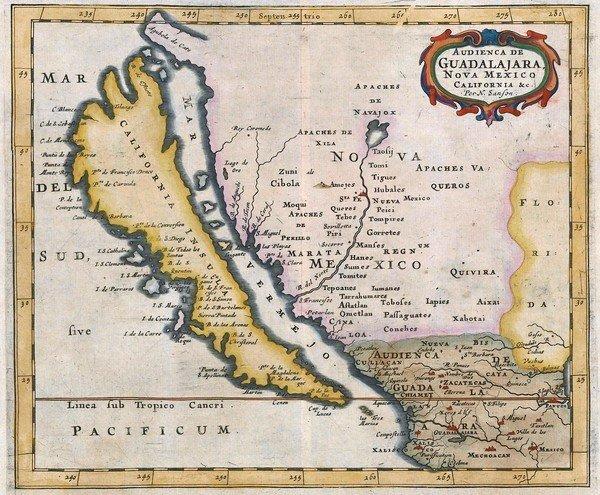
How California Got Its Name

The etymology of California has a curious story. America’s richest and most populous state is named after a fictional country from a 16th-century Spanish novelWhen the Spanish were exploring the Americas, they named the lands northwest of Mexico after the made-up island of California. It would be like naming a place Gondor or Narnia today.

Garci Rodriguez de Montalvo wrote the Amadis series around 1500 by translating and retelling older French and Portuguese tales. His books followed the adventures of Amadis of Gaul, a knight-errant who went about slaying giants and rescuing damsels. Although near unknown today, it was incredibly popular in its time. A century later, Miguel Cervantes parodied the Amadis books in Don Quixote, whose lead character claims Amadis of Gaul as his favourite.

books african history African Queens Queen Calafia ...

The land of California appears in Montalvo’s fifth bookThe Exploits of Esplandian (1510). Written when the Spanish were exploring the New World, which they still thought was Asia, it follows the adventures of Amadis’s son and his war with the amazon queen Califia (whose name likely derives from the Arabic ‘caliph’). Her kingdom, California was an island somewhere west of the Caribbean and east of Constantinople. Its people were amazons who rode griffins to battle and whose only metal was gold. Of course, by the end of the novel, Esplandian defeats Califia; she converts to Christianity and accepts men into her land.

Montalvo describes:

Know that on the right hand of the Indies exists an island called California, very close to a side of the Eartlhy paradise; and it was populated by black women, without any man existing there because they lived in the way of the Amazons. They had beautiful and robust bodies and were brave and very strong. Their island was the strongest of the World, with its cliffs and rocky shores. Their weapons were golden and so were the harnesses of the wild beasts that they were accustomed to taming so that they could be ridden because there was no other metal in the island than gold.

Montalvo’s chivalric romances were easily accessible, credit to the newly invented printing press, and especially popular amongst men seeking adventure in the New World. Hernan Cortes referenced Amadis when seeing Tenochtitlan for the first time.

In 1542, Juan Rodriguez, a Portuguese conquistador working for the Spanish, sailed from Honduras up the western coast of North America. Like most Spanish adventurers, he was familiar with Montalvo’s books and may even have thought them true. Rodriguez found a peninsular, mistook it for an island and named it California. In 1602 the Spanish colonised the region and applied the name not only to the peninsular (today’s Baja California, Mexico) but the land north as well, which they still believed to be an island. The name California has stuck ever since. 

Source: John Man – Amazons: The Real Warrior Women of the Ancient World (2017)

See Also:

Conn Iggulden – The Falcon of Sparta

Book Review: The Falcon of Sparta by Conn Iggulden – THE ...

The Falcon of Sparta (2018), by English author Conn Iggulden, is a fictionalised account of Xenophon’ Anabasis: a story of ten thousand Greek mercenaries stranded in the heart of the Persian Empire and their journey home. It features such characters as Xenophon, Socrates, Artaxerxes of Persia and the rebel prince Cyrus.

The book’s first half deals with the campaign of the charismatic Cyrus the Younger to take the throne from his scholarly elder brother Artaxerxes under a falcon banner. To do so he assembles a Persian army and hires mercenaries from across the Greek cities, including their old enemies the Spartans. Even before the battle, he faces struggles. Dissension, bankruptcy and mutiny plague his campaign. The date is 409 BC, roughly between the Battle of Thermopylae and the conquests of Alexander.

Leaderless in the desert and hopelessly outnumbered, the Greeks must confront the impossible. Iggulden focuses just as much on the logistics of moving an army and the challenges that come with it, as combat itself. The Greeks must assail long deserts and snowy mountains to get to the Black Sea.

The Battle of Cunaxa is described in an epic and near-legendary tone. It is hard to imagine that the greatest armies in the world did clash in such numbers but Iggulden does a good enough job in describing the fight from the perspective of the combatants in as historically accurate terms as possible. Aspects of the second half, such as the Greeks’ battle with the Carduchi mountain tribes, seem a little rushed but are compelling enough.

Prince Cyrus, and his Spartan general Clearchus, are well portrayed as characters. Xenophon, who wrote the story in real life, is somewhat of a self-hating Athenian, associated with the Thirty Tyrants, a Spartan puppet regime and preferring the Spartan system to his own. Beginning the story as an intelligent but resentful young man, it is Socrates who persuades him to head east and make something of himself. Tissaphernes, the conniving former tutor, makes an easy to hate villain.

Though the story is told largely from the Greek perspective, I liked how it begins with the Persians and portrays the Greek culture as alien and strange, rather than the other way around. The story occurs at a time when the Greeks were more busy fighting each other than the Persians, who cooperate with powers like Sparta.

The Sunday Express called The Falcon of Sparta Iggulden’s ‘finest work to date’ and that quote made me buy the book. While better than his Roman series, I still prefer his Conqueror books about the Mongol khans, if only because the murkier history allowed more creative liberties.

See Also:

Saint Francis

Saint Francis of Assisi (1181 – 1226, San Francesco in Italian) is a Catholic saint and founder of the Franciscan Order. Like the Buddha, he traded a life of luxury for one of poverty and spirituality. He was known for his love of the world and is regarded as the patron saint of the environment. San Francisco, California and the current pope take their names from him.

Francis was born the son of a wealthy cloth merchant and his French wife in the Italian town of Assisi. His name means ‘the Frenchman’. A strongwilled and fashionable young man, he originally followed in his father’s footsteps and gained a reputation as a partier and spendthrift.

During Assisi’s war with neighbouring Perugia, Francis was captured spent a year in a dungeon until his father ransomed him. He returned to his old ways until on impulse he embraced a leper and give away all the money in his pockets.

After an alleged vision from Jesus in a crumbling cathedral urged him to ‘rebuild the church’, Francis gave away some of his father’s gold to its priest. Furious, his father beat him and demand he return what he stole. Francis laid all his possessions, including his clothes at his father’s feet and disowned himself of any inheritance. They did not speak again.

Reinventing himself as a man of God, Francis travelled across Italy helping the poor and caring for the sick. He and his followers founded the Franciscan Order of friars for men and the Poor Clares for women, who dedicated themselves to lives of poverty in service to local communities in emulation of Jesus and the apostles. He allegedly performed miracles. Within ten years, the order swelled to 5,000 followers from all social classes. In 1231 he attempted to convert the Sultan of Egypt to Catholicism and end the Crusades but was captured instead. The sultan released him but did not convert.

Saint Francis and the wolf | Mark McMillion

Legend claimed Saint Francis could communicate with animals. It was said he tamed the voracious wolf of Gubbio by acknowledging its hunger and forging a pact between the wolf and the local village. They fed the beast and in return, it ceased its attacks. Francis was particularly fond of birds.

The Canticle of the Sun is a religious poem Saint Francis wrote towards the end of his life after he went blind. It venerates the sun, moon, natural elements, animals and finally death, whom he describes as his ‘brothers’ and ‘sisters’. Francis believed the world was inherently good and beautiful but polluted by humanity’s misdemeanours. Pope Gregory IX canonised him in 1228. Before he was even dead, local towns were competing for his body.

Sources: Biography.com, Catholic Encyclopedia

See Also:

2020 So Far

Trump rushed to White House bunker amid protests

Disclaimer: This post is based on information from the media by someone living outside of North America as I currently understand it. It focuses on events in the world hegemon, the USA.

In January, tensions between the USA and Iran reached an all-time high following the assassination of Iranian general Qassem Soleimani. World War 3 memes flooded the internet while, in Iran and elsewhere, the protests of 2019 continued. The year’s greatest challenge to the USA and its hegemony proved not an external enemy however, but a global disease and problems within the nation itself.

In February, Covid-19, a deadly virus, spread from a market in Wuhan across China. By March it went global, killing hundreds of thousands. Governments forced their populations into lockdown, closing businesses and urging their people to stay at home. Transmission stalled at the economy’s expense.

By May, the USA had suffered the most, with over a million cases and over 100,000 dead. Black Americans were hit disproportionately.

On May 21st, white Minneapolis police officer Derek Chauvin arrested George Floyd, an unarmed black man, for using a counterfeit bill. The officer then kneeled on Floyd’s neck for nine minutes as he cried ‘I can’t breathe’ until he died. Floyd’s death, the latest in a long list of documented murders-by-police, was the spark which set the forest ablaze. 

Minneapolis, and over 75 other cities, erupted in protests against systemic racism and police brutality. With law enforcement stretched thin, looters took to the streets at night. Businesses big and small suffered. Authorities deployed State Troopers and on, June 1st the National Guard. Currently ongoing, it is the USA’s worst civil unrest since the 1960s. 

There has been major unrest in the USA every generation. Unlike the 1965 Watts Riots, or 1992 Rodney King Riots, however, the George Floyd protests have coincided with a pandemic, economic collapse and the century’s most unpopular presidency. Through such concurrences, empires fall.

The USA was already in a fragile state. Millions, particularly those on minimum hour contracts, lost their livelihoods in the lockdown. With a weak social safety net and a terrible healthcare system, America has not weathered the storm well. People are angry and have little to lose. 

What happens next?

Donald Trump will run on a law and order platform as Nixon did in 1968. Against the uninspiring Joe Biden, he will likely win.

As for the bigger picture, there are three possibilities:

  1. Cities invoke meaningful steps to reform and demilitarise the American police and the prison-industrial complex. They hold murderous cops accountable. 
  2. Protests continue but struggle against heavy law enforcement. Riots abate. Systemic racism enters the public discourse and small steps are taken to meet protestor demands. The status quo prevails.
  3. Riots worsen. Armed groups intervene. Someone fires at police lines and they respond with live bullets. Trump calls the military. The USA implodes as Rome did and the rest of the world fights over its ashes. 

Whatever the case, Covid-19 will spike in the USA. It will take months to fully recover.

The LAPD reformed somewhat following the Rodney King Riots of 1992. Now the Minneapolis city government pledges to defund the police and mandate officers intervene against colleagues using excessive force. Proclaiming support for Black Lives Matter has become trendy amongst corporations. Most significantly, the protests have brought attention to the structural inequality that persists in the United States but also highlighted the political and social division which defines our era. Whatever happens in the next six months, historians will study 2020 for years to come.

Sources: Data.pnj, CNN, The Economist, The Guardian, Vox

See Also: