

The Sumerians were an ancient people who built the world’s first civilisation. Historians credit them with the invention of writing, mathematics, literature and the wheel. The thousand year Sumerian civilisation rose and fell while mammoths still walked the earth.
Ancient Sumer is the land where the Tigris and Euphrates rivers meet the sea, now southern Iraq. The coastline was further north than today, the land was greener, and the rivers ran a different course. The cities of Sumer are now ruins in the desert.

At first glance, Sumer seems an unlikely place for cities. Unlike in Egypt, river floods were violent and unpredictable. Few trees grew and metal was scarce. The soil of southern Iraq is notoriously prone to salination. The Sumerians learned to tame the rivers and build canals to extend them inland, where they grew wheat, barley, chickpeas, onions and other crops. As timber was scarce, they built houses and temples from clay and sundried mudbrick.
Sumerian was a language isolate, meaning it bore no relationship to the neighboring Semitic and Indo-European tongues or any language spoken today. The Sumerians could have come from India, North Africa or land now swallowed by the Persian Gulf. Their many stories include that of a flood from long ago.
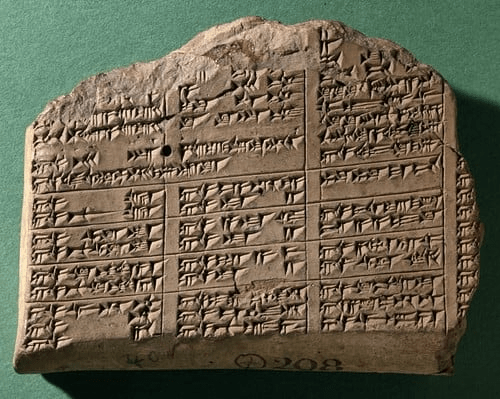
Cuneiform script involved etching symbols into wet clay using a reed stylus. It is from their extensive writings we know so much about Sumerians today. They recorded stories, hymns, inventories, poetry, and the deeds of their kings. The world’s oldest known piece of literature – the Epic of Gilgamesh – was first written in Sumerian.
The Sumerians organised cities through complex bureaucracies. They knew how to measure weight, sail, study the stars, tax and build city walls. Sumerian armies marched in tightly packed units of spearmen, backed by archers and wagons drawn by donkeys. Their merchants traded with their neighbours, including those as far afield as Africa and the Indus Valley. They imported not only wood and metal, but ivory, lapiz lazuli and gold.
For most of their history, the Sumerian cities were independent, ruled first by priests and then ‘big men’ or kings. Around 2400 BC, Eannatum, king of Lagash, took over Sumer by force and proclaimed his victory on the Stele of Vultures. He was in turn overthrown by Lugal-Zage-Si of Umma, who fell to Sargon, a Semetic speaking king from Akkad in the north. Three centuries later, the Akkadian Empire fell to raiders from the mountains and Sumer returned to native rule – this time by the kings of Ur.
 The ‘Third Dynasty of Ur’ ruled Sumer for a century. King Ur-Nammu inscribed a code of laws, predating the more famous and harsher Code of Hammurabi by three hundred years. He also built the Great Ziggurat of Ur, which still stands today.
Climate change was Sumer’s downfall. Centuries of bad practice led to exhaustion of a soil plagued increasingly by salt from the mountains upstream. In place of wheat, farmers grew barley. Semitic-speaking tribes pushed into Sumer as drought and famine forced them from the Syrian Desert. As the price of bread shot up and trade collapsed, invaders ravaged the land. Ur and its dynasty fell around 2,000 BC.
As the people of Sumer abandoned their cities and dispersed across Mesopotamia, their spoken language died out. Written Sumerian, revered by the Assyrians and Babylonians who followed, survived as a language of temples and priests for another two thousand years, much as Latin did in the west.
See Also:
 Iran has one of the oldest and most influential civilisations in the world. Iranian culture dominated Central Asia and the Middle East from the time of Cyrus the Great to the Islamic Conquests and in some ways continues to do so.
 Persia is the old Greek world for Iran and its English name until 1932. The modern Persian language swapped the P sound for F, so ‘Persia Proper’ is today Iran’s Fars province. The Persian language is Farsi. The Zoroastrians who fled to India when the Muslims took over before the language changed are called the Parsi.
 Medians (non-Persian Iranians, 678 – 549 BC)
 The Safavid Dynasty restored native rule in the 1500s. They retained Persian culture, made Persian, not Arabic, the country’s official language and made Iran the centre of the Shia Muslim world. In 1979 clerics overthrew the last Shah, Reza Muhammad of the Pahlavi Dynasty, and replaced the monarchy with a theocratic republic, ending 2,500 years of imperial rule.
 Among other things, Persia has given the world:
 In 1750, China, India and the Middle East led the world in technology, power and sophistication, as they had for most of history. In 1775 India and China controlled 66% of the world’s economy. Less than a century later the British ruled India and China accounted for only 5%. By 1900 all the Americas spoke European languages, and Britain, a formerly insignificant island, ruled a quarter of the world. How was that possible?
 Hunter-gatherers enjoyed nutritious diets. Instead of dairy and grain, products of the Agricultural Revolution, they lived off wild fruit, fish, and meat, free from excess calories, sugar or saturated fat. They were fit too; in contrast to our sedentary lifestyles where we get by with minimal physical exertion and pass on our ‘unremarkable genes’, hunter-gatherers were constantly on the move and used all parts of their body. The average Stone Age human was as fit as an Olympic athlete.

 Why don’t we farm hippopotamuses for their meat? They are fat enough. Why can we ride horses but not zebras? Why did humans domesticate some animals but fail with others?

 From the Parapet