
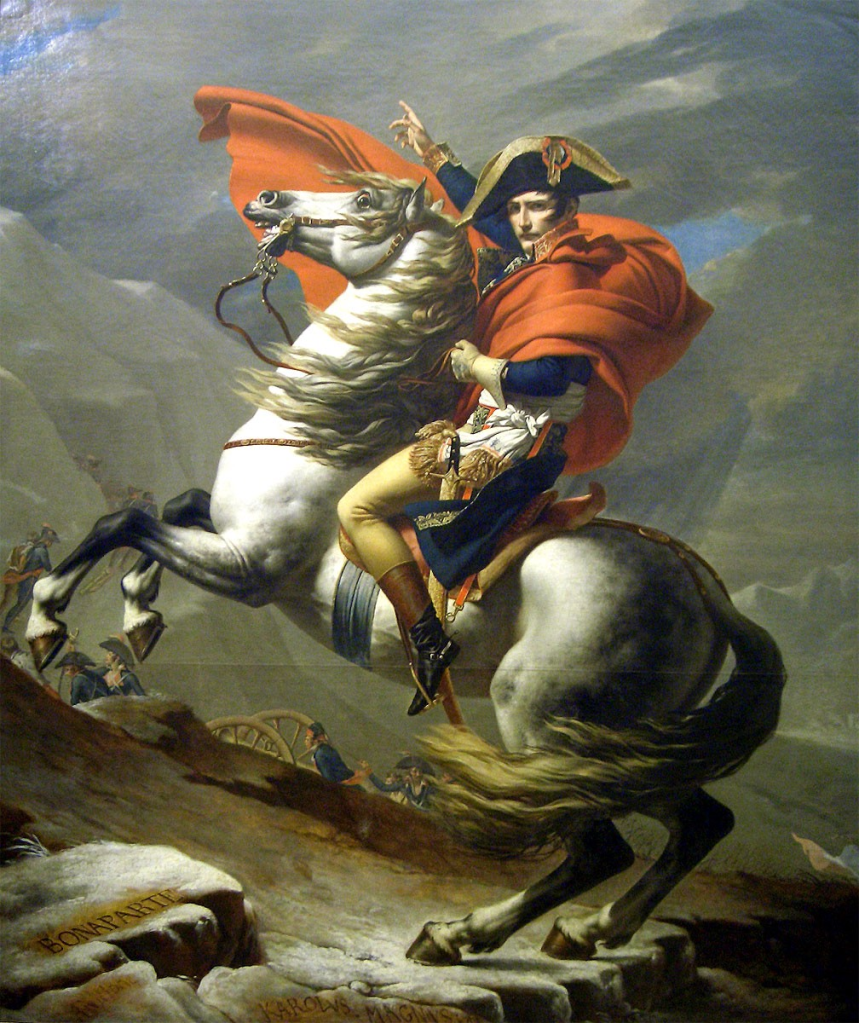
Napoleon Bonaparte (1769-1821) was the greatest military commander in history. He led France through 15 years of war and almost conquered Europe. Napoleon’s nemesis, the Duke of Wellington, said his presence on the battlefield was worth 40,000 men; historian Martin van Creveld calls him ‘the most competent human being who ever lived’.
Napoleon’s army were mainly conscripts fighting with muskets and bayonets, but were highly motivated. They called their general the ‘Little Corporal’ as a term of endearment. He was 5’6 – average height at the time, but shorter than most aristocrats and generals. His British enemies called him ‘the Corsican Ogre’.
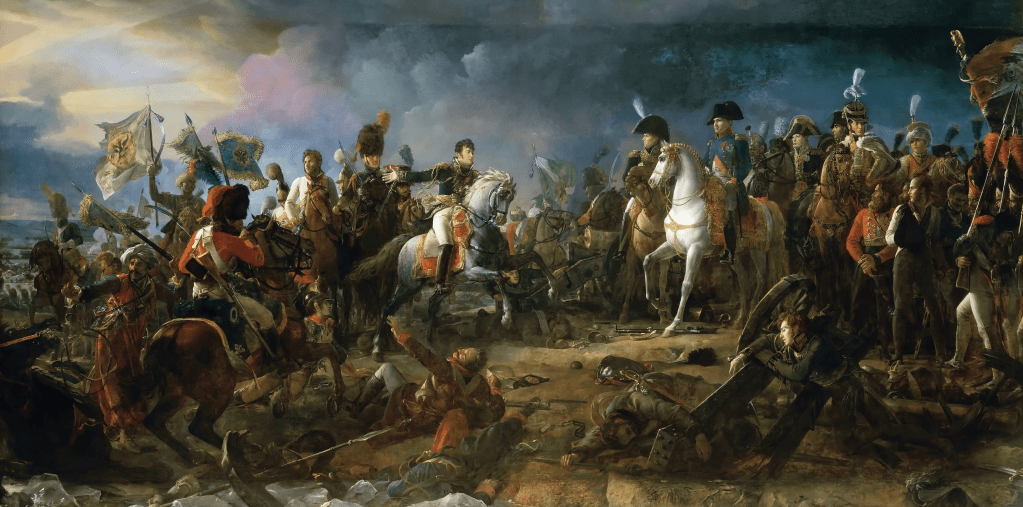
As a commander, Napoleon was calculating and bold. He eschewed gentlemanly conduct and used ambush and deception wherever possible. Napoleon invented the modern corps system, which divides armies into autonomous mixed units instead of specialised blocks. His most famous victories include Rivoli (1792), Austerlitz (1805) and Jena-Auerstedt (1807), all against superior numbers. Of 56 battles, he lost only ten.
Napoleon was born to a large and impoverished family in Corsica, the year France took over. He maintained an accent throughout his life and never learnt to spell in French. It was not until 1789, at 20 years old, that Napoleon embraced a French identity.
That year, revolutionary mobs seized control of France and overthrew its king. European powers, fearing the revolution would spread, declared war. For 20 years, France fought its neighbours – chiefly Austria, Prussia, Russia and Britain. They formed seven ‘coalitions’ – at first to end the revolution, and then to unseat Napoleon.
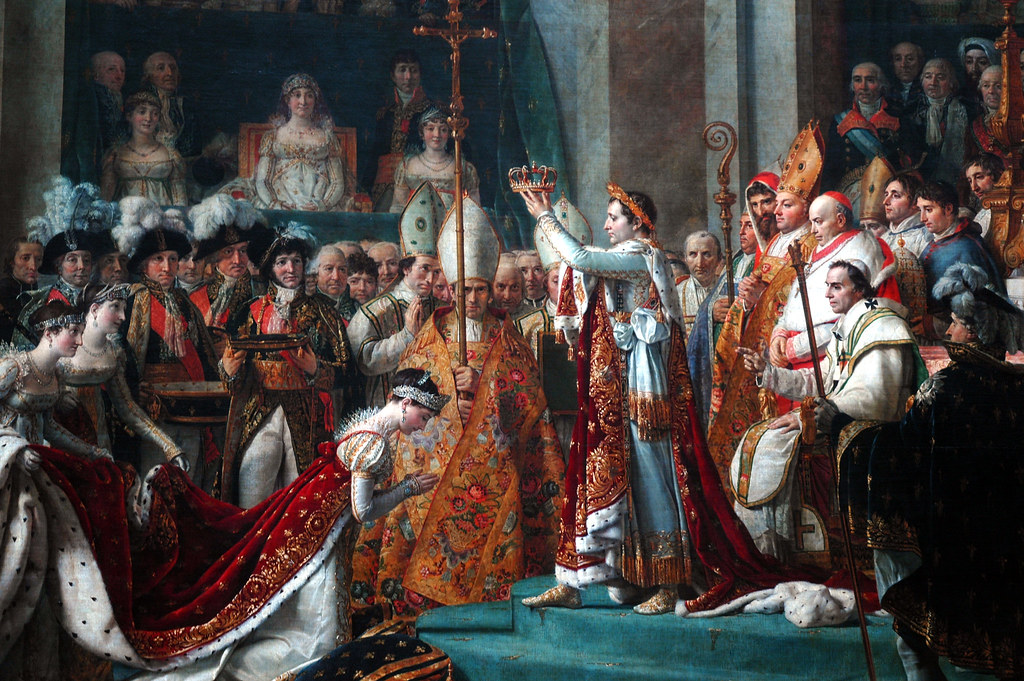
As an artillery officer in the Revolutionary Wars, Napoleon proved exceptional. By 24, he was a general. He plundered art from Egypt and Italy, including the Mona Lisa, which remains in the Louvre today. By 30, Napoleon seized power in a coup d’etat. In 1808, he crowned himself Emperor.
For his victories and the stability he brought at home, the French public adored Napoleon. He introduced the Napoleonic Code, which ended religious discrimination and hereditary privilege while denying rights to women. It standardised laws and introduced state education. The Code prevails today. To fund his wars, Napoleon sold the French possessions in North America to the USA for 30c an acre and restored Haitian slavery.

At the peak of his power, Napoleon ruled France, Germany, Italy, Spain, the Low Countries and Poland through a network of client states (light blue). He ended the Holy Roman Empire in 1805.
While triumphing on land, Napoleon could never defeat the British at sea. Instead, he tried to strangle their trade. He forced mainland Europe into the ‘Continental System’, which embargoed British trade. When Russia refused, Napoleon invaded.

The Russian campaign was a disaster. After seizing Moscow in 1812, winter forced Napoleon’s Grand Armée to retreat. With only their horses to eat, his soldiers died not from Russian bullets but disease, starvation, and cold. Of the 500,000 men who set off, only 120,000 returned.
In 1814, the ‘Sixth Coalition’ defeated what remained of the Grand Armée. They exiled Napoleon to Elba, an island in the Mediterranean, and restored Europe’s borders and the French monarchy.
In 1815, Napoleon escaped Elba and returned to France where a regiment apprehended him. Approaching the soldiers, he said ‘Here I am, kill your emperor if you wish.’ Instead of firing, the soldiers cheered ‘Viva L’Empereur’ and marched with him to Paris. Alarmed by his return, the nations of Europe – led by Britain and Prussia – formed the final, Seventh Coalition. The Duke of Wellington – who had studied Napoleon’s military record intently – faced him at Waterloo. It was the emperor’s last defeat.

Napoleon Bonaparte spent his last six years in a rotting cabin in St Helena in the South Atlantic. His body was returned to France for a state funeral twenty years later.
 Saparmurat Niyazov ruled Turkmenistan from 1991 – 2006. Brutal, eccentric and narcissistic even for a dictator, he impoverished his oil-rich country and built one of the world’s most extensive cults of personality.
 Niyazov was born in 1940. His father died in the Second World War and an earthquake killed his mother when he was seven. After a lonely childhood, he studied engineering in Leningrad and joined the Communist Party in the 60s, where he demonstrated a flair for intrigue and a lust for power.
 renaming all days of the week and months of the year, including one month after himself and another after his mother
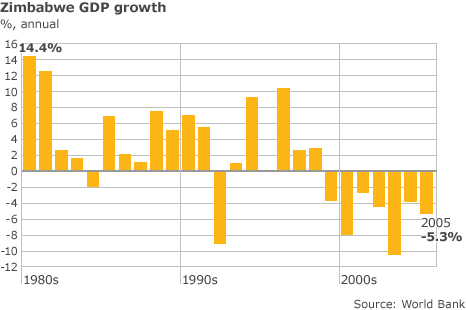
 Robert Gabriel Mugabe (1924-) is the founding father of Zimbabwe and a dictator of 37 years. At age 93, he was, until very recently, the world’s oldest serving head of state. A champion of Black Nationalism against white minority rule Mugabe was once a glimmering hope for post-colonial Africa. Nearly four decades later and he has left a nation plagued by corruption and tyranny.
 The former schoolteacher was a hero in 1980, fiercely popular within Zimbabwe and without. He had led the insurrection against Rhodesia’s white minority government and won the following election in a landslide. Like Nelson Mandela, he was a Marxist, a revolutionary, an intellectual, a political prisoner for over a decade and a relentless crusader against minority government and Apartheid. At the official independence ceremony, Bob Marley played his ‘Zimbabwe’ to a jubilant crowd in Mugabe’s honour. Mugabe was lauded by both his Communist backers and the western left. The US gave 25 million dollars in aid to his nascent regime.

 From the Parapet