
 The Turkic Migrations were the greatest population movement before Colombus. Throughout the Middle Ages, Turkic speaking nomads conquered and settled across Central Asia and Anatolia – assimilating some, replacing others. Once slave-soldiers, they came to rule the Muslim world.
Today there are seven Turkic nations, ordered by population:
- Turkey
- Azerbaijan
- Uzbekistan
- Kazakhstan
- Turkmenistan
- Kyrgyzstan
Significant minorities also live in Russia and China.
The Turks originated in the Altai Mountains of western Mongolia. Their name comes from the Chinese Tujue, meaning combat helmet, after a hill where they once lived. The early Turks were horse nomads and raiders who wrote in a runic script, worshipped the sky and worked iron.
The Gokturk Khaganate (Celestial Turks) ruled the Asian Steppe from 552-744. Under the Gokturks a common Turkic identity was born and when the confederation fell, Turkic peoples migrated in all directions, intermarrying with and absorbing native peoples where they went. Accordingly, the wider Turkic ethnicity encompasses a range of peoples and appearances.
Their migratory waves are reflected through language.

Speakers of the Oghur branch were the first Turks to migrate west (unless counting the Huns, who may have been Turkic). They included the Khazars, Bulgars and Chuvash. The Khazars, who converted to Judaism, ruled Ukraine from 648 – 1048. The Bulgars forged an empire in the Balkans, became Orthodox Christians and assimilated with their Slavic subjects. Only Chuvash in Russia is still spoken. In the Oghur languages, the common ‘z’ suffix becomes ‘r’: both ‘Oghur’ and ‘Oghuz’ mean tribe.
The Kipchak Branch is named after the Kipchak Confederation (1067-1271) of southern Russia. They fought against, then for the Mongols when they invaded, from whom many descend. Most were Muslim by the 1300s and, of all the Turks, stayed nomads the longest. They include the Kazakhs, Kyrgyz, Tatars and Bashkirs.

The Siberian Branch migrated northward before the rise of the Gokturks and mingled with the indigenous forest people. They traditionally herded reindeer and bred cattle and ponies to withstand Siberian winters. Today they mix Turkic shamanism with ‘modern’ religions – Christianity for the Yakuts and Buddhism for the Tuvans.

The Southeastern Branch includes Uzbek and Uyghur. The Uyghurs of Mongolia overthrew the eastern Gokturks and in the 800s, migrated to western China. They settled down, adopted agriculture, a written script and Manichaeism. They were Buddhist for a time then Muslim. The Uzbeks settled the oasis cities of Central Asia as soldiers in the Mongol Horde, ruling until the Russians came.

The Oghuz of Central Asia were heirs to the Gokturks. After converting to Islam, Oghuz Turks served as slaves, mercenaries and bodyguards for Persian and Arab lords. So reliant did the caliph in Baghdad become on his Turkic generals, that by the 900s, the Seljuk tribe was the power behind the throne.
In 1071 a Seljuk army defeated the Byzantines at Manzikert and seized Anatolia. Turkic tribes flooded the region and over time native Greeks and Armenians adopted Islam and the Turkish language. The remainder were killed or expelled in the early 20th century. The modern Turkish are genetically closer to Greeks and Armenians than other Turkic people: only 15-20% of their ancestry being Central Asian. Azeri, Turkish and Turkmen belong to the Oghuz Branch.

Turkic migrations. Sakha – Yakut, Cuman- Kipchak.
Sources: The Diplomat, Khazaria.com, Science on the Web, Wikipedia
See Also:

 Archaeological sites and fossils give a rough idea of when Homo Sapiens were first living in a particular place.


 In 1973 scientists discovered a 13,000 year-old skeleton in a cave at Lagoa Santa, Brazil. The ‘Luzia Woman’ was the oldest human remains found in the Western Hemisphere. Curiously the Luzia woman’s skull resembled an Australian Aborigine more than a Native American.
  Some Amerindians carry DNA from Population Y. In 2015 scientists sequenced the genome of three Amazonian tribes – the Xavante (pictured), Karitiana and Surui, who were uncontacted until the 20th century. 1-2% of their DNA was shared with Australasians. Smaller amounts were also found in Mixe people of Mexico and Aleutian Islanders but no other groups. The findings were published in Nature. Population Y comes from Ypykuera – an Amazonian word for ‘ancestor’.
 Proto-Australasians or ‘Black Asians’ were the first homo sapiens to leave Africa and the original inhabitants of Australia and Southeast Asia. Their descendants include the Aborigines of Australia, the Negritos of Southeast Asia, Melanesians, and Andaman Islanders. Population Y would suggest they reached South America too.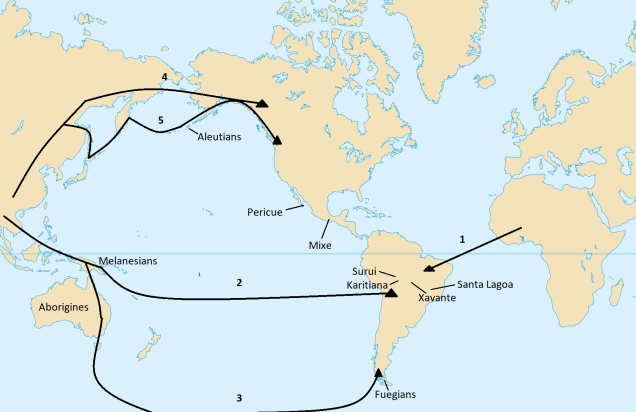
 The people of the Indochinese Peninsular (Burma, Cambodia, Laos, Thailand and Vietnam) descend from four principle migrations. Each has contributed to the languages, cultures and genetic makeup of the region today.
 Austroasiatic speaking farmers migrated from the north around 2,000 BC and introduced wet rice cultivation and bronze tools. They were part of a population boom from the birth of agriculture in China. More numerous and better organised, they replaced the indigenous population and spread throughout the region as far as East India and Malaysia. Indian traders strongly influenced the Mon and Khmer, who adopted Theravada Buddhism and Indic scripts. Austroasiatic farmers in the Red River Delta, who were more influenced by China, would become the Vietnamese.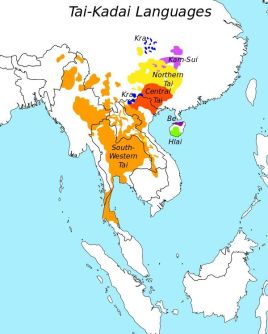
 Austronesian speakers related to Malays and Filipinos founded the kingdom of Champa in southern Vietnam. First Hindu, then Muslim, it lasted over a thousand years until its conquest by the Vietnamese in the 18th century. The Cham are now a minority in Vietnam and Cambodia.
 Hmong-Mien is another language family from China, possibly the original inhabitants of the Yellow River Valley. Today, their 6 million speakers are scattered across the mountains of China, Vietnam and Laos. The Hmong, who migrated to Southeast Asia in the 1800s, are the largest group.
 The Polynesian Migrations (1200 BC-AD 1250) brought mankind to the far-flung islands of the Pacific Ocean, the last part of the world to be inhabited bar Antarctica.

 In isolated Easter Island (Rapa Nui) settlers sculpted over 8000 moai out of volcanic rock. The tallest statue was 9 metres high. By European arrival, however, the Easter Islanders had felled the island’s forests and had no wood in which to build canoes and escape.
 The Cheddar Man is the oldest complete human skeleton found in Britain. He died a violent death around 7150 BC in Gough’s Cave in Chedder Gorge, Somerset, where his remains were uncovered in 1903. Cheddar Man made headlines when the latest forensic reconstruction from London’s Natural History Museum depicted him as dark skinned, a surprising revelation some criticised as politically motivated.
 Europe in Cheddar Man’s time
 Modern European Y chromosomal haplogroups
 Despite this, scientists have speculated Mesolithic Europeans were dark-skinned for some time. The genes for blue eyes evolved before the genes which determine light skin and blond hair. The Spanish LaBrana man (pictured right), a contemporary of Cheddar Man, exhibited similar traits.
 From the Parapet