This is a story about doing “it” anyway when others tell you: “You can’t!” “You shouldn’t!” “You’d be a fool!” or “You don’t belong!”
As a young adult, when I set out to hike all 2,000-plus miles of the Appalachian Trail, I was told that I would never finish it. I did.
When as beginning paddlers, my wife and I planned a 540-mile canoe trip down the Chattahoochee and Apalachicola rivers, experienced canoeists thought us foolhardy and asked with concern, “are you sure you know what you’re doing?” In fact, we had no clue, but we did it anyway.
When in 2005, Dana Skelton, April Ingle and I determined we’d organize a week-long, group canoe/kayak journey down the Chattahoochee River under the banner of Georgia River Network, similar questions surfaced: “You’re doing what? With 300 people!?” We did it anyway. What was launched in a fit of ignorance and confidence has become the country’s largest week-long paddling sojourn.

Over the past 20 years, we’ve paddled some 2,000 miles with some 7,000 people and raised more than $1 million for river protection.
On the brink of my sixth decade on this Earth, I take this lesson from life thus far. When society tells you, “No;” calls you “foolish;” or says, “you don’t belong;” do it anyway. It’s likely to prove worthwhile, perhaps even life changing.
I was reminded of this recently during Georgia Rivers Okefenokee-Suwannee River Adventure when I met Ann (she asked that I not use her last name) and her friend Elizabeth. As we ventured down river, I noticed the two paddling stern-to-bow with Ann tailing close behind in her solo kayak, following Elizabeth’s every stroke with occasional instruction from Elizabeth: “left,” “right.” Though odd and unconventional, it seemed to work. I inquired.
Ann, as it turned out, is visually impaired (words she prefers to ”legally blind”) and on this trip, she was fulfilling a dream that she’d held for 25 years. To go paddling. With Elizabeth’s guidance, she navigated 22 miles of the Okefenokee Swamp and the Suwannee River’s narrow and winding path. I was impressed and inspired.
Recently retired from a career as a physical trainer, she was looking for new challenges and adventures. She shrugged off my admiration. When people tell her she’s courageous, she said, she dismisses it. She’s simply doing what she needs to do. “It’s just another obstacle,” she said.

This set me to thinking about other paddlers and the obstacles they’ve brushed off to “do it anyway.”
My friend, Alan Crawford, a scuba diver who once cleaned and repaired boats for a living, lost use of his legs to a rare neurological condition. His love of water brought him to kayaking and to Paddle Georgia. As his health permits, he’s logged hundreds of miles in his boat. Unbroken.

Long-time Paddle Georgia participant Marcelle Harris, diagnosed with Parkinson’s disease several years ago, was still stroking this summer, despite that disease’s relentless and brutal progression. Persistent.

Then there’s the Barkes family—Philip and Liliana and their seven children. When they first inquired about joining us on our trips, I was dubious. Their youngest was under two, the oldest 14. As a young paddling parent, I could barely manage one daughter. Seven? In fact, the Barkes DID know what they were doing. Those kids controlled their canoe better than most adults! Seven children? Obstacle? Overcome.

Across twenty years of leading paddle trips, I’ve come to understand there’s obstacles that culture throws up as well. This has been especially evident during the past year as Georgia Rivers has worked to get underserved youth, women, people of color, people with physical challenges, recent immigrants and lower income families on our trips.
Lets be honest, the paddlesports world is one dominated largely by white, upper-middle class men of a certain age. For those that look different, entering this world can be intimidating.
Thankfully, our rivers don’t discriminate. They welcome all. Over the past year, I’ve paddled with a lot of folks who look, talk and act different than me…folks our culture might say don’t fit on wild rivers: refugees from Afghanistan and Ukraine; a Black mom and her four children; a non-binary mom and her daughter…to name just a few.
Like Ann, the visually-impaired swamp paddler, each, in their own way, were overcoming obstacles. As one first-time paddler told me, “It was challenging, but in a good way.”

We need more folks on our rivers overcoming obstacles and staring down challenges. If the folks enjoying our rivers grow as diverse as the host of critters that live in them (Georgia ranks 3rd among states in aquatic biodiversity), Georgia’s water will have a powerful voice.
Old white guys alone cannot save a river, a stream or a swamp. It takes everyone. And, everyone needs to experience our rivers.
Joining a Georgia Rivers stewardship paddle trip or training class is a great way to challenge yourself. We welcome beginners and avid paddlers alike! See our full list of day trips, weekend adventures, and kayak training classes at garivers.org/events. (or button). If you’d like to donate to support our scholarship program aimed at diversifying the paddlesports and river advocacy communities, CLICK HERE!


 Paddlers challenged each other to see who could jump farthest or who could do the best back flip. We also kept cool with frequent and welcome water gun wars. There is nothing like a little rivalry to boast morale.
 After a hard day of paddling, both Tent City and the cool gym are great places to conclude our successful Father’s Day on the Ogeechee River.
 the water- smiling from ear to ear. Be sure to check out the
 own exponentially in popularity in recent years, and Paddle Georgia paddlers are no exception.
 elease of water from the bottom of Buford Dam, which has changed the historic warm waters of the river to a chilly 48 degrees and in turn the species of fish that are able to live here. Participants learned more about this at
  the Buford Trout Hatchery today, where millions of trout are stocked into the Chattahoochee and other Georgia rivers each year.
 What an amazing first day on the Chattahoochee river…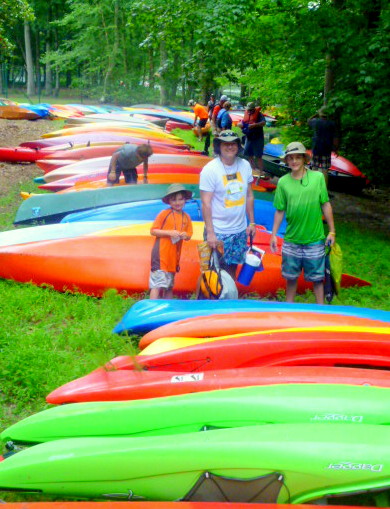




 Greetings fellow river rats!
 The 23.8 mile Dub Denman Canoe Trail located on the Tallapoosa River is soon to be officially on the map after years of planning. Five sites along the Tallapoosa River are being considered for trail access, including two on county property and three on private property. Two of the three access point require stream buffer variances which are awaiting approval. Tallapoosa Planning Coordinator, Patrick Clarey, explained that the city has been moving forward with two of the original five proposed kayak and canoe launch sites with the help of a $51,150 Georgia Department of Natural Resources grant awarded to the county. The launch sites will include concrete staircases and wooden canoe launches, where needed, as well as gravel parking lots, trash receptacles and signage.
 Legendary musician Otis Redding is memorialized in a life size statue at beautiful Gateway Park, trailhead of the Ocmulgee River Heritage Trail.
 Georgia River Network is encouraging river lovers to celebrate Georgia’s rivers – from wild places to urban waterways – by taking 13 people, who might not otherwise go on their own, paddling in 2013.
 Get your tickets NOW for our
  In 2013, Weekend for Rivers is celebrating the 40th anniversary of the Clean Water Act by focusing on “The Value of Water.”
 Each paddling trip will include lunch and presentations along the way ranging from natural history and water quality testing to river cleanup training and kayak fishing.
 Announcing the Georgia River Network Guidebooks series!
 Georgia Environmental Protection Division Outreach Unit and Georgia River Network are working in partnership to develop web-based interactive maps for Georgia‘s water trails. Our goal is to create an interactive map for all water trails throughout the State.Water trails that satisfy the
  You can now experience the new National Water Trails System through an
  The message that “trails don’t just happen” is vital in nurturing public support for the funding sources behind trails. The source of funds for land acquisition as well as facilities is also important. Some programs are specific to a locality, such as sales tax support. Other projects are funded by state sources, such as lotteries. Many trails are partly funded by grants from federal funds, such as the Recreational Trails Program and the Land & Water Conservation Fund.
 Stand-up paddling exercise has been described as everything from great, fun and exciting to calming and intense. Stand-up paddle boarding is an ancient form of surfing, yet it is most widely enjoyed on relatively flat water.


 Paddle Georgia, A Project of Georgia River Network - Weblog