Yesterday,I had to go into the city centre. It is about two, maybe 2.5 miles from my home, yet I rarely go there. Strange, is in not? I buy my groceries in suburbia, other stuff I buy at out of town shopping malls, or smaller towns further away. The city centre? Well, mostly it has stuff I don't want or need. I'm not a window-shopper, I do a targeted hit on stores to get what I want, I go in, head for my goal, and get out as soon as I can. But I broke my phone. As in, I dropped it and cracked the screen, and the whole thing became unresponsive, brain-dead. Let me warn you, the Google Nexus 4 is an awesome thing, but if you bust the glass, as I did, about a five-foot drop, smack, onto hard tarmac, then you''ll discover that it's a far more expensive repair than most, as the glass isn't a separate veneer, you need an expensive unit of screen, digitiser, and glass, all in one.
I'd decided to take it to a reputable manufacturer approved repairer, rather than risk a cheaper back street shop, where I'm paranoid they'll strip my passwords and other stuff out...
Hence the city centre trip. Truly, it's more than a couple of years since I've been on foot-safari here.
All sorts of things change. It has more of a vibe of a cosmopolitan euro-city than I remember, lots more pavement cafes and bars, more modern apartments in buildings old and new, and a new mall, or centre, as we call it,
Trinity Centre. A redevelopment of an area that was always a bit of a shabby seventies construction. I liked it. Holy Trinity Church, on Boar Lane, stands at the edge of the centre to which it gives its name.

Holy Trinity, commenced 1722, known locally as The Wedding-Cake church, after its pillared spire.


I really like this giant pack-horse sculpture, made of small pieces of welded and galvanised steel, to make perforated form,through which the light penetrates, the sculptor was Andy Scott. This shopping centre is near the conjunction of two of the oldest roads in the city, Briggate, which runs north south, and Boar Lane, east west. Back in the past, before railways, pack-horses were the major transporters of freight, and just north of Leeds Bridge, on Briggate, was where traders set up their stalls. The woolpacks and the woven cloth from the Pennine hills came here, were traded in the cloth halls, loaded onto fresh packhorses for the long journey south, to London. Not far away, also off Briggate, is the Pack-Horse pub, first mentioned, selling food, ale, and beds for weary travellers in 1615.
So it's fitting that a pack-horse be remembered here. Nimble footed, hardy traveller.
The old Pack-Horse Inn. Still there 400 years later.


Close by, the Corn Exchange, a hall built specifically for the trade of corn. Not the corn Americans think of, nothing to do with maize, this hall was where wheat, oats, and barley were traded, farmers selling their harvests to the corn merchants, the merchants selling to flour mills, breweries, and export trade.

This is my favourite building in the city, because its elliptical form on the outside is so unusual, but more so the wonderful arched zeppelin of the roof, enclosing a bright, airy space with no intruding pillars.
The coat of arms of the city, "Pro Rege et Lege" , for King and parliament. After the 17th century bloodbath of the civil war, the city came up with this motto to declare allegiance to both sides, also, clearly, to remind both that together, not separately, they rule, checks and balances. Owls, well, they're supposed to be wise, and the centre is a woolen fleece, from which the city made its wealth.

Where traders stood, now we sit and drink coffee.

Memories remain. John Smiths Brewery is still active, in Tadcaster, about twelve or so miles to the north-east. I've bought their beers in Texas!
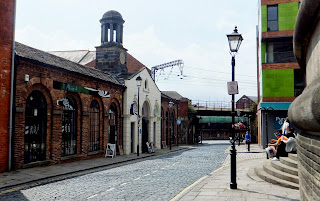
The packhorses would have been here in great numbers.

The building on the right of the entryway to the city markets was, when I was a kid, the horse-butchers. There was a big slaughterhouse behind these buildings, stockyards of lowing cattle, just on the edge of the city centre. In the 1970s there was a huge fire, and all the slaughterhouse and much of the old market were destroyed.

Butcher's Row in the market. Keen pricing. My dad used to know all the old butchers, and get the sunday roast from here. Of course, he loved to haggle, and knew that the best prices were to be had in the half-hour before closing on a saturday.


RDG loves dragons and wyverns, (these are wyverns) And these are for her. A few years ago, we were in the market together, sought permission from the manager to go up onto the balconies to take photographs. And of course, as I took these photographs, I was missing her.
Not for much longer, all being well.
More pics later.
Updated:
I'm allergic to fish, but that doesn't lessen my interest in the arts of the fishmonger.
Up the fish aisle, then out of the market, and across Vicar Lane.

Town planning from 1900. Queen Victoria street and King Edward street, this whole area, now known as The Victoria Quarter. I used to park on these streets, but they've undergone a transformation, pedestrianised, and QV street enclosed with a glass roof. Interestingly we see a social divide here. The market is a place where all go, in search of value, bargains, fresh produce, market folk shouting their wares, interacting with the customer. Cross the road and it's all more subdued, upmarket stores targeting upmarket custom. You notice the shouty beer-belly guys, the foul-mouthed women and the gaggles of brats with adhd just aren't there. Maybe it's too quiet, and they need the barrage of noise and bustle to survive. The tough pubs used to be around the market too. The Scotsman, ha, that used to be the place for the serious all-day drunks, and the Market Tavern, well, that was pretty basic, dare I say smelly? And was also full of all-day drunks. When I was a teenager, it was a pub of choice, on the grounds that it never asked for i.d., hell if you had money, of course it would serve you. Sometimes you had to be nimble to get out of the way of fights though.

I like cupolas, and turrets. Always wanted to have my bedroom in a pointy topped turret.
Arcades were what came before malls, covered streets.
1901
I was fascinated by a window full of vintage sewing machines
The Horse and Trumpet. Had a few pints in here too, in my youth.
There's a chocolateier in this arcade, Ladies.
And a mechanical clock. The Ivanhoe Clock. On the hour, the knight and the bowman take turns to strike the bell, the figures move. Wait, maybe it's on YouTube?


