Anniversary and Gratitude

mincha-london.jpg

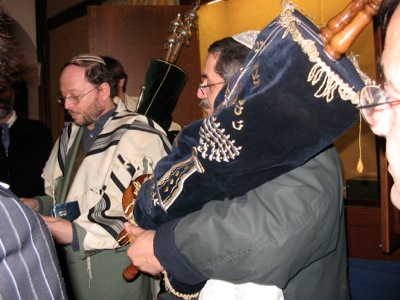
Eight years ago, on Tevet 1, the sixth day of Chanukah, I converted to Judaism. I took a very early train to Paris where all the other passengers were black and arab workers on their way to work – the people we never see but to whom we owe our buildings and roads. Then on we took the shuttle and made for Leo Baeck College in London for an interview with the Beit Din and the mikveh ceremony.

It was a very impressive day, filled of joy and wonder. Although the rabbi had told me I was ready, I could not help being anxious about the interview. Talking about your spiritual journey with strangers, even in a benevolent atmosphere, is quite daunting. The immersion that followed was obviously very moving. I emerged feeling proud and in awe of what lay ahead of me.

Eight years later, I am grateful that I have found a spiritual home where learning and studying are valued. I am grateful that I belong to the Jewish people and that we share a common history and destiny. I am also particularly grateful for the people I have met on the way, some of whom have become my friends (I hope you recognise yourselves) and who mean so much to me.

בָּרוּךְ אַתָּה יְיָ אֱלֹהֵֽנוּ מֶֽלֶךְ הָעוֹלָם, שֶׁעָשַֽׂנִי יִשְׂרָאֵל

The Last Jew

287a2f10.jpgAfter enjoying the Physician so much, I thought I would read another Noah Gordon’s novel. So I went to one of the local bookshops. They had three. The Last Jew seemed to be the most interesting. I also picked it up because, although it is not that far from home, I have actually never been to Spain. I suspect I needed something a bit exotic.

Another reason I chose this novel, rather than the two other ones, is that I felt I wanted to know more about the Jewish community which was expelled by Ferdinand and Isabella of Spain in 1492. The Edict of Expulsion was issued against the Jews of Spain on March 31. All Jews of whatever age were ordered to leave the kingdom by the last day of July, (one day before Tisha B’Av), the “saddest day in Jewish history” and a traditional day of mourning.

It is estimated that 165,000 emigrated, 50,000 converted and 20,000 died en route. This is a low estimate; people disagree on the actual figures.

In today’s French Jewish community a lot of people are the descendants of the Spanish Jews who settled around the Mediterranean Sea, mostly in Algeria, Egypt, Morocco, Turkey and Greece.

During the twentieth century they were forced out of the countries where they had settled but their Spanish roots is reflected in their surnames; they are called Toledano, Bitton, Cardozo, Malka, Marciano…

In fact the novel is not so much about the Jews who left than those who stayed on, one teenager in particular Yonah. The book deals with his attempt at remaining a Jew when everything and almost everyone was against it. As in The Physician, its author manages to convey historical authenticity and the story rings true.

Who is a Jew?

numberstar.gifProspective converts to Judaism usually know that if you want your conversion to be accepted everywhere, it is wiser to convert under the auspices of an Orthodox Bet Din. Otherwise your conversion won’t be deemed kosher by most rabbinic authorities.

Henceforth your marriage won’t be recognized as a Jewish marriage, your children won’t be allowed in Jewish schools, they won’t be allowed to marry in the state of Israel as only the High Rabbinical Court, an Orthodox institution, will validate their wedding, when you die it will not be possible for you to be buried in an ordinary cemetery (at least in Israel, I’m not sure about other countries.)

There are obviously numerous other reasons why future converts choose to undergo an Orthodox conversion but worldwide recognition by all authorities (obviously Reform and Conservative authorities endorse Orthodox conversions) is an important factor. Or so they thought…

Apparently the High Rabbinical Court of Israel has decided to invalidate a conversion conducted 15 years ago by Chaim Druckman. This decision was made when it became obvious that the convert never adhered to Orthodox Jewish practice after her conversion.

Rabbi Chaim Druckman was born in Poland in 1944. He was a member of the National Religious Party, served in a number of Knessets, as well as deputy minister of religious affairs. He is a major figure in the nationwide Bnei Akiva movement, as well as a respected rosh yeshiva.

The fundamental principle of, “A Jew, even if he sins, is still a Jew” – seems to have gone with devastating effects on the woman’s children. Now what is worse is that the High Rabbinical Court has ruled to overrule all conversions conducted by Chaim Druckman since 1999. This ruling is bound to upset the lives of thousands who believed their had undergone a kosher conversion, are most likely to be sincere observant Jews and now discover all this is nought.

It is paradoxical, not to say cynical, that this ruling should have been issued now while every night we count the Omer, thus getting nearer to Shavuot every day, getting ready to listen to the story of Ruth, the most famous Jew-by-choice in Judaism.

Treppenwitz was the one who attracted my attention to this story in the first place; you might also like to read the JP article.